InspectAPedia.com InspectAPedia®
Google
InspectAPedia
 

Free Encyclopedia of Building & Environmental Inspection, Testing, Diagnosis, Repair

Ask a Question or Search InspectAPedia

  • HOME
  • AIR CONDITIONING
  • DAMAGE ASSESSMENT
  • ELECTRICAL
  • EXTERIORS
  • HEATING
  • HOME INSPECTION
  • INTERIORS
  • PLUMBING
  • ROOFING
  • SEPTIC SYSTEMS
  • STRUCTURE
  • WATER SUPPLY
  • ENERGY SAVINGS
  • ENVIRONMENT
  • INDOOR AIR IAQ
  • INSULATION
  • MOLD INSPECT TEST REMOVE
  • NOISE
  • ODORS
  • SOLAR ENERGY
  • VENTILATION
  • EXPERTS DIRECTORY
  • CONTACT US


InspectAPedia ® Home

SEPTIC SYSTEM INSPECT DIAGNOSE REPAIR

SEPTIC CARE INSTRUCTIONS
SEPTIC CONSULTANTS
SEPTIC D-BOX INSPECTION
SEPTIC DRAINFIELD FAILURE DIAGNOSIS
SEPTIC DRAWINGS
SEPTIC DYE TEST PROCEDURE
SEPTIC FAILURE SIGNS
SEPTIC INSPECTION & TEST GUIDE
SEPTIC LIFE EXPECTANCY
SEPTIC ODORS
SEPTIC PUMPS
SEPTIC SUPPLIES & PARTS
SEPTIC SYSTEM DESIGN ALTERNATIVES
SEPTIC SYSTEM DESIGN BASICS
SEPTIC SYSTEMS, HOME BUYERS GUIDE to
SEPTIC SYSTEM SAFETY WARNINGS
SEPTIC TANKS
SEPTIC TREATMENTS & CHEMICALS
SEWAGE & SEPTIC CONTAMINANTS
SEWAGE BACKUP, WHAT TO DO
SEWAGE BACKUP TEST & CLEANUP
SEWAGE BACKUP PREVENTION
SEWAGE CONTAMINATION in buildings
SEWAGE CONTAMINANTS in FRUIT / VEGETABLES
SEWAGE EJECTOR / GRINDER PUMPS
SEWAGE LEVELS in SEPTIC TANKS
SEWAGE NITROGEN CONTAMINANTS
SEWAGE PATHOGENS in SEPTIC SLUDGE
SEWAGE PUMPS
SEWER BACKUP PREVENTION
SEWER GAS ODORS
SEWER LINE REPLACEMENT
SINKHOLES, WARNING SIGNS
SMELL PATCH TEST to Track Down Odors
SOAKAWAY BED FAILURE DIAGNOSIS
SULPHUR & SEWER GAS SMELL SOURCES
SUMP PUMPS

TOILETS, INSPECT, INSTALL, REPAIR
TOILET ALTERNATIVES
TOILETS, DON'T FLUSH LIST
TRAPS on PLUMBING FIXTURES
TREATMENTS & CHEMICALS, SEPTIC

VIDEO GUIDES: Septic Videos

WASHING MACHINES & SEPTIC SYSTEMS
WATER SOFTENERS & CONDITIONERS
WATER SUPPLY & DRAIN PIPING
WASTEWATER TREATMENT BASICS
WATER, WELLS, WATER TANKS: TESTING GUIDE
WINTERIZE A BUILDING

More Information

Photograph of  a seepage pitConstruction Details for Drywells & Seepage Pits
     

  • Seepage pit construction details - how to build a seepage pit or drywell pit
    • Drywell construction details & alternative materials
    • Seepage pit lining & connections
    • Seepage pit or drywell separation requirements
    • Drywell & seepage pit materials strength
  • CESSPOOLS - separate article
  • CISTERNS - separate article
  • DRYWELL DESIGN & USES - separate article
  • DRYWELL SAFETY CONCERNS - separate article
  • DRYWELLS ARE THEY ACTUALLY DRY? - separate article
  • DRYWELL / SEEPAGE PIT SPECIFICATIONS - separate article
  • DRYWELL / SEEPAGE PIT CONSTRUCTION DETAILS
  • DRYWELL / SEEPAGE PIT COLLAPSE or FAILURE - separate article
  • GREYWATER SYSTEMS - separate article
  • Questions & Answers about how to build a drywell or seepage pit.
  • References

Click to Show or Hide Related Topics

  • SEPTIC SYSTEM INSPECT DIAGNOSE REPAIR - home
  • ALTERNATIVE SEPTIC DESIGNERS & ALTERNATIVE SEPTIC PRODUCTS
  • BACKUP PREVENTION, SEPTIC & BACKUP PREVENTION, SEWER
  • BIOMAT FORMATION & SEPTIC LIFE
  • CLEARANCE DISTANCES, SEPTIC SYSTEM
  • CLOGGED DRAIN DIAGNOSIS & REPAIR & CLEANOUTS
  • DEFINITIONS, SEPTIC SYSTEM
  • DIFFICULT SEPTIC SITES
  • DISPERSAL METHODS, WASTEWATER
  • DISTRIBUTION-BOX D-BOX
  • DRAWINGS, SEPTIC
  • DRIVING or PARKING OVER SEPTIC
  • FLOODED SEPTIC SYSTEMS, REPAIR
  • GARBAGE DISPOSAL vs SEPTICS
  • GREYWATER SYSTEMS
  • GUIDE TO SEPTIC SYSTEMS
  • HOME BUYERS GUIDE to SEPTIC SYSTEMS & HOME SELLERS GUIDE
  • HOW SEPTIC SYSTEMS WORK
  • METHANE GAS
  • ODORS, SEPTIC or SEWER
  • PLANTS & TREES OVER SEPTIC SYSTEMS
  • PUMPS SEPTIC EFFLUENT & SEPTIC PUMP REPAIR
  • PUMPS SEWAGE EJECTOR / GRINDER
  • SEPTIC & CESSPOOL SAFETY
  • SEPTIC CODES & REFERENCES & SEPTIC AUTHORITIES
  • SEPTIC CONSULTANTS
  • SEPTIC DRAINFIELD INSPECTION & TEST - home
  • SEPTIC LOADING & DYE TEST PROCEDURE - home
  • SEPTIC MAINTENANCE INSTRUCTIONS - home
  • SEPTIC SYSTEM DESIGN ALTERNATIVES - home
  • SEPTIC SYSTEM DESIGN BASICS - home
    • CESSPOOLS & CESSPOOL SAFETY WARNINGS
    • COMMERCIAL SEPTIC DESIGN
    • DRYWELL DESIGN & USES
    • FILTERS SEPTIC & GREYWATER
    • SEEPAGE PITS
    • SEPTIC CLEARANCES
    • SEPTIC SOIL & PERC TESTS
    • SEPTIC DRAINFIELD LOCATION
    • SEPTIC DRAINFIELD SIZE & SEPTIC DRAINFIELD SHAPE
    • SEPTIC REFERENCES & SEPTIC BOOKSTORE
  • SEPTIC SYSTEM DESIGN MANUAL - Online
  • SEPTIC SYSTEM INSPECTION & TEST GUIDE - home
  • SEPTIC SYSTEM REPAIR
  • SEPTIC TANKS - home
    • SEPTIC TANK BAFFLES & SEPTIC TANK TEES
    • SEPTIC TANK COVERS & SEPTIC TANK DEPTH
    • SEPTIC TANK, HOW TO FIND
    • SEPTIC TANK INSPECTION PROCEDURE - home
    • SEPTIC TANK LEAKS & SEPTIC TANK LEVELS of SEWAGE
    • SEPTIC TANK PUMPING PROCEDURE & PUMPING REASONS
    • SEPTIC TANK PUMPING SCHEDULE
    • SEPTIC TANK SAFETY
    • SEPTIC TANK SIZE
  • SEPTIC VIDEOS
  • TOILETS, INSPECT, INSTALL, REPAIR & TOILET ALTERNATIVES
  • TREATMENT LEVELS, WASTEWATER
  • TYPES OF SEPTIC SYSTEMS - master list
InspectAPedia tolerates no conflicts of interest. We have no relationship with advertisers, products, or services discussed at this website.

How to build a drywell or seepage pit: this document describes the actual building (on-site construction) of a drywell or seepage pit. The specifications for drywells & seepage pits, such as pit size, depth, absorption area, site space requirements & clearances, are described separately at DRYWELL / SEEPAGE PIT SPECIFICATIONS.

Green links show where you are. © Copyright 2013 InspectAPedia.com, All Rights Reserved. Author Daniel Friedman.

Seepage Pit & Drywell Construction Details: Linings, Separation, Strength, Connections

Photograph of  a modern concrete seepage cesspool or seepage pit

(v) Seepage pit linings may be precast concrete, cast-in-place concrete, or built in place with unmortared hollow cinder or concrete blocks. Concrete shall have a minimum compressive strength of 2,500 psi and 3,000 psi is recommended. Material with comparable structural strength, determined in accordance with commonly accepted sewage construction standards, principles or practices, may be allowed on an individual basis to prevent unreasonable hardship, provided public health is not prejudiced.

(vi) The separation between the outside edges of seepage pits shall be three times the effective diameter of the largest pit. This separation is measured as the undisturbed soil between pit excavations.

(vii) Pits shall be designed with sufficient structural stability to withstand lateral soil forces as well as vertical loads.

(4) Construction of seepage pits for septic effluent disposal or drywells for graywater disposal
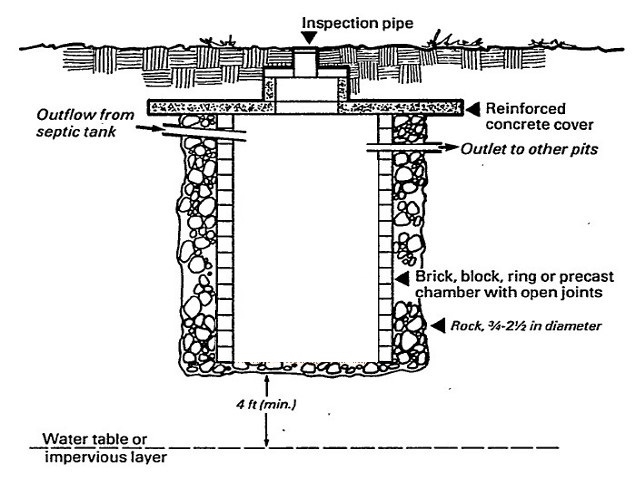
Seepage pit USDA DJFThe schematic of a seepage pit (left, courtesy USDA) shows typical construction of a site built seepage pit using brick, block, or pre-cast concrete rings with open joints, surrounded by stone to improve soil absorption.

(i) Laterals leading to each seepage pit must be at least four inches in diameter with a minimum slope of 1/8 inch per foot.

(ii) Seepage pits shall not be connected in series. A distribution box shall be required where more than one seepage pit is installed.

(iii) The pit excavation is to be raked to minimize sidewall smearing that may occur and reduce infiltration capacity. If groundwater is encountered, the pit shall be backfilled with the original soil to a level at least three feet higher than maximum groundwater and adjustments made in the pit dimensions.

(iv) The linings are placed upon a concrete block, poured concrete, or precast footing and surrounded by a six inch minimum annular ring of large aggregate (2 1/12 - 4 inches in size).

(v) The rock is covered to prevent soil from filling the void spaces. Building paper, a four inch thick layer of hay or straw may be used.

(vi) The seepage pit cover shall be structurally sound and capable of supporting 300 pounds per square foot at the weakest point. Covers may be precast concrete or cast-in-place and shall be reinforced. A manhole with an opening of at least 20 inches in the shortest dimension shall be provided.


Frequently Asked Questions (FAQs)

...

Ask a Question or Search InspectApedia

Questions & answers & design specifications: how to design and build a drywell or seepage pit for graywater or septic effluent disposal

Ask a Question or Enter Search Terms in the InspectApedia search box just below.

Technical Reviewers & References

Related Topics, found near the top of this page suggest articles closely related to this one.

  • Table of Required Septic & Well Clearances: Distances Between Septic System & Wells, Streams, Trees, etc.
  • Soil Percolation Tests soil perc testing guide and instructions
  • Percolation Testing Manual, CNMI Division of Environmental Quality, PO Box 501304, Saipan, MP 96950
  • Test Pit Preparation for Onsite Sewage Evaluations, State of Oregon Department of Environmental Quality, Portland OR, 800 452-4011. PDF document. We recommend this excellent document that offers detail about soil perc tests, deep hole tests, safety, and septic design. Readers should also see Soil Percolation Tests and for testing an existing septic system, also see Dye Tests
  • How Big Should the Leach Field Be? includes a practical example using sample calculations and a table of soil percolation rate vs. field size
  • Design Basics for Septic Systems: Choosing Septic Tank Size, Leach Field Size - basic septic system volume and absorption system design guides.
  • Components of a Septic System- the Basic Parts of a Conventional Septic Tank and Leachfield, a chapter in the Home Buyers Guide to Septic Systems
  • Sketches of the Septic System Components Private Sewage Disposal Systems - Septic Drawing Library
  • Cesspools for more in-depth information about those systems.
  • DRYWELL DESIGN & USES in-depth information about drywells
  • Septic Tank/Soil-Absorption Systems: How to Operate & Maintain [ copy on file as /septic/Septic_Operation_USDA.pdf ] - , Equipment Tips, U.S. Department of Agriculture, 8271 1302, 7100 Engineering, 2300 Recreation, September 1982, web search 08/28/2010, original source: http://www.fs.fed.us/t-d/pubs/pdfimage/82711302.pdf.
  • Pennsylvania State Fact Sheets relating to domestic wastewater treatment systems include
    • Pennsylvania State Wastewater Treatment Fact Sheet SW-161, Septic System Failure: Diagnosis and Treatment
    • Pennsylvania State Wastewater Treatment Fact Sheet SW-162, The Soil Media and the Percolation Test
    • Pennsylvania State Wastewater Treatment Fact Sheet SW-l64, Mound Systems for Wastewater Treatment
    • Pennsylvania State Wastewater Treatment Fact Sheet SW-165, Septic Tank-Soil Absorption Systems
    • Document Sources used for this web page include but are not limited to: Agricultural Fact Sheet #SW-161 "Septic Tank Pumping," by Paul D. Robillard and Kelli S. Martin. Penn State College of Agriculture - Cooperative Extension, edited and annotated by Dan Friedman (Thanks: to Bob Mackey for proofreading the original source material.)
  • ...

Books & Articles on Building & Environmental Inspection, Testing, Diagnosis, & Repair

  • Our recommended books about building & mechanical systems design, inspection, problem diagnosis, and repair, and about indoor environment and IAQ testing, diagnosis, and cleanup are at the InspectAPedia Bookstore. Also see our Book Reviews - InspectAPedia.
  • Home Reference Book - Carson DunlopThe Home Reference Book - the Encyclopedia of Homes, Carson Dunlop & Associates, Toronto, Ontario, 25th Ed., 2012, is a bound volume of more than 450 illustrated pages that assist home inspectors and home owners in the inspection and detection of problems on buildings. The text is intended as a reference guide to help building owners operate and maintain their home effectively. Field inspection worksheets are included at the back of the volume. Special Offer: For a 10% discount on any number of copies of the Home Reference Book purchased as a single order. Enter INSPECTAHRB in the order payment page "Promo/Redemption" space. InspectAPedia.com editor Daniel Friedman is a contributing author.

    Or choose the The Home Reference eBook for PCs, Macs, Kindle, iPad, iPhone, or Android Smart Phones. Special Offer: For a 5% discount on any number of copies of the Home Reference eBook purchased as a single order. Enter INSPECTAEHRB in the order payment page "Promo/Redemption" space.

  • GO TO Carson Dunlop's Home Study Course Information - How to Become a Home Inspector: Carson Dunlop's nationally recognized Home Study Course, selected by ASHI the American Society of Home Inspectors and other professionals and associations. This website author is a contributor to this course.
  • GO TO Carson Dunlop's Home Study Course Information - How to Become a Home Inspector: Carson Dunlop's nationally recognized Home Study Course, selected by ASHI the American Society of Home Inspectors and other professionals and associations. This website author is a contributor to this course.
  • GO TO Carson Dunlop's Home Study Course Information - How to Become a Home Inspector: Carson Dunlop's nationally recognized Home Study Course, selected by ASHI the American Society of Home Inspectors and other professionals and associations. This website author is a contributor to this course.
    Building inspection education & report writing systems from Carson, Dunlop & Associates Ltd
  • Advanced Onsite Wastewater Systems Technologies, Anish R. Jantrania, Mark A. Gross. Anish Jantrania, Ph.D., P.E., M.B.A., is a Consulting Engineer, in Mechanicsville VA, 804-550-0389 (2006). Outstanding technical reference especially on alternative septic system design alternatives. Written for designers and engineers, this book is not at all easy going for homeowners but is a text I recommend for professionals--DF.
  • Builder's Guide to Wells and Septic Systems, Woodson, R. Dodge: $ 24.95; MCGRAW HILL B; TP; Quoting from Amazon's description: For the homebuilder, one mistake in estimating or installing wells and septic systems can cost thousands of dollars. This comprehensive guide filled with case studies can prevent that. Master plumber R. Dodge Woodson packs this reader-friendly guide with guidance and information, including details on new techniques and materials that can economize and expedite jobs and advice on how to avoid mistakes in both estimating and construction. Chapters cover virtually every aspect of wells and septic systems, including on-site evaluations; site limitations; bidding; soil studies, septic designs, and code-related issues; drilled and dug wells, gravel and pipe, chamber-type, and gravity septic systems; pump stations; common problems with well installation; and remedies for poor septic situations. Woodson also discusses ways to increase profits by avoiding cost overruns.
  • Country Plumbing: Living with a Septic System, Hartigan, Gerry: $ 9.95; ALAN C HOOD & TP; Quoting an Amazon reviewer's comment, with which we agree--DF:This book is informative as far as it goes and might be most useful for someone with an older system. But it was written in the early 1980s. A lot has changed since then. In particular, the book doesn't cover any of the newer systems that are used more and more nowadays in some parts of the country -- sand mounds, aeration systems, lagoons, etc.

Design Manuals for Septic Systems

  • US EPA Onsite Wastewater Treatment Systems Manual [online copy, free] Top Reference: US EPA's Design Manual for Onsite Wastewater Treatment and Disposal, 1980, available from the US EPA, the US GPO Superintendent of Documents (Pueblo CO), and from the National Small Flows Clearinghouse. Original source http://www.epa.gov/ORD/NRMRL/Pubs/625R00008/625R00008.htm Onsite wastewater treatment and disposal systems, Richard J Otis, published by the US EPA. Although it's more than 20 years old, this book remains a useful reference for septic system designers. U.S. Environmental Protection Agency, Office of Water Program Operations; Office of Research and Development, Municipal Environmental Research Laboratory; (1980)
  • "International Private Sewage Disposal Code," 1995, BOCA-708-799-2300, ICBO-310-699-0541, SBCCI 205-591-1853, available from those code associations.
  • "Manual of Policy, Procedures, and Guidelines for Onsite Sewage Systems," Ontario Reg. 374/81, Part VII of the Environmental Protection Act (Canada), ISBN 0-7743-7303-2, Ministry of the Environment,135 St. Clair Ave. West, Toronto Ontario M4V 1P5 Canada $24. CDN.
  • Manual of Septic Tank Practice, US Public Health Service's 1959.

Onsite Wastewater Disposal Books

  • Onsite Wastewater Disposal, R. J. Perkins; Quoting from Amazon: This practical book, co-published with the National Environmental Health Association, describes the step-by-step procedures needed to avoid common pitfalls in septic system technology. Valuable in matching the septic system to the site-specific conditions, this useful book will help you install a reliable system in both suitable and difficult environments. Septic tank installers, planners, state and local regulators, civil and sanitary engineers, consulting engineers, architects, homeowners, academics, and land developers will find this publication valuable.
  • Onsite Wastewater Treatment Systems, Bennette D. Burks, Mary Margaret Minnis, Hogarth House 1994 - one of the best septic system books around, suffering a bit from small fonts and a weak index. While it contains some material more technical than needed by homeowners, Burks/Minnis book on onsite wastewater treatment systems a very useful reference for both property owners and septic system designers.
  • Septic Tank/Soil-Absorption Systems: How to Operate & Maintain [ copy on file as /septic/Septic_Operation_USDA.pdf ] - , Equipment Tips, U.S. Department of Agriculture, 8271 1302, 7100 Engineering, 2300 Recreation, September 1982, web search 08/28/2010, original source: http://www.fs.fed.us/t-d/pubs/pdfimage/82711302.pdf
  • Planting Over Septic System Component", Daniel Friedman (author/editor, InspectAPedia.com), The Innovator, Winter/Spring 2008, BCOSSA, British Columbia OnSite Sewage Association, 201-3542 Blansard St., Victoria BC V8X 1W3 Canada
  • Save the Septic System - Do Not Flush These Items Down the Toilet, Daniel Friedman, InspectAPedia.com - PDF document, printable
  • Septic System Owner's Manual, Lloyd Kahn, Blair Allen, Julie Jones, Shelter Publications, 2000 $14.95 U.S. - easy to understand, well illustrated, one of the best practical references around on septic design basics including some advanced systems; a little short on safety and maintenance. Both new and used (low priced copies are available, and we think the authors are working on an updated edition--DF. Quoting from one of several Amazon reviews: The basics of septic systems, from underground systems and failures to what the owner can do to promote and maintain a healthy system, is revealed in an excellent guide essential for any who reside on a septic system. Rural residents receive a primer on not only the basics; but how to conduct period inspections and what to do when things go wrong. History also figures into the fine coverage.
  • US EPA Onsite Wastewater Treatment Systems Manual Top Reference: US EPA's Design Manual for Onsite Wastewater Treatment and Disposal, 1980, available from the US EPA, the US GPO Superintendent of Documents (Pueblo CO), and from the National Small Flows Clearinghouse. Original source http://www.epa.gov/ORD/NRMRL/Pubs/625R00008/625R00008.htm
  • Water Wells and Septic Systems Handbook, R. Dodge Woodson. This book is in the upper price range, but is worth the cost for serious septic installers and designers. Quoting Amazon: Each year, thousands upon thousands of Americans install water wells and septic systems on their properties. But with a maze of codes governing their use along with a host of design requirements that ensure their functionality where can someone turn for comprehensive, one-stop guidance? Enter the Water Wells and Septic Systems Handbook from McGraw-Hill.
    Written in language any property owner can understand yet detailed enough for professionals and technical students this easy-to-use volume delivers the latest techniques and code requirements for designing, building, rehabilitating, and maintaining private water wells and septic systems. Bolstered by a wealth of informative charts, tables, and illustrations, this book delivers:
    * Current construction, maintenance, and repair methods
    * New International Private Sewage Disposal Code
    * Up-to-date standards from the American Water Works Association
  • Wells and Septic Systems, Alth, Max and Charlet, Rev. by S. Blackwell Duncan, $ 18.95; Tab Books 1992. We have found this text very useful for conventional well and septic systems design and maintenance --DF. Quoting an Amazon description:Here's all the information you need to build a well or septic system yourself - and save a lot of time, money, and frustration. S. Blackwell Duncan has thoroughly revised and updated this second edition of Wells and Septic Systems to conform to current codes and requirements. He also has expanded this national bestseller to include new material on well and septic installation, water storage and distribution, water treatment, ecological considerations, and septic systems for problem building sites.
  • The NSFC Products List has an excellent list of design manuals/modules available from their website or by telephone 800-624-8301
  • Submissions welcome. send us a suggested document link or request an exchange of website links
  • ...

HOME ABOUT CONTACT COPYING DESCRIPTION POLICIES PRINTING PRIVACY © 2013 Copyright InspectAPedia.com