
InspectAPedia® FREE Encyclopedia of Building & Environmental Construction, Diagnosis, Maintenance & Repair |
Question? Just ask us! InspectAPedia
|
 Drywell & Seepage Pit Design Specifications
- POST a QUESTION or COMMENT about & design specifications for the design & construction a drywell or seepage pit for graywater or septic effluent disposal
Specifications for drywells or seepage pits or soakpits:
This document discusses and describes design specifications for seepage pits and drywells. We describe sepage pit size, area requirements, depth, and other construction requirements if you plan to use a seepage pit for roof or site drainage, to receive graywater or to receive septic effluent.
InspectAPedia tolerates no conflicts of interest. We have no relationship with advertisers, products, or services discussed at this website.
Site Requirements for septic seepage pits & drywells
(i) If soil and site conditions are adequate for absorption trenches, seepage pits shall not be used.
(ii) A minimum three foot vertical separation must exist between the bottom of any pit and the high groundwater level, bedrock, or other impervious layer.
Design Criteria for seepage pits used to dispose of septic effluent
(i) The required "effective seepage pit area" is obtained from Tables 6 and 7 which are shown below.
(ii) No allowance for infiltration area is made for the bottom area of a pit or the surface area of impervious soil layers (percolation rate slower than 60 minutes/inch).
(iii) The effective diameter of a seepage pit includes the diameter of the lining plus the added diameter provided by the annular ring of aggregate. Any area surrounding the liner with rock smaller than 2 1/2 inches in size shall not be included as part of the effective diameter.
(iv) Effective seepage pit depth is measured from the invert of the seepage pit inlet to the floor of the pit, with the thickness of impervious layers deducted.
Site Distance Requirements for Drywells
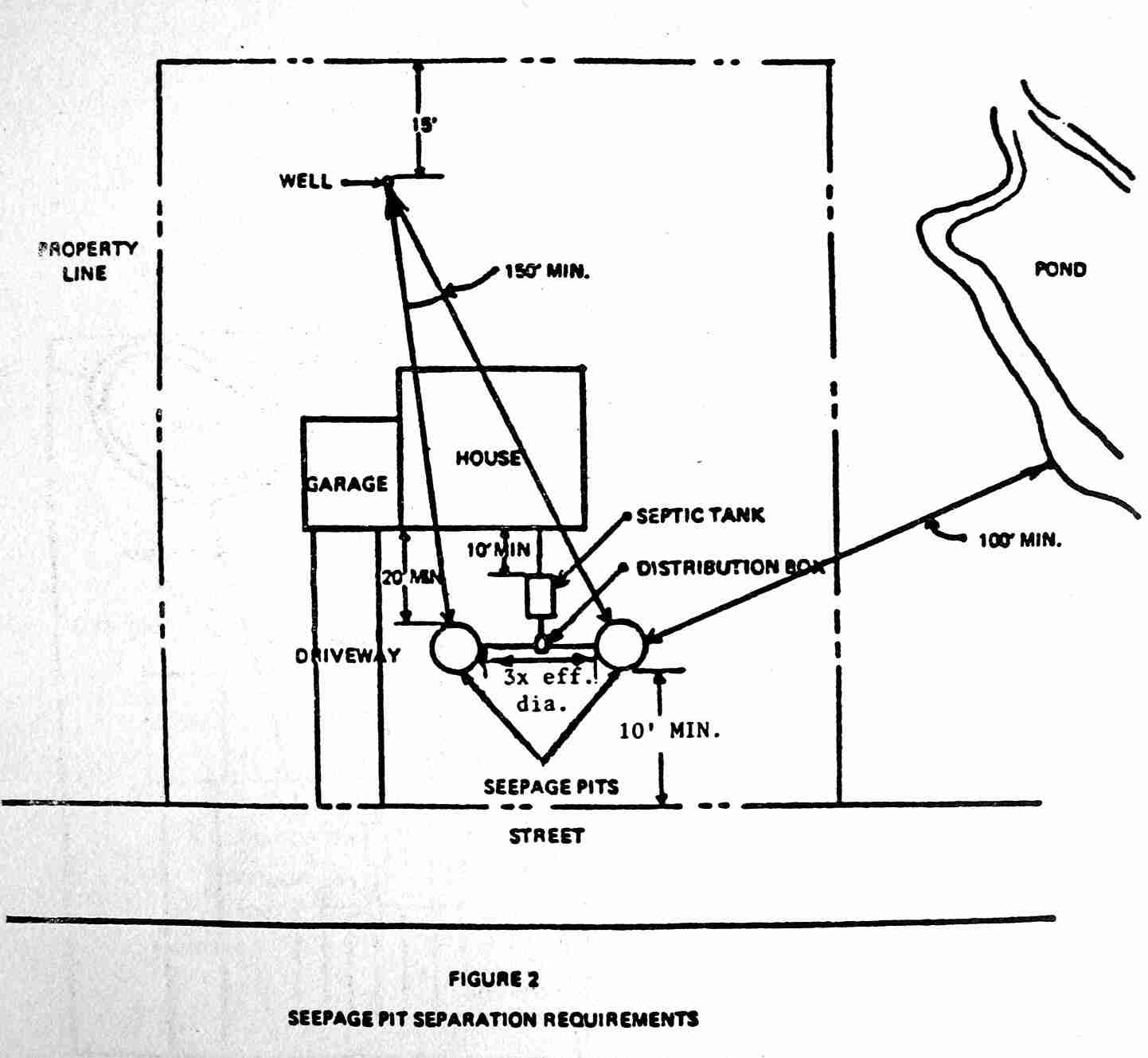 This sketch (from New York's Wastewater Regulations) shows the recommended site clearances between seepage pit (used to
receive septic tank effluent in this case) and other building and site features.
This sketch (from New York's Wastewater Regulations) shows the recommended site clearances between seepage pit (used to
receive septic tank effluent in this case) and other building and site features.
A more detailed list of site clearances between all site features and all types of septic system components is listed at "More Reading" just below.
Notice that absorption pits like this one not only need to be at a sufficient distance from the building, from wells, from property lines, but also if multiple absorption pits are installed, if you expect each pit to dispose of the graywater or effluent sent to it, they should be adequately separated from one another.
- Clearances for Septic Components Required - Well distance to Septic, Septic clearance from well, trees, lakes, streams, property boundary, etc.
- 75-A.0 New York State Regulation of Private Septic Systems
Effluent Soil Absorption Area Requirements for Seepage Pits
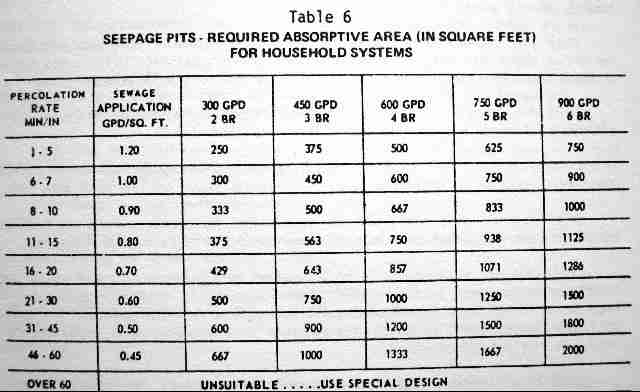
The table given above for historical purposes, shows and older copy of the required soil absorption area for seepage pits as a function of soil percolation rate and anticipated daily wastewater flow in gallons. A current seepage pit sizing table is given just below.
[Click to see an enlarged, detailed version of this or any other image or table found at InspectApedia.com]
TABLE 6 - SEEPAGE PITS - REQUIRED ABSORPTIVE AREA (IN SQUARE FEET) FOR HOUSEHOLD SYSTEMS
Given in more detail here:
NYS Table 6: Seepage Pits / Soak Pits: Required Absoptive Area for Household Systems(Table body gives the required square feet of soakpit absorptive surface area) |
||||||||||||||||
| Soil Percolation Rate (Minutes per inch) |
Sewage Application Rate (Gallons per day per square foot) | 2 Bedrooms |
3 Bedrooms |
4 Bedrooms |
5 Bedrooms |
6
Bedrooms |
||||||||||
Septic Wastewater Effluent Input Flow Rate (Gallons per Day) |
||||||||||||||||
| 220 gpd | 260 gpd | 300 gpd | 330 gpd | 390 gpd | 450 gpd | 440 gpd | 520 gpd | 600 gpd | 550 gpd | 650 gpd | 750 gpd | 660 gpd | 780 gpd | 900 gpd | ||
| 1 - 5 | 1.20 | 183 | 217 | 250 | 275 | 325 | 375 | 367 | 433 | 500 | 458 | 542 | 625 | 550 | 650 | 750 |
| 6 - 7 | 1.00 | 220 | 260 | 300 | 330 | 390 | 450 | 440 | 520 | 600 | 550 | 650 | 750 | 660 | 780 | 900 |
| 8 - 10 | 0.90 | 244 | 289 | 333 | 367 | 433 | 500 | 489 | 578 | 667 | 611 | 722 | 833 | 733 | 867 | 1000 |
| 11 - 15 | 0.80 | 275 | 325 | 375 | 413 | 488 | 563 | 550 | 650 | 750 | 688 | 813 | 938 | 825 | 975 | 1125 |
| 16 - 20 | 0.70 | 314 | 371 | 429 | 471 | 557 | 643 | 629 | 743 | 857 | 786 | 929 | 1071 | 943 | 1114 | 1286 |
| 21 - 30 | 0.60 | 367 | 433 | 500 | 550 | 650 | 750 | 733 | 867 | 1000 | 917 | 1083 | 1250 | 1100 | 1300 | 1500 |
| 31 - 45 | 0.50 | 440 | 520 | 600 | 660 | 780 | 900 | 880 | 1040 | 1200 | 1100 | 1300 | 1500 | 1320 | 1560 | 1800 |
| 46 - 60 | 0.45 | 489 | 578 | 667 | 733 | 867 | 1000 | 978 | 1156 | 1333 | 1222 | 1444 | 1667 | 1467 | 1733 | 2000 |
| Over 60 | Unsuitable soils for conventional seepage pit design. Use a special design. | |||||||||||||||
Notes Original source: New York State NYS75-A.8 Table 4A. Updated 12 January 2015. The current standard document is provided as a PDF and can be seen in its entirety atReferences or Citations . Watch out: OPINION: as we explain in this article series, because of the depth below ground surface of most seepage pits or soakpits or cesspools there is a lack of adequate aerobic bacteria for proper treatment of sewage wastewater effluient. As a result, even if the system successfully disposes of effluent it is probably not treating it adequately. The result is a risk of environmental and water aquifer contamination by pathogens. |
||||||||||||||||
Seepage Pit Size Requirements to Obtain Necessary Absorption Area
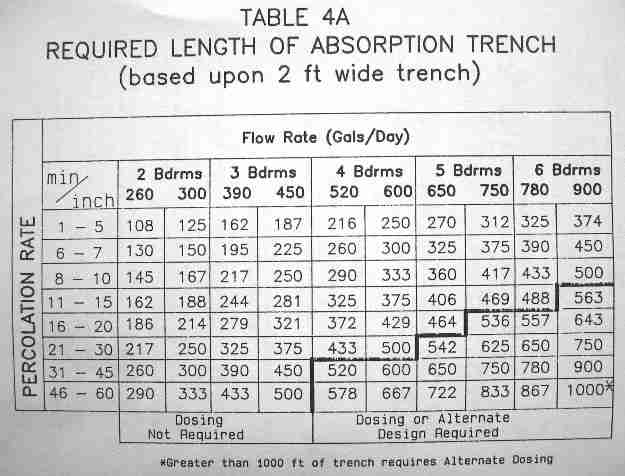
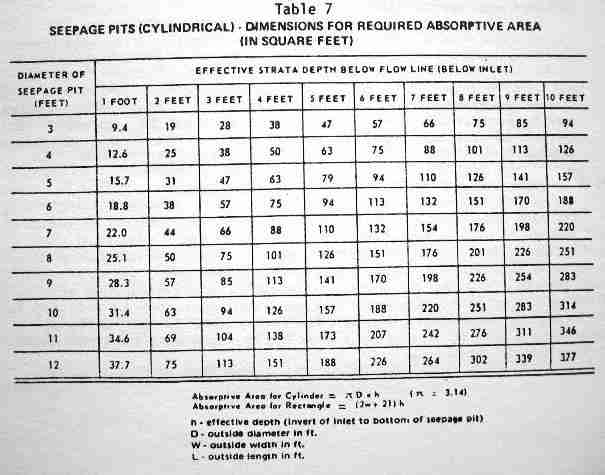
The table below shows the size of seepage pit necessary in order to provide the required soil absorption area for seepage pits. First use the preceding table to determine the necessary seepage pit absorption area, then use this table (below) to determine the necessary seepage pit size to provide that absorption area.

[Click to enlarge any image]
Original source: New York State NYS75-A.8 Table 4A. Updated 12 January 2015. The current standard document is provided as a PDF and can be seen in its entirety atReferences or Citations .
TABLE 7 - SEEPAGE PITS (CYLINDRICAL) - DIMENSIONS FOR REQUIRED ABSORPTIVE AREA (IN SQUARE FEET)
Older copy for historical reasons:
...
Continue reading at DRYWELL / SEEPAGE PIT CONSTRUCTION DETAILS or select a topic from the closely-related articles below, or see the complete ARTICLE INDEX.
Or see these
Recommended Articles
- CESSPOOLS
- CESSPOOL SAFETY WARNINGS
- DRYWELL DESIGN & USES
- GREYWATER SYSTEMS
- SEEPAGE PITS
- SEPTIC TANKS - home
Suggested citation for this web page
DRYWELL / SEEPAGE PIT SPECIFICATIONS at InspectApedia.com - online encyclopedia of building & environmental inspection, testing, diagnosis, repair, & problem prevention advice.
Or see this
INDEX to RELATED ARTICLES: ARTICLE INDEX to SEPTIC SYSTEMS
Or use the SEARCH BOX found below to Ask a Question or Search InspectApedia
Ask a Question or Search InspectApedia
Questions & answers & design specifications: how to design and build a drywell or seepage pit for graywater or septic effluent disposal
Try the search box just below, or if you prefer, post a question or comment in the Comments box below and we will respond promptly.
Search the InspectApedia website
Note: appearance of your Comment below may be delayed: if your comment contains an image, photograph, web link, or text that looks to the software as if it might be a web link, your posting will appear after it has been approved by a moderator. Apologies for the delay.
Only one image can be added per comment but you can post as many comments, and therefore images, as you like.
You will not receive a notification when a response to your question has been posted.
Please bookmark this page to make it easy for you to check back for our response.
Our Comment Box is provided by Countable Web Productions countable.ca
Citations & References
In addition to any citations in the article above, a full list is available on request.
- New York State Department of Health, APPENDIX 75-A WASTEWATER TREATMENT STANDARDS - INDIVIDUAL HOUSEHOLD SYSTEMS , [PDF] New York State Department of Health, 3 February 2010, retrieved 3/1/2010, original source: https://www.health.ny.gov/regulations/nycrr/title_10/part_75/appendix_75-a.htm
- SEPTIC TANK/SOIL-ABSORPTION SYSTEMS: HOW TO OPERATE & MAINTAIN [PDF] - , Equipment Tips, U.S. Department of Agriculture, 8271 1302, 7100 Engineering, 2300 Recreation, September 1982, web search 08/28/2010, original source: http://www.fs.fed.us/t-d/pubs/pdfimage/82711302.pdf.
- Septic Tank/Soil-Absorption Systems: How to Operate & Maintain, Equipment Tips, U.S. Department of Agriculture, 8271 1302, 7100 Engineering, 2300 Recreation, September 1982, web search 08/28/2010, original source: http://www.fs.fed.us/t-d/pubs/pdfimage/82711302.pdf
- Document Sources used for this web page include but are not limited to: Agricultural Fact Sheet #SW-161 "Septic Tank Pumping," by Paul D. Robillard and Kelli S. Martin. Penn State College of Agriculture - Cooperative Extension, edited and annotated by Dan Friedman (Thanks: to Bob Mackey for proofreading the original source material.)
- US EPA ONSITE WASTEWATER TREATMENT SYSTEMS MANUAL [online copy, free] Top Reference: US EPA's Design Manual for Onsite Wastewater Treatment and Disposal, 1980, available from the US EPA, the US GPO Superintendent of Documents (Pueblo CO), and from the National Small Flows Clearinghouse. Original source http://www.epa.gov/ORD/NRMRL/Pubs/625R00008/625R00008.htm Onsite wastewater treatment and disposal systems, Richard J Otis, published by the US EPA. Although it's more than 20 years old, this book remains a useful reference for septic system designers. U.S. Environmental Protection Agency, Office of Water Program Operations; Office of Research and Development, Municipal Environmental Research Laboratory; (1980)
- "International Private Sewage Disposal Code," 1995, BOCA-708-799-2300, ICBO-310-699-0541, SBCCI 205-591-1853, available from those code associations.
- "Manual of Policy, Procedures, and Guidelines for Onsite Sewage Systems," Ontario Reg. 374/81, Part VII of the Environmental Protection Act (Canada), ISBN 0-7743-7303-2, Ministry of the Environment,135 St. Clair Ave. West, Toronto Ontario M4V 1P5 Canada $24. CDN.
- Onsite Wastewater Disposal, R. J. Perkins; Quoting from Amazon: This practical book, co-published with the National Environmental Health Association, describes the step-by-step procedures needed to avoid common pitfalls in septic system technology. Valuable in matching the septic system to the site-specific conditions, this useful book will help you install a reliable system in both suitable and difficult environments. Septic tank installers, planners, state and local regulators, civil and sanitary engineers, consulting engineers, architects, homeowners, academics, and land developers will find this publication valuable.
- Onsite Wastewater Treatment Systems, Bennette D. Burks, Mary Margaret Minnis, Hogarth House 1994 - one of the best septic system books around, suffering a bit from small fonts and a weak index. While it contains some material more technical than needed by homeowners, Burks/Minnis book on onsite wastewater treatment systems a very useful reference for both property owners and septic system designers.
- US EPA ONSITE WASTEWATER TREATMENT SYSTEMS MANUAL Top Reference: US EPA's Design Manual for Onsite Wastewater Treatment and Disposal, 1980, available from the US EPA, the US GPO Superintendent of Documents (Pueblo CO), and from the National Small Flows Clearinghouse. Original source http://www.epa.gov/ORD/NRMRL/Pubs/625R00008/625R00008.htm
- In addition to citations & references found in this article, see the research citations given at the end of the related articles found at our suggested
CONTINUE READING or RECOMMENDED ARTICLES.
- Carson, Dunlop & Associates Ltd., 120 Carlton Street Suite 407, Toronto ON M5A 4K2. Tel: (416) 964-9415 1-800-268-7070 Email: info@carsondunlop.com. Alan Carson is a past president of ASHI, the American Society of Home Inspectors.
Thanks to Alan Carson and Bob Dunlop, for permission for InspectAPedia to use text excerpts from The HOME REFERENCE BOOK - the Encyclopedia of Homes and to use illustrations from The ILLUSTRATED HOME .
Carson Dunlop Associates provides extensive home inspection education and report writing material. In gratitude we provide links to tsome Carson Dunlop Associates products and services.
 | HOME | ABOUT | ASK a QUESTION | CONTACT | CONTENT USE POLICY | DESCRIPTION | POLICIES | PRIVACY | |
| © 2024 - 1985 Publisher InspectApedia.com - Daniel Friedman | |||||||||