
InspectAPedia® FREE Encyclopedia of Building & Environmental Construction, Diagnosis, Maintenance & Repair |
Question? Just ask us! InspectAPedia
|
 Methane Gas & Sewer Gas Dangers
Septic & Sewer Gas Explosion & Health Risks
- POST a QUESTION or COMMENT about methane gas produced by septic tanks and septic systems
Sewer gas & methane gas dangers:
This article explains Methane Gas & Septic System Dangers from Gases, gives basic advice, and cites additional reference material.
This article is part of our Septic Safety article series that outlines safety warnings & procedures for septic systems and cesspools, and provides some safety suggestions for septic system inspectors, septic system inspections, septic pumping contractors, and home owners.
Septic tanks, cesspools, and drywells present serious hazards including septic cave-in's or collapses, methane gas explosion hazards, and asphyxiation hazards. Simple precautions which we describe here can help avoid a dangerous or expensive septic problem.
InspectAPedia tolerates no conflicts of interest. We have no relationship with advertisers, products, or services discussed at this website.
Methane Gas Hazards around Septic Systems, Methane Gas Toxicity vs. Methane Explosion & Asphyxiation Risks, & How to Measure Methane Gas Levels
 Methane Gas Hazards are primarily of explosion or asphyxiation
We commented at SEPTIC SYSTEM SAFETY That methane gas which maybe encountered in septic system is both explosive and an asphyxiant.
A thoughtful reader, George Fielder, previously a salesperson for GfG Instrumentation, pointed out that these are the hazards. (We had inaccurately stated that methane gas was "toxic".)
[Click to enlarge any image]
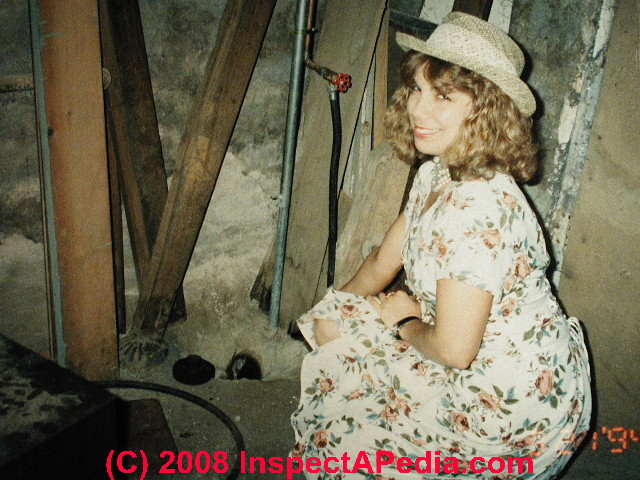
Our photo illustrates a previously hidden source of sewer gas odors in this home: an open waste line cleanout that had been hidden under a pile of rubble.
Measurement Instruments for Levels of Methane Gas
Mr. Fielder added that
... additionally, toxic and combustible gases like methane and H2S that would be found in a septic tank can be readily measured by a portable, handheld gas monitor that can be rented from almost any safety equipment supply company or trench equipment rental company like United Rentals.
They are easy to use and understand direct reading instruments that if nothing else might satisfy the curiosity of the do-it-yourselfer who likes to stick his nose in it.
True the user will need to know and understand the measurement scale and exposure levels for the particular gases being measured but this also can be easily explained when renting said instrument and reviewing an MSDS sheet.
Most portable handheld monitors on the market today are less complex than a volt-ohm meter and can readily be understood with a brief explanation.
Consult Your Local Safety Equipment Distributor
Readers who have the need to measure methane gas levels or who have questions about the hazards of entering confined spaces such as septic tanks should contact their local safety equipment distributor for further advice.
In addition, local fire & emergency service officials as well as gas distribution companies as well as some home inspectors or environmental testing firms may have expertise and gas testing or measurement equipment on hand.
For more detailed information on methane gas exposure levels and testing
see TOXIC GAS TESTING - Methane Gas Hazards
More information about methane gas hazards, toxicity, or other environmental hazards is available from public and professional agencies and associations such as the American Industrial Hygiene Association (AIHA) www.aiha.org, OSHA www.osha.gov, and the Mine Safety & Health Administration www.msha.gov. Also see Industrial Hygiene News.
Stay out of Septic Tanks and Link to Septic & Cesspool Safety Article
However, we emphasize that in ordinary procedures used in the care, repair, or maintenance of septic systems, the safety warnings we've listed above should be followed with care, and in general, quantitative measurements of the level of methane or other gases are not needed during a septic system repair.
Anyone working on or around or owning a septic tank should be sure to
Beware of Explosion or Asphyxiation Hazards of Sewer Gas or Fuel Gas Accumulation in buildings
As we report at SEWER GAS ODORS, potentially explosive levels of gases can accumulate in a building from several sources including explosive levels of sewer gas, swamp gas, or fuel gas from a variety of possible sources including plumbing leaks, improper plumbing venting, LP or natural gas piping leaks or errors, or even swamp gas accumulation under a building.
At OUTHOUSE / LATRINE FIRE & EXPLOSION we describe a methane gas explosion in an outhouse - admittedly an unusual event.
Also see BACKDRAFTING & SEWER/SEPTIC ODORS
...
Continue reading at METHANE GAS SOURCES or select a topic from the closely-related articles below, or see the complete ARTICLE INDEX.
Or see METHANE GAS HAZARD FAQs - questions & answers posted originally at this page.
Or see these
Recommended Articles
- BACKDRAFTING & SEWER/SEPTIC ODORS
- METHANE GAS EXPOSURE LIMITS
- METHANE & SEWER GAS HAZARDS
- METHANE GAS SOURCES
- PLUMBING S-TRAP CODES & HAZARDS
- PLUMBING DRAIN NOISES how errors cause trap siphonage, odors, and noises
- PLUMBING SYSTEM ODORS - home for guidance in tracking down plumbing smells
- SEPTIC & CESSPOOL SAFETY
- SEWER GAS ODORS
- TESTS for SEWER GAS INDOORS
- TOXIC GAS TESTING - Methane Gas Hazards
Suggested citation for this web page
METHANE & SEWER GAS HAZARDS at InspectApedia.com - online encyclopedia of building & environmental inspection, testing, diagnosis, repair, & problem prevention advice.
Or see this
INDEX to RELATED ARTICLES: ARTICLE INDEX to GAS HAZARDS in BUILDINGS
Or use the SEARCH BOX found below to Ask a Question or Search InspectApedia
Ask a Question or Search InspectApedia
Try the search box just below, or if you prefer, post a question or comment in the Comments box below and we will respond promptly.
Search the InspectApedia website
Note: appearance of your Comment below may be delayed: if your comment contains an image, photograph, web link, or text that looks to the software as if it might be a web link, your posting will appear after it has been approved by a moderator. Apologies for the delay.
Only one image can be added per comment but you can post as many comments, and therefore images, as you like.
You will not receive a notification when a response to your question has been posted.
Please bookmark this page to make it easy for you to check back for our response.
Our Comment Box is provided by Countable Web Productions countable.ca
Citations & References
In addition to any citations in the article above, a full list is available on request.
- New York State Department of Health, APPENDIX 75-A WASTEWATER TREATMENT STANDARDS - INDIVIDUAL HOUSEHOLD SYSTEMS , [PDF] New York State Department of Health, 3 February 2010, retrieved 3/1/2010, original source: https://www.health.ny.gov/regulations/nycrr/title_10/part_75/appendix_75-a.htm
- Thanks to Denise Cermola for permission to use the photo above, showing a dump truck collapsed into a seepage pit. (email 11/16/06 to 12/10/06). The contractor drove over this seepage pit connected to septic tank and caused total destruction of the system.
- Thanks to George Fielder who points out that methane gas is not toxic, but rather (we add) the hazards of methane gas produced by septic systems include possible explosions or the asphyxiation of someone who enters or even just leans over a septic tank opening. (email 10/20/2007)
- "7 Killed by Blast in Mexico Resort",
The New York Times, 15 November 2010, p. A9, reported (via AP) that in Playa del Carmen, Mexico, seven people were killed on 11/14/2010 when an explosion occurred in a large resort hotel in Mexico south of Cancun. Twelve others were injured. Authorities believed that swamp gas may have accumulated under the hotel that was constructed on a concrete slab over a swampy area near the beach. - Pennsylvania State Wastewater Treatment Fact Sheet SW-161, Septic System Failure: Diagnosis and Treatment
- Pennsylvania State Wastewater Treatment Fact Sheet SW-162, The Soil Media and the Percolation Test
- Pennsylvania State Wastewater Treatment Fact Sheet SW-l64, Mound Systems for Wastewater Treatment
- Pennsylvania State Wastewater Treatment Fact Sheet SW-165, Septic Tank-Soil Absorption Systems
- Document Sources used for this web page include but are not limited to: Agricultural Fact Sheet #SW-161 "Septic Tank Pumping," by Paul D. Robillard and Kelli S. Martin. Penn State College of Agriculture - Cooperative Extension, edited and annotated by Dan Friedman (Thanks: to Bob Mackey for proofreading the original source material.)
- In addition to citations & references found in this article, see the research citations given at the end of the related articles found at our suggested
CONTINUE READING or RECOMMENDED ARTICLES.
- Carson, Dunlop & Associates Ltd., 120 Carlton Street Suite 407, Toronto ON M5A 4K2. Tel: (416) 964-9415 1-800-268-7070 Email: info@carsondunlop.com. Alan Carson is a past president of ASHI, the American Society of Home Inspectors.
Thanks to Alan Carson and Bob Dunlop, for permission for InspectAPedia to use text excerpts from The HOME REFERENCE BOOK - the Encyclopedia of Homes and to use illustrations from The ILLUSTRATED HOME .
Carson Dunlop Associates provides extensive home inspection education and report writing material. In gratitude we provide links to tsome Carson Dunlop Associates products and services.
 | HOME | ABOUT | ASK a QUESTION | CONTACT | CONTENT USE POLICY | DESCRIPTION | POLICIES | PRIVACY | |
| © 2024 - 1985 Publisher InspectApedia.com - Daniel Friedman | |||||||||