\
InspectAPedia.com InspectAPedia®
Google
InspectAPedia
 

Free Encyclopedia of Building & Environmental Inspection, Testing, Diagnosis, Repair

Ask a Question or Search InspectAPedia

  • HOME
  • AIR CONDITIONING
  • DAMAGE ASSESSMENT
  • ELECTRICAL
  • EXTERIORS
  • HEATING
  • HOME INSPECTION
  • INTERIORS
  • PLUMBING
  • ROOFING
  • SEPTIC SYSTEMS
  • STRUCTURE
  • WATER SUPPLY
  • ENERGY SAVINGS
  • ENVIRONMENT
  • INDOOR AIR IAQ
  • INSULATION
  • MOLD INSPECT TEST REMOVE
  • NOISE
  • ODORS
  • SOLAR ENERGY
  • VENTILATION
  • EXPERTS DIRECTORY
  • CONTACT US


InspectAPedia ® Home

SEPTIC SYSTEM INSPECT DIAGNOSE REPAIR

SEPTIC CARE INSTRUCTIONS
SEPTIC CONSULTANTS
SEPTIC D-BOX INSPECTION
SEPTIC DRAINFIELD FAILURE DIAGNOSIS
SEPTIC DRAWINGS
SEPTIC DYE TEST PROCEDURE
SEPTIC FAILURE SIGNS
SEPTIC INSPECTION & TEST GUIDE
SEPTIC LIFE EXPECTANCY
SEPTIC ODORS
SEPTIC PUMPS
SEPTIC SUPPLIES & PARTS
SEPTIC SYSTEM DESIGN ALTERNATIVES
SEPTIC SYSTEM DESIGN BASICS
SEPTIC SYSTEMS, HOME BUYERS GUIDE to
SEPTIC SYSTEM SAFETY WARNINGS
SEPTIC TANKS
SEPTIC TREATMENTS & CHEMICALS
SEWAGE & SEPTIC CONTAMINANTS
SEWAGE BACKUP, WHAT TO DO
SEWAGE BACKUP TEST & CLEANUP
SEWAGE BACKUP PREVENTION
SEWAGE CONTAMINATION in buildings
SEWAGE CONTAMINANTS in FRUIT / VEGETABLES
SEWAGE EJECTOR / GRINDER PUMPS
SEWAGE LEVELS in SEPTIC TANKS
SEWAGE NITROGEN CONTAMINANTS
SEWAGE PATHOGENS in SEPTIC SLUDGE
SEWAGE PUMPS
SEWER BACKUP PREVENTION
SEWER GAS ODORS
SEWER LINE REPLACEMENT
SINKHOLES, WARNING SIGNS
SMELL PATCH TEST to Track Down Odors
SOAKAWAY BED FAILURE DIAGNOSIS
SULPHUR & SEWER GAS SMELL SOURCES
SUMP PUMPS

TOILETS, INSPECT, INSTALL, REPAIR
TOILET ALTERNATIVES
TOILETS, DON'T FLUSH LIST
TRAPS on PLUMBING FIXTURES
TREATMENTS & CHEMICALS, SEPTIC

VIDEO GUIDES: Septic Videos

WASHING MACHINES & SEPTIC SYSTEMS
WATER SOFTENERS & CONDITIONERS
WATER SUPPLY & DRAIN PIPING
WASTEWATER TREATMENT BASICS
WATER, WELLS, WATER TANKS: TESTING GUIDE
WINTERIZE A BUILDING

More Information

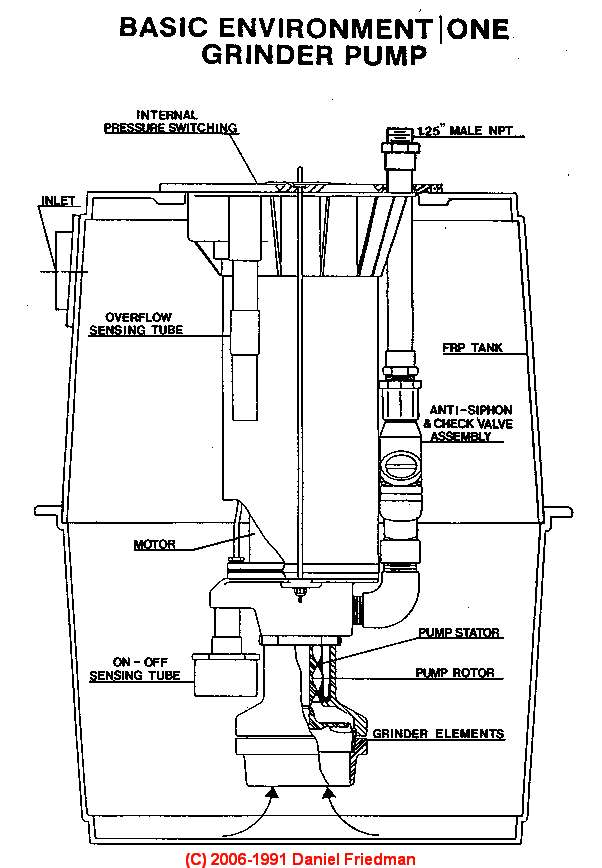
Sketch of a common sewage grinder pump used in a modern basement Buying, Installation & Maintenance Guide for Sewage Pumps, Septic Pumps, Effluent Pumps & Sump Pumps
     

  • Septic tank pumps, septic grinder pumps, septic effluent pumps - Septic Pump Alarm & Septic Alarm demo video; Definitions of types of septic system pumps; Warning of items that will clog septic pumps and grinder pumps & Warning about trip and fall and health hazards of exposed sewage ejector pumps
  • FILTERS SEPTIC & GREYWATER - separate article
  • SEPTIC SYSTEM PUMPS
  • SEWAGE EJECTOR / GRINDER PUMPS - separate article
    • Free-Standing Sewage Grinder Pump - separate article
    • Septic Pump Alarm Systems - separate article
    • Septic Pump Buyers Guide - separate article
    • Septic Pump Duplex System Designs - separate article
    • Septic Pump Inspection & Maintenance - separate article
    • Septic Pump Installation Guide - separate article
    • Septic Pumping Stations - separate article
  • SEWAGE PUMP CLOG DAMAGE - separate article
  • SUMP PUMPS - separate article
  • WHAT CAN GO INTO TOILETS & DRAINS? - separate article
  • Questions & Answers about buying, installing, and repairing sewage ejector pumps and pump controls and about sewage and sump pump safety
  • References

Click to Show or Hide Related Topics

  • SEPTIC SYSTEM INSPECT DIAGNOSE REPAIR - home
  • ALTERNATIVE SEPTIC DESIGNERS
  • ALTERNATIVE SEPTIC PRODUCTS
  • BACKUP PREVENTION, SEPTIC
  • BACKUP PREVENTION, SEWER
  • CHEMICALS & TREATMENTS for SEPTICS
  • CLEANOUTS, DRAIN, SEPTIC
  • CLEARANCE DISTANCES, SEPTIC SYSTEM
  • CLOGGED DRAIN DIAGNOSIS & REPAIR
  • D BOX TROUBLESHOOTING
  • DRYWELL DESIGN & USES
  • EFFLUENT RETENTION TIME
  • FILTERS SEPTIC & GREYWATER
  • GARBAGE DISPOSAL vs SEPTICS
  • GUIDE TO SEPTIC SYSTEMS
  • HOW SEPTIC SYSTEMS WORK
  • HOME BUYERS GUIDE to SEPTIC SYSTEMS
  • HOME SELLERS GUIDE TO SEPTIC SYSTEMS
  • ODORS, SEPTIC or SEWER
  • ODORS, PLUMBING SYSTEM
  • SEPTIC & CESSPOOL SAFETY
  • SEPTIC COMPONENT LOCATIONS
  • SEPTIC DRAINFIELD SIZE
  • SEPTIC DRAINFIELD LIFE
  • SEPTIC SYSTEM INSPECTION & TEST GUIDE - home
  • SEPTIC LOADING & DYE TEST PROCEDURE - home
  • SEPTIC MAINTENANCE INSTRUCTIONS
  • SEPTIC PUMPS
  • SEPTIC PUMPING REPAIR
  • SEPTIC SYSTEM REPAIR
  • SEPTIC TANK ABANDONMENT GUIDE
  • SEPTIC TANK BAFFLES
  • SEPTIC TANK TEES
  • SEPTIC TANK CLEANING
  • SEPTIC TANK COVERS
  • SEPTIC TANK DEPTH
  • SEPTIC TANK GRASS or SNOWMELT
  • SEPTIC TANK, HOW TO FIND
  • SEPTIC TANK INSPECTION PROCEDURE - home
  • SEPTIC TANK LEAKS
  • SEPTIC TANK LEVELS of SEWAGE
  • SEPTIC TANK PUMPING PROCEDURE
  • SEPTIC TANK PUMPING REASONS
  • SEPTIC TANK PUMPING SCHEDULE
  • SEPTIC TANK SAFETY
  • SEPTIC TANK SIZE
  • SEPTIC TANKS, CONCRETE
  • SEPTIC TANKS, FIBERGLASS / PLASTIC
  • SEPTIC TANKS HOME MADE SITE BUILT
  • SEPTIC TANKS, STEEL
  • SEPTIC TESTS: DYE & LOADING TESTS
  • SEPTIC TREATMENTS & CHEMICALS
InspectAPedia tolerates no conflicts of interest. We have no relationship with advertisers, products, or services discussed at this website.

This article explains the differences between Septic System Pumps (SEPTIC SYSTEM PUMPS) and Sump Pumps (SUMP PUMPS) , Sewage Ejector Pumps, Septic Grinder Pumps, Sewage Pumping Stations, & Septic Pump Alarms. Advice is given for septic tank effluent or sewage pump selection and use. Septic pumps used for pumping air in aeration systems and septic pumps used to move effluent in a drip dispersion system are discussed under the appropriate septic system type which are outlined at SEPTIC SYSTEM DESIGN ALTERNATIVES.

Green links show where you are. © Copyright 2013 InspectAPedia.com, All Rights Reserved. Author Daniel Friedman.

What are Septic Pumps, Sewage Grinders, Sewage Effluent Pumps, & Sump Pumps
Our septic tank alarm video at right demonstrates the operation of a septic tank pump system alarm. More videos on septic system maintenance are at SEPTIC VIDEOS.

Septic alarms indicate when the septic tank pump is not operating. Repair is needed promptly.

Citation of this article by reference to this website and brief quotation for the sole purpose of review are permitted. Citation of this article by reference to this website and brief quotation for the sole purpose of review are permitted. Use of this information at other websites, in books or pamphlets for sale is reserved to the author. Technical review by industry experts has been performed and comments from readers are welcomed. Contributors are listed at the end of each article.

Readers have asked the difference between a sump pump, simplex and duplex sump pumps, a septic effluent pump, a sewage grinder pump, and an effluent pump. This article explains the various types of pumps and their purchase, installation, inspection, and maintenance.

Other videos: VIDEO GUIDES at InspectAPedia.com


Duplex sump pump installationHere we use "sewage pump" and "septic pump" as synonyms. Both classes of pumps handle blackwater or sewage. It is their destination that is different.

A sewage pump, speaking strictly, is pumping blackwater (toilet waste) to a public sewer line.

A septic pump, strictly speaking, is pumping blackwater (toilet waste) to a private septic tank and drainfield system.

But people use these terms loosely, and even among manufacturers it is important to ask, or read the manufacturer's description of what a particular pump model is intended to handle. In addition, even among sewage pumps and grinder pumps that are intended to either pass solids or grind solids up and pump them, the vulnerability of different pump models to damage, clogging, or motor burn-up from debris that people may flush down drains and toilets varies - a problem we discuss further at SEWAGE PUMP CLOG DAMAGE.
What is a Sump Pump?

Definition of Sump pumps, which we discuss on this page, are designed to remove unwanted water, such as surface or ground water that leak into a building. Sump pumps only have to pump water, never solids.

A sump pump is normally installed in a pit at the low end of a basement or crawl space floor.

In a bad building water entry situation water runs across the basement/crawl space floor into the sump pit where it is pumped away (after already wetting the building and inviting a mold contamination problem). This condition pertains when water is entering a building through foundation walls, often because the roof drainage or surface runoff are directed right against the building foundation itself.

Keeping gutters and leaders working and correcting outside drainage errors are critical in keeping water out of a building. Doesn't it make more sense to prevent water from coming into a building than to let it in and then pump it out?

In a good situation, openings in the sides and bottom of the sump pit, or an under-floor drainage system direct subsurface water into the sump pit before the ground water level rises enough to send water into the building.

Over several years of operation, and partly by pumping a little soil silt as it operates, a sump pump may actually improve the flow of under-floor water into the sump pit, thus reducing building water entry.

What is a Septic Pump, Sewage Pump, or Grinder Pump? Definitions of the Types of Septic Pumps & Grinder Pumps

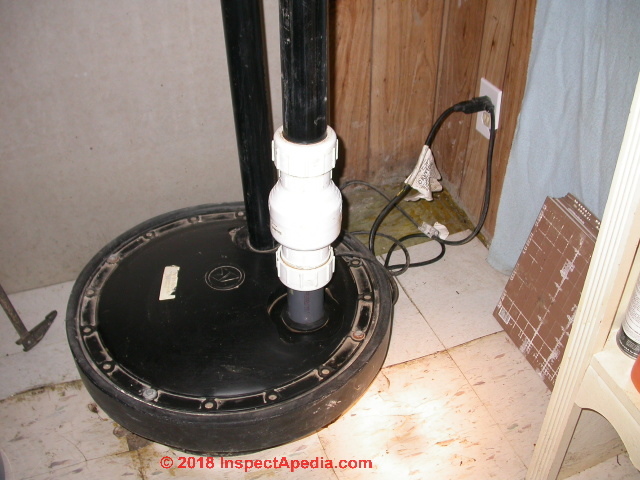
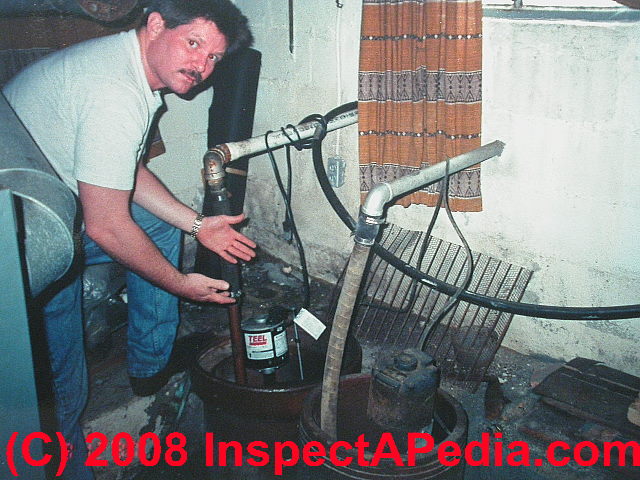
Typical home sewage grinder pump

Septic pumps, sewage pumps, or sewage ejector pumps, which we discuss in detail beginning at SEWAGE EJECTOR / GRINDER PUMPS, are designed to remove sewage from a building where plumbing fixtures and their drains are lower than the building sewer line and/or septic tank.

Septic pumps have to move solids, either by being able to pass large solid objects through the pump without clogging, or by grinding the solids into fine debris.

Municipal lift stations, duplex sewage pumps, septic alarms, grinder pumps, submersible pumps, are discussed in more detail in this article.

A sewage pump may be designed to either pass solids up to a certain size, or it may be a sewage grinder pump designed to macerate solid waste so that it can be pumped through a sewer line, perhaps a smaller diameter "force main" sewer line to a public sewer or septic tank.

Sewage grinder/ejector pumps are available in various horsepower models, typically from .5 to 1hp for residential applications, and are sold to operate at various voltages including 110-120V, 220-240V, 440-480V, and even 600V models using either single phase (most common) and three-phase motors.

Typically the piping connection from the ejector pump to the building sewer line is 2" and incorporates a check valve (the white valve shown in the front-right pipe in our photo at left).

Sewage ejector pump installation and maintenance are discussed in detail at SEWAGE EJECTOR / GRINDER PUMPS

What is a Septic Effluent Pump?

Septic effluent pumps are used to move clarified septic effluent out of a pumping chamber to a drainfield. Septic effluent pumps do not have to move solids, but are built to standards of durability and duty cycle more demanding than a typical sump pump used to remove ground water from a building.

Typical examples of applications where septic effluent pumps are used include raised bed, mound, or sand-bed filtration septic systems in which the absorption bed is located higher than the septic tank. In these installations septic effluent is pumped from a final chamber in the septic tank or from a second effluent chamber up to the absorption system.

Watch out: Pump manufacturers may show that the same pump models can serve as a sump pump, effluent pump, and de-watering pump. But that is not universally the case - in other words, there are some sump pumps that work just fine as effluent pumps, but other sump pump models (such as low-cost sump pumps using a vertical float and rod switch and intended for indoor de-watering in basements) may not be suitable for septic effluent pumping and may not be designed to be used in a septic effluent tank or drywell.

In a pinch we've seen people use SUMP PUMPS for septic tank effluent pumping but that is not a durable nor a recommended solution.

Be Sure to Select the Proper Septic or Sump Pump Type

Sewage pump (C) Daniel Friedman


The distinction among sewage pumps or septic pump types is important when installing or repairing a septic system that uses pumps since choosing the wrong pump can mean a short operating life for the pump, an unreliable septic system, and unnecessary expense.

In addition to explaining these different septic pump types, in this article we also describe a community sewage pumping station and septic pump alarms as well as the inspection and installation details for this equipment.

Beware, there may be some confusion, depending on with whom you speak, because people don't always use just the right terms for construction or septic system parts - and the right sewage pump term, or right septic handling product versus the wrong one can be an important distinction.

Sewage Pumps Clogging Failures

Details about cause and prevention of sewage pump clogging and damage are at Sewage Pump Clog Damage. Excerpts are below. Also see WHAT CAN GO INTO TOILETS & DRAINS?.

Watch out for the following conditions that cause clogging and even burnup of various types of sewage pumps, grinder pumps, ejector pumps, and septic pumps:

Don't Flush These Items Down the Toilet - They Clog or Burn Up the Grinder Pump

  • Abrasive debris such as sand
  • Cat litter, kitty litter, or other fine gravel or clay products (such as aquarium bottom gravel - don't clean your fish tank by dumping the gravel, sea shells, or other solid waste into a toilet)
  • Caustic chemicals
  • Cigarette butts are not biodegradable and should not be flushed into the septic system. And the filters on cigarette butts can clog and destroy septic pumps.
  • Clay such as modeling clay or children's play-doh® modeling compound can enter and clog sewage grinder pumps
  • Cloth strips or scraps, rag fragments
  • Clothes dryer sheets used as fabric softener or to make your dry clothes "smell nicer" - the quantity of chemical in these sheets is unlikely to be sufficient to damage the septic tank bacteria, but the synthetic fabric from which dryer sheets are made will not break down in the septic tank. These items not only add to the solid waste in the septic tank, a dryer sheet might clog the septic tank inlet at the baffle.
  • Coffee grounds - can enter and clog sewage pumps
  • Condoms won't clog a pipe but like some other debris, because they are of modest size and are quite flexible, but condoms are (usually) not bio degradable. So we listed condoms, or other latex products such as latex gloves above as "never flush".

    A condom in the septic tank will probably join other debris in the tank's floating scum layer, and will be removed at the next tank pump-out. Of course, if the septic tank outlet tee baffles are missing, the condom will join other floating debris on its way out to clog the drainfield, so ask your septic pumper to check the condition of the septic tank baffles when the septic tank is next pumped.

    BUT if your system uses a septic pump or grinder pump or sewage ejector pump, this material can clog the pump impeller and cause expensive pump damage or motor burnout.
  • Cotton swabs (Q-tips®) have been known to clog a drain or two - not biodegradable, though trivial in volume. BUT if your system uses a septic pump or grinder pump or sewage ejector pump, this material can clog the pump impeller and cause expensive pump damage or motor burnout.
  • Dental floss - is not biodegradable, though trivial in volume, dental floss can enter and clog grinder pump and effluent pump mechanisms
  • Degreasing solvents
  • Diapers and similar items which are not biodegradable will simply clog a septic system and are very likely to clog building drains
  • Disposable wipes - such as baby wipes or personal hygiene wipes, even products described as "biodegradable" or "OK for use in septic systems" may NOT be OK: if your system uses a septic pump or grinder pump or sewage ejector pump, this material can clog the pump impeller and cause expensive pump damage or motor burnout.
  • Explosive or flammable materials
  • Glass or glass fragments
  • Grease waste, cooking fat, lard, etc.
  • Hair waste such as hair clippings
  • Latex condoms, gloves, or similar products - we discuss condoms in septic systems further in the next section of this article.
  • Oils such as lubricating oils
  • Metal shavings, scraps, debris
  • Mud, silt, sand
  • Paper towels and facial tissues (Kleenex™) do not break down easily and should not be flushed into the septic system. Toilet paper breaks down quickly and should not be a problem in an ordinary septic tank system.
  • Panty liners should never be flushed down a building drain
  • Plastic bags or other plastic scrap or trash of any kind should never be flushed down a building drain, nor any other plastic scraps, fragments, or objects
  • Sanitary napkins should never be flushed down a building drain
  • Sticks, even toothpicks and cotton swabs can enter and clog sewage pump impeller assemblies
  • String or cord - like dental floss above, can clog or bind grinder pump or sewage pump impeller assemblies leading to pump burnout.
  • Tampons should not be flushed down a building drain
  • Wipes such as baby wipes or clean-up or makeup removing wipes
  • Any other solid, semi-solid objects that do not dissolve readily in water

See TOILETS, DON'T FLUSH LIST for a more extensive list of "don't flush" materials, and also see WHAT CAN GO INTO TOILETS & DRAINS? for complete details.

List of Producers of Septic Pumps, Sewage Pumps, Grinder Pumps, Effluent Pumps

CONTACT us to add pumps to this list. No fees or costs are involved. InspectAPedia.com has no financial relationship with any company, product, or service discussed at this website.

  • Crane Pumps and Systems, 420 Third Street, Piqua, Ohio 45356 Phone: (937) 778-8947 and Crane Pumps and Systems, 83 West Drive, Bramton, Ontario, Canada L6T 2J6, Phone: (905) 457-6223 Fax: (937) 773-7157 Fax: (905) 457-2650 www.cranepumps.com. See Weinman submersible sewage ejector pump installation and service manual for an example instructions for the Weinman Series WE and 3WE sewage ejector pumps ranging from .5 to 1 hp.
  • Drain & Sewage Ejector Packages, plumbingsupply.com, Tel: 530-891-6428, 24 hour message phone: 530-891-1556, Email: sales2011@plumbingsupply.com Sewage Ejector pump types, models, float control switches using Little Giant and Zoeller sewage pumps as examples, web search 08/15/11, original source http://www.plumbingsupply.com/

  • Float Switches for Pumps, plumbingsupply.com, Sewage Ejector pump types, models, float control switches using Little Giant and Zoeller sewage pumps as examples, web search 08/15/11, original source http://www.plumbingsupply.com/
  • Flotec 800-365-6832, Flotec produces a wide range of effluent pumps, grinder pumps, sewage pumps, sump pumps
  • Gorman-Rupp, P.O. Box 1217, Mansfield, Ohio 44901-1217, Tel: (419) 755-1011 Fax (419) 755-1263. Gorman produces a very wide range of pumps including septic pumps, sewage pumps, effluent pumps, grinder pumps, submersible shredder pumps, IPT
  • Grundfos Pumps Corporation, 2555 Clovis Ave., Clovis CA 93612, Tel: 800-333-1366, web search 8/9/11, original source
    http://www.us.grundfos.com/web/download.nsf/Pages/
    7C03990D6E09EC6C882565220069C131/$File/Seeje-io.pdf
  • Hydromatic Pentair Water, 740 East 9th Street, Ashland, OH 44805, Phone: 1-888-957-8677, Web Site: http://www.hydromatic.com
  • Little Giant, Tel: 877-869-0200, Email: sales@little-giantpump.com, Little Giant produces a wide range of pumping equipment including sewage and wastewater pumps
  • Liberty Pumps, Liberty Pumps, 7000 Apple Tree Avenue, Bergen, NY 14416, Tel: 1-800-543-2550 Fax: 1-585-494-1839, Email: liberty@libertypumps.com. Submersible pumps, sewage pumps, effluent pumps, grinder pumps. Submersible sewage pumps include the LE series line ranging from 4/10 hp up to 2 hp. LIberty also provides simplex and duplex pump systems and engineered septic and sewage pump systems.
  • Myers, Myers Applied Wastewater Systems - 1101 Myers Parkway Ashland, OH 44805, Phone: 419-289-1144, Fax: 419-289-6658, or in Canada: Myers, 269 Trillium Drive, Kitchener, Ontario, Canada N2G 4W5 Tel: 519-748-5470 Fax 519-748-2553Myers produces a wide range of pumps including sump pumps, sewage pumps, effluent pumps
  • Pit-Viper Add-A-JOhn low-profile sewage systems (integrated plastic tank, pump, toilet mounting base)
  • Superior 2805 Fairview Ave. N Roseville, MN 55113, Tel: 800-495-9278Tel: 651-487-0378. Superior produces sewage pumps (float operated submersibles)
  • Tsurumi Pumps, Tsurumi (America), Inc. 1625 Fullerton Court, Glendale Heights, IL 60139, tel: 630-793-0127, fax: 630-793-0146, toll free: 888-TSURUMI (878-7864), info@tsurumiamerica.comTsurumi Pump produces sewer pumps and submersible pumps, categorized as wastewater pumps, sewage pumps, and centrifugal pumps including portable equipment.
  • Wayne , Wayne Pumps, 101 Production Drive, Harrison OH 45030, Tel: 800-237-0987. Wayne produces a range of sewage pumps and water pumps including cast iron submersible pumps
  • Weinman sewer pumps - see Crane above.
  • Zoeller Pump Company, 3649 Cane Run Rd., Louisville, KY 40211, Phone: 1-800-928-7867, 502-778-2731 Fax: 502-774-3624. Technical support and/or quote related emails: zcotechnical@zoeller.com. Zoeller produces just about every kind of septic, sewage, effluent, grinder, and sump pump. Homeowners who need a sewage pump are asked to contact their local representative or retail sales outlet. Zoeller classes their pumps into these categories:
    • Grinder pumps, such as Zoeller's 810/815 Turnkey Grinder Systems, 800-series Grinder Pumps, Cold-Climate grinder pumps, Simplex prepackaged grinder pump systems, and Simplex and Duplex (two pumps) grinder systems including four outdoor use.
    • Utility, pedestal, & gas engine pumps. These are portable gas-engine powered pumps used typically in construction, service, or emergencies
    • Sewage & Dewatering pumps, such as certain Aqua-Mate Models and Waste-Mate models, and Sewage-Waste 600-series pumps
    • Sump, Effluent, Dewatering pumps, such as Water Ridd'r , Mighty-Mate, Aqua-Mate, Flow-Mate, and High Head Flow-Mate pumps - of certain models - be sure to read the manufacturer's intended use for a pump model before purchasing it

Frequently Asked Questions (FAQs) about Septic Pumps & Sewage Ejector Pumps

Question: sewage sump pump odor control

What can be poured into the comode, to go through the ejector pump or grinder pump, to eliminate smell? This is in a basement and pumps up to the tank system. - Don Votaw

Reply:

Don, Cloroben and other manufacturers produce drain cleaning liquids that are enzymes that should not harm a septic system. But I'd expect the smell to return as the system is used. Better to find the exact odor source and fix that - assuring good plumbing venting, no leaks at toilets or equipment, etc.

Question: What to do about a grinder pump that keeps getting clogged with string, cigarette butts, etc.

Having a problem with grinding pump constantly getting bound with string, butts etc. Is there a pump that can handle grinding most material, or would we be better off with just a pump We only have a 1" discharge line. - Anon

Reply:

Anon: in the text above and also at TOILETS, DON'T FLUSH LIST we advise against ever flushing cigarette butts, dental floss, or string down building drains, precisely because, as you report, they can clog and even burn up sewage pumps by entering and binding the impeller assembly.

There may be large capacity commercial grinder pumps that can better handle these problems than a residential sewage pump, but to me that seems a big expense that should not be necessary when cooperation by the building occupants can avoid these costs.

At the bottom of this page in our references section you'll see contact information for Grundfos, one of the larger manufacturers of grinder pumps. Give them a call to ask if they have a residential-sized unit that can tolerate some of the abuses that your system suffers.

Keep us posted, what you learn will help other readers.

Question: Where to find a wiring diagram for a sewage pump

I've been looking for hours (really) to find a wire diagram of the pump to alarm. I've tried msn, I've tried Google and some sites say they do have it...but when you go there, they don't. How hard can this be? I've tried to find a video, a drawing and just electrical to no avail. - Stumpman

Reply:

Stumpman The wiring diagram for septic pump alarms are surely included with the alarm itself. Basically, when the pump fails to run when it should, the rising effluent level in the pump trips an alarm sound and light. If you give me the brand of your septic alarm device I'll research this and get details for you.

Question: Sump pump float replacement vs pump replacement?

If the float goes, and needs replacing, does the pump require replacing too? I have a yes from one company and a no from another - thanks. - AssocHomeowner

Reply: list of sources for replacement sewer or sump pump float switches and submersible floats

Assoc.,

The float switch assembly on at least some sewage ejector pumps is a replaceable part. Check the installation manual for your sewage grinder pump and you'll see part numbers to order an exact replacement, though generic switches are also available. If you can't find that information, tell us the brand of your pump and we'll research it for you.

Watch out: there may be some pump models whose water-tight assembly does not encourage replacement of the float switch. The problem is that the electrical components have to be absolutely water-tight to avoid electrocution hazards.

But even in the case of an integral float switch that cannot be repaired without breaking the water-tight seal on the pump assembly, it may be possible to simply tie off the old floats to keep them out of the way (avoiding fouling or tangling the replacement floats), followed by installation of an independent float switch control assembly. Independent float switches include a submersible float switch that is inserted into the pumping chamber, along with an electrical connector that plugs in above ground between the existing pump electrical power connection and the power source. So no electrical connections are exposed to wet conditions.

  • Some sources of float switches for sewer pumps and sump pumps include:
  • Burcam sewage and sump pump float switch
  • Dwyer - level float switches
  • Flotec sump pump replacement submersible float switches
  • Grainger - Grainger.com sells float switches
  • Zoeller float switches

Question: Check valve on sewage ejector pump?

In my basement bathroom my sewage injector pumps come on every 15-30 minutes. I have a check valve on the discharge side. Is the check valve leaking back? causing the injector pump to come ? The pump is less than a year old. - Tyuan Rice

Reply: Sewage ejector pumps and check valves

Tyuan,

Indeed it's not unusual for a check valve on a sewage ejector pump to become sticky or clogged, allowing sewage to drain back into the pump and thus causing the pump to come on more frequently than desired. Worse, depending on piping arrangement in the building, other wastewater from other fixtures higher in the building may drain backwards into and even clog the check valve. So if your sewage ejector pump is cycling even when the fixtures that drain directly into that pump system are not in use, I suspect in-drainage from other parts of the building.

Septic pumps, sewage pumps, or sewage ejector pumps, which we discuss in detail beginning at SEWAGE EJECTOR / GRINDER PUMPS, are designed to remove sewage from a building where plumbing fixtures and their drains are lower than the building sewer line and/or septic tank.

Question: Pumping frequency for effluent holding chambers at a pumping station

How often do you recommend pumping out the tank where an effluent pump is located? Our neighborhood has a shared leach field. Each house has a septic tank, and the gray water goes to pump stations and from there to the leach field. We're creating an association and any advice as to maintenance schedules, etc. is greatly appreciated. Thank you! - Deb Loomis

Reply:

Deb:

For septic *tank* pumping frequency, take a look at the suggestions at SEPTIC TANK PUMPING SCHEDULE (article links listed at Related Topics ).

If the septic tanks are working properly, that is they are being pumped on schedule and checked for damage such as lost or broken baffles, the rate of accumulation of solids, scum, and sludge in the effluent pumping chamber is much less. I have not found a design specification for that condition but my experience suggests that you have the effluent pumping chamber pumped after the first year of use so that you can obtain data on the rate of accumulation of scum and sludge in the tank.

Most likely that will indicate that you will be able to extend the effluent holding tank pumping frequency to a longer interval. But in sum, I'd base it on experience not on a table, and I'd be sure that someone is monitoring the maintenance of the individual feeding-septic tanks. One broken septic tank baffle could send a large volume of solids into the pumping chamber and thence it would damage the drainfield.

Question: do we need a septic tank ahead of the lift station?

We are installing a simplex sewage ejection station in a new house. The town has asked us to install a 1000 gal septic tank before the lift station. Is this a recommended step? It seems redundant and unnecessary. - Nick P.

Reply:

Nick:

The requirement for a septic tank before the lift station may have arisen from one of these concerns:

  • A concern that there was a need for separation of solids from effluent - not something that makes sense if we're talking about a grinder pump lifting to a public sewer.

or

  • A concern that the design needed a buffer or holding tank to permit accumulation of septage to permit the residents to continue to use toilets and plumbing systems for some period in event of a power failure.

You need to discuss their reasoning with your town officials - find out what the worry is. If it's the need for a buffering tank, the solution where a grinder pump is installed probably lies in the specification of the size of the main pumping chamber, not the requirement to install a septic tank ahead of the pumping lift station. After all, once installed, the septic tank will remain always full anyway. It wouldn't do a thing for you except add maintenance costs.

Question: We added a septic pump when adding a basement bathroom - how can we avoid using the pump?

We used to have a natural gravity flow to the septic system until we added a bathroom in the basement which required a septic pump (but everyone around here always call it a sump pump). Want to go back to the gravity flow method and would like to know if there is a way to also keep the pump system that could be only turned on when/if needed. Is it possible to incorporate a dual system? - T. Head

Reply: how sewage grinder pumps work; what's the difference between a sewage pump and a sump pump?

T.H.

Most often the addition of a sewage ejector pump to allow installation of a basement bath becomes necessary because the bathroom floor is lower than the existing sewer line. The pump has to lift only the waste from the new bathroom - up to the existing sewer line where it then flows by gravity out to the existing septic tank or sewer system.

You don't want to put a manual switch on your basement bath's sewage pump - the pump will run only when that bathroom is used.

By the way, while people may speak carelessly about what these pumps are called, the proper term is sewage pump, sewerage pump, sewage ejector pump, or grinder pump. These pumps all include a grinder that macerates solid waste so that it can flow up through smaller-diameter piping to a point where it empties into the main building drain.

A sump pump is designed only to pump water, such as ground water, or graywater from a laundry sink. If your plumber installs a sump pump into a pit handling solid waste, it won't last long at all - it's the wrong pump.

Question: dog and daughter fell into sump pit; dog died.

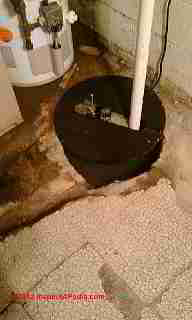
Sump pit accident (C) D Friedman / T.C. I recently moved in a house with this nasty hole in the basement.the first night my dog fell in and my daughter fell in the get the dog.2 hrs later the poor dog died but my daughter in ok.what can be put over this sump pump hole firmly so this does not happen again? I am devastated for my dog but what if it was my 3yr ..my landlord was uncaring can you help! - T.C.

[A photo of the sump pit was subsequently provided by the reader - shown at left]

Reply: consult your doctor, inform your landlord in writing, look for other unsafe conditions

A competent onsite inspection by an expert usually finds additional information that can help understand just what the hazards are in your home, not just around the sump pit. Your email raises these concerns in my mind:

  1. What kind of "sump" are you talking about? If this was a groundwater ejector pump or typical "sump pump" installation, the hazards may include injury, even drowning, as well as exposure to possible contaminants in groundwater; if you are talking about a sewage ejector pump the hazards of bacterial and other pathogenic infections to your daughter and family are significant; in either case you should consult your family doctor immediately if your daughter was exposed to potential contaminants or sewage.
  2. The inexperience or inattention that causes a building owner to leave a sump pit open, exposing occupants to a trip and fall hazard even if there are no other biological health hazards involved, leads me to suggest that there could be other safety hazards at the property.

While the topic is different, our advice to renters who encounter mold contamination at a property includes the importance of making sure that the building owner and manager know, in writing, of your concerns. Details are at RENTERS & TENANTS GUIDE TO MOLD

Immediately:

  1. Block or rope off access around this hazard; depending on the type of sump pit that was installed, there may be a prefabricated and safe cover that can be installed over the opening. Such covers are sold at building supply stores such as Home Depot and Loews. Normally I'd expect that correction to be the responsibility of the building owner. But your first priority is to prevent another accident.
  2. Inform your landlord of the accident and of this unsafe condition.

Please keep me posted on how things progress, and send along photos of the sump hole if you can. Such added details can help us understand what's happening and often permit some useful further comment. What we both learn may help me help someone else.

Reader Follow-Up:

Hello, these are the pics i have. And i have no idea what kind of pump it is.help me please.im scared for my kids.also little fly nat bugs are coming from it.

Comment:
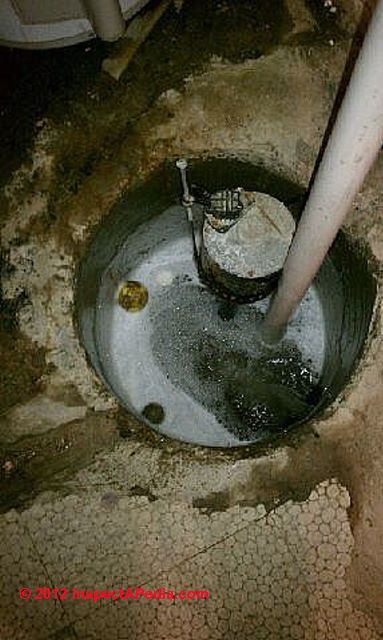
Sump pit with cover off - sudsy (C) D FriedmanYour photos show an ordinary sump pump used to remove groundwater from below a basement slab and to carry off water that leaks into the basement, runs across the floor and enters the sump pit.

It also looks as if in most of the photos a sump pit cover was in place - so it would be useful to know if the cover has just been added, or was it left off, or how else did your daughter and pet fall into the pit?

From your photo [see covered sump pup pit photo above] it looks as if the pump and controls are so high in the sump pit that the cover, perhaps a home-made one, includes a large opening in its top through which a child or pet could step.

Also, one of your photos [photo of open sump pit shown at left] shows the sump pit with the cover off - and the water in your photo (it's a bit blurry picture) looks sudsy. If the building dumps a laundry sink or washer into the pit and is then pumping that washer drainage to the ground surface outside, that'd most likely be a health and plumbing code violation.

Finally, it also looks as if the floor is broken up around the sump pit, perhaps to improve water entry into the pit from the floor surface? Is that uneven surface also a trip hazard.

Meanwhile, make sure the sump cover is secure and block off access to this corner to protect your family from trip and fall hazards.

Question: what are the common causes for a pump alarm to go off

What are the most common causes a pump tank alarm would go off? My grinder pump is only 4 yrs old and we are still building, so it does not get that much use. C.S. 8/5/12

Reply:

A competent onsite inspection by an expert usually finds additional clues that help accurately diagnose a problem with a sewage pump such as a defective check valve or a running toilet that keeps filling the reservoir tank. That said, the alarm sounds when the level in the reservoir reaches a level that means that the primary pump is not working, or in a single pump system, that no pump is working.

So in addition to checking for a running toilet and bad check valve, check that the float switch is properly installed.

Details about sewage and septic pump alarms (and a copy of this Q&A) are found at at Septic Pump Alarm Systems

Question: Short cycling lift station pump: Warrick 67 intrinsic safe 2 pump controller

Hello and thank you for your help. We have a lift station with a lead and lag pump. Pump one is short cycling and I don't know why! We have a new Warrick 67 intrinsic safe 2 pump controller. The controller test out fine how ever when we leave both pumps in auto when pump it's pump ones turn it short cycles. Why? We also think we have a float issue and we are in the process of getting a new one for the well.

Originally I got a call saying the pump went air borne because pump one never shut off. We put a temp float in and new controller which was bad and still not fixed. Where do I go from here. We even verified the float wires all the way back to the controller. Please help direct my next move. Thank you very much. Dan :-) 8/7/12

Reply:

I am guessing that your control panel is http://www.gemssensors.com/Products/Level/Warrick/Kits-panels-alarms/Control-Panels/CP-67

With a duplex pump system. And chances are you already have the manual.

What I can't accurately guess is if we're looking at

  • a bad float (could be a bad internal switch),
  • a loose wire,
  • a bad sensor location/mount, or
  • an actual wastewater level sensor defect.

At this point I'd call Warrick for smarter help than I can offer. Warrick can be called directly at 1-800-378-1600 - and as they know their controls best, that may be the smartest move.

Outside the US: 860-747-3000
Fax: 860-747-4244
Email info@gemssensors.com

Their website is www.warrick.com or apparently also Gems Sensors Inc. One Cowles Road Plainville, CT 06062 (860)793-4579 FAX(860)793-4580

As the Warrick site auto-forwards to www.gemssensors.com

Ask a Question or Search InspectApedia

Questions & answers or comments about buying, installing, and repairing sewage ejector pumps and pump controls and about sewage and sump pump safety

Ask a Question or Enter Search Terms in the InspectApedia search box just below.

Technical Reviewers & References

Related Topics, found near the top of this page suggest articles closely related to this one.

  • [1] Weinman Installation and Operation Manual, Submersible Sewage Ejector Pump, Crane Pumps and Systems, 420 Third Street, Piqua, Ohio 45356 Phone: (937) 778-8947 and Crane Pumps and Systems, 83 West Drive, Bramton, Ontario, Canada L6T 2J6, Phone: (905) 457-6223 Fax: (937) 773-7157 Fax: (905) 457-2650 www.cranepumps.com. See Weinman submersible sewage ejector pump installation and service manual for an example instructions for the Weinman Series WE and 3WE sewage ejector pumps ranging from .5 to 1 hp. Web search 8/9/11, original source: http://www.cranepumps.com/downloadables/CATALOGS_OIPMs/
    Manuals%20&%20Instruction%20sheets/108038.pdf
  • [2] Grundfos Sewage Ejector Pump Package Installation and Operating Instructions, Grundfos Pumps Corporation, 2555 Clovis Ave., Clovis CA 93612, Tel: 800-333-1366, web search 8/9/11,original source
    http://www.us.grundfos.com/web/download.nsf/Pages/
    7C03990D6E09EC6C882565220069C131/$File/Seeje-io.pdf
  • [3] Submersible Sewage Ejector Pump Installation, Operation, & Parts Manual, by Hydromatic Pentair Water, 740 East 9th Street, Ashland, OH 44805, Phone: 1-888-957-8677, Web Site: http://www.hydromatic.com
  • [4] The Sewage Pumping Handbook, Grundfos, web search 11/30/2011, original source: http://www.grundfos.com/content/dam/Global%20Site/Industries
    %20%26%20solutions/waterutility/pdf/sewage-handbook.pdf
  • Pennsylvania State Fact Sheets relating to domestic wastewater treatment systems include:
  • Pennsylvania State Wastewater Treatment Fact Sheet SW-161, Septic System Failure: Diagnosis and Treatment
  • Pennsylvania State Wastewater Treatment Fact Sheet SW-162, The Soil Media and the Percolation Test
  • Pennsylvania State Wastewater Treatment Fact Sheet SW-l64, Mound Systems for Wastewater Treatment
  • Pennsylvania State Wastewater Treatment Fact Sheet SW-165, Septic Tank-Soil Absorption Systems
  • Document Sources used for this web page include but are not limited to: Agricultural Fact Sheet #SW-161 "Septic Tank Pumping," by Paul D. Robillard and Kelli S. Martin. Penn State College of Agriculture - Cooperative Extension, edited and annotated by Dan Friedman (Thanks: to Bob Mackey for proofreading the original source material.)

Books & Articles on Building & Environmental Inspection, Testing, Diagnosis, & Repair

  • Our recommended books about building & mechanical systems design, inspection, problem diagnosis, and repair, and about indoor environment and IAQ testing, diagnosis, and cleanup are at the InspectAPedia Bookstore. Also see our Book Reviews - InspectAPedia.
  • Home Reference Book - Carson DunlopThe Home Reference Book - the Encyclopedia of Homes, Carson Dunlop & Associates, Toronto, Ontario, 25th Ed., 2012, is a bound volume of more than 450 illustrated pages that assist home inspectors and home owners in the inspection and detection of problems on buildings. The text is intended as a reference guide to help building owners operate and maintain their home effectively. Field inspection worksheets are included at the back of the volume. Special Offer: For a 10% discount on any number of copies of the Home Reference Book purchased as a single order. Enter INSPECTAHRB in the order payment page "Promo/Redemption" space. InspectAPedia.com editor Daniel Friedman is a contributing author.

    Or choose the The Home Reference eBook for PCs, Macs, Kindle, iPad, iPhone, or Android Smart Phones. Special Offer: For a 5% discount on any number of copies of the Home Reference eBook purchased as a single order. Enter INSPECTAEHRB in the order payment page "Promo/Redemption" space.

  • GO TO Carson Dunlop's Home Study Course Information - How to Become a Home Inspector: Carson Dunlop's nationally recognized Home Study Course, selected by ASHI the American Society of Home Inspectors and other professionals and associations. This website author is a contributor to this course.
  • GO TO Carson Dunlop's Home Study Course Information - How to Become a Home Inspector: Carson Dunlop's nationally recognized Home Study Course, selected by ASHI the American Society of Home Inspectors and other professionals and associations. This website author is a contributor to this course.
  • GO TO Carson Dunlop's Home Study Course Information - How to Become a Home Inspector: Carson Dunlop's nationally recognized Home Study Course, selected by ASHI the American Society of Home Inspectors and other professionals and associations. This website author is a contributor to this course.
    Building inspection education & report writing systems from Carson, Dunlop & Associates Ltd
  • Builder's Guide to Wells and Septic Systems, Woodson, R. Dodge: $ 24.95; MCGRAW HILL B; TP; Quoting from Amazon's description: For the homebuilder, one mistake in estimating or installing wells and septic systems can cost thousands of dollars. This comprehensive guide filled with case studies can prevent that. Master plumber R. Dodge Woodson packs this reader-friendly guide with guidance and information, including details on new techniques and materials that can economize and expedite jobs and advice on how to avoid mistakes in both estimating and construction. Chapters cover virtually every aspect of wells and septic systems, including on-site evaluations; site limitations; bidding; soil studies, septic designs, and code-related issues; drilled and dug wells, gravel and pipe, chamber-type, and gravity septic systems; pump stations; common problems with well installation; and remedies for poor septic situations. Woodson also discusses ways to increase profits by avoiding cost overruns.
  • Country Plumbing: Living with a Septic System, Hartigan, Gerry: $ 9.95; ALAN C HOOD & TP; Quoting an Amazon reviewer's comment, with which we agree--DF:This book is informative as far as it goes and might be most useful for someone with an older system. But it was written in the early 1980s. A lot has changed since then. In particular, the book doesn't cover any of the newer systems that are used more and more nowadays in some parts of the country -- sand mounds, aeration systems, lagoons, etc.
  • ...

HOME ABOUT CONTACT COPYING DESCRIPTION POLICIES PRINTING PRIVACY © 2013 Copyright InspectAPedia.com