
InspectAPedia® FREE Encyclopedia of Building & Environmental Construction, Diagnosis, Maintenance & Repair |
Question? Just ask us! InspectAPedia
|
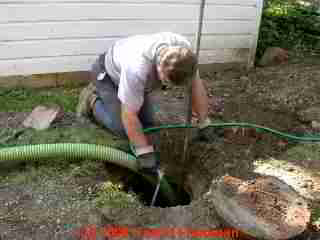 Cleaning the Septic Tank, How & Why to Wash Septic Tank Interior
- POST a QUESTION or COMMENT about how & why to wash down a septic tank interior after pumping.
Septic tank cleaning procedures:
How and why the septic tank interior is washed down after tank pumpout. Cleaning the septic tank during and at the end of the septic tank pump-out procedure can expose damage to the septic tank sides and bottom that cannot otherwise be found.
This septic tank pumpout article series provides a step by step, photo-illustrated guide to opening, pumping, and inspecting septic tanks, how a conventional septic tank is located, opened, pumped out, cleaned, and inspected. This guideline is intended for septic pumping tank truck operators and as general information for homeowners or septic service companies concerned with septic system care.
InspectAPedia tolerates no conflicts of interest. We have no relationship with advertisers, products, or services discussed at this website.
Recomendations for Washing Down Septic Tank Sides/Bottom After Pumpout is Completed
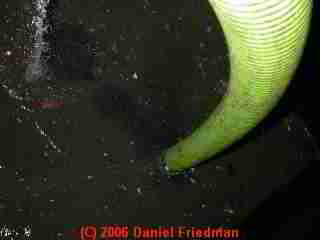
After the septic tank is nearly empty the operator might connect a garden hose to wash-down the tank baffles, septic tank
sides, and tank bottom. The pump will continue to run to remove the excess water that is entering the tank.
This step is not mandatory, and some septic pumping contractors leave it out. But if it is performed
we have an opportunity to better inspect the septic tank sides and bottom for cracks, breaks, or spalling.
In sum, washing the septic tank permits a more careful inspection of the condition of the septic tank interior.
The additional water in the septic tank
and any remaining bottom debris is washed out at this time.
The need for septic tank interior washing depends on the tank type,
age, and conditions which may require extra water for final sludge removal or wash-down to permit
inspection of suspected problems such as a rusted-out tank bottom or missing tank plug. Certainly if the
effluent levels in the tank were abnormally low at the start of pumping, this wash-down and detailed inspection is a good idea.
Incidental bits of masonry debris in the bottom of the septic tank such as chips from a concrete cover, stones, or old terra cotta waste line which happen
to remain on the tank bottom may remain in place and are harmless.
If septic tank damage is found such as cracking, it may be possible to repair the septic tank by cleaning the surfaces and applying an appropriate masonry patching compound.
Watch out: But no one should enter the septic tank without proper equipment or preparation as there is a real danger of death by asphyxiation by the methane gas remaining in the tank.
Reader Question: septic tank pumpers who churn and return sewage to the tank
(May 16, 2012) Bob said:
The septic pumping contractors convinced our municipalities that after a septic tank has been emptied it should be immediately refilled (to its original level) with effluent from the pumper truck - claiming that
a) gravity in the pumper truck's tank separates the solids from the liquids (during the 5 to 10 minutes the effluent is in the truck) so that mostly only liquid is returned to the septic tank; and
b) that this return of effluent improves septic performance. I can see the financial advantage for the contractors (fewer trips to the water treatment facility; lower disposal costs; charge homeowners extra $$$ for 'complete' emptying) but I cannot find any independent evidence from a reputable source that supports these claims. Does anyone know of any sources that actually support these claims? Thanks!
Reply:
Bob, you also posted your question at the end of the article titled INSPECT the SEPTIC TANK AFTER PUMPING. There we have provided a detailed reply to the improper and destructive septic tank effluent churn-and-return procedure you describe below.
You might want to warn your municipalities as well as the pumpers that once homeowners discover that the approach you describe is going to cause very costly damage to the septic systems (by pushing solids into the drainfields) as well as environmental damage the pumpers and municipalities are inviting class action litigation by the aggrieved homeowners.
Below at in the form of individual detailed articles are the Steps in Septic Tank Cleaning Procedure in the order that they should be performed:
...
Continue reading at INSPECT the SEPTIC TANK AFTER PUMPING or select a topic from the closely-related articles below, or see the complete ARTICLE INDEX.
Or see these
Septic Pumping Procedure & Pumper Truck Operation Articles
- SEPTIC TANK INSPECTION PROCEDURE
- SEPTIC TANK PUMPING MISTAKES
- SEPTIC TANK PUMPING PROCEDURE
- CLEANING SEPTIC TANKS
- WHEN to CLEAN THE SEPTIC TANK
- WHEN NOT TO PUMP A SEPTIC TANK
- FIND the SEPTIC TANK, HOW TO
- HOW TO OPEN a SEPTIC TANK
- INSPECT the SEPTIC TANK BEFORE PUMPING
- SEPTIC TANK INSPECTION PROCEDURE
- SEPTIC TANK LEVELS of SEWAGE
- PUMPER TRUCK OPERATION PROCEDURE
- PUMPING the SEPTIC TANK
- RECORD SEPTIC TANK LOCATION
- SEPTIC PUMPING CONCLUSIONS
- SEPTIC TANK PUMPING REASONS
- SEPTIC TANK PUMPING SCHEDULE
- SEPTIC TANK SAFETY
- SEPTIC TANK LEVELS of SEWAGE
Suggested citation for this web page
WASH SEPTIC TANK SIDES/BOTTOM at InspectApedia.com - online encyclopedia of building & environmental inspection, testing, diagnosis, repair, & problem prevention advice.
Or see this
INDEX to RELATED ARTICLES: ARTICLE INDEX to SEPTIC SYSTEMS
Or use the SEARCH BOX found below to Ask a Question or Search InspectApedia
Ask a Question or Search InspectApedia
Try the search box just below, or if you prefer, post a question or comment in the Comments box below and we will respond promptly.
Search the InspectApedia website
Note: appearance of your Comment below may be delayed: if your comment contains an image, photograph, web link, or text that looks to the software as if it might be a web link, your posting will appear after it has been approved by a moderator. Apologies for the delay.
Only one image can be added per comment but you can post as many comments, and therefore images, as you like.
You will not receive a notification when a response to your question has been posted.
Please bookmark this page to make it easy for you to check back for our response.
Our Comment Box is provided by Countable Web Productions countable.ca
Citations & References
In addition to any citations in the article above, a full list is available on request.
- New York State Department of Health, APPENDIX 75-A WASTEWATER TREATMENT STANDARDS - INDIVIDUAL HOUSEHOLD SYSTEMS , [PDF] New York State Department of Health, 3 February 2010, retrieved 3/1/2010, original source: https://www.health.ny.gov/regulations/nycrr/title_10/part_75/appendix_75-a.htm
- Special thanks to M & O Sanitation, Dutchess County NY (845) 471-0308 for permitting us to photograph steps during septic system service at our demonstration property.
- Pennsylvania State Wastewater Treatment Fact Sheet SW-161, Septic System Failure: Diagnosis and Treatment
- Pennsylvania State Wastewater Treatment Fact Sheet SW-162, The Soil Media and the Percolation Test
- Pennsylvania State Wastewater Treatment Fact Sheet SW-l64, Mound Systems for Wastewater Treatment
- Pennsylvania State Wastewater Treatment Fact Sheet SW-165, Septic Tank-Soil Absorption Systems
- Document Sources used for this web page include but are not limited to: Agricultural Fact Sheet #SW-161 "Septic Tank Pumping," by Paul D. Robillard and Kelli S. Martin. Penn State College of Agriculture - Cooperative Extension, edited and annotated by Dan Friedman (Thanks: to Bob Mackey for proofreading the original source material.)
- Our recommended books about building & mechanical systems design, inspection, problem diagnosis, and repair, and about indoor environment and IAQ testing, diagnosis, and cleanup are at the InspectAPedia Bookstore. Also see our Book Reviews - InspectAPedia.
- In addition to citations & references found in this article, see the research citations given at the end of the related articles found at our suggested
CONTINUE READING or RECOMMENDED ARTICLES.
- Carson, Dunlop & Associates Ltd., 120 Carlton Street Suite 407, Toronto ON M5A 4K2. Tel: (416) 964-9415 1-800-268-7070 Email: info@carsondunlop.com. Alan Carson is a past president of ASHI, the American Society of Home Inspectors.
Thanks to Alan Carson and Bob Dunlop, for permission for InspectAPedia to use text excerpts from The HOME REFERENCE BOOK - the Encyclopedia of Homes and to use illustrations from The ILLUSTRATED HOME .
Carson Dunlop Associates provides extensive home inspection education and report writing material. In gratitude we provide links to tsome Carson Dunlop Associates products and services.
 | HOME | ABOUT | ASK a QUESTION | CONTACT | CONTENT USE POLICY | DESCRIPTION | POLICIES | PRIVACY | |
| © 2024 - 1985 Publisher InspectApedia.com - Daniel Friedman | |||||||||