
InspectAPedia® FREE Encyclopedia of Building & Environmental Construction, Diagnosis, Maintenance & Repair |
Question? Just ask us! InspectAPedia
|
 How to Close the Septic Tank & How to Record the Septic Tank Location
- POST a QUESTION or COMMENT about safe closure of the septic tank after service, pumping, cleanout, or inspection
How to close the septic tank - restoring a save access cover to septic tank cleanouts & inspection ports.
This septic tank pumpout article series provides a step by step, photo-illustrated guide to opening, pumping, and inspecting septic tanks, how a conventional septic tank is located, opened, pumped out, cleaned, and inspected.
InspectAPedia tolerates no conflicts of interest. We have no relationship with advertisers, products, or services discussed at this website.
How to Close the Septic Tank (safely & without leaks) after inspection or cleanout
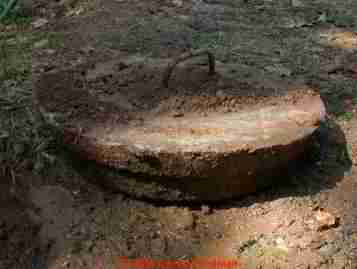
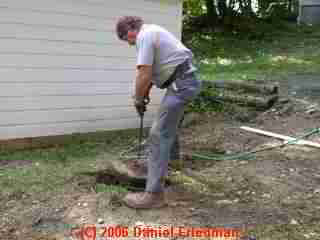
When inspection of the septic tank is complete, the cover is replaced and the operator should make sure that the cover is sound and secure against falling-in.
The first photo above shows that this septic tank cover is in good condition and ready for re-use.
Septic Tank Cover Replacement Safety Warnings
But when replacing the septic tank cover, be sure that your tank cover is un-damaged, that it seals against any significant surface or ground water entering the septic tank, and most important, be sure that the septic tank cover is securely set in place so that it cannot be tipped, moved, or opened by a child. Loose septic tank covers risk a fatal septic-tank fall-in.
The second photo shows the operator replacing the septic tank cover. Notice that he has placed his feet carefully and securely so as to avoid slipping while replacing the cover.
A Photographic Guide to Pumping a Septic Tank
This article series is intended for septic pumping tank truck operators and as general information for homeowners or septic service companies concerned with septic system care. Citation of this article by reference to this website and brief quotation for the sole purpose of review are permitted.
Use of this information at other websites, in books or pamphlets for sale is reserved to the author. Technical reviewers are welcome and are listed atReferences or Citations .
This is a chapter of SEPTIC SYSTEM INSPECTION & MAINTENANCE COURSE an online book on septic systems.
Before Covering the Septic Tank Access Cover, Record the Location (so that it can be found again)
When the septic tank has been located and its cleanout port found, if one does not already exist, make a drawing
showing just where the tank is located to assist the owner/septic service company in the future.
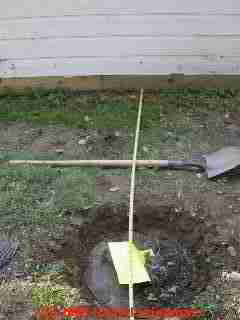
The photo shows how we measured from a nearby garage wall to the septic tank cleanout cover.
We measured at a right angle to the garage wall the distance from the wall to the center of the cleanout cover.
We recorded that distance (in this case, 78 inches).
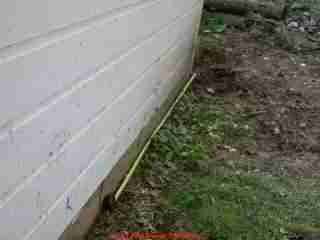
Then we measured from the garage rear corner to the point along the wall from which we measured out from wall to tank (in this case, 90 inches.) Since the garage is a fixed site feature, we can easily locate the septic tank cleanout cover again with just these two numbers.

We also buried a square of yellow plastic right at the tank cover so that when excavating it in the future
we'll readily see that we've found the right location.
Finally, having recorded the septic tank cleanout cover location, we covered the septic tank cleanout access port with several inches of top soil and re-seeded with grass seed.
"SEPTIC TANK LOCATION- How to Find the Septic Tank" provides additional explanation and illustration of recording the location of septic system components.
Provide the results of what was learned during septic tank pumpout and issue any appropriate SAFETY WARNINGS to SEPTIC SYSTEM OWNERS
Question:
(July 13, 2015) Paul Perdek said:
I have a bungalow in Toms River NJ
The Septic System was abandoned in 1968. It was pumped out and filled with sand. Back then....there are no records with the Town or my parents.
Now we want to sell the lot. After 45 years, there is no environmental issue....we have been tapped into the City Sewer.
And the septic system was never used with any laudry machines.
Can you comment.
thanks
Reply:
Paul,
I'm unclear what comment you want for the situation you've described. You are describing an abandoned septic system for which we have no information whatsoever besides your one sentence. If the system was properly abandoned there may be no issue. If it was not, there could be fatal hazards present.
...
Continue reading at RECORD SEPTIC TANK LOCATION or select a topic from the closely-related articles below, or see the complete ARTICLE INDEX.
Or see these
Septic Pumping Procedure & Pumper Truck Operation Articles
- SEPTIC TANK INSPECTION PROCEDURE
- SEPTIC TANK PUMPING MISTAKES
- SEPTIC TANK PUMPING PROCEDURE
- CLEANING SEPTIC TANKS
- WHEN to CLEAN THE SEPTIC TANK
- WHEN NOT TO PUMP A SEPTIC TANK
- FIND the SEPTIC TANK, HOW TO
- HOW TO OPEN a SEPTIC TANK
- INSPECT the SEPTIC TANK BEFORE PUMPING
- SEPTIC TANK INSPECTION PROCEDURE
- SEPTIC TANK LEVELS of SEWAGE
- PUMPER TRUCK OPERATION PROCEDURE
- PUMPING the SEPTIC TANK
- RECORD SEPTIC TANK LOCATION
- SEPTIC PUMPING CONCLUSIONS
- SEPTIC TANK PUMPING REASONS
- SEPTIC TANK PUMPING SCHEDULE
- SEPTIC TANK SAFETY
- SEPTIC TANK LEVELS of SEWAGE
Suggested citation for this web page
CLOSE the SEPTIC TANK at InspectApedia.com - online encyclopedia of building & environmental inspection, testing, diagnosis, repair, & problem prevention advice.
Or see this
INDEX to RELATED ARTICLES: ARTICLE INDEX to SEPTIC SYSTEMS
Or use the SEARCH BOX found below to Ask a Question or Search InspectApedia
Ask a Question or Search InspectApedia
Try the search box just below, or if you prefer, post a question or comment in the Comments box below and we will respond promptly.
Search the InspectApedia website
Note: appearance of your Comment below may be delayed: if your comment contains an image, photograph, web link, or text that looks to the software as if it might be a web link, your posting will appear after it has been approved by a moderator. Apologies for the delay.
Only one image can be added per comment but you can post as many comments, and therefore images, as you like.
You will not receive a notification when a response to your question has been posted.
Please bookmark this page to make it easy for you to check back for our response.
Our Comment Box is provided by Countable Web Productions countable.ca
Citations & References
In addition to any citations in the article above, a full list is available on request.
- New York State Department of Health, APPENDIX 75-A WASTEWATER TREATMENT STANDARDS - INDIVIDUAL HOUSEHOLD SYSTEMS , [PDF] New York State Department of Health, 3 February 2010, retrieved 3/1/2010, original source: https://www.health.ny.gov/regulations/nycrr/title_10/part_75/appendix_75-a.htm
- Special thanks to M & O Sanitation, Dutchess County NY (845) 471-0308 for permitting us to photograph steps during septic system service at our demonstration property.
- Pennsylvania State Wastewater Treatment Fact Sheet SW-161, Septic System Failure: Diagnosis and Treatment
- Pennsylvania State Wastewater Treatment Fact Sheet SW-162, The Soil Media and the Percolation Test
- Pennsylvania State Wastewater Treatment Fact Sheet SW-l64, Mound Systems for Wastewater Treatment
- Pennsylvania State Wastewater Treatment Fact Sheet SW-165, Septic Tank-Soil Absorption Systems
- Document Sources used for this web page include but are not limited to: Agricultural Fact Sheet #SW-161 "Septic Tank Pumping," by Paul D. Robillard and Kelli S. Martin. Penn State College of Agriculture - Cooperative Extension, edited and annotated by Dan Friedman (Thanks: to Bob Mackey for proofreading the original source material.)
- Our recommended books about building & mechanical systems design, inspection, problem diagnosis, and repair, and about indoor environment and IAQ testing, diagnosis, and cleanup are at the InspectAPedia Bookstore. Also see our Book Reviews - InspectAPedia.
- In addition to citations & references found in this article, see the research citations given at the end of the related articles found at our suggested
CONTINUE READING or RECOMMENDED ARTICLES.
- Carson, Dunlop & Associates Ltd., 120 Carlton Street Suite 407, Toronto ON M5A 4K2. Tel: (416) 964-9415 1-800-268-7070 Email: info@carsondunlop.com. Alan Carson is a past president of ASHI, the American Society of Home Inspectors.
Thanks to Alan Carson and Bob Dunlop, for permission for InspectAPedia to use text excerpts from The HOME REFERENCE BOOK - the Encyclopedia of Homes and to use illustrations from The ILLUSTRATED HOME .
Carson Dunlop Associates provides extensive home inspection education and report writing material. In gratitude we provide links to tsome Carson Dunlop Associates products and services.
 | HOME | ABOUT | ASK a QUESTION | CONTACT | CONTENT USE POLICY | DESCRIPTION | POLICIES | PRIVACY | |
| © 2024 - 1985 Publisher InspectApedia.com - Daniel Friedman | |||||||||