
InspectAPedia® FREE Encyclopedia of Building & Environmental Construction, Diagnosis, Maintenance & Repair |
Question? Just ask us! InspectAPedia
|
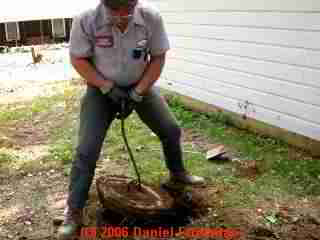 How to Open a Septic Tank: Step by Step Guide
- POST a QUESTION or COMMENT about safe and proper opening of a septic tank for inspection or cleaning.
How to open the septic tank.
Septic tank cleanout or cover location, access, opening procedures. We describe some things to check before opening the septic tank, such as subsidence, evidence of recent work, or unsafe septic tank covers.
Then we illustrate how the septic tank cover or access port cover is removed. We explain why the best way to clean a septic tank is to pump out through a central manhole-sized cover, not an 8" cleanout port and not through the inlet or outlet baffle.
InspectAPedia tolerates no conflicts of interest. We have no relationship with advertisers, products, or services discussed at this website.
Procedures for Safe Opening of a Septic Tank, Cesspool, or Drywall for Inspection or Cleaning
Inspection Points Before Removing a Septic Tank Cover
A Photographic Guide to Pumping a Septic Tank
Article contents:
- How to remove a septic tank cover
- Which septic tank opening should be used for pumping out the septic tank? Why?
This septic tank pumpout article series provides a step by step, photo-illustrated guide to opening, pumping, and inspecting septic tanks, how a conventional septic tank is located, opened, pumped out, cleaned, and inspected.
This guideline is intended for septic pumping tank truck operators and as general information for homeowners or septic service companies concerned with septic system care.
- Subsidence (depressions or low areas in the soil) at the septic tank location - may risk dangerous, potentially fatal collapse
- Evidence of recent work which may need to be investigated to understand the condition of the septic system
- Evidence of backup or effluent breakout at the surface in the septic tank area
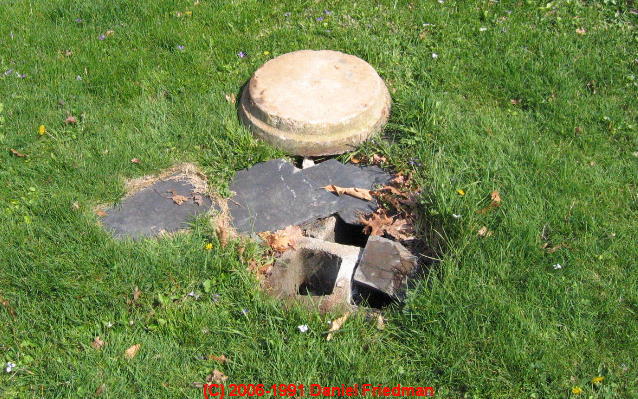
- Septic Tank Cover Safety: here a round tank cover was found over a collapsing home-made collection of concrete blocks
which had been stacked by the owner to form a septic tank access well.
There was a dangerous collapse risk forming a fatal hazard because the masonry blocks were askew and loose, and because the tank opening into was larger than the cover.
We covered the area with plywood, roped it off, and told the occupants and owner of this condition immediately orally and also in writing.
Procedure for Opening the Septic Tank Pumping Access Port
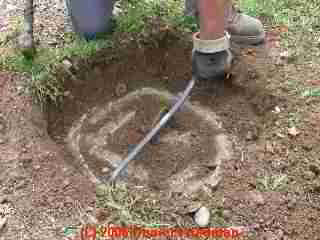
The septic tank should be cleaned from a cleanout port - usually located in the center of the tank.
Pumping the septic tank through a small access opening such as over the intake or outlet baffle does not provide enough space to adequately reach and remove sludge from the septic tank bottom, and it risks future clogging of the tank inlet or outlet by incompletely-removed floating scum.
In this example we knew from prior work, the measurements to the exact location of the septic tank cleanout cover.
The photo shows the septic tank cleanout port which we found and excavated to prepare for opening the septic tank. The cover is about to be removed using a wrecking bar.
Note that we excavated far enough back from the tank opening itself that when we remove the cover we won't have a lot of dirt falling into the septic tank.
Reader Comments, Questions & Answers About The Article Above
Below you will find questions and answers previously posted on this page at its page bottom reader comment box.
Reader Q&A - also see RECOMMENDED ARTICLES & FAQs
On 2021-02-27 - by (mod) -
@Ron,
A properly constructed concrete septic tank lid includes both access openings and cast in iron loops to which a hoist can be connected. However if your septic tank cover does not include those points of purchase for lifting you will need a flat bar and a larger wrecking bar to pry up the excavated lid from the septic Tank sufficient that you can put a chain around the lid probably 2 Chainz, to lift the lid with a hoist and tripod mechanism or you will use an on-site motorized hoist
On 2021-02-27 by Ron
The best to tool cement 57 1/2 x 27/4 pulling up septic tank top
On 2021-02-24 - by (mod) -
@Phil, what you describe is certainly technically possible but it might be less expensive and more sensible to Simply replace the entire lid of the septic tank with one that has the correct openings for Access covers. That's because simply sewing a round hole doesn't guarantee me that I'm making a hole through which the lid cannot be dropped. Typically those are either holes with sloped sides or holes with a lip or Edge
On 2021-02-24 by Phil
My concrete septic tank does not have manholes or openings for pumping out and was installed back in 1979 when the house was built. The tank measures 6' x 12' and I'm not sure of the depth. Is it possible to cut two 20"/24" diameter manholes with a concrete saw and then install risers with a lid?
On 2020-03-28 - by (mod) -
Darn-it.
Can you post a photo of the tank top?
Is it concrete? Usually the concrete top is tapered; it may be just stuck with effloresent salts and crud.
If while using a chain hoist or a section of horizontal lumber propped over the tank lid, supported one end by a post and the other by a hydraulic jack, neverthelss the lid remains stuck and you're breaking a good 4x4 thenb I suspect just pulling isn't going to work.
It's even possible that someone, trying to seal the tank lid against ground water leakage, oozed some silicone or maybe butyl sealant around the lid edges when it was last installed: that'd stop leaks but makes a heck of a job for the next person needing to open the tank.
However you can usually loosen the stuck septic tank top by some thoughful hammering with a SMALL sledge, with CARE so as not to break open the top of the tank.
Try tapping around the edges of the cover a few times. Wear goggles so you don't get infected debris in your eyes. For me this has worked pretty much always.
On a rare occasion I've seen septic pumpers have to break off a section of the lid and pry it out with a wrecking bar and more-rarely I've seen some heavy handed blokes break the lid and of course drop it into the tank, requiring a new tank lid.
If your septic tank lid isn't close to ground surface, I'd consider installing a septic tank riser, sealed to the tank top, and a new secure cover atop the riser.
Watch out: falling into a septic tank is usually quickly fatal.
Never work alone.
On 2020-03-28 by Doug
I have tried to get the top off of my septic tank to get pumped. I have set up 2 oak 4x4 over the top of the lifting ring. Chained them to the top and used a 2 ton hydraulic jack to pull straight up. All I have done 3 times is break those 4x4. Kid has not moved.
Any suggestions? The is Doug
On 2019-10-24 - by (mod) -
A septic tank pumping company can remove plastic bags along with small rocks as well as of course the solids scum and sludge in your tank.
On 2019-10-23 0 by Pamela Orosco
someone threw plastic grocery bags in the septic tank. how do i get them out
On 2019-08-20 - by (mod) -
Gerard
A plastic bag as a sewer line cap doesn't sound right to me - not durable, wrong material if a cap is needed, and if it's a vent not an access pipe then the vent needs to be open to the atmosphere and screened against animal entry.
On 2019-08-20 by Gerard Ventre
After having the septic tank pumped out, does it make sense to put a plastic bag over the top opening of the tank? What purpose does it serve?
On 2019-08-20 by (mod) - A plastic bag as a sewer line cap
Gerard
A plastic bag as a sewer line cap doesn't sound right to me - not durable, wrong material if a cap is needed, and if it's a vent not an access pipe then the vent needs to be open to the atmosphere and screened against animal entry.
On 2019-08-20 by Gerard Ventre
After having the septic tank pumped out, does it make sense to put a plastic bag over the top opening of the tank? What purpose does it serve?
On 2018-01-31 by (mod) - In order to pump out the tank they made a hole in it .how do I fix it
John,
This sounds a bit strange to me. A normal septic tank has clean out access covers at the right location. So I really don't understand what kind of tank you have. it may be that something as simple as heavy flat piece of concrete or stone will suffice or not.
Watch out: We don't want surface water leaking into the tank, and we don't want an unsafe cover that could permit injury or death if someone falls into the tank. frankly I would have expected the contractor who made the hole to be responsible for leaving the system proper and safe.
On 2018-01-30 by John
In order to pump out the tank they made a hole in it .how do I fix it
On 2017-10-10 by (mod) - Where would I purchase septic tank covers?
Maree,
You can find online septic tank vendors, but most practical is to find a nearby septic tank supplier where you live.
On 2017-10-09 by Maree
Where would I purchase septic tank covers?
On 2016-11-24 by (mod) - ok to install septic tank risers?
Tom,
In my opinion what you want to do is perfectly reasonable.
On 2016-11-24 by Tom Roseman
I had brand new house built a few years ago. I had my tanks cleaned last week everything was fine, But he had to dig below ground about 12 inches for two lids . I have three plastic polylok lids the one for the pump is above ground . I am not sure why only that one was slightly above ground level
. I would like to get risers to make all three at about 6 inches below ground level . It will make easier to dig the two tank lids . but a little harder to get at pump if necessary.
What are pro and cons. will the grass at only 6 inches dirt . Any other suggestions. or by some law does the pump cover have to be above ground. Sorry for long post. Thanks for your help.
On 2016-08-15 by (mod) -
Sorry "True Bolt" is not a term I know nor associate with septic tank lids.
On 2016-08-14 by Rene Fire
What tool do I need to open septic with true bolt?
On 2016-05-17 by (mod) -
Not necessarily, Mary as the pumper may be able to access all of the tank bottom from one opening; it depends on tank size and shape; but you might want both openings opened to check the condition of the tank baffles if your pumper can't do that from one end.
On 2016-05-16 by mary@msmartin.com
My septic tank has two openings. Do both have to be opened for a pump out?
Question: cannot find the manhole cover of the septic tank
(Aug 8, 2014) vicki levin said:
We've found the cesspool concrete lid (about 12 foot diameter) but after digging a 2 foot circumference, we cannot find the manhole cover in order to have an inspection. Help? My guy is getting frustrated with digging!
Reply:
IF it's actually a cesspool, not a septic tank, and it's round, usually the access lid would be in the center.
Question: how do i remove septic tank lid that is stuck
(Oct 5, 2014) Anonymous said:
how do i remove septic tank lid that is stuck down 1 inch below surface of tank.
Reply:
Anon:
WATCH OUT: if indeed the septic tank cover, lid or access opening has partly caved into or sunken into the tank then the situation is very dangerous - an unsafe cover means someone could fall into the tank - which is usually quickly fatal.
Keep people away from the septic tank area until you've had the tank inspected and opened for further inspection by an expert.
Actually if the hooks or handles intended to permit septic tank lid removal have broken away or were omitted, removing the lid may require using a pry bar or wrecking bar, even a small portable winch (not ususally) or other equipment depending on the tank material and condition.
...
Continue reading at INSPECT the SEPTIC TANK BEFORE PUMPING or select a topic from the closely-related articles below, or see the complete ARTICLE INDEX.
Or see these
Septic Pumping Procedure & Pumper Truck Operation Articles
- SEPTIC TANK INSPECTION PROCEDURE
- SEPTIC TANK PUMPING MISTAKES
- SEPTIC TANK PUMPING PROCEDURE
- CLEANING SEPTIC TANKS
- WHEN to CLEAN THE SEPTIC TANK
- WHEN NOT TO PUMP A SEPTIC TANK
- FIND the SEPTIC TANK, HOW TO
- HOW TO OPEN a SEPTIC TANK
- INSPECT the SEPTIC TANK BEFORE PUMPING
- SEPTIC TANK INSPECTION PROCEDURE
- SEPTIC TANK LEVELS of SEWAGE
- PUMPER TRUCK OPERATION PROCEDURE
- PUMPING the SEPTIC TANK
- RECORD SEPTIC TANK LOCATION
- SEPTIC PUMPING CONCLUSIONS
- SEPTIC TANK PUMPING SCHEDULE
- SEPTIC TANK SAFETY
Suggested citation for this web page
HOW TO OPEN a SEPTIC TANK at InspectApedia.com - online encyclopedia of building & environmental inspection, testing, diagnosis, repair, & problem prevention advice.
Or see this
INDEX to RELATED ARTICLES: ARTICLE INDEX to SEPTIC SYSTEMS
Or use the SEARCH BOX found below to Ask a Question or Search InspectApedia
Ask a Question or Search InspectApedia
Try the search box just below, or if you prefer, post a question or comment in the Comments box below and we will respond promptly.
Search the InspectApedia website
Note: appearance of your Comment below may be delayed: if your comment contains an image, photograph, web link, or text that looks to the software as if it might be a web link, your posting will appear after it has been approved by a moderator. Apologies for the delay.
Only one image can be added per comment but you can post as many comments, and therefore images, as you like.
You will not receive a notification when a response to your question has been posted.
Please bookmark this page to make it easy for you to check back for our response.
Our Comment Box is provided by Countable Web Productions countable.ca
Citations & References
In addition to any citations in the article above, a full list is available on request.
- New York State Department of Health, APPENDIX 75-A WASTEWATER TREATMENT STANDARDS - INDIVIDUAL HOUSEHOLD SYSTEMS , [PDF] New York State Department of Health, 3 February 2010, retrieved 3/1/2010, original source: https://www.health.ny.gov/regulations/nycrr/title_10/part_75/appendix_75-a.htm
- Special thanks to M & O Sanitation, Dutchess County NY (845) 471-0308 for permitting us to photograph steps during septic system service at our demonstration property.
- Onsite Wastewater Treatment Systems, Bennette D. Burks, Mary Margaret Minnis, Hogarth House 1994 - one of the best septic system books around, suffering a bit from small fonts and a weak index. While it contains some material more technical than needed by homeowners, Burks/Minnis book on onsite wastewater treatment systems a very useful reference for both property owners and septic system designers.
- Wells and Septic System, Alth, Max and Charlet, Rev. by S. Blackwell Duncan, $ 18.95; Tab Books 1992. We have found this text very useful for conventional well and septic systems design and maintenance --DF. Quoting an Amazon description:Here's all the information you need to build a well or septic system yourself - and save a lot of time, money, and frustration. S. Blackwell Duncan has thoroughly revised and updated this second edition of Wells and Septic Systems to conform to current codes and requirements. He also has expanded this national bestseller to include new material on well and septic installation, water storage and distribution, water treatment, ecological considerations, and septic systems for problem building sites.
- Builder's Guide to Wells and Septic Systems, Woodson, R. Dodge: $ 24.95; MCGRAW HILL B; TP; Quoting from Amazon's description: For the homebuilder, one mistake in estimating or installing wells and septic systems can cost thousands of dollars. This comprehensive guide filled with case studies can prevent that. Master plumber R. Dodge Woodson packs this reader-friendly guide with guidance and information, including details on new techniques and materials that can economize and expedite jobs and advice on how to avoid mistakes in both estimating and construction. Chapters cover virtually every aspect of wells and septic systems, including on-site evaluations; site limitations; bidding; soil studies, septic designs, and code-related issues; drilled and dug wells, gravel and pipe, chamber-type, and gravity septic systems; pump stations; common problems with well installation; and remedies for poor septic situations. Woodson also discusses ways to increase profits by avoiding cost overruns.
- In addition to citations & references found in this article, see the research citations given at the end of the related articles found at our suggested
CONTINUE READING or RECOMMENDED ARTICLES.
- Carson, Dunlop & Associates Ltd., 120 Carlton Street Suite 407, Toronto ON M5A 4K2. Tel: (416) 964-9415 1-800-268-7070 Email: info@carsondunlop.com. Alan Carson is a past president of ASHI, the American Society of Home Inspectors.
Thanks to Alan Carson and Bob Dunlop, for permission for InspectAPedia to use text excerpts from The HOME REFERENCE BOOK - the Encyclopedia of Homes and to use illustrations from The ILLUSTRATED HOME .
Carson Dunlop Associates provides extensive home inspection education and report writing material. In gratitude we provide links to tsome Carson Dunlop Associates products and services.
 | HOME | ABOUT | ASK a QUESTION | CONTACT | CONTENT USE POLICY | DESCRIPTION | POLICIES | PRIVACY | |
| © 2024 - 1985 Publisher InspectApedia.com - Daniel Friedman | |||||||||