
InspectAPedia® FREE Encyclopedia of Building & Environmental Construction, Diagnosis, Maintenance & Repair |
Question? Just ask us! InspectAPedia
|
 Types of Septic Systems & Septic Designs
List of septic designs for various sites & conditions
- POST a QUESTION or COMMENT about the different types of septic systems, onsite wastewater disposal systems used for private onsite wastewater and graywater treatment & disposal
Types of septic systems: onsite waste disposal system types.
This septic system design reference lists and describes all of the types of septic systems, including both conventional septic tank and drainfield systems and alternative septic system designs for difficult building sites such as wet sites, steep sites, rocky sites, limited space, bad soils with no percolation or sandy soils with too fast percolation, and other difficult site conditions.
We provide detailed articles about each alternative septic system design choice, listing its features, design requirements, inspection details, maintenance needs, product sources.
We include links to septic design engineers, advanced septic system products and septic design books and building codes. This document is a chapter provides in our Septic Systems Online Book.
InspectAPedia tolerates no conflicts of interest. We have no relationship with advertisers, products, or services discussed at this website.
Definitions of Septic System Types & Onsite Wastewater Treatment Alternative Designs
 Daniel Friedman, Massachusetts Title 5 Licensed Septic System Inspector, & New York State H.I. License # 16000005303 (inception to 2008).
This document catalogs conventional and alternative septic system designs and provides links to detailed descriptions of these designs for onsite wastewater treatment.
"Septic System Alternative Designs" refers to any onsite wastewater disposal method other than the widely used conventional septic tank and leach field. In the U.S. most states require that an "alternative septic system" be designed by a professional and submitted to the local health department for approval.
Examples of advanced septic designs include aerobic septic systems, chemical, composting, incinerating & waterless toilets, evaporation-transpiration (ET) septic systems, septic media filters, greywater systems, holding tank septic systems, mound septics, raised bed septics, pressure dosing septic systems, sand bed filters, peat beds, constructed wetlands, wastewater lagoons, constructed wetlands, and septic disinfection systems.
Each of the links below presents a document with more in-depth information about each of these alternative septic system designs.
Septic Tank Types
Septic tanks are responsible for retaining solid waste in a residential onsite wastewater treatment system (septic system), and for partial treatment of sewage and septic effluent to improve its sanitation.
In a typical conventional septic tank waste water is treated to about 40% of total treatment required before discharge to the environment.
The remaining effluent treatment normally occurs in the soils around and under the drainfield or absorption system. Some more advanced or alternative-design private septic systems achieve much higher levels of treatment by oxygenation (aerobic septic systems), chemical treatment (disinfection systems), or other methods.
See SEPTIC SYSTEM DESIGN ALTERNATIVES.
Septic tanks of Single vs. Multiple Compartments
More septic tank compartments means that solid waste (floating scum, settled sludge) are better-separated from septic effluent before it is discharged to a drainfield.
Below we illustrate single compartment (below left) and two-compartment (below right) septic tank designs. Image source: USDA.
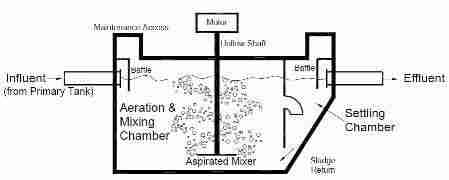
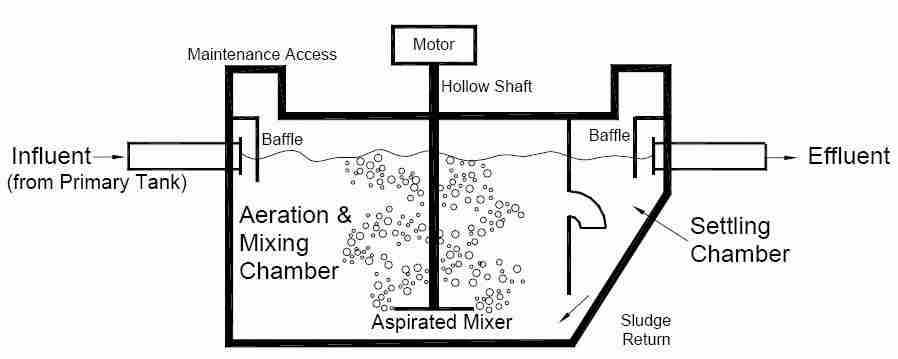
Advanced treatment septic tanks may use more compartments, including a final pumping chamber, as well as other features such as aerobic systems (shown at the top of this page), media filters, or effluent filters that both improve the level of wastewater treatment and also improve the life expectancy of the absorption field or drainfield.
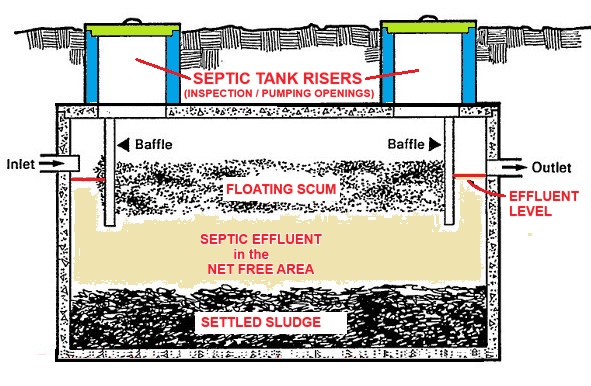
You may also notice that our septic tank shown above has inlet and outlet baffles constructed of concrete while the septic tank below shows an inlet baffle constructed using plastic pipe - a common repair method if septic tank baffles are damaged.
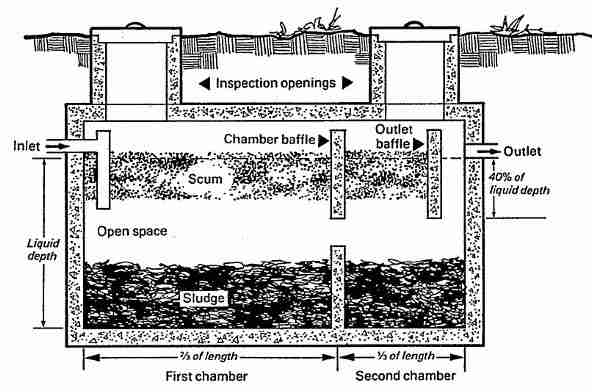
...
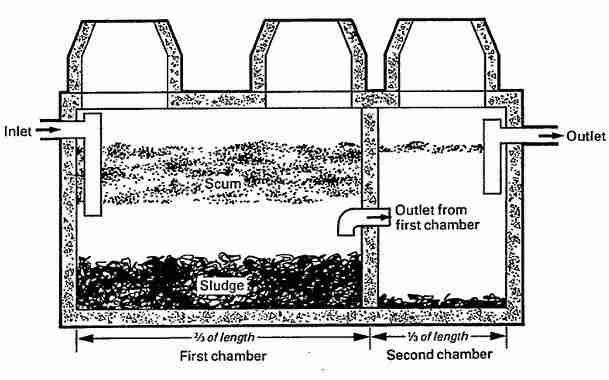
This USDA sketch of a different two-compartment septic tank design illustrates how additional compartments can help retain solid waste in the septic tank and improve the quality of wastewater discharged to the drainfield or soakaway bed or absorption bed.
Septic Tank Materials & Construction
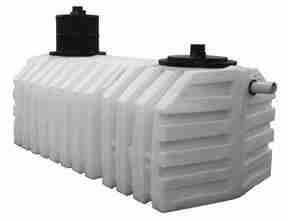
Typical septic tank materials of construction include
- Home-made site-built, using concrete blocks, stone, or even in on occasion wood; often we find such tanks are unsafe, under-sized, and short lived.
See HOME MADE SITE BUILT TANKS. Wood septic tanks should not be used. - Poured concrete, normally reinforced, rectangular, on occasion round.
See CONCRETE SEPTIC TANKS - Steel, round or rectangular, various profiles including low-profile for shallow-depth rocky sites; extra risk of rust-out, leaks, unsafe covers, lost baffles. Depending on soil conditions, a steel septic tank can rust through in as few as five years, and typically last less than 20 years.
See STEEL SEPTIC TANKS - Fiberglass - wide range of sizes and shapes.
See FIBERGLASS / PLASTIC SEPTIC TANKS - Plastic - wide range of sizes & shapes.
See FIBERGLASS / PLASTIC SEPTIC TANKS
Basic septic system designs are discussed in the articles listed just below
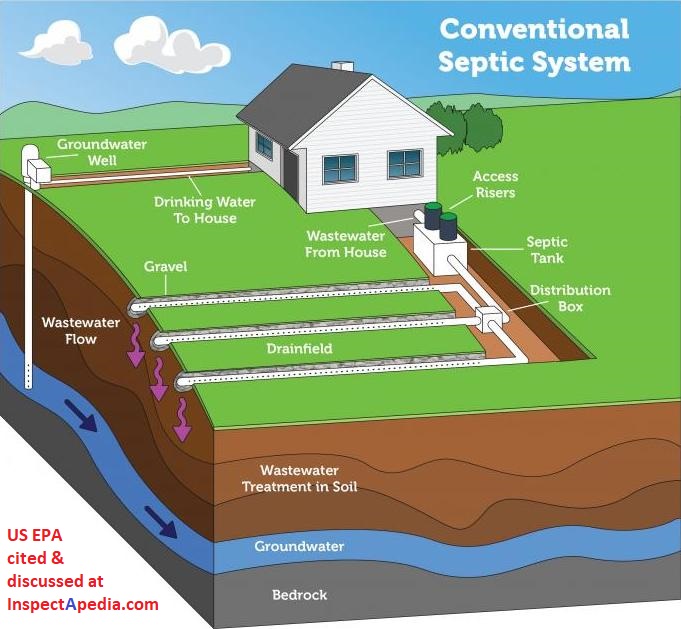 Basic septic tank and drainfield systems are discussed
at SEPTIC SYSTEM DESIGN BASICS.
Image source: - U.S. EPA, Types of Septic Systems, retrieved 2019/04/22 original source: https://www.epa.gov/septic/types-septic-systems
Here are some more detailed articles about basic septic system design, installation, inspection, maintenance, cleaning or pumping, & repair.
- SEPTIC SYSTEM DESIGN MANUAL - Online
- SEPTIC SYSTEM, HOME BUYERS GUIDE
- OUTHOUSES & LATRINES
- ALTERNATIVE & WATERLESS TOILETS
- TOILET TYPES, CONTROLS, PARTS
Alternative or Advanced Septic System Design Types (for Difficult Sites)
- Alternative septic system designs & products, typically used at difficult sites, are
at SEPTIC SYSTEM DESIGN ALTERNATIVES
Definitions of Types of Septic Systems, Toilets, Components
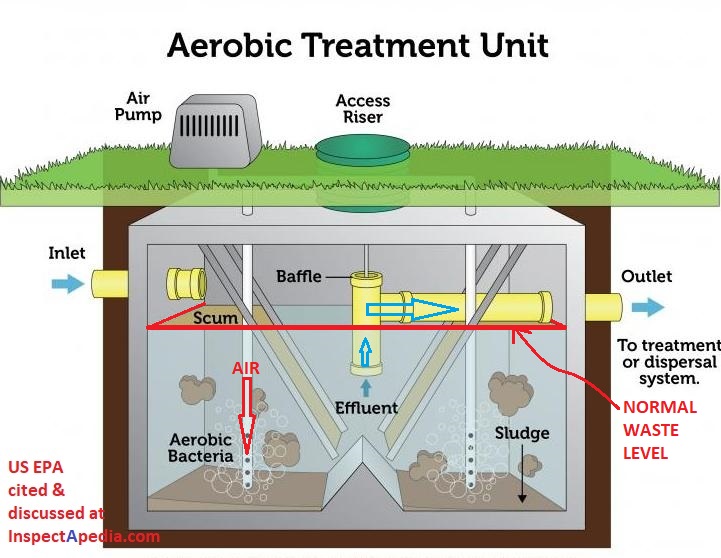
- Aerobic Treatment Septic Systems: in residential use, ATUs are pre-packaged septic treatment systems which are in essence a mini-wastewater
treatment plant for home use.
ATUs are perhaps the most common alternative septic system design besides septic mounds or raised bed septic designs:
Waste is fed into a "trash tank" (similar to a septic tank); effluent moves to a clarifier. Air (oxygen) is pumped through the system to provide oxidation and waste treatment using a variety of designs. - Aerobic septic system treatment units (ATUs) are used at sites where a conventional drain field system cannot be employed, and
are capable of successful wastewater treatment of septage on difficult or "impossible" residential sites.
See AEROBIC TREATMENT SEPTIC SYSTEMS - topic home, where you will find descriptions, manufacturers, design guides, manuals
also AEROBIC SEPTIC SYSTEM DISINFECTION - Use of calcium hypochlorite tablets for aerobic septic systems. (Do not use pool chlorine tablets) - AEROBIC SEPTIC CONTINUOUS FLOW, Suspended Growth -
The activated sludge process is an aerobic suspended-growth process that maintains a relatively high population of microorganisms (biomass) by recycling settled biomass back to the treatment process.
The biomass converts soluble and colloidal biodegradable organic matter and some inorganic compounds into cell mass and metabolic end products.
The biomass is separated from the wastewater through settling in a clarifier for recycling or wasting to sludge handling processes.
Preliminary treatment to remove settleable solids and floatable materials is usually provided by a septic tank or other primary treatment device.
Most onsite designs are capable of providing significant ammonia oxidation and effective removal of organic matter. - CHAMBER SEPTIC SYSTEMS - also called "no-rock"or Gravelless septic systems, use a domed chamber, ofte constructed of PVC, in wide short trenches to provide the septic drainfield or effluent absorption system.
- CHEMICAL TOILETS: use a
chemically treated reservoir located directly below the toilet seat. The chemicals reduce odors and perform partial (incomplete) disinfection of the waste.
Chemical toilets have limited storage capacity and must be pumped and periodically cleaned by a septic company.
Similar to simple chemical toilets but more sophisticated in design are recirculating toilets which separate the waste from the chemical and then re circulate the fluid through the toilet tank.
Also see ALTERNATIVE & WATERLESS TOILETS. - COMPOSTING TOILETS: may be used where the water supply is limited or not available at all, or where a building owner for other reasons wishes to conserve water use. Other wastewater treatment will still be required for handling graywater from sinks and showers.
Also see ALTERNATIVE & WATERLESS TOILETS for details.
Also see VERMICULTURE - WORM SEPTIC SYSTEMS where we include a discussion of worm-based composting toilets & septic systems
- DISINFECTION SEPTIC SYSTEMS: use chlorination or ultraviolet light (UV) to disinfect wastewater effluent before it is discharged to the environment.
- Dosing Systems, Pressure or Gravity: Dosing septic systems permit the septic system drain field to rest between effluent doses and, depending on design, may alternate use of drainfield sections.
Two broad types of dosing systems are Gravity-Dosing (effluent flows from an effluent tank to the absorption system by gravity) or Pressure-Dosing (effluent is pumped from a dosing chamber to the absorption field).
See GRAVITY DOSING SEPTIC SYSTEMS
and PRESSURE-DOSED DRAINFIELD SEPTIC SYSTEMS for details. - Drainfields: a generic term for septic effluent disposal, usually referring to "conventional-design" septic leach fields or septic leaching beds, leach fields, septic gravity trenches, septic leach lines, septic seepage beds or septic system drainaway fields.
See SEPTIC DRAINFIELD SIZE for design specifications for septic drainfields.
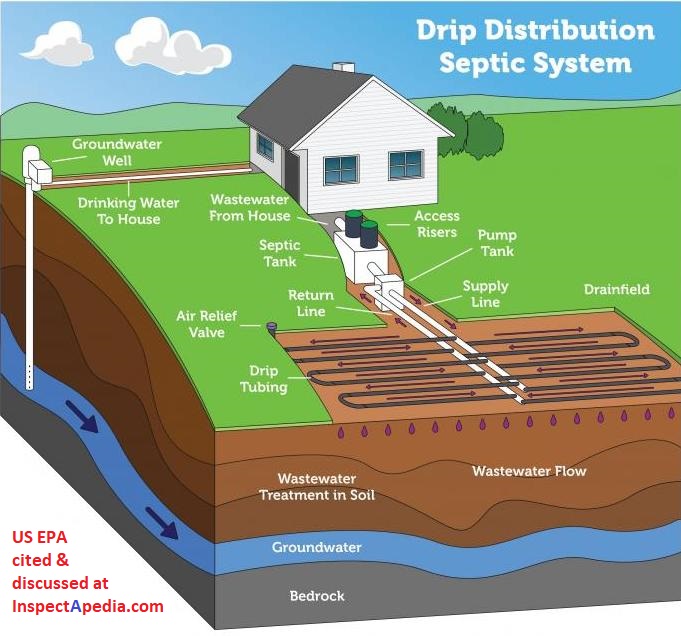
- DRIP DISPERSAL SEPTIC TANK EFFLUENT SYSTEMS - (Jantrania/Gross wastewater system type III or if treated
to level 2 or better effluent, Jantrania/Gross wastewater system type VII).
Septic effluent is distributed to the soil by a drip system that flows by gravity from through a series of perforated pipes or porous piping material. Note that effluent may enter the drip system from a pump and pumping chamber however. - DISINFECTION SYSTEMS, SEPTIC EFFLUENT for septic system designs. The process of disinfection destroys pathogenic and other microorganisms in wastewater.
A number of important waterborne pathogens are found in the United States, including some bacteria species, protozoan cysts, and viruses. All pretreatment processes used in onsite wastewater management remove some pathogens, but data are scant on the magnitude of this destruction.
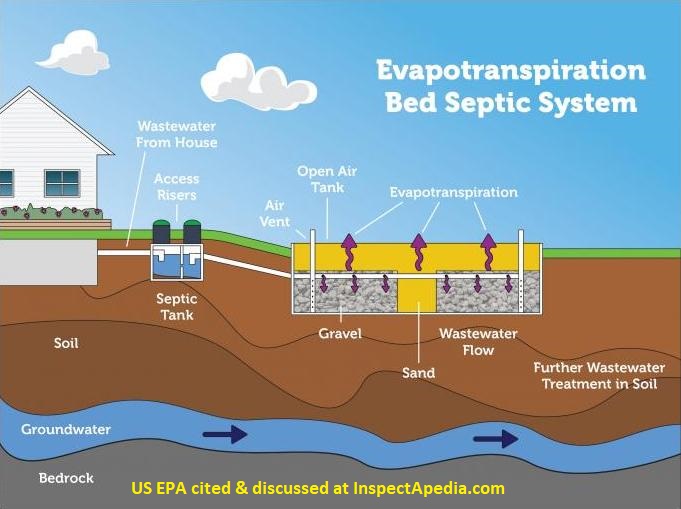
- EVAPORATION-TRANSPIRATION (ET) Septic Systems: and Evapo-Transpiration Absorption Septic Systems (ETA) dispose of septic effluent from the septic tank by providing
a surface area intended to allow the effluent to evaporate.
ET systems depend entirely on evaporation while ETA systems make use of both evaporation and (limited) soil absorption of septic effluent. (Jantrania/Gross wastewater system type IX if effluent is treated to level 2 or better).
ET beds may be used with or without intermediate storage tanks and with or without effluent recycling systems. In this discussion of evaporation/transpiration septic systems we include the
advanced Tafgard SOIL BASED WASTEWATER TREATMENT SYSTEMS - developed in Japan by Taisei Kogyo Co., Ltd., this system uses a combination of a five-chamber waste treating septic tank designed by Taisei, effluent disposed-of by an evaporation-transpiration system through aer - ated soil (effluent spread horizontally and upwards from distribution piping).
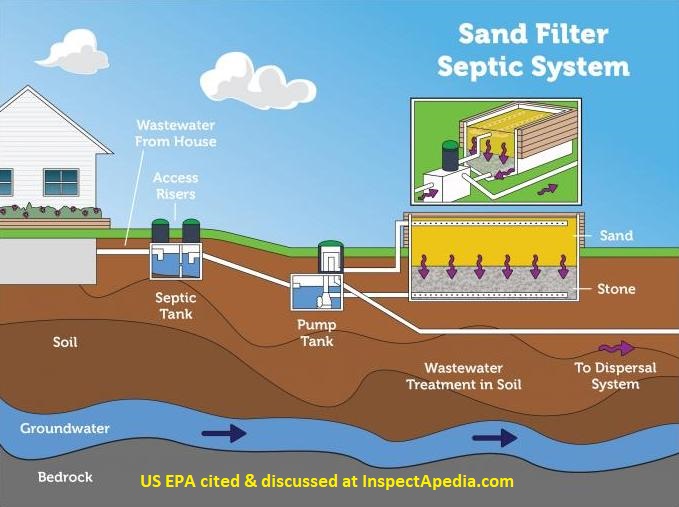
- Filter bed effluent treatment septic systems (if treated to level 2 effluent or better, Jantrania/Gross wastewater system type VIII) - see various filter media types listed here such as sand beds, fabric filters, etc.
Filter bed septic designs may be
MOUND SEPTIC SYSTEMS - shown above
RAISED BED septic systems,
MEDIA FILTER septic systems, septic systems or
SAND BED filter septic systems.
Readers should distinguish between types of septic filter beds (listed above) and other septic filter products such as
FILTERS SEPTIC & GREYWATER used at or in the septic tank or seepage pit are a simpler device installed at the effluent outlet tee or baffle. - FIXED-FILM PROCESSOR septic system designs (FFS) are biological treatment processes that employ a medium such as rock, plastic, wood, or other natural or synthetic solid material that will support biomass on its surface and within its porous structure.
At least two types of fixed-film systems may be considered--those in which the medium is held in place and is stationary relative to fluid flow (trickling filter) and those in which the medium is in motion relative to the wastewater (e.g., rotating biological disk).
A third classification includes dual-process systems that encompass both fixed and suspended biomass together or in series. This approach is covered in Fact Sheet No. 1 on continuous-flow suspended-growth aerobic systems (CFSGAS).
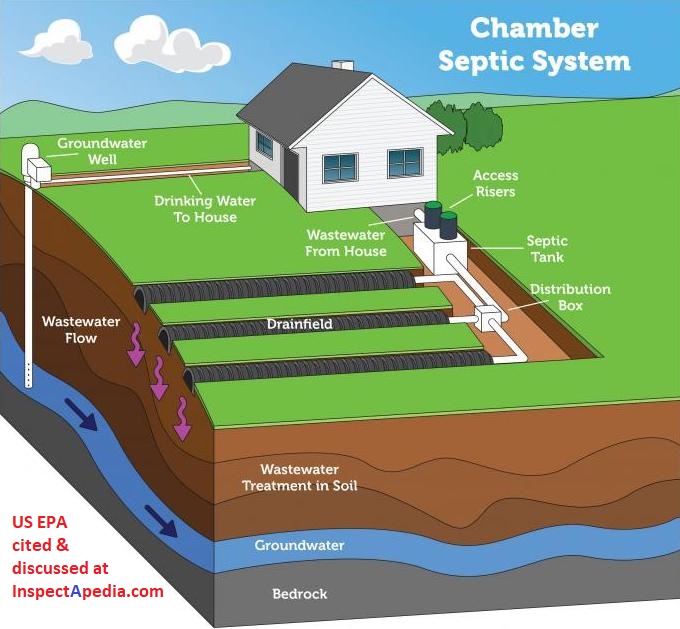
- GRAVELLESS SEPTIC SYSTEMS or "no rock" or "chamber" systems are not a complete alternative onsite wastewater design. Rather these are special products using geotextiles,
plastic chambers, or polystyrene-wrapped perforated piping for effluent disposal into the soil, providing alternatives to conventional gravel-trench drainfields.
In some cases these systems might permit design of an acceptable effluent disposal system where a site too little space for a conventional drainfield, or where gravel is unavailable or is very expensive. Some gravelless systems are accepted for use in areas with difficult or low-perc soils. - GREYWATER SYSTEMS: refer to systems which reduce the liquid effluent load on a septic system by separating greywater (or graywater) from sinks and showers from
blackwater (black water) from toilets. When we inspect a home which uses a separate drywell to handle greywater we presume that the owners discovered that their septic system, or at least its leach field, was of limited capacity
or life.
Also see ALTERNATIVE & WATERLESS TOILETS. - GRAVITY or SIPHON DOSING SEPTIC SYSTEMS:
move septic effluent from the septic tank to a final effluent treatment/dispersal/disposal system such as a drainfield by accumulating septic effluent in a dosing tank or chamber and
periodically sending the "dose" of effluent to the drainfield.
To move effluent from the dosing tank to the drainfield a "gravity" dosing system uses a mechanical device such as a bell siphon system, tipping tank, or float valve to determine when the dosing tank is full and ready to send effluent to the drainfield at intermittent frequencies or in "doses".
Effluent flows from the dosing tank to the drainfield by gravity. Gravity/siphon dosing systems usually require a larger effluent holding tank or chamber than pressure dosing systems.
While some gravity dosing systems do not require electricity to operate, other "gravity" dosing system designs which place the dosing tank uphill and distant from the septic tank, can require an effluent pump to move wastewater from the septic tank to the remote dosing chamber/tank.
Dosing systems permit the drain field to rest between doses and, depending on design, may alternate use of drainfield sections. - GRAVITY TRENCH SEPTIC SYSTEMS is a generic term to describe distribution of septic effluent into a treatment and dispersal/disposal
system using perforated pipes buried in gravel-filled trenches dug into the soil.
An example is the conventional septic drainfield but gravity trenches can be used in other designs such as with gravity or pressure dosing systems.
Gravity trench effluent systems may also be designed for "level 2 or better" effluent treatment (Jantrania/Gross wastewater system type V). Septic gravity trenches and their design specifications are discussed in detail
at SEPTIC DRAINFIELD SIZE. - Greenhouse treatment of septic effluent to level 3 or better (Jantrania/Gross wastewater system type XI). Greenhouses, like ET beds, may be used with or without storage tanks and effluent recycling systems. The system uses an
enclosed "greenhouse" constructed around plants and a mini "constructed wetlands" to treat effluent.
Greenhouse wastewater treatment systems permit maintaining the treatment system at a higher temperature than otherwise might be possible, such as in a cold or cool climate area.
Also see Constructed and Natural
WETLAND SEPTIC SYSTEMS
and
also LAGOON SEPTIC SYSTEMS - HOLDING TANK SEPTIC SYSTEMS: use a sealed tank to hold household waste and wastewater until the tank can be pumped out by a septic pumping company.
Most jurisdictions do not permit septic holding tanks as a permanent wastewater handling method for full-time occupied residences, but holding tanks may be permitted during new home construction and in other special cases.
In New York State we've seen holding tank systems in use on small-lot properties located along the Hudson River. Generally such systems will not be acceptable for full time occupied residences as even a large tank of several thousand gallons will require frequent and costly pumping and disposal. - INCINERATOR TOILET SYSTEMS: incinerating toilets use electricity or gas to burn the waste placed into these systems.
Like chemical toilets and holding tanks they have limited capacity, are used where water is not available or must be conserved, and they do not address the handling of remaining graywater from sinks and showers.
My favorite of this type was the "Destroylet" incinerator toilet which was electric/propane fueled and which is no longer on the market. Each flush resulted in a more than 10-minute burn cycle which produced a pretty smelly exhaust.
See ALTERNATIVE & WATERLESS TOILETS for details about all types of waterless toilet systems. - Inspection and Testing of septic systems is discussed at
SEPTIC DYE TEST PROCEDURE
and at
SEPTIC FAILURE SIGNS - LAGOON SEPTIC SYSTEMS: also known as "pond systems" for onsite wastewater treatment are less often found in use for
single family residential wastewater treatment. A residential lagoon system may use a conventional septic tank, but effluent from the tank flows to a storage pond or lagoon for further treatment.
Lagoon systems require comparatively large land areas and are more likely to be found therefore in rural areas or where a common wastewater treatment system has been designed to serve multiple dwellings. Also
see CONSTRUCTED WETLAND SEPTIC SYSTEMS - LATRINES, Latrine or simple trench systems, useful in remote and impoverished areas to improve sanitation and thus the quality of drinking water and other special, extremely low-cost waste handling, wastewater treatment systems are ignored by most modern texts on onsite wastewater treatment, excepting perhaps military manuals which address field toilets and sanitation for military operations. This topic needs considerably more attention as a step in assisting rural, poor
areas in developing nations.
Articles, illustrations, and text contributions are wanted; additions to this special topic will be provided as they are developed at this website. Inadequate disposal and treatment of human and animal waste in poor areas is a major cause of dysentery and often high infant and child mortality.
Meanwhile see the helpful but inadequate resource sketches at http://www.africanwater.org/ecosan_main.htm"the African Water Page and Ecological Sanitation" and http://peacecorps.mtu.edu/erda/links.htm a peace corps site on composting latrines - LOW COST SEPTIC SYSTEMS - suggestions for improving sanitation when a home has no septic tank and no septic system and where money is scarce.
- MEDIA FILTER SEPTIC SYSTEMS: use a conventional septic
tank followed by any of several methods to further filter and treat septic effluent before it is discharged to the soil, soil surface, or waterway. Treatment is by both actual filtration and ultimately by a biochemical process as the
filter "matures" and includes its own biomass.
Both natural media filter septic systems (such as sand, gravel, or peat) and synthetic media filter septic systems (foam cubes, glass, slag) are used. See these septic media filter design articles- BAT MEDIA SEPTIC PLANTS - Biologically Accelerated Treatment septic system designs - BAT systems - aka "Best Available Treatment" or "Best Available Technology" in other septic design documents.
- DOSING CONTROL for SEPTIC MEDIA SYSTEMS
- FOAM CUBE SEPTIC MEDIA FILTERS
- PEAT SEPTIC MEDIA FILTERS
- POD SEPTIC SYSTEMS
- RUCK® SEPTIC MEDIA FILTER SYSTEMS
- SAND FILTER SEPTIC DESIGN SPECIFICATIONS
- SAND SEPTIC MEDIA FILTERS
- SANDY SOIL SEPTIC DESIGNS
- SEPTIC MEDIA FILTER CAPACITY & MAINTENANCE
- SEPTIC MEDIA FILTER SOURCE LIST
- SEPTIC MEDIA FILTER SYSTEM OPERATION
- SINGLE PASS vs RECIRCULATING SEPTIC MEDIA FILTER DESIGNS
- TEXTILE SEPTIC MEDIA FILTERS
- TYPES of SEPTIC MEDIA FILTER MATERIALS
- VERMICULTURE - WORM SEPTIC SYSTEMS
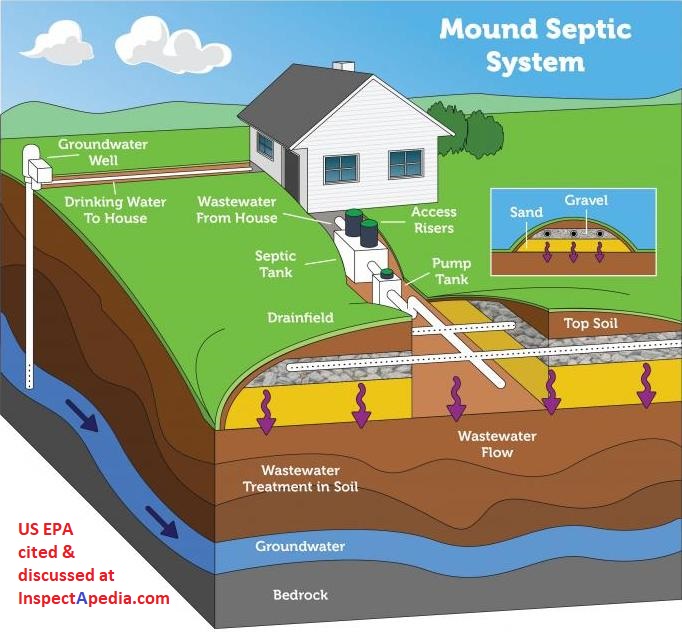
- MOUND SEPTIC SYSTEMS:
a wastewater absorption trench system which has been constructed using "suitable soil-fill material" which has been placed on top of the natural soil on a building lot.
Mound systems are often confused with "raised systems" (see below) but have different design requirements, are generally smaller in total size, and depend on the fill material for successful wastewater treatment.
Also see "Raised Bed Septic Systems" in this list. - Natural Septic Systems - see WETLAND SEPTIC SYSTEMS
- OUTHOUSES & LATRINES -
Outhouses, or latrines or simple trench systems, useful in remote and impoverished areas to improve sanitation and thus the quality of drinking water and other special, extremely low-cost waste handling, wastewater treatment systems are ignored by most modern texts on onsite wastewater treatment, excepting perhaps military manuals which address field toilets and sanitation for military operations.
This topic needs considerably more attention as a step in assisting rural, poor areas in developing nations.
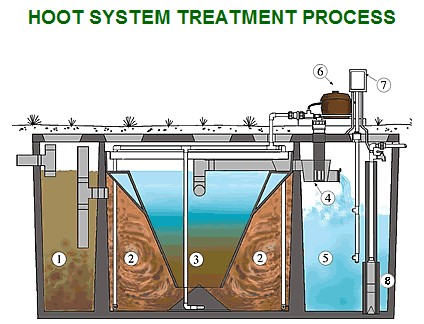
- SEWAGE TREATMENT PLANTS, RESIDENTIAL - Cluster & Packaged Septic Systems: Onsite Residential and Small Commercial Septic Systems.
Illustration: A Hoot septic system described and cited in the article link given just above. [Click to enlarge any image]
Cluster and package centralilzed wastewater treatment systems can handle both clulsters of buildings (more cost-efficient and more-likely to work than many small septic systems in densely populated areas), and in smaller designs, packaged septic treatment systems can support individual buildings or private homes.
These complete packaged onsite wastewater treatment systems can produce sufficiently cleaned and treated wastewater that these systems may be permitted where local regulations would not permit a conventional septic tank and absorption field.
For an example see HOOT AEROBIC SEPTIC TROUBLESHOOTING
- PEAT FILTERED SEPTIC SYSTEMS:
Septic effluent treatment systems using peat as the filter media include an effluent dosing system,
peat filter media, and a drainage system. Unlike sand bed filters, peat filtration systems are sold as
prepackaged systems which provide modular peat units enclosed in containers or "pods" ready to install.
Also see MEDIA FILTER SEPTIC SYSTEMS - POD SEPTIC SYSTEMS: Septic Filter Pods or FILTERPODs: Septic filter pods are small individual septic wastewater treatment units that typically are made up of a settlement section and a filter section. These may be comprised of two physically separate tanks or they may be combined in one physical unit.
- PRESSURE-DOSED DRAINFIELD SEPTIC SYSTEMS: pressure dosing systems use a separate dosing chamber and pump, located downstream from the septic tank, to move effluent into a drainfield which
in turn distributes effluent through a pressure-fed network of distribution pipes. (Jantrania/Gross wastewater system type II or if treated to level 2 or better effluent, system type VI)
Pressure dosing is used in a variety of disposal field designs including mounds and sand beds, and have the advantage of being able to distribute effluent uniformly throughout the absorption system, and the disadvantage of added system cost and complexity, along with the requirement for electricity for system operation.
An alternative but possibly less long-term reliable version of a drainfield dosing system that may not require electricity is the siphon system.
Also see DOSING SYSTEM SEPTICS, GRAVITY/SIPHON - RAISED BED SEPTIC SYSTEMS: a wastewater absorption trench system which has been constructed in soil-fill material which has been placed
on top of the natural soil on a building lot.
Raised systems are often confused with "mound systems" (see below) but have different design requirements, and make at least partial use of existing soils for wastewater treatment. Also see "Mound Systems" above. - SAND BED or SAND FILTER SEPTIC SYTEMS: also referred to as an Intermittent Sand Filter Septic System: wastewater effluent from the septic tank is intermittently distributed over the surface of a specially prepared
bed of sand placed atop the existing soil surface.
Effluent which has passed through the sand is collected by additional pipes at the bottom of the sand bed.
The sand is not visible as it's covered by topsoil. - AEROBIC SEPTIC EFFLUENT SPRAY HEAD REPAIR effluent dispersal systems often combined with aerobic septic system designs, treat septic wastewater effluent to level 3 or better (Jantrania/Gross wastewater system type X).
S
eptic spray systems are high-level-of-treatment aerobic septic systems using spray heads to disperse effluent require maintenance that includes occasional spray head cleaning or replacement.
You'll need to identify the brand and model effluent spray head on your aerobic septic system in order to replace with the same part in-kind.
Also see ALTERNATIVE DESIGN SEPTIC SYSTEM SUPPLIERS for directory lists of other septic system component suppliers for sources of septic effluent spray system repair parts and sprayers.
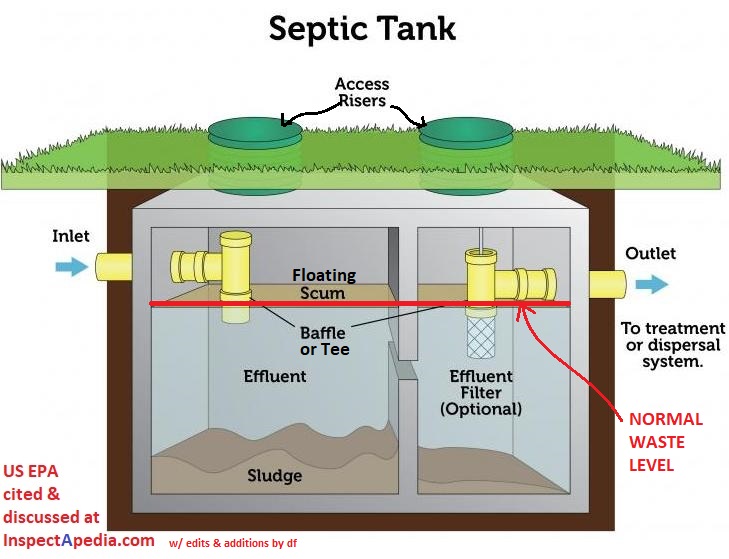
- Septic Tanks: septic tank types are described
at TANK INSPECTION PROCEDUREand include- steel septic tanks,
- concrete septic tanks,
- plastic and
- fiberglass septic tanks, and
- home-made septic tanks that we've found constructed of stone, concrete block, bamboo, brick, and wood.
- SEPTIC TANK & GRAYWATER FILTERS are products used at a septic tank outlet or at a graywater tank inlet or outlet to prevent suspended solids from reaching and
clogging the soil absorption system. Readers should distinguish between in-tank septic or graywater filters
and types of septic media filter and bed systems such as:
MOUND SEPTIC SYSTEMS or
RAISED BEDseptic systems,
MEDIA FILTER septic systems, septic systems
or SAND BED SEPTIC systems.
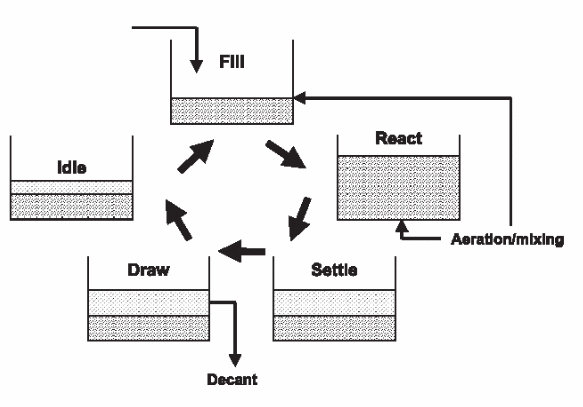
- SEQUENCING BATCH REACTOR SEPTIC SYSTEMS - The sequencing batch reactor (SBR) process is a sequential suspended growth (activated sludge) process in which all major steps occur in the same tank in sequential order (figure 1).
There are two major classifications of SBRs:
the intermittent flow (IF) or "true batch reactor," which employs all the steps described in the illustration above and described in our article (above),
and the continuous flow (CF) system, which does not follow these steps. - STEEP SLOPE SEPTIC SYSTEM DESIGNS - how to install sewer lines from building to septic tank; how to install septic drainfields, leach field systems at steep or sloped sites.
- TOILETS, INSPECT, INSTALL, REPAIR
- Trenches for effluent dispersal, gravity fed or pressure dosed, with gravel or gravelless systems are discussed under conventional septic and drainfield pages, pressure dosing, or gravelless systems. Also see "Gravity Trenches" above.
- VEGETATED SUBMERGED BED SEPTIC SYSTEMS and
other HIGH SPECIFIC SURFACE ANEROBIC REACTOR SEPTIC SYSTEMS - A high-specific-surface anaerobic reactor is any tank or cavity filled with solid media through which wastewater flows with a high hydraulic retention time (HRT).
In onsite treatment the two primary types are vegetated submerged beds (VSBs) and anaerobic upflow filters (AUFs).
The first is characterized by horizontal flow and prolific growth of macrophytes on the surface.
The second comes in a variety of forms from upflow sludge blanket systems and fixed media anaerobic filters to partially fluidized beds of fine media.
Both have long HRTs, produce anaerobic effluents, generally treat either high-strength or minimally pretreated wastewater, and usually require some form of posttreatment to meet surface discharge or water reuse requirements - Wastewater Treatment Systems, Onsite, Packaged:
see SEWAGE TREATMENT PLANTS, RESIDENTIAL
- WATERLESS TOILETS: also see the various toilet types and greywater/graywater links on this
page
such
as CHEMICAL TOILETS, COMPOSTING TOILETS,
and INCINERATOR TOILET SYSTEMS. (Jantrania/Gross wastewater system type IV).
Also see GREYWATER SYSTEMS.
See ALTERNATIVE & WATERLESS TOILETS for details of all of these systems.
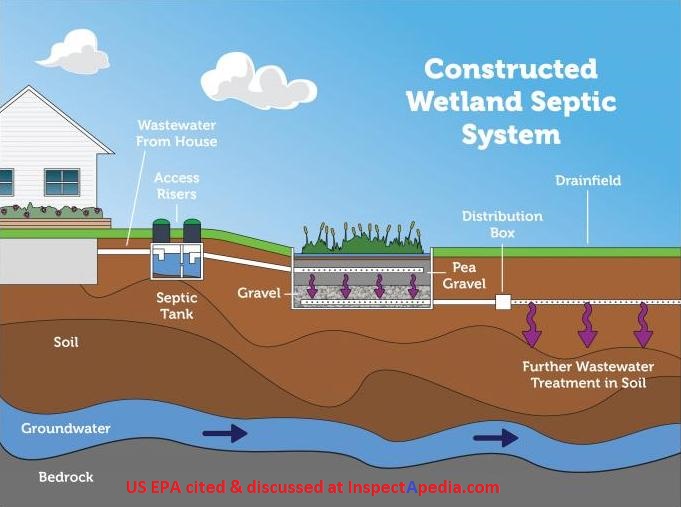
- WETLAND SEPTIC SYSTEMS or "natural" septic
systems use a constructed wetlands area (or a greenhouse) to treat septic effluent.
These systems are more common in Louisiana, Mississippi, Tennessee, South Dakota, and Florida where both municipal wetland septic designs and private homeowner wetland septic system designs are in use
. "Wetlands" may include both visible water such as open ponds, and underground water located in constructed beds which are covered with soil.
Also see LAGOON SEPTIC SYSTEM DESIGNS
Research on Types of Septic Systems - Basic & Alternative Designs
- Advanced Onsite Wastewater Systems Technologies, Anish R. Jantrania, Mark A. Gross. Anish Jantrania, Ph.D., P.E., M.B.A., is a Consulting Engineer, in Mechanicsville VA, 804-550-0389 (2006), Advanced Onsite Wastewater Systems Technologies. Outstanding technical reference especially on alternative septic system design alternatives. Written for designers and engineers, this book is not at all easy going for homeowners but is a text we recommend for professionals--DF.
- New York State Department of Health, APPENDIX 75-A WASTEWATER TREATMENT STANDARDS - INDIVIDUAL HOUSEHOLD SYSTEMS , [PDF] New York State Department of Health, 3 February 2010, retrieved 3/1/2010, original source: https://www.health.ny.gov/regulations/nycrr/title_10/part_75/appendix_75-a.htm
- "International Private Sewage Disposal Code," 1995, BOCA-708-799-2300, ICBO-310-699-0541, SBCCI 205-591-1853, available from those code associations.
- "Manual of Policy, Procedures, and Guidelines for Onsite Sewage Systems," Ontario Reg. 374/81, Part VII of the Environmental Protection Act (Canada), ISBN 0-7743-7303-2, Ministry of the Environment,135 St. Clair Ave. West, Toronto Ontario M4V 1P5 Canada $24. CDN.
- US HEW, MANUAL of SEPTIC TANK PRACTICE [PDF] 1975, U.S. Department of Health, Education and Welfare, Public Health Servicve, original source: https://nepis.epa.gov/
- Manual of Septic Tank Practice, US Public Health Service's 1957, reprinted in 1963, 1967, 1969 and in a 1975 edition given just above.
- Builder's Guide to Wells and Septic Systems, Woodson, R. Dodge: $ 24.95; MCGRAW HILL B; TP;
Quoting from Amazon's description: For the homebuilder, one mistake in estimating or installing wells and septic systems can cost thousands of dollars. This comprehensive guide filled with case studies can prevent that. Master plumber R. Dodge Woodson packs this reader-friendly guide
with guidance and information, including details on new techniques and materials that can economize and expedite jobs and advice on how to avoid mistakes in both estimating and construction.
Chapters cover virtually every aspect of wells and septic systems, including on-site evaluations; site limitations; bidding; soil studies, septic designs, and code-related issues; drilled and dug wells, gravel and pipe, chamber-type, and gravity septic systems; pump stations; common problems with well installation; and remedies for poor septic situations. Woodson also discusses ways to increase profits by avoiding cost overruns. - Country Plumbing: Living with a Septic System, Hartigan, Gerry: $ 9.95; ALAN C HOOD & TP;
Quoting an Amazon reviewer's comment, with which we agree--DF:
This book is informative as far as it goes and might be most useful for someone with an older system. But it was written in the early 1980s.
A lot has changed since then. In particular, the book doesn't cover any of the newer systems that are used more and more nowadays in some parts of the country -- sand mounds, aeration systems, lagoons, etc.
Composting Toilets - Books & References
- COMPOSTING TOILETS - home
- Composting Toilet System Book: A Practical Guide to Choosing, Planning and Maintaining Composting Toilet Systems, David Del Porto, Carol Steinfeld. Quoting an Amazon review:
Del Porto's book is the definitive composting toilet book at this time. There is nothing even close. His book covers all aspects of composting toilet systems and touches on graywater issues as well.
He treats the composting toilet as part of the home system. If a person is seriously interested in installing/having a composting toilet, this book can save him/her all of the mistakes people usually make. He even (carefully) explodes some of the advertising myths that the purveyors of composting toilets would have us believe.
The book covers ready-made systems as well as home built systems. As trite as this sounds, the book truly is a must for someone considering installing composting toilet. - The Humanure Handbook: A Guide to Composting Human Manure, 3rd Ed.,
Joseph C. Jenkins. Quoting part of an Amazon review:
The Humanure Handbook provides a wealth of thoroughly researched, hands-on experience and scientific data that demonstrates that after a natural process called "thermophilic" bacterial digestion, which occurs in a compost bin and where all pathogens are killed, excreta is then converted to a valuable nutrient for agriculture and thereby completing a full-circle life cycle.
Most importantly, effluent can then be kept out of our drinking water and not treated or referred to as an undesirable "waste product".
The information is conveyed in a humorous, folksy, down-to-earth easy to understand style along with drawings, charts, tables, photos and a wealth of resource info for further research. Jenkins' website has a forum for sharing more info, experiences and to answer any and all questions in the process of humanuring and constructed wetland gray water treatment. - Thermal composting of fecal matter as treatment and possible disinfection method--laboratory-scale and pilot-scale studies,
B. Vinneras, A. Bjorklund, H. Jonsson. Quoting Amazon review:
When using toilets where the urine and faeces are collected separately for reuse as nutrients in agriculture, the collected matter should be disinfected. One way to do this is by thermal composting. Composting of different material mixes was investigated in a laboratory-scale experiment. This showed that the best mixture for dry thermal composting was a mix of faeces, food waste and amendment.
The urine was collected separately by use of urine-diverting toilets. A new method was developed to mathematically evaluate and estimate the safety margins of pathogen inactivation during thermal composting.
The method is based upon a mathematical calculation of the number of times total inactivation (at least 12log"1"0 reduction) of the organisms is achieved. In a pilot-scale experiment, the disinfection of a faeces/food waste mix was performed with a calculated safety margin of more than 37 times the total die-off of Enteroviruses and some 550 times that of Ascaris.
Thus, well functioning composting seems to be effective for disinfection of faecal matter. To get a high temperature in all of the material, the reactor has to have sufficient insulation. A major disadvantage is the initial need for handling the raw un-disinfected material. The degradation of the organic matter in the compost was almost 75%, resulting in a small final volume that could safely be recycled. - Experiences with a composting toilet article from: Countryside & Small Stock Journal, available as HTML download.
Quoting Amazon review:
This digital document is an article from Countryside & Small Stock Journal, published by Countryside Publications Ltd. on May 1, 1994. The length of the article is 1516 words. The page length shown above is based on a typical 300-word page. The article is delivered in HTML format and is available in your Amazon.com Digital Locker immediately after purchase. You can view it with any web browser.
From the supplier:
A composting toilet is a good alternative to propane burning toilets, but it also has many problems. The worst part is emptying the waste and compost every 4-6 weeks. Other problems are the fan that must be kept running constantly and bug infestation. - Decentralized Systems Technology Fact Sheet: Septic Tank - Soil Absorption Systems, U.S. EPA, PDF Document provides basic information about septic tanks and drainfields.
Design Manuals for Septic Systems
- US EPA ONSITE WASTEWATER TREATMENT SYSTEMS MANUAL [online copy, free] Top Reference: US EPA's Design Manual for Onsite Wastewater Treatment and Disposal, 1980, available from the US EPA, the US GPO Superintendent of Documents (Pueblo CO), and from the National Small Flows Clearinghouse. Original source
http://www.epa.gov/ORD/NRMRL/Pubs/625R00008/625R00008.htm Onsite wastewater treatment and disposal systems, Richard J Otis, published by the US EPA. Although it's more than 20 years old, this book remains a useful reference for septic system designers. U.S. Environmental Protection Agency, Office of Water Program Operations; Office of Research and Development, Municipal Environmental Research Laboratory; (1980) - Eco John® Innovative Toilet Solutions, Global Inventive Industries, Fountain Valley CA, PDF, product brochure
- "International Private Sewage Disposal Code," 1995, BOCA-708-799-2300, ICBO-310-699-0541, SBCCI 205-591-1853, available from those code associations.
- "Manual of Policy, Procedures, and Guidelines for Onsite Sewage Systems," Ontario Reg. 374/81, Part VII of the Environmental Protection Act (Canada), ISBN 0-7743-7303-2, Ministry of the Environment,135 St. Clair Ave. West, Toronto Ontario M4V 1P5 Canada $24. CDN.
- Manual of Septic Tank Practice, US Public Health Service's 1959.
Greywater System Books
- The New Create an Oasis With Greywater, Art Ludwig; Buy New: $14.25.
Ludwig is one of the most thoughtful, prolific, and sometimes controversial writers on gray water systems and alternative designs.
We recommend his book as clear, easy-to-understand writing aimed at property owners who want or need to consider a graywater installation to conserve water, recycle water, reduce water use, or to reduce the load on their septic system. This is the latest edition of this Art Ludwig's greywater design book classic. - Builder's Greywater Guide, Art Ludwig; Buy New: $10.17. Installation of Greywater Systems in New Construction & Remodeling; A Supplement to the Book "Create an Oasis With Greywater" (Paperback).
Quoting a review from Amazon:
I recommend that you get the 3 companion books on greywater treatment "Create an Oasis", "Branched Drain Greywater Systems" and "Builder's Greywater Guide". The information in these volumes will keep most of us far more informed than most of the regulators, the system builders, and the experts-in-theory. These volumes are real-world gems.
Art Ludwig has cut to the core of wastewater issues. He's obviously done all of his homework, mulled-over the variables, and come up with a common sense, economically reasonable, environmentally responsible approach to wastewater.
I expect to save money that I would have spent on a post-septic tank, aerobic unit that would seemingly have been ecologically responsible; but because of the technological overkill, ultimately that system would have defeated my altruistic environmental concerns.
... These books talk the talk and walk the walk better than anything else that I've seen. Buy a set for yourself, a set for your neighbors, and a set for the regulators. - Branched Drain Greywater Systems [superseded by "The New Create an Oasis with Greywater"], Art Ludwig.
If you already have this book but are in the process of installing new gray water systems you should take a look at the newer edition listed first above in this section of our Greywater book recommendations.
You may prefer the newest edition, but there is great information in this older version, perhaps all you need, and these copies are sold at very low prices - an aid to people of limited means. - Create an Oasis With Greywater: Your Complete Guide to Choosing, Building and Using Greywater Systems, Art Ludwig, [superseded by new edition] (Paperback)
You may prefer the newest edition, but as I said above, there is great information in this older version, perhaps all you need, and these copies are sold at very low prices - an aid to people of limited means. - Rainwater Catchment Systems for Domestic Supply: Design, Construction and Implementation,
Erik Nissen-Petersen, John Gould. (Mr. Ludwig, while much appreciated, is not the only author providing really useful design guides for graywater systems--DF)
Quoting from an Amazon review:
This book reviews the art of roof and ground catchment systems for rainwater. The water collected can be used for household or other purposes. The designs are aimed for individuals with limited access to electricity and/or civic water utilities.
The text includes drawings, photographs and step-by-step instructions.
One might say the book is really written for the 'aid worker' since it also considers ethnic and gender issues that would be 'obvious' to the future owners of the the systems. - Guidelines on rainwater catchment systems for Hawaii, (CTAHR resource management publication) Patricia S. H Macomber. This more technical document may be especially helpful for rainwater collection and recycling systems for climates where there is heavy rainfall such as demonstrated for Hawaii.
- Design for Water: Rainwater Harvesting, Stormwater Catchment, and Alternate Water Reuse, Heather Kinkade-Levario.
Quoting from Amazon's review: Design for Water is an accessible and clearly written guide to alternate water collection, with a focus on rainwater harvesting in the urban environment. The book:
Outlines the process of water collection from multiple sources-landscape, residential, commercial, industrial, school, park, and municipal systems Provides numerous case studies, Details the assembly and actual application of equipment, Includes specific details, schematics, and references.
All aspects of rainwater harvesting are outlined, including passive and active system setup, storage, storm water reuse, distribution, purification, analysis, and filtration. There is even a section on rainwater harvesting for wildlife.
In addition to rainwater, there are several affordable and accessible alternate sources, including cooling tower bleed-off water, air conditioning condensate, gray water, and fog collection. Design for Water is geared to providing those making development decisions and guidelines with the information they need to set up passive harvesting techniques.
The book will especially appeal to engineers, landscape architects, municipal decision-makers, developers, and landowners.
Heather Kinkade-Levario is a land-use planner in Arizona and the author of the award-winning Forgotten Rain.
She is president of Forgotten Rain L.L.C., a rainwater harvesting and stormwater reuse company. - The Toilet Papers: Designs to Recycle Human Waste and Water : Dry Toilets, Greywater Systems and Urban Sewage (Paperback) Sim Van Der Ryn, Wendell Berry; Quoting from an Amazon review:
With a title like "Toilet Papers" and from a distinguished eco-architect like Sim Van der Ryn, I needed no intro or review to buy a copy of this little, but well researched historical over-view of effluent mitigation and current eco-friendly toilet design.
This book is filled with good line drawings and photographs to depict everything from the historical perspective to the current dry toilets and their construction.. - Rainwater Reservoirs Above Ground Structures for Roof Catchment: Most Common Rainwater Tanks in Comparison and Construction Manua, (Paperback) Rolf Hasse.
[I have not reviewed this book --DF, but it may be helpful to people constructing rainwater collection and reservoir systems for use in arid climates such as Mexico and the U.S. Southwest. - Quality issues in harvested rainwater in arid and semi-arid Loess Plateau of northern China,
K. Zhu, L. Zhang, W. Hart, M. Liu, H. Chen (out of print, find by search and deferred order).
Amazon's description may be helpful:
Loess soils cover vast areas in the arid and semi-arid regions of northern China. Due to the lack of reliable surface water and ground-water, rainwater harvesting has played a prominent role in farmers' domestic usage and agricultural irrigation.
An economical and valid type of water storage cistern with optimum design of components has been introduced to rural areas in the Loess Plateau. Different collection alternatives showed apparent variations in rainwater quality.
By using different catchments, such as mortar roofs and cement-paved courtyards, compacted land or road surfaces, rainwater can be effectively collected for storage in cisterns.
This study focused mainly on the quality of rainwater harvested from the different catchment systems and stored for different periods of time.
By analysis of the water samples stored in these cisterns, it was evident that rainwater quality could be improved significantly by self-purification during the storage.
With emphasis on rainwater quality affected by the different catchment systems, it was found that the measured inorganic compounds in the rainwater harvested from roof-yard catchment systems generally matched the WHO standards for drinking water, while the concentrations of some inorganic compounds in the rainwater collected from land and road surfaces appeared to be higher than the guideline values for drinking water, but generally not beyond the maximum permissible concentrations.
However, Fecal Coliform, which is an important bacteriological parameter for the three catchment systems, exceeded the limits of drinking water to a greater extend. Trace amounts of 55 organic pollutants were identified, including aliphatic hydrocarbons, aromatic compounds and phthalate esters, etc.
The analytical results indicated that roof-yard catchments that included the ''first flush'' usually provided safe drinking water with low organic contents, even for rainwater collected immediately after rainfall. In contrast, rainwater harvested from road surfaces had poor quality with respect to the organic constituents, regardless of stored time. - City eying home water-recycling technology; uses bath and washer water for irrigation., (ReWater Systems' equipment for greywater irrigation)
This is an article from: San Diego Business Journal [HTML] (Digital) available online in digital format. I have not (yet) reviewed it -- DF
Effluent Dosing Septic System References & Products
- Rissy Plastics, 350 Cedar Lane, Torrington, CT 06790 USA, Tel: 877-221-4426, Email: tanxrus@aol.com, for information about the the Flout™ floating outlet valve dosing system control for septic systems and onsite wastewater disposal.
- Please also see ALTERNATIVE DESIGN SEPTIC SYSTEM SUPPLIERS and also review the suppliers listed at ATU Suppliers
Evapotranspiration and Evapotranspiration / Infiltration Systems for Septic Effluent Disposal
- Bauer, D.H., E.T. Conrad, and D.G. Sherman. 1979. Evaluation of Existing and Potential Technologies for Onsite Wastewater Treatment and Disposal. EPA/600/S2-81-178. U.S. Environmental Protection Agency, Cincinnati, OH.
- Beck, A.F. 1979. Evapotranspiration bed design. Journal of Environmental Engineering Division-American Society of Civil Engineers 105(2): 411-415.
- Frank, W.L. 1996. Engineering parameters in the design of evapotranspiration beds. Water and Engineering Management November, 31-37.
- Ingham, A.T. 1987. Guidelines for Evapotranspiration Systems. State Water Resources Control Board, State of California. Sacramento, CA.
- Lomax, K.M., et al. 1978. Guidelines for Evapotranspiration Systems. State Water Resources Control Board, State of California. Sacramento, CA.
- National Small Flows Clearinghouse (NSFC). 1998. Evapotranspiration Systems Fact Sheet. Cooperative Agreement CX825652, U.S. Environmental Protection Agency, Washington, DC.
- National Small Flows Clearinghouse (NSFC). 2000. Evapotranspiration systems. Pipeline 11(1).
- Peters, E.C. 1988. An Evaluation of Enhanced ET Onsite Sewage Treatment and Disposal Systems. Master's thesis, University of Maryland, College Park.
- Salvato, J.A. 1982. Rational design of evapotranspiration bed. Journal of Electrical Engineering-American Society of Civil Engineers 109(3):646-660.
- U.S. Environmental Protection Agency (USEPA). 1999. Manual: Constructed Wetlands Treatment of Municipal Wastewaters. EPA/625/R-99/010. U.S. Environmental Protection Agency, Cincinnati, OH.
- Victoria (AUS)-Environmental Protection Agency. 1980. The Use of Transpiration Beds for Domestic Wastewater Disposal. EPA Report No. 104. Melbourne, Australia.
- Wheeter, D.W. 1979. The Use of Evapotranspiration as a Means of Wastewater Disposal. Research Report No. 73. Tennessee Water Resources Research Center, University of Tennessee, Knoxville
Media Filters - Septic Media Filter System References & Products
- Measuring Septic Sludge & Scum Levels in Septic Tanks - Measuring the Level of Accumulated Solids, Sludge and Floating Scum in Treatment Tanks
- Septic Contaminants, identifying - what are the Nitrogen contaminants produced by septic systems and what can be done about them if they escape initial treatment?
- SEPTIC & CESSPOOL SAFETY Septic System, Septic Tank, & Cesspool Safety Warnings for Septic Inspectors, Septic Pumpers, and Homeowners
- Sewage & Septic Backups and what to do about sewage spillage in buildings
- SEPTIC SYSTEM FLOOD DAMAGE REPAIR when and what to do to a septic system after area flooding
- "Septic Tank/Drainfield System Fact Sheet", Utah Department of Environmental Quality, Division of Drinking Water, Source Protection Program - (801) 536-4200 Division of Water Quality - (801) 538-6146 Sonja Wallace, Pollution Prevention Coordinator - (801) 536-4477 Environmental Hotline - 1-800-458-0145 - Original source: http://www.drinkingwater.utah.gov/documents/spec_services/pollution_prevention_septic_tanks.pdf
- New York State Wastewater Treatment Standards - Individual Household Systems, Appendix 75-A (1990), Public Health Law 201(1)(1).
- New York State Alternative Septic System Design Regulations, Wastewater Treatment Standards - Individual Household Systems, Appendix 75-A, of Public Health Law 201(1)(1) 1990.
Peat Media - Septic Peat Moss Bed Designs & Suppliers
- Ecoflo Pennsylvania system - distributed in Falling Springs Technologies, PO Box 410, Newburg, PA 17240 http://www.ecoflopa.com - (814) 632-9692.
- Puraflo peat biofilter – distributed in Pennsylvania by Site Development Services, PO Box 5873, Wyomissing, PA 19610, 610-478-9900, puraflo1@comcast.net
Sand Filters - Septic Sand Filter System References & Products
- Using a Sand Bed Effluent Disposal System as a Component of Alternative Septic Systems for Difficult Sites. This document includes the NYS Appendix 75-A section on sand filter beds (next citation) as well as sand filter bed design comments and advice from other experts
- SAND FILTER SEPTIC DESIGN SPECIFICATIONS - New York State Appendix 75-A Design Details for Intermittent Sand Bed Filter Septic Systems
Sequencing Batch Reactor Septic System References & Products
- Arora, M.L., et al. 1985. Technology evaluation of sequencing batch reactors. Journal of the Water Pollution Control Federation 57:867.
- Ayres Associates. 1998. Florida Keys Onsite Wastewater Nutrient Reduction Systems Demonstration Project. HRS Contract No. LP988. Florida Department of Health, Gainesville, FL.
- Buhr, H.O., et al. 1984. Making full use of step feed capability. Journal of the Water Pollution Control Federation 56:325.
- Deeny, K.J., and J.A. Heidman. 1991. Implementation of Sequencing Batch Reactor Technology in the United States. Paper presented at the 64th Annual Meeting of the Water Pollution Control Federation, Toronto, Canada.
- Eikum, A.S., and T. Bennett. 1992. New Norwegian Technology for Treatment of Small Flows. In Proceedings of Seventh Northwest Onsite Wastewater Treatment Short Course, ed. R.W. Seabloom. University of Washington, Seattle.
- U.S. Environmental Protection Agency (USEPA). 1986. Summary Report, Sequencing Batch Reactors. EPA 625/8-86-001. Technology Transfer, Cincinnati, OH.
- U.S. Environmental Protection Agency (USEPA). 1987. Analysis of a Full-Scale SBR Operation at Grundy Center, Iowa. EPA/600/J-87-065. U.S. Environmental Protection Agency, Cincinnati, OH.
- U.S. Environmental Protection Agency (USEPA). 1993. Process Design Manual for Nitrogen Removal. EPA 625/R-93-010. U.S. Environmental Protection Agency, Cincinnati, OH.
- Water Environment Federation. 1998. Design of Municipal Wastewater Treatment Plants. Manual of Practice No. 8. Water Environment Federation, Alexandria, VA.
- [Websearch original material on Onsite wastewater treatment: Morrison-Maierle, Inc - http://www.m-m.net/techsheets/on_site_ww_treatment.pdf ]
Vermiculture & Worm-based Septic Systems
Question: can you tell me about worm-based septic systems?
2021/11/04 Lisa King
I read once about a septic system made by a student that uses worms to break down waste. Is is available for purchase?
Moderator reply: Vermiculture, worm-based septic treatment systems & composting toilets
@Lisa King,
There are worm-based septic system designs and some commercial or industrial worm based organic waste processing systems. The principal or most-widely used and successful of these appear to us to be commercial or industrial-level systems but residential worm-septic designs and worm-based or vermiculture-based composting toilet designs are also available.
OPINION: From what we've read you would not be advised to try to set up such a system for a private septic treatment system unless you're in the right climate and are prepared to pay attention to the worm-based septic inspection, maintenance, and media care/replacement requirements.
You'll might that the system capacity is limited, the cost may be high, the life short, and the maintenance or replacement costly, AND you may find, from what we've researched to date, that the system may not be legal - not approved by your local septic authority.
There are also some graywater treatment systems that have proposed using worms or earthworms to improve the breakdown of the greywater constituents (worms added to a pine-bark filter), again not an approved design in most locations.
Watch out: To avoid confusion with a true earthworm septic system design, we note that there are also companies advertising "Earthworm Septic & Cesspool Treatment" that are simply an enzyme septic additive. We note that for conventional septic systems no additives or treatments are necessary and some are illegal and unsafe (though enzymes are generally safe or harmless in that application). See those details
at SEPTIC TREATMENTS & CHEMICALS
There are also composting toilet designs that make use of worms. If you research "Vericomposting" you'll find both vendors of such worm-toilet designs and research on Vericomposting.
We've discussed Vericomposting at COMPOSTING TOILETS
Bottom line:
In our OPINION vermiculture septic systems and vermicuilture composting toilets: worm-septics and worm-composting toilets can work successfully if properly designed, installed, and maintained, and if they are in a suitable climate and at a suitable (well-drained, non-freezing) site,
but
like quite a few other alternative septic or toilet designs with which we've worked over the last 50 years,
ANY system that requires an extra level of owner/occupant attention and maintenance tends to be un-attended and to perform less-reliably than a simpler, hands-off design.
It's also our opinion and experience that enthusiasts installing a worm based septic system or vermiculture composting toilet may be un-prepared for the extra attention and extra costs of periodic inspection, cleaning, media replacement, reduction in wastewater volume or other attentions that are required to keep any septic or toilet system working properly. Where such systems are reliably and regularly maintained by a trained expert technician they tend to perform better and last longer - at the cost of such service.
Examples and information on Vermiculture & Worm Septic Media Systems
Worm-based septic systems or graywater / greywater system opinions, designs & suppliers
Australia:
WORM-BASED SEWAGE TREATMENT [PDF] Western Australia Department of Health, Water
Department of Health Telephone: 9388 4999 Email: ehinfo@health.wa.gov.au - original source: ww2.health.wa.gov.au/Articles/U_Z/Worm-based-sewage-treatment-systems
A&A Worm Farm Waste Systems 5/2135 Frankston Flinders Road Hastings VIC 3195 Tel: 03 5979 1887
Website excerpt:
Worm farm septic tank systems are a natural, biological septic tank solution that effectively processes sewage, all household wastewater and organic waste, including food and vegetation, as well as weeds using humble septic tank worms. Combined with naturally occurring organisms, the worm liquid opens up and improves the quality of your soil – enabling you to reuse and recycle it as liquid fertiliser under your garden, lawns and bushland.
Wormsmart Australia,
1300 Wormsmart - 1300 967 676 Tel:
Mobile - 0437 497 284
New Zealand & Pacific Islands
Mobile - 0274 372 089
Web: www.wormsmart.com.au/
Website excerpt: "Based upon entirely natural processes, the WormSmart system was conceived in Australia and it’s swiftly drawing international recognition as the cleanest, most sustainable, cost-effective and ecologically balanced waste conversion system available; an unobtrusive, practical and economical alternative to those smelly septic systems of days gone by.
WormSmart is the only system of its type to receive full government approvals from every state and territory of Australia, together with New Zealand and as far afield as heavily-populated India."
Chile: worm-septic systerms
BioFiltro, CHILE, Tel: +56 2 3224 3648 Hernando de Aguirre 201, Of 1301, Providencia, Santiago, Chile
EcoWatch, cites a successful worm-based wastewater treatment system used in Chile:
"... since 1995, Chilean company BioFiltro has recycled more than 28 billion gallons of water to date with this humble organism: the worm. ...
BioFiltro currently has 129 facilities installed in six countries. They process the wastewater from the Chilean Air Force Base on Antarctica as well as the Atacama Desert, which is the driest desert in the world. The company is currently constructing plants in California to serve the needs of food processors, wineries, waste haulers and sanitary waste..." Chow, Lorraine, "The Role of the Worm in Recycling Wastewater" EcoWatch, 2016/04/23 - source: www.ecowatch.com/the-role-of-the-worm-in-recycling-wastewater-1891122409.html
United States + Chile, Peru & New Zealand worm based septic systems
BioFiltro,
UNITED STATES
+530 564 4260
1949 5th Street, Suite 101,
Davis, CA 95616
---
Peru - worm-based septic systems
BioFiltro,
Peru, Tel:
+51 944 579 292,
Calle Miguel Dasso 139,
Of 701, San Isidro, Lima
New Zealand Vermiculture / Worm-based septic systems
BioFiltro, New Zealand, Tel: +530 564 4260 81 Springs Road, East Tamaki, Auckland, New Zealand
Wormsmart Australia,
1300 Wormsmart - 1300 967 676 Tel:
Mobile - 0437 497 284
New Zealand & Pacific Islands,
Mobile - 0274 372 089
Web: www.wormsmart.com.au/
Portugal - worm septic systems
Vericomposting Toilets, www.vermicompostingtoilets.net/why-worms/
Recent installations in Portugal;
Contact:
wendy (at) permaculturinginportugal.net
or
Arq. Vera Filipa Rocha
Phone: +351 912533876 / 235728061
Email: eco.vfr (at) gmail.com
UK Worm Septic Systems
Biocell, Web: biocellwater.com/septic-tank-worms-additives-explained/
Tel: +442080128198 Ireland Flag +35391705964 Email sales@biocellwater.com
[We could not find a mailing or physical address at the Biocell website - ed.]
WTE Ltd, Water Technology Engineering, Unit 2, Bolton LaneBoltonYORKYorkshireYO41 5QX United Kingdom
Telephone: 01759 369915 Email: sales@wte-ltd.co.uk
Web: www.wte-ltd.co.uk/contact_us.html
Website excerpts:
We get many calls regarding septic tank and soakaway worms and if they actually work?
... if the environment in your septic system is able to support a worm colony, wild worms WILL appear in it, without the need to buy them. If you need to buy them, then the environment is not able to sustain them.
...
So, a website that sells these worms and which states that worms do not drown in water and that most septic tanks and soakaways have an aerobic process that takes place, are WRONG. Septic tanks are an anaerobic system and soakaways are also very oxygen depleted, so HOW can these worms stay alive? Also, I have seen many worms that have drowned in puddles and I am sure that you have too.
...
We asked for a sample of these worms to test on our test site and despite reminding the seller twice, they were never delivered.
...
Make your own mind up.
Composting Toilet System using Worms - Vermiculture
VERICOMPOSTING TOILET DESIGN [PDF] retrieved 2021/11/04 original source: www.vermicompostingtoilets.net/design-construction/
at InspectApedia at
Website excerpt:
...
There are many good fully-referenced studies now available on earthworms’ role in soil creation and waste treatment. Here are a few for further reading …
Sewage treatment by vermifiltration with synchronous treatment of sludge by earthworms: a low-cost sustainable technology over conventional systems with potential for decentralization. Sinha, R K, Bharambe, G & Chaudhari, U. Environmentalist, December 2008, Volume 28, Issue 4.
An Overview of the Environmental Applicability of Vermicompost: From Wastewater Treatment to the Development of Sensitive Analytical Methods. Pereira, M G et al. The Scientific World Journal Volume 2014 (2014).
A Review on Effectiveness of Earthworms for Treatment of Wastewater. Gupta, H. International Journal of Engineering Development and Research, Volume 3, Issue 3 (2015).
Worming the Way to a Greener Future: Vermicomposting for Municipal Organic Waste Disposal. Katie Kilpatrick. Senior Thesis Environmental Studies, Dr. Liz Gron, Mentor March 15, 2013
Design and Suitability of Modular Vermifilter for Domestic Sewage Treatment. Bhise H S, Anaokar G S. International Journal of Emerging Engineering Research and Technology, Volume 3, Issue 4, April 2015.
Vermicomposting of source-separated human faeces by Eisenia fetida: effect of stocking density on feed consumption rate, growth characteristics and vermicompost production. Yadav K D, Tare V, Ahammed M M. Waste Management, Volume 31, Issue 6, June 2011, Pages 1162–1168
The life-cycle of the compost worm Eisenia fetida (Oligochaeta). Venter, J M & Reinecke, A J. South African Journal of Zoologyy, 23:3, 161-165 (1988)
Reader Comments, Questions & Answers About The Article Above
Below you will find questions and answers previously posted on this page at its page bottom reader comment box.
Reader Q&A - also see RECOMMENDED ARTICLES & FAQs
On 2020-08-29 by Elie
Can a sealed septic tank be changed to a septic tabk with a secondary?
How much would that cost approx.
Do i need city approval to change the type of tank?
On 2020-07-26 - by (mod) -
Ben I don't know what brand of aerobic septic system aerator you've got. Look for a brand on its label or data tag and the manufacturer will certainly have an installation & operation manual; or call the people from whom you bought it.
On 2020-07-25 by Ben Baldwin
I just took delivery of a 770++L Aerator and there was no instruction or any paperwork in the box. Now I want to assemble the 770++L and need a diagram with measurements to put it together. Thank you, Ben at benbaldwin2@gmail.com.
On 2020-03-02 - by (mod) -
Joey
You need a local septic design engineer who knows what particular septic systems your local board will accept: such as a mound or raised bed septic that is installed atop and sufficiently above the clay.
On 2020-03-02 by Joey c.
In va. Home built 1957 failed drain feild. Failed soil test (clay) other side of the back yard is to close to an abandant well. No where else to put it. No county water/sewar in this area. What do I do?
On 2020-01-05 - by (mod) -
Jeff
Moving a septic system into a building basement is not a reasonable plan
On 2020-01-05 by Jeff billips
I have a small yard where my traditionss as l septic system takes it all up. I’d like to put a system in my basement to free up the yard for a pool. How do I do this?
...
Continue reading at SEPTIC SYSTEM DESIGN BASICS - home, or select a topic from the closely-related articles below, or see the complete ARTICLE INDEX.
Or see SEPTIC SYSTEM TYPES FAQs - questions and answers posted originally on this page.
Or see these
Recommended Articles
- SEPTIC TANK & SYSTEM CARE BASICS
- SEPTIC LIFE EXPECTANCY
- SEPTIC SYSTEM DESIGN ALTERNATIVES - home
- SEPTIC SYSTEM DESIGN BASICS - home
- SEPTIC SYSTEM DESIGN REGULATIONS
- SEPTIC SYSTEM INSPECT DIAGNOSE REPAIR - home
- SEPTIC SYSTEM TROUBLE: WHAT GOES WRONG
- SEPTIC SYSTEM TYPES - home
- SEPTIC TANKS - home
Suggested citation for this web page
SEPTIC SYSTEM TYPES at InspectApedia.com - online encyclopedia of building & environmental inspection, testing, diagnosis, repair, & problem prevention advice.
Or see this
INDEX to RELATED ARTICLES: ARTICLE INDEX to SEPTIC SYSTEMS
Or use the SEARCH BOX found below to Ask a Question or Search InspectApedia
Ask a Question or Search InspectApedia
Try the search box just below, or if you prefer, post a question or comment in the Comments box below and we will respond promptly.
Search the InspectApedia website
Note: appearance of your Comment below may be delayed: if your comment contains an image, photograph, web link, or text that looks to the software as if it might be a web link, your posting will appear after it has been approved by a moderator. Apologies for the delay.
Only one image can be added per comment but you can post as many comments, and therefore images, as you like.
You will not receive a notification when a response to your question has been posted.
Please bookmark this page to make it easy for you to check back for our response.
Our Comment Box is provided by Countable Web Productions countable.ca
Citations & References
In addition to any citations in the article above, a full list is available on request.
- Our recommended books about building & mechanical systems design, inspection, problem diagnosis, and repair, and about indoor environment and IAQ testing, diagnosis, and cleanup are at the InspectAPedia Bookstore. Also see our Book Reviews - InspectAPedia.
- In addition to citations & references found in this article, see the research citations given at the end of the related articles found at our suggested
CONTINUE READING or RECOMMENDED ARTICLES.
- Carson, Dunlop & Associates Ltd., 120 Carlton Street Suite 407, Toronto ON M5A 4K2. Tel: (416) 964-9415 1-800-268-7070 Email: info@carsondunlop.com. Alan Carson is a past president of ASHI, the American Society of Home Inspectors.
Thanks to Alan Carson and Bob Dunlop, for permission for InspectAPedia to use text excerpts from The HOME REFERENCE BOOK - the Encyclopedia of Homes and to use illustrations from The ILLUSTRATED HOME .
Carson Dunlop Associates provides extensive home inspection education and report writing material. In gratitude we provide links to tsome Carson Dunlop Associates products and services.
 | HOME | ABOUT | ASK a QUESTION | CONTACT | CONTENT USE POLICY | DESCRIPTION | POLICIES | PRIVACY | |
| © 2024 - 1985 Publisher InspectApedia.com - Daniel Friedman | |||||||||