
InspectAPedia® FREE Encyclopedia of Building & Environmental Construction, Diagnosis, Maintenance & Repair |
Question? Just ask us! InspectAPedia
|
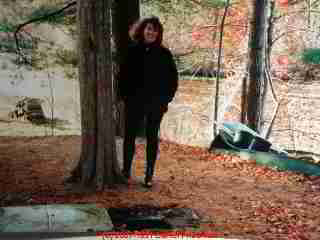 How to Spot Areas Where one Should Not Expect to Find (nor Install) the Septic Drainfield
- Video 4
How to Spot Areas Where one Should Not Expect to Find (nor Install) the Septic Drainfield
- Video 4
- POST a QUESTION or COMMENT about how to rule certain site areas out of the search for a septic drainfield or tank
When looking for the soakbed or leach field it helps to know where that component is not likely to be found:
How to find the soakaway bed, leaching bed, drainfield or drywell for a septic system or seepage pit - method 5: ruling out certain locations. If you can't find the septic tank or drainfield this article helps direct your search by describing visual inspection of the site that will show areas where you can pretty much rule out expecting to find a buried septic tank or drainfield.
InspectAPedia tolerates no conflicts of interest. We have no relationship with advertisers, products, or services discussed at this website.
A Guide to Finding the Drainfield - Part 4: unlikely septic system component locations
What areas are least likely to contain the drain field, or if they contain a drainfield, are likely to be a problem?
Click the image above, or use this YouTube URL Click the image above, or use this YouTube URL https://youtu.be/-KjsASDscvk to see the video above in a larger window.
The septic system video#4 above describes walking a homesite by a lake in order to reason that the drainfield, which must be not only uphill from the lake but in this case uphill from the septic tank too, cannot be located in the front yard, even though that looks attractive for a drainfield. In the center of the yard we spot the well casing - end of story.
The septic field should not be located here.
A septic pumping system will be needed and the drainfield will have to be located elsewhere on the site, and at a good distance from the well. More videos on septic system location & maintenance are
at SEPTIC VIDEOS.
Site areas too close to a drinking water well cannot be used for septic drainfields.
See TABLE of Required Septic Tank, Drainfield, & Well Clearances if you need to reference typical septic component clearance distance guidelines.
Our video at the top of this page demonstrates how we discover where the well is located and why that should preclude finding the septic fields in an area that otherwise looked pretty attractive.
[Click to enlarge any image]
Uphill areas, areas that are higher than the elevation of the septic tank are not a first choice to contain the drainfield or leaching beds.
Unless a septic pump or effluent pump system are installed (you'd find wiring, and perhaps alarms) the drain field is going to be at or below the elevation of the septic tank. In other words, down hill from the septic tank since effluent has to enter a conventional drainfield by gravity..
Naturally nothing prevented the installer from burying the leach lines very deeply in an area which is, on the surface "uphill" from the tank, but this would be an extra costly installation (more excavation) and also it would violate good design (leach trenches too deep).
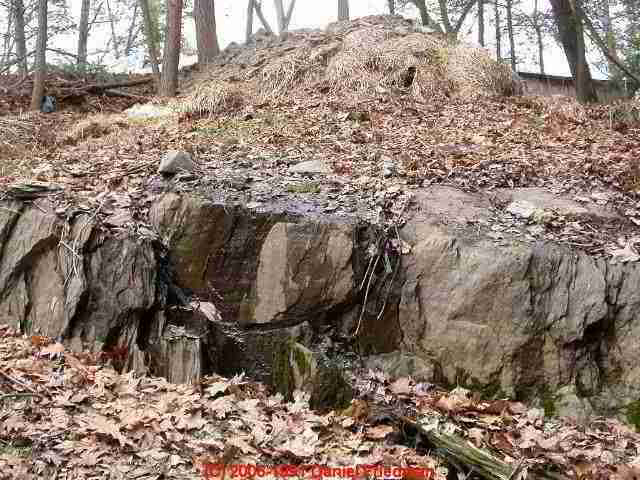
Rocky areas like this should not contain a septic drainfield but sometimes they do - even though a conventional septic system won't work on rock: such as the failed septic system shown at left, and areas where bedrock is exposed on the surface won't make a normal absorption field.
But beware, we've found non-functioning systems installed in just such a location as the rocky, steep site shown in the photo . The wet marks were water from the septic system leaking across the hillside.
At the upper center of the photo above you can see straw that the owner's contractor piled atop of the septic tank in anticipation that any problems would be hidden from view.
All we had to do was walk downhill at this steep rocky site to see these signs of a totally inadequate septic system installation
Septic effluent running over bare rock
- Bare bedrock so close to the soil surface that no working septic drainfield could be installed here without considerably more fill
- A septic tank overflow pipe that spills directly onto the soil surface - visible at the bottom center of the straw pile
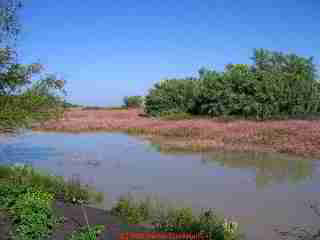
Swamps or low wet areas, unless the site is using a constructed wetlands for effluent treatment (such as we show in this area of Mexico in our photo above) should not contain conventional drainfields.
If the septic fields are too close to a wet area like this the property may be disposing of septic effluent but a conventional tank and drainfield spilling untreated wastewater effluent into a swamp, stream, or lake, is not properly treating it and is contaminating the environment.
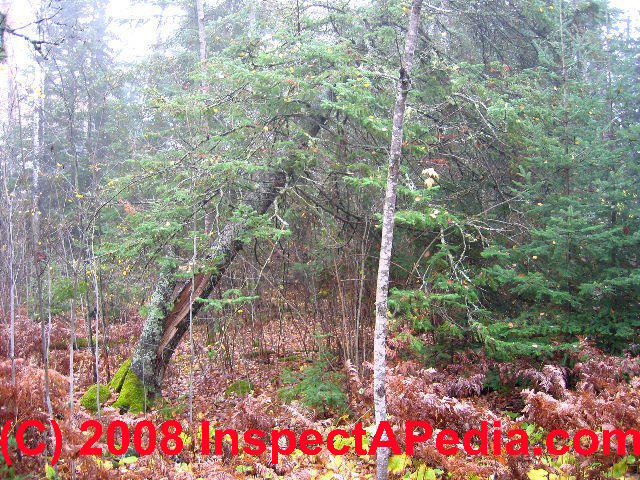
Areas with Trees: thickly forested areas are unlikely to contain a drainfield, first because of the tree root-drain-clog problem and second because the backhoe operator would have a heck of a time manipulating the excavation equipment in such a tight area.
If there is no room to operate a backhoe it is unlikely that there is a recently-installed drainfield in that area.
This area on a homesite in the Northern U.S. is an unlikely spot to place a drainfield - certainly the presence of trees close together means a backhoe has not been in here digging in many years.
But don't rule out a very old, overgrown, and ruined drainfield in such a spot at an older property.
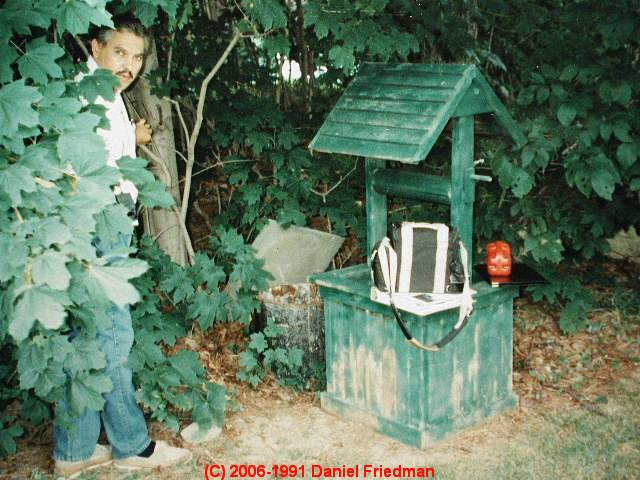
Site areas too close to a drinking water well cannot be used for septic drainfields, as we demonstrate in our site-walking septic-locating video at the top of this page.
Our septic search photo shows that some well locations are pretty obvious - we don't expect to find the septic tank or drainfield within 75' to 100' of this spot - but we might, depending on the age and size of the building site.
Sites too close to a lake or stream should not contain the septic tank and certainly not the drainfield - but they might
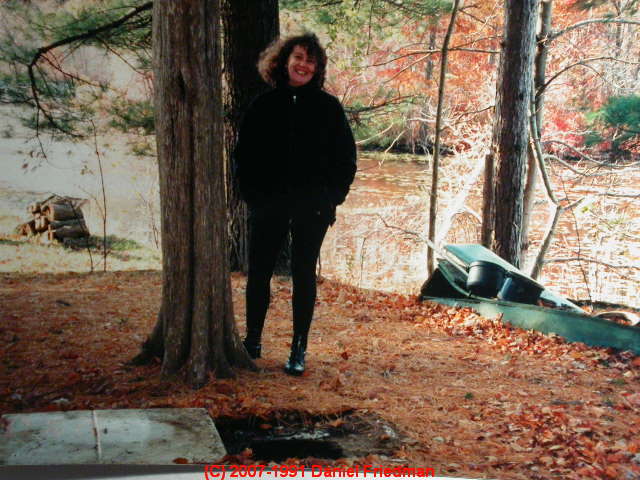
Especially at older, unsupervised, or remote rural properties, the temptation to simply route effluent leaving the septic tank to a stream, lake, pond is sometimes overwhelming (though unsanitary and illegal).
This is particularly true at sites where the soils into which one would have to put the drainfield are rocky, wet, or where the drainfield has previously failed.
We discuss this problem installation further at SURPRISING DRAINFIELD LOCATIONS.
...
Continue reading at VISUAL CLUES LOCATE the DRAINFIELD or select a topic from the closely-related articles below, or see the complete ARTICLE INDEX.
Or see these
Septic Drainfield Location Articles
- CLEARANCE DISTANCES, SEPTIC SYSTEM
- SEPTIC COMPONENT LOCATIONS
- SEPTIC DRAINFIELD LOCATION
- DRAINFIELD PIPE LOCATION, PRECISE
- EXCAVATE to LOCATE DRAINFIELD
- REASONS to FIND THE DRAINFIELD
- RECORDS to LOCATE the DRAINFIELD
- SURPRISING DRAINFIELD LOCATIONS
- UNLIKELY DRAINFIELD LOCATIONS
- VISUAL CLUES LOCATE the DRAINFIELD
- VISUAL CLUES LOCATE the SEPTIC TANK
- SEPTIC DRAINFIELD SIZE
- SEPTIC DRAINFIELD SHAPE
- SEPTIC TANK, HOW TO FIND - details about finding the septic tank or chamber or drywell or seepage pit.
- SEPTIC VIDEOS - home, showing how to find the septic system, septic tank, & septic drainfield
Suggested citation for this web page
UNLIKELY DRAINFIELD LOCATIONS at InspectApedia.com - online encyclopedia of building & environmental inspection, testing, diagnosis, repair, & problem prevention advice.
Or see this
INDEX to RELATED ARTICLES: ARTICLE INDEX to SEPTIC SYSTEMS
Or use the SEARCH BOX found below to Ask a Question or Search InspectApedia
Ask a Question or Search InspectApedia
Try the search box just below, or if you prefer, post a question or comment in the Comments box below and we will respond promptly.
Search the InspectApedia website
Note: appearance of your Comment below may be delayed: if your comment contains an image, photograph, web link, or text that looks to the software as if it might be a web link, your posting will appear after it has been approved by a moderator. Apologies for the delay.
Only one image can be added per comment but you can post as many comments, and therefore images, as you like.
You will not receive a notification when a response to your question has been posted.
Please bookmark this page to make it easy for you to check back for our response.
Our Comment Box is provided by Countable Web Productions countable.ca
Citations & References
In addition to any citations in the article above, a full list is available on request.
- SEPTIC TANK/SOIL-ABSORPTION SYSTEMS: HOW TO OPERATE & MAINTAIN [PDF] - , Equipment Tips, U.S. Department of Agriculture, 8271 1302, 7100 Engineering, 2300 Recreation, September 1982, web search 08/28/2010, original source: http://www.fs.fed.us/t-d/pubs/pdfimage/82711302.pdf.
- Pennsylvania State Wastewater Treatment Fact Sheet SW-161, Septic System Failure: Diagnosis and Treatment
- Pennsylvania State Wastewater Treatment Fact Sheet SW-162, The Soil Media and the Percolation Test
- Pennsylvania State Wastewater Treatment Fact Sheet SW-l64, Mound Systems for Wastewater Treatment
- Pennsylvania State Wastewater Treatment Fact Sheet SW-165, Septic Tank-Soil Absorption Systems
- Our recommended books about building & mechanical systems design, inspection, problem diagnosis, and repair, and about indoor environment and IAQ testing, diagnosis, and cleanup are at the InspectAPedia Bookstore. Also see our Book Reviews - InspectAPedia.
- In addition to citations & references found in this article, see the research citations given at the end of the related articles found at our suggested
CONTINUE READING or RECOMMENDED ARTICLES.
- Carson, Dunlop & Associates Ltd., 120 Carlton Street Suite 407, Toronto ON M5A 4K2. Tel: (416) 964-9415 1-800-268-7070 Email: info@carsondunlop.com. Alan Carson is a past president of ASHI, the American Society of Home Inspectors.
Thanks to Alan Carson and Bob Dunlop, for permission for InspectAPedia to use text excerpts from The HOME REFERENCE BOOK - the Encyclopedia of Homes and to use illustrations from The ILLUSTRATED HOME .
Carson Dunlop Associates provides extensive home inspection education and report writing material. In gratitude we provide links to tsome Carson Dunlop Associates products and services.
 | HOME | ABOUT | ASK a QUESTION | CONTACT | CONTENT USE POLICY | DESCRIPTION | POLICIES | PRIVACY | |
| © 2024 - 1985 Publisher InspectApedia.com - Daniel Friedman | |||||||||