
InspectAPedia® FREE Encyclopedia of Building & Environmental Construction, Diagnosis, Maintenance & Repair |
Question? Just ask us! InspectAPedia
|
 Installation Guide for Septic Pumps
- POST a QUESTION or COMMENT about buying sewage pumps, sewage ejectors & grinder pump installation procedures
Guide to septic pump or sewage ejector pump installation:
This article describes sewage ejector pumps and residential or light commercial-use sewage grinder pumps used to move wastewater from low areas to a septic tank or to a municipal sewer line.
This septic pump or sewage pump article series will help you diagnose and fix problems with sewage pumps, perform normal sewage ejector pump maintenance, and when needed, select and buy a sewage pump.
This article series also explains the differences between and gives installation and maintenance advice for Sump Pumps, Sewage Ejector Pumps, Septic Grinder Pumps, Sewage Pumping Stations, & Septic Pump Alarms. Citation of this article by reference to this website and brief quotation for the sole purpose of review are permitted.
InspectAPedia tolerates no conflicts of interest. We have no relationship with advertisers, products, or services discussed at this website.
Guide to Sewage Grinder Pump Installation Parts & Procedures

Parts of a Sewage Grinder Pump System
The sewage grinder pump is housed in a plastic or steel reservoir which receives waste from the bathroom or other plumbing fixtures it serves.
When a float inside the reservoir indicates that the sewage level has reached a high level in the reservoir, the float turns on the grinder pump which grinds and pumps away the waste.
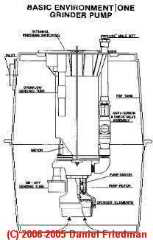
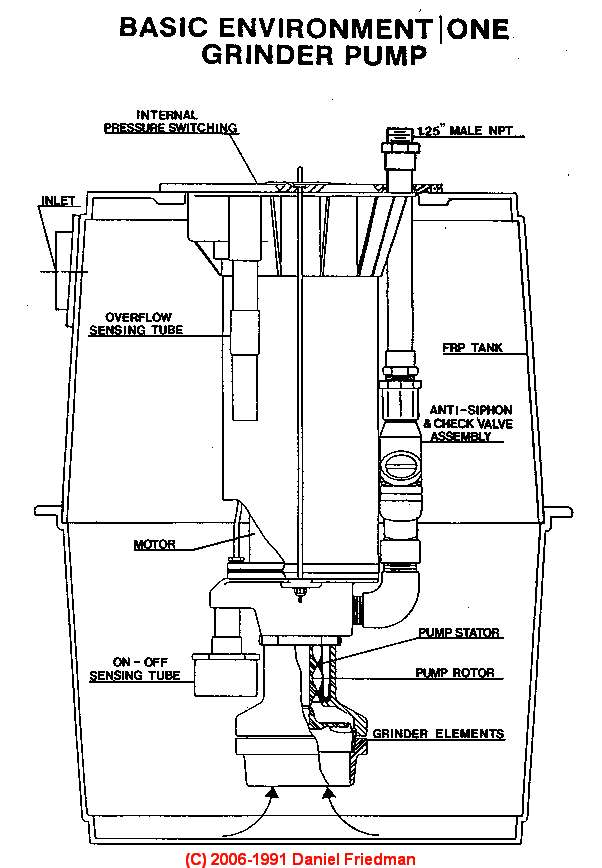
The pump shown at the top of this page is a sewage grinder pump which grinds the waste and pumps the solid/liquid measure to the building main drain. At left the sewage grinder pump parts include:
- Sewage Grinder tank (this is an Environment One Grinder Pump System)
- Lifting eyes for removing the assembly (the circles at the mid-tank seam)
- Electrical wiring leads for the grinder pump and septic pump alarm
- Electrical disconnect box for the grinder pump system
- Drain inlet: 4" PVC tank inlet for connection to building drains served by the pump
- Sewage pump tank vent. The sewage grinder tank must be vented either directly or through the inlet pipe and within 4 ft. of the tank to a building plumbing vent stack
- Drain inlet gravity service line - wastewater flows into the tank by gravity from this line.
- Ground sewage outlet: 1 1/4" male pipe thread discharge outlet (the small diameter pipe leaving the tank at top right and passing through the foundation wall)
- Concrete septic pumping tank anchor (900 pounds, or about 6 cu .ft. of concrete to prevent the tank from floating up out of the ground)
- Sewage Pumping Tank bedding gravel, 6" deep of rounded pea gravel.
(Sketch is from the Environment One Low Pressure Sewer Systems Grinder Pump catalog.)
Sewage or Septic Grinder pumps grind the solid waste entering the system, then pump it to the building drain. The building sewer drain then carries this mixture by gravity (a gravity main system) or by pump pressure (a forced main) to its destination at a septic tank and drainfield system or to a municipal sewer. Septic grinders are intended for use at residential or small commercial locations.
Because the waste is ground and pumped under pressure, these pumps can lift high distances, say from a basement floor even to a street sewer which may be uphill from the home, or to a high pressure sewer main that may be located some distance away.
For example, we inspected a summer camp community which used this force-main sewer system to move waste from buildings across a site covering several acres to a common septic system.
Small sewage ejectors are for homes and commercial applications where toilet usage and wastewater loads are modest.
A typical home sewage grinder pump uses a 1/3 to two horsepower electric motor which powers a grinder mechanism that grinds the waste, and an actual sewage waste pump which moves the ground sewage/wastewater mixture up a riser pipe to its destination: the building main sewer drain, where the wastewater is carried to a septic tank or to a community sewer line.
Sewage Pump Installation Details
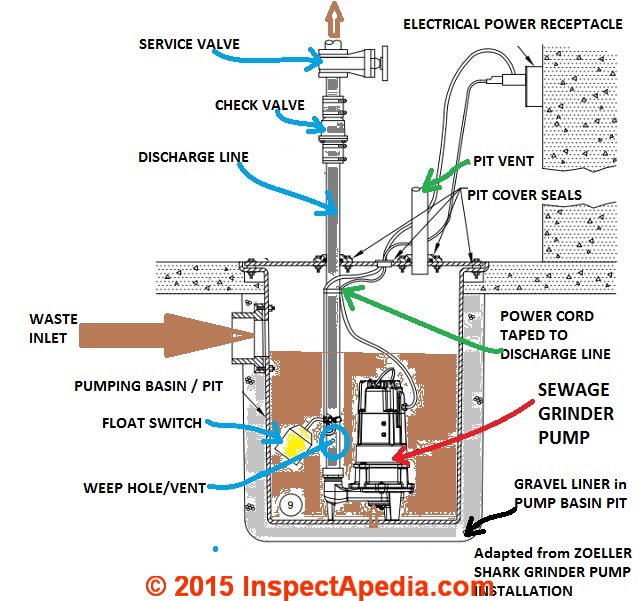
[Click to enlarge any image]
- Read the instruction manual from the grinder pump manufacturer
If you don't have the manual for your pump Sewage / Septic Grinder Pump Installation Tips adapted from Zoeller Pumps & other sources & installation manuals are given at the end of this page at
References or Citations - Install a duplex or two-pump system along with a pump alarm system if your building may be damaged by system overload or by an inability to keep up with water or waste inflow rates into the pump system
- Check for the requirement for local building permits, electrical & plumbing inspections, code compliance requirements for your installation
- Electrical power for the sewage or septic pump
- Turn off electrical power to the grinder pump circuit before handling or installing the pump. The pump electrical circuit should be properly grounded, without splices in the connecting pump cord. Don't use an extension cord to take power to the pump.
- Make sure that the pump basin or well is large enough in diameter to give free movement to the float assembly without binding
- Don't lift the pump by its power cord
- Electrical circuit splices in damp or wet area need to be in waterproof junction boxes
- Install a battery-backup pumping system if your building is subject to power outages
- Tape or secure the pump's power cord to the discharge line and keep it well away from the float assembly, sharp edges, moving parts
- Confirmn good electrical ground: by electrical testing (DMM/VOM) that the electrical ground for the pump circuit is in fact connected and working. The pump motor should be connected using the factory-supplied 3-prong plug and it should be connected to a 3-prong grounded electrical receptacle.
- Pumping basin, well or chamber
for the sewage or septic pump
- Be sure there is no debris in the bottom of the grinder pump well or basin; remove small pebbles, sticks, other solid debris
- Be sure that the pump base can stand on a solid, flat, level base. Deepen the well accordingly if you need to install a concret block or other support below the pump
- Provide a secure, child-proof basin cover for the pumping chamber
- Plumbing for the sewage / septic grinder pump
- The discharge pipe must not be smaller in diameter than the diameter of the sewage pump's discharge pipe connection opening
- A check valve should be installed in the pump's discharge line, otherwise it will be pumping the same wastewater repeatedly at each pumping cycle.
- A check valve vent should be installed in the discharge line at the proper level.
See SEPTIC / SEWAGE PUMP DISCHARGE VENT for details. - A gate valve or ball valve should be installed ahead of a Unicheck or a union on the pump discharge line to permit servicing the pump assembly
- Turn on electrical power & test the pump operation by filling the pumping chamber with clean water.
Sewage, Grinder, Septic & Efflulent Pump or Sump Pump Vent Opening Requirements & Turbulence
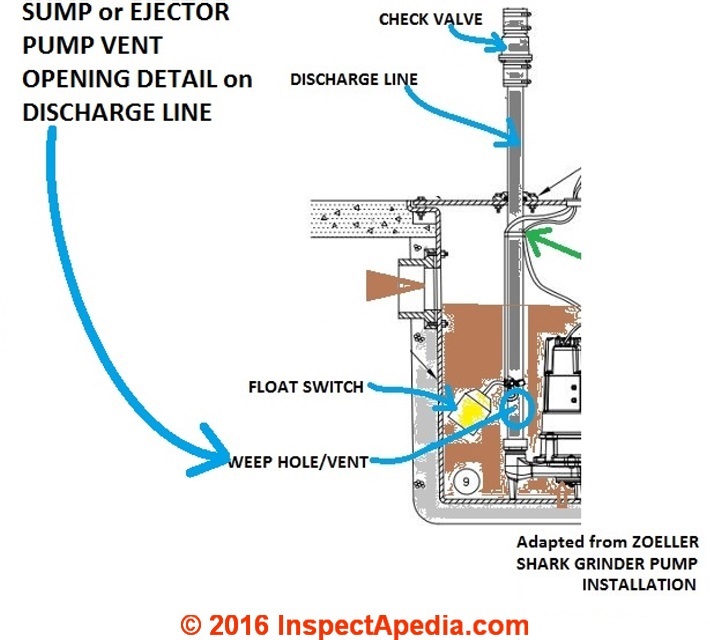 The weep hole or sewage / effluent / ejector pump discharge line vent hole permits purging of air trapped in the discharge line at the start of a pump-on cycle. This vent prevents discharge line clogging and pump seal failures. Note that some grinder pumps include a vent opening right in the pump housing oppsite the float control. Even so, the vent in the discharge line is still required.
At bottom left of our illustration you can see the weep hole vent location for a typical grinder or effluent discharge pump discharge line marked and circled in blue.
[Click to enlarge any image]
Zoeller Pump and some other sewage pump manufacturers provide a combined union/check valve, [For example Zoeller's "Unicheck" valve]. Zoeller notes that with this valve is installed, the installer must drill a 3/16" (5mm) vent opening in the discharge line at a height even with the top of the pump.
This discharge line must be cleaned periodically. You should see water squirting out of this opening when the pump is running.
The following excerpt is from Zoeller (2009) cited atReferences or Citations
It is necessary that all submersible sump, effluent, and sewage pumps capable of handling various sizes of solid waste be of the bottom intake design to reduce clogging and seal failures.
If a check valve is incorporated in the installation, a vent hole (approx. 3/16") must be drilled in the discharge pipe below the check valve and pit cover to purge the unit of trapped air. Trapped air is caused by agitation and/or a dry basin.
Vent hole should be checked periodically for clogging. The 50 or 90 Series [Zoeller] pumps have a vent located in the pump housing opposite the float, adjacent to a housing lug, but an additional vent hole is recommended.
Watch out: Zoeller also issues this warning about use of vent holes on high-head sump or ejector pump installations:
The vent hole on a High Head application may cause too much turbulence. You may not want to drill one. If you choose not to drill a vent hole, be sure the pump case and impeller is covered with liquid before connecting the pipe to the check valve and no inlet carries air to the pump intake.
NOTE: THE [sewage, sump, or effluent pump vent] HOLE MUST ALSO BE BELOW THE BASIN COVER AND CLEANED PERIODICALLY. Water stream will be visible from this hole during pump run period. - Zoeller (2009)
Set the Sewage Ejector Pump Float Control Switch
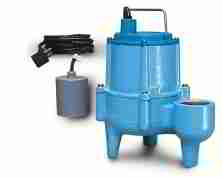
A float control switch is used to turn the sewage pump on and off. Be sure to set the switch position and to adjust the float positions that turn the pump on and off in accordance with the manufacturer's installation instructions.
Most float switches used on sump pumps and sewage ejector pumps are set to turn the pump on well before the holding chamber is at risk of flooding the building, and to turn the sewage pump off while the pump body or at least the pump impeller assembly is still below the liquid level in the chamber.
See more illustrations of types of sewage ejector float control switches and notes on float position setting found
at SEWAGE PUMP DAMAGE & REPAIR.
The sewage pump shown at left is a Little Giant model, available from plumbingsupply.com [4] and other plumbing suppliers.
Guide to Non-Clogging Sewer Pumps
Non-clogging sewer pumps, or "non-clogs", are similar in principle to the grinder pumps discussed above, but they have more capacity, and can move solids up to 4" in diameter to a sewer main or waste handling system.
Non-clogging pumps are used in some residential installations but more often in commercial or community systems or
Reader Comments, Questions & Answers About The Article Above
Below you will find questions and answers previously posted on this page at its page bottom reader comment box.
Reader Q&A - also see RECOMMENDED ARTICLES & FAQs
On 2020-07-13 - by (mod) -
John
Got a sewage ejector station event that you refer to is usually and air inlet valve not an air outlet valve so it's correct that you should not smell any sewer gas at that location.
It would be diagnostic to determine if the sewage smell that you are observing is coming down from the rooftop vent at is stronger Outdoors or if you are smelling it stronger inside which would suggest there may be a leak in a vent pipe or drain system in the building.
On 2020-07-13 by John
I have a small basement Holding tank below grade. The sewage is pumped up into the Ceptic tank.
There is a small vent pipe on the tank which opens into the basement. No smell comes from the vent pipe. However, whenever we shower anywhere in the house, we smell the sewage from the rooftop vent pipe. We tried extending the vent pipe but that doesn’t work. What could be wrong?
On 2020-05-30 - by (mod) -
Anon
The pump inlet is above the chamber floor, usually provided by the pump base design or feet
On 2020-05-30 by Anonymous
Does the grinder pump set on the basin floor or is the pump suspended a few inches above the floor ?
On 2020-05-08 by Anonymous
y does the pump shake wildly
On 2018-02-09 - by (mod) -
Bob
IN a residential plumbing drain system that's connected to a private septic tank and absorption field, a septic pump, probably a sewage ejector pump if the right pump was selected, moves waste out to the septic tank.
If your property includes a physically separate graywater disposal system (like a seepage pit that's separate from the septic system) would the graywater be pumped to that different destination.
If you don't know if your graywater is being sent to a separate destination and if you do not have a septic/graywater system drawing and plan, and if you can't find one at your local building and zoning department, then you'd have to follow the pipes - which is a devil of a job if the pipes and ground are frozen.
On 2018-02-0 by Bob
I have septic pump inside of my house. Is the 2" pipe with gray water , pumped out directly to the field ? , or it is routed through the tank. It's freezing , and I need to know how it is routed under the ground.
On 2016-05-03 - by (mod) -
See AIR ADMITTANCE VALVES AAVs at https://inspectapedia.com/plumbing/Plumbing_Vent_Definitions.php#AAV
On 2016-05-02 by dman178
I think I need to offer some more information: The location of the new toilet in my friend's DIY remodel is not near an existing vent (over 15 ft), and venting up through the roof isn't an option.
The reason he believes he needs the pump is that the soil line is too tight against the top of the crawl space to allow a Studor valve to be installed at the minimum required height.
The solution that was posed to me was to put the pump/basin in the crawl space under the toilet with a Studor valve mounted to the basin lid (36" above the lid, actually) to provide venting for the pump.
Does this sound plausible? Someone else suggested that the one-way venting from the Studor valve could cause methane to build up and risk rupturing the basin. I'm not on the hook for any of this, but I want to offer the best advice possible. Thanks for your help.
On 2016-05-02 - by (mod) -
dm
As long as it's properly supported against tipping, and as long as the elevations work with respect to drainage in to the unit, it does not have to be set into the ground.
On 2016-05-02 by dman278
I'm looking to install a septic grinder pump in a 5' high crawl space with concrete floor. Does the basin have to go into the ground or can it sit on the concrete floor?
...
Continue reading at SEWAGE PUMP BUYERS GUIDE & MANUALS or select a topic from the closely-related articles below, or see the complete ARTICLE INDEX.
Or see these
Septic & Sewage Pump Articles
- SEWAGE EJECTOR / GRINDER PUMPS - home
- DISPOSABLE WET WIPE CLOGS
- FREE-STANDING GRINDER PUMPS
- SEWAGE TREATMENT PLANTS, RESIDENTIAL
- SEPTIC SYSTEM PUMPS
- SEPTIC PUMP ALARM SYSTEMS
- SEPTIC PUMP BUYERS GUIDE & MANUALS
- SEPTIC PUMP DUPLEX DESIGNS
- SEPTIC PUMP INSPECTION & MAINTENANCE
- SEPTIC PUMP INSTALLATION
- SEWAGE PUMP DAMAGE & REPAIR
- SEWAGE PUMP INTERMITTENT CYCLING
- SEWAGE PUMPING STATIONS
- SEWAGE PUMP BUYERS GUIDE & MANUALS
- SEWAGE PUMP DAMAGE & REPAIR
- SEWAGE PUMP ODORS
- SEWAGE ODOR SOURCE LOCATION
- SEWAGE PUMPING STATIONS
- WAXY BIOFILM SLIME CLOGS in DRAINS & PUMPS
- SUMP PUMPS
Suggested citation for this web page
SEPTIC PUMP INSTALLATION at InspectApedia.com - online encyclopedia of building & environmental inspection, testing, diagnosis, repair, & problem prevention advice.
Or see this
INDEX to RELATED ARTICLES: ARTICLE INDEX to SEPTIC SYSTEMS
Or use the SEARCH BOX found below to Ask a Question or Search InspectApedia
Ask a Question or Search InspectApedia
Try the search box just below, or if you prefer, post a question or comment in the Comments box below and we will respond promptly.
Search the InspectApedia website
Note: appearance of your Comment below may be delayed: if your comment contains an image, photograph, web link, or text that looks to the software as if it might be a web link, your posting will appear after it has been approved by a moderator. Apologies for the delay.
Only one image can be added per comment but you can post as many comments, and therefore images, as you like.
You will not receive a notification when a response to your question has been posted.
Please bookmark this page to make it easy for you to check back for our response.
Our Comment Box is provided by Countable Web Productions countable.ca
Citations & References
In addition to any citations in the article above, a full list is available on request.
- Zoeller Pump Company, "Installation & Service Instructions, 803/805/807 Grinder Pumps", [PDF] Zoeller Pump Co., P.O. BOX 16347 • Louisville, KY 40256-0347, Website: Zoeller.com Retrieved 2016/04/05, original source: http://www.zoellerpumps.com/en-na/product/1242-#documents
- Zoeller Pump Company, "Installation Instructions, Recommended Models, Effluent/Sump/DeWatering & Sewage[pumps]", [PDF] Zoeller Pump Co., P.O. BOX 16347 • Louisville, KY 40256-0347, Website: Zoeller.com Retrieved 2016/04/05, original source: http://www.deanbennett.com/53-install-inst.pdf
- New York State Department of Health, APPENDIX 75-A WASTEWATER TREATMENT STANDARDS - INDIVIDUAL HOUSEHOLD SYSTEMS , [PDF] New York State Department of Health, 3 February 2010, retrieved 3/1/2010, original source: https://www.health.ny.gov/regulations/nycrr/title_10/part_75/appendix_75-a.htm
- [1] Weinman Installation and Operation Manual, Submersible Sewage Ejector Pump, Crane Pumps and Systems, 420 Third Street, Piqua, Ohio 45356 Phone: (937) 778-8947 and Crane Pumps and Systems,
83 West Drive, Bramton,
Ontario, Canada L6T 2J6,
Phone: (905) 457-6223
Fax: (937) 773-7157 Fax: (905) 457-2650
www.cranepumps.com. See Weinman submersible sewage ejector pump installation and service manual for an example instructions for the Weinman Series WE and 3WE sewage ejector pumps ranging from .5 to 1 hp. Web search 8/9/11, original source: http://www.cranepumps.com/downloadables/CATALOGS_OIPMs/
Manuals%20&%20Instruction%20sheets/108038.pdf - [2] Grundfos Sewage Ejector Pump Package Installation and Operating Instructions, Grundfos Pumps Corporation, 2555 Clovis Ave., Clovis CA 93612, Tel: 800-333-1366, web search 8/9/11,original source
http://www.us.grundfos.com/web/download.nsf/Pages/
7C03990D6E09EC6C882565220069C131/$File/Seeje-io.pdf - [3] Submersible Sewage Ejector Pump Installation, Operation, & Parts Manual, by Hydromatic Pentair Water, 740 East 9th Street, Ashland, OH 44805, Phone: 1-888-957-8677, Web Site: http://www.hydromatic.com
- [4] Drain & Sewage Ejector Packages, plumbingsupply.com, Sewage Ejector pump types, models, float control switches using Little Giant and Zoeller sewage pumps as examples, web search 08/15/11, original source http://www.plumbingsupply.com/
- [5] Float Switches for Pumps, plumbingsupply.com, Sewage Ejector pump types, models, float control switches using Little Giant and Zoeller sewage pumps as examples, web search 08/15/11, original source http://www.plumbingsupply.com/
- In addition to citations & references found in this article, see the research citations given at the end of the related articles found at our suggested
CONTINUE READING or RECOMMENDED ARTICLES.
- Carson, Dunlop & Associates Ltd., 120 Carlton Street Suite 407, Toronto ON M5A 4K2. Tel: (416) 964-9415 1-800-268-7070 Email: info@carsondunlop.com. Alan Carson is a past president of ASHI, the American Society of Home Inspectors.
Thanks to Alan Carson and Bob Dunlop, for permission for InspectAPedia to use text excerpts from The HOME REFERENCE BOOK - the Encyclopedia of Homes and to use illustrations from The ILLUSTRATED HOME .
Carson Dunlop Associates provides extensive home inspection education and report writing material. In gratitude we provide links to tsome Carson Dunlop Associates products and services.
 | HOME | ABOUT | ASK a QUESTION | CONTACT | CONTENT USE POLICY | DESCRIPTION | POLICIES | PRIVACY | |
| © 2024 - 1985 Publisher InspectApedia.com - Daniel Friedman | |||||||||