
InspectAPedia® FREE Encyclopedia of Building & Environmental Construction, Diagnosis, Maintenance & Repair |
Question? Just ask us! InspectAPedia
|
 Diagnosing and Curing Sewer Gas Smells and Septic Tank Odors Caused by Site Problems

- POST a QUESTION or COMMENT about septic gas or sewer gas smell cause, diagnosis & repair
This article describes how to diagnose, find, and cure odors in buildings including septic or sewage or sewer gas smells or "gas odors" in buildings with a focus on homes with a private onsite septic tank but including tips for owners whose home is connected to a sewer system as well.
What makes the smell in sewer gas? Sewer gases are more than an obnoxious odor.
InspectAPedia tolerates no conflicts of interest. We have no relationship with advertisers, products, or services discussed at this website.
Site Conditions, Weather Conditions, or Failing Neighboring Septic Systems or Plumbing Can Produce Local Sewer Gas Odors
Watch out: Because sewer gas contains
methane gas (CH4) there is a risk of an explosion hazard or even fatal asphyxiation.
See METHANE GAS SOURCES
[Click to enlarge any image]
Sewer gases also will typically contain HYDROGEN SULFIDE GAS (H2S). In addition some writers opine that there are possible health hazards from sewer gas exposure, such as a bacterial infection of the sinuses (which can occur due to any sinus irritation).
Depending on the sewer gas source and other factors such as humidity and building and weather conditions, mold spores may also be present in sewer gases.
Also see SEWER GAS ODORS in COLD / WET WEATHER for additional odor tracing and cure advice for odors occurring during wet or cold weather.
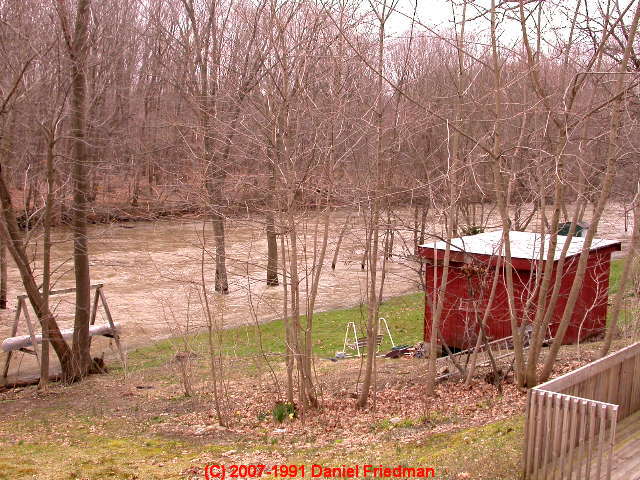
- Check for sources of ground water or surface water that are flooding your septic tank or drainfield. Runoff from roof drainage or surface or subsurface water can easily enter and flood a septic tank and drainfield, including at surprising locations such as an opening at the septic tank top, a crack in the septic tank, or an opening in a drain line entering or leaving the septic tank. Our photo (above left) shows Wappingers Creek in flood conditions (Dutchess County, New York) - nearby septic drainfields are also flooded and saturated.
- Excavate and the soil around the drainfield: a few test holes, combined with a septic loading and dye test can tell us if the water flooding a septic field is coming from the building's septic tank and wastewater or from invading surface runoff.
Septic loading and dye test procedures are given in detail at this website.
See SEPTIC LOADING & DYE TESTS: how to perform a Septic Loading and Dye Test - the complete procedure for septic loading & dye testing, a septic function test. - Inspect the septic tank for evidence of flooding from invading ground water.
See TANK INSPECTION PROCEDURE - Use an intercept drain: Probably the most common problem, however, is ground water or surface water flooding the leach field, causing it to fail or back up. It may be possible to install intercept drainage around the septic field to salvage the system.
- Excavate and the soil around the drainfield: a few test holes, combined with a septic loading and dye test can tell us if the water flooding a septic field is coming from the building's septic tank and wastewater or from invading surface runoff.
- Check neighboring properties and drains: before digging up your yard and septic tank, walk around the neighborhood. Is the smell getting stronger as you walk away from your property? Perhaps a neighbor has a failing septic system or is having work performed on their septic system.
- Check nearby storm drains for odor sources.
- Check for unusual site and wind conditions: I've encountered buildings where all of the plumbing vent installations appear to be to code and complete, but where unusual terrain shape (house at the bottom of a large hill) and prevailing winds conspired (in some weather conditions) to blow septic gases back down from above the roof to a bedroom window or even to ground level.
Depending on the building roof shape, orientation, and prevailing or even uncommon wind direction, wind blowing at the building can cause downdrafts around a plumbing vent stack, sending normal sewer gases and odors back closer to the ground or even into the building.
If your sewer gas odors seem to correlate to windy conditions I'd check this out further. Extending the plumbing vents higher or installing a wind block at the vent top might help. - Weather: how rain and flooding can cause sewage odors at a building or site:
- Rain or stormwater flooding a local sewer/storm drain system: can cause sewer gases to back up through a building's drain/waste/vent piping and into the building.
- Flooding the private septic system drainfield causes sewage effluent to reach the surface
- Failing septic drainfields: Even a septic drainfield that is not flooded may be smelly if it is improperly constructed or has lost its ability to treat septic effluent, but these conditions may be expected to be worse in wet weather
- Flooding the septic tank, by invasive ground water, surface runoff, or from actual flood conditions is likely to also leave the system not functional and possibly releasing septic gases
See SEPTIC SYSTEM FLOOD DAMAGE REPAIR
- Other Sources of Smells that are less like "sewer gas" odors (in my opinion) include the odor of burning electrical components. If you trace odors to an appliance or fixture or switch, shut off electricity to that device (or un-plug it if it's an appliance) and have the system or appliance checked by a licensed electrician. Burning electrical components and insulation, and overheating florescent light ballasts can make quite an odor but that's the just a warning sign of an unsafe condition that needs prompt attention.
- Submissions are invited: Contact Us if you have other examples of tracking down septic or sewer gas smells to their source. Credit and link-exchanges given.
...
Continue reading at SULPHUR & SEWER GAS SMELL SOURCES or select a topic from the closely-related articles below, or see the complete ARTICLE INDEX.
Or see these
Septic & Sewer Odor Articles
- ODORS GASES SMELLS, DIAGNOSIS & CURE - home
- BACKDRAFTING & SEWER / SEPTIC ODORS
- BUILDING DRAIN ODOR SOURCES
- CLOGGED DRAIN DIAGNOSIS & REPAIR
- PLUMBING VENT BLOCKAGE ODORS
- DRAIN LINE SEWER ODORS
- DRAIN PIPING & SEWER ODORS
- DRAINFIELD ODORS, FAILURES
- FIXTURE vs SYSTEM DRAIN BLOCKAGE
- FLOOR DRAIN / TRAP ODORS
- GAS DETECTION INSTRUMENTS
- HYDROGEN SULFIDE GAS
- INDOOR SEPTIC ODOR, OUTDOOR CAUSES
- METHANE GAS HAZARDS SEPTIC / SEWER
- METHANE GAS SOURCES
- ODORS GASES SMELLS, DIAGNOSIS & CURE - home
- OTHER ODORS BLAMED on SEPTIC / SEWER
- OUTDOOR SEWER ODORS
- PLUMBING FIXTURE TRAPS
- PLUMBING VENT DEFECTS & NOISES
- SEWAGE PUMP ODORS
- SEPTIC SYSTEM ODOR CURES
- SEPTIC / SEWER ODOR SOURCE TABLE
- SEPTIC / SEWER PIPING LEAKS
- SEPTIC ODORS INDICATING DRAINFIELD FAILURE
- SEPTIC TANK LEAKS
- SEWAGE CONTAMINATION in BUILDINGS
- SEWAGE EJECTOR / GRINDER PUMPS
- SEWER GAS ODORS
- SEWER GAS ODORS in COLD / WET WEATHER
- SEWER GAS ODOR REMEDIES
- SEWER SEPTIC GAS CONDUIT LEAKS
- SEWER SEPTIC ODORS in HVAC DUCTS
- SITE WEATHER or NEIGHBOR'S SEWER ODORS
- SULPHUR & SEWER GAS SMELL SOURCES
- TESTS for SEWER GAS INDOORS
- TOILET SEAL LEAKS & ODORS
- TOXIC GAS TEST PROCEDURES
- TRACK SEPTIC ODORS to SOURCE
- TRACK SEWER ODOR by WEATHER
- TRAP SIPHONAGE & SEWER GAS
- WATER POLLUTANT SOURCES
- WET WEATHER SEWER ODORS
Suggested citation for this web page
SITE WEATHER or NEIGHBOR'S SEWER ODORS at InspectApedia.com - online encyclopedia of building & environmental inspection, testing, diagnosis, repair, & problem prevention advice.
Or see this
INDEX to RELATED ARTICLES: ARTICLE INDEX to SEPTIC SYSTEMS
Or use the SEARCH BOX found below to Ask a Question or Search InspectApedia
Ask a Question or Search InspectApedia
Try the search box just below, or if you prefer, post a question or comment in the Comments box below and we will respond promptly.
Search the InspectApedia website
Note: appearance of your Comment below may be delayed: if your comment contains an image, photograph, web link, or text that looks to the software as if it might be a web link, your posting will appear after it has been approved by a moderator. Apologies for the delay.
Only one image can be added per comment but you can post as many comments, and therefore images, as you like.
You will not receive a notification when a response to your question has been posted.
Please bookmark this page to make it easy for you to check back for our response.
Our Comment Box is provided by Countable Web Productions countable.ca
Citations & References
In addition to any citations in the article above, a full list is available on request.
- New York State Department of Health, APPENDIX 75-A WASTEWATER TREATMENT STANDARDS - INDIVIDUAL HOUSEHOLD SYSTEMS , [PDF] New York State Department of Health, 3 February 2010, retrieved 3/1/2010, original source: https://www.health.ny.gov/regulations/nycrr/title_10/part_75/appendix_75-a.htm
- Thanks to Slade Franklin for the reminder that a leaky wax ring at a toilet can lead to septic odors in bathrooms. 11/2007
- Thanks to J.V. (privacy protected) for the reminder to make a detailed inspection of the plumbing vent system when sewer gas odors are present. 07/2008
- Thanks to Roger Hankey & Cheryll Brown, www.hankeyandbrown.com, ASHI home inspectors in Minnesota, for the deteriorated transite pipe gas flue vent photograph and comments. Mr. Hankey is a past chairman of the ASHI Technical Committee, serves as co-chairman of ASHI legislative committee, and has served in other ASHI professional and leadership roles. 7/2007.
- Cold Weather Septic Odors or Sewage Odor Diagnosis for additional odor tracing and cure advice focused on sewer gas odor tracking in cold or wet weather.
- PLUMBING DRAIN NOISE DIAGNOSIS: may indicate defective or clogged plumbing: how to diagnose and cure drain sounds
- SEPTIC TANK/SOIL-ABSORPTION SYSTEMS: HOW TO OPERATE & MAINTAIN [PDF] - , Equipment Tips, U.S. Department of Agriculture, 8271 1302, 7100 Engineering, 2300 Recreation, September 1982, web search 08/28/2010, original source: http://www.fs.fed.us/t-d/pubs/pdfimage/82711302.pdf.
- Pennsylvania State Wastewater Treatment Fact Sheet SW-161, Septic System Failure: Diagnosis and Treatment
- Pennsylvania State Wastewater Treatment Fact Sheet SW-162, The Soil Media and the Percolation Test
- Pennsylvania State Wastewater Treatment Fact Sheet SW-l64, Mound Systems for Wastewater Treatment
- Pennsylvania State Wastewater Treatment Fact Sheet SW-165, Septic Tank-Soil Absorption Systems
- Document Sources used for this web page include but are not limited to: Agricultural Fact Sheet #SW-161 "Septic Tank Pumping," by Paul D. Robillard and Kelli S. Martin. Penn State College of Agriculture - Cooperative Extension, edited and annotated by Dan Friedman (Thanks: to Bob Mackey for proofreading the original source material.)
- In addition to citations & references found in this article, see the research citations given at the end of the related articles found at our suggested
CONTINUE READING or RECOMMENDED ARTICLES.
- Carson, Dunlop & Associates Ltd., 120 Carlton Street Suite 407, Toronto ON M5A 4K2. Tel: (416) 964-9415 1-800-268-7070 Email: info@carsondunlop.com. Alan Carson is a past president of ASHI, the American Society of Home Inspectors.
Thanks to Alan Carson and Bob Dunlop, for permission for InspectAPedia to use text excerpts from The HOME REFERENCE BOOK - the Encyclopedia of Homes and to use illustrations from The ILLUSTRATED HOME .
Carson Dunlop Associates provides extensive home inspection education and report writing material. In gratitude we provide links to tsome Carson Dunlop Associates products and services.
 | HOME | ABOUT | ASK a QUESTION | CONTACT | CONTENT USE POLICY | DESCRIPTION | POLICIES | PRIVACY | |
| © 2024 - 1985 Publisher InspectApedia.com - Daniel Friedman | |||||||||