
InspectAPedia® FREE Encyclopedia of Building & Environmental Construction, Diagnosis, Maintenance & Repair |
Question? Just ask us! InspectAPedia
|
 Flush Household Chemicals into a Septic Tank?
Septic Tank Maintenance Advice
- POST a QUESTION or COMMENT about the effects of household chemicals, soaps, etc. on the function of a septic tank and drainfield
What typical household chemicals and substances are safe to flush down the toilet and into a private septic system?
Is it ok to flush common household chemicals & household cleaners cleaners into the septic tank?
Which household chemicals may damage the septic tank or leach fields and at what levels of usage are they harmful? This document explains how to extend the life of the septic system by being careful about what goes into it.
InspectAPedia tolerates no conflicts of interest. We have no relationship with advertisers, products, or services discussed at this website.
Effects of Household Chemicals Flushed Into a Septic System
Household Chemicals Commonly Put Into Septic System or Down Building Drains
 What common household cleaners or chemicals are OK to flush into the septic tank?What household cleaners or other common household liquids should NOT be flushed into the septic tank?What do bleach, epsom salts, liquor, whiskey, wine do to the septic tank and drainfield?
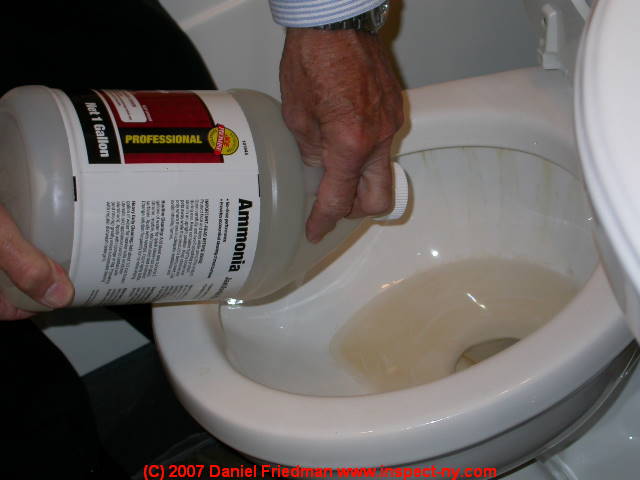
- Ammonia - in normal dilute quantities such as from mopping a kitchen floor, should not be a concern. Don't dump bottles of un-wanted ammonia or any other chemicals into the building drains or septic system.
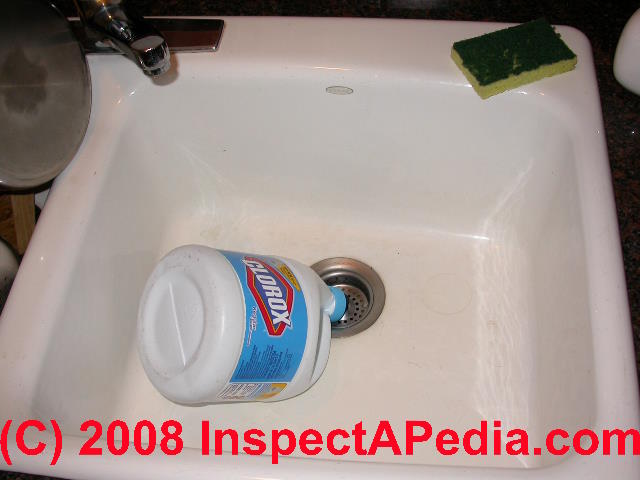
- Bleach - in normal quantities, modest household usage is so dilute in the septic tank as to not be much of a concern; but if you're doing a lot of wash using lots of bleach, consider using an oxygen bleach product (sodium percarbonate) as an alternative.
- Bleach at large quantities such in an attempt to subvert a well test or septic dye test, can damage the septic system and should not be poured into it.
Technical review, content suggestions, critique are welcomed and are listed at "References."
This article is part of our series:
SEPTIC SYSTEM INSPECTION & MAINTENANCE COURSE an online book on septic systems.
- De-Greasing chemicals: de-greasing or cleaning chemicals such as those used in industrial processes or for cleaning metal parts should not be flushed into the septic system, while other de-greasing or FOG (Fats Oils Grease) removing drain and septic maintenance chemicals and treatments are likely to be acceptable.
Details and a discussion of FOG (Fat Oil Grease) de-greasers used in drain maintenance and a comparison of those products with industrial de-greasing chemicals are given in this article
at FOG DEGREASERS. - Detergents & household cleaners at normal levels: Small and normal quantities of household cleaner such as water used to mop a floor or clean a counter,
are unlikely to damage a septic system by their volume, concentration in the septic tank, nor by their chemical content.
Normal levels of household cleaning, detergents, fabric softeners, shampoos, and bath soap, at normal levels of household use are sufficiently dilute when they reach the septic tank that they should not be a problem for a conventional septic tank and drainfield system.
However clothes washing machine and dishwashing machine detergents commonly contain phosphates and surfactants which are environmental contaminants.
Laundry detergents & soaps used in washing machines & dishwashers are discussed separately
at WASHING MACHINES & SEPTIC SYSTEMS
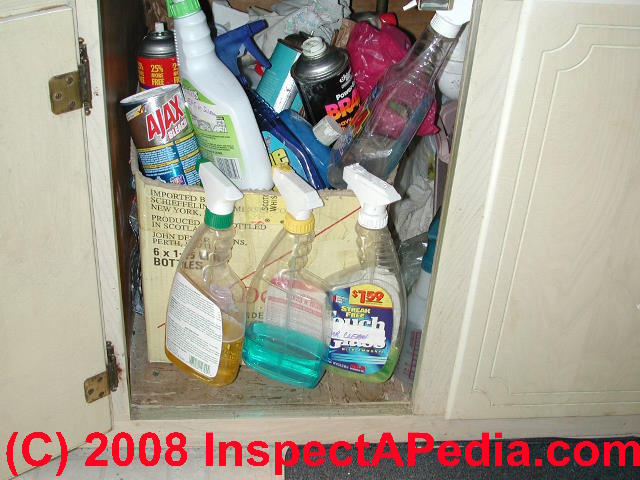
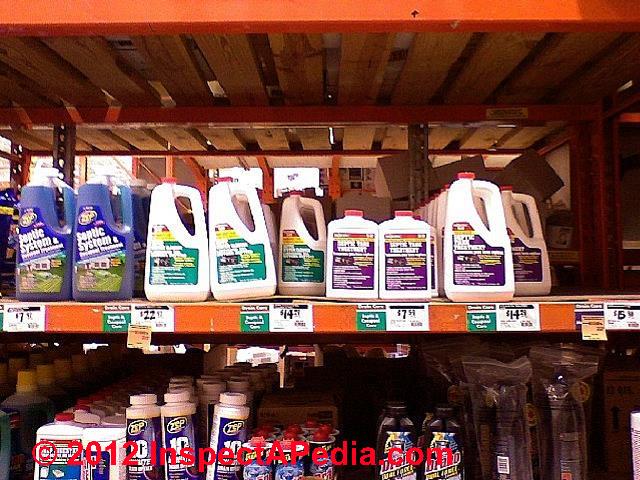
- Drain Cleaners & Septic Treatment Chemicals , such as used to unclog building drains, of all types, caustic or organic, should be ok provided that you follow the manufacturer's instructions.
Regular, daily, weekly, or monthly use of drain openers, drain cleaners should not be needed in residential septic systems and some products that are caustics may be harmful to the system and to the environment when used often or in larger-than-recommended quantities.
Septic treatment chemicals are generally not needed, sometimes contaminate the environment, and are illegal in many jurisdictions in the U.S. and all of Canada. - See CHEMICALS & TREATMENTS for SEPTICS
See BLOCKED DRAIN REPAIR METHODS for a detailed step by step guide to un-blocking clogged drains.
Articles at that page also assist in diagnosing the location and cause of drain blockages.
Also see CLOGGED DRAIN DIAGNOSIS & REPAIR.
Thanks to David Peterson for suggesting clarification on drain cleaners and septic systems. - Epsom salts, such as used to bathe feet, at normal use should also be OK.
- Liquor or Whiskey: how to get rid of un-wanted whiskey or liquor: pouring a small amount, say a bottle or two of unwanted liquor down the drain and on into the septic tank is not likely to be harmful.
Frequent pouring of liquor into a septic system or pouring large amounts, say a case at a time, is probably a bad idea. It'd be better to give the liquor away.
Look into a charitable gifts foundation if your whiskey bottles are in good shape. - Photo chemicals: But if a building is hosting non-residential activities such as a photo lab or other activity that sends a concentrated dose of chemicals into the system it's likely to be a problem either for the septic system or for the environment.
- While liquids are not going to clog a pipe, they can, especially if in high concentration, damage the bacterial action in the septic tank or in the leach fields where the biomat is needed to process pathogens and thus to make the effluent safe to discharge into the environment.
- Even a chemical which does not directly damage the biomat may be nonetheless neither filtered nor neutralized by the septic system process. So if you're dumping large amounts of photo chemicals or cleaners down yo
Reader Question: Will antibacterial soap interfere with a septic system?
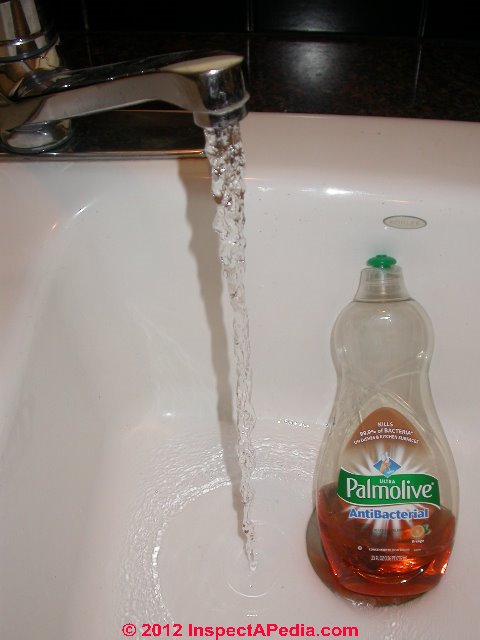 I've done a search on your informative site but I was unable to ascertain as to whether or not antibacterial soaps should be used at a home with a septic system.
Will the antibacterial quality of the soap interfere with the needed bacteria in the system? -- V.W.
Reply: At normal usage levels antibacterial soap won't hurt the septic tank
A short answer is "no" - not in the amounts that would normally be used in a household.
At normal household usage levels such as washing hands or washing dishes, anitbacterial soap will be sufficiently dilute in the septic tank as to do no harm.
We use the same reasoning as used for normal usage of household cleaners and laundry bleach discussed in the article above. - Ed.
Reade Question: what causes drain clogging or septic pump clogging by a white waxy substance?
What causes the large amount of white waxy clumpy substance that i found recently in my septic pump container?
The substance was stuck to the sides of the tank(severeal inches thick), stuck all over the pump, and stuck all over the float switch which of course was the problem and the reason for opening the septic tank.
This goopy accumulation happened over 2 years and 5 months.
thanks. - Rani 8/11/11
Reply:
Rani,
I can't be certain what the white stuff was without seeing a sample in our forensic lab. But I can warn that using more powdered detergent in a dishwasher or clothes washer can lead to accumulation of a gooey mess that clogs drains or even septic drainfields.
You've added another important example: excessive detergent use OR using a budget detergent that contains large amounts of clay fillers can clog the pump float control switch or the pump intake in a sewage ejector pump or sewer pump as well.
We discuss the causes of white waxy deposits in drains and sewage or ejector pumps
at WAXY BIOFILM SLIME CLOGS in DRAINS & PUMPS
Is it ok to use degreasing solvents in septic tanks?
On 2016-06-08 by Kathleen Waterman - why can't I dispose of degreasing solvents into the septic tank
Why cant degreasing solvents be thrown down the drain into a septic
This question was originally posted at SEPTIC SYSTEM PUMPS
On 2016-06-08 Reply by (mod) - distinguish cleaning de-greasers from plumbing drain degreasing products
I have not included common plumbing drain FOG (Fat Oil Grease) degreasers (such as Cloroben PT-4) in our Don't Flush List (link given below) though excessive use of any solvent may not only harm the septic tank but some solvents are harmful to humans directly or if found in groundwater.
However other degreasing solvents such as those used in industry to clean metal parts, or in garages to clean automotive parts, are a completely different product that should not be flushed down drains into septic systems, and that might be prohibited from drain disposal in municipal sewer systems as well.
See this example MSDS safety sheet for Cloroben PT4, a plumbing drain cleaner also described as a "flow improver" and "grease control agent" produced and marketed by Hercules. As pointed out by Hughes (1954) often safety has focused first on explosion or fire hazards.
Some Hercules products such as Hercules PT-GIO1™ combine grease solvents and "waste disgesting bacteria" while Hercules PT-4 (or Cloroben PT-4) is a formlua designed to rapidly dissolve FOG (Fats Oils and Grease) using a non-acidic, non-caustic formula that is described as "safe on all types of piping materials when used as directed"
- CLOROBEN PT4 SAFETY DATA SHEET, [PDF], HCC Holdings, Inc. an Oatey Affiliate, 4700 West 160th Street Cleveland, OH 44135, USA, retrieved 2017/02/22, original source: http://www.oatey.com/msds/sds-us--hercules-cloroben-pt4.pdf
- CLOROBEN PT-4 Product Specifations Sheet, [PDF] Op. Cit. http://www.oatey.com/doc/pt4.pdf
Cloroben PT-4 can be used to improve flow of gravel absorption beds around cesspools, drywells, leach tanks and drain field laterals.
Can be used to clean lines to and from grease traps, cleans main lines or soil stacks/vents of apartment buildings, condominiums and hotels or for commercial applications; controls grease caking and fouling in clarifiers, lines and digesters and helps maintain good percolation in aeration basins of municipal waste treatment plants. - Hercules PT- and WHAM Product literature: http://www.oatey.com/doc/lcs982greasecontrolwhampt4ptbiocanadapdf081015.pdf (op cit)
Because of the potential health impacts, the U.S. EPA has ste maximum contaminant levels (MCLs) for some solvents such as chlorinated solvents in groundwater in the United States.
- Moran, Michael J., John S. Zogorski, and Paul J. Squillace. "Chlorinated solvents in groundwater of the United States." Environmental Science & Technology 41, no. 1 (2007): 74-81.
- Murphy, Brian L., and Thomas D. Gauthier. "Current developments in environmental forensics: Forensic analysis of chlorinated solvent contamination data." Environmental Claims Journal 11, no. 4 (1999): 81-96.
- Viraraghavan, T., and Simon Hashem. "Trace organics in septic tank effluent." Water, Air, & Soil Pollution 28, no. 3 (1986): 299-308.
And some supposedly-safe solvents have been demonstrated to be hazardous
- Hughes, James P. "Hazardous exposure to some so-called safe solvents." Journal of the American Medical Association 156, no. 3 (1954): 234-237.
Abstract:
There is scarcely an industrial plant or a business that does not use some solvents. The kinds and the quantities vary from the can of type cleaner in the secretary's desk to tank car loads of less familiar substances used as degreasing agents in the metal trades or as vehicles in the manufacture of chemicals.
There are hazards in the handling of all solvents because of their appreciable volatility. Some danger may be recognized by the user, but flammability and explosiveness are more likely to be considered than physiological action.
The selection of a solvent for a specific purpose depends on technological factors, such as required action, volatility, handling practice (including vapor recovery), the tendency of the substance to leave a residual film on metal surfaces, cost, and availability.
The safety aspect may be introduced as a last consideration but, perhaps, only in terms of risk of fire or explosion.
Reader Comments, Questions & Answers About The Article Above
Below you will find questions and answers previously posted on this page at its page bottom reader comment box.
Reader Q&A - also see RECOMMENDED ARTICLES & FAQs
On 2019-07-02 by (mod) - impact of Steradent on septic system? Steradent MSDS
BrianThe MSDS for Steradent - produced by Reckitt Benckiser UK - at http://www.providercc.co.uk/downloads/msds_pdfs/Steradent%20Tablets.pdf - lists several acids and other chemicals and gives use warnings.
Among them is this quote:
6. ACCIDENTAL RELEASE MEASURES
See also Sections 8 and 13.
Do not allow the product to enter drains. Sweep up the loose tablets and transfer to a suitable container for subsequent disposal.
8. EXPOSURE CONTROL AND PERSONAL PROTECTION
See also Section 7.
Avoid contact with eyes and prolonged skin contact.
13. DISPOSAL CONSIDERATIONS
Consumer Instructions The prepared liquid may be disposed of by pouring to drain. Empty packaging may be disposed of with
normal household waste.
Bulk Quantities Dispose of in accordance with local, regional or national requirements.
(unsold stock) For further information contact your local waste authority.
I find that confusing as hell. One paragraph says keep out of drains; another says ok to put down drains.
I SPECULATE that what they meant to say was that at normal individual household use you can dispose of the waste Steradent down building drains but at commercial or industrial levels that should not be done.
70693-62-8 274-778-7
Potassium
monopersulfate 10 - 15% C, O R8, R22, R34
15630-89-4 239-707-6
Sodium
percarbonate 8 - 13% O, Xn R8, R22, R36/617-48-1
617-48-1 230-022-8 Malic acid 3 - 8% Xi R36
77-92-9 201-069-1 Citric acid 13 - 25% Xi R36
5239-14-6 226-218-8 Sulfamic acid 0.5 - 1.5% Xi R36/38, R52/53
497-19-8 Sodium carbonate 8 - 12% Xi R36
On 2019-07-01 by Brian Ord O'Neill
I have been advised to use Steradent for a newly fitted denture. After use can the steradent solution be flushed into a Septic tank system?On 2019-06-13 1 - by (mod) - cooked cream of rice or cream of wheat, pan remnants, won't hurt eptic system
If you are eating the cereal and not flushing it down the drains directly you should be fine.
The small remnant bits of cookd cerial from cleaning your dishes won't hurt the septic, though in my OPINION, to reduce the risk of clogging your drains, keep the sink strainer in when washing dishes, and
empty its accumulation of food debris directly into the garbage can.
On 2019-06-11 by Pam Hill
Your web site does not list cooked cream of rice cereal. After cooking it the pan and bowl have an almost glue like residue left behind. I eat 3 servings per day for a digestive disorder. I have a septic system.
Will cooked cream of rice cereal clog my septic system?
On 2019-01-28 - by (mod) -
Should be ok at normal household usage levels such as cleaning a sinkOn 2019-01-28 by Gary Phillips
Is Pine O Clean safe for Septic Systems. The bottle is silent on this matterOn 2019-01-28 by Gary Phillips
Can Exit Mould be used in a Septic SystemOn 2018-11-04 - by (mod) -
No, Olivia,At normal household usage levels hair dye will not have a harmful impact on septic systems.
The situation may be different if you were talking about a septic system serving a beauty salon.
On 2018-11-04 by Olivia Schmidt
Does hair dye have any effects on septic systems?...
Continue reading at CHEMICALS to KEEP OUT OF SEPTICS or select a topic from the closely-related articles below, or see the complete ARTICLE INDEX.
Or see CHEMICALS & CLEANERS in the SEPTIC TANK FAQs - questions and answers posted originally on this page.
Or see these
Recommended Articles
- CHEMICALS & TREATMENTS for SEPTICS - do we need to put treatments in the septic tank?
- CHEMICALS to KEEP OUT OF SEPTICS
- TOILETS, DON'T FLUSH LIST
- SEWAGE PUMPING STATIONS
- WAXY BIOFILM SLIME CLOGS in DRAINS & PUMPS
Suggested citation for this web page
CHEMICALS & CLEANERS into the SEPTIC TANK? at InspectApedia.com - online encyclopedia of building & environmental inspection, testing, diagnosis, repair, & problem prevention advice.
Or see this
INDEX to RELATED ARTICLES: ARTICLE INDEX to SEPTIC SYSTEMS
Or use the SEARCH BOX found below to Ask a Question or Search InspectApedia
Ask a Question or Search InspectApedia
Questions & answers or comments about problems with the operation of aerobic septic systems
Try the search box just below, or if you prefer, post a question or comment in the Comments box below and we will respond promptly.
Search the InspectApedia website
Note: appearance of your Comment below may be delayed: if your comment contains an image, photograph, web link, or text that looks to the software as if it might be a web link, your posting will appear after it has been approved by a moderator. Apologies for the delay.
Only one image can be added per comment but you can post as many comments, and therefore images, as you like.
You will not receive a notification when a response to your question has been posted.
Please bookmark this page to make it easy for you to check back for our response.
Our Comment Box is provided by Countable Web Productions countable.ca
Citations & References
In addition to any citations in the article above, a full list is available on request.
- New York State Department of Health, APPENDIX 75-A WASTEWATER TREATMENT STANDARDS - INDIVIDUAL HOUSEHOLD SYSTEMS , [PDF] New York State Department of Health, 3 February 2010, retrieved 3/1/2010, original source: https://www.health.ny.gov/regulations/nycrr/title_10/part_75/appendix_75-a.htm
- Thanks to reader David Peterson for suggesting text clarification on drain cleaners 04/2009
- SEPTIC TANK/SOIL-ABSORPTION SYSTEMS: HOW TO OPERATE & MAINTAIN [PDF] - , Equipment Tips, U.S. Department of Agriculture, 8271 1302, 7100 Engineering, 2300 Recreation, September 1982, web search 08/28/2010, original source: http://www.fs.fed.us/t-d/pubs/pdfimage/82711302.pdf.
- Ten Steps to Keeping a Septic System Working, suggestions from the U.S. EPA, edits and additions by DJF
- Pennsylvania State Wastewater Treatment Fact Sheet SW-161, Septic System Failure: Diagnosis and Treatment
- Pennsylvania State Wastewater Treatment Fact Sheet SW-162, The Soil Media and the Percolation Test
- Pennsylvania State Wastewater Treatment Fact Sheet SW-l64, Mound Systems for Wastewater Treatment
- Pennsylvania State Wastewater Treatment Fact Sheet SW-165, Septic Tank-Soil Absorption Systems
- Document Sources used for this web page include but are not limited to: Agricultural Fact Sheet #SW-161 "Septic Tank Pumping," by Paul D. Robillard and Kelli S. Martin. Penn State College of Agriculture - Cooperative Extension, edited and annotated by Dan Friedman (Thanks: to Bob Mackey for proofreading the original source material.)
- Our recommended books about building & mechanical systems design, inspection, problem diagnosis, and repair, and about indoor environment and IAQ testing, diagnosis, and cleanup are at the InspectAPedia Bookstore. Also see our Book Reviews - InspectAPedia.
- In addition to citations & references found in this article, see the research citations given at the end of the related articles found at our suggested
CONTINUE READING or RECOMMENDED ARTICLES.
- Carson, Dunlop & Associates Ltd., 120 Carlton Street Suite 407, Toronto ON M5A 4K2. Tel: (416) 964-9415 1-800-268-7070 Email: info@carsondunlop.com. Alan Carson is a past president of ASHI, the American Society of Home Inspectors.
Thanks to Alan Carson and Bob Dunlop, for permission for InspectAPedia to use text excerpts from The HOME REFERENCE BOOK - the Encyclopedia of Homes and to use illustrations from The ILLUSTRATED HOME .
Carson Dunlop Associates provides extensive home inspection education and report writing material. In gratitude we provide links to tsome Carson Dunlop Associates products and services.
 | HOME | ABOUT | ASK a QUESTION | CONTACT | CONTENT USE POLICY | DESCRIPTION | POLICIES | PRIVACY | |
| © 2024 - 1985 Publisher InspectApedia.com - Daniel Friedman | |||||||||