
InspectAPedia® FREE Encyclopedia of Building & Environmental Construction, Diagnosis, Maintenance & Repair |
Question? Just ask us! InspectAPedia
|
 Guide to Septic Tank, Drywell & Cesspool Abandonment
Procedures, laws, safety advice to decommission an unused septic system
- POST a QUESTION or COMMENT about how to discontinue or abandon a septic tank, drywell, cesspool, or seepage pit
How to abandon a septic tank, cesspool, drywell or seepage pit.
Septic tanks are abandoned for any of several reasons: connection of the building to a public sewer, installation of a new septic tank, perhaps at a different location on the property, or when a building and its septic system are to be demolished to permit a different use of the property.
This document outlines basic procedures for finding and safely abandoning unused septic systems and cesspools, and provides some safety suggestions for septic system inspectors, septic system inspections, septic pumping contractors, and home owners.
When a septic tank, drywell, or cesspool is no longer to be used, either because a building is connected to a municipal sewer or because the old tank is being left in place and a new septic installed elsewhere, there are very important safety steps that should be taken.
We describe the steps in abandoning a septic tank in-place and alternatively we describe how the abandoned septic tank may be removed completely.
InspectAPedia tolerates no conflicts of interest. We have no relationship with advertisers, products, or services discussed at this website.
Guide to Proper Abandonment of Unused Septic Tanks, Drywells, Etc.
 Safety Concerns in Abandoning Septic Systems, Seepage Pits, Cesspools, Drywells, even dug wells
Septic tanks, cesspools, and drywells present serious hazards including septic cave-in's or collapses, methane gas explosion hazards, and asphyxiation hazards.
Simple precautions which we describe here can help avoid a dangerous septic, cesspool, or drywell hazard.
In addition to having been consulted in fatalities involving humans, we have learned that falling into septic tanks and cesspools is a risk for animals as well. Readers should also see specific warnings about cesspools
Watch out: for unsafe septic tanks and cesspools or drywells and for systems that were not properly abandoned.
In 2008 Mark Cramer shared a report from an owner that that their horse fell into a septic tank and died tragically before it could be rescued.
The collapsing septic tank was not in the location which the owners thought it would be found, and clearly it had an unsafe cover. We were consulted in a Long Island death of an adult who fell into and was buried in a collapsing cesspool.
And in 2012 we were contacted for comment involving the death of two boys who fell into and perished in an "abandoned" septic tank or cesspool that lacked a safe cover.
It is important to properly abandon unused septic tanks, cesspools, or drywells. If an old septic tank, cesspool, or drywell is simply "left alone" there may be very serious cave-in or fall-in safety hazards.
Septic tank, drywell, or cesspool abandonment or tank closure may involve complete tank removal, tank crushing (steel septic tanks), or most common with site-built tanks/cesspools/drywells, and with concrete tanks, the cover is opened and the tank is filled-in with rubble and soil.
Details of septic tank, cesspool, drywell abandonment procedures are discussed in this article.
Article Contents
- SEPTIC TANK ABANDONMENT CHOICES
- SEPTIC D-BOX & DRAINFIELD ABANDONMENT STEPS
- SEPTIC TANK ABANDONMENT - TANK LEFT IN PLACE
- SEPTIC TANK ABANDONMENT - TANK REMOVED
- SEPTIC SYSTEM ABANDONMENT REGULATIONS
Septic Tank Abandonment Choices
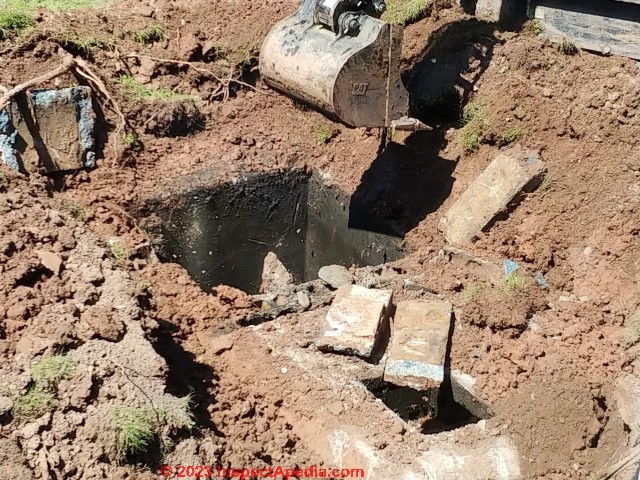 When a septic tank is no longer going to be used, various factors determine what will happen to the old tank:
- Cesspools & Drywells:
If the old septic system component to be discontinued is a cesspool or drywell, and occasionally with septic tanks, the old tank might be left in place and "daisy chained" to the new one.
This was common at country and farm properties that relied on a cesspool for onsite waste disposal.
Owners hoped that the old system might still help a little with wastewater treatment and disposal even though it had stopped working.
This approach is dangerous if the old system has an unsafe cover, is in danger of collapse, or is leaking where it should not be. - Steel septic tanks
are often removed, crushed, and buried back at the site, possibly below or along side a new septic tank - details are below. - Concrete septic tanks
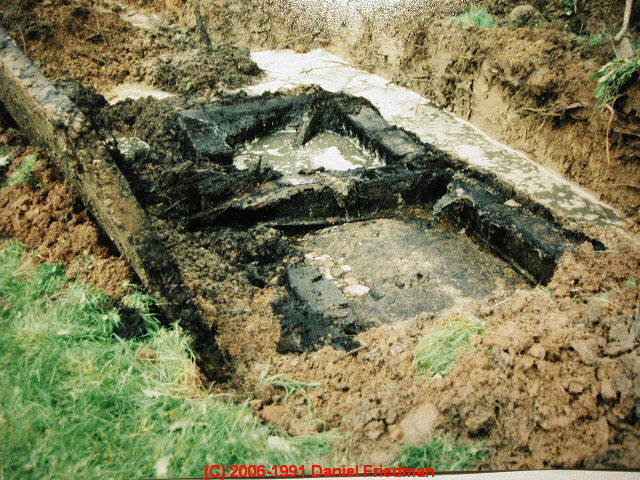
like the septic tank shown in our photo just above are often filled-in after holes are broken into the tank and the cover itself is broken up and dropped in - details are below. - Plastic or fiberglass septic tanks
are a newer item with less experience in abandonment. If such a tank is badly damaged and leaky it needs to be removed and replaced. It may be possible to crush and bury such a tank as in the case of steel tanks.
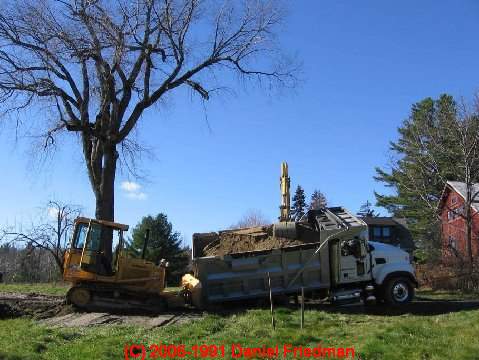
To avoid the risk of a collapsing septic tank, cesspool, or drywell which is no longer used, it is important to find and properly close out such facilities at any property, residential or commercial. In the photo at the top of this page, the truck "found" an abandoned septic tank by driving over it.
Septic D-Box, Piping, & Drainfield Abandonment?
Are septic tank and D-box abandonment actually required?
Yes, for safety and sanitation, a septic tank and D-box that will no longer be used must be properly abandoned as we describe in this article. Health risks associated with sewage left in an abandoned septic tank and the risk of a cave-in or of a person falling into an abandoned septic tank, cesspool, or drywall are very serious, often resulting in death.
In addition, in many jurisdictions a proper, inspected septic tank and D-box abandonment must be completed within a limited time after a building has been connected to a public sewer. Our review of septic regulations found that that time varied between 30 to 90 days.
In most jurisdictions whose septic abandonment regulations we have reviewed, the septic drainfield, mound, or raised-bed septic and D-box can be left in place when a septic tank and system are to be abandoned.
Exceptions were found such as Michigan's recommendation that the drainfield be inspected by test holes to permit inspection for excess effluent and to provide for its removal - cited in detail below.
Septic D-Box Abandonment Procedure
The septic D-box will not normally contain solids or actual sewage but may contain sewage effluent. Hover if the septic system has failed such as by broken outlet baffles at the septic tank, there could be raw sewage, including solids, in the distribution box or D-box.
The D-box should be pumped out by a licensed septic pumping contractor and the D-box then can be removed completely or it can be left in place and filled in with rubble and topsoil.
Septic Drainfields, mound systems, sand mounds, raised bed septic Abandonment
When a septic system is being abandoned the septic drainfields, mound systems, sand mounds, raised bed septic or similar soil absorption system can be left in place, but these areas should not be excavated nor constructed upon for at least a year after the septic system was last used.
Michigan's guidelines are one of the few SDS and septic system abandonment guides that includes steps to assure that the soil absorption system (septic drainfield, soakaway, leach field, or soakbed) does not contain harmful levels of sewage effluent at the time of abandonment.
The suggestions below were developed by the U.S. state of Michigan and the state's department of Environment, Great Lakes, and Energy (EGLE).
Excerpt:
To ensure the soil dispersal area does not contain excess liquid waste before removal,
it is helpful to dig a hole in the four corners of the soil dispersal area along with a hole in
the middle to create sump pits that the liquid septage waste can pool and collect to be
pumped out by the licensed septage hauler.
This process may take numerous days to
ensure the surrounding soil, pipes, and dispersal media are drained. T
his method should
be completed prior to the removal of the dispersal area and bringing it to the ground
surface. Removing saturated dispersal media to dry at the ground surface will threaten the
public health of nearby residents and the contractors removing the material due to
potential exposure to pathogens in the process.
- source: MI EGLE Onsite Wastewater Program:
Soil Dispersal System and Septic Tank Abandonment [PDF] Michigan - cited in more detail below on this page.
Abandon a Septic Tank, Drywell, Cesspool - Tank Left in Place
Properly abandoning a septic tank, drywell, or cesspool which is no longer in use involves at least the following steps:
- Locate all of the unused septic tanks, cesspools, drywells
on the property. At some properties there may be multiple systems and tanks, such as a chain of old cesspools or one or more septic tanks with a separate drywell. See these articles on finding hidden, lost, buried septic system components:- SEPTIC TANK, HOW TO FIND which offers detailed steps and multiple approaches, including our septic tank and drainfield location videos. An experienced plumber or septic contractor can assist in these steps and may have special equipment that speeds the process. These subtopics are addressed
- WHO KNOWS SEPTIC LOCATION?
- FIND MAIN WASTE LINE EXIT
- DISTANCE TO SEPTIC TANK
- POSSIBLE SEPTIC TANK LOCATIONS
- SEPTIC TANK LOCATING EQUIPMENT
- SEPTIC TANK COVERS
- SEPTIC TANK LOCATION SKETCH
- FIND the SEPTIC TANK, HOW TO an introduction to this topic with the basics of tank location
- SPECIAL SEPTIC SAFETY WARNINGS for Homeowners
- Pump out the septic tank, cesspool, or drywell
A septic pumping contractor performs this step.
In most communities the septic tank must be pumped by an approved or permitted waste hauler, and you may be required to show a receipt to confirm that that step has been taken.
Watch out: if there is a public sewer nearby that does NOT mean that you can pump your septic tank into the sewer system. That's generally not allowed.
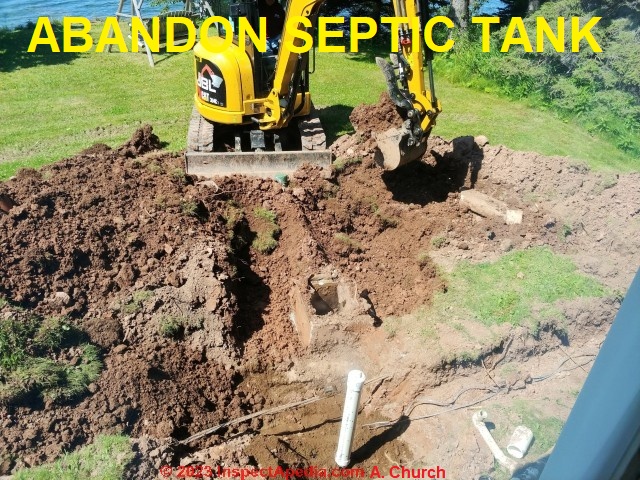
Photo: after installing a new septic tank at this property in Two Harbors, Minnesota, and after the old septic tank has been pumped out, the contractor begins the abandonment procedure for a concrete septic tank by removing soil from the top of the septic tank.
In the foreground you can see a cleanout/inspection access in the new main waste line that connects the building to a new septic tank (not in view).
- Expose the Tank & Remove / Break-up the Septic Tank Cover
Once the septic tank has been pumped (and in some communities, disinfected), the cover is removed from the property for proper disposal; in some jurisdictions it may be permitted to bury the tank cover along-side the filled-in septic tank.
As our photo shows above, the contractor will excavate to expose the top of the septic tank and then remove or break-up the septic tank cover depending on how the cover is to be handled.
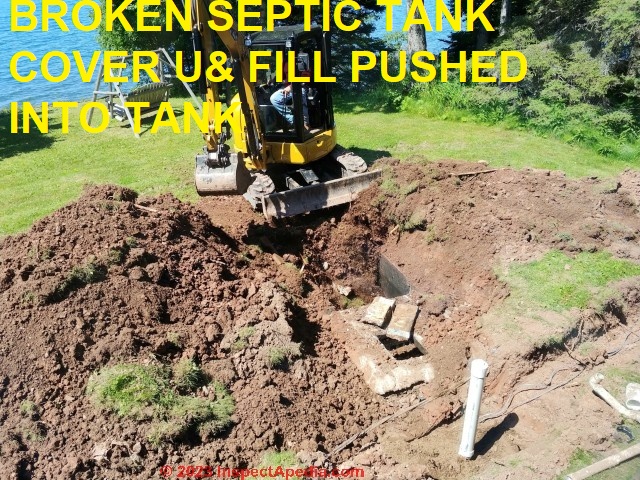
The concrete septic tank cover will be broken up and dropped back into the empty septic tank.
A steel septic tank cover and tank may be crushed completely or may be crushed and dropped along-side of a new septic tank if one is being placed in the same location. - Open the abandoned septic tank bottom for drainage
So that it won't hold surface runoff, forming an unwanted water or mud reservoir.
In a metal or plastic septic tank a bottom hole or opening should be no less than 4 inches in diameter (12-inches in some jurisdictions) and in a multi-compartment septic tank a drainage hole must be cut into the bottom of each septic tank section.
A concrete septic tank bottom can be broken-up rather than trying to "cut" a drainage hole.
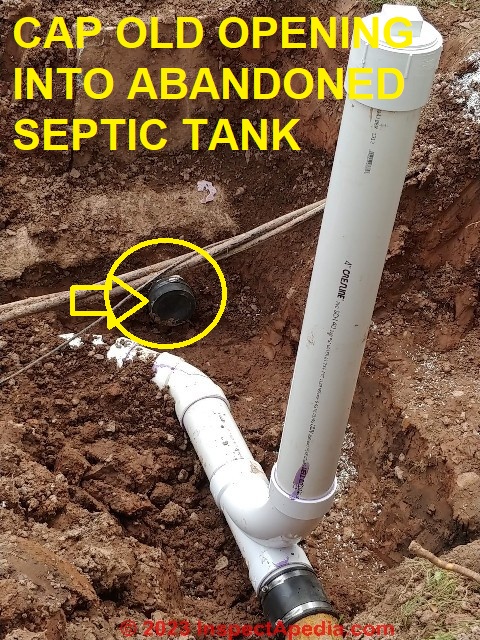
Photo above: the black neoprene cap shown by our yellow arrow is installed to assure that surface and ground water don't run into the remains of the abandoned septic tank.
The white PVC in the foreground is an inspection port and sewer line connecting the building to the new septic tank (not in the image).
- Disable the abandoned septic tank inlet & outlet openings
A concrete or plastic tank or steel tank that is to be left with its walls intact should be sealed against inlet or outlet at its openings or in some jurisdictions you can simply cut-off the pipes connected to the septic tank inlet and outlet and then plug those openings at the tank.
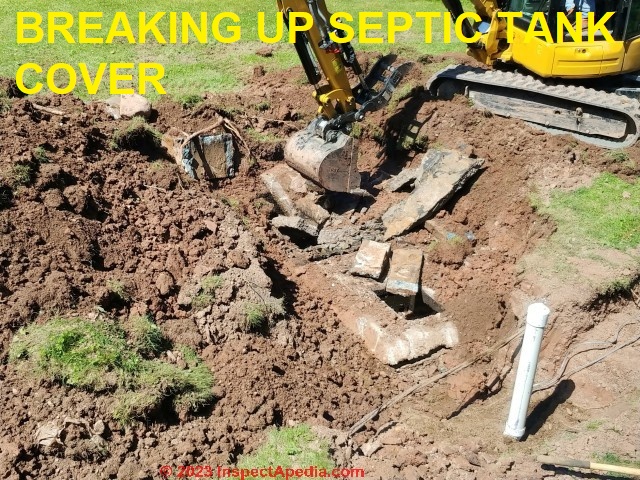
Above: the contractor is using the backhoe to break up the concrete septic tank cover.
Below: the contractor begins pushing broken-up tank cover components over half of the tank along with soil into the tank so that he can move forward to complete breaking up the remainder of the tank cover in the foreground.
- Crush & bury old steel septic tanks / Break-Up & Bury Cover to Concrete Septic Tank:
If the septic tank is steel, often the contractor may dig out the tank, crush it, and then bury it back in the original hole along with its steel cover.
If you are taking the crushed septic tank option, after the tank has been pumped and crushed you may need to call for a septic abandonment inspection at that time - before backfill.
When we installed a new concrete septic tank the contractor pulled out the old steel septic tank, crushed the old steel septic tank into a flat slab of rusty metal by driving his backhoe over it, dropped the new concrete septic tank into the old excavation, slipped the old flat steel septic tank on edge alongside the new concrete tank, and buried it.
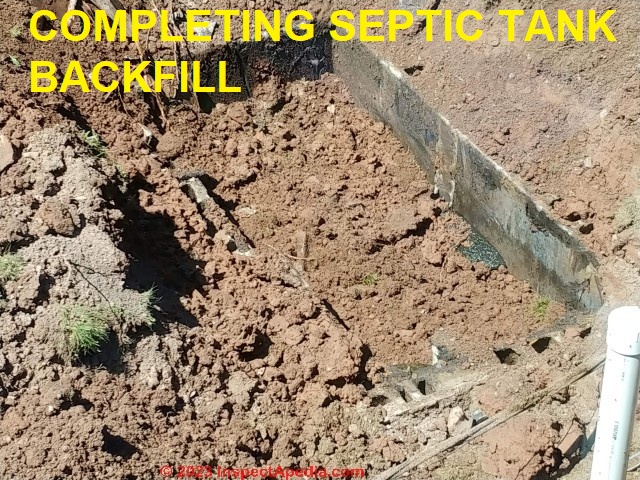
- Complete Backfill of Abandoned Septic Tank or Tank Excavation
The contractor uses remaining fill to complete filling the abandoned septic tank or the hole from which a tank may have been removed.
Often the contractor will slightly mound the fresh fill over the excavation to allow for further settlement. - Request a septic tank abandonment inspection
In many jurisdictions you will be required to call for an inspection of the septic tank or its remains before the excavation is back-filled.
At this inspection you may also be asked to show the receipt demonstrating that the septic tank was pumped - emptied of its sewage at the start of the process.
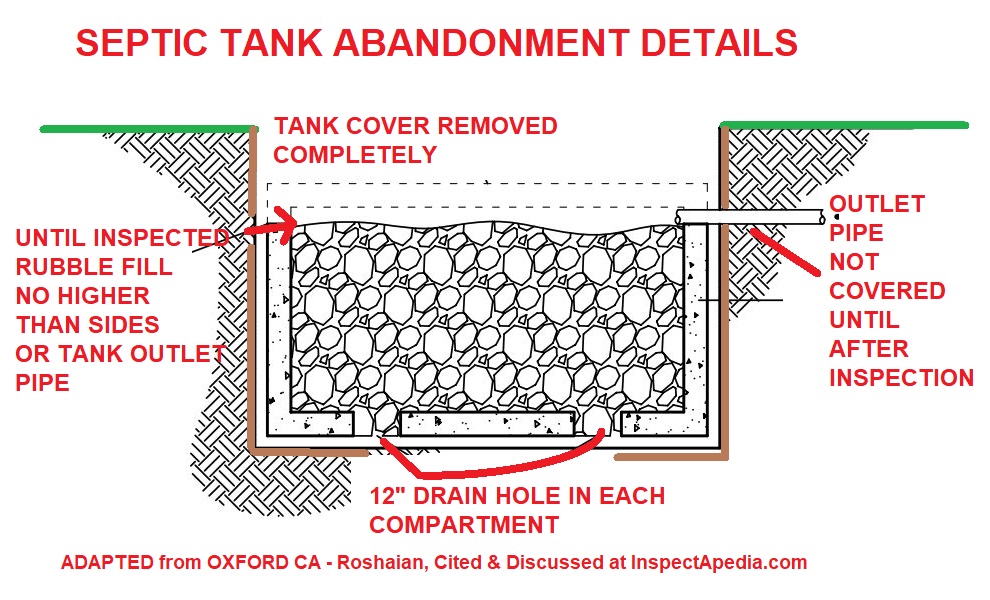
Illustration, adapted from the City of Oxnard, CA, Septic Tank Abandonment guide from the Oxnard Department of Engineering, by Ro Roshanian, cited in detail below.
With the top cover removed the septic tank pumped and cleaned, (disinfected some jurisdictions) and 12-inch drain openings cu into the tank bottom, the septic tank is filled with sand, gravel, stone rubble, or other approved material, but the fill must not extend above the top of the vertical portions of the tank's sidewalls nor above the level of the septic tank outlet pipe until after the abandonment job has been inspected by the local authority.
- Fill in the septic tank, cesspool, or drywell, or hole
Where the tank was located or where the open septic tank remains, that opening is filled with stone, rubble, and soil so that there is on future collapse or subsidence hazard.
If the old septic tank was steel and was crushed (as above), the excavation contractor may decide to clean-up the existing septic tank hole and use it to drop in the new tank in the same location - this is fine, and it simplifies plumbing connections to the new septic tank. - Assure that the septic tank fill is solid & compacted
and that a secure cover remains. Otherwise future settlement of the septic tank fill can cause sudden dangerous collapses. - Document the location of the filled-in septic tank, cesspool, drywell,
so that future site work or building plans can avoid or at least anticipate these buried obstructions. - If newer septic tanks, cesspools, or drywells remain in use
at the property, that is if you're not simply connecting the building to a municipal sewer line, then:- Document remaining septic components:
be sure that the remaining septic tank, drywell, or cesspool locations are documented
See SEPTIC TANK LOCATION SKETCH - Safe septic tank covers:
Be sure that each remaining septic tank, drywell, cesspool that has not been abandoned has an intact, secure cover that will not cave in nor be easily opened by a child
See SEPTIC TANK COVERS - Keep livestock away
from septic tanks and drainfields: We've written elsewhere about the importance of keeping livestock off of septic drainfields and septic tanks. There may be an extra risk of livestock-caused septic tank collapse where old septic tank or cesspool covers or even new fiberglass septic tanks and covers are installed.
- Document remaining septic components:
Abandon a Septic Tank by Septic Tank Removal
- Locate the septic tank
As above, find the septic tank and all other related systems to be abandoned such as drywells or old cesspools that may have been daisy-chained together. - Pump out the septic tank
Using an approved septage hauler the tank is emptied. Keep the receipt for this work for review by your local health authorities - Remove the septic tank lid and the septic tank itself from the ground and from the property.
It may be necessary to cut plumbing connections into and out of the septic tank as part of its removal.
Your contractor will dispose of the old tank and lid at an approved disposal site, for which there may be a disposal fee. - Request a septic tank removal inspection
In many jurisdictions you will be required to call for an inspection of the septic tank excavation before that hole in the ground can be back-filled.
At this inspection you may also be asked to show the receipt demonstrating that the septic tank was pumped - emptied of its sewage at the start of the process. - Back-fill the excavation where the septic tank was located
Backfill the hole with stone, rubble, and soil, compacting as appropriate during the backfill procedure.
The contractor may leave the final topsoil fill a bit high over the septic tank hole to allow for additional soil settlement.
Septic Tank Abandonment Codes & Regulations
Watch out: although there are potential life safety hazards in ignoring an unused or "abandoned" septic tank, seepage pit, cesspool, drywell, or holding tank, regulations vary widely by country and jurisdiction within country. For example in the U.S. the New York state Department of Health does not require abandoning an unused septic tank BUT local regulations may do so.
Watch out: regardless of whether or not local laws require you to make sure that an unused septic tank or similar buried vault is properly abandoned or made safe, you should do so properly in order to avoid the risk of a fatal injury.
- AK,
[3] HOW to MAINTAIN YOUR SEPTIC SYSTEM [PDF] Alaska Department of Environmental Conservation, Division of Water, retrieved 8/8/12, original source: http://dec.alaska.gov/water/wwdp/onsite/maintain_septic.htm [copy on file as Alaska_Septic_Care.pdf
Alaska Septic Tank Abandonment Requirements:When wastewater disposal systems are abandoned, a septic tank and seepage pit must have the sewage removed by a septic tank pumper, and must be crushed in place or completely filled with compacted soil, concrete, or other approved material, as required by the Uniform Plumbing Code.
Depending on specific site conditions, disinfection may also be required. - Alaska Manual [5]
- CA SEPTIC TANK, CESSPOOL, BRICK-LINED SEEPAGE PIT ABANDONMENT [PDF](2007) Oxnard California City Engineering Department - see the illustration above.
Excerpt: City code requires that the septic tank, cesspool, or brick-lined seepage pit be abandoned / demolished within 30 days after connection to the city sewer. - CA SEPTIC TANK ABANDONMENT PROCEDURES [PDF] (2018) County of Santa Clara, CA Department of Environmental Health Consumer Protection Division 1555 Berger Drive, Suite 300 San Jose, CA 95112-2716 Phone (408)918-3400 Fax (408)258-5891 Website: www.EHinfo.org Email: dehweb@deh.sccgov.org - retrieved 2022/06/22 original source: https://cpd.sccgov.org/sites/g/files/exjcpb706/files/LU_Septic_Tank_Abandonment.pdf
- CA, SEPTIC SYSTEM ABANDONMENT [PDF] Yolo County California DOH, - retrieved 2022/06/22 original source: https://www.yolocounty.org/government/ general-government-departments/ community-services/ environmental-health-division/land-use-programs/ onsite-wastewater-treatment-system-program/septic-system-abandonment
Excerpt:
Because septic tanks present serious hazards for people, pets, and other animals, the septic tank is the only septic system component that is required to be abandoned under permit. This includes septic tanks, pump or vault tanks, holding tanks, cesspools and seepage pits.
The leach field can remain in the ground as it was built. At times, there are building projects that require a leach field to be removed, but it is not generally a requirement of Environmental Health to remove a leach field. - DE, SEPTIC TANK ABANDONMENT POLICY [PDF] (2007) Sussex County Delaware Engineering Department, - retrieved 2022/06/22 original source: https://sussexcountyde.gov/sites/default/files/PDFs/septic_abandonment.pdf
- FL, SEPTIC TANK ABANDONMENT PERMIT [PDF] Florida Department of Health, HIllsborough County, Tel: 813-307-8059 - retrieved 2022/06/22 original source: https://hillsborough.floridahealth.gov/programs-and-services/environmental-health/septic-systems/abandonment/index.html
- FL, SEPTIC TANK ABANDONMENT PROCEDURE / SEWER CONNECTION [PDF] City of North Miami Beach, Florida, Building Department, 17050 NE 19th Avenue North Miami Beach, FL 33162-3194 (305) 948-2965 (305) 919-3708 citynmb.com
This procedure includes advice for the piping necessary to change the direction of a building's original waste or drain piping to re-route it to connect to a public sewer. - MI EGLE Onsite Wastewater Program:
Soil Dispersal System and Septic Tank Abandonment [PDF] State of Michigan and ELGLE - retrieved 2022/06/22 original source: https://www.michigan.gov/egle/-/media/ Project/Websites /egle/Documents/Programs/ DWEHD/ Onsite-Wastewater-Management/ Soil-Dispersal-System-and-Septic-Tank-Abandonment.pdf? rev=e4231490da4c467988999ff97d1962a5
MI Environment, Great Lakes, and Energy - EGLE website: https://www.michigan.gov/egle Email: EGLE-Assist@Michigan.gov Tel: 800-662-9278 - NJ ABANDONED SEPTIC SYSTEMS New Jersey - Admin. Code § 7:9A-12.8 [PDF]
- NY, SEPTIC ABANDONMENT in NYS SYSTEMS DESIGN HANDBOOK (2012) New York State Department of Health, Health Education Services, POB 7126, Albany NY 12224 Tel: 518-439-7286 - retrieved 2022/06/22 original source: https://www.greenegovernment.com/wp-content/uploads/2014/04/NYSDOH-Decommissioning-SepticTanks.pdf
Excerpt:
There are no NYSDOH regulations for abandoning/decommissioning septic system tanks and other system components (such as pump and siphon tanks, ETUs, cesspools, seepage pits, distribution boxes).
Contact your LHD to check for local codes or guidance. In the absence of such local codes or guidance, the following is recommended:
Whenever septic tanks or other system components are to be abandoned/decommissioned because public sewers are being installed or replacing a tank(s), the tank(s) and other system components can be removed and taken to a solid waste facility or decommissioned in place
. Septic system tanks must be properly decommissioned to minimize potential health and safety hazards.
Contact your local solid waste management official to discuss options for proper disposal of the tanks and used absorption field soils, stone, pipe and other components. If the tank will be left in-place, a NYSDEC permitted waste transporter should pump out the tank, wash off, and remove as much residuals as possible.
The use of lime as a disinfectant is an option for treating the tank(s) and absorption area and system components. Care should be taken when accessing and cleaning septic system tanks.
Properly disconnect all alarms and electrical services, if any, from septic system tanks and other system components. The top of the tank should be knocked in and the bottom punctured, if possible, to allow for drainage of rain or surface water. Backfill the tank with sand or gravel to prevent a safety hazard.
The area that was disturbed should be properly graded and seeded. If settling occurs over time, it may be necessary for additional fill material.
Absorption field components (soils, pipe, aggregate, etc.) can be left in place unless local laws or codes require their removal.
For the purpose of future home construction projects, property improvements and/or home sale, a record of the location of the abandoned/decommissioned septic tank and other components should be made. - New York State Department of Health, APPENDIX 75-A WASTEWATER TREATMENT STANDARDS - INDIVIDUAL HOUSEHOLD SYSTEMS , [PDF] New York State Department of Health, 3 February 2010, retrieved 3/1/2010, original source: https://www.health.ny.gov/regulations/nycrr/title_10/part_75/appendix_75-a.htm
- OR, SEPTIC SYSTEM AND WELL ABANDONMENTS [PDF] City Of Mcminnville
Building Division,
231 NE 5th Street, McMinnville, OR 97128
Office: 503) 434-7314 FAX: 503) 474-4955
24-Hour Inspection Request Line: 503) 434-7542
Excerpt: Abandoned systems must be approved by the Yamhill County Planning and Building Department. A copy of their approval must be provided to the City’s Building Division prior to approval of demolition permit final inspections.
Reader Comments, Questions & Answers About The Article Above
Below you will find questions and answers previously posted on this page at its page bottom reader comment box.
Reader Q&A - also see RECOMMENDED ARTICLES & FAQs
On 2021-10-02 by inspectapedia.com.moderator (mod) - area of 12" deep settlement over old abandoned septic tank may be unsafe
@Dana,
For safety you want an excavator to be sure that the septic tank has been properly abandoned - filled-in; you may need to add fill;
Septic tanks can also be crushed or broken-up and collapsed in place or removed - a more-expensive option usually not required;
While we are not attorneys here at IAP, our opinion is that you, as property owner, own this problem and its cost and you are responsible for safety issues or hazards at property you own.
On 2021-10-02 by Dana
The house I purchased about 5 years ago had used a septic tank years ago but was converted to city sewer maybe 20 years ago.
The first year here, I noticed an area in the back yard about 3 ft in diameter was slightly sunken in.
Since then it has grown to about 12 in deep. There are also 3 other places in the yard at least that size.
You can also now see where the septic tank was because all the grass has died over top of it. I'm to the point that I do very little in the yard except mow. What can be done and who would be responsible for what I assume is going to be quite an expensive project?
On 2021-09-14 by Anonymous
@inspectapedia.com.moderator,
Thank you very much for the quick response and information!
On 2021-09-14 by inspectapedia.com.moderator (mod)
@Pat,
The first order of business is to clean up any unsanitary conditions in the basement: sewage backups are a health hazard, particularly indoors.
The second order of business is to confirm what is present and to determine its condition.
Is that simply a drain leak at a sewer line cleanout that's backing up or is there really an abandoned septic tank under the basement floor slab?
If there is a septic tank that was not properly-abandoned it needs to be emptied and then filled-in.
On 2021-09-14 by Pat
Hi ,
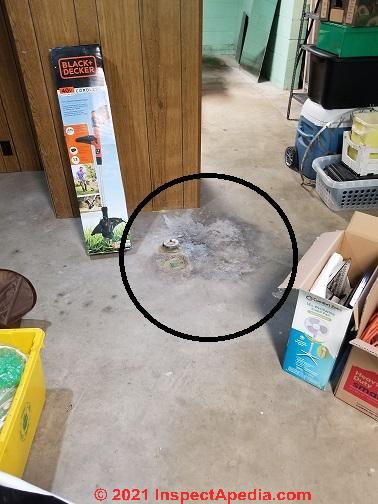
I am looking to purchase a home and we noticed an abandoned septic tank in the basement, please see attached image.
Would this cause any future problems with health concerns or the structure of the basement floor? Should the tank be removed or filled and then covered with concrete before we buy it?
Thanks in Advance for your advice.
On 2021-09-14 by inspectapedia.com.moderator (mod)
@Welch,
Most likely the septic tank remains water tight and is in a low area allowing surface runoff to pond above it. You may need to add fill and correct surface grading to avoid the ponding.
On 2021-09-12 by Welch
My old abandoned septic tank is covered with water. What does that mean?
On 2021-09-09 by mak.church (mod)
@Andrew,
You're welcome.
We've worked hard on this material for decades, so are really grateful when a reader finds it useful and trustworthy.
We also welcome your photos, questions, criticism or suggestions.
On 2021-09-08 by Andrew
@mak.church,
Understood, and thanks again. It's very much appreciated.
On 2021-09-08 by mak.church (mod) - fill in the empty septic tank
@Andrew,
If unable to collapse, the main issue is that it's completely and solidly filled in.
On 2021-09-08 by Andrew
@mak.church,
Thanks for the reply! Is the collapsing necessary? It's a residential area and getting a backhoe into the backyard would be quite difficult and expensive.
On 2021-09-08 by mak.church (mod) - usual procedure for breaking up an old septic tank
@Andrew,
Usually an old septic tank is broken up in-place using a backhoe.
The backhoe operator may pull in the tank sides, crush them, and push the parts to the bottom then back-fill with soil and rubble. At the same time, the backhoe operator can break a few holes in the bottom of the tank so that it won't hold surface runoff, forming an un-wanted water or mud reservoir.
As far as using the patio stones and concrete as part of the fill, that is fine. Along with the gravel you mention, make sure that the septic tank fill is solid & compacted to avoid future settlement of the septic tank fill that can cause sudden dangerous collapses.
On 2021-09-08 by Andrew
I recently realized we have a 60 year old concrete septic tank that hasn't been used in, probably, over 40 years that was possibly never drained.
While locating it, my probe went between two lids (It has 3 lids which are side by side), and came up wet.
I'm unsure whether it's just groundwater or if the tank was never pumped when it was abandoned. I'm having it pumped, but I'm unsure about filling it. It's currently beneath a patio consisting of 88 patio stones.
My thought it that, since I need to dispose of those stones, I can just dump them in the tank, once it's been emptied. Then fill the rest with gravel, and finally a layer of concrete (I'm having concrete poured for a project, so the expense of topping the tank off is not an issue.
Does this sound reasonable? Would the extra weight from the patio stones/gravel/concrete be a concern? Would this tank need holes bashed in the bottom, considering how it will be filled? Thanks!
On 2021-07-12 by inspectapedia.com.moderator (mod)
@Anonymous,
For safety be sure that you block off access to the area so that no one can fall into the septic tank.
Any local excavator can provide the tank excavation and fill service that you need.
On 2021-07-12 by Anonymous
@John,
Hi, the same think just happened to me at my house.
I just found a hole in my yard end it came from an old septic system back in the 60s it wasn’t filled in properly when the house was connected to the town water. How much did it cost? And Can you recommend anyone to do the job?
On 2021-06-22 by Anonymous
@inspectapedia.com.moderator, Thanks!
On 2021-06-22 by inspectapedia.com.moderator (mod) - Could I build a residence neighborhood on what once was a leach field ?
@Nick,
I have not found a "standard practice" across any country on this question.
In my OPINON it would make a lot more sense to
1. Identify the construction plan: what excavation will be required?
2. How much septic drainfield soil will be disturbed, to what depth, and what will remain, and where?
3. With 1 & 2 addressed, obtain objective data by having appropriate soil - bacteria tests performed to determine the level of contamination and this to guide any further action (if any is needed).
In my OPINION the cost of such tests and construction planning would be next-to-nothing and would far outweigh the cost of simply waiting some arbitrary guideline time period without a shred of data about the actual conditions at the actual building site.
On 2021-06-22 by Nick
Could I build a residence neighborhood on what once was a leach field after proper decommission of the septic tank and leach field? How long would one wait for the soil to be considered "uncontaminated?" My county and city ordinances don't address this; what would you consider standard practice? Thanks.
On 2021-05-28 - by (mod) -
@John,I am of course completely sympathetic with your point and have myself in many articles emphasize this safety hazards, and I have personally been involved in investigating fatalities in which someone fell into a collapsing system. So of course I take this seriously.
However the important thing now is to address what you agree is a significant hazard and to argue about who should have done what later.
On 2021-05-28 by John
I understand what you are saying but I still think whoever installed the sewer should have made sure it was filled in. I know they currently do but it seems unfair t have to pay several thousand dollars for something that could have been prevented years ago.
I was never "being served" by the system since the property already had sewers when I bought it.
Also I think those ion charge of these thing should publicize the dangers they pose since they can have fatal consequences.
I had no idea that it was even there until I looked out a window and saw a big hole in my backyard.
On 2021-05-15 by (mod) - My abandoned tank lid fell into the tank.
@John,
Thank you for asking and important question that clarifies who is responsible for septic tank abandonment. The answer is the property owner.
This is just an opinion, but I think that in every Community private on-site septic systems are the installation, responsibility, and cost to the property owner who is in fact the person who is being served by the septic system.
You wouldn't expect the town to be obligated to pay for that any more than you would expect the town to pay for fixing your electric wiring or putting shingles on your roof.
However the more important consideration now is that of safety.
If there's an open hole in your property if needs to be filled in.
It should be a straightforward job in any local excavation contractor can perform.
Meanwhile rope off the area and keep people away so that no one will be injured by falling into the hole.
On 2021-05-15 by John
My abandoned tank lid fell into the tank. I had some dirt dumped into the hole but after reading a number of articles, it appears that this is not the best solution.
I called the town right after it happened and they said it is my problem because it is on private property.
I have lived in my home about 30 years and was not even aware it was there.
It also seems that there will be a considerable expense to correct this. I am on a limited income and get about $1200 a month Social Security.
What I want to know is why the town didn't require it to be filled in properly when sewers were installed. And since it wasn't, why do I have to pay for it?
On 2019-12-12 by (mod) -
Marcie
Usually an old septic tank is broken up in-place using a backhoe. The backhoe operator may pull in the tank sides, crush them, and push the whole steel tank to the bottom then back-fill with soil and rubble.
In a DIY project we might use a heavy steel wrecking bar or "digging bar" like the six-foot long Westward-brand bar shown below: just punch a dozen holes in the old steel tank bottom.
Watch out: falling into the old septic tank risks being cut and badly infected even if the tank is already emptied of sewage. Don't work alone.
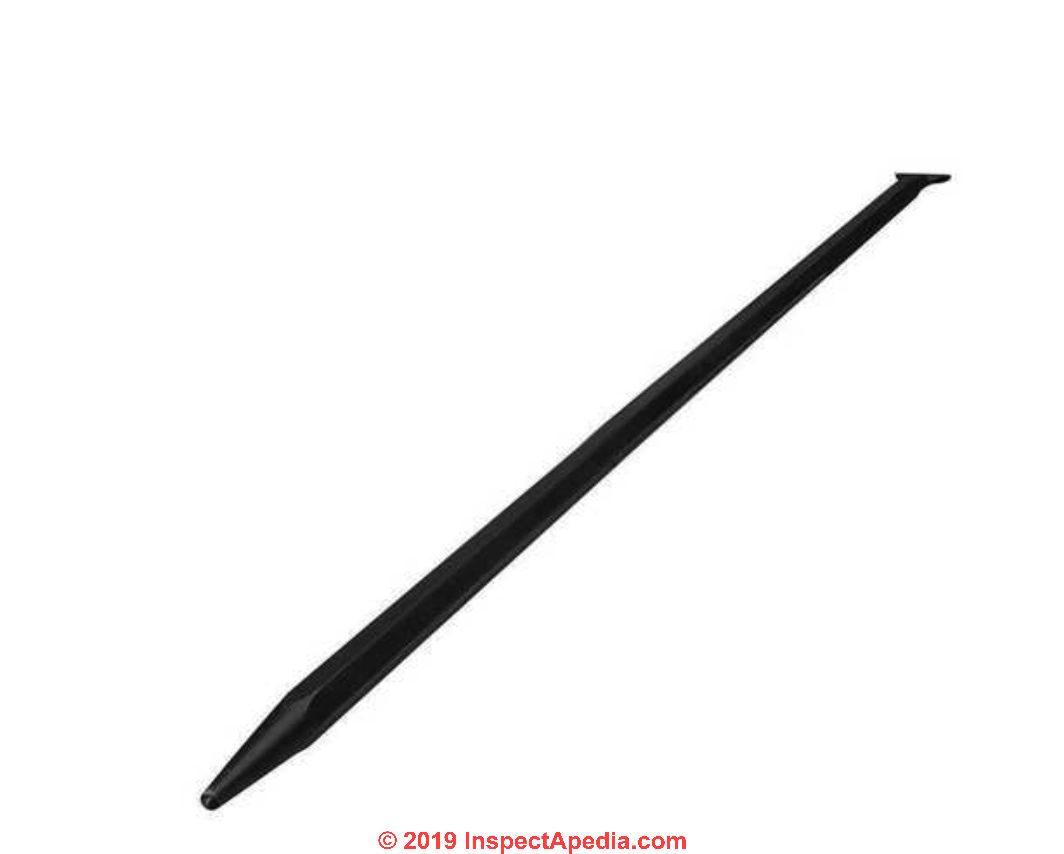
On 2019-12-12 by (mod) - wrecking bar or digging bar to punch holes in old steel septic tank bottom?
Marcie
Usually an old septic tank is broken up in-place using a backhoe. The backhoe operator may pull in the tank sides, crush them, and push the whole steel tank to the bottom then back-fill with soil and rubble.
In a DIY project we might use a heavy steel wrecking bar to just punch holes in the old steel tank bottom.
Watch out: leaning-over or falling into the old septic tank risks being cut and badly infected even if the tank is already emptied of sewage. Don't work alone.
On 2019-12-12 by Marcie
How do I bust through the bottom of an old septic tank and just how much do I need to tear it up before filling it? There's a septic tank that used to service my house, which I found when digging in a garden. I uncovered the whole thing. It's metal and the roof was corroding. I rented a pump and pumped the rain water out.
The tank probably hasn't been in use for 20+ years (I've been in the house for 13 years), but one of the former owners just didn't bother fill it. A plumber cleared me to get the tank filled.
Another company was supposed to fill it, but it rained heavily the day they were supposed to do the work. The machine they would use will tear up my yard if the yard isn't completely dry.
Right now, I don't know when that will be, since the weather channel is predicting more rain. I already have the dirt to fill the tank. I just need to know how to bust the holes.
On 2019-08-17 by (mod) - don't leave an abandoned septic tank empty in place - it's dangerous
Watch out: For safety I recommend filling in the old brick-built septic tank completely.
The alternative is to risk a sudden fatal collapse some day in the future when some unfortunate person walks over the tank.
On 2019-08-17 by DIANE WILD
I've had our septic tank replaced with a sewage treatment plant in April 2019. The old brick built septic tank has been emptied .
Does this need filling in completely OR could I seal over the inspection cover with paving & leave essentially "empty"?
Many thanks, Diane
On 2019-07-06 by (mod) - pump out & fill - abandoned seepage pits
Anon:
I can't say for sure but generally if the seepage pits no longer function they are abandoned.
However in some installations they're left in line rather than excavating and running all new drain lines.
But in your case, as the Infiltrator system is going to be nowhere nearly-as deep, you'll disconnect and abandon the pits.
Watch out: an abandoned septic tank or seepage pit can cause injury of death if someone falls-in. It'd be best to have the pits emptied and filled with rubble.
On 2019-06-15 by Anonymous
My septic has 25 ft deep drain pits cause ground don't absorb water well ,was upgrading to infiltrator chambers do I still need the 25 ft deep pits
On 2019-05-30 by (mod) - remove 6 buried septic tanks
Jonathan, a final reliable answer really depends on what gets discovered at the site.
However for life safety reasons it is important to at the very least find and properly abandon each of those unused septic tanks.
That means finding the tank emptying it opening it and filling it with sand or gravel.
If the tank is going to be removed the cost goes up.
Sometimes the steel tank can be crushed and left in place at the bottom of a hole. In that case of course you're not filling the tank, you're crushing it
On 2019-05-29 by Jonathan
I've inherited where a mobile lot used to be out in the country. There are six septic tanks buried there. I do know where each are.
I'm wanting to dig them up and build a pond on the land. Is this even cost feasible or is properly having them drained, collapsing them and filling them in and then having them removed going to cost me a fortune? THX!!!!
On 2019-05-29 by Moderator - use of land over abandoned septic tank?
For gardening, there are so many variables to consider including:
- the degree of sewage effluent water that actually was in the soil that will be in contact with plant roots
- the soil properties
- the soil moisture level
- the health of aerobic and anaerobic bacteria in the soil
- the type of crops intended for planting and their root depth
In the case of a septic system that was not sending effluent to the surface, my inexpert OPINION is I'd wait a year or more before planting root crops (potatoes) or low crops that might be contaminated by rain splash-up.
Taller crops that produce edibles high enough above ground to avoid those risks, and fruit trees, are safe for planting sooner."
On 2019-05-29 by Kim
If a drain field is abandoned, and a new drain field is constructed in a different area, could you make use of the land where the abandoned drain field is? If so, what precautions should you take?
How long should you wait before using the abandoned drain field? Can you use it for purposes of gardening or building a patio on top?
On 2019-05-29 by Jonathan - dig out the septic tanks and put in a pond?
I've inherited where a mobile lot used to be out in the country.
There are six septic tanks buried there. I do know where each are. I'm wanting to dig them up and build a pond on the land. Is this even cost feasible or is properly having them drained, collapsing them and filling them in and then having them removed going to cost me a fortune? THX
On 2019-05-14 by (mod) -
Jack you'll find oil tank abandonment described on this page - above and in the ARTICLE INDEX you'll find OIL TANK REGULATIONS - which vary by country and jurisdiction such as state, province, or city.
Generally you test to assure that there has been no leakage, then either fill in place a buried tank (eg with sand) or remove the tank.
If the tank has leaked it must be physically removed and the oil contaminated soil removed.
On 2019-05-14 by Jack Kelly
Need a how to abandon a old residence septic tank what regulation covers this topic
On 2019-04-06 by (mod) -
Don
My most complete suggestions are in the article above. Please take a look and let me know if you have any questions.
On 2019-04-04 by don salter
We have a kitchen extension which revealed a Victorian cess pit which has been long abandoned.
There is absolutely no smell and the walls and floor are brick which we have cleaned. We want to fill this in with approx measurements 1.6 m deep 2 m long and 1 wide. What is the best way to do this please.
On 2019-01-02 by (mod) -
Investigate the yuck smell further.
If the septic tank was "filled in" without first pumping out the sewage then it was not properly abandoned. In that case you *might* have success by adding a plastic barrier then more fill; otherwise it's dig up, haul away, and bring in fresh fill and re-seed.
On 2019-01-02 by Victoria
We are buying a house that had an old septic tank filled in. All I can smell is pure yuck in the backyard. What can be done?
...
Continue reading at SEPTIC & CESSPOOL SAFETY or select a topic from the closely-related articles below, or see the complete ARTICLE INDEX.
Or see SEPTIC TANK ABANDONMENT PROCEDURE FAQs - questions & answers posted originally at this article
Or see these
Recommended Articles
- ABANDONED or NEW SEPTIC SYSTEM TESTS
- SEPTIC & CESSPOOL SAFETY
- SEPTIC LOCATION VIDEO
- SINKHOLE DETECTION, WARNING SIGNS
- WELL ABANDONMENT PROCEDURE
Suggested citation for this web page
SEPTIC TANK ABANDONMENT GUIDE at InspectApedia.com - online encyclopedia of building & environmental inspection, testing, diagnosis, repair, & problem prevention advice.
Or see this
INDEX to RELATED ARTICLES: ARTICLE INDEX to SEPTIC SYSTEMS
Or use the SEARCH BOX found below to Ask a Question or Search InspectApedia
Ask a Question or Search InspectApedia
Questions & answers or comments about problems with the operation of aerobic septic systems
Try the search box just below, or if you prefer, post a question or comment in the Comments box below and we will respond promptly.
Search the InspectApedia website
Note: appearance of your Comment below may be delayed: if your comment contains an image, photograph, web link, or text that looks to the software as if it might be a web link, your posting will appear after it has been approved by a moderator. Apologies for the delay.
Only one image can be added per comment but you can post as many comments, and therefore images, as you like.
You will not receive a notification when a response to your question has been posted.
Please bookmark this page to make it easy for you to check back for our response.
Our Comment Box is provided by Countable Web Productions countable.ca
Citations & References
In addition to any citations in the article above, a full list is available on request.
- Thanks to Donica Ben who points out the danger of digging into buried electrical wires (11/11/07)
- [1] Pennsylvania State Fact Sheets relating to domestic wastewater treatment systems include
- Pennsylvania State Wastewater Treatment Fact Sheet SW-161, Septic System Failure: Diagnosis and Treatment
- Pennsylvania State Wastewater Treatment Fact Sheet SW-162, The Soil Media and the Percolation Test
- Pennsylvania State Wastewater Treatment Fact Sheet SW-l64, Mound Systems for Wastewater Treatment
- Pennsylvania State Wastewater Treatment Fact Sheet SW-165, Septic Tank-Soil Absorption Systems
- Document Sources used for this web page include but are not limited to: Agricultural Fact Sheet #SW-161 "Septic Tank Pumping," by Paul D. Robillard and Kelli S. Martin. Penn State College of Agriculture - Cooperative Extension, edited and annotated by Dan Friedman (Thanks: to Bob Mackey for proofreading the original source material.)
- Septic Tank/Soil-Absorption Systems: How to Operate & Maintain [PDF ] - , Equipment Tips, U.S. Department of Agriculture, 8271 1302, 7100 Engineering, 2300 Recreation, September 1982, web search 08/28/2010, original source: http://www.fs.fed.us/t-d/pubs/pdfimage/82711302.pdf.
- [4] Installers Manual for Conventional Onsite Domestic Wastewater Treatment and Disposal Systems", Alaska Department of Environmental Conservation, Division of Water, retrieved 1/15/2001, original source: [copy on file as Alaska_Certified_Installer's_Manual.pdf]
- Advanced Onsite Wastewater Systems Technologies, Anish R. Jantrania, Mark A. Gross. Anish Jantrania, Ph.D., P.E., M.B.A., is a Consulting Engineer, in Mechanicsville VA, 804-550-0389 (2006). Outstanding technical reference especially on alternative septic system design alternatives. Written for designers and engineers, this book is not at all easy going for homeowners but is a text I recommend for professionals--DF.
- "Manual of Policy, Procedures, and Guidelines for Onsite Sewage Systems," Ontario Reg. 374/81, Part VII of the Environmental Protection Act (Canada), ISBN 0-7743-7303-2, Ministry of the Environment,135 St. Clair Ave. West, Toronto Ontario M4V 1P5 Canada $24. CDN.
- Manual of Septic Tank Practice, US Public Health Service's 1959.
- Onsite Wastewater Disposal, R. J. Perkins;
- Septic System Owner's Manual, Lloyd Kahn, Blair Allen, Julie Jones, Shelter Publications, 2000 $14.95 U.S.
- Wells and Septic System, Alth, Max and Charlet, Rev. by S. Blackwell Duncan, $ 18.95; Tab Books 1992.
- In addition to citations & references found in this article, see the research citations given at the end of the related articles found at our suggested
CONTINUE READING or RECOMMENDED ARTICLES.
- Carson, Dunlop & Associates Ltd., 120 Carlton Street Suite 407, Toronto ON M5A 4K2. Tel: (416) 964-9415 1-800-268-7070 Email: info@carsondunlop.com. Alan Carson is a past president of ASHI, the American Society of Home Inspectors.
Thanks to Alan Carson and Bob Dunlop, for permission for InspectAPedia to use text excerpts from The HOME REFERENCE BOOK - the Encyclopedia of Homes and to use illustrations from The ILLUSTRATED HOME .
Carson Dunlop Associates provides extensive home inspection education and report writing material. In gratitude we provide links to tsome Carson Dunlop Associates products and services.
 | HOME | ABOUT | ASK a QUESTION | CONTACT | CONTENT USE POLICY | DESCRIPTION | POLICIES | PRIVACY | |
| © 2024 - 1985 Publisher InspectApedia.com - Daniel Friedman | |||||||||