
InspectAPedia® FREE Encyclopedia of Building & Environmental Construction, Diagnosis, Maintenance & Repair |
Question? Just ask us! InspectAPedia
|
 Toilet Paper: What Kinds are Best For a Septic Tank - Septic Tank Maintenance Guide
- POST a QUESTION or COMMENT about using biodegradable toilet paper in homes connected to a septic tank
Choosing toilet paper:
Should we use special or bio-degradable toilet paper when a home is connected to a private septic system? What kinds of paper or toilet tissue may damage the septic tank or leach fields?
InspectAPedia tolerates no conflicts of interest. We have no relationship with advertisers, products, or services discussed at this website.
Which toilet tissue is best to use?
 Are Special Toilet Tissue or other Special Septic Products Needed for Homes Connected to a Private Septic Tank & Drainfield?
Discussed here: Does toilet tissue create a problem in the septic tank?
Should we be using special kinds of biodegradable toilet tissue?Recommendations for use of recycled-paper toilet tissue versus ultra-soft fluffy toilet paper brands address using recycled paper versus cutting down standing trees. Recommendations for use of biodegradable toilet paper
Ordinary toilet tissue does not appear harm ordinary septic tank and drainfield systems
In a conventional septic system using a tank and drainfield, ordinary toilet tissue does not harm the septic system. The tissue remains in the septic tank, kept from flowing into the drainfield by septic tank baffles.
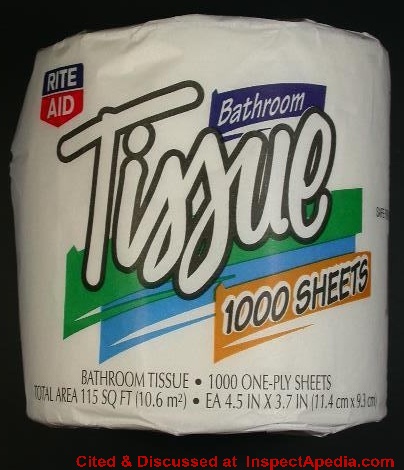
Actually lower-cost toilet tissues such as the Rite-Aid bathroom tissue shown at left perform better (break down faster and more completely) in septic tanks than some plush extra soft brands containing softening additives.
Eventually (we think) toilet tissue breaks down in the septic tank and is not a solid bulk problem at normal levels of usage.
See TOILET TISSUE TEST for details.
But as we discuss just below at What About Putting No Toilet Paper into the Septic Tank At All? we're not sure about the ultimate breakdown of cellulose fibers from toilet tissue, and the break-down of toilet paper may vary depending on the type of paper and its composition.
Certainly, other types of paper or paper products (writing paper, newspaper, magazine paper, bills and private letters) should not be flushed down a toilet.
See WHAT CAN GO INTO TOILETS & DRAINS?.
That document explains how to extend the life of the septic system by being careful about what goes into it.
Toilet paper made from recycled paper is recommended
However, because the manufacture of fluffy soft toilet tissue requires the use of new wood fibers from trees, we recommend that consumers purchase and use toilet tissue made of recycled paper.
Not because soft toilet tissue hurts our septic system, but because ultra-soft tissue brands mean we're flushing our forests down the drain unnecessarily.
Look for toilet tissue that is made entirely or at least in part from recycled paper. It won't hurt you.
In February 2009 Greenpeace joined the ranks of associations who recommend against flushing our trees down the toilet.
What About Putting No Toilet Paper into the Septic Tank At All?
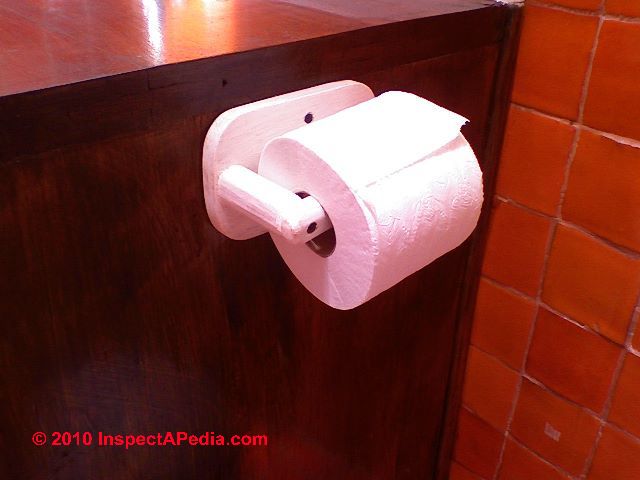
In some areas toilet tissue is not flushed into the septic system at all: Our photo (left) shows a home-made toilet paper dispenser in San Miguel de Allende, Guanajuato, Mexico. In many areas of Mexico custom is to avoid flushing toilet tissue into the septic system at all. Instead a waste container is provided near each toilet, and the user disposes of tissue therein.

Inspecting the interior of septic tanks in other areas of North America, we don't observe large volumes of visible toilet tissue forming a big percentage of the solid waste retained in the septic tank. But our Mexican neighbors might be on to something.
While we think that toilet paper "dissolves" in septic effluent, preliminary results of our own laboratory test of the break-down of toilet tissue in tap water show that fine particles of cellulose may be discharged to the drainfield, possibly adding to soil clogging there.
But our lab test is incomplete, and has not yet considered the effects of bacteria and water-borne fungi in cellulose decomposition in septic systems.
See TOILET TISSUE TEST.
Note: actually a very common reason for avoiding sending anything unnecessary down a toilet drain, including toilet tissue, is that in some locales building drain piping is small in diameter, old, poorly installed, includes unnecessary bends or sharp angles, and is more prone to clogging than otherwise. Avoiding sending handfuls of toilet tissue down the drains along with solid wastes can help avoid clogging drain piping.
What is Toilet Paper Made From?
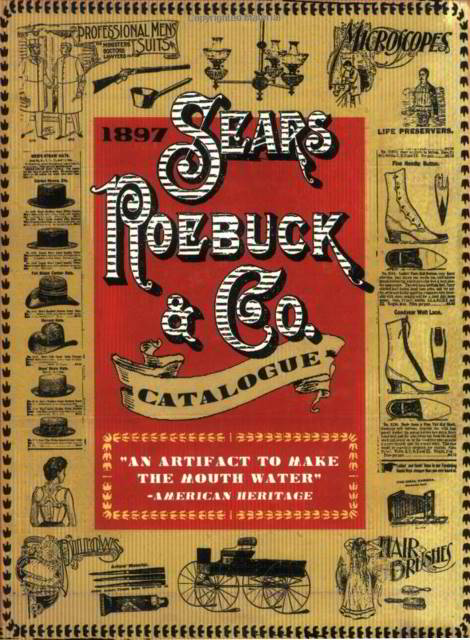 Traditional toilet paper used in a privy or outhouse included books, newspapers, the Sears catalog, corncobs, scraps of rag, and whatever else was at hand.
Since all waste including toilet paper ended up in the same direct-deposit system there was no concern for clogged pipes nor interference with a soakbed operation.
Austin Woerner, writing for The New York Times Magazine and interviewing Su Wei, a novelist who teaches Chinese languate and literature at Yale, gave this interesting report by Su Wei who described the effects of Chairman Mao's ban on feudalist or capitalist or revisionist literature in China during the cutlural revolution.
Fifteen year old Sue began working on the Xipei Rubber Plantation in southern China.
"... one morning, as I was preparing to go to work, I saw a thick wad of paper nailed to a door with a heavy metal spike. It was a novel by Liu Qing, and it was called "To Build a New Life."
The older boys liked to steal books from the shuttered plantation library and pin them to their doors, so they could tear off pages to use as bathroom tissue when they went to the latrine." - Su Wei, as told to Austin Woerner, "Privy to the Plot", The New York Times Magazine, March 2015, p. 28. Other translations: "The Builder of a New Life". Liu Qing / Liu Yunhua (1916 - 1978).
Su continues to explain that by finding something else to be used as toilet paper he was ermitted to rescue Liu Qing's novel - a text that began his real education that he continued by reading other books that he saved from "a similar fate" as toilet paper in southern China.
Modern toilet tissue with a high percentage or even 100% of recycled paper is less soft and fluffy than other brands, but we agree with Dr. Allen Heskowitz, senior scientist and waste expert at the Natural Resource Defense Council who, according to a 2009 New York Times report, said
"No forest of any kind should be used to make toilet paper." The Times reported that American "... obsession with soft paper has driven the growth of brands like Cottonelle Ultra™, Quilted Northern™ and Charmin Ultra™" brands of toilet tissue.
Producers of "Soft" Toilet Tissue
Proctor & Gamble produces soft toilet tissue sold under the Charmin Ultra™ brand. Kimberly Clark produces soft toilet paper produces soft toilet tissue sold under the Cotonelle™ brand. Scott™ produces soft fluffy toilet tissue as well. Georgia Pacific is the parent company of the toilet tissue brand Quilted Northern Ultra™.
Some of these manufacturers also produce other toilet papers made from recycled paper. (See below).
What is Used to Make Soft Toilet Tissue?
The manufacture of these ultra-soft toilet papers (and similar soft tissue sold under other brands) requires the use of paper made from live, standing trees. According to the Times article, 25% to 50% of the wood pulp used in toilet paper comes from tree farms in South America and the U.S.
The remaining 50% to 75% of toilet paper wood pulp is cut from old growth forests including Canadian old growth timber. Some of these boreal forest trees are 200 years old, and all of them were functioning as an important carbon sink.
Use Recycled-Fiber Toilet Tissue
Toilet paper made from recycled paper fibers also uses less chlorine-based bleach, reducing groundwater pollution, and it produces less landfill volume as well. Using recycled paper-based toilet tissue also means that the volume of toilet tissue in private septic tanks will actually be reduced, possibly slightly extending the time between septic tank pumpouts.
Use Alternatives to Toilet Paper: Disposable Wet Wipes & Baby Wipes?
Really? Generally you'd be advised to keep these out of your toilets, plumbing system, septic system, or sewer system.
For details - see DISPOSABLE WET WIPE CLOGS
Also see NEVER FLUSH INTO SEPTICS for a complete list.
Where to Buy Toilet Paper made from Recycled Paper
Greenpeace recommends these toilet tissue brands as "most green": Green Forest, 365, April soft, Earth Friendly, Fiesta & Fiesta Green, Natural Value, Seventh Generation, Trader Joe's.
Marcal Small Steps and Earth First are also made of 100% recycled fibers but with low percentage of post-consumer content. High post-consumer content toilet paper brands are less likely to have come from ancient forests.
Marcal Corporation markets recycled paper-based toilet paper through Walgreens at prices below the "soft fluffy" brands.
Kimberly Clark Corporation was reported in the Times as not philosophically opposed to recycled products and the company uses them in products sold to restaurants, offices, and schools.
Bio-degradable toilet tissue is recommended in certain cases
Where a chemical toilet is in use, such as on a boat or recreational vehicle, special toilet tissue which dissolves rapidly is recommended.
These other kinds of paper should never be flushed into a septic system
- Paper Towels: Do not flush paper towels into the septic system.
- Documents & newsprint: Do not use your toilet to dispose of unwanted documents, torn-up or not. Most document papers, even newsprint, are slow to degrade in a septic tank.
- Facial tissues into the septic are ok? maybe not. Some authorities also advise not flushing facial tissues into the septic system
See TOILET TISSUE TEST for an explanation of how bathroom tissue breaks down in the septic system.
See WASTEWATER TREATMENT BASICS for a simple explanation of how septic systems work.
Use of Recycled Paper - Based Toilet Paper, US EPA Recommendation, vs. Septic Tank Enzymes
Readers have often asked if it is necessary to add a septic tank treatment chemical or enzyme to reduce septic system clogging problems due to use of toilet paper.
No septic system additives are needed for system maintenance, and some are illegal in some states and in all of canada all of them are illegal, as we discuss in this article (see above).
See our article TOILET TISSUE CHOICES for a discussion of recommended kinds of toilet paper to use in homes connected to a septic system. Even regular toilet tissue breaks down to fine particles quickly. Also
see TOILET TISSUE TEST.
But in our OPINION (and that of the US EPA) we recommend using recycled paper-based toilet paper because of the benefit of saving trees - it’s too bad to chop down and grind up new trees to make toilet paper.
The data below quotes from the US EPA's information on Environmentally Preferable Purchasing (EPP) products, including types of toilet tissue and tissue vendors: [Bathroom Tissue - US EPA's comprehensive bath tissue procurement guidelines (CPG): the following quotes from the US EPA]
Commercial/ Industrial Sanitary Tissue Recommendations from the US EPA
Sanitary tissue products include bathroom and facial tissue, paper towels, napkins, and general-purpose industrial wipers.
They are generally sold in rolls or sheets and are used in personal care, food service, and cleaning applications.
The grades of sanitary tissue products covered in the CPG are manufactured for use by restaurants, hotels, schools, government agencies, and other similar commercial and institutional buyers. Some recycled-content sanitary tissue products are softer, stronger, and more absorbent than others.
| EPA's Recommended Recovered Fiber Content Levels for Commercial/Industrial Sanitary Tissue Products | ||
|---|---|---|
| Item | Post consumer Fiber (%): | Recovered Fiber (%): |
| Bathroom Tissue | 20-60 | 20-100 |
| Paper Towels | 40-60 | 40-100 |
| Paper Napkins | 30-60 | 30-100 |
| Facial Tissue | 10-15 | 10-100 |
| General Purpose Industrial Wipes | 40 | 40-100 |
Notes to the table above
NOTE: The toilet paper content levels should be read as X% recovered fiber, including Y% post consumer fiber and not as X% recovered fiber plus Y% postconsumer fiber.
Toilet Paper Product Information:
-
Database of Manufacturers and Suppliers including toilet tissue using recycled paper:
This database identifies manufacturers and suppliers of commercial/industrial sanitary tissue products containing recovered fiber.
[See epa.gov/epawaste/conserve/tools/cpg/database.htm ] - we did not find this data base working very well at producing lists of recycled toilet tissue manufacturers - but see our product lists and description at TOILET TISSUE CHOICES - GSA Advantage!: Sanitary tissue products can be ordered through the General Service Administration's (GSA's) online ordering system. In addition, GSA publishes various supply catalogues, guides, and schedules for recycled-content products available through the Federal Supply Service. [See gsaadvantage.gov ]
Question: what's the best toilet paper to use to avoid harming the septic system?
 2018/06/20 Rena said:
What is best toilet paper to use that will not cause septic problems?
This question and reply were posted originally
[Click to enlarge any image]
Reply: pumping the septic tank on time is more important than choice of toilet paper
Rena
Thanks for an important and popular question: which TP is best to use to avoid septic problems.
IMO any TP is fine.
Any toilet tissue that has not broken down in the septic tank will be removed when the septic tank is pumped - on schedule. That pumping is the most-critical step to maintain the septic system.
See SEPTIC TANK PUMPING SCHEDULE
There are a few details worth considering:
1. There's not much difference in my experience between the breakdown rate of toilet papers:
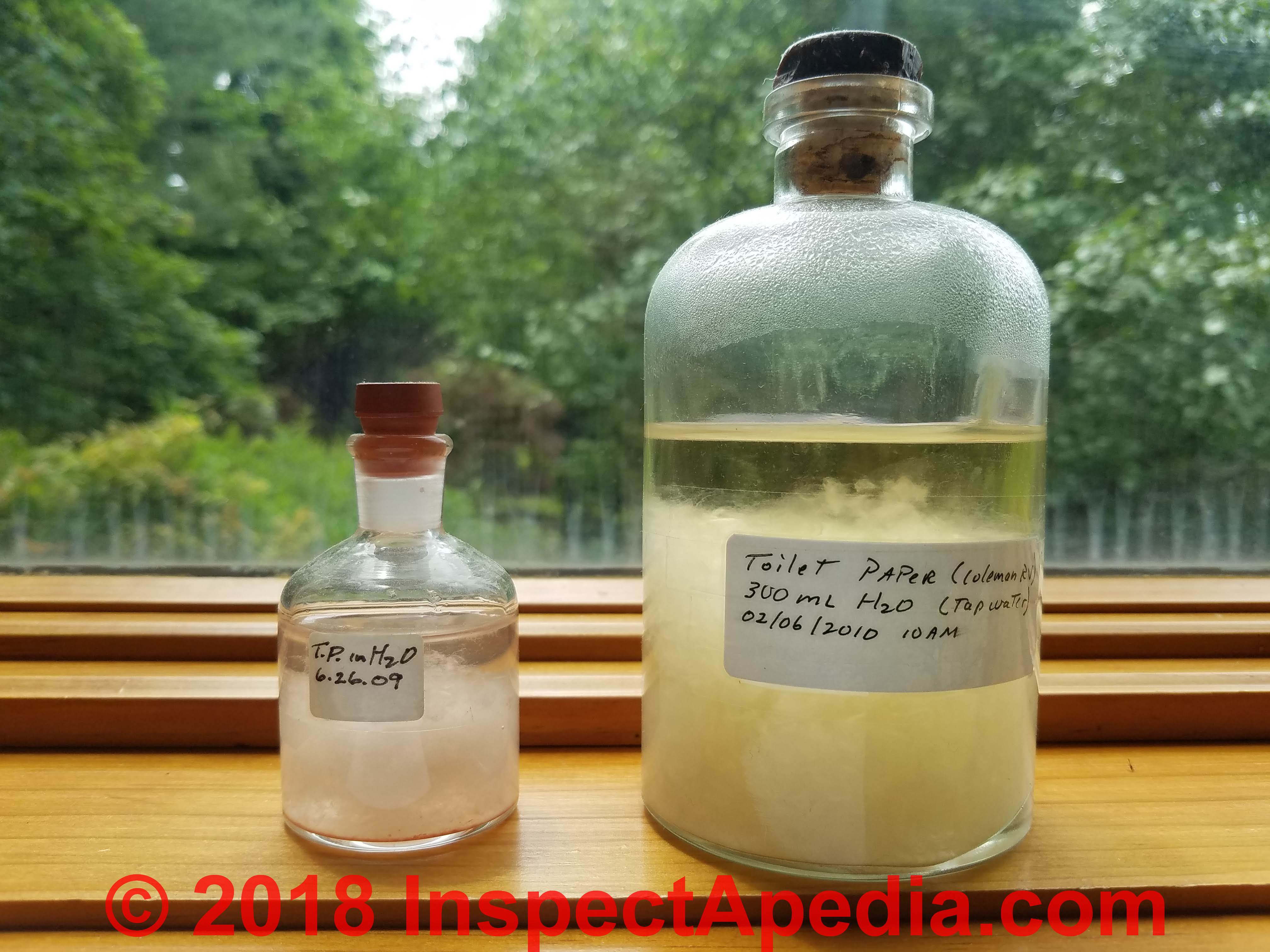
The toilet tissue test I report on above was begun in 2009 and 2010 using conventional toilet paper in water (2009) and Coleman RV toilet paper in 2010. Today, eight years later, both bottles show that the paper looks about the same.
To be fair, I'm using water, not sewage that would contain more bacteria that might speed the paper's break-down.
However there is some bacterial action going on even in my toilet paper samples.
A photo of the ongoing toilet paper test samples is below.
2. There is some risk that a toilet paper that claims to rapidly break down into small particles (recommended for RV or chemical toilet use) might actually cause damage to some septic drainfields:
if other septic system defects like a lost baffle or tank tee or the absence of a septic tank outlet filter permits solids to flow into the drainfield, those small paper fragments might speed field clogging.
...
Continue reading at TOILET TISSUE TEST or select a topic from the closely-related articles below, or see the complete ARTICLE INDEX.
Or see TOILET TISSUE CHOICES FAQs - questions & answers about types of toilet paper posted originally at this page.
Or see these
Recommended Articles
- DISPOSABLE WET WIPE CLOGS
- NEVER FLUSH INTO SEPTICS
- TOILETS, DON'T FLUSH LIST
- TOILET TISSUE CHOICES
- TOILET TISSUE TEST
Suggested citation for this web page
TOILET TISSUE CHOICES at InspectApedia.com - online encyclopedia of building & environmental inspection, testing, diagnosis, repair, & problem prevention advice.
Or see this
INDEX to RELATED ARTICLES: ARTICLE INDEX to TOILET INFORMATION
Or use the SEARCH BOX found below to Ask a Question or Search InspectApedia
Ask a Question or Search InspectApedia
Try the search box just below, or if you prefer, post a question or comment in the Comments box below and we will respond promptly.
Search the InspectApedia website
Note: appearance of your Comment below may be delayed: if your comment contains an image, photograph, web link, or text that looks to the software as if it might be a web link, your posting will appear after it has been approved by a moderator. Apologies for the delay.
Only one image can be added per comment but you can post as many comments, and therefore images, as you like.
You will not receive a notification when a response to your question has been posted.
Please bookmark this page to make it easy for you to check back for our response.
Our Comment Box is provided by Countable Web Productions countable.ca
Citations & References
In addition to any citations in the article above, a full list is available on request.
- Flegenheimer, Matt, "Wet Wipes Box Says Flush. New York's Sewer System Says Don't", The New York Times, 13 March 2015
- New York State Department of Health, APPENDIX 75-A WASTEWATER TREATMENT STANDARDS - INDIVIDUAL HOUSEHOLD SYSTEMS , [PDF] New York State Department of Health, 3 February 2010, retrieved 3/1/2010, original source: https://www.health.ny.gov/regulations/nycrr/title_10/part_75/appendix_75-a.htm
- New York Times: "What Mr. Whipple Didn't Say: Softer Paper is Costly to Forests", Leslie Kaufman, New York Times, 2/26/2009 p. A17
- Greenpeace: 2/18/2009 article at http://www.greenpeace.org/usa/press-center/reports4/tissueguide includes a downloadable .PDF file. The Greenpeace site reports "Did you know? Americans could save more than 400,000 trees if each family bought a roll of recycled toilet paper—just once. Recycled tissue products help protect ancient forests, clean water, and wildlife habitat. It's easier on the Earth to make tissues from paper instead of trees. Download our printable pocket-sized version of the Guide."
- Kazunori, Hanyu, Hirohisa Kishino, Hidetoshi Yamashita and Chikio Hayashi. "Linkage between recycling and consumption: a case of toilet paper in Japan." Resources, Conservation and Recycling, Volume 30, Issue 3 (1 September, 2000): 177-199.
This study examines consumer factors of paper recycling in Japan. The study specifically focuses on toilet paper as a paper product and attempts to reveal how individuals evaluate recycled toilet paper, how the evaluation relates to toilet paper consumption, and why people use or do not use recycled toilet paper. The study also examines what factors influence collection recycling behavior, and what people believe as necessary to achieve a society with better recycling. Responses were obtained from 1242 respondents in Japan. Four results were found. (1) People cannot judge the raw material of virgin toilet papers correctly, while people can correctly judge the raw material of recycled toilet paper. Furthermore, the image of recycled toilet paper also had negative impact on the willingness to use recycled toilet paper. (2) The primary criterion for purchasing recycled toilet paper was pro-environmental attitude. For the virgin toilet paper, it was brand. As expected, recycled toilet paper users had a positive evaluation and image of recycled toilet paper, while virgin toilet paper users had a negative evaluation and image of it. (3) Actual recycling behavior might not relate directly to consumption behavior of recycled paper. Rather, it was determined by the knowledge of waste collection systems and payment systems. (4) Most people have not realized that without the consumption of recycled products, the recycling system is not completed.
- Recycled Content in toilet paper (US EPA definition): When reporting recycled content, some toilet paper (and other product) manufacturers report total recycled content (combining pre- and post-consumer waste re-use) while others report post-consumer only. Both pre-consumer and post-consumer recycled materials provide the environmental benefits of displacing virgin feedstocks such as toilet paper using a high percentage of paper made from trees. Using post-consumer content has the added benefit of providing markets for materials separated for recycling by consumers, such as newspapers and magazines.
- Postconsumer Materials (US EPA definition): A material or finished product that has served its intended use and has been diverted or recovered from waste destined for disposal, having completed its life as a consumer item. Postconsumer materials are part of the broader category of recovered materials.
- Recovered materials: Waste materials and byproducts that have been recovered or diverted from solid waste, but does not include materials and byproducts generated from, and commonly reused within, an original manufacturing process.
- Pennsylvania State Wastewater Treatment Fact Sheet SW-161, Septic System Failure: Diagnosis and Treatment
- Pennsylvania State Wastewater Treatment Fact Sheet SW-162, The Soil Media and the Percolation Test
- Pennsylvania State Wastewater Treatment Fact Sheet SW-l64, Mound Systems for Wastewater Treatment
- Pennsylvania State Wastewater Treatment Fact Sheet SW-165, Septic Tank-Soil Absorption Systems
- Document Sources used for this web page include but are not limited to: Agricultural Fact Sheet #SW-161 "Septic Tank Pumping," by Paul D. Robillard and Kelli S. Martin. Penn State College of Agriculture - Cooperative Extension, edited and annotated by Dan Friedman (Thanks: to Bob Mackey for proofreading the original source material.)
- Our recommended books about building & mechanical systems design, inspection, problem diagnosis, and repair, and about indoor environment and IAQ testing, diagnosis, and cleanup are at the InspectAPedia Bookstore. Also see our Book Reviews - InspectAPedia.
- In addition to citations & references found in this article, see the research citations given at the end of the related articles found at our suggested
CONTINUE READING or RECOMMENDED ARTICLES.
- Carson, Dunlop & Associates Ltd., 120 Carlton Street Suite 407, Toronto ON M5A 4K2. Tel: (416) 964-9415 1-800-268-7070 Email: info@carsondunlop.com. Alan Carson is a past president of ASHI, the American Society of Home Inspectors.
Thanks to Alan Carson and Bob Dunlop, for permission for InspectAPedia to use text excerpts from The HOME REFERENCE BOOK - the Encyclopedia of Homes and to use illustrations from The ILLUSTRATED HOME .
Carson Dunlop Associates provides extensive home inspection education and report writing material. In gratitude we provide links to tsome Carson Dunlop Associates products and services.
 | HOME | ABOUT | ASK a QUESTION | CONTACT | CONTENT USE POLICY | DESCRIPTION | POLICIES | PRIVACY | |
| © 2024 - 1985 Publisher InspectApedia.com - Daniel Friedman | |||||||||