
InspectAPedia® FREE Encyclopedia of Building & Environmental Construction, Diagnosis, Maintenance & Repair |
Question? Just ask us! InspectAPedia
|
 Does a home Washing Machine Affect the Septic Tank?
- POST a QUESTION or COMMENT about septic system maintenance where a washing machine is used and empties into the septic tank
Clothes washing machines vs. the septic system:
Can we use a clothes washer or "washing machine" when a home is connected to a private septic system? What steps should be taken to protect the septic system from excessive water use or clothes lint or detergents? How to extend the life of a septic system.
InspectAPedia tolerates no conflicts of interest. We have no relationship with advertisers, products, or services discussed at this website.
Washing Machine Draining into Septic System
Article Contents
[Click to enlarge any image]
Does a washing machine overload and harm the septic system?
The volume of water from home washing machine use should not be a problem with a normal septic system in good working order.
As we discussed at Dishwashers, in some conditions you should avoid emptying washing machine discharge into the septic system:
- Drainfield capacity limits: If the absorption system (leach field, drainfield) has limited capacity to absorb effluent
- Drainfields near failure: If the absorption system is showing evidence of failure, such as effluent coming to the surface of the property or backing up into the building (nonetheless you need septic field investigation and repair)
Below we discuss steps you can take to minimize the possible effects of extra wastewater loads caused by washing machines, and then we discuss the effects of detergents and soaps when operating a clothes washer connected to a septic system or drywell.
Does Washing Machine Detergent Harm the Septic Tank or Septic System Drainfield?
The volume of detergent from a residential clothes washer entering the septic system is so low as to be very dilute when it enters the septic tank, dilute enough that it is not going to harm the septic tank bacteria at normal levels of residential dishwasher use.
Clothes washing machine detergents do not make a high level of suds inside the machine.They rely on surfactants, high water temperature, and time spent agitating the contents of the clothes washing machine to clean them.
However many if not most washing machine (and dishwasher) detergents contain phosphates or nonylphenol ethoxylate surfactants. Surfactants are what make detergents effective in lifting soil particles off of a surface (a dish in the dishwasher or a shirt in the washing machine). These chemicals may be serious contaminants of ground water and surface water in the environment.
What laundry detergents or soaps should we use in a Clothes Washing Machine connected to a septic tank or to a Graywater System?
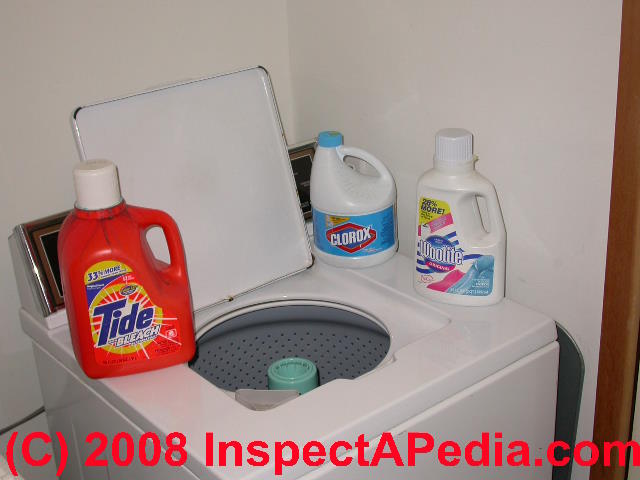
Sometimes we find that dry powder clothes washer soap appears as clots and clogs in the system - usually because the homeowner is pouring in too much detergent and is not following the manufacturer's instructions.
Passing
solid clumps of detergent into the septic tank speed clogging of the system and in severe cases can even block a
building drain.
Recommended dishwasher & laundry detergents: are discussed in detail separately
at DETERGENTS in our article
at DISHWASHERS vs SEPTICS where we discuss recommended detergents and also the effects of phosphates & detergents on the environment.
How to minimize the possible clogging or other effects of laundry soaps on the septic system
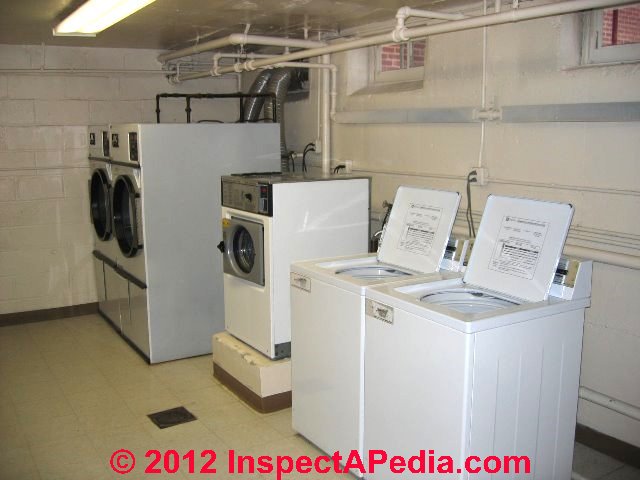
A private septic system tank and drainfield can be protected from clogging due to excessive use of detergents.
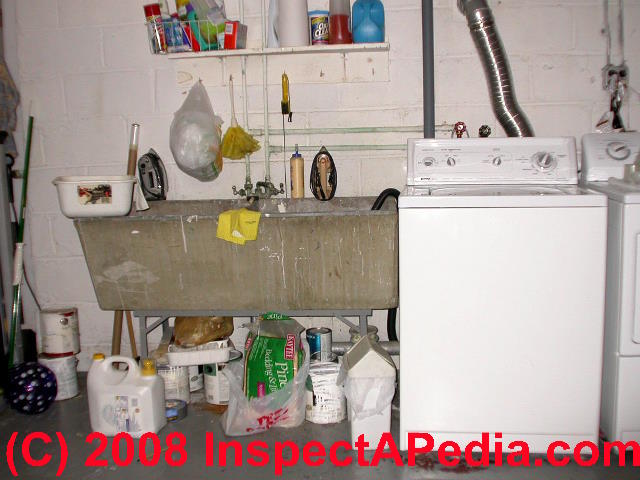
And even if a building's wastewater is carried to a public sewer there may be concerns with detergent clogging in the drain system. In the laundry room serving a residential apartment building such as shown in our photo (left, Bronx, NY), asking residents to follow these suggestions can help prevent sewer drain clogging.
- Avoid using more than the necessary amount of powdered laundry or dishwasher detergent. Excessive amounts of powdered laundry detergent often fail to dissolve in the washing machine.
- Liquid laundry detergent: Safer if you are not the one operating the clothes washing machine, use liquid laundry detergent.
- "Budget" powdered laundry detergents contain extra amounts of fillers (in some cases montmorillonite clay) which increase the risk of system drainage or drainfield clogging.
- High phosphate laundry detergents may be a factor in reducing drainfield life [more data is needed on this point.]
- Liquid detergents recommended: We prefer to use liquid detergents in the recommended amounts or less in clothes washers connected to or draining into any onsite disposal system, septic tank, cesspool, or drywell.
The following measures may relieve the water volume load on septic fields from the washing machine:
- Use liquid laundry detergent
rather than a dry soap powder laundry detergent to reduce septic system clogging. Some experts report septic system clogging in pipes, septic tank, and drain field when large amounts of dry laundry soap powders are used. - Install a lint filter
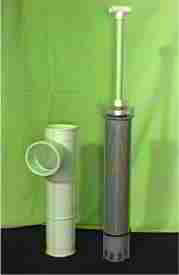
on the washing machine water drain line to avoid sending lint into the septic tank and fields or install a graywater filter ahead of your drywell if you are using one to receive washing machine discharge waters. Details are
at FILTERS SEPTIC & GREYWATER - Install a separate drywell
to receive water from the washing machine drain, and perhaps dishwasher and other graywater. - Spread out use of the washing machine
over longer intervals - perhaps washing loads in morning and at night rather than running one laundry load right after another. This "dosing" of the septic system or drywell gives the absorption system time to recover between washes. - Cleaning out the septic tank more often than the minimum
schedule will extend the life of your drainfield. In turn, this will permit the drainfield to better absorb the extra volume of wastewater generated by clothes washing.
Similarly, any other measures that protect the drainfield's ability to absorb water, such as avoiding flooding the fields with surface runoff, become more important if a family is using their washing machine alot.
Also see CHEMICALS & CLEANERS into the SEPTIC TANK?
& CHEMICALS to KEEP OUT OF SEPTICS - separate articles
Effects of Household Bleach on the Septic System
Bleach at normal household usage levels should not harm the septic system.
- Braida, Washington, Say Kee Ong, William L. Smith, and James W. McCabe. "Fate of adsorbable organic halides from bleached laundering in septic tank systems." Environmental toxicology and chemistry 17, no. 3 (1998): 398-403.
Abstract:
A study was conducted to assess the fate of adsorbable organic halide (AOX) formed from the use of household bleach during laundering in a septic system.
Experiments were conducted using laboratory-scale septic tanks and leachfield systems. Addition of feed water containing 20% of bleached or unbleached laundry wash water did not affect the performance of the septic tanks or the leach fields.
Overall chemical oxidation demand (COD) and total organic carbon (TOC) removal rates through the septic systems were in the range of 90%. Adsorbable organic halide from unbleached laundry wash water with concentrations between 0.13 and 0.21 mg/L appeared to be removed in the septic tank but not in the leach field.
The average overall AOX removal rate using unbleached laundry wash water was approx. 43%. In contrast, the overall removal rate of AOX generated from the use of sodium hypochlorite in bleached laundry wash water was between 87 and 94%. About one-third of the AOX was removed in the septic tank, and the rest was removed in the leach field.
Analysis of the septic tank sludge and the soil in the leach field showed no accumulation of AOX from the use of hypochlorite, and the AOX was most likely removed by biodegradation and/or chemical degradation.
Reader Comments, Questions & Answers About The Article Above
Below you will find questions and answers previously posted on this page at its page bottom reader comment box.
Reader Q&A - also see RECOMMENDED ARTICLES & FAQs
On 2020-08-08 by (mod)
Donna:
Some common explanations include:
- a partly-blocked drain thta can't handle the higher volume of wastewater flow
- a failing septic system or cesspool that backs up when you are sending a larger volume of water into it
On 2020-08-08 by Donna
Why do my tub shower and toilet back up when I wash clothes?
On 2018-05-27 - by (mod) -
I don't think liquid laundry detergent would be causing a white greasy blockage in a drain.
More often that's fats or Oils for example from cooking. You might want to have a plumbing company run a sewer line camera through the drain in order to find out if it's damaged, broken, or improperly pitched.
On 2018-05-27 by Bruce K Bernard
We are on a septic system. The pipe between the house and the septic tank has gotten blocked several times. When using a snake, big gobs of a white material seem to be causing a blockage. We thought it was grease,
but we are VERY CAREFUL not to put grease down the drain. A friend told us it could be the laundry detergent. We use a liquid, and don't use too much. Is it possible it's the laundry detergent? What should we use.
On 2015-10-17 by Jo
I want to dye clothes in the washing machine, but have aseptic tank. is this OK
On 2014-08-30 - by (mod) -
Andy,
Though there are caustics that can break up soap scum they are harmful to the environment and probably illegal in your area. A better drywell or soakpit design for a washing machine water disposal system allows water to disperse into the soil not just from the bottom of the pit but through the sides as well. Details are at
https://inspectapedia.com/septic/Drywell_Design.htm
Meanwhile you might be able to get some temporary improvement by pumping and cleaning the existing installation or by disturbing its bottom layer mechanically.
On 2014-08-29 by Andy
I have separate tank for my washing machine. It is actually aplastic drum with no bottom. After 5 years the bottom is covered with soap scum and the water will not drain out. Is there a chemical that I can put in the drum that will remove the soap scum?
On 2012-11-08 - by (mod) -
Smutty,
thanks for the good question. I will do some research and post a more detailed reply here - but I need a week or two.
Meanwhile, stickmwith liquid detergents if you can, and be sure to use no kore than the manufacturer's recommended detergent quantity per wash load. The chief problem i know of is overdosing detergent and solid detergent clogs from using too much.
On 2012-11-08 by Smitty
what are some recommended detergents for an aeration system? I have seen too many confusing lists.
On 2012-11-06 - by (mod) -
Marital advice from InspectApedia
Let your husband wash with whatever he likes in the shower. Unless someone is literally pouring bottles of soap down the drain I'm doubtful that it's going to explain a septic tank or system failure;
Detergent clogs are generally traced to solid detergents (and their over-use in a washing machine) not to liquid soaps.
On 2012-11-06 by Lanaye
I'm using he detergents and biodegradable also on my septic system...but my husband gets a little carried away with BODY WASHES in the shower.
too many bubbles going into septic? we just finished clearing up a HUGE detergent clog when we had the tank pumped a few weeks ago! Took us 3 days of "perseverence"
On 2012-09-27 by Anonymous
Ron, I agree. About the only way clothes *dryer* lint from a conventional clothes dryer would get into the septic system would be if someone foolishly pulled lint out of the dryer and flushed it down a toilet.
Donna if you could give me the brand and model of your combination unit I will research how filters work on those units.
On 2012-09-26 by Ron Jackson
How would dryer lint ever make it to your septic tank let alone your drain field? Do you mean to say the lint remaining within the wash water?
On 2012-09-11 by Donna
I'm wondering if a ventless washer/dryer combo is a bad idea, since dryer lint could potentially end up in the septic field. Any idea how effective the lint filters built into these appliances are?
On 2012-08-13 by Maria Mutnansky
So... in order to be more economical I have been making my own liquid laundry detergent. This, however, is made from powdered ingredients. Fels Naptha soap which is "melted" in hot water first, washing soda and borax. I have to say it IS way cheaper.
BUT for about 4 months now, or maybe even longer, we have had a horrible smell (intermittent, not constant) which smells like sewage. We'd had a break in our toilet line, it was fixed... but then the toilet wouldn't flush at all... my husband snaked it and suddenly we had this horrible odor about every evening, but mostly in the evening. I had the tank cleaned (and you know that isn't cheap).
Still, a bad odor. Recently the company which has a "contract" to inspect our tank came out and said everything was fine (we were not home when they came... so we could not ask questions... very annoying). So is there any chance my stink could be caused by buildup from my detergent?
And if so, how do I get rid of it... and if not, what in the world could be causing the stink? Oh, and the aerator was giving us some trouble (yes, days after they checked it) but when we got it going again the smell was SO intense and bad.
Is there something between the piping and the toilet which should be prohibiting smells from coming up? I don't have a lot of money to spend on this, but I need to find some answers.
...
Continue reading at WATER SOFTENER IMPACT on SEPTIC or select a topic from the closely-related articles below, or see the complete ARTICLE INDEX.
Or see WASHING MACHINES & SEPTIC SYSTEMS FAQs - questions & answers posted originally at the end of this page.
Or see these
Recommended Articles
- TOILETS, DON'T FLUSH LIST - home
- NEVER FLUSH INTO SEPTICS
- CHEMICALS to KEEP OUT OF SEPTICS
- CHLORINE IN SEPTIC WASTEWATER
- DISHWASHERS vs SEPTICS
- GARBAGE GRINDERS vs SEPTICS
- GARBAGE GRINDERS on SEPTIC or SEWER
- REVERSE OSMOSIS CONCENTRATE DISPOSAL
- SEPTIC TREATMENTS & CHEMICALS
- TOILET TISSUE CHOICES
- WASHING MACHINES & SEPTIC SYSTEMS
- WATER SOFTENER IMPACT on SEPTIC
Suggested citation for this web page
WASHING MACHINES & SEPTIC SYSTEMS at InspectApedia.com - online encyclopedia of building & environmental inspection, testing, diagnosis, repair, & problem prevention advice.
Or see this
INDEX to RELATED ARTICLES: ARTICLE INDEX to SEPTIC SYSTEMS
Or use the SEARCH BOX found below to Ask a Question or Search InspectApedia
Ask a Question or Search InspectApedia
Try the search box just below, or if you prefer, post a question or comment in the Comments box below and we will respond promptly.
Search the InspectApedia website
Note: appearance of your Comment below may be delayed: if your comment contains an image, photograph, web link, or text that looks to the software as if it might be a web link, your posting will appear after it has been approved by a moderator. Apologies for the delay.
Only one image can be added per comment but you can post as many comments, and therefore images, as you like.
You will not receive a notification when a response to your question has been posted.
Please bookmark this page to make it easy for you to check back for our response.
Our Comment Box is provided by Countable Web Productions countable.ca
Citations & References
In addition to any citations in the article above, a full list is available on request.
- Braida, Washington, Say Kee Ong, William L. Smith, and James W. McCabe. "Fate of adsorbable organic halides from bleached laundering in septic tank systems." Environmental toxicology and chemistry 17, no. 3 (1998): 398-403.
Abstract:
A study was conducted to assess the fate of adsorbable organic halide (AOX) formed from the use of household bleach during laundering in a septic system. Experiments were conducted using laboratory-scale septic tanks and leachfield systems. Addition of feed water containing 20% of bleached or unbleached laundry wash water did not affect the performance of the septic tanks or the leach fields. Overall chemical oxidation demand (COD) and total organic carbon (TOC) removal rates through the septic systems were in the range of 90%. Adsorbable organic halide from unbleached laundry wash water with concentrations between 0.13 and 0.21 mg/L appeared to be removed in the septic tank but not in the leach field. The average overall AOX removal rate using unbleached laundry wash water was approx. 43%. In contrast, the overall removal rate of AOX generated from the use of sodium hypochlorite in bleached laundry wash water was between 87 and 94%. About one-third of the AOX was removed in the septic tank, and the rest was removed in the leach field. Analysis of the septic tank sludge and the soil in the leach field showed no accumulation of AOX from the use of hypochlorite, and the AOX was most likely removed by biodegradation and/or chemical degradation. - New York State Department of Health, APPENDIX 75-A WASTEWATER TREATMENT STANDARDS - INDIVIDUAL HOUSEHOLD SYSTEMS , [PDF] New York State Department of Health, 3 February 2010, retrieved 3/1/2010, original source: https://www.health.ny.gov/regulations/nycrr/title_10/part_75/appendix_75-a.htm
- "International Private Sewage Disposal Code," 1995, BOCA-708-799-2300, ICBO-310-699-0541, SBCCI 205-591-1853, available from those code associations.
- "Manual of Policy, Procedures, and Guidelines for Onsite Sewage Systems," Ontario Reg. 374/81, Part VII of the Environmental Protection Act (Canada), ISBN 0-7743-7303-2, Ministry of the Environment,135 St. Clair Ave. West, Toronto Ontario M4V 1P5 Canada $24. CDN.
- Manual of Septic Tank Practice, US Public Health Service's 1959.
- Planting Over Septic System Component", Daniel Friedman (author/editor, InspectAPedia.com), The Innovator, Winter/Spring 2008, BCOSSA, British Columbia OnSite Sewage Association, 201-3542 Blansard St., Victoria BC V8X 1W3 Canada
- Save the Septic System - Do Not Flush These Items Down the Toilet, Daniel Friedman, InspectAPedia.com - PDF document, printable
- Septic System Owner's Manual, Lloyd Kahn, Blair Allen, Julie Jones, Shelter Publications, 2000 $14.95 U.S. - easy to understand, well illustrated, one of the best practical references around on septic design basics including some advanced systems; a little short on safety and maintenance. Both new and used (low priced copies are available, and we think the authors are working on an updated edition--DF. Quoting from one of several Amazon reviews: The basics of septic systems, from underground systems and failures to what the owner can do to promote and maintain a healthy system, is revealed in an excellent guide essential for any who reside on a septic system. Rural residents receive a primer on not only the basics; but how to conduct period inspections and what to do when things go wrong. History also figures into the fine coverage.
- US EPA ONSITE WASTEWATER TREATMENT SYSTEMS MANUAL Top Reference: US EPA's Design Manual for Onsite Wastewater Treatment and Disposal, 1980, available from the US EPA, the US GPO Superintendent of Documents (Pueblo CO), and from the National Small Flows Clearinghouse. Original source http://www.epa.gov/ORD/NRMRL/Pubs/625R00008/625R00008.htm
- Water Wells and Septic Systems Handbook, R. Dodge Woodson. This book is in the upper price range, but is worth the cost for serious septic installers and designers.
- Wells and Septic System, Alth, Max and Charlet, Rev. by S. Blackwell Duncan, $ 18.95; Tab Books 1992. We have found this text very useful for conventional well and septic systems design and maintenance --DF.
- Advanced Onsite Wastewater Systems Technologies, Anish R. Jantrania, Mark A. Gross. Anish Jantrania, Ph.D., P.E., M.B.A., is a Consulting Engineer, in Mechanicsville VA, 804-550-0389 (2006). Outstanding technical reference especially on alternative septic system design alternatives. Written for designers and engineers, this book is not at all easy going for homeowners but is a text I recommend for professionals--DF.
- Onsite Wastewater Disposal, R. J. Perkins; Quoting from Amazon: This practical book, co-published with the National Environmental Health Association, describes the step-by-step procedures needed to avoid common pitfalls in septic system technology. Valuable in matching the septic system to the site-specific conditions, this useful book will help you install a reliable system in both suitable and difficult environments. Septic tank installers, planners, state and local regulators, civil and sanitary engineers, consulting engineers, architects, homeowners, academics, and land developers will find this publication valuable.
- Onsite Wastewater Treatment Systems, Bennette D. Burks, Mary Margaret Minnis, Hogarth House 1994 - one of the best septic system books around, suffering a bit from small fonts and a weak index. While it contains some material more technical than needed by homeowners, Burks/Minnis book on onsite wastewater treatment systems a very useful reference for both property owners and septic system designers.
- The NSFC Products List has an excellent list of design manuals/modules National Small Flows Clearinghouse (NSFC) now (2019/12/13) hosted at http://www.nesc.wvu.edu/ Tel: 304-293-4191 e-mail info@mail.nesc.wvu.edu.
the National Small Flows Clearinghouse (NSFC) was funded by the U.S. Environmental Protection Agency (EPA) to help America's small communities and individuals solve their wastewater problems through objective information about onsite wastewater collection and treatment systems. NSFC products and information are the only national resource of its type, dealing with small community wastewater infrastructure. or by telephone 800-624-8301 - In addition to citations & references found in this article, see the research citations given at the end of the related articles found at our suggested
CONTINUE READING or RECOMMENDED ARTICLES.
- Carson, Dunlop & Associates Ltd., 120 Carlton Street Suite 407, Toronto ON M5A 4K2. Tel: (416) 964-9415 1-800-268-7070 Email: info@carsondunlop.com. Alan Carson is a past president of ASHI, the American Society of Home Inspectors.
Thanks to Alan Carson and Bob Dunlop, for permission for InspectAPedia to use text excerpts from The HOME REFERENCE BOOK - the Encyclopedia of Homes and to use illustrations from The ILLUSTRATED HOME .
Carson Dunlop Associates provides extensive home inspection education and report writing material. In gratitude we provide links to tsome Carson Dunlop Associates products and services.
 | HOME | ABOUT | ASK a QUESTION | CONTACT | CONTENT USE POLICY | DESCRIPTION | POLICIES | PRIVACY | |
| © 2024 - 1985 Publisher InspectApedia.com - Daniel Friedman | |||||||||