
InspectAPedia® FREE Encyclopedia of Building & Environmental Construction, Diagnosis, Maintenance & Repair |
Question? Just ask us! InspectAPedia
|
 Things Should NEVER Be Flushed Down the Toilet
Avoid drain clogs & septic system clogging
- POST a QUESTION or COMMENT about stuff that should not be flushed down toilets
What things should you never flush down the drains and into a septic tank?
What items and chemicals are safe to flush down the toilet and into a private septic system? What may damage the septic tank or leach fields?
This document explains how to extend the life of the septic system by being careful about what goes into it.
Discussed: List of chemicals, objects, and trash items that it would be should NEVER be flushed down a toilet Cat litter, dryer sheets, disposable diapers, drugs, coffee grounds, & lots of other stuff should not go into the septic tank nor down a drain into a public sewer.
InspectAPedia tolerates no conflicts of interest. We have no relationship with advertisers, products, or services discussed at this website.
List of chemicals, objects, and trash items that should NEVER be flushed down a toilet
 at TOILETS, DON'T FLUSH LIST we introduce the topic of stuff that should not be flushed down drains and into septic systems, and we explain the sorts of problems that can occur: drain clogging, sewage backups into buildings, costly septic system failure, and environmental contamination.
Here we list items that should never be flushed down a building drain much less onwards into a septic tank.
- Antibiotics, used in quantity, particularly in hospitals or nursing homes that are served by onsite wastewater treatment plants, can kill off bacteria in the septic tank as antibiotics are excreted in urine.
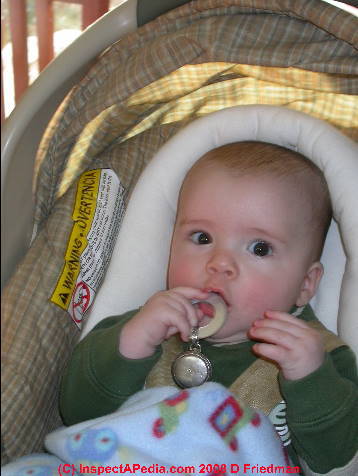
In our opinion, however, occasional use of antibiotics by one household member in treatment of a non-chronic illness are not likely to have a lasting impact on the septic system. - Baby Wipes & Baby "Disposable" Diapers (here modeled by my grandson, Tanner D., but discretely hidden in the photo) and many other items which are not biodegradable will simply clog a septic system and are very likely to clog building drains.
Other items that people may think about disposing-of by flushing down a building drain, such as chemicals or unwanted cooking oil are contaminants or can clog or damage the drainfield.
Also see DISPOSABLE WET WIPE CLOGS
Here are examples of other things that should not be flushed down a toilet nor down any other building drain (and onwards into the septic tank):
- Cat Litter: clogs pipes, septic baffles - see KITTY LITTER in TOILETS below
- Clothes dryer sheets used as fabric softener or to make your dry clothes "smell nicer" - the quantity of chemical in these sheets is unlikely to be sufficient to damage the septic tank bacteria, but the synthetic fabric from which dryer sheets are made will not break down in the septic tank.
These items not only add to the solid waste in the septic tank, a dryer sheet might clog the septic tank inlet at the baffle.
See DISPOSABLE WET WIPE CLOGS and also
see SEWAGE PUMP DAMAGE & REPAIR - Condoms won't clog a pipe but like some other debris, because they are of modest size and are quite flexible, but condoms are (usually) not bio degradable. So we listed condoms, or other latex products such as latex gloves above as "never flush".
A condom in the septic tank will probably join other debris in the tank's floating scum layer, and will be removed at the next tank pump-out. Of course, if
the SEPTIC TANK OUTLET TEE or tank baffles are missing,
the condom will join other floating debris on its way out to clog the drainfield, so ask your septic pumper to check the condition of the septic tank baffles when the septic tank is next pumped.
BUT if your system uses a septic pump or grinder pump or sewage ejector pump, this material can clog the pump impeller and cause expensive pump damage or motor burnout.
See SEWAGE PUMP DAMAGE & REPAIR - Dirt - such as from people who clean their flower pots in the bath tub or in a "potting sink"
- Cotton swabs (Q-tips(R)) have been known to clog a drain or two - not biodegradable, though trivial in volume. BUT if your system uses a septic pump or grinder pump or sewage ejector pump, this material can clog the pump impeller and cause expensive pump damage or motor burnout.
And the plastic sticks used by some cotton swabs and that are flushed through public sewers have been reported to remain indefinitely in the environment, ending as ultra-fine plastic fragments in the ocean, on remote beaches, even in sea life.

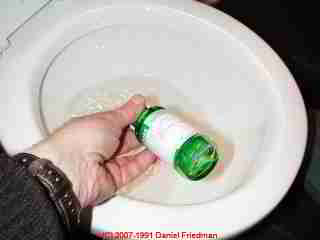
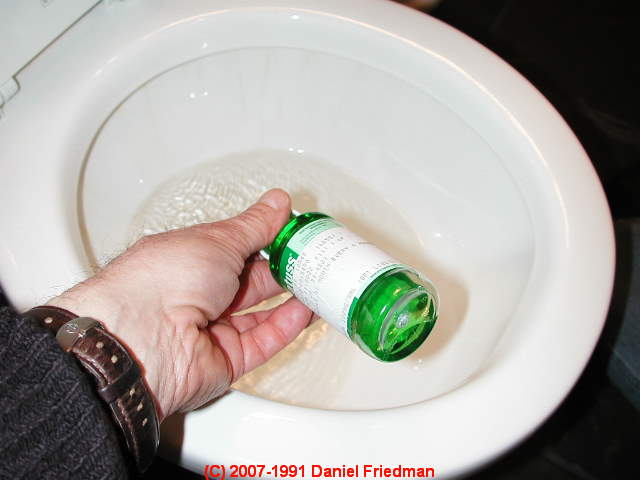
- Chemicals: photo chemicals (see page top photo), paints, thinners, oils, varnishes, pesticides, used motor oil, unwanted cooking oil should never be flushed down a toilet nor put into any other building drains.
- Cigarette butts are not biodegradable and should not be flushed into the septic system.
And the filters on cigarette butts can clog and destroy septic pumps.
See SEWAGE PUMP DAMAGE & REPAIR - Coffee grounds should not be flushed into the septic system.
For an example source of this warning from an aerobic septic system manufacturer, see this Pro-Flo Aerobic Septic Systems Manual [PDF] Use your browser "back" button to return here.

- Diapers, cloth, disposable, cotton, paper, plastic should never be flushed down a toilet.
Things like a baby diaper, modeled here by this really cute granddaughter, Sophie, that is, little nappies and other things that do not dissolve in water or are generally not biodegradable, things that are big enough to risk clogging a drain line, if flushed down a toilet, at the least, increase the pumping frequency needed at the tank, and at the worst, may damage the system leading to costly repairs.
See DISPOSABLE WET WIPE CLOGS - Dental floss - is not biodegradable, though trivial in volume. BUT if your system uses a septic pump or grinder pump or sewage ejector pump, this material can clog the pump impeller and cause expensive pump damage or motor burnout.
See SEWAGE PUMP DAMAGE & REPAIR - Dirt - such as from people who clean their flower pots in the bath tub should never be flushed down a building drain
- Disposable wipes - such as baby wipes or personal hygiene wipes, even products described as "biodegradable" or "OK for use in septic systems" may NOT be OK: if your system uses a septic pump or grinder pump or sewage ejector pump, this material can clog the pump impeller and cause expensive pump damage or motor burnout.
Also see DISPOSABLE WET WIPE CLOGS - Drugs, prescription or prescription medicines, should never be flushed down a toilet unless your pharmacist or the drug
manufacturer tells you specifically that the particular drug is absolutely harmless to the environment.
See DRUGS INTO the SEPTIC TANK? for more details about what happens when we flush drugs into the septic system.
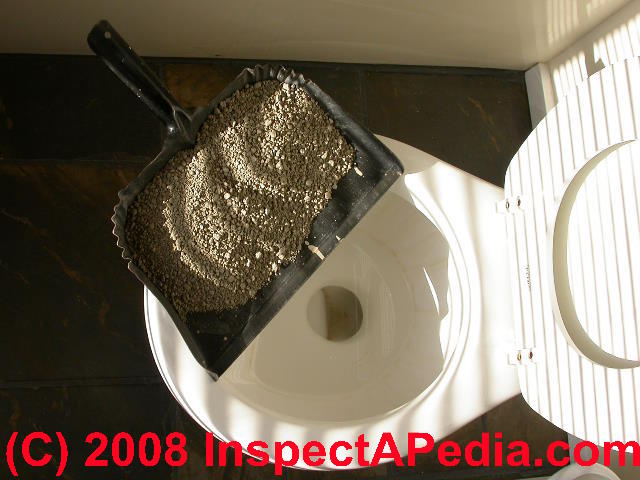
- Kitty litter into the septic tank? cat litter should never be flushed down a building drain.
Cat litter is a material that includes
- mostly clay particles (bentonite clay)
- that clog pipes and
- add solid waste volume in the septic tank
- that will not break down in the septic tank.
This warning includes those "clumps" of cat litter from special clumping litter that solidifies around cat urine or cat feces.
It's tempting to just toss these clumps of animal waste into the toilet and flush away. But clumps of cat litter or cat litter bound by cat urine add to the solid waste load in the septic tank.
Our photo (left) shows conventional cat litter in a glass of water. There can be no doubt that this material settles to the bottom of a septic tank where it adds to the solid layer just as you see in this lab photograph.
After a month our TEST of KITTY LITTER in the SEPTIC TANK [image] showed that the clay material remained intact, settled on the bottom of our test glass.
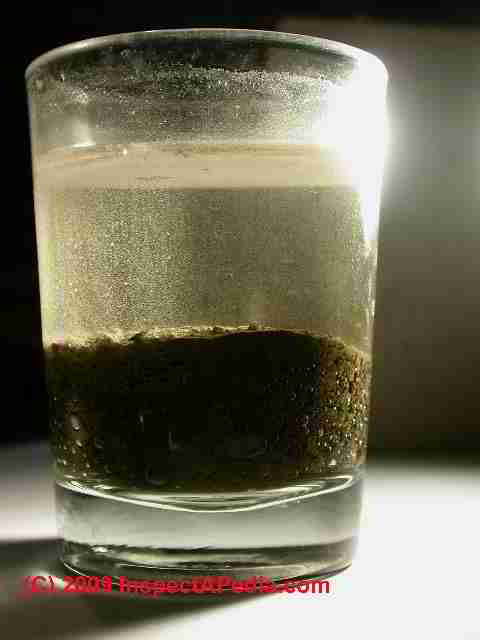
Zeolite is the prime ingredient in cat litter. This clay-like material is used in other products and has even been under experimentation for use in capturing radioactive material [atReferences or Citations ] in ground water near Lake Erie.
What about other cat litter products that are advertised as "flushable" kitty litter? Some of these products, described as biodegradable, are made of processed newsprint, corn cobs, or wheat by-products.
OPINION: with the data at hand we do not believe that these products should be put into the septic tank unless their total monthly volume is absolutely trivial (a cubic foot or less). All cat litter products add solid waste or floating scum layer waste that adds to the septic system load.
Certainly we wouldn't flush newspapers down a toilet in any form. Nor corn cobs nor wheat. It is unlikely that these products dissolve in the septic tank in the same manner that does toilet tissue. Even if such a product does "dissolve", if it is present in volume it may interfere with septic tank bacterial action.
FACT: We don't know how these flushable products actually perform in the septic tank - do they float, settle, or dissolve? Is there independent supporting research by any of the sellers?
Meanwhile, if cat litter of any form has already been flushed into the septic tank it may be useful to open and pump the septic tank ahead of schedule, evaluate the level of solids in the tank, and in the future, open, pump, and inspect more often where these products are in use, until hard evidence shows that there is no discernable increase in the volume of solids, floating scum layer, nor interference with bacterial action in the septic tank.
(Research reports are invited.)
The cost to clean out clogged septic or sewer lines tells a the story. We recommend that you dispose of kitty litter waste in sealed garbage bags, not in your toilet.

- Latex condoms, gloves, or similar products - we discuss condoms in septic systems further in the next section of this article.
- Paper towels and facial tissues (Kleenex(TM)) do not break down easily and should not be flushed into the septic system. Toilet paper breaks down quickly and should not be a problem in an ordinary septic tank system.
- Panty liners should never be flushed down a building drain.
See SEWAGE PUMP DAMAGE & REPAIR - Plastic bags or other plastic scrap or trash of any kind should never be flushed down a building drain
- Sanitary napkins should never be flushed down a building drain.
- Swimming pool chemicals and swimming pool back-wash water should never be flushed into a septic tank. It may seem surprising but we've been asked if it was ok to discharge swimming pool into a septic tank
- High volumes of water from a pool into a septic tank will flood the tank and prevent proper processing of the waste therein
- High volumes of water from a pool backwash onto a drainfield will flood the field and prevent proper processing of the septic tank effluent that is meant to be discharged there.
- You should not discharge swimming pool backwash into a septic tank, ever
- You should not discharge swimming pool backwash anywhere within 100 feet of a drainfield..
- See details about the effects of swimming pool backwash water volume, flow rate, and chlorine
at CHLORINE IN SEPTIC WASTEWATER
- Tampons should not be flushed down a building drain.
See SEWAGE PUMP DAMAGE & REPAIR - Trash and scrap such as dental floss should not be flushed down a building drain
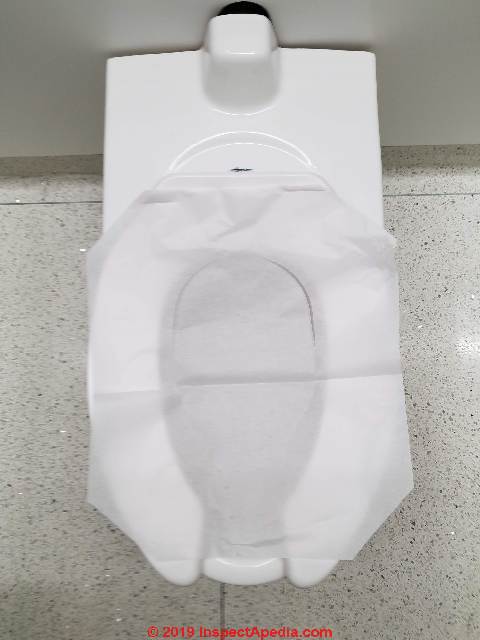
- Toilet seat covers - stronger paper toilet seat covers may be flushed into public sewers or commercial septic systems using suitable grinder pumps but are likely to clog the building drain or sewer piping or septic tank when flushed using a gravity flush toilet or sent into a septic tank.
- Toys should never be flushed down a building drain - this may seem odd, but little kids may toss a toy car, doll, or other object into the john where it's at risk of causing a costly clog.
At an apartment in Wappingers Falls, NY, the guest toilet frequently clogged and overflowed. We finally removed the toilet to find a huge toy bone wedged across the drain.
Prior owners' dog perhaps had been washing off his treat. Had the bone moved end-ways into the drain this could have been a more costly repair.
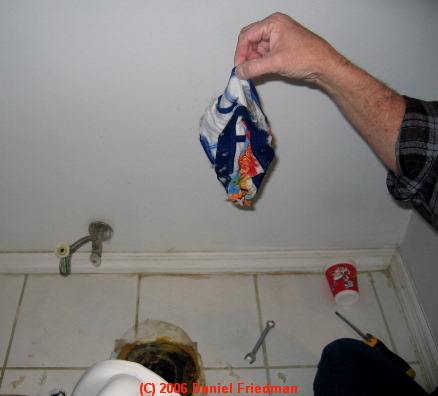
- Underpants - or other cloth items. My grandson Chase P., learning to use the toilet, flushed his new underpants down the drain because they were wet (12/09/2006 CPG), leading to a troublesome drain clog and toilet overflow problem. Cloth does not degrade in a septic tank.
We suggested that JAIL might be in his future [image] if he did this trick again, but as the photo indicates, he was not very worried. Actually it's quite common for small children to flush toys, diapers, underpants, or just about anything down the toilet. Something to be avoided.
Child Safety Warning about Toilets: an open toilet can be a child drowning hazard. Toilet lid locks are available for use in households with toddlers. - Water Softener regeneration cycle discharge water is likely to contain high levels of salts and possibly also other minerals that can significantly harm the drainfield or soakaway bed of a septic system by killing off soil bacteria and by forming a salt-crust in the absorption trench.
High volumes of wastewater from frequent regen cycles or worse from a water softener that is not working properly, perhaps stuck in "regen" mode, can also flood a drainfield and destroy it. - Water in large quantities from roof gutters or surface runoff should always be directed well away from
the septic tank and drainfield areas and should never be discharged into the septic system.
A septic system for handling onsite wastewater is designed to handle normal household wastewater flows from showers, sinks, tubs, laundry, etc., not roof runoff or surface drainage. Do not let roof gutters or surface runoff drain into an area where that water can enter the septic tank or drainfield. - Water from a high or rising groundwater level that reaches within a foot or so of the bottom of a drainfield trench is likely to prevent the drainfield from discharging treated effluent properly into the environment.
Such septic field designs are prohibited in some jurisdictions and are regulated by code such as the Massachusetts Title 5 Septic law. - Wet wipes & disposable wipes: should not be flushed into toilets. Apparently most of these products do not break down and can cause costly clogs of plumbing systems, sewer systems, and septic systems.
See DISPOSABLE WET WIPE CLOGS below.

Also see TOILET REPAIR GUIDE.
Don't Flush Disposable Wet Wipes, Diapers, Dryer Sheets, Cloth into toilets
We have moved this information to a separate article now found at DISPOSABLE WET WIPE CLOGS
Watch out: Do not flush "disposable" wet wipes, baby wipes, clothes dryer sheets, sanitary napkins, nor any cloth or fabric waste into toilets anywhere, regardless of whether the toilet is connected to public sewer or private septic system.
Reader Comments, Questions & Answers About The Article Above
Below you will find questions and answers previously posted on this page at its page bottom reader comment box.
Reader Q&A - also see RECOMMENDED ARTICLES & FAQs
On 2020-05-22 - by (mod) -
Dennis
Good grief, that is absolutely crazy advice and completely mistaken.
In fact nitrogen at excessive levels is a soil contaminant that is characteristic of septic spillage where it doesn't belong or of septic system failure.
NO septic treatment is necessary for a conventional septic system - and some are harmful.
See details at SEPTIC TREATMENTS & CHEMICALS https://inspectapedia.com/septic/Septic_Tank_Treatments.php
The only exception I've found to that guideline is that some septic systems, including some aerobic septic systems, use a disinfectant that is added to clarified effluent before it is dispersed.
Don't add nitrogen pellets to your septic system.
On 2020-05-22 5 by Denis
It was suggested by our property's previous owner to flush 1 cup of nitrogen pellets into our septic system through the toilet...
Is this a safe practice ??
On 2019-04-09 - by (mod) -
 )
)
Holly
The women enthusiasts for toilet seat covers ought to be joined by men. Certainly I've been put off by peed-on toilet seats in mens toilets, principally at public toilets.
I think paper toilet seat covers are a variation on toilet paper - but the paper does not (in my OPINION) break down or soften as rapidly as toilet tissue.
Therefore my first concern is a risk of clogging the building sewer line or drain ahead of the septic tank.
Where I"ve seen paper toilet seat covers in use they've been on power-flush toilets such as those operated by a flushometer or Sloan valve such as those I discuss at
FLUSHOMETER VALVES for TOILETS URINALS https://inspectapedia.com/plumbing/Flushometer_Valves.php
Those are flushing (usually) into a larger diameter public sewer and are using a more-forceful flush water dose as well.
So I don't recommend flushing paper toilet seat covers down a gravity-operated toilet nor into septic tanks.
See NEVER FLUSH INTO SEPTICS at https://inspectapedia.com/septic/Never_Flush_in_Toilets.php
Instead perhaps we can offer a more assertive program of bathroom inspection and cleaning.
On 2019-02-06 by Holly
What about toilet seat covers and septic systems? We have an office in town but it is on its own septic system and the women want toilet seat covers. Yes or no???
On 2012-12-18 - by (mod) -
Concerned,
Are there chemicals in your boiler? If so, depending on what they are, indeed you might be harming the septic tank bacteria. Boiler drainage might be acidic or otherwise not a great idea, though if the volume were trivial so probably would be the impace.
I have not tried building a list of the chemistry of boiler additives, rather my approach has been to look up the MSDS for the specific boiler additive in question. That's where we can find the answer. If you know what chemicals were used in your boiler let me know and I'll be glad to dig into it if you don't yourself.
On 2012-12-17 by Concerned
Had a phone call this morning which alarmed me from the get go....A company wanted to drain the boiler system into the septic system and said it wouldn't harm the system....I strongly disagree from a matter of knowledge I have on this subject matter....do you have a accurate list of "boiler chemicals" that can or can not be flushed into a septic system?
On 2012-10-05 - by (mod) -
Anon, about flushing coffed grounds down the drain,
the typical volume of coffee grinds that might be put into a cesspit won't injure it chemically, but adding any low or non-biodegradable material to the system will in the case of a cesspit (cesspool) shorten its life, and in the case of a septic tank, mean that it needs to be pumped more often.
And some septic systems can be seriously damaged or clogged, leading to a need for costly repairs. In the article above read about coffee grounds and you'll find a link to comments by an aerobic septic system manufacturer who explains the problem further.
On 2012-10-05 - by (mod) -
Otto,
No one should be flushing fertilizer down a drain nor into a septic system. But perhaps you are asking about something else.
On 2012-08-11 by otto bahn
Anything known about organic and non organic fertilizers in tanks?
On 2012-06-22 by Anonymous
why cant you put coffee grinds into a ses pit
On 2011-11-27 - by (mod) -
Saone, the impacts of flushing improper materials into a septic tank include:
- pipe clogging and sewer backups
- added solid volume to the septic tank increasing the need for more frequent pumping
- damage to the bacteria in the septic tank resulting in under-treatment of the septic effluent before it is discharged to the drainfield, resulting in turn in a shorter drainfield life and very costly drainfield repairs
On 2011-11-23 by saone bikitshane
what are the impacts of doing this.
...
Continue reading at BETTER NOT TO FLUSH or select a topic from the closely-related articles below, or see the complete ARTICLE INDEX.
Or see NEVER FLUSH INTO TOILETS - FAQs questions & answers posted originally at this article
Or see these
Recommended Articles
- TOILETS, DON'T FLUSH LIST - home
- NEVER FLUSH INTO SEPTICS
- BETTER NOT TO FLUSH
- CHEMICALS & CLEANERS into the SEPTIC TANK?
- CHEMICALS to KEEP OUT OF SEPTICS
- CHLORINE IN DRINKING WATER
- CHLORINE IN SEPTIC WASTEWATER
- DISHWASHERS vs SEPTICS
- DRUGS INTO the SEPTIC TANK?
- GARBAGE GRINDERS vs SEPTICS
- GARBAGE GRINDERS on SEPTIC or SEWER
- * NO FLUSH SUMMARY LIST
- REVERSE OSMOSIS CONCENTRATE DISPOSAL
- RV HOLDING TANK DUMP INTO SEPTIC TANK?
- SEPTIC TREATMENTS & CHEMICALS
- SEWAGE PUMP DAMAGE & REPAIR
- TOILET TISSUE CHOICES
- WASHING MACHINES & SEPTIC SYSTEMS
- WATER SOFTENER IMPACT on SEPTIC
Suggested citation for this web page
NEVER FLUSH INTO SEPTICS at InspectApedia.com - online encyclopedia of building & environmental inspection, testing, diagnosis, repair, & problem prevention advice.
Or see this
INDEX to RELATED ARTICLES: ARTICLE INDEX to TOILET INFORMATION
Or use the SEARCH BOX found below to Ask a Question or Search InspectApedia
Ask a Question or Search InspectApedia
Try the search box just below, or if you prefer, post a question or comment in the Comments box below and we will respond promptly.
Search the InspectApedia website
Note: appearance of your Comment below may be delayed: if your comment contains an image, photograph, web link, or text that looks to the software as if it might be a web link, your posting will appear after it has been approved by a moderator. Apologies for the delay.
Only one image can be added per comment but you can post as many comments, and therefore images, as you like.
You will not receive a notification when a response to your question has been posted.
Please bookmark this page to make it easy for you to check back for our response.
Our Comment Box is provided by Countable Web Productions countable.ca
Citations & References
In addition to any citations in the article above, a full list is available on request.
- Flegenheimer, Matt, "Wet Wipes Box Says Flush. New York's Sewer System Says Don't", The New York Times, 13 March 2015
- New York State Department of Health, APPENDIX 75-A WASTEWATER TREATMENT STANDARDS - INDIVIDUAL HOUSEHOLD SYSTEMS , [PDF] New York State Department of Health, 3 February 2010, retrieved 3/1/2010, original source: https://www.health.ny.gov/regulations/nycrr/title_10/part_75/appendix_75-a.htm
- Thanks to reader Megan O'Connell for discussion of biodegradable cat litter disposal in septic tanks 04/2009.
- "It Blocks Cat Odors And Maybe Radiation - material used in litter is tested in sopping up nuclear contaminants", Andrew Revkin, New York times, 24 February 2000, p. B1. This article describes testing of cat litter used in a trench filled with zeolite (cat litter) to form a wall to intercept radioactive contaminated ground water seeping towards a stream that empties into Lake Erie. The article explains that zeolite is a family of 48 minerals that absorb odors and moisture, found in various brands of "animal litter". The most abundant mineral in the zeolite family is clinoptiloite that has a strong affinity for strontium 90.
- In addition to citations & references found in this article, see the research citations given at the end of the related articles found at our suggested
CONTINUE READING or RECOMMENDED ARTICLES.
- Carson, Dunlop & Associates Ltd., 120 Carlton Street Suite 407, Toronto ON M5A 4K2. Tel: (416) 964-9415 1-800-268-7070 Email: info@carsondunlop.com. Alan Carson is a past president of ASHI, the American Society of Home Inspectors.
Thanks to Alan Carson and Bob Dunlop, for permission for InspectAPedia to use text excerpts from The HOME REFERENCE BOOK - the Encyclopedia of Homes and to use illustrations from The ILLUSTRATED HOME .
Carson Dunlop Associates provides extensive home inspection education and report writing material. In gratitude we provide links to tsome Carson Dunlop Associates products and services.
 | HOME | ABOUT | ASK a QUESTION | CONTACT | CONTENT USE POLICY | DESCRIPTION | POLICIES | PRIVACY | |
| © 2024 - 1985 Publisher InspectApedia.com - Daniel Friedman | |||||||||