
InspectAPedia® FREE Encyclopedia of Building & Environmental Construction, Diagnosis, Maintenance & Repair |
Question? Just ask us! InspectAPedia
|
 It Would Be Better Not to Flush These Items Into the Septic Tank

- POST a QUESTION or COMMENT about things that may not immediately ruin the septic system but still would be better kept out of it
What sorts of waste, trash, personal items, chemicals or cleaners or meds would be better not flushed down the toilet and into a private septic system?
This article lists things that are often flushed down toilets or drains into septic systems but that would be better avoided.
InspectAPedia tolerates no conflicts of interest. We have no relationship with advertisers, products, or services discussed at this website.
Stuff which would be better not to flush down a toilet or into the septic system
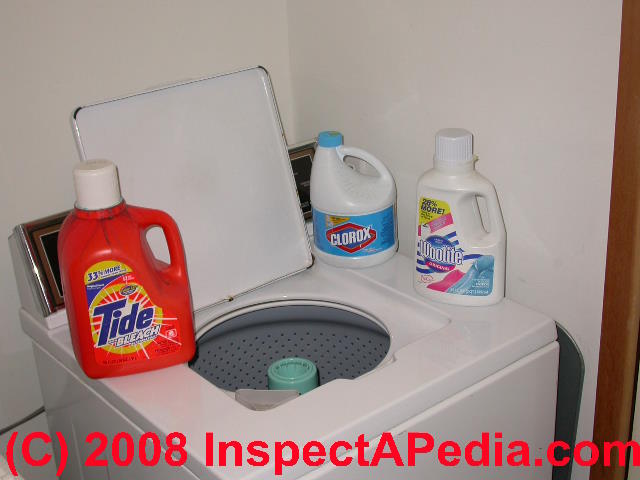
What kinds of items may damage the septic tank or leach fields? Can we dump "just a little bit"? Are condoms, dental floss, or food scraps a problem for the septic system?
This document explains how to extend the life of the septic system by being careful about what goes into it.
- Antibacterial soaps, used in quantity may be capable of reaching a concentration in the septic tank sufficient to harm key bacteria - opinion from Jet Inc., in their owners' manual
for BAT MEDIA SEPTIC PLANTS - Antibiotics, used in quantity, particularly in hospitals or nursing homes that are served by onsite wastewater treatment plants, can kill off bacteria in the septic tank as antibiotics are excreted in urine. In our opinion, however, occasional use of antibiotics by one household member in treatment of a non-chronic illness are not likely to have a lasting impact on the septic system.
- Condoms won't clog a pipe but like some other debris, because they are of modest size and are quite flexible, but condoms are (usually) not bio degradable. So we listed condoms, or other latex products such as latex gloves above as "never flush".
A condom in the septic tank will probably join other debris in the tank's floating scum layer, and will be removed at the next tank pump-out. Of course, if the septic
tank OUTLET TEE baffles are missing,
the condom will join other floating debris on its way out to clog the drainfield, so ask your septic pumper to check the condition of the septic tank baffles when the septic tank is next pumped. * Septic Pump Damage Warning - Cotton swabs (Q-tips(R)) have been known to clog a drain or two - not biodegradable, though trivial in volume.
Worse, plastic-stemmed cotton swabs have been reported to virtually never break down completely in the environment, eventually forming ultra-small or even microscopic bits of plastic litter that contaminate oceans, beaches, and that enter the biological systems of sea life and ultimately the human food chain.
See * Septic Pump Damage Warning below. - Dental floss - is not biodegradable, though trivial in volume.
* Septic Pump Damage Warning - Food scraps - increase the solids load in the tank and so may be slow to settle into the sludge layer or scum layer.
For more details on the effects of a garbage disposer or grinder on septic systems
see GARBAGE GRINDERS vs SEPTICS. - Fats, oils, grease - waste or un-wanted cooking oil (other than incidental oils and fats from washing dishes and pots and pans).
- Fabric softener, liquid: some septic system designers recommend using dryer sheets instead of liquid fabric softeners in the clothing wash cycle.
- Ground food from a garbage disposer - which adds to the solids load in the septic tank and increases the needed pumping frequency. Using a garbage grinder increases the biological oxygen demand in the septic tank to decompose the added food waste, thus reducing the quality of wastewater discharged from the septic tank or treatment system .
- Hair - animal or human hair combings do not biodegrade in septic tanks and can speed clogging
of SEPTIC FILTERS . - Laundry detergent - avoid using more than the necessary amount of powdered laundry or dishwasher detergent, or better, use liquid laundry
detergent.
Excessive amounts of powdered laundry detergent often fail to dissolve in the washing machine.
Many septic system experts and some septic system design or service companies emphsize that it's best to use detergents without phosphates and give these examples of acceptable laundry detergents that should be of particular interest to homeowners/occupants at properties where aerobic, batch media, or other high-treatment septic systems are installed:- Seventh Generation Free& Clear, Method 3x Concentrate, Arm & Hammer, Era, Oxydol laundry detergents.
More detail on the effect of washing machines on septic systems and tips on avoiding problems can be read
at WASHING MACHINES & SEPTIC SYSTEMS
- Seventh Generation Free& Clear, Method 3x Concentrate, Arm & Hammer, Era, Oxydol laundry detergents.
- Plumbing drain cleaning chemicals, particularly "heavy duty" or "professional" plumbing drain cleaning chemical products using caustics, lye, or acids should be avoided, particularly in high-treatment-level septic systems.
Occasional moderate use of a drain cleaning chemical in home drains is less likely to affect the septic system as in the septic tank and drainfield under continued normal use it will become quite diluted in wastewater.
(Whelan 1992 atReferences or Citations ).
Details about high-treatment level septic systems are
at BAT MEDIA SEPTIC PLANTS - Tampons - which are basically not biodegradable cotton are advised against in the "Don't Flush" list above. In fact a couple of tampons are not going to clog up a drain line
nor ruin the septic tank. However they'll still be there years later when the tank is pumped.
In a large household where many of these items may need to be disposed-of, wrapping them in toilet tissue and placing them in the garbage is a better destination. Tampons, dental floss, string, and similar products are also likely to clog a sewage grinder pump risking costly damage. - Un-wanted cooking oil, cleaners, and the like should not be emptied down your drains. So we listed them above as "never flush".
- Washing machine lint which speeds the clogging of septic systems can be kept out of the septic tank and drainfield by using
a washing machine lint filter.
Don't flush your clothes dryer lint into the septic system.
* Septic Pump Damage Warning
Watch out: some of the items in this list won't damage the septic tank itself as their volume is small and they don't usually block the septic piping or baffles, but if your septic system or even public sewer connection use a septic pump, grinder pump, or sewage ejector pump, the items marked with
* Septic Pump Damage Warning
can clog and damage or even destroy a sewage pump, leading to costly repairs.
See SEWAGE PUMP DAMAGE & REPAIR for details.
...
Continue reading at CHEMICALS & CLEANERS into the SEPTIC TANK? or select a topic from the closely-related articles below, or see the complete ARTICLE INDEX.
Or see BETTER NOT TO FLUSH FAQs - questions & answers posted originally on this page
Or see these
Recommended Articles
- TOILET CLOG REPAIR, UN-BLOCK
- TOILETS, DON'T FLUSH LIST - home
- NEVER FLUSH INTO SEPTICS
- BETTER NOT TO FLUSH
- CHEMICALS & CLEANERS into the SEPTIC TANK?
- CHEMICALS to KEEP OUT OF SEPTICS
- CHLORINE IN SEPTIC WASTEWATER
- DISHWASHERS vs SEPTICS
- DRUGS INTO the SEPTIC TANK?
- GARBAGE GRINDERS vs SEPTICS
- GARBAGE GRINDERS on SEPTIC or SEWER
- * NO FLUSH SUMMARY LIST
- REVERSE OSMOSIS CONCENTRATE DISPOSAL
- RV HOLDING TANK DUMP INTO SEPTIC TANK?
- SEPTIC TREATMENTS & CHEMICALS
- SEWAGE PUMP DAMAGE & REPAIR
- TOILET TISSUE CHOICES
- WASHING MACHINES & SEPTIC SYSTEMS
- WATER SOFTENER IMPACT on SEPTIC
Suggested citation for this web page
BETTER NOT TO FLUSH at InspectApedia.com - online encyclopedia of building & environmental inspection, testing, diagnosis, repair, & problem prevention advice.
Or see this
INDEX to RELATED ARTICLES: ARTICLE INDEX to TOILET INFORMATION
Or use the SEARCH BOX found below to Ask a Question or Search InspectApedia
Ask a Question or Search InspectApedia
Try the search box just below, or if you prefer, post a question or comment in the Comments box below and we will respond promptly.
Search the InspectApedia website
Note: appearance of your Comment below may be delayed: if your comment contains an image, photograph, web link, or text that looks to the software as if it might be a web link, your posting will appear after it has been approved by a moderator. Apologies for the delay.
Only one image can be added per comment but you can post as many comments, and therefore images, as you like.
You will not receive a notification when a response to your question has been posted.
Please bookmark this page to make it easy for you to check back for our response.
Our Comment Box is provided by Countable Web Productions countable.ca
Citations & References
In addition to any citations in the article above, a full list is available on request.
- Alhajjar, Bashar J., John M. Harkin, and Gordon Chesters. "Detergent formula effect on transport of nutrients to ground water from septic systems." Ground water 27, no. 2 (1989): 209-219.
- Brandes, Marek. "Characteristics of effluents from gray and black water septic tanks." Journal (Water Pollution Control Federation) (1978): 2547-2559.
- Braida, Washington, Say Kee Ong, William L. Smith, and James W. McCabe. "Fate of adsorbable organic halides from bleached laundering in septic tank systems." Environmental toxicology and chemistry 17, no. 3 (1998): 398-403.
Abstract:
A study was conducted to assess the fate of adsorbable organic halide (AOX) formed from the use of household bleach during laundering in a septic system. Experiments were conducted using laboratory-scale septic tanks and leachfield systems. Addition of feed water containing 20% of bleached or unbleached laundry wash water did not affect the performance of the septic tanks or the leach fields. Overall chemical oxidation demand (COD) and total organic carbon (TOC) removal rates through the septic systems were in the range of 90%. Adsorbable organic halide from unbleached laundry wash water with concentrations between 0.13 and 0.21 mg/L appeared to be removed in the septic tank but not in the leach field. The average overall AOX removal rate using unbleached laundry wash water was approx. 43%. In contrast, the overall removal rate of AOX generated from the use of sodium hypochlorite in bleached laundry wash water was between 87 and 94%. About one-third of the AOX was removed in the septic tank, and the rest was removed in the leach field. Analysis of the septic tank sludge and the soil in the leach field showed no accumulation of AOX from the use of hypochlorite, and the AOX was most likely removed by biodegradation and/or chemical degradation. - Close, Murray E., Lynley R. Hodgson, and Greg Tod. "Field evaluation of fluorescent whitening agents and sodium tripolyphosphate as indicators of septic tank contamination in domestic wells." New Zealand journal of marine and freshwater research 23, no. 4 (1989): 563-568.
- Braida, Washington, Say Kee Ong, William L. Smith, and James W. McCabe. "Fate of adsorbable organic halides from bleached laundering in septic tank systems." Environmental toxicology and chemistry 17, no. 3 (1998): 398-403.
- Patterson, Robert A. "A resident’s role in minimising nitrogen, phosphorus and salt in domestic wastewater." In On-Site Wastewater Treatment X, 21-24 March 2004, p. 1. American Society of Agricultural and Biological Engineers, 2004.
- Whelan, B. R., and Z. V. Titamnis. "Daily chemical variability of domestic septic tank effluent." Water, Air, and Soil Pollution 17, no. 2 (1982): 131-139.
- Ten Steps to Keeping a Septic System Working, suggestions from the U.S. EPA, edits and additions by DJF
- Our recommended books about building & mechanical systems design, inspection, problem diagnosis, and repair, and about indoor environment and IAQ testing, diagnosis, and cleanup are at the InspectAPedia Bookstore. Also see our Book Reviews - InspectAPedia.
- In addition to citations & references found in this article, see the research citations given at the end of the related articles found at our suggested
CONTINUE READING or RECOMMENDED ARTICLES.
- Carson, Dunlop & Associates Ltd., 120 Carlton Street Suite 407, Toronto ON M5A 4K2. Tel: (416) 964-9415 1-800-268-7070 Email: info@carsondunlop.com. Alan Carson is a past president of ASHI, the American Society of Home Inspectors.
Thanks to Alan Carson and Bob Dunlop, for permission for InspectAPedia to use text excerpts from The HOME REFERENCE BOOK - the Encyclopedia of Homes and to use illustrations from The ILLUSTRATED HOME .
Carson Dunlop Associates provides extensive home inspection education and report writing material. In gratitude we provide links to tsome Carson Dunlop Associates products and services.
 | HOME | ABOUT | ASK a QUESTION | CONTACT | CONTENT USE POLICY | DESCRIPTION | POLICIES | PRIVACY | |
| © 2024 - 1985 Publisher InspectApedia.com - Daniel Friedman | |||||||||