
InspectAPedia® FREE Encyclopedia of Building & Environmental Construction, Diagnosis, Maintenance & Repair |
Question? Just ask us! InspectAPedia
|
 Find Out if a Public Sewer is Available for a Building
- POST a QUESTION or COMMENT about how to figure out if a home is connected to public sewer or private septic
This article explains how to determine if a public sewer line is available at a given property or building.
Previously in this article series on how to determine if a building is connected to a public sewer or to a private septic tank we explained what basic questions to ask. Continuing here, we find out if a public sewer line is available at all at a property. If no one knows, this is the first question to settle.
If a public sewer is present the building may or may not be connected to it. But if no sewer is available at a property then a buyer needs to use different, and more involved and detailed investigative steps to find and check out the septic tank and drainfield.
InspectAPedia tolerates no conflicts of interest. We have no relationship with advertisers, products, or services discussed at this website.
These clues suggest that a public or community sewer system is or is not present at a building
- Municipal building department: This data is normally recorded with the town, village, or other municipality in which the home is located. Ask your town or village building department if your street and the homes on it are connected to a sewer.
- Ask your neighbors about sewer lines or septic tanks: occupants of any neighborhood have a vital interest in local handling of waste and wastewater.
Even if you or a realtor or attorney don't know if a sewer line is present or if homes have been connected, and even if there is no prior owner available to ask about your particular building, your neighbors are likely to know about their own buildings. - Age of the sewer: If a sewer system is present, ask when it was installed so that you can compare that with the age of the building or home you are buying.
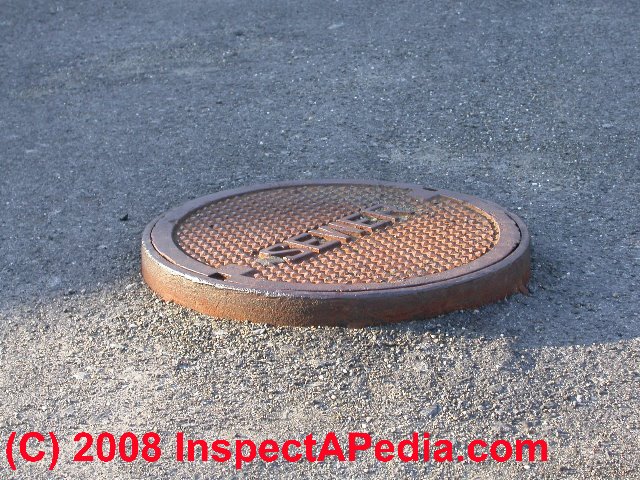
- Manholes: Also if you see large manholes in the street, especially if the lid says “SEWER” then a local sewer is probably present.
Our photo shows a sewer main access cover.
The fact that the cover projects above the level of the pavement tells us that this is a pretty new system and that final street paving is probably incomplete.
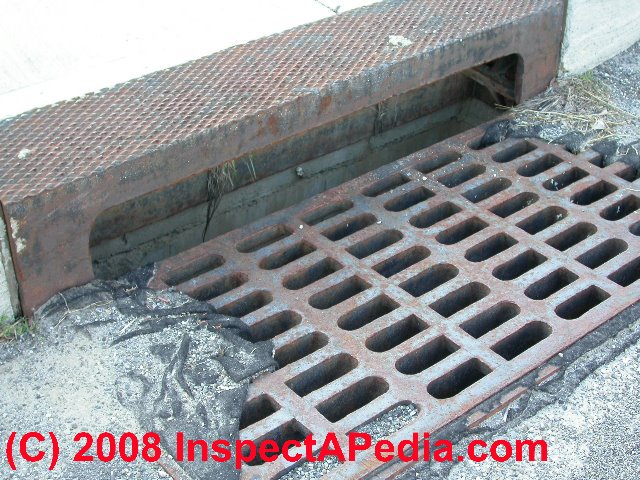
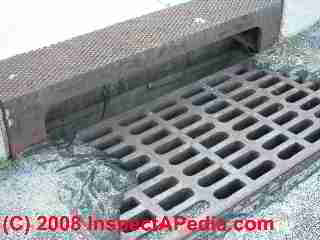
- Storm Drains: If you see storm drains like this one in the street, a local sewer main may be located there as well.
But be careful! In some communities the storm drain system is separate and distinct from the sewer piping system.
However it would be odd for any community to go to the expense of installing a storm drainage system without also installing a sewer system.
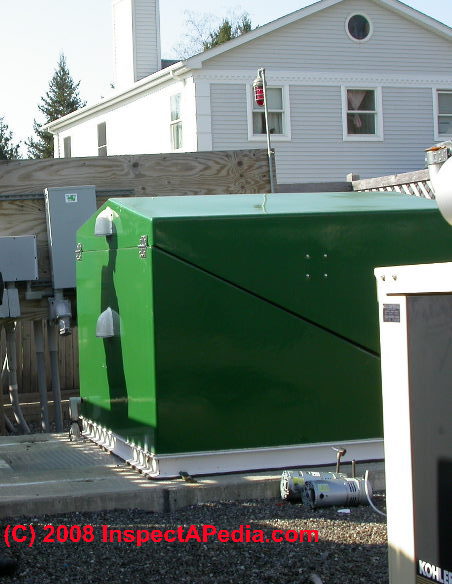
- Sewage Pumping stations: If the home or street is downhill from or lower than a local sewer main, a home or neighborhood pumping station (municipal lift station) will be somewhere nearby. Pumping Stations describes sewer system pumping stations.
We are referring to a large public pumping station not an individual private pumping system serving just the building you are concerned about.
A sewage grinder pump or pumping system installed at or in the individual building does not tell us whether the pump is sending waste up to a public sewer main or waste out to a private septic system that happens to be higher than the building main drain.
Reader Comments, Questions & Answers About The Article Above
Below you will find questions and answers previously posted on this page at its page bottom reader comment box.
Reader Q&A - also see RECOMMENDED ARTICLES & FAQs
On 2020-08-27 by NANCY
Is Public Sewer available for our house at 6223 Laramie St Humble Tx 77396
On 2020-06-20 - by (mod) -
Sophia
You will want to
1. have a sound reason for wanting to pay the tens of thousands of dollars of cost for a new private septic system onsite
2. ask your local building or plumbing department if private septics are permitted in your jurisdiction
3. have a septic engineer review your site for adequate space for septic tank and drainfield (just a tank is not useful, you need both), and to perform soil perc tests so as to undertand the type and cost of system that would be needed
On 2020-06-18 by Sophia
I am looking into buying a house but it is on public sewer, is there a way to have a septic tank installed instead?
On 2020-06-06 - by (mod) -
Allen
Did you try contacting your local Sewer Authority to ask them if a sewer main runs in your street?
On 2020-06-04 by Allen Carmona
Morning,, i would love to find out if 443 Congo rd Gibertsville Pa 19525 is able to connect to public sewer ? We are in process of buying this home and would like information to be able to switch to public sewers ?
On 2020-05-22 - by (mod) -
James
That's a fair question to ask: is public sewer available in my neighborhood,
but with apologies, I can't answer it as I have no idea of your country or city of residence.
Give a call to your local building or public sewer department, give them your street address, and they can certainly tell you if there is a public sewer serving your address.
On 2020-05-22 by James Anisko
Do we have city sewer available for my neighborhood?
On 2019-05-02 by Rebeck
Public sewer locations
On 2018-12-06 - by (mod) -
Your neighbors, or your town building department, Water Department, or sewer department will know if there is a sewer line in your street. If you call one of the Department's just give them your address and ask him if there's Sewer Service in your street.
On 2018-12-06 by Jerry
How do I find out if There is a sewer so I can get rid of my septic and hook up to a sewer
On 2018-08-08 - by (mod) -
Easy, Claire. Contact your local water department to ask where the public water service line is available.
You might also check with your immediate neighbours to ask if they are connected to public water supply.
On 2018-08-08 by claire
i want to know if the public water line near my house?
it is well water.
On 2016-06-01 - by (mod) -
Check the article CLUES INDICATING CONNECTED to SEWER
On 2016-05-22 by scott
how do i know if my house has a septic tank or not , i live in long port NJ my house was built in 1899
...
Continue reading at CLUES INDICATING CONNECTED to SEWER or select a topic from the closely-related articles below, or see the complete ARTICLE INDEX.
Or see these
Recommended Articles
- CLOGGED DRAIN DIAGNOSIS
- FIND the SEPTIC TANK, HOW TO
- SEPTIC or SEWER CONNECTION?
- topic home
- WHAT TO ASK ABOUT SEWERS or SEPTICS
- CLUES INDICATING A SEWER LINE is PRESENT
- CLUES INDICATING CONNECTED to SEWER
- GUIDE for BUILDINGS CONNECTED to PUBLIC SEWER
- GUIDE for BUILDINGS PRE-DATING SEWER INSTALLATION
- GUIDE for BUILDINGS CONNECTED to PRIVATE SEPTIC
- WHAT TO DO IF NO ONE KNOWS - if the connection is to sewer or septic
- SEPTIC VIDEOS show how to walk the site for possible septic tank & drainfield locations
- SEWER / SEPTIC PIPE CAMERAS
Suggested citation for this web page
CLUES INDICATING A SEWER LINE is PRESENT at InspectApedia.com - online encyclopedia of building & environmental inspection, testing, diagnosis, repair, & problem prevention advice.
Or see this
INDEX to RELATED ARTICLES: ARTICLE INDEX to SEPTIC SYSTEMS
Or use the SEARCH BOX found below to Ask a Question or Search InspectApedia
Ask a Question or Search InspectApedia
Try the search box just below, or if you prefer, post a question or comment in the Comments box below and we will respond promptly.
Search the InspectApedia website
Note: appearance of your Comment below may be delayed: if your comment contains an image, photograph, web link, or text that looks to the software as if it might be a web link, your posting will appear after it has been approved by a moderator. Apologies for the delay.
Only one image can be added per comment but you can post as many comments, and therefore images, as you like.
You will not receive a notification when a response to your question has been posted.
Please bookmark this page to make it easy for you to check back for our response.
Our Comment Box is provided by Countable Web Productions countable.ca
Citations & References
In addition to any citations in the article above, a full list is available on request.
- Our recommended books about building & mechanical systems design, inspection, problem diagnosis, and repair, and about indoor environment and IAQ testing, diagnosis, and cleanup are at the InspectAPedia Bookstore. Also see our Book Reviews - InspectAPedia.
- In addition to citations & references found in this article, see the research citations given at the end of the related articles found at our suggested
CONTINUE READING or RECOMMENDED ARTICLES.
- Carson, Dunlop & Associates Ltd., 120 Carlton Street Suite 407, Toronto ON M5A 4K2. Tel: (416) 964-9415 1-800-268-7070 Email: info@carsondunlop.com. Alan Carson is a past president of ASHI, the American Society of Home Inspectors.
Thanks to Alan Carson and Bob Dunlop, for permission for InspectAPedia to use text excerpts from The HOME REFERENCE BOOK - the Encyclopedia of Homes and to use illustrations from The ILLUSTRATED HOME .
Carson Dunlop Associates provides extensive home inspection education and report writing material. In gratitude we provide links to tsome Carson Dunlop Associates products and services.
 | HOME | ABOUT | ASK a QUESTION | CONTACT | CONTENT USE POLICY | DESCRIPTION | POLICIES | PRIVACY | |
| © 2024 - 1985 Publisher InspectApedia.com - Daniel Friedman | |||||||||