
InspectAPedia® FREE Encyclopedia of Building & Environmental Construction, Diagnosis, Maintenance & Repair |
Question? Just ask us! InspectAPedia
|
 How to Locate the Main Building Drain
- POST a QUESTION or COMMENT about how to locate the main sewer line or building drain at a building
This article describes how we identify the main building drain and how we find where it exits the building.
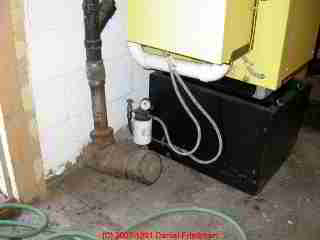
Our page top photo illustrates what a typical main building drain exit point will look like at the foundation wall.
We present an actual case study, illustrated with photos of each step in the diagnosis and replacement of a blocked sewer line.
InspectAPedia tolerates no conflicts of interest. We have no relationship with advertisers, products, or services discussed at this website.
Guide to Locating the main drain exit point from the building
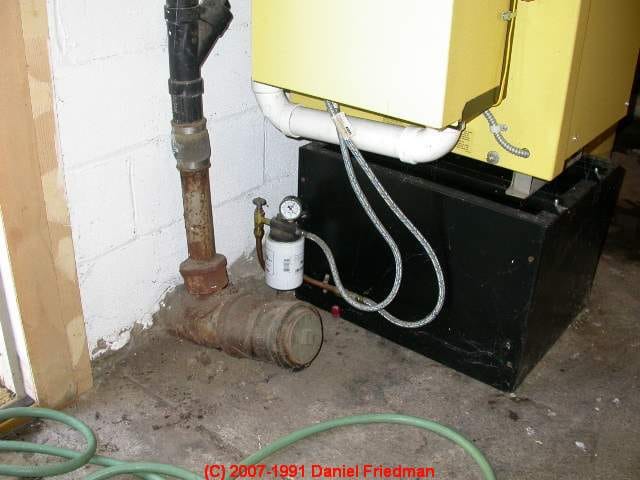
By simple visual inspection, following the pipes in the home, we could see two interesting facts: first a main drain and cleanout were located in the house rear foundation wall, and second, the toilet drain passed separately through the same rear foundation wall just a few feet away.
While we never bet big on where buried drain lines run, the geometry of the basement of this home made for a small, cramped space.
It seemed likely to us from the angle of the pipes and the ultimate destination of the piping (a septic tank downhill in the rear yard), that the two lines joined outside the home, near the house rear wall, using a wye connector. (That later proved to be the case.)
Bottom line: follow the building drains that you can see, sloping downwards until you find the main drain exiting typically at a building wall or floor.
If you don't have visual access, such as if all of building interior surfaces, walls, ceilings, floors, are finished, then using a drain line inspection camera or drain tracing tools can still find the location of drain lines in your building.
See SEWER / SEPTIC PIPE CAMERAS - find the condition of the drain line and find the point(s) of & distance to drain line elbows, bends, or damage or blockage.
and DRAINFIELD PIPE LOCATION, PRECISE - tools to trace drain pipes in a building or underground
More examples of how to find where a main drain exits the building are
at FIND MAIN WASTE LINE EXIT for septic tank location or repair
...
Continue reading at USE a POWER SNAKE to CLEAR a BLOCKED DRAIN or select a topic from the closely-related articles below, or see the complete ARTICLE INDEX.
Or see these
Recommended Articles
- SEWER LINE REPLACEMENT - home
- DIAGNOSE a BLOCKED DRAIN
- WHEN to CALL a PLUMBER
- FIND the MAIN BUILDING DRAIN
- USE a POWER SNAKE to CLEAR a BLOCKED DRAIN
- FIND DISTANCE to DRAIN BLOCKAGE
- DETERMINE NEED for DRAIN LINE REPLACEMENT
- REPLACE SEWER LINE, STEP BY STEP
- MAKE OTHER SEPTIC REPAIRS
- INSTALLING the NEW SEWER LINE
- BED the SEWER LINE in SAND
- FINAL BACKFILL SEWER LINE TRENCH
- DOCUMENT BURIED COMPONENT LOCATION
- FINAL SEEDING & RESTORATION
- SEWER / SEPTIC LINES at STEEP SITES
- SEPTIC TANK, HOW TO FIND - home
Suggested citation for this web page
FIND the MAIN BUILDING DRAIN at InspectApedia.com - online encyclopedia of building & environmental inspection, testing, diagnosis, repair, & problem prevention advice.
Or see this
INDEX to RELATED ARTICLES: ARTICLE INDEX to DRAIN SEPTIC SEWER PIPES
Or use the SEARCH BOX found below to Ask a Question or Search InspectApedia
Ask a Question or Search InspectApedia
Try the search box just below, or if you prefer, post a question or comment in the Comments box below and we will respond promptly.
Search the InspectApedia website
Note: appearance of your Comment below may be delayed: if your comment contains an image, photograph, web link, or text that looks to the software as if it might be a web link, your posting will appear after it has been approved by a moderator. Apologies for the delay.
Only one image can be added per comment but you can post as many comments, and therefore images, as you like.
You will not receive a notification when a response to your question has been posted.
Please bookmark this page to make it easy for you to check back for our response.
Our Comment Box is provided by Countable Web Productions countable.ca
Citations & References
In addition to any citations in the article above, a full list is available on request.
- New York State Department of Health, "Appendix 75-A Wastewater Treatment Standards - Individual Household Systems", [PDF] (2010) New York State Department of Health, 3 February 2010, retrieved 3/1/2010, original source: https://www.health.ny.gov/regulations/nycrr/title_10/part_75/appendix_75-a.htm
- Thanks to Thomas Gleason, excavators, Poughkeepsie, NY 845-454-3730, for the excavating work at the project photo documented here in September 2006
- Thanks to Cleveland Plumbing, the prime plumbing contractor, Staatsburgh, NY 845-485-7700 for the plumbing work and drain clog diagnosis work documented here in September 2006
- In addition to citations & references found in this article, see the research citations given at the end of the related articles found at our suggested
CONTINUE READING or RECOMMENDED ARTICLES.
- Carson, Dunlop & Associates Ltd., 120 Carlton Street Suite 407, Toronto ON M5A 4K2. Tel: (416) 964-9415 1-800-268-7070 Email: info@carsondunlop.com. Alan Carson is a past president of ASHI, the American Society of Home Inspectors.
Thanks to Alan Carson and Bob Dunlop, for permission for InspectAPedia to use text excerpts from The HOME REFERENCE BOOK - the Encyclopedia of Homes and to use illustrations from The ILLUSTRATED HOME .
Carson Dunlop Associates provides extensive home inspection education and report writing material. In gratitude we provide links to tsome Carson Dunlop Associates products and services.
 | HOME | ABOUT | ASK a QUESTION | CONTACT | CONTENT USE POLICY | DESCRIPTION | POLICIES | PRIVACY | |
| © 2024 - 1985 Publisher InspectApedia.com - Daniel Friedman | |||||||||