
InspectAPedia® FREE Encyclopedia of Building & Environmental Construction, Diagnosis, Maintenance & Repair |
Question? Just ask us! InspectAPedia
|
 How to Find the Location of Blockage in a Drain Line
- POST a QUESTION or COMMENT about how to find the point of blockage in a building drain or buried pipe
How to find the point of blockage in a building drain or buried pipe: this article describes how we find the location of blockage in a building drain. We show how to use a plumbing snake or other clues to locate the point of blockage in a building drain or sewer line
The line which was replaced in this photo-illustrated case runs from the building exterior to a septic tank located downhill from the home. We present an actual case study, illustrated with photos of each step in the diagnosis and replacement of a blocked sewer line.
The waste line in this case was found to be blocked, damaged, old, and needing replacement in the course of an attempt to clear a blocked drain between the house and septic tank. Technical reviewers are welcome and are listed at "References."
InspectAPedia tolerates no conflicts of interest. We have no relationship with advertisers, products, or services discussed at this website.
How to Find the Distance to the drain blockage - locating the blockage point in a Drain Pipe
Observing where an obstruction was felt in the drain line during operation of the power snake was an important point because on pulling the power snake back out of the line from this point we could determine how far away from the house the blockage actually was.
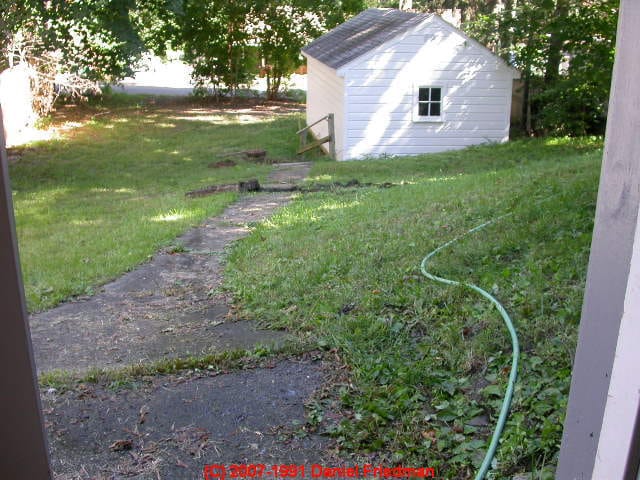
Leaving the power snake operating and rotating inside the sewer pipe two of us dashed outdoors to walk down the hill between house and septic tank location to the approximate distance indicated by what we'd discovered inside.
While buried pipes might run anywhere, one would expect in this case that they run in a nearly straight line down the hill from the house to the septic tank.
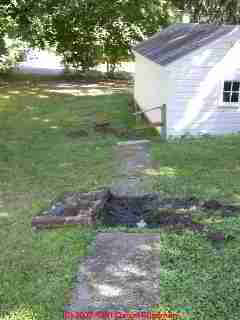
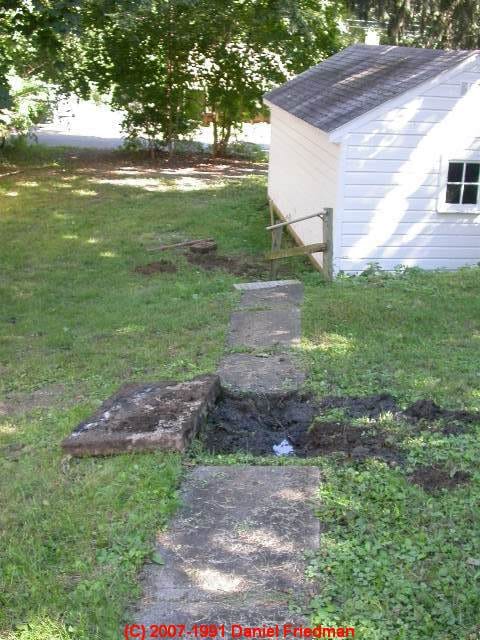
Looking and feeling the ground for vibration caused by the power snake and listening for the sound of the snake turning inside the drain line, was easy in this case when we stopped over a section of concrete sidewalk. We could both feel and hear the snake turning in the ground below. (The disturbed sidewalk far down the hill shows where we heard and felt the vibration of the power snake being operated by the plumber.)
Another method of "listening" for the plumbing snake noise inside a sewer line or other drain was suggested by PHG from Poughkeepsie, who said he uses a mechanic's stethoscope to follow the drain line. Using a long screwdriver he probes into the (soft) soil down to where he thinks the drain line is running. He inserts the mechanic's stethoscope into the opening made by the screwdriver. The rod of the stethoscope conducts noise from the pipe or nearby pipe or soils.
Use a sewer or drain line video inspection camera: this method can find the point of blockage and it can tell us the condition of the entire drain or sewer line: information we need to decide if the right repair is to clear the line or if actual repair or replacement of the sewer or drain line is needed.
See SEWER / SEPTIC PIPE CAMERAS
Spending money on drain cleaning attempts when a new drain is what's needed?
The cost of this attempt to unblock a clogged building drain was several hundred dollars to pay the workers and for use of the power snake machine. While it was disappointing to have spent this money only to discover that what was needed was a drain replacement, we considered it the fair cost for a confident diagnosis of what work was needed.
In hindsight, we could
have assumed that the drain replacement was needed based on the age of the home and
gone directly to hiring the excavator, but most experts would consider that a rash step
since there are plenty of instances of blocked drains that do not need to be replaced.
...
Continue reading at DETERMINE NEED for DRAIN LINE REPLACEMENT or select a topic from the closely-related articles below, or see the complete ARTICLE INDEX.
Or see these
Recommended Articles
- USE a POWER SNAKE to CLEAR a BLOCKED DRAIN
- SEWER LINE REPLACEMENT - home
- SEWER / SEPTIC PIPE CAMERAS - find the condition of the drain line and find the point(s) of & distance to blockage or broken sewer or septic pipe
Suggested citation for this web page
FIND DISTANCE to DRAIN BLOCKAGE at InspectApedia.com - online encyclopedia of building & environmental inspection, testing, diagnosis, repair, & problem prevention advice.
Or see this
INDEX to RELATED ARTICLES: ARTICLE INDEX to DRAIN SEPTIC SEWER PIPES
Or use the SEARCH BOX found below to Ask a Question or Search InspectApedia
Ask a Question or Search InspectApedia
Try the search box just below, or if you prefer, post a question or comment in the Comments box below and we will respond promptly.
Search the InspectApedia website
Note: appearance of your Comment below may be delayed: if your comment contains an image, photograph, web link, or text that looks to the software as if it might be a web link, your posting will appear after it has been approved by a moderator. Apologies for the delay.
Only one image can be added per comment but you can post as many comments, and therefore images, as you like.
You will not receive a notification when a response to your question has been posted.
Please bookmark this page to make it easy for you to check back for our response.
Our Comment Box is provided by Countable Web Productions countable.ca
Citations & References
In addition to any citations in the article above, a full list is available on request.
- New York State Department of Health, "Appendix 75-A Wastewater Treatment Standards - Individual Household Systems", [PDF] New York State Department of Health, 3 February 2010, retrieved 3/1/2010, original source: https://www.health.ny.gov/regulations/nycrr/title_10/part_75/appendix_75-a.htm
- Thanks to Thomas Gleason, excavators, Poughkeepsie, NY 845-454-3730, for the excavating work at the project photo documented here in September 2006
- Thanks to Cleveland Plumbing, the prime plumbing contractor, Staatsburgh, NY 845-485-7700 for the plumbing work and drain clog diagnosis work documented here in September 2006
- Inspecting Septic Systems: Online Book, Inspection, Test, Diagnosis, Repair, & Maintenance: our Online Septic Book: Septic Testing, Loading & Dye Tests, Septic Tank Pumping, Clearances, details of onsite waste disposal system inspection, testing, repair procedures.
- Advanced Onsite Wastewater Systems Technologies, Anish R. Jantrania, Mark A. Gross. Anish Jantrania, Ph.D., P.E., M.B.A., is a Consulting Engineer, in Mechanicsville VA, 804-550-0389 (2006), Advanced Onsite Wastewater Systems Technologies. Outstanding technical reference especially on alternative septic system design alternatives. Written for designers and engineers, this book is not at all easy going for homeowners but is a text we recommend for professionals--DF. I>
- Country Plumbing: Living with a Septic System, Hartigan, Gerry: $ 9.95; ALAN C HOOD & TP; Quoting an Amazon reviewer's comment, with which we agree--DF
- In addition to citations & references found in this article, see the research citations given at the end of the related articles found at our suggested
CONTINUE READING or RECOMMENDED ARTICLES.
- Carson, Dunlop & Associates Ltd., 120 Carlton Street Suite 407, Toronto ON M5A 4K2. Tel: (416) 964-9415 1-800-268-7070 Email: info@carsondunlop.com. Alan Carson is a past president of ASHI, the American Society of Home Inspectors.
Thanks to Alan Carson and Bob Dunlop, for permission for InspectAPedia to use text excerpts from The HOME REFERENCE BOOK - the Encyclopedia of Homes and to use illustrations from The ILLUSTRATED HOME .
Carson Dunlop Associates provides extensive home inspection education and report writing material. In gratitude we provide links to tsome Carson Dunlop Associates products and services.
 | HOME | ABOUT | ASK a QUESTION | CONTACT | CONTENT USE POLICY | DESCRIPTION | POLICIES | PRIVACY | |
| © 2024 - 1985 Publisher InspectApedia.com - Daniel Friedman | |||||||||