
InspectAPedia® FREE Encyclopedia of Building & Environmental Construction, Diagnosis, Maintenance & Repair |
Question? Just ask us! InspectAPedia
|
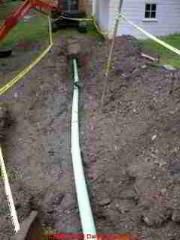 Sewer Line Replacement Procedure
- POST a QUESTION or COMMENT about laying septic or sewer piping into trenches
Sewer or septic line replacement: placing the new pipe in the trench.
This article describes how the new sewer line is installed when a sewer pipe or "drain line" is replaced.
We present an actual case study, illustrated with photos of each step in the diagnosis and replacement of a blocked sewer line.
InspectAPedia tolerates no conflicts of interest. We have no relationship with advertisers, products, or services discussed at this website.
Guide to installing the replacement sewer pipe line
 This article on sewer line replacement addresses installing the new sewer pipe and making connections.
- Safety during sewer line or septic line excavation
- Recommended allowable slope for sewer or septic line piping
- Sewer or septic line trench specifications: uniformity, soil compaction, width
- Specifications for placing sewer or septic piping into the excavated trenches
- Recommended sewer line size (diameter) and slope
- Avoiding rocks, voids, using sand, protecting the new septic or sewer pipe from damage
Safety of occupants and neighbors during excavation for sewer line repairs
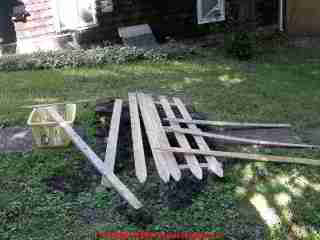
When the plumbers left the site we had created a hole which was a trip hazard to folks who might cross the yard.
While our immediate makeshift hazard indicators (nearby wood fence scraps and a laundry basket) was amateur and insecure, at least we had an immediate visual indicator that there was something here to watch out for.
We then went in search for some more sturdy materials to cover the hole until further repair work could begin.
Safety during sewer line trench excavation
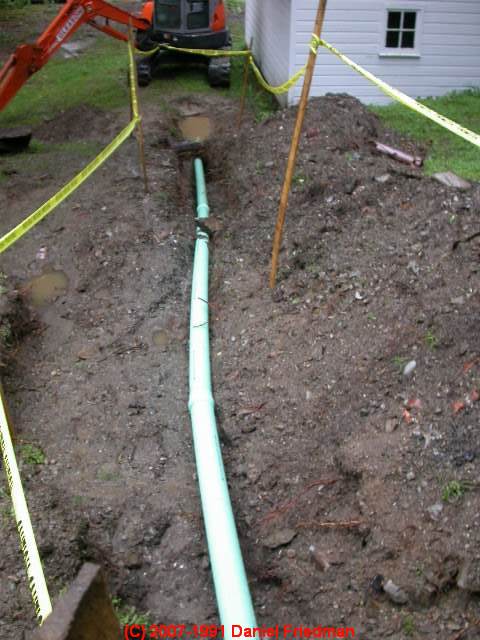 During excavation, when the excavators had to leave the site between job stages,
the site was also marked-off with yellow hazard tape tied to sticks.
During excavation, when the excavators had to leave the site between job stages,
the site was also marked-off with yellow hazard tape tied to sticks.
Also amateur but successful at warning people about the risk of falling into a ditch.
Do not leave any site excavations open and unattended: the risks are injury as someone may fall in, and in freezing climates there may be a risk of piping freeze damage.
What is the proper slope for sewer lines between house and septic tank or sewer main?
Sewer line trenches should be as uniform in slope as possible and should slope between 2% and 10% grade - that is, the sewer line slope can drop between two feet and ten feet per one hundred feet of run. [4]
You can see that the sewer line slope down this hillside is excessive. A risk (less in plastic pvc than in cast iron pipes) is that the water and the solids in the sewage don't remain together, leaving solids behind to clog the piping. Also the wastewater flowing into the septic tank at the bottom of the hill is really zooming in velocity - making the condition of the septic tank inlet baffle even more important.
Sewer Line Trench Details: uniformity, soil compaction
If you don't want sagging or broken sewer line pipes, clogs, and failures in the piping, then the sewer line trench bottom should be properly and uniformly sloped and compacted. The bottom of the sewer line trench should be virgin soil - not over-excavated. But since excavating is a rough art, some trench sections may be uneven and deeper than others. In that case the soil used for fill beneath the sewer piping must be adequately compacted to avoid future sags.
If you place the sewer piping in soft fill or areas where the fill compaction varies, the risk is that the piping develops low spots, sags, even breaks, leading to future clogging. And if trenches are not below the frost line, wastewater sitting in a low pipe sag in freezing climates may freeze, totally blocking the system.
The Alaska Septic Installation Manual suggests that sewer line trenches should be as narrow as possible in width and that piping should be laid on undisturbed soil or on compacted backfill soil. [4]
Installing the replacement sewer line
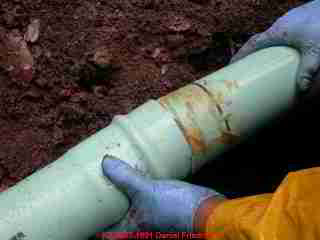 Installing and connecting the new drain sections
Sewer line diameter
The minimum diameter sewer line piping allowed in most jurisdictions (and Alaska) is 4-inches in diameter. Smaller lines are prone to clogging. We are referring to gravity-flow sewer lines here. A pumped or forced sewer main is usually carrying sewage that has been through a grinder pump and as a result, in residential applications smaller diameter piping may be allowed.
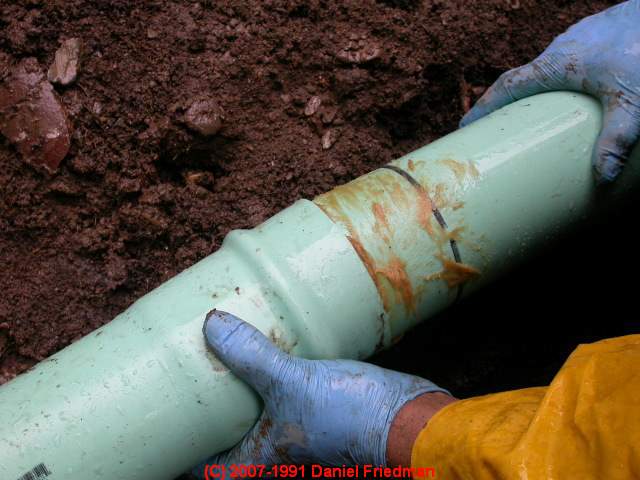
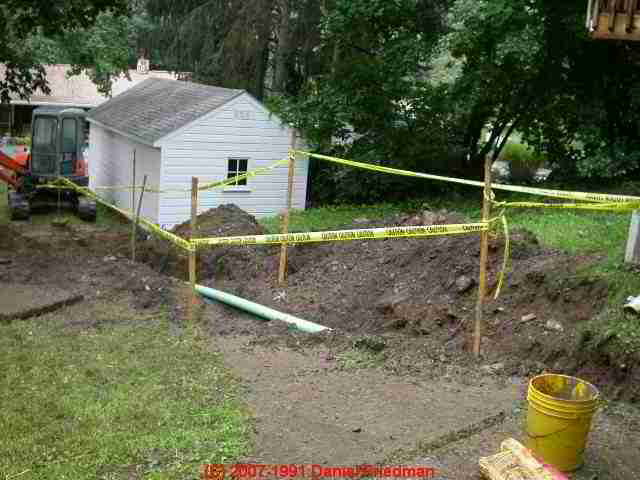
Sections of the new drain were laid along the trench for installation, cut to length at either end, and then connected together. Note the grease used to slip the sections of drain pipe together.
At the up-hill house end, we connected the new drain line to the existing stub of cast iron sewer line outside of the house foundation wall.
This avoided the cost and trouble of having to break through the foundation wall to install a new line into the home, and avoided possible damage to the nearby heating boiler.
The rubber coupling used to connect the two drains leaked and had to be re-connected.
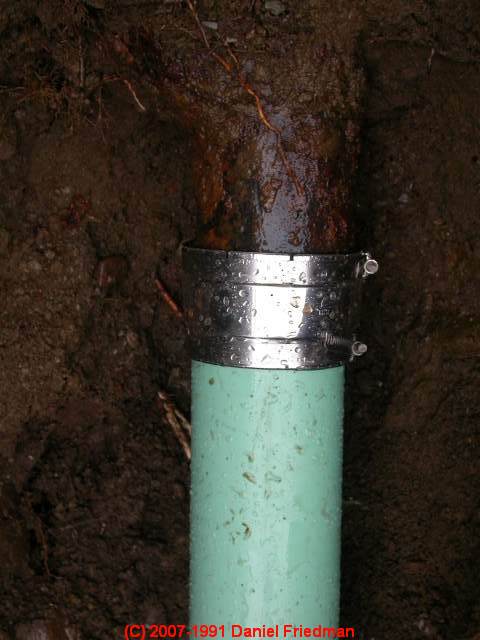
These couplings work fine, durably, and reliably provided the pipes they connect are lined up carefully. An askew pipe connection is more likely to leak.
Also see CLOGGED DRAIN DIAGNOSIS & REPAIR diagnosing septic backups and septic system failures versus clogged drains.
Question:
(Feb 2, 2012) sail said:
What is the international building code for minimum size sewer drain line and are 90 degree corners within code? If 90's are acceptable is there a limit? such as 2 or 3?
Reply:
Sail,
Plumbers avoid 90's on sewer piping because they tend to clog. Use a 45 or if you need to make a 90 degree turn, use two 45s. More bends than necessary also increases the chances of clogging.
Question:
(Sept 5, 2012) demersjutta@gmail.com said:
what is the correct dia. of the new PVC drainage pipe to connect to the side opening of a concrete septic tank that measures 5 3/4" inner dia. and 7 1/2" outer dia. and what do i use to seal the opening in an area with a serious root problem
Question: connecting the new sewer line to a septic tank that was connected to terra-cotta piping
29 March 2015 joh hyman said:
how do you get the terra cotta pipe out of the septic tank where the 4inch pvc pipe it goes in? can you step the pipe size down to three inches where it goes into the tank?
Reply:
Joh
If there is an old segment of terra-cotta sewer line entering the septic tank it's probably sealed with concrete. Luckily terra-cotta is quite soft. You will need to take the following steps:
1. With the tank excavated enough to have working space, and NEVER WORKING ALONE - as falling into a septic tank is usually fatal - you will use a hammer and mason's chisel to chip out the old terra-cotta line. Wear goggles and other protective gear of course. I want to remove the old terra cotta not only because we want to connect the new PVC sewer line to the tank but also because
2. you will need to install a baffle or pipe tee in the tank (from the inside walll of the tank) (DO NOT ENTER A SEPTIC TANK NOR LEAN OVER IT as THAT CAN BE FATAL)
The tank tee may protrude through the opened wall of the septic tank to provide a connection point outside using standard PVC pipe fittings.
3. You'll need to seal around the pipe passage using a masonry sealer or cement.
Question: find the sepic tank cleanout port
Anonymous said:
how do you find the inspection holes to have the tank pumped?
Reply:
Anon in a series of articles beginning at SEPTIC TANK, HOW TO FIND we explain how to find the septic tank. At that point you simply uncover it to expose the cleanout port(s) in the tank top. IF the tank is deep, before re-burying it again discuss with your septic contractor an extra step of adding septic tank risers to make the next cleanout easier.
...
Continue reading at BED the SEWER LINE in SAND or select a topic from the closely-related articles below, or see the complete ARTICLE INDEX.
Or see this
Article Series
- SEWER LINE REPLACEMENT
- DIAGNOSE a BLOCKED DRAIN
- WHEN to CALL a PLUMBER
- FIND the MAIN BUILDING DRAIN
- USE a POWER SNAKE to CLEAR a BLOCKED DRAIN
- FIND DISTANCE to DRAIN BLOCKAGE
- DETERMINE NEED for DRAIN LINE REPLACEMENT
- REPLACE SEWER LINE, STEP BY STEP
- MAKE OTHER SEPTIC REPAIRS
- INSTALLING the NEW SEWER LINE
- BED the SEWER LINE in SAND
- FINAL BACKFILL SEWER LINE TRENCH
- DOCUMENT BURIED COMPONENT LOCATION
- FINAL SEEDING & RESTORATION
- SEWER / SEPTIC LINES at STEEP SITES
Suggested citation for this web page
INSTALLING the NEW SEWER LINE at InspectApedia.com - online encyclopedia of building & environmental inspection, testing, diagnosis, repair, & problem prevention advice.
Or see this
INDEX to RELATED ARTICLES: ARTICLE INDEX to DRAIN SEPTIC SEWER PIPES
Or use the SEARCH BOX found below to Ask a Question or Search InspectApedia
Ask a Question or Search InspectApedia
Try the search box just below, or if you prefer, post a question or comment in the Comments box below and we will respond promptly.
Search the InspectApedia website
Note: appearance of your Comment below may be delayed: if your comment contains an image, photograph, web link, or text that looks to the software as if it might be a web link, your posting will appear after it has been approved by a moderator. Apologies for the delay.
Only one image can be added per comment but you can post as many comments, and therefore images, as you like.
You will not receive a notification when a response to your question has been posted.
Please bookmark this page to make it easy for you to check back for our response.
Our Comment Box is provided by Countable Web Productions countable.ca
Citations & References
In addition to any citations in the article above, a full list is available on request.
- Thanks to Thomas Gleason, excavators, Poughkeepsie, NY 845-454-3730, for the excavating work at the project photo documented here in September 2006
- Thanks to Cleveland Plumbing, the prime plumbing contractor, Staatsburgh, NY 845-485-7700 for the plumbing work and drain clog diagnosis work documented here in September 2006
- [1] Pennsylvania State Fact Sheets relating to domestic wastewater treatment systems include
- Pennsylvania State Wastewater Treatment Fact Sheet SW-161, Septic System Failure: Diagnosis and Treatment
- Pennsylvania State Wastewater Treatment Fact Sheet SW-162, The Soil Media and the Percolation Test
- Pennsylvania State Wastewater Treatment Fact Sheet SW-l64, Mound Systems for Wastewater Treatment
- Pennsylvania State Wastewater Treatment Fact Sheet SW-165, Septic Tank-Soil Absorption Systems
- Document Sources used for this web page include but are not limited to: Agricultural Fact Sheet #SW-161 "Septic Tank Pumping," by Paul D. Robillard and Kelli S. Martin. Penn State College of Agriculture - Cooperative Extension, edited and annotated by Dan Friedman (Thanks: to Bob Mackey for proofreading the original source material.)
- Septic Tank/Soil-Absorption Systems: How to Operate & Maintain [PDF ] - , Equipment Tips, U.S. Department of Agriculture, 8271 1302, 7100 Engineering, 2300 Recreation, September 1982, web search 08/28/2010, original source: http://www.fs.fed.us/t-d/pubs/pdfimage/82711302.pdf.
- [3] "How to Maintain Your Septic System", Alaska Department of Environmental Conservation, Division of Water, retrieved 8/8/12, original source: http://dec.alaska.gov/water/wwdp/onsite/maintain_septic.htm [copy on file as Alaska_Septic_Care.pdf]
- [4] Installers Manual for Conventional Onsite Domestic Wastewater Treatment and Disposal Systems", Alaska Department of Environmental Conservation, Division of Water, retrieved 1/15/2001, original source: [copy on file as Alaska_Certified_Installer's_Manual.pdf]
- Tyler, E. T., R. Laak, E. McCoy, and S. S. Sandhu. 1977. "The Soil as a Treatment System." in Home Sewage Treatment. ASAE publication 5-77
- Septic Tank Maintenance - Guide M-113, R. Craig Runyan, Extension Water Quality Specialist, New Mexico septic tank size table , scheduled for update 11/07 (pending), Cooperative Extension Service, College of Agriculture and Home Economics, New Mexico State University (Las Cruces)
- In addition to citations & references found in this article, see the research citations given at the end of the related articles found at our suggested
CONTINUE READING or RECOMMENDED ARTICLES.
- Carson, Dunlop & Associates Ltd., 120 Carlton Street Suite 407, Toronto ON M5A 4K2. Tel: (416) 964-9415 1-800-268-7070 Email: info@carsondunlop.com. Alan Carson is a past president of ASHI, the American Society of Home Inspectors.
Thanks to Alan Carson and Bob Dunlop, for permission for InspectAPedia to use text excerpts from The HOME REFERENCE BOOK - the Encyclopedia of Homes and to use illustrations from The ILLUSTRATED HOME .
Carson Dunlop Associates provides extensive home inspection education and report writing material. In gratitude we provide links to tsome Carson Dunlop Associates products and services.
 | HOME | ABOUT | ASK a QUESTION | CONTACT | CONTENT USE POLICY | DESCRIPTION | POLICIES | PRIVACY | |
| © 2024 - 1985 Publisher InspectApedia.com - Daniel Friedman | |||||||||