
InspectAPedia® FREE Encyclopedia of Building & Environmental Construction, Diagnosis, Maintenance & Repair |
Question? Just ask us! InspectAPedia
|
 Sewer Line Replacement Procedure
- POST a QUESTION or COMMENT about using sand to protect sewer, septic, or other buried pipes from future damage
Use sand around buried sewer or water pipes:
Sand is bedded beneath and around buried plumbing lines to avoid damage.
This article describes the use of sand around a sewer pipe during backfill when a sewer pipe or "drain line" is replaced.
InspectAPedia tolerates no conflicts of interest. We have no relationship with advertisers, products, or services discussed at this website.
Use of sand to bed the new drain piping: why & how - specifications for bedding sewer piping in sand in trenches
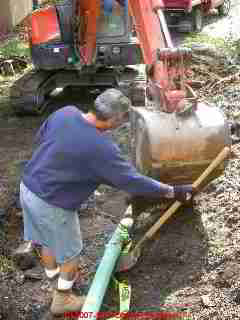
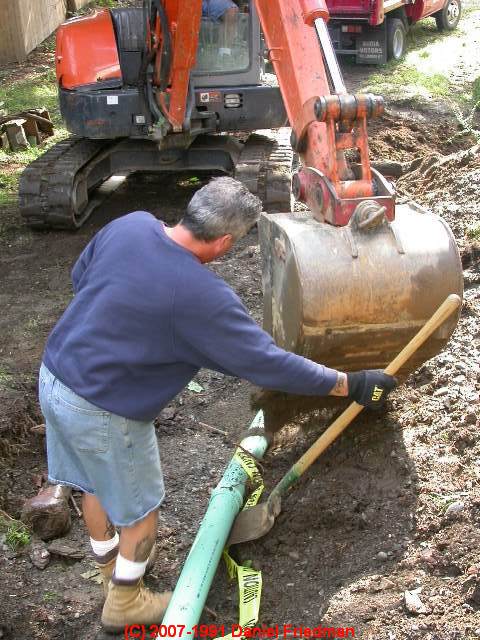
Sand under and around a plastic sewer line protects it from breakage or penetration by sharp objects that may be nearby after backfill.
We were particularly concerned for the durability of the new piping in this installation because there was not much backfill available to cover the piping where it had to pass over shallow bedrock.
Not only to be in compliance with building codes but also because these pipes pass over shallow bedrock and could be damaged by future settlement or traffic, the excavator brought in a truckload of sand which was used to bed the new sewer line before final backfill over the piping.
A worker standing in the trench lifted each pipe section to assure that sand would be beneath the pipe to cushion it from rocks below.
Just covering the pipe on top with sand would be a poor practice.
What is the Proper Material for Bedding Buried Sewer or Water Pipes?
Sewer lines in sand, possibly in pea gravel: Our contractor for the sewer line replacement project documented in this article used clean sand for bedding the new sewer piping. Sand was specified by our local building department. Some local codes permit and some contractors like to use pea gravel for plastic sewer line protection, asserting that pea gravel settles less than sand in the pipe trench.
However water supply piping must be bedded in clean sand. Where copper water supply pipes have been buried in gravel contractors find that over time the gravel, perhaps moving by frost or water passage through the soil, actually works against the metal water piping to create multiple holes and leaks in the water main.
One of our consultants, George from Jeneral Sewer Service reported that on excavating a water supply line with poor water pressure, he found that the entire length of the copper water pipe had multiple perforations - "When we dug it up and turned on water pressure at the curb box the water line looked like a sprinkler hose!" he said.
Where plastic water supply piping is used the risk of gravel perforation from the backfill material is little or none unless the excavator permits a large or sharp stone to become buried close to the piping. .
Reader Comments, Questions & Answers About The Article Above
Below you will find questions and answers previously posted on this page at its page bottom reader comment box.
Reader Q&A - also see RECOMMENDED ARTICLES & FAQs
On 2021-04-21 - by (mod) -
@alex miller,
use clean
sand
On 2021-04-20 by alex miller
if replacing sewer line and water supply line to a residential home what material is best to use to bed the pipes?
On 2020-07-26 by Floyd Hundley
Wouldn't send me to soft around the erosion from the water dirt I was thinking of what kind of stone should be around before the dirt am I correct
On 2020-06-02 - by (mod) -
Your co cern is reasonable, though the risk may be high or low ... the answer is in the exact details, thst unfortunately we don't have.
On 2020-05-31 by Drain Rocks Sewer Pipe
I wonder if not putting any gravel or rocks underneath the PVC sewer pipe will create a problem in the future. I hired this guy who does sewer pipe commercial every day from his company. The sewer company gave us an estimate and told us that they saw from the camera that the concrete sewer pipe had belly and it must be replace with pvc sewer pipe.
The guy we hired did this on the side for a day for extra money and also to help me out, however, i found out that he did not put the gravel or drain rocks underneath the pvc sewer pipe because he said it was safe and will not break because they put a new concrete cement for the flooring to complete the job.
My concern now is that, if he filled out everything back with dirt and put back some of the broken concrete sewer pipe underneath the final concrete flooring, will that damage the sewer pvc? I don't know why he said that it should not matter because he puts in the dirt back to fill up the pvc sewer pice but did not put the gravel or drain rocks. Please let me know the possible issue that could happen in the future. Thank you so much.
On 2017-03-02 - by (mod) -
Fair question, Garreth. I'd check with your local plumbing inspector.
On 2017-03-02 by Garreth Tuck
Do you have to use a sand bed on a 25mm water pipe if the soil is clean from sharp stones/objects?
On 2016-04-21 - by (mod) -
Sand is a recommended under-bed as well as over-fill to protect any buried piping.
On 2016-04-20 by Cyrus
is bank sand is good for filling around pvc waste water pipe line?
...
Continue reading at FINAL BACKFILL SEWER LINE TRENCH or select a topic from the closely-related articles below, or see the complete ARTICLE INDEX.
Or see these
Recommended Articles
- SANDY SOIL SEPTIC DESIGNS
- SEWER LINE REPLACEMENT
- DIAGNOSE a BLOCKED DRAIN
- WHEN to CALL a PLUMBER
- FIND the MAIN BUILDING DRAIN
- USE a POWER SNAKE to CLEAR a BLOCKED DRAIN
- FIND DISTANCE to DRAIN BLOCKAGE
- DETERMINE NEED for DRAIN LINE REPLACEMENT
- REPLACE SEWER LINE, STEP BY STEP
- MAKE OTHER SEPTIC REPAIRS
- INSTALLING the NEW SEWER LINE
- BED the SEWER LINE in SAND
- FINAL BACKFILL SEWER LINE TRENCH
- DOCUMENT BURIED COMPONENT LOCATION
- FINAL SEEDING & RESTORATION
- SEWER / SEPTIC LINES at STEEP SITES
Suggested citation for this web page
BED the SEWER LINE in SAND at InspectApedia.com - online encyclopedia of building & environmental inspection, testing, diagnosis, repair, & problem prevention advice.
Or see this
INDEX to RELATED ARTICLES: ARTICLE INDEX to DRAIN SEPTIC SEWER PIPES
Or use the SEARCH BOX found below to Ask a Question or Search InspectApedia
Ask a Question or Search InspectApedia
Try the search box just below, or if you prefer, post a question or comment in the Comments box below and we will respond promptly.
Search the InspectApedia website
Note: appearance of your Comment below may be delayed: if your comment contains an image, photograph, web link, or text that looks to the software as if it might be a web link, your posting will appear after it has been approved by a moderator. Apologies for the delay.
Only one image can be added per comment but you can post as many comments, and therefore images, as you like.
You will not receive a notification when a response to your question has been posted.
Please bookmark this page to make it easy for you to check back for our response.
Our Comment Box is provided by Countable Web Productions countable.ca
Citations & References
In addition to any citations in the article above, a full list is available on request.
- New York State Department of Health, APPENDIX 75-A WASTEWATER TREATMENT STANDARDS - INDIVIDUAL HOUSEHOLD SYSTEMS , [PDF] New York State Department of Health, 3 February 2010, retrieved 3/1/2010, original source: https://www.health.ny.gov/regulations/nycrr/title_10/part_75/appendix_75-a.htm
- Thanks to Thomas Gleason, excavators, Poughkeepsie, NY 845-454-3730, for the excavating work at the project photo documented here in September 2006
- Thanks to Cleveland Plumbing, the prime plumbing contractor, Staatsburgh, NY 845-485-7700 for the plumbing work and drain clog diagnosis work documented here in September 2006
- Thanks to Jeneral Sewer Service - George - 845-297-2285, a New York Hudson Valley drain and sewer cleaning and de-clogging expert for
- Advanced Onsite Wastewater Systems Technologies, Anish R. Jantrania, Mark A. Gross. Anish Jantrania, Ph.D., P.E., M.B.A., is a Consulting Engineer, in Mechanicsville VA, 804-550-0389 (2006), Advanced Onsite Wastewater Systems Technologies. Outstanding technical reference especially on alternative septic system design alternatives. Written for designers and engineers, this book is not at all easy going for homeowners but is a text we recommend for professionals--DF. I>
- In addition to citations & references found in this article, see the research citations given at the end of the related articles found at our suggested
CONTINUE READING or RECOMMENDED ARTICLES.
- Carson, Dunlop & Associates Ltd., 120 Carlton Street Suite 407, Toronto ON M5A 4K2. Tel: (416) 964-9415 1-800-268-7070 Email: info@carsondunlop.com. Alan Carson is a past president of ASHI, the American Society of Home Inspectors.
Thanks to Alan Carson and Bob Dunlop, for permission for InspectAPedia to use text excerpts from The HOME REFERENCE BOOK - the Encyclopedia of Homes and to use illustrations from The ILLUSTRATED HOME .
Carson Dunlop Associates provides extensive home inspection education and report writing material. In gratitude we provide links to tsome Carson Dunlop Associates products and services.
 | HOME | ABOUT | ASK a QUESTION | CONTACT | CONTENT USE POLICY | DESCRIPTION | POLICIES | PRIVACY | |
| © 2024 - 1985 Publisher InspectApedia.com - Daniel Friedman | |||||||||