
InspectAPedia® FREE Encyclopedia of Building & Environmental Construction, Diagnosis, Maintenance & Repair |
Question? Just ask us! InspectAPedia
|
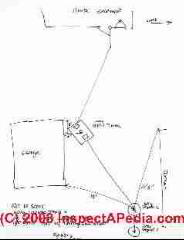 Measure and document buried plumbing & septic components
- POST a QUESTION or COMMENT about finding and documenting the location of buried plumbing, tanks, septic systems, pipes, wells or other site features
This article describes how we measure and document the location of buried items when a sewer pipe or "drain line" is replaced.
InspectAPedia tolerates no conflicts of interest. We have no relationship with advertisers, products, or services discussed at this website.
Documenting the Location of Buried Site Components
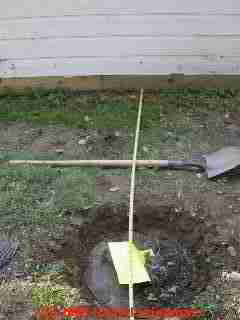
We took advantage of having excavated and exposed the septic tank as well as the drain line to photograph, sketch, and mark the exact location of these components to make future repairs easier.
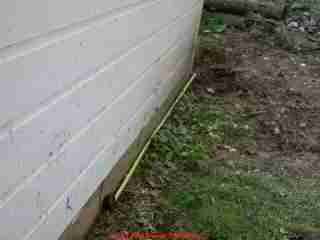
In this case we simply measured the distance from the garage wall out to the septic tank cleanout as shown in the photo.
That measurement, combined with this measurement along the garage wall to the point on its side in line with the septic tank cover (i.e. where to measure "out" from the garage over to the tank) was sufficient.
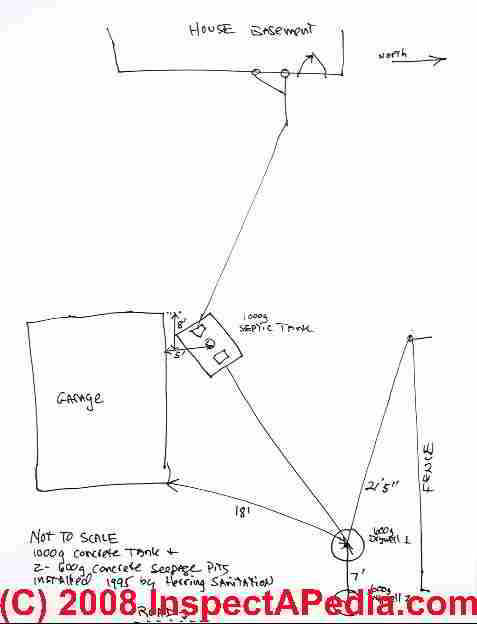
Here's our sketch that locates the septic components at this property.
It's rough, ugly, but accurate. We simply documented measurements to the center of the septic tank from the garage rear corner and measurements to the seepage pits from the garage and from a fence post.
Technical reviewers are welcome and are listed at "References." This is a chapter of SEPTIC SYSTEM INSPECTION & MAINTENANCE COURSE an online book on septic systems. Also see CLOGGED DRAIN DIAGNOSIS & REPAIR diagnosing septic backups and septic system failures versus clogged drains.
Citation of this article by reference to this website and brief quotation for the sole purpose of review are permitted. Use of this information at other websites, in books or pamphlets for sale is reserved
to the author.
...
Continue reading at FINAL SEEDING & RESTORATION or select a topic from the closely-related articles below, or see the complete ARTICLE INDEX.
Or see these
Recommended Articles
- SEWER LINE REPLACEMENT
- DIAGNOSE a BLOCKED DRAIN
- WHEN to CALL a PLUMBER
- FIND the MAIN BUILDING DRAIN
- USE a POWER SNAKE to CLEAR a BLOCKED DRAIN
- FIND DISTANCE to DRAIN BLOCKAGE
- DETERMINE NEED for DRAIN LINE REPLACEMENT
- REPLACE SEWER LINE, STEP BY STEP
- MAKE OTHER SEPTIC REPAIRS
- INSTALLING the NEW SEWER LINE
- BED the SEWER LINE in SAND
- FINAL BACKFILL SEWER LINE TRENCH
- DOCUMENT BURIED COMPONENT LOCATION
- FINAL SEEDING & RESTORATION
- SEWER / SEPTIC LINES at STEEP SITES
Suggested citation for this web page
DOCUMENT BURIED COMPONENT LOCATION at InspectApedia.com - online encyclopedia of building & environmental inspection, testing, diagnosis, repair, & problem prevention advice.
Or see this
INDEX to RELATED ARTICLES: ARTICLE INDEX to DRAIN SEPTIC SEWER PIPES
Or use the SEARCH BOX found below to Ask a Question or Search InspectApedia
Ask a Question or Search InspectApedia
Try the search box just below, or if you prefer, post a question or comment in the Comments box below and we will respond promptly.
Search the InspectApedia website
Note: appearance of your Comment below may be delayed: if your comment contains an image, photograph, web link, or text that looks to the software as if it might be a web link, your posting will appear after it has been approved by a moderator. Apologies for the delay.
Only one image can be added per comment but you can post as many comments, and therefore images, as you like.
You will not receive a notification when a response to your question has been posted.
Please bookmark this page to make it easy for you to check back for our response.
Our Comment Box is provided by Countable Web Productions countable.ca
Citations & References
In addition to any citations in the article above, a full list is available on request.
- New York State Department of Health, APPENDIX 75-A WASTEWATER TREATMENT STANDARDS - INDIVIDUAL HOUSEHOLD SYSTEMS , [PDF] New York State Department of Health, 3 February 2010, retrieved 3/1/2010, original source: https://www.health.ny.gov/regulations/nycrr/title_10/part_75/appendix_75-a.htm
- Thanks to Thomas Gleason, excavators, Poughkeepsie, NY 845-454-3730, for the excavating work at the project photo documented here in September 2006
- Thanks to Cleveland Plumbing, the prime plumbing contractor, Staatsburgh, NY 845-485-7700 for the plumbing work and drain clog diagnosis work documented here in September 2006
- Advanced Onsite Wastewater Systems Technologies, Anish R. Jantrania, Mark A. Gross. Anish Jantrania, Ph.D., P.E., M.B.A., is a Consulting Engineer, in Mechanicsville VA, 804-550-0389 (2006), Advanced Onsite Wastewater Systems Technologies. Outstanding technical reference especially on alternative septic system design alternatives. Written for designers and engineers, this book is not at all easy going for homeowners but is a text we recommend for professionals--DF. I>
- In addition to citations & references found in this article, see the research citations given at the end of the related articles found at our suggested
CONTINUE READING or RECOMMENDED ARTICLES.
- Carson, Dunlop & Associates Ltd., 120 Carlton Street Suite 407, Toronto ON M5A 4K2. Tel: (416) 964-9415 1-800-268-7070 Email: info@carsondunlop.com. Alan Carson is a past president of ASHI, the American Society of Home Inspectors.
Thanks to Alan Carson and Bob Dunlop, for permission for InspectAPedia to use text excerpts from The HOME REFERENCE BOOK - the Encyclopedia of Homes and to use illustrations from The ILLUSTRATED HOME .
Carson Dunlop Associates provides extensive home inspection education and report writing material. In gratitude we provide links to tsome Carson Dunlop Associates products and services.
 | HOME | ABOUT | ASK a QUESTION | CONTACT | CONTENT USE POLICY | DESCRIPTION | POLICIES | PRIVACY | |
| © 2024 - 1985 Publisher InspectApedia.com - Daniel Friedman | |||||||||