
InspectAPedia® FREE Encyclopedia of Building & Environmental Construction, Diagnosis, Maintenance & Repair |
Question? Just ask us! InspectAPedia
|
 Sewer & Septic Odor Cures
Remedies for Sewer Odors Caused by Plumbing Defects or Septic System Defects
- POST a QUESTION or COMMENT about how to get rid of or fix sewer gas or septic odors coming from the septic system or plumbing system
Cure for sewer smells & odors in or around buildings:
How to find and fix the source of sewer or septic smells & gas odors in or at buildings: common odor sources and how to find and fix them.
Here we provide descriptions of sewage smell sources and list of links to details about steps to take in curing methane gas, sewer gas, or septic gas smells that are traced to these building plumbing or to an onsite septic or cesspool or drywell system.
InspectAPedia tolerates no conflicts of interest. We have no relationship with advertisers, products, or services discussed at this website.
Remedies for Sewer Odors Caused by Plumbing Defects or Septic System Defects
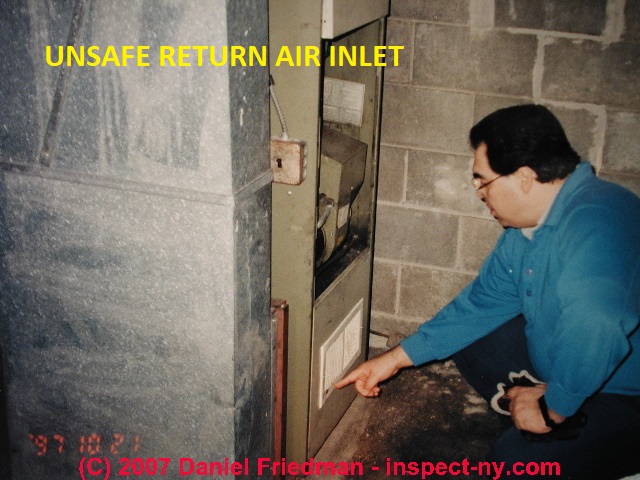
Watch out: as we show in this home inspection photograpn, locating a return air inlet close to a heating furnace, particularly a gas or oil fired heater may be unsafe, risking drawing combustion gases into the buildings HVAC duct system.
See UNSAFE DUCT OPENINGS for more about picking up un-wanted gases or odors at return air inlets.
[Click to enlarge any image]
Article Contents:
- COMMON SOURCES of PLUMBING ODORS
- DRAIN LINE BLOCKAGE or LEAKS
- BLOCKED DRAIN REPAIRS
- SLOW DRAIN REPAIRS
Also see our broad-scope article on diagnosis and cure of sewer gas and septic odors:
SEWER GAS ODORS diagnosing, finding, and curing septic tank and sewer line smells.
List of Common Sources of Odors Traced to Building Plumbing Systems
- Abandoned plumbing drains:
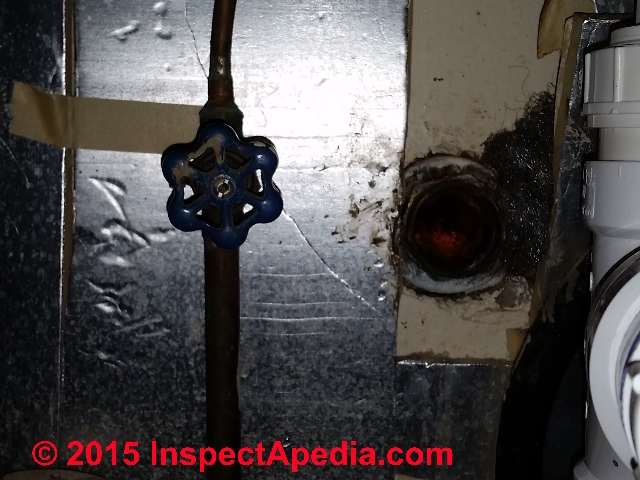
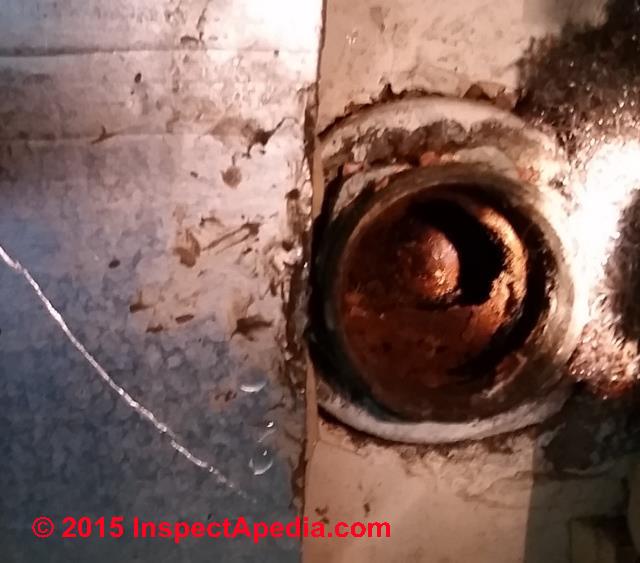
Aan abandoned plumbing drain that was simply cut without permanently-sealing the opening in any drain pipes or vent pipes left in place can be a hard-to-spot source of building odors. Below we illustrate the problem.
Taking a quick look beneath a kitchen sink in a dark corner that was hard to see, we saw a rusty rag poking out of the building wall.
An older galvanized iron kitchen sink drain line had simply been cut off when installing a new sink. The remaining drain piping was still connected to the building drain and sewer piping system: sewer gases could enter this home through the opening we illustrate below.
Use the flashlight, Luke!
- Backdrafting in building causing sewer gas odors:
bath or other building exhaust fans may draw sewer gases up from drain piping, especially if there are dry plumbing traps. See- BACKDRAFTING & SEWER / SEPTIC ODORS
- Make sure that bath and other vent fans are properly installed and located
- Make sure that the building has adequate fresh air intake,
- Check that there are no dry traps or siphoning traps.
- Add plumbing venting or vacuum breaker vents (where permitted) to stop trap siphonage if necessary.
- Clogged plumbing traps or drains may result in siphonage of the trap water, then releasing sewer gases into the building.
- Check for and repair clogged traps or drains. See
- CLOGGED DRAIN DIAGNOSIS & REPAIR - un-clog the problem traps or drain lines.
- TRAP SIPHONAGE & SEWER GAS
- Cold weather correlates with sewer odors or slow, noisy drains:
If your sewer or septic odors appear to occur only in cold or freezing weather,you will want to install a larger diameter plumbing vent stack from the roof surface up, or from the attic floor out through the roof (if your attic is un-heated). See- SEWER GAS ODORS in COLD / WET WEATHER for more sewage odor diagnostic articles.
- Plumbing traps indoors, smelly:
Special plumbing traps which include a built-in seal against gas backups are available for use in problem locations. We just pour mineral oil into unused traps to prevent evaporation of the trap seal. See- PLUMBING DRAIN NOISES
- PLUMBING DRAIN NOISE REPAIR
- TRAP SIPHONAGE & SEWER GAS - how loss of water in the plumbing trap releases dangerous & smelly sewer gas
- Plumbing vent diameter or height
Inadequate plumbing vent diameter or height: If it's a plumbing vent diameter problem the solution would be to install a larger diameter vent pipe, eg 2" up through the roof and outside. See- PLUMBING VENT BLOCKAGE ODORS - why plumbing vents may stop working in freezing weather
- PLUMBING DRAIN NOISES - an explanation of plumbing vent requirements, and see
- PLUMBING VENT DEFECTS & NOISES- diagnostic procedures.
- Plumbing venting Inadequate, incomplete, missing
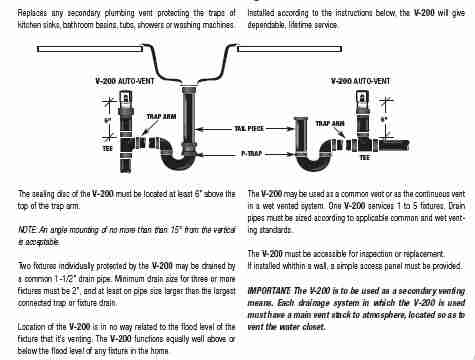
plumbing drain line venting: if building vent piping is missing or inadequate or improperly installed get advice from a plumber on both stop-gap ("V-200" vacuum breaker vents [photo] from Oakville Stamping & Bending)* or proper (vent piping) repair alternatives.
See PLUMBING DRAIN NOISES for an explanation of plumbing vents, and see PLUMBING VENT DEFECTS & NOISESfor diagnostic procedures.
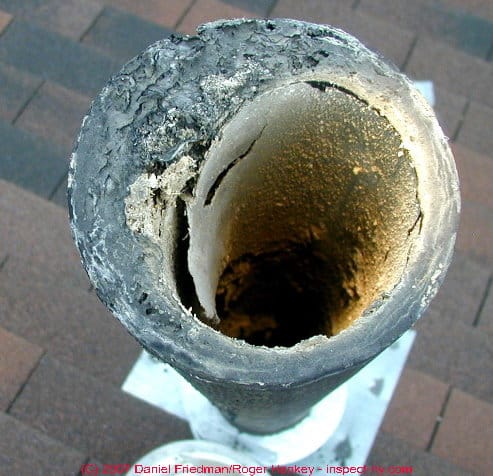
- Plumbing vent clogged -
Ddue to animals, insect nests, or damaged vent material such as transite piping. Repair or replace the clogged or damaged plumbing vent piping. - See PLUMBING DRAIN NOISE DIAGNOSIS for more about diagnosing clogged plumbing vents
- See TRANSITE PIPE CHIMNEYS & FLUES for more about plumbing vents made of transite pipe
- See TRAPS on DRAINS and PLUMBING VENT DEFECTS & NOISES
- Plumbing Vent location,
Bad: if a building vent is too close to a window or otherwise is delivering gases to occupants, it may be possible to extend or relocate it.
See PLUMBING VENT DEFECTS & NOISES for diagnostic procedures like gurgling drains - Plumbing vent discharging into the building attic or roof space
Plumbing vents should terminate outside, above the roof level. This defect should be corrected as soon as possible as there are both health and methane gas explosion hazards when sewer gases are vented indoors.
See PLUMBING VENT DEFECTS & NOISESfor diagnostic procedures.
Odors and Plumbing Drain Line Leaks or Blockage Repairs
 Diagnose leaks and/or sewer gas odors due to damaged drain or sewer line piping
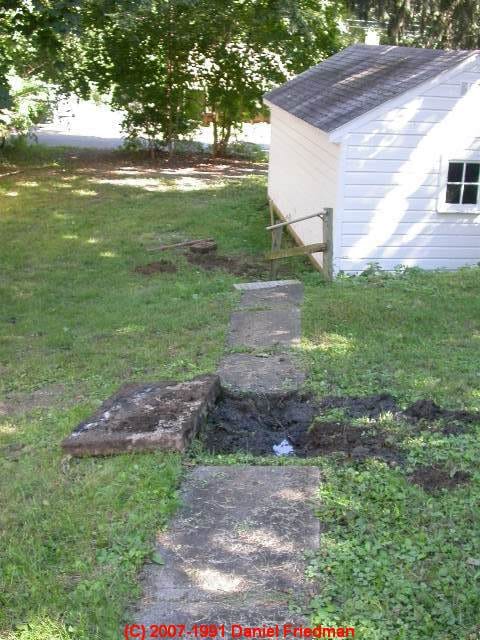
If a building drain is damaged and leaking the point of damage needs to be found and repaired.
If it's an indoor drain the leak can usually be found by evidence of leaks into the building; if it's an outdoor drain leak, use of a plumbing snake, judicious careful probing, or excavation will be needed.
Sometimes simply lifting a section of sidewalk over a drain or lifting a large stone will disclose a previously unrecognized wet area where a drain line has been broken or damaged.
Our photo (left) shows a source of both sewage odors and a blocked main drain line between a house and its septic tank.
The sewer line was broken when a heavy commercial lawn mower drove over the concrete sidewalk below which the sewer line had been installed.
We replaced the entire drain line between the house and the septic tank and our contractor made sure that the new plastic sewer line was properly protected from damage by bedding it in sand.
See SEWER LINE REPLACEMENT for details about installing a new sewer line.
Blocked Drains as a Cause of Septic or Sewage Odors
If building drains are blocked or appear blocked
hire a plumber to snake the drains.
If all drains are blocked or slow,
the plumber might start by snaking out the main drain.
During this process an experienced plumbing power snake handler can tell if the drain line is broken or damaged or clogged by tree roots. If this is the case an excavator and drain line repairs are needed.
See CLOGGED DRAIN DIAGNOSIS & REPAIR
Slow Drains as a Cause of Septic or Sewer Gas Odors
If building drains are not blocked but drainage is slow,
sluggish, smelly, or backing up into the building, an inspection of the septic tank can indicate (by abnormally high level) that the tank inlet baffle or outlet baffle are blocked (or missing entirely), or that the tank outlet to drainfield is backing up, or blocked, or the drainfield not working.
Also see CLOGGED DRAIN DIAGNOSIS & REPAIR
Pumping out or cleaning the septic tank to address an "odor problem"
probably won't help: while periodic pumpout of a septic tank is important maintenance to protect the drainfield, will never "fix" one of these problems. The cause of blockage or failure needs to be identified and repaired.
We can think of a case, however, where pumping and inspecting the septic tank baffles might help diagnose a sewer gas odor outdoors or in the building. If the septic tank inlet or outlet baffle is partially blocked by the floating scum layer (the tank is past due for cleaning) sewer gases may back up into the building.
See SEPTIC TANK PUMPING SCHEDULE
and for a guide to inspecting septic tank baffles,
see SEPTIC TANK BAFFLES.
...
Continue reading at SITE WEATHER or NEIGHBOR'S SEWER ODORS or select a topic from the closely-related articles below, or see the complete ARTICLE INDEX.
Or see SEWER GAS ODOR REMEDY FAQs - questions & answers posted originally at the end of this page.
Or see these
Recommended Articles
- DRAIN PIPING & SEWER ODORS - home
- FLOOR DRAIN / TRAP ODORS
- PLUMBING SYSTEM ODORS - home
- SEPTIC SYSTEM ODORS - home
- SEWAGE PUMP ODORS
- SEWER GAS ODORS - home
- SEPTIC / SEWER ODOR SOURCE TABLE
- SEWAGE ODOR SOURCE LOCATION
- SEWER GAS ODORS in COLD / WET WEATHER
- SEWER GAS ODOR REMEDIES
- SEWER LINE REPLACEMENT
- SEWER / SEPTIC PIPE CAMERAS
- SEWER SEPTIC GAS CONDUIT LEAKS
- SEWER SEPTIC ODORS in HVAC DUCTS
- SITE WEATHER or NEIGHBOR'S SEWER ODORS
- TESTS for SEWER GAS INDOORS
- TRACK SEPTIC ODORS to SOURCE
- TRACK SEWER ODOR by WEATHER
- TRAP SIPHONAGE & SEWER GAS
- WATER POLLUTANT SOURCES
- WET WEATHER SEWER ODORS
Suggested citation for this web page
SEWER GAS ODOR REMEDIES at InspectApedia.com - online encyclopedia of building & environmental inspection, testing, diagnosis, repair, & problem prevention advice.
Or see this
INDEX to RELATED ARTICLES: ARTICLE INDEX to PLUMBING SYSTEMS
Or use the SEARCH BOX found below to Ask a Question or Search InspectApedia
Ask a Question or Search InspectApedia
Try the search box just below, or if you prefer, post a question or comment in the Comments box below and we will respond promptly.
Search the InspectApedia website
Note: appearance of your Comment below may be delayed: if your comment contains an image, photograph, web link, or text that looks to the software as if it might be a web link, your posting will appear after it has been approved by a moderator. Apologies for the delay.
Only one image can be added per comment but you can post as many comments, and therefore images, as you like.
You will not receive a notification when a response to your question has been posted.
Please bookmark this page to make it easy for you to check back for our response.
Our Comment Box is provided by Countable Web Productions countable.ca
Citations & References
In addition to any citations in the article above, a full list is available on request.
- Herb Reed County Extension Director, Agricultural and Natural Resources Educator, Calvert County Maryland - private email to DF 9/5/2006 adding comments about odors and partial blockages.
- Oakville Stamping & Bending, 2200 Speers Rd.,
Oakville, Ontario
Canada L6L 2X8
(905) 827-0320 or
(905) 827-6375 FAX - Email: osb@osb.ca produces and supplies the V-200 automatic plumbing vent.
The Sealing Disc of the V-200 automatic plumbing vent anti siphon valve must be located at least 6" above the top of the trap arm. NOTE: An Angle Mounting of no more than 15 degrees from the Vertical is acceptable. Location of the V-200 is no way related to the flood level of the fixture that it's venting. The V-200 functions equally well above or below the flood level of any fixture in the home. - V-200 ABS Auto Trap Vent product description, V-200 anti siphon valve automatic plumbing vent installation instructions from manufacturer Oakville Stamping & Bending. - Septic Tank/Soil-Absorption Systems: How to Operate & Maintain [ copy on file as /septic/Septic_Operation_USDA.pdf ] - , Equipment Tips, U.S. Department of Agriculture, 8271 1302, 7100 Engineering, 2300 Recreation, September 1982, web search 08/28/2010, original source: http://www.fs.fed.us/t-d/pubs/pdfimage/82711302.pdf.
- Pennsylvania State Fact Sheets relating to domestic wastewater treatment systems include
- Pennsylvania State Wastewater Treatment Fact Sheet SW-161, Septic System Failure: Diagnosis and Treatment
- Pennsylvania State Wastewater Treatment Fact Sheet SW-162, The Soil Media and the Percolation Test
- Pennsylvania State Wastewater Treatment Fact Sheet SW-l64, Mound Systems for Wastewater Treatment
- Pennsylvania State Wastewater Treatment Fact Sheet SW-165, Septic Tank-Soil Absorption Systems
- Document Sources used for this web page include but are not limited to: Agricultural Fact Sheet #SW-161 "Septic Tank Pumping," by Paul D. Robillard and Kelli S. Martin. Penn State College of Agriculture - Cooperative Extension, edited and annotated by Dan Friedman (Thanks: to Bob Mackey for proofreading the original source material.)
- Advanced Onsite Wastewater Systems Technologies, Anish R. Jantrania, Mark A. Gross. Anish Jantrania, Ph.D., P.E., M.B.A., is a Consulting Engineer, in Mechanicsville VA, 804-550-0389 (2006). Outstanding technical reference especially on alternative septic system design alternatives. Written for designers and engineers, this book is not at all easy going for homeowners but is a text I recommend for professionals--DF.
- Country Plumbing: Living with a Septic System, Hartigan, Gerry: $ 9.95; ALAN C HOOD & TP; Quoting an Amazon reviewer's comment, with which we agree--DF:This book is informative as far as it goes and might be most useful for someone with an older system. But it was written in the early 1980s. A lot has changed since then. In particular, the book doesn't cover any of the newer systems that are used more and more nowadays in some parts of the country -- sand mounds, aeration systems, lagoons, etc. US EPA ONSITE WASTEWATER TREATMENT SYSTEMS MANUAL [online copy, free] Top Reference: US EPA's Design Manual for Onsite Wastewater Treatment and Disposal, 1980, available from the US EPA, the US GPO Superintendent of Documents (Pueblo CO), and from the National Small Flows Clearinghouse. Original source http://www.epa.gov/ORD/NRMRL/Pubs/625R00008/625R00008.htm Onsite wastewater treatment and disposal systems, Richard J Otis, published by the US EPA. Although it's more than 20 years old, this book remains a useful reference for septic system designers. U.S. Environmental Protection Agency, Office of Water Program Operations; Office of Research and Development, Municipal Environmental Research Laboratory; (1980)
- Eco John® Innovative Toilet Solutions, Global Inventive Industries, Fountain Valley CA, PDF, product brochure
- "International Private Sewage Disposal Code," 1995, BOCA-708-799-2300, ICBO-310-699-0541, SBCCI 205-591-1853, available from those code associations.
- "Manual of Policy, Procedures, and Guidelines for Onsite Sewage Systems," Ontario Reg. 374/81, Part VII of the Environmental Protection Act (Canada), ISBN 0-7743-7303-2, Ministry of the Environment,135 St. Clair Ave. West, Toronto Ontario M4V 1P5 Canada $24. CDN.
- Manual of Septic Tank Practice, US Public Health Service's 1959.
- Onsite Wastewater Disposal, R. J. Perkins; Quoting from Amazon: This practical book, co-published with the National Environmental Health Association, describes the step-by-step procedures needed to avoid common pitfalls in septic system technology. Valuable in matching the septic system to the site-specific conditions, this useful book will help you install a reliable system in both suitable and difficult environments. Septic tank installers, planners, state and local regulators, civil and sanitary engineers, consulting engineers, architects, homeowners, academics, and land developers will find this publication valuable.
- Onsite Wastewater Treatment Systems, Bennette D. Burks, Mary Margaret Minnis, Hogarth House 1994 - one of the best septic system books around, suffering a bit from small fonts and a weak index. While it contains some material more technical than needed by homeowners, Burks/Minnis book on onsite wastewater treatment systems a very useful reference for both property owners and septic system designers.
- US EPA ONSITE WASTEWATER TREATMENT SYSTEMS MANUAL Top Reference: US EPA's Design Manual for Onsite Wastewater Treatment and Disposal, 1980, available from the US EPA, the US GPO Superintendent of Documents (Pueblo CO), and from the National Small Flows Clearinghouse. Original source http://www.epa.gov/ORD/NRMRL/Pubs/625R00008/625R00008.htm
- Water Wells and Septic Systems Handbook, R. Dodge Woodson. This book is in the upper price range, but is worth the cost for serious septic installers and designers.
- Wells and Septic System, Alth, Max and Charlet, Rev. by S. Blackwell Duncan, $ 18.95;/li>
- In addition to citations & references found in this article, see the research citations given at the end of the related articles found at our suggested
CONTINUE READING or RECOMMENDED ARTICLES.
- Carson, Dunlop & Associates Ltd., 120 Carlton Street Suite 407, Toronto ON M5A 4K2. Tel: (416) 964-9415 1-800-268-7070 Email: info@carsondunlop.com. Alan Carson is a past president of ASHI, the American Society of Home Inspectors.
Thanks to Alan Carson and Bob Dunlop, for permission for InspectAPedia to use text excerpts from The HOME REFERENCE BOOK - the Encyclopedia of Homes and to use illustrations from The ILLUSTRATED HOME .
Carson Dunlop Associates provides extensive home inspection education and report writing material. In gratitude we provide links to tsome Carson Dunlop Associates products and services.
 | HOME | ABOUT | ASK a QUESTION | CONTACT | CONTENT USE POLICY | DESCRIPTION | POLICIES | PRIVACY | |
| © 2024 - 1985 Publisher InspectApedia.com - Daniel Friedman | |||||||||