
InspectAPedia® FREE Encyclopedia of Building & Environmental Construction, Diagnosis, Maintenance & Repair |
Question? Just ask us! InspectAPedia
|
 Where to Discharge Sump Pumps
- POST a QUESTION or COMMENT about sump pump discharge piping
How do I get rid of the water pumped by the sump pump? This article explains how and where to route water that is being pumped out of a building by a sump pump.
- Where should sump pumps discharge their water? Is it ok to pipe the sump pump to the building drain system?
- How to inspect & maintain sump pumps to remove water from buildings or to prevent basement leakage or crawl space water entry
InspectAPedia tolerates no conflicts of interest. We have no relationship with advertisers, products, or services discussed at this website.
Where does the sump pump send its Discharge Water?
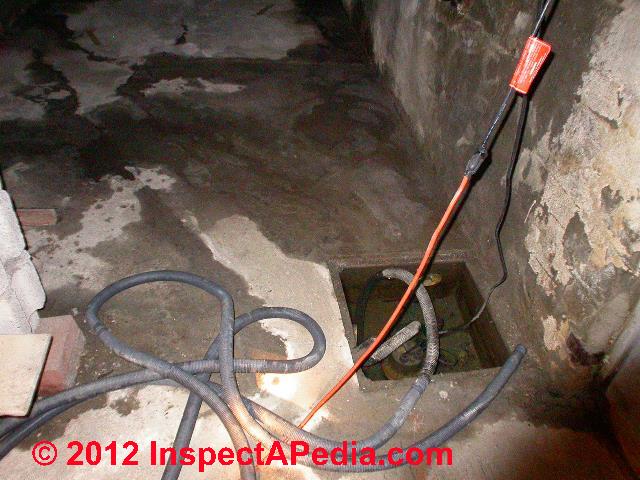 Sump pumps, which we discuss on this page, are designed to remove unwanted water, such as surface or ground water that leak into a building.
But the sump pump system will be ineffective if the water it discharges is routed where the same water simply leaks back into the building.
The sump pump installation may also be improper or even illegal in some communities if it discharges into the sewer system.
- In this photo a temporary sump pump discharge line has been left on the basement floor - no good destination has been assigned to sump outlet hose.
- If this sump pump is called-on to operate in this condition the building will simply be flooded.
Sump pumps that have been added to an older structure
often pump their discharge to the ground surface where it runs to a storm drain or area drainage setting.
If you have such a system be sure that the sump pump discharge empties where it meets these criteria:
- The water leaving the sump pump
should be discharged to a location where it does not flow back towards the building. Otherwise it may simply cycle the same water endlessly, possibly even undermining the building foundation

- Water discharge from a sump pump
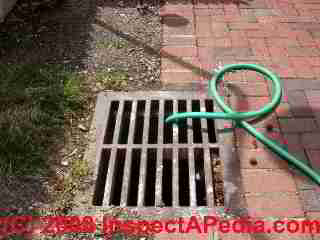
must go to a legal destination. In the photo we're emptying the sump pump via a small diameter (Limited flow capacity) to a local storm drain.
This might be legal and fine in the summer for an unusual event, but this is not a reliable, permanent sump pump installation.
As this system was found in Maine, we can expect it to freeze or simply not work in winter or early spring when it may be most needed.
Discharging onto a neighbor, and in some communities, discharging into local storm drains, may be prohibited and are certainly a bad practice. - In freezing climates,
the sump discharge needs to be protected from freezing or the system may not work when most needed.
A long sump discharge line outside, especially one with minimal pitch or slope, is likely to freeze up in cold weather.
We've inspected homes where the sump pump was running continuously but not moving any water because its discharge line was blocked by ice. - This condition permits water to rise in and even flood a building.
- Reader sgbotsford has additional suggestions for avoiding frozen sump outlet piping just below at the reader Q&A section.
Reader Comments, Questions & Answers About The Article Above
Below you will find questions and answers previously posted on this page at its page bottom reader comment box.
Reader Q&A - also see RECOMMENDED ARTICLES & FAQs
On 2021-06-06 by mak.church (mod) - avoiding sump pump trouble in freezing weather
 @sgbotsford@gmail.com,
Thank you for sharing your ideas about avoiding sump pump trouble in freezing weather, SG; that's indeed a problem in cold climates, as we discuss in this article series.
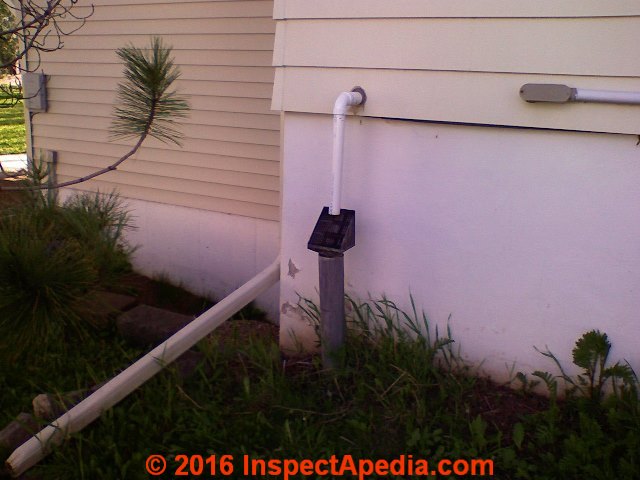
Photo: installed in a Duluth Minnesota home, this is the outside discharge line for the sump pump serving an interior basement de-watering system.
I'd ask where the buried discharge line goes as we want to be sure that water will continue to leave the building and not freeze or back-up during times of heavy runoff or snow-melt.
In cold climates such as northern Minnesota there is often considerable surface runoff (and basement water entry) while the ground is still frozen.
The sump discharge destination has to be able to accept the incoming water or the basement will flood.
The greatest risk of a frozen sump pump drain line blockage leading to basement or crawl space flooding is near the end of a cold winter when the ground (and buried sump drain) are frozen (or at risk of freezing) while at the same time warming conditions and increasing snow-melt, often trapped close to the building foundation, add to the chances of water penetrating the foundation wall or coming up through the basement or crawl space floor.
We also include this warning about the problem of freezing sump pump outlets the end of
and at
BASEMENT DE-WATERING SYSTEMS we suggest that letting the water come into the building and then working to get rid of it is perhaps less costly than fixing the trouble outdoors, but it's not so reliable.
At WATER ENTRY/DAMAGE PREVENTION WITHOUT GUTTERS we suggest other measures to take outside the building, especially where it's tough to keep gutters and downspouts working or where they are omitted entirely.
We welcome your questions, criticism, or content suggestions. Working together makes us smarter.
On 2021-06-06 by sgbotsford@gmail.com - sump cavitation when drain line is frozen
You need a special pump if you want to get all/most of the water out. Most pumps will start to cavitate when there less than a few inches of water above the inlet.
You will hear the pump making a much rougher sound. (See wikipedia article on cavitation) Cavitation is hard on the impeller.
In cold climates, you need to worry about the discharge line freezing and plugging up. On my house I now use 40 feet of ABS pipe that is 1/4" larger diameter than the pipe that comes through the foundation. This pipe is supported so that it has a continuous down grade of about 4"/10 feet.
The bottom end is supported 18" off the ground.
By spring I have a small glacier at the end of the pipe.
Failure Modes at the Sump Pump Drain
- The discharge line has a dip where water doesn't empty. It freezes and blocks the line. Supporting the line on chunks of firewood, or boxes is not good. Put in posts at ~10 foot intervals, and support the line either with a block of wood, or metal pipe hanger tape.
- The ice builds a glacier at the end point and blocks the line. This is why the discharge is at least a foot above the ground.
- The pump cycle isn't long enough to fully melt the residue of ice from the last pump cycle. This is why the grade is necessary.
- By making the external line larger than the discharge pipe at the house, air can get into the external line to drain it. If the external line blocks, the pump can still get the water outside the basement.
On 2020-02-11 by (mod) - use flexible sealant where sump discharge passes through masonry foundation wall
You can use any flexible sealant that will bond with masonry to seal the hole that you drill through the wall for your exit.
Sump pump line. However in my opinion. It's not likely that a garden hose is going to be of adequate diameter to handle the flow rate from a basement sump pump. Not unless the water volume and inflow rate are extremely small in your case..
On 2020-02-10 by K Parce
I want to know how to make a sealed exit hole (in exterior wall) for a garden hose which disposes sump pump water located in crawl space. Thanks for any suggestions.
On 2016-08-06 by (mod) - normal amount of water in sump pit bottom
Linda
It's normal for there to be an inch or three in the bottom of the sump pit as most sump pumps do not draw 100% of the water from the pit (or "drum") bottom.
But watch your sump system as it empties.
IF at the end of the pump cycle you see water running back into the sump pit then you need to replace a defective check valve on the sump outlet line.
On 2016-08-06 by Linda
I filled my sump pump up just to make sure that it was working. It drained but there is still water in the drum.
Should it drain completely? I've had a terrible odor throughout my house and thought that this could be the source. The HAVC system picks up the odor and it smells everywhere.
On 2016-01-09 by (mod) - water coming up other house drains
I'd look for a blocked drain or a check valve installed in the wrong direction
On 2016-01-07 by John
I replaced my old sump pump and now when it drains water comes up my kitchen drains what happened
On 2015-12-15 by (mod) -
Check for
- a partly blocked drain into which the sump is draining
- a blocked, missing, or incomplete plumbing vent
watch out: the gurgling means air is being drawn into the sink drain; that can empty the water from the sink trap that can in turn allow unpleasant, even dangerous, sewer gases into the building
On 2015-12-15 by levitheson
When my sump pump drains there is a loud gurgling sound that comes out of the kitchen sink. Why would this be? What can I do to stop/change it?
On 2015-02-21 by (mod) -
Dnt
Sounds as if there is a drain leak somewhere that's entering the sump pit. From an etext alone I doubt one couldmsaymwhere in a building the fault originates.m
On 2015-02-21 by dnt
my sump pump smells like sewage. Plumbers have check all floor drains and sanitary drains with a camera and found nothing. this is in a condo complex. any ideas?
On 2013-02-01 by S2F
You might try pouring some rock salt or non-toxic ice melt down the discharge line outside of your house. You might have to repeat this as the salt works its way down your pipe.
If it is 20 below you would likely need Calcium Chloride Flakes which melts snow/ice down to -25 degrees. You can pick some up at Home Depot or Menards.
Watch out: do NOT dump automotive anti-freeze or gas line antifreeze products into your sump system. You may result in contaminating the local environbment with toxich chemicals, even polluting nearby wells. Besides those products will not thaw a frozen sump system.
On 2013-01-26 by Gord G
With the cold snap we are having the discharge for my sump pump has pretty much frozen. Also,it is buried outside the building but obviously not deep enough.
Is there any way I can add something to the water in the collector reservoir to help open up this flow?
I threw a bottle of automotive gas line antifreeze in it but that didn't do anything. I really don't want to have to try digging up the outside line in 20+ below temps. :(
Tanx for any suggests.
Gord
...
Continue reading at SUMP PUMP INSPECTION or select a topic from the closely-related articles below, or see the complete ARTICLE INDEX.
Or see these
Recommended Articles
- CROSS CONNECTIONS, PLUMBING - avoid connecting potable water to drain line
- SEPTIC SYSTEM PUMPS - if you are looking for septic system pumps not sump pump information
- SUMP PUMPS - home
- APPLIANCE DIAGNOSIS & REPAIR
- BATTERY BACKUP SUMP PUMPS
- CRAWL SPACE DRYOUT
- CROSS CONNECTIONS, PLUMBING
- MERCURY HAZARDS in SUMP PUMP CONTROLS
- PEDESTAL SUMP PUMP GUIDE
- SUMP PUMP DISCHARGE
- SUMP PUMP INSPECTION
- SUMP PUMP MANUALS
- SUMP PUMP RELIABILITY
- SUMP PUMP TYPES
- SUBMERSIBLE SUMP PUMP GUIDE
- SUMP PUMP SINGLE vs DUPLEX
- SEPTIC PUMP DUPLEX DESIGNS
- WATER ENTRY in BUILDINGS
- WATER POWERED SUMP PUMPS
Suggested citation for this web page
SUMP PUMP DISCHARGE at InspectApedia.com - online encyclopedia of building & environmental inspection, testing, diagnosis, repair, & problem prevention advice.
Or see this
INDEX to RELATED ARTICLES: ARTICLE INDEX to BUILDING LEAKS & WATER ENTRY
Or use the SEARCH BOX found below to Ask a Question or Search InspectApedia
Ask a Question or Search InspectApedia
Questions & answers or comments about sump pump discharge piping
Try the search box just below, or if you prefer, post a question or comment in the Comments box below and we will respond promptly.
Search the InspectApedia website
Note: appearance of your Comment below may be delayed: if your comment contains an image, photograph, web link, or text that looks to the software as if it might be a web link, your posting will appear after it has been approved by a moderator. Apologies for the delay.
Only one image can be added per comment but you can post as many comments, and therefore images, as you like.
You will not receive a notification when a response to your question has been posted.
Please bookmark this page to make it easy for you to check back for our response.
Our Comment Box is provided by Countable Web Productions countable.ca
Citations & References
In addition to any citations in the article above, a full list is available on request.
- New York State Department of Health, APPENDIX 75-A WASTEWATER TREATMENT STANDARDS - INDIVIDUAL HOUSEHOLD SYSTEMS , [PDF] New York State Department of Health, 3 February 2010, retrieved 3/1/2010, original source: https://www.health.ny.gov/regulations/nycrr/title_10/part_75/appendix_75-a.htm
- In addition to citations & references found in this article, see the research citations given at the end of the related articles found at our suggested
CONTINUE READING or RECOMMENDED ARTICLES.
- Carson, Dunlop & Associates Ltd., 120 Carlton Street Suite 407, Toronto ON M5A 4K2. Tel: (416) 964-9415 1-800-268-7070 Email: info@carsondunlop.com. Alan Carson is a past president of ASHI, the American Society of Home Inspectors.
Thanks to Alan Carson and Bob Dunlop, for permission for InspectAPedia to use text excerpts from The HOME REFERENCE BOOK - the Encyclopedia of Homes and to use illustrations from The ILLUSTRATED HOME .
Carson Dunlop Associates provides extensive home inspection education and report writing material. In gratitude we provide links to tsome Carson Dunlop Associates products and services.
 | HOME | ABOUT | ASK a QUESTION | CONTACT | CONTENT USE POLICY | DESCRIPTION | POLICIES | PRIVACY | |
| © 2024 - 1985 Publisher InspectApedia.com - Daniel Friedman | |||||||||