
InspectAPedia® FREE Encyclopedia of Building & Environmental Construction, Diagnosis, Maintenance & Repair |
Question? Just ask us! InspectAPedia
|
 Fix Water Softener Backup, Leaks, Stuck Controls
- POST a QUESTION or COMMENT about diagnosing & fixing a water softener that sticks in backup or regeneration cycle or that is leaking
Repair Water Softener Leaks or Stuck Backup & Regeneration Controls:
This article explains how to diagnose & fix water conditioner / water softener leaks, overflows, backups, or building floods due to water softener malfunction.
We give steps in fixing a stuck water treatment device control that can otherwise leave your water softener running continuously in backwash or regeneration mode. We also explain other problems, such as a crimped water softener drain, that can leave the water conditioner stuck in regeneration mode.
InspectAPedia tolerates no conflicts of interest. We have no relationship with advertisers, products, or services discussed at this website.
Water Softener Stuck in Backwash or Regeneration Cycle Can Flood a Building or Septic System
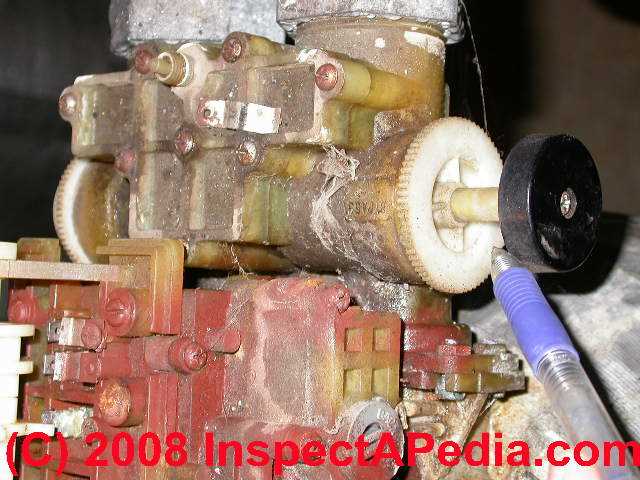 Catalog of Common Water Softener Leak Points
When you find water on the floor and suspect the leak is at the water softener it's important to find the actual point of leakage.
Here are common places where readers report leaks on water softeners and conditioners.
The repair for water softener leaks starts with drying the unit off and then inspecting it carefully to find where the leak is occurring.
Illustration: a leaky water softener bypass valve - note the white corrosion and scale deposits.
[Click to enlarge any image]
- Air leaks in the water softener plumbing or tubing
may show up as foamy water at the tap. As often there will also be water leaks out, check for leaks at the control head, piping, valves, and tubing. - Plumbing leaks at control valves and occasionally in piping, particularly if the water supply is corrosive or if amateur plumbing work has been performed.
Watch out: while a dripping water shutoff valve may not be a critically-urgent repair, left un-repaired long enough you may find that when you need to use the valve to turn off the water it won't work. - Brine tank tubing crimp, blockage, or leak -
in the plastic tubing used to send water into the brine tank to produce brine and used again to send brine back through the water softener during a regeneration cycle.
If the tubing is cracked or damaged beyond repair, turn off the softener or put it in bypass, then remove the damaged tubing, take it as a size example to your local plumbing supplier or hardware store, buy a suitable length of new tubing and replace the old. - Brine tank overflow leak -
a stuck brine tank float or defective water softener control head may over-fill the brine tank and lead to overflow. Repair or replace the brine tank float valve.
See WATER SOFTENER BRINE TANK WATER TOO HIGH
and see WATER SOFTENER BRINE TANK FLOAT VALVE ADJUST - Bypass valve leak -
some water softener bypass valves use internal O-rings that can be replaced; other water softener manufacturers provide a by-pass valve re-build kit. Otherwise, replace the valve.
See BYPASS VALVE on WATER SOFTENERS - Brine drain line leaks -
if there are leaks at fittings or tees along the brine drain be sure that the plastic tubing is properly clamped to the tees or connectors along its route.
If there are leaks from the tubing itself along its route, it is probably damaged by a crack or pinhole and should be replaced .
See details at PIPE / HOSE CLAMP LEAK REPAIR - Control head leaks
may occur where the control mounts to the resin tank - sometimes repairable by replacing a mounting O-ring. Change seals, spacer, piston assembly in the control head
See details at SOFTENER CONTROL HEAD O-RING REPLACEMENT - DLFC failure: a clogged drain line flow control valve can cause flooding and overflow leaks at the softener or brine tank
See DLFC LOCATION for help finding this part
- Ejector pump failure -
if your water softener drains into a sump pump or ejector pump used to remove that wastewater from the building, an ejector pump failure can cause softener overflow and leaks
See SUMP PUMPS - home - for a series of ejector pump or sump pump diagnosis and repair articles
Question: What Caused our Water Softener to Flood the Building?
We had a water softener overflow into the kitchen and am wondering if this could be caused by the electricity being turned off for several days and then being turned on without resetting the water softener? Maybe it just kept on running since it was not reset? - (Anonymous)
Reply: Stuck Water Softener Controls May Be the Culprit
Loss of electrical power itself would not in a straightforward way make a water softener overflow - the softener usually works by a clock control and automatically backwashes itself on a timer scheduled basis.
[Click to enlarge any image or table]
To overflow something else had to be wrong such as a lost connection between softener and its drain pipe or a problem in the control itself leaving it "stuck" in regeneration mode.
But if your water softener control equipment became damaged (such as by an electrical power surge that might have accompanied an electrical storm, lightning strike, or local power outage), or the water softener timer or control mechanism has been damaged (or corroded, leak damaged, or crud-jammed)
so that it became "stuck" in its backwash mode, and if we had a compound error of a blocked or slow backwash water drain, the equipment might indeed overflow into the building.
So if there was an event that damaged the softener control and there was at the same time a new or pre-existing blocked or slow drain, the events might be related.
In short, a softener ought not to backup or overflow due to loss of power, but coincidences are suspicious.
In the past when we have seen a softener problem like this, the control was "stuck" in regeneration (or "backwash") cycle. Sometimes moving the control manually (turning a timer dial) or resetting the control electrically will cure the problem.
But watch out: keep an eye on the system or try a few manual backwash cycles to be sure that the system is stopping its regeneration cycle properly.
When a water softener gets stuck in regeneration mode what usually happens is water flows into the building drain continually, sometimes for days or longer before it is discovered. I've seen this flood a septic drainfield.
In the case of a softener that is emptying into a building drain, especially one on an upper floor, if we have the bad luck that that drain is itself slow, blocked, or draining into a blocked or flooded septic tank, the whole system can back up into the building.
Perhaps that's what happened in your case.
Further Diagnostic Steps for Overflowing Water Softener
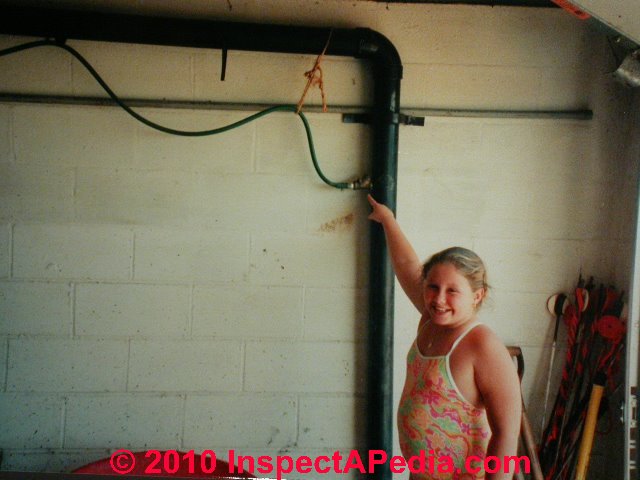 Can you trace the water softener drain piping to see where it is connected. If it's connected right at the sink or trap where the overflow occurred, check further for a blocked trap.
If the softener drain is connected to a different building pipe check the building drain system from that point onwards (downstream) for a blockage or partial drain blockage.
Finally, if the softener drain is improperly connected directly to a sewer line with an airtight connection such as shown in our photo at left, it is forming an unsanitary "cross connection" that is actually a technical building code violation as well.
A sewer backup can back into the softener and contaminate the building water supply. (See CROSS CONNECTIONS, PLUMBING)
When such a connection is made, if the softener gets stuck in regeneration mode and begins to flood a private septic system or drain into a blocked or partly blocked building drain, that too can cause drain backups and even an overflow on upper building floors.
Water Softener Leak Troubleshooting
 Question: fix a leak at the water softener control head O-ring

Trying to help a friend.
His house has an Aqua Pure water softener that has a small leak at the top between the media tank and the controller.
It looks like an O-ring about 3 1/4" in diameter.
I am not having any luck finding a parts manual for a part number, or any local appliance store that recognizes the Aqua Pure brand.
I assume it is an AWS of some variety, but don't see any number like AWS150M or AWS 200M etc.
The side of the tank has a large sticker listing 100M, 150M, 200M, 250M and 300M specifications.
The side of the controller has a sticker with this info.
GE Infrastructure Milwaukee, WI Autotrol Brand Model 268/760 WO# 1238480 Ser No. L268164074282
- Anonymous by private email 2018.12.28
Reply: buy a generic O-ring or get the right one from the manufacturer
Anon:
When I've been stuck like that I've taken the exact measurements of the broken overing and simply bought a new generic one.
The fact is the manufacturer's don't design the equipment to use a unique off measurement size it'll certainly be one that's mass-produced. That might be worth a try.
Watch out: But I add that when you are matching an O-ring the diameter or cross-sectional thickness of the O-ring when stretched to the proper size is really important. If it's just a little bit too thin it's going to leak.
If it's extremely close to exact you can sometimes fix that problem by coating the O-ring with silicone grease.

Watch out: a typical water softener manual will say quite clearly: Use only silicone grease for lubrication with this unit.
Reader follow-up:
I installed it thinking all was good but after the system had been under pressure for an hour it was starting to leak at the joint again.
I think the homeowner will be best to just replace the whole unit.
Our photo [above shows the ] leak as it begins to appear with the water being turned back on using the automotive O-ring.
Reply:
I would never replace an entire water softener just because I didn 't have a repair O-ring. I'd find the O-ring.
At WATER CONDITIONER / SOFTENER MANUALS you can find the manual for hour softener, listed under 3M Aqua Pure
Here is the manual for your softener
3M AquaPure AWS100M WATER SOFTENER INSTALLATION & OPERATION MANUAL [PDF] Models AWS100M, AWS150M, AWS 200M, AWSD300M,
In that manual we find contact information: I realize it's a warranty claim number but I'd call call 1-800-222-7880 3M Purifi cation Inc., 400 Research Parkway, Meriden, CT 06450 USA
and if they don't have the part they can refer you to their parts department. Most likely you can order it from them directly.
Reader follow-up:
I just had time to talk with the phone number you provided.
Chad suggested ordering it from www.softenerparts.com using p/n ORG234 and re-assembling with silicone grease.
Thanks for the lead!
Softenerparts.com Water Softener Parts, Valves, and Water Filters Fleck, GE Osmonics Autotrol, Sears / North Star and other brands. www.softenerparts.com
Reply:
So glad we got somwhere that sounds useful.
Be sure to get that silicone grease.
...
Continue reading at or select a topic from the closely-related articles below, or see the complete ARTICLE INDEX.
Or see WATER SOFTENER BACKUP, FLOODING, LEAK FAQs - questions and answers posted originally on this page
Or see these
Water Softener Repair Articles
- WATER SOFTENERS & CONDITIONERS - home
- DIAGNOSE WATER SOFTENER PROBLEMS
- IDENTIFY WATER SOFTENER BRAND / MODEL
- INSTALLATION of WATER SOFTENERS
- PIPE / HOSE CLAMP LEAK REPAIR
- WATER SOFTENER ADJUSTMENT & CONTROLS
- WATER SOFTENER BRINE TANK DIAGNOSIS & REPAIR
- WATER SOFTENER BYPASS VALVE
- WATER SOFTENER CLEANING & SANITIZING
- WATER SOFTENER CONTROLS & OPERATION
- WATER SOFTENER DIAGNOSIS
- WATER SOFTENER EDUCTOR REPAIR
- WATER SOFTENER MANUALS
- WATER SOFTENER PLUMBING PROBLEMS
Suggested citation for this web page
WATER SOFTENER BACKUP, FLOODING, LEAKS at InspectApedia.com - online encyclopedia of building & environmental inspection, testing, diagnosis, repair, & problem prevention advice.
Or see this
INDEX to RELATED ARTICLES: ARTICLE INDEX to WATER TREATMENT SYSTEMS
Or use the SEARCH BOX found below to Ask a Question or Search InspectApedia
Ask a Question or Search InspectApedia
Questions & answers or comments about How to diagnose problems with a water softener backup, regeneration, or cycle problem: stuck controls & leaks.
Try the search box just below, or if you prefer, post a question or comment in the Comments box below and we will respond promptly.
Search the InspectApedia website
Note: appearance of your Comment below may be delayed: if your comment contains an image, photograph, web link, or text that looks to the software as if it might be a web link, your posting will appear after it has been approved by a moderator. Apologies for the delay.
Only one image can be added per comment but you can post as many comments, and therefore images, as you like.
You will not receive a notification when a response to your question has been posted.
Please bookmark this page to make it easy for you to check back for our response.
Our Comment Box is provided by Countable Web Productions countable.ca
Citations & References
In addition to any citations in the article above, a full list is available on request.
- [1] North Dakota Standards for Water Softeners, North Dakota General Authority Law, Chapter 62-04-08, Water Softener Units http://www.legis.nd.gov/information/acdata/pdf/62-04-08.pdf. "The objective of this chapter is to provide a standard of quality, capacity, and performance for water softener units. Water softener performance is to be based upon referee tests procedures described in section 62-04-08-09."
- [2] Culligan Mark 10 Water Softener 1994-1998 Installation and Operating Instructions (covering models manufactured after 1995) (1-96) 01881948.pdf available from www.culligan.com
- [3] Water Softeners, CMHC, Canadian Mortgage and Housing Corporation, cmhc-schl.gc.ca/en/co/maho/wawa/wawa_005.cfm - October 2008. Canada Mortgage and Housing Corporation acknowledges the contribution of Health Canada to the development of this document. For further questions regarding water treatment and water quality, contact Health Canada at watereau@hc-sc.gc.ca or call 613-957-2991 or 1-866-225-0709.
- [4] "Commercial Water Softener Installation and Operating Instructions", IBC Filtration & Water Treatment Products (Australia) for commercial, industrial and residential application www.ibcwater.com.au (07) 3219 2233
- [5] "Non electric water softener, Installation and Operating Instructions", IBC Filtration & Water Treatment Products (Australia), op.cit.
- [6] "Water Softener Twin Tank Installation and Operating Instructions", IBC Filtration & Water Treatment Products (Australia), op.cit.
- [8] Thanks to reader [Anonymous] for discussing water softener backups and floods after an electrical outage - August 2010
- In addition to citations & references found in this article, see the research citations given at the end of the related articles found at our suggested
CONTINUE READING or RECOMMENDED ARTICLES.
- Carson, Dunlop & Associates Ltd., 120 Carlton Street Suite 407, Toronto ON M5A 4K2. Tel: (416) 964-9415 1-800-268-7070 Email: info@carsondunlop.com. Alan Carson is a past president of ASHI, the American Society of Home Inspectors.
Thanks to Alan Carson and Bob Dunlop, for permission for InspectAPedia to use text excerpts from The HOME REFERENCE BOOK - the Encyclopedia of Homes and to use illustrations from The ILLUSTRATED HOME .
Carson Dunlop Associates provides extensive home inspection education and report writing material. In gratitude we provide links to tsome Carson Dunlop Associates products and services.
 | HOME | ABOUT | ASK a QUESTION | CONTACT | CONTENT USE POLICY | DESCRIPTION | POLICIES | PRIVACY | |
| © 2024 - 1985 Publisher InspectApedia.com - Daniel Friedman | |||||||||