InspectAPedia.com InspectAPedia®
Google
InspectAPedia
 

Free Encyclopedia of Building & Environmental Inspection, Testing, Diagnosis, Repair

Ask a Question or Search InspectAPedia

  • HOME
  • AIR CONDITIONING
  • DAMAGE ASSESSMENT
  • ELECTRICAL
  • EXTERIORS
  • HEATING
  • HOME INSPECTION
  • INTERIORS
  • PLUMBING
  • ROOFING
  • SEPTIC SYSTEMS
  • STRUCTURE
  • WATER SUPPLY
  • ENERGY SAVINGS
  • ENVIRONMENT
  • INDOOR AIR IAQ
  • INSULATION
  • MOLD INSPECT TEST REMOVE
  • NOISE
  • ODORS
  • SOLAR ENERGY
  • VENTILATION
  • EXPERTS DIRECTORY
  • CONTACT US


InspectAPedia ® Home

PLUMBING SYSTEM INSPECT DIAGNOSE REPAIR

BIOLOGICAL POLLUTANTS

CHEMICAL CONTAMINANTS in WATER
CLOGGED SUPPLY PIPING

DEBRIS in WATER SUPPLY, Water Heater
DRINKING WATER TESTING

EPA GUIDE to WATER QUALITY

FHA WATER TESTS REQUIRED
FILTERS, WATER
FREEZE-PROOF A BUILDING

HARD WATER - SOFTENERS
HEAT TAPE USAGE GUIDE

MUNICIPAL WATER PRESSURE IMPROVEMENTS

ODORS GASES SMELLS, DIAGNOSIS & CURE
ODORS IN WATER

PLUMBING SYSTEM ODORS
PRESSURE CONTROL SWITCH ADJUSTMENT

REVERSE OSMOSIS CONCENTRATE DISPOSAL

SEWER GAS ODORS

WATER HEATER SCALE REMOVAL
WATER HEATER SCALE PREVENTION
WATER ODORS, CAUSE CURE
WATER PRESSURE & FLOW MEASUREMENT
WATER QUALITY TESTS, CONTAMINANTS, TREATMENT
WATER SOFTENERS & CONDITIONERS
WATER SOURCE ALTERNATIVES
WATER SUPPLY & DRAIN PIPING
WATER TANK: USES, TROUBLESHOOTING
WATER TESTS, CONTAMINANTS, TREATMENT
WINTERIZE A BUILDING

More Information

Water softener brine tank (C) Daniel FriedmanWater Softener Cleaning & Sanitizing Procedures
     

  • How to clean & or sanitize a water softener or water conditioner
    • Check the water conditioner brine tank for salt crusting
    • Check the water softener brine tank for dirt and debris build up
    • How to Sanitize a Water Softener or Water Conditioner - get rid of rotten egg or sulphur smells
    • Detailed Water Softener Salt Salt Storage Tank Sanitizing Procedure
    • How to Clean Iron (or other) Sediment out of a Water Softener
    • Water Treatment Solutions using Iron Removing Chemicals (Super Iron Out)
    • Water Softener Cleaning Using Manufacturer-Recommended Resins or Cleaning Compounds
  • Questions & Answers about Cleaning & Sanitizing Water Softeners & About using a sanitizer in water softeners and the effect of sanitizers on septic systems
  • References

Click to Show or Hide Related Topics

  • WATER TREATMENT EQUIPMENT CHOICES - home
  • WATER SOFTENERS & CONDITIONERS - home
  • BYPASS VALVE on WATER SOFTENERS
  • DE-WINTERIZE WATER SOFTENER
  • DIAGNOSE WATER SOFTENER PROBLEMS
  • DIAGNOSE SOFTENER BACKUP / FLOODING
  • HEALTH RISKS & WATER SOFTENERS
  • HOW SOFTENERS WORK
  • INSTALLATION of WATER SOFTENERS
  • REDUCE IMPACT of SOFTENER on SEPTIC
  • SALT / SOFT WATER IMPACT on SEPTIC, PLUMBING, HEATERS
  • SOFTENER ADJUSTMENT & CONTROLS
  • SOFTENER CLEANING & SANITIZING
  • OTHER WATER SOFTENING METHODS
  • WINTERIZE WATER SOFTENER
  • WATER HARDNESS: HOW TO DETECT
  • WATER HARDNESS: HOW TO MEASURE
InspectAPedia tolerates no conflicts of interest. We have no relationship with advertisers, products, or services discussed at this website.

Guide to Water Softener Cleaning & Sanitizing: this article provides an owner's guide to water softener cleaning, and sanitizing - two steps in keeping a water conditioner working properly. We discuss the use of various chemicals & cleaners to sanitize or clean out water softeners and their brine tanks, and we comment on the effect of such chemicals on septic systems. We discuss the formation of salt crust in the brine tank, the accumulation of dirt & debris in the brine tank, & how to remove these problems & contaminants in a water conditioner. We also discuss using iron removing products or other chemicals to clean & sanitize a water softener.

Green links show where you are. © Copyright 2013 InspectAPedia.com, All Rights Reserved. Author Daniel Friedman.

Owner's Guide to Cleaning & Sanitizing the Water Softener / Water Conditioner Brine Tank
Water softener brine tank (C) Daniel FriedmanPhoto of a water softener salt tank ready for cleaning

If your water softener does not seem to be working or is not working properly, also see DIAGNOSE WATER SOFTENER PROBLEMS

Also see SOFTENER ADJUSTMENT & CONTROLS for details of water conditioner controls, how they work, how to set them. Separately at  INSTALLATION of WATER SOFTENERS we discuss how this equipment should be installed. If your water softener is not working, see DIAGNOSE WATER SOFTENER PROBLEMS.

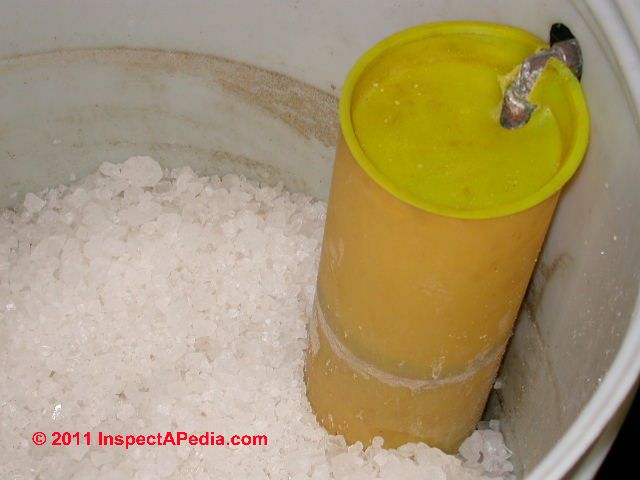
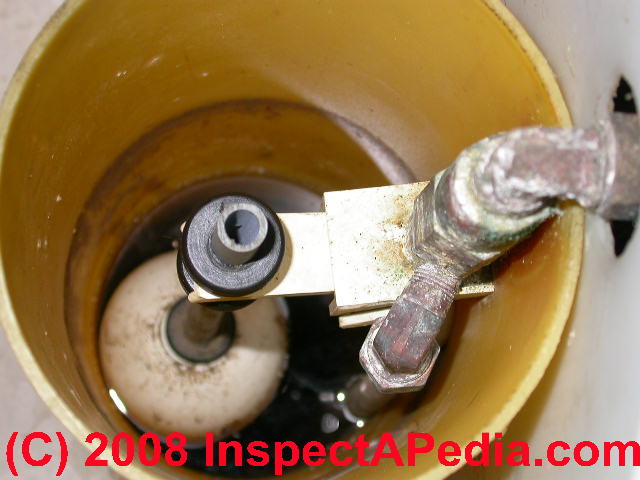
Our photo at left shows the interior of a water softener salt tank. Notice that brown soil line marking where dirty water has risen in this tank? Our photo at right shows a closeup of the inside of the float tube in the water softener tank - it's the same yellow tube you see in the left hand photo.

Although the salt you dump into the water softener's salt reservoir tank looks clean, the salt you have purchased is usually mined from the earth and will contain small amounts of soil and other debris. The debris accumulates in the water softener salt tank over time and can become filthy and possibly unsanitary. Debris in the salt tank can also clog water softener controls.

We recommend waiting until the salt in the tank has been consumed, or nearly all consumed. This will leave a water softener salt reservoir tank which is nearly empty and which is quite light, making it easy to disconnect, carry outside, and hose out.

Be careful not to break the float controls in the softener tank, but if you do break something or if you find that the float no longer moves freely, this part can and should be replaced.

Check the water conditioner brine tank for salt crusting

A salt crust may form on the sides or across the whole interior surface of the brine tank. Periodically you should break up and remove this scale as it may prevent proper water softener operation. For example a thick salt crust may prevent salt in the tank from falling freely to the tank bottom where it is needed to mix with water during the regeneration cycle.

Check the water softener brine tank for dirt and debris build up
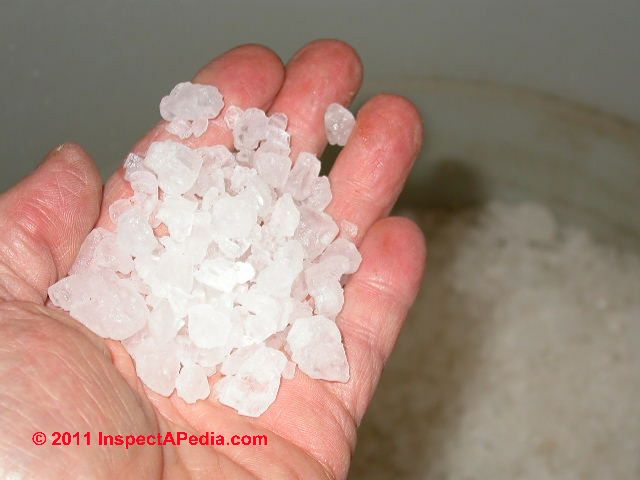
Water conditioner salt sample (C) Daniel FriedmanWhen salt is low in the tank check for an accumulation of dirt and debris.

Salt is a naturally-mined mineral that is dug out of the ground. Although it looks (and is) pretty clean when you dump salt into your brine tank, a bit of soil (earth, dirt) comes along with it and may accumulate in the bottom of the brine tank.

So even though the salt looks clean and beautiful (our photo at left) when you are pouring it into the brine tank, in fact it may contain soil particles or other debris. Because soil particles (dirt) does not dissolve and pass out of the system during the backwash/regeneration cycle, it accumulates in the bottom of the water softener brine tank where eventually it looks like muddy water.

You won't see this dirty crud because it's always hidden by the new salt you keep pouring on top of what's already in the brine tank - until you allow the water softener to "use up" its salt enough that you're looking at a nearly-empty brine tank.

When your water conditioner's brine tank looks dirty just empty it out and wash its interior with an ordinary household cleaner or detergent. See Basic Procedure To Clean or Sanitize a Water Softener and Detailed Procedure to Clean & Sanitize a Water Softener.

How to Sanitize a Water Softener or Water Conditioner

All salt used in water softeners, whe3ther it is "rock salt", "salt pellets", "solar salt" or "evaporated salt" is a natural mineral that will contain impurities and possibly soil particles. These materials accumulate in the bottom of the salt tank during normal use and eventually can interfere with water softener operation or water quality.

Every year or two we let the water softener use up its salt so that we can inspect and remove any dirt or sludge that may have accumulated at the bottom of the salt tank. The following procedures are given in both basic and detailed forms and are adapted from maintenance recommendations from Culligan™ and other water conditioner companies.

If your water softener has been shut down for a week or more, if you are restoring to service a building that has been winterized, or if your building water supply both hot and cold water have a stinky sulphur smell or "rotten egg" smell (caused by harmless but nasty smelling sulfate-reducing bacteria), you'll want to try the sanitizing procedure we describe below. If only the hot water supply in the building smells like rotten eggs, see Check the Sacrificial Anode on the Water Heater. Also see How to Identify Odors in Drinking Water.

Basic Procedure To Clean or Sanitize a Water Softener (and its salt reservoir or brine tank):

  1. Turn off any other water treatment equipment that uses Sodium hydrosulfite, Sodium bisulfite, or any other reducing agent and disconnect that device temporarily. If you're not sure what your other water treatment equipment is, ask your plumber or water treatment company who installed it. If you are not the original owner of the building and don't know who installed your equipment, look on the equipment for its name, model number, and for a sticker that may identify the local installer.
  2. Run a manual regeneration cycle to flush out the equipment;
  3. Add bleach to the brine tank: Pour a one cup of household bleach (if your water softener is a 9" diameter unit) or two cups of bleach (if your water softener is a 12-inch diameter unit) right into the salt tank.

    We pour the bleach into the yellow tube that houses the float assembly but don't do this and let the bleach sit there for days since it might be so concentrated as to damage water softener parts. Just go ahead to the next step.
  4. Run an extra manual water softener recharge cycle: set the water softener to perform an extra (manual) recharge cycle.

    This will flush salty chlorine disinfectant through the equipment. (No, using the recommended quantity of bleach will not harm the septic system.)

Detailed Procedure to Clean & Sanitize a Water Softener Salt Salt Storage Tank

These instructions presume that your water conditioner (water softener) uses a separate salt or brine tank. The following instructions are adapted from advice from Culligan.

You will need these tools to clean out the salt storage tank

  • A scoop to remove salt
  • A clean bucket
  • A phillips-head screwdriver
  • A garden hose
  • A scrub brush or sponge
Water softener brine tank (C) Daniel Friedman
  • Turn off electrical power to your water softener - or check the control to be sure that the water softener won't be starting a backwash/regeneration cycle while you are in the middle of cleaning out the salt tank. [You can leave power on if you're sure you are not going to encounter a regen cycle during your cleanout. Leaving power on avoids having to later re-set the water softener timer or clock.]
  • Remove the cover from the salt storage tank.

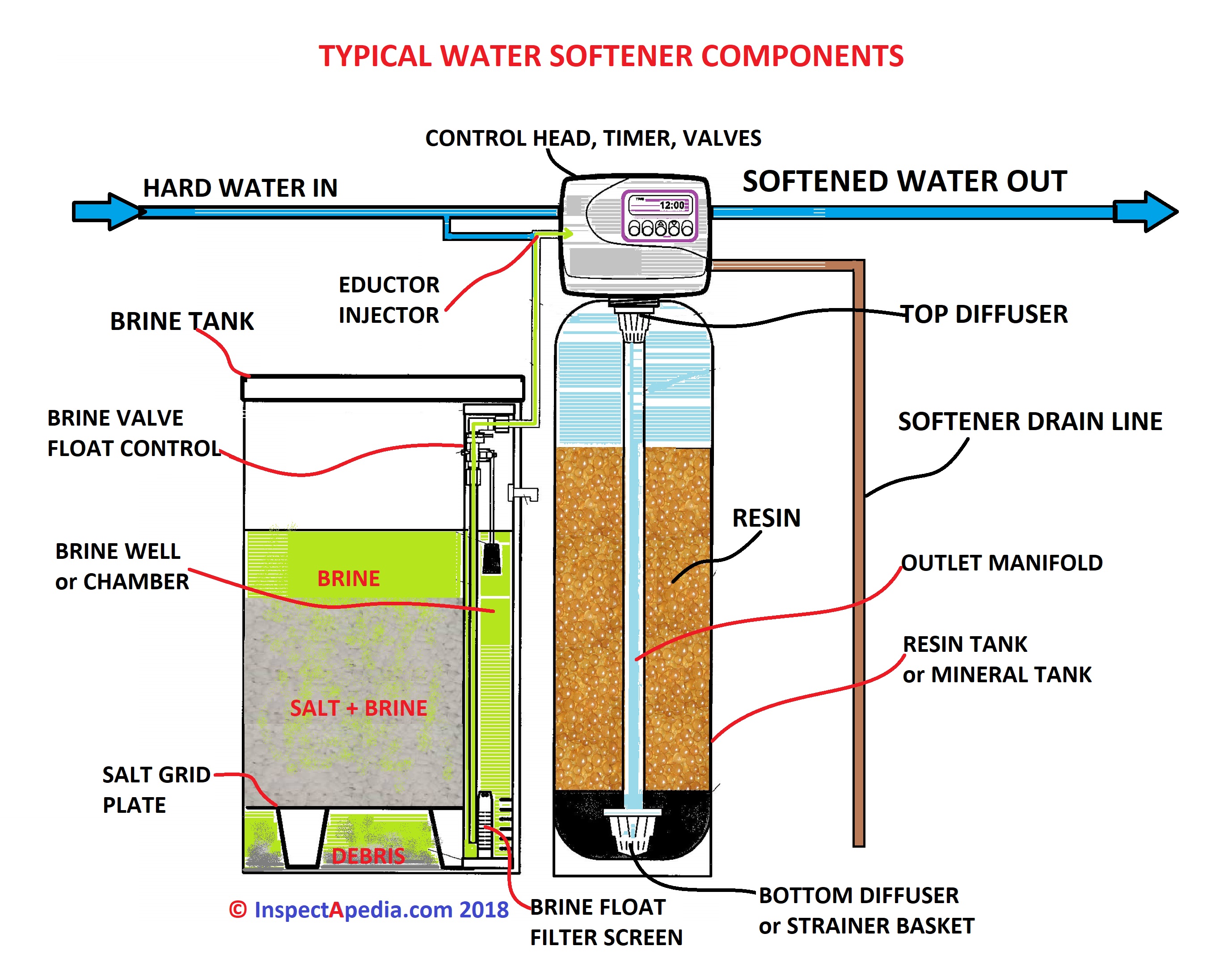
Remove the cap from the brine valve chamber. The brine valve chamber is the smaller diameter vertical tube that you will find inside the salt tank when you have removed the tank's cover.

Our photo (above-left) shows the interior of a salt tank or "brine tank" with the cover removed. The yellow tube is the brine valve chamber. Brine valves are discussed and illustrated at Brine Refill Control Valve, Water Softener.


Photo of a water softener salt tank ready for cleaning

  • Lift the brine valve (the assembly inside the vertical yellow plastic tube in our photo (left) out of the valve chamber (the yellow tube) and place it aside in an "upright" position.
  • Save clean salt: if your salt tank contains a volume of clean salt you can scoop out the salt and save it in a clean container such as a plastic bucket or even in clean dry grocery bags if needed.

    If the salt at the bottom of the tank and if it is visibly dirty we recommend that you remove all of it and throw it away. [Don't dump unused salt on the ground - you will kill your plants.]
  • Clean out remaining salt and debris from the bottom of the salt chamber using your scoop. Since you have removed the brine valve assembly, your salt tank may at this point be simply a free-standing plastic container, so you can tip it or move it if that helps clean out its contents.
  • Remove the brine chamber itself from the salt tank. You will probably have to remove a retaining screw and nut that hold the chamber to the side of the salt tank.
  • Remove the salt plate at the bottom of the brine tank
  • Wash out the salt tank: Place the salt tank on its side [do this outdoors or at an indoor floor drain if you must work inside] and using your garden hose and sprayer, spray out all of the residue or debris that remain inside the salt tank. We perform this operation in our gravel driveway in an area where we don't want weeds and grass to grow since we expect that the salt may kill grass anyway.

Now we are ready to put the water conditioner salt tank and its controls back together.

  • Return the salt tank to its original location and stand it upright. You do not have to dry the tank interior.
  • Replace the salt plate in the bottom of the salt tank. If the plate is dirty, wash it off before returning it to the tank.
  • Replace the brine valve chamber in position and secure it to the salt tan k with the screw and nut you removed earlier. If that hardware has become corroded and difficult to re-use it can be replaced.
  • Replace the brine valve into the brine valve chamber and replace the brine valve chamber cap. Inspect the brine valve assembly before returning it to its chamber. If it is dirty or if you find broken parts or parts that are not moving freely those parts may be cleaned or replaced.
  • Put water into the bottom of the salt tank - typical instructions call for 4-6 inches of water in the bottom of the tank.
  • Fill the salt tank with salt to about 3-inches from the tank top edge. Be careful not to spill salt into the separate, smaller-diameter brine valve chamber - that's why it's important to keep the cap on that chamber. Salt falling into the brine valve chamber will interfere with proper movement of the brine valve float and valve.
  • Put the cover back onto the salt tank.
  • Turn the electrical power back on at your water softener if you turned it off earlier. If you turned off power or pulled the plug you may also need to re-set the water softener timer or clock to the correct time or position.

- Reference: Culligan Mark 100 Water Softener Owner's Guide, 1994-1998

How to Clean Iron (or other) Sediment out of a Water Softener

Question: Using Iron Out™ (sodium hydrosulfite) to remove iron deposits from the water softener resin tank: reduced water pressure traced to water conditioner resin tank fouling

Iron stains on bathroom sink (C) D FriedmanMy existing Culligan water softener is 22 years and has in place between it and the water supply an iron filter, which does a good job in removing iron.

[Our photo at left illustrates iron staining on a bathroom sink - Ed.]

But like all filters of any sort do not filter 100% of a substance. Unnoticed over the years, until at some arbitrary point is reached, the flow rate over the years at the tap was reduced. This was found to be iron fowling in the resin in our water softener tank.

But prior to that fact Culligan personnel were telling me that the water conditioner unit should be replaced. I did further research into this problem.

Initially I did not suspect it was iron fouling because I had an iron filter installed ahead of the water conditioner.

The solution to this problem turned out to be simple. From the hardware store I obtained a powder to remove iron from any thing. I followed the instructions on the container for a softener. By repeating the instructions three times, once at each recharging cycle, the problem was solved over about nine days.

The product for removing iron is called 'Iron Out' The principle ingredient is sodium hydrosulfite, which is used in some application as a water conditioner. - M.P.

M.P. continues:

I was not too concerned about residue of the product in the softened water as all water that is used for human and pet consumption is drawn before the softener but after the iron filter, therefore, I cannot answer the question about possible poisoning or resin damage.

Independent of the iron removing product, we prefer not to drink conditioned water because of the sodium content and the lack of calcium and magnesium, of which those two ingredients are in my opinion beneficial to health. My softener is a Culligan Mark 88. The softener consists of a brine tank and a resin column with the controls on top of the column, probably a unit that's quite standard to others. - M.P.

Watch out: There could be health hazards from drinking or bathing in water produced by a water conditioner or other water treatment equipment after running cleaning chemicals through the system. Any chemicals used to try cleaning or sanitizing a resin tank should be thoroughly flushed out of the system. It should be easy to do this by repeating enough water softener backwash or "regeneration" cycles. See the Super Iron Out usage instructions from the manufacturer, below, and see the MSDS for that cleaner also found just below.

Watch out: And could the iron remover damage the water conditioner resin? Check with your water softener manufacturer before trying this.

Iron and Rust removing Chemicals & Stain Removers are available from a number of manufacturers including

  • Super Iron Out™, Summit Brands, Super Iron Out, 2010 Summit Brands,| 7201 Engle Road, Fort Wayne, IN 46804-2228, 888-476-6688

    Super Iron Out is intended for use as a stain remover; the company's website does however describe using the product in a potable (drinkable) water system, but it does mention water softeners. Quoting:
    Super Iron Out Rust Stain Removers clean and prevent rust stains from toilets, sinks, bathtubs, dish-washers, water softeners, white laundry, and nearly all surfaces in and around your home... without the chore of scrubbing.
  • Pro Rust Out™, Pro Products, LLC, 502 Incentive Dr., Fort Wayne IN 46825, tel: 800-285-9176, website: www.proproducts.com- web search 08/29/2011, original source: www.proproducts.com/Libraries/MSDS/Rust_Out.sflb.ashx [3]

Water Treatment Solutions using Iron Removing Chemicals (Super Iron Out)

According to Summit Brands in discussing the use of Super Iron Out to clean a water softener system:

Does your water softener make your water taste bad? Water softeners and heater tanks need regular maintenance to operate efficiently and effectively. Rust never sleeps. Using Super Iron Out on a regular basis knocks rust out before it stains your home's surfaces.

Water Softener - First Application — Use 1 cup (250 mL) Regular Use - Use 1/4 cup (62 mL) All softeners treating high iron content water require Super Iron Out as preventative maintenance and to eliminate iron buildup.

First Application of Iron Remover in a Water Softener

  1. Add 1 cup in 1/2 gallon of cold water
  2. Pour directly into brine well (for softeners with no brine well, pour directly into salt tank when salt level is low)
  3. Manually regenerate softener
  4. Repeat for heavily fouled unit.

Regular Use of Iron Out in Water Softeners

  1. Add 1/4 cup per 40 lbs. of salt
  2. Repeat regularly for continuous treatment

Note: If taste or odor is detected in tap water, manually regenerate softener again, then run cold water until odor is gone. For cabinet models, use for periodic cleaning only. Follow First Application instructions above.

Please follow cautions and instructions on the label carefully.

MSDS Material Data Safety Sheet for Super Iron Out rust and stain remover.
- Reference: web search 01/31/2011, adapted from original source: www.superironout.com/water-uses.php

MSDS Material Data Safety Sheet for Pro Rust Out, rust and stain remover, Pro Products, contains sodium hydrosulfite & sodium bisulfite. Warnings include against inhalation, eye and skin contact, ingestion (which would include drinking). Overexposure can exacerbate asthma or lung disease. [3]

Water Softener Cleaning Using Manufacturer-Recommended Resins or Cleaning Compounds

Sears Kenmore water softner cleaning resin - about $20. from SearsUsing a water softener cleaner or resin cleaner can improve water softener operation and keep parts working longer according to both manufacturers and independent experts. [19][20]

Sears Kenmore water sofener instructions for some models point out that consumers can buy water softner salt that includes an iron removing additive, increasing the ater softener's ability to remove iron content in the water supply along with minerals associated with ahrd water.

That manufacturer recommends using a special water softener cleaning resin provided by the manufacturer.

Some salts have an additive to help the softener handle iron in the water supply.

These salts may be used if your water supply has a high iron con tent. It is recommended to use Sears Water Softener Clean er (refer to the parts list in back of manual for part number) for periodic treatments to keep your resin bed clean.

Where to Buy Water Softener Cleaners & Sanitizers

The following products are sold and described as specifically designed for use in water softeners and water conditioners:

  • Filter-Mate Water Softener Cleaner (from Summit Brands, available at Loewes Building Supply Stores) "Removes dirt and organic compounds from a fouled smelling water softener " [summitbrands.com] Filter mate provides a liquid water softener cleaner sold in Menards stores and online.
  • Pro Softener Mate "Water Softener Cleaner,Function Chemically Removes Manganese, Limited Iron, Silt, Metal Particles and Organic Compounds, For Use With Water Softeners" (available at Amazon.com)
  • Resin Rescue water softener cleaner .resinrescue.com/] "Recommended for use every 4 to 6 months as a water softener resin cleaner" Tel: 800-755-6541 or Email: mike@resinrescue.com
  • Res Care® liquid resin cleaner for water softeners, "Pro Res Care is a specially formulated liquid resin cleaner designed to clean resin pores of iron, manganese, silt, metal particles and organic compounds that cause softener inefficiencies. Regular use of Res Care resin cleaner will restore the softener beads and control valve parts back to peak efficiency and maintain the life of the unit. For best results, use a Res Care Automatic Feeder or manually add during regeneration to prevent mineral build up." [proproducts.com]
  • Sears Kenmore brand special water softener cleaning compound is available at your local Sears store and in 2013 retailed for abut $20. U.S. .  [19]

Take a look at Michele Hébert's Water Softeners Annual Maintenance [separate PDF from the University of Fairbanks Cooperative Externsion] for more detail about chemicals & processes used to clean water softeners.


Frequently Asked Questions (FAQs) about Cleaning & Sanitizing Water Softeners & About using a sanitizer in water softeners and the effect of sanitizers on septic systems

Question: Will using BioSafe™ sanitizer harm the septic system?

We have been doing business with a company called Biosafe and have not be satisfied with the results. I am referencing your article on line “Water Softeners – water softener effect on drinking water and on septic systems" [found at SALT OR WATER INTO SEPTIC].

As I understand the fine print on page 1, you are saying you do not recommend this product. My husband read it just the opposite….that biosafe is one of the recommended products. Could you please clarify. - B.R.

Reply: BioSafe's Hydrogen Peroxide and Peroxyacetic acid - based sanitizers

BioSafe's Hydrogen Peroxide and Peroxyacetic acid - based sanitizers, used as directed, should have significantly less impact on the environment (and therefore on a residential septic system) than certain other chemicals used as sanitizers or disinfectants. But be sure you were using the right product for the right application and in the proper manner.

The article you cited, found at SALT OR WATER INTO SEPTIC - does not discuss Biosafe nor any other specific sanitizer or disinfectant, but perhaps you saw a Google-placed a Biosafe ad at the top of our page.

The "fine print" to which you refer may have been our statement affirming our independence from any advertisers, products, or services that I quote here:

Our site offers impartial, unbiased advice without conflicts of interest. We will block advertisements which we discover or readers inform us are associated with bad business practices, false-advertising, or junk science. Our contact info is at InspectAPedia.com/Contact.htm.

I took a look at a Biosafe site (www.biosafesystems.com) that may be the source of the product you asked about: BioSafe Systems LLC - but you should confirm that this is the company whose product you are asking about.

BioSafe Systems produces a wide range of sanitizing products used in agriculture, animal health, greenhouses, water and wastewater industries, food safety, turf, pond and lawn care, and general sanitation. The BioSafe product line, as I read the company's information on general sanitation, is based on activated peroxygen sanitizers marketed as an alternative to chlorine, phenol, and quat-based formulas. Even as a layman not a chemist, it is easy to understand the basis of the company's assertion that their approach is less harsh and less persistent in the environment than some of the alternatives.

Here you can see a list of links to MSDS sheets for BioSafe™ products: http://www.biosafesystems.com/Product-PH-MSDSsheets.asp

Of their products, and not knowing which Biosafe product you're interested in, I looked at SaniDate 5.0 Sanitizer/Disinfectant a sanitizer described at http://www.biosafesystems.com/MSDS%20Labels/SaniDate5.0MSDS.pdf

The BioSafe MSDS shows that the hazardous components of this product are Hydrogen Peroxide and Peroxyacetic acid - two very common and widely used disinfectants that are less dangerous to the environment than some other chemicals because the products are not cumulative in the environment. BioSafe says that the product degrades 99% in 20 minutes. That's quite a good argument supporting the assertion of no bioaccumulation. It's worth noting that the product is however in direct contact acutely toxic to fish, crustaceans, and bacteria (bacteria was probably its target in the first place, no?)

Watch out: at BioSafe's website I did not read specific advice addressing use of their products in a residential water softener. I have asked the company for more information and advice.

In Sum:

I am not an expert in the field, but as a general researcher/investigator I interpret the information about the product to indicate that the product, used as directed by its producer, and at normal levels and frequency of household use, is unlikely to damage a septic system drainfield.

Your husband is right in intent (product OK) but wrong in a literal sense (we do not recommend specific products) - the product does not look harmful to the septic system, with how-to guidance from the manufacturer might be fine for sanitizing a water softener, but in particular, we do not recommend specific products or services. (Google ads support our website; to avoid any conflict of interest, we have no relationship whatsoever with products or services advertised or discussed)

Further details needed:

Please tell me what product you were using, why you are not satisfied with the results, and keep me posted on how things progress in your own case, let me know how you were intending to use the product, and send along photos of any equipment (like water softener) involved if you can. Such added details can help us understand what's happening and often permit some useful further comment.

Also if you were dissatisfied with a BioSafe product you should contact the company to assure that you were using their product for an application that they recommend, and in the manner that they recommend for that use.

What we both learn may help me help someone else.

Question: Is it Ok to Use Pro Rust Out as regular water softener maintenance, sodium hydrosulfite and sodium metabisulfite, in a water softener

I have added Pro Rust Out very occasionally in small measures to our water softener as a maintenance measure. Pro Rust Out contains sodium hydrosulfite and sodium metabisulfite. Will these chemicals make our water unsafe for drinking? Thank you so much for your reply. Jon

Reply: Used as directed these water softener cleaning products should be safe. Here are details, examples of use, usage instructions, & health warnings.

The product you ask about, Pro Rust Out™, is produced and sold by Pro Products [3], a company that distributes a line of water softener cleaning products. Quoting, the company produces:

Water softener cleaners designed to clean, restore and maintain the life of water softeners. These products are formulated to treat water softeners with iron issues or for daily preventative maintenance.

Rust Out softener rust remover chemically removes iron and rust build-up that coats the resin beds and fouls the softener. This iron build-up is not totally removed during normal regeneration of a water softener. Using Rust Out softener rust remover in a water softener will eliminate rust and foreign matter from the resin bed. This increases the life of the softener and reduces rust staining on household fixtures and other surfaces. Use the softener rust remover regularly as preventative maintenance to ensure the softening and recharging efficiency of the softener's resin bed.

Usage Instructions for Pro Rust Out™ water softener cleaner:

Water Softeners: Rust Out softener rust remover dissolves the iron in the mineral bed and is rinsed from the softener much the same as salt brine.

First Application: Dissolve 1 in 1/2 gallon cold water. Pour directly into brine well (softeners with no brine well, pour directly into salt tank when salt level is low). Manually regenerate softener. Repeat for heavily fouled unit.

Preventative Maintenance: Add 1/4 cup for every 40lbs. of salt added to brine tank. Layer to ensure a continuous dose with each regeneration.

General Purpose Cleaning: Our softener rust remover works on dishwashers, dishes, glassware, white clothes or fabrics, and water softeners - follow directions on the back of the package.

Information about the use of sodium metabisulfite and sodium hydrosulfite in water treatment equipment:

Sodium metabisulfite (Na2S2O5) is an inorganic compound used as a disinfectant, antioxidant, or preservative. Its uses include both as a food additive and as a sanitization and cleaning agent. It is also used in some medical applications such as in the EpiPen. [4] Sodium hydrosulfite (Na2S205) is used as a cleaning agent for reverse osmosis water treatment equipment. [2]

In sum, the company's instructions indicate that used as directed (1/4 cup for every 40 lbs. of salt added) for regular water softener maintenance, the product should be safe. Certainly it would appear that the concentration of sodium hydrosulfite and metabisulfite will be very low in the building water supply.

Concentration of sodium metabisulfite and sodium hydrosulfite in water processed through a treated water softener

If we use a guesstimate of 4 pounds of salt used per water softener regen cycle (check your machine's actual salt dosage level) that would place an average of about 0.025 cups (1/4 divided by 10) of chemicals in the water used to clean and regenerate the water softener during a regen cycle.

Furthermore, as that water is supposed to be flushed through and then out of the water softener resin tank during the regen cycle, only a low level of salt + Sodium Hydrosulfite and Metabisulfite would be expected to remain inside that resin tank and to come into contact with drinking water during subsequent use.

Watch out: that analysis presumes that a water softener is adjusted and working properly and that you are using the cleaning agents as recommended by the manufacturer. To do otherwise could be unsafe. For example, used in concentrated form, sodium metabisulfite is even used to remove tree stumps! [4]

At SOFTENER CLEANING & SANITIZING (above) we have provided further comments on the use of sodium hydrosulfite on water softeners and on the safety of drinking or bathing in such treated water.

The bottom line advice on water softener treatment using sodium hydrosulfite and metabisulfite

The bottom line is that while such chemicals may be effective in cleaning out iron and sediments, it is very important to thoroughly flush the system before returning the water softener to operation, or there could be health hazards from chemicals that enter the water supply from chemicals left in the resin tank.

That article includes recommendations for safe levels of usage of several water softener cleaners and treatments. We also include links to health and safety information (MSDS forms) and information for the chemicals involved. I've checked and added information about the second chemical you name, sodium metabisulfite.

In general, should a more harsh treatment or cleaning be needed at a water softener, it may be acceptable do to so provided the system is adequately flushed and cleaned afterwards.

It's possible to thoroughly flush and clean out a resin tank if it has first been emptied of all salt (and any dirt and debris are of course first manually cleaned.

On the other hand, it would be quite difficult to thoroughly flush cleaning or treatment chemicals out of a water softener and brine tank if the tank remains full or partially full of salt. So many repeated flush cycles would be needed that you'd be wasting both water and salt. And if the building is served by a private septic system there could be a risk of flooding or damaging the drainfield by that added water and salt volume as they would exceed normal usage levels.

Also you'll note that we warned that some water softener resins might be damaged by some cleaning chemicals. Check with the manufacturer of your water softener or its resin content.

Question: Do I Need to Add Water to the Salt Tank After Cleaning it Out?

I had to take all of salt out because it was getting to hard and water was above the salt. When I put new salt in should I also add some water? - Brian

Reply: No, water will be placed into the salt tank by the softener control during the next regen cycle

Brian you do not need to add water to the water softener brine tank when you have emptied, cleaned, and then refilled the tank with salt. The water softener regen cycle and float control will automagically put the correct amount of water back into the salt tank.

Reader Comment:

If all the water is emptied out of brine tank upon cleaning, depending on model of softener, you might need to add water. All the fleck valves need water added. Kinetico and possibly culligan do not.

A. Carlin Water tech. - Jan 2012

Reply:

Thanks so much Carlin Water Tech. Contact us if you want to be listed and linked-to as an expert resource.

Question: is water softener resin dangerous

Resin broke through to our pipes and came out our faucets. Is this dangerous to our health in any way?

Reply:

Deana,

Naturally it's not good to drink particles or debris of any sort. Presuming you are talking only about a conventional water softener that uses a resin tank and salt (that is not a treatment system that includes more dangerous chemicals) the drinking water that you were consuming before was passing through that very resin.

However the resin risks clogging pipes and valves and faucets and needs to be flushed out.

Question: corroded drains & faucets - does this mean a water softener problem?

Our drains and faucets are starting to corrode and rust. we have always used a water softener and maintained it. Is this an indication that there is a problem with our softener? - Sharon Osterby 9/16/12

Reply:

Sharon I'm not sure the problem is with your water softener or with the chemistry of your water. If the softener is not working you might see white mineral build-up at faucet strainers and openings; If the water chemistry is aggressive that might be a factor in plumbing corrosion.

Start by testing your softened water to see if it is effectively treated, and if not, clean, adjust, repair the water softener first.

If you suspect a problem with water chemistry (say the softener is working normally and the water at the tap is not hard) then I suggest asking a water treatment company to test your water. Such vendors often will test your water at no charge (they want to sell you equipment) or if you're doubtful, pick up a steril bottle from your local water test lab and ask their recommendations for what screening tests to perform.

Question: Laundry stains

I have a 2 1/2 yr old water softener. We put it in when we built our house. In the past two months I have noticed laundry stains that are irremovable. They are large and look like they were poured on. On whites they look grey, on darks they look like a wet spot that won't dry, on colored clothes they are bluish. I have changed washer/dryers, laundry detergent, etc. Could this be a problem caused by a water softener? I am out of options and don't know what else could be causing it. It has gone on now for 2 months. Our neighbors don't have this problem and we are all on the same city line. Thanks for your help! - Amy 9./19/12

Reply:

Amy
If you suspect the water softener as a source of stains rather than pipe corrosion or a washing machine problem, in suggest cleaning and sanitizing the unit as described above, followed by an extra regen cycle to see if that helps.


Frequently Asked Questions (FAQs)

...

Ask a Question or Search InspectApedia

Questions & answers or comments about Cleaning & Sanitizing Water Softeners & About using a sanitizer in water softeners and the effect of sanitizers on septic systems.

Ask a Question or Enter Search Terms in the InspectApedia search box just below.

Technical Reviewers & References

Related Topics, found near the top of this page suggest articles closely related to this one.

  • [1] North Dakota Standards for Water Softeners, North Dakota General Authority Law, Chapter 62-04-08, Water Softener Units http://www.legis.nd.gov/information/acdata/pdf/62-04-08.pdf. "The objective of this chapter is to provide a standard of quality, capacity, and performance for water softener units. Water softener performance is to be based upon referee tests procedures described in section 62-04-08-09."
  • [2] Nitto Denko, Hydronautics, Hydranautics 401 Jones Rd. Oceanside, CA 92058 Tel: (760) 901-2500 Fax: (760) 901-2664 e-mail: info@Hydranautics.com Technical Service Bulletin TSB107.20, July 2010, web search 08/29/11, original source: /www.membranes.com/docs/tsb/tsb107.pdf
    Quoting:
    This is a lower pH cleaning solution (natural pH is between pH 4 and 6. No pH adjustment is required) 1.0% (w) of Na2S2O4 (sodium hydrosulfite). It is useful in the removal of metal oxides and hydroxides (especially iron fouling), and to a lesser extent calcium sulfate, barium sulfate and strontium sulfate. Sodium hydrosulfite is strong reducing agent and is also known as sodium dithionite. The solution will have a very strong odor so proper ventilation is required.
  • [3] Pro Products, LLC, 502 Incentive Dr., Fort Wayne IN 46825, tel: 800-285-9176, website: www.proproducts.com- web search 08/29/2011, adapted from original source: www.proproducts.com/Libraries/MSDS/Rust_Out.sflb.ashx
  • [4] "Chemical tests for sodium hydrosulfite & sodium metabisulfite", web search 08.29/2011, wikipedia.
  • A.I. McDermott Co., Inc. produces the AquaSoft series of water softeners including the AquaSoft Pro-Plus 460-series water softeners Pro 255, Pro Performa 400, Pro 460i, Logix, and CL softeners. Here is an example water softener manual for the Aquasoft Pro Plus water softener with the 460i Controllers such as PES32M268-MP - web search 09/11/2010, original source: http://www.gewater.com/pdf/resdntl/manuals/1017948.pdf describing a General Electric GE-produced control.
  • [5] Autotrol Series 255 Valve / 460i Water Conditioning Control System, Installation, Operation, and Maintenance Manual, web search 09/01/2010 original source: http://www.qualitywatertreatment.com/PDF/Autotrol%20255-460i_Manual.pdf
  • [6] Aquatell (Nelsen Corporation) produces Autotrol Water Conditioners. Email: sales@aquatell.com Tel: Toll Free 1-866-966-9951 Website: Toll Free 1-866-966-9951 Website: http://www.aquatell.com/
  • [7] BioSafe Systems LLC, Robert Larose, President/CEO, Mailing Address: 22 Meadow Street East Hartford, CT 06108, Toll-Free Phone: 1.888.273.3088 Email: info@biosafesystems.com
  • [8] "Commercial Water Softener Installation and Operating Instructions", IBC Filtration & Water Treatment Products (Australia) for commercial, industrial and residential application www.ibcwater.com.au (07) 3219 2233
  • [9] Culligan System 19 and 23 Water Conditioners (Filament Wound Tank) Installation and Operating Instructions, Cat. No. 00-8816-57 (Printed 6/89), Culligan INternational Company, Northbrook IL. 60062, San Bernadino CA 92402, Culligan NV/Brussels, Belgium, Culligan Italiana SpA/Bologna, Italy, Culligan of Canada, Ltd., Mississauga, Ontario, Canada L5K 1A5
  • [10] Culligan Mark 10 Water Softener 1994-1998 Installation and Operating Instructions (covering models manufactured after 1995) (1-96) 01881948.pdf available from www.culligan.com
  • [10] "Non electric water softener, Installation and Operating Instructions", IBC Filtration & Water Treatment Products (Australia), op.cit.
  • [12] North Dakota Standards for Water Softeners, North Dakota General Authority Law, Chapter 62-04-08, Water Softener Units http://www.legis.nd.gov/information/acdata/pdf/62-04-08.pdf. "The objective of this chapter is to provide a standard of quality, capacity, and performance for water softener units. Water softener performance is to be based upon referee tests procedures described in section 62-04-08-09."
  • [13] Water Hardness Table used in this article series originated with but was edited and added to from http://www.bestfish.com/tips/110598.html and also from http://www.water-research.net/hardness.htm
  • [14] "Water Softener Twin Tank Installation and Operating Instructions", IBC Filtration & Water Treatment Products (Australia), op.cit.
  • [15] Water Softeners, CMHC, Canadian Mortgage and Housing Corporation, cmhc-schl.gc.ca/en/co/maho/wawa/wawa_005.cfm - October 2008. Canada Mortgage and Housing Corporation acknowledges the contribution of Health Canada to the development of this document. For further questions regarding water treatment and water quality, contact Health Canada at watereau@hc-sc.gc.ca or call 613-957-2991 or 1-866-225-0709.
  • [16] Watts Industries of North Andover, Mass., provides its ZRO-4 under counter system intended to target the independent water dealer market.
  • [17] Thanks to reader M.P. for discussing the requirement to adjust the float level in water softener brine tanks - January 2011
  • [18] Thanks to reader M.P. for discussing using an "iron out" chemical to remove iron sediment that was clogging a water softener resin tank and causing poor water pressure - January 2011
  • [19] Kenmore Water Softener Use & Care Guide, Model 635.383000 (with a high flow valve), retrieved 2/14/2013, original source: http://c.sears.com/assets/own/896150e.pdf [ copy on file as Kenmore_Softener_No.625.383_Manual.pdf ]
  • [20] Michele Hébert, "Water Softeners Annual Maintenance", University of Fairbanks Cooperative Extension, HCM-2020, January 2011

Books & Articles on Building & Environmental Inspection, Testing, Diagnosis, & Repair

  • Our recommended books about building & mechanical systems design, inspection, problem diagnosis, and repair, and about indoor environment and IAQ testing, diagnosis, and cleanup are at the InspectAPedia Bookstore. Also see our Book Reviews - InspectAPedia.
  • Home Reference Book - Carson DunlopThe Home Reference Book - the Encyclopedia of Homes, Carson Dunlop & Associates, Toronto, Ontario, 25th Ed., 2012, is a bound volume of more than 450 illustrated pages that assist home inspectors and home owners in the inspection and detection of problems on buildings. The text is intended as a reference guide to help building owners operate and maintain their home effectively. Field inspection worksheets are included at the back of the volume. Special Offer: For a 10% discount on any number of copies of the Home Reference Book purchased as a single order. Enter INSPECTAHRB in the order payment page "Promo/Redemption" space. InspectAPedia.com editor Daniel Friedman is a contributing author.

    Or choose the The Home Reference eBook for PCs, Macs, Kindle, iPad, iPhone, or Android Smart Phones. Special Offer: For a 5% discount on any number of copies of the Home Reference eBook purchased as a single order. Enter INSPECTAEHRB in the order payment page "Promo/Redemption" space.

  • GO TO Carson Dunlop's Home Study Course Information - How to Become a Home Inspector: Carson Dunlop's nationally recognized Home Study Course, selected by ASHI the American Society of Home Inspectors and other professionals and associations. This website author is a contributor to this course.
  • GO TO Carson Dunlop's Home Study Course Information - How to Become a Home Inspector: Carson Dunlop's nationally recognized Home Study Course, selected by ASHI the American Society of Home Inspectors and other professionals and associations. This website author is a contributor to this course.
  • GO TO Carson Dunlop's Home Study Course Information - How to Become a Home Inspector: Carson Dunlop's nationally recognized Home Study Course, selected by ASHI the American Society of Home Inspectors and other professionals and associations. This website author is a contributor to this course.
    Building inspection education & report writing systems from Carson, Dunlop & Associates Ltd
  • Inspecting Septic Systems: Online Book, Inspection, Test, Diagnosis, Repair, & Maintenance: our Online Septic Book: Septic Testing, Loading & Dye Tests, Septic Tank Pumping, Clearances, details of onsite waste disposal system inspection, testing, repair procedures.

  • Advanced Onsite Wastewater Systems Technologies, Anish R. Jantrania, Mark A. Gross. Anish Jantrania, Ph.D., P.E., M.B.A., is a Consulting Engineer, in Mechanicsville VA, 804-550-0389 (2006). Outstanding technical reference especially on alternative septic system design alternatives. Written for designers and engineers, this book is not at all easy going for homeowners but is a text I recommend for professionals--DF.
  • Builder's Guide to Wells and Septic Systems, Woodson, R. Dodge: $ 24.95; MCGRAW HILL B; TP; Quoting from Amazon's description: For the homebuilder, one mistake in estimating or installing wells and septic systems can cost thousands of dollars. This comprehensive guide filled with case studies can prevent that. Master plumber R. Dodge Woodson packs this reader-friendly guide with guidance and information, including details on new techniques and materials that can economize and expedite jobs and advice on how to avoid mistakes in both estimating and construction. Chapters cover virtually every aspect of wells and septic systems, including on-site evaluations; site limitations; bidding; soil studies, septic designs, and code-related issues; drilled and dug wells, gravel and pipe, chamber-type, and gravity septic systems; pump stations; common problems with well installation; and remedies for poor septic situations. Woodson also discusses ways to increase profits by avoiding cost overruns.
  • Country Plumbing: Living with a Septic System, Hartigan, Gerry: $ 9.95; ALAN C HOOD & TP; Quoting an Amazon reviewer's comment, with which we agree--DF:This book is informative as far as it goes and might be most useful for someone with an older system. But it was written in the early 1980s. A lot has changed since then. In particular, the book doesn't cover any of the newer systems that are used more and more nowadays in some parts of the country -- sand mounds, aeration systems, lagoons, etc.

Design Manuals for Septic Systems

  • US EPA Onsite Wastewater Treatment Systems Manual [online copy, free] Top Reference: US EPA's Design Manual for Onsite Wastewater Treatment and Disposal, 1980, available from the US EPA, the US GPO Superintendent of Documents (Pueblo CO), and from the National Small Flows Clearinghouse. Original source http://www.epa.gov/ORD/NRMRL/Pubs/625R00008/625R00008.htm Onsite wastewater treatment and disposal systems, Richard J Otis, published by the US EPA. Although it's more than 20 years old, this book remains a useful reference for septic system designers. U.S. Environmental Protection Agency, Office of Water Program Operations; Office of Research and Development, Municipal Environmental Research Laboratory; (1980)
  • Eco John® Innovative Toilet Solutions, Global Inventive Industries, Fountain Valley CA, PDF, product brochure
  • "International Private Sewage Disposal Code," 1995, BOCA-708-799-2300, ICBO-310-699-0541, SBCCI 205-591-1853, available from those code associations.
  • "Manual of Policy, Procedures, and Guidelines for Onsite Sewage Systems," Ontario Reg. 374/81, Part VII of the Environmental Protection Act (Canada), ISBN 0-7743-7303-2, Ministry of the Environment,135 St. Clair Ave. West, Toronto Ontario M4V 1P5 Canada $24. CDN.
  • Manual of Septic Tank Practice, US Public Health Service's 1959.

Greywater System Books

  • The New Create an Oasis With Greywater, Art Ludwig; Buy New: $14.25. Ludwig is one of the most thoughtful, prolific, and sometimes controversial writers on gray water systems and alternative designs. We recommend his book as clear, easy-to-understand writing aimed at property owners who want or need to consider a graywater installation to conserve water, recycle water, reduce water use, or to reduce the load on their septic system. This is the latest edition of this Art Ludwig's greywater design book classic.
  • Builder's Greywater Guide, Art Ludwig; Buy New: $10.17. Installation of Greywater Systems in New Construction & Remodeling; A Supplement to the Book "Create an Oasis With Greywater" (Paperback). Quoting a review from Amazon: I recommend that you get the 3 companion books on greywater treatment "Create an Oasis", "Branched Drain Greywater Systems" and "Builder's Greywater Guide". The information in these volumes will keep most of us far more informed than most of the regulators, the system builders, and the experts-in-theory. These volumes are real-world gems.
    Art Ludwig has cut to the core of wastewater issues. He's obviously done all of his homework, mulled-over the variables, and come up with a common sense, economically reasonable, environmentally responsible approach to wastewater. I expect to save money that I would have spent on a post-septic tank, aerobic unit that would seemingly have been ecologically responsible; but because of the technological overkill, ultimately that system would have defeated my altruistic environmental concerns.
    ... These books talk the talk and walk the walk better than anything else that I've seen. Buy a set for yourself, a set for your neighbors, and a set for the regulators.
  • Branched Drain Greywater Systems [superseded by "The New Create an Oasis with Greywater"], Art Ludwig. If you already have this book but are in the process of installing new gray water systems you should take a look at the newer edition listed first above in this section of our Greywater book recommendations. You may prefer the newest edition, but there is great information in this older version, perhaps all you need, and these copies are sold at very low prices - an aid to people of limited means.
  • Create an Oasis With Greywater: Your Complete Guide to Choosing, Building and Using Greywater Systems, Art Ludwig, [superseded by new edition] (Paperback) You may prefer the newest edition, but as I said above, there is great information in this older version, perhaps all you need, and these copies are sold at very low prices - an aid to people of limited means.
  • Rainwater Catchment Systems for Domestic Supply: Design, Construction and Implementation, Erik Nissen-Petersen, John Gould. (Mr. Ludwig, while much appreciated, is not the only author providing really useful design guides for graywater systems--DF) Quoting from an Amazon review: This book reviews the art of roof and ground catchment systems for rainwater. The water collected can be used for household or other purposes. The designs are aimed for individuals with limited access to electricity and/or civic water utilities. The text includes drawings, photographs and step-by-step instructions.
    One might say the book is really written for the 'aid worker' since it also considers ethnic and gender issues that would be 'obvious' to the future owners of the the systems.
  • Guidelines on rainwater catchment systems for Hawaii, (CTAHR resource management publication) Patricia S. H Macomber. This more technical document may be especially helpful for rainwater collection and recycling systems for climates where there is heavy rainfall such as demonstrated for Hawaii.
  • Design for Water: Rainwater Harvesting, Stormwater Catchment, and Alternate Water Reuse, Heather Kinkade-Levario. Quoting from Amazon's review: Design for Water is an accessible and clearly written guide to alternate water collection, with a focus on rainwater harvesting in the urban environment. The book:
    Outlines the process of water collection from multiple sources-landscape, residential, commercial, industrial, school, park, and municipal systems Provides numerous case studies, Details the assembly and actual application of equipment, Includes specific details, schematics, and references.
    All aspects of rainwater harvesting are outlined, including passive and active system setup, storage, storm water reuse, distribution, purification, analysis, and filtration. There is even a section on rainwater harvesting for wildlife.
    In addition to rainwater, there are several affordable and accessible alternate sources, including cooling tower bleed-off water, air conditioning condensate, gray water, and fog collection. Design for Water is geared to providing those making development decisions and guidelines with the information they need to set up passive harvesting techniques. The book will especially appeal to engineers, landscape architects, municipal decision-makers, developers, and landowners.
    Heather Kinkade-Levario is a land-use planner in Arizona and the author of the award-winning Forgotten Rain. She is president of Forgotten Rain L.L.C., a rainwater harvesting and stormwater reuse company.
  • The Toilet Papers: Designs to Recycle Human Waste and Water : Dry Toilets, Greywater Systems and Urban Sewage (Paperback) Sim Van Der Ryn, Wendell Berry; Quoting from an Amazon review: With a title like "Toilet Papers" and from a distinguished eco-architect like Sim Van der Ryn, I needed no intro or review to buy a copy of this little, but well researched historical over-view of effluent mitigation and current eco-friendly toilet design.
    This book is filled with good line drawings and photographs to depict everything from the historical perspective to the current dry toilets and their construction.
    .
  • Rainwater Reservoirs Above Ground Structures for Roof Catchment: Most Common Rainwater Tanks in Comparison and Construction Manual, (Paperback) Rolf Hasse. [I have not reviewed this book --DF, but it may be helpful to people constructing rainwater collection and reservoir systems for use in arid climates such as Mexico and the U.S. Southwest.
  • Quality issues in harvested rainwater in arid and semi-arid Loess Plateau of northern China, K. Zhu, L. Zhang, W. Hart, M. Liu, H. Chen (out of print, find by search and deferred order). Amazon's description may be helpful: Loess soils cover vast areas in the arid and semi-arid regions of northern China. Due to the lack of reliable surface water and ground-water, rainwater harvesting has played a prominent role in farmers' domestic usage and agricultural irrigation. An economical and valid type of water storage cistern with optimum design of components has been introduced to rural areas in the Loess Plateau. Different collection alternatives showed apparent variations in rainwater quality. By using different catchments, such as mortar roofs and cement-paved courtyards, compacted land or road surfaces, rainwater can be effectively collected for storage in cisterns. This study focused mainly on the quality of rainwater harvested from the different catchment systems and stored for different periods of time. By analysis of the water samples stored in these cisterns, it was evident that rainwater quality could be improved significantly by self-purification during the storage. With emphasis on rainwater quality affected by the different catchment systems, it was found that the measured inorganic compounds in the rainwater harvested from roof-yard catchment systems generally matched the WHO standards for drinking water, while the concentrations of some inorganic compounds in the rainwater collected from land and road surfaces appeared to be higher than the guideline values for drinking water, but generally not beyond the maximum permissible concentrations. However, Fecal Coliform, which is an important bacteriological parameter for the three catchment systems, exceeded the limits of drinking water to a greater extend. Trace amounts of 55 organic pollutants were identified, including aliphatic hydrocarbons, aromatic compounds and phthalate esters, etc. The analytical results indicated that roof-yard catchments that included the ''first flush'' usually provided safe drinking water with low organic contents, even for rainwater collected immediately after rainfall. In contrast, rainwater harvested from road surfaces had poor quality with respect to the organic constituents, regardless of stored time.
  • City eying home water-recycling technology; uses bath and washer water for irrigation., (ReWater Systems' equipment for greywater irrigation): This is an article from: San Diego Business Journal [HTML] (Digital) available online in digital format. I have not (yet) reviewed it -- DF
  • Super Iron Out, MSDS Material Data Safety Sheet rust and stain remover; the manufacturer indicates this product can be used to clean rust sediment from water softeners. Summit Brands. See Iron Removal from Water Softener
  • Lime Out / Lime Out Extra, lime remover MSDS, produced by Summit Brands, 7201 Engle Road, Fort Wayne, Indiana 46804–222, Tel: 1–888–476–6688, Email: info@summitbrands.com Email See WATER HEATER SCALE - De-Liming Procedure

Onsite Wastewater Disposal Books

  • Onsite Wastewater Disposal, R. J. Perkins; Quoting from Amazon: This practical book, co-published with the National Environmental Health Association, describes the step-by-step procedures needed to avoid common pitfalls in septic system technology. Valuable in matching the septic system to the site-specific conditions, this useful book will help you install a reliable system in both suitable and difficult environments. Septic tank installers, planners, state and local regulators, civil and sanitary engineers, consulting engineers, architects, homeowners, academics, and land developers will find this publication valuable.
  • Onsite Wastewater Treatment Systems, Bennette D. Burks, Mary Margaret Minnis, Hogarth House 1994 - one of the best septic system books around, suffering a bit from small fonts and a weak index. (DF volunteers to serve as indexer if Burks/Minnis re-publish this very useful volume.)While it contains some material more technical than needed by homeowners, Burks/Minnis book on onsite wastewater treatment systems a very useful reference for both property owners and septic system designers. We refer to it often. While Minnis says the best place to buy this book is at Amazon (our link at left), you can also see this book at Minnis' website at http://web page .pace.edu/MMinnisbook
  • Septic Tank/Soil-Absorption Systems: How to Operate & Maintain [ copy on file as /septic/Septic_Operation_USDA.pdf ] - , Equipment Tips, U.S. Department of Agriculture, 8271 1302, 7100 Engineering, 2300 Recreation, September 1982, web search 08/28/2010, original source: http://www.fs.fed.us/t-d/pubs/pdfimage/82711302.pdf
  • Soil Percolation Tests soil perc testing guide and instructions
  • Percolation Testing Manual, CNMI Division of Environmental Quality, PO Box 501304, Saipan, MP 96950
  • Planting Over Septic System Component", Daniel Friedman (author/editor, InspectAPedia.com), The Innovator, Winter/Spring 2008, BCOSSA, British Columbia OnSite Sewage Association, 201-3542 Blansard St., Victoria BC V8X 1W3 Canada
  • Save the Septic System - Do Not Flush These Items Down the Toilet, Daniel Friedman, InspectAPedia.com - PDF document, printable
  • SEPTIC STANDARDS
  • SEPTIC MAGAZINES
  • Septic System Owner's Manual, Lloyd Kahn, Blair Allen, Julie Jones, Shelter Publications, 2000 $14.95 U.S. - easy to understand, well illustrated, one of the best practical references around on septic design basics including some advanced systems; a little short on safety and maintenance. Both new and used (low priced copies are available, and we think the authors are working on an updated edition--DF. Quoting from one of several Amazon reviews: The basics of septic systems, from underground systems and failures to what the owner can do to promote and maintain a healthy system, is revealed in an excellent guide essential for any who reside on a septic system. Rural residents receive a primer on not only the basics; but how to conduct period inspections and what to do when things go wrong. History also figures into the fine coverage.
  • Test Pit Preparation for Onsite Sewage Evaluations, State of Oregon Department of Environmental Quality, Portland OR, 800 452-4011. PDF document. We recommend this excellent document that offers detail about soil perc tests, deep hole tests, safety, and septic design. Readers should also see Soil Percolation Tests and for testing an existing septic system, also see Dye Tests
  • Grass is Always Greener Over the Septic Tank, Bombeck, Erma: $ 5.99; FAWCETT; MM; This septic system classic whose title helps avoid intimidating readers new to septic systems, is available new or used at very low prices. It's more entertainment than a serious "how to" book on septic systems design, maintenance, or repair. Not recommended -- DF.
  • US EPA Onsite Wastewater Treatment Systems Manual Top Reference: US EPA's Design Manual for Onsite Wastewater Treatment and Disposal, 1980, available from the US EPA, the US GPO Superintendent of Documents (Pueblo CO), and from the National Small Flows Clearinghouse. Original source http://www.epa.gov/ORD/NRMRL/Pubs/625R00008/625R00008.htm
  • Water Wells and Septic Systems Handbook, R. Dodge Woodson. This book is in the upper price range, but is worth the cost for serious septic installers and designers. Quoting Amazon: Each year, thousands upon thousands of Americans install water wells and septic systems on their properties. But with a maze of codes governing their use along with a host of design requirements that ensure their functionality where can someone turn for comprehensive, one-stop guidance? Enter the Water Wells and Septic Systems Handbook from McGraw-Hill.
    Written in language any property owner can understand yet detailed enough for professionals and technical students this easy-to-use volume delivers the latest techniques and code requirements for designing, building, rehabilitating, and maintaining private water wells and septic systems. Bolstered by a wealth of informative charts, tables, and illustrations, this book delivers:
    * Current construction, maintenance, and repair methods
    * New International Private Sewage Disposal Code
    * Up-to-date standards from the American Water Works Association
  • Wells and Septic Systems, Alth, Max and Charlet, Rev. by S. Blackwell Duncan, $ 18.95; Tab Books 1992. We have found this text very useful for conventional well and septic systems design and maintenance --DF. Quoting an Amazon description:Here's all the information you need to build a well or septic system yourself - and save a lot of time, money, and frustration. S. Blackwell Duncan has thoroughly revised and updated this second edition of Wells and Septic Systems to conform to current codes and requirements. He also has expanded this national bestseller to include new material on well and septic installation, water storage and distribution, water treatment, ecological considerations, and septic systems for problem building sites.
  • The NSFC Products List has an excellent list of design manuals/modules available from their website or by telephone 800-624-8301
  • Submissions welcome. send us a suggested document link or request an exchange of website links
  • ...

HOME ABOUT CONTACT COPYING DESCRIPTION POLICIES PRINTING PRIVACY © 2013 Copyright InspectAPedia.com