
InspectAPedia® FREE Encyclopedia of Building & Environmental Construction, Diagnosis, Maintenance & Repair |
Question? Just ask us! InspectAPedia
|
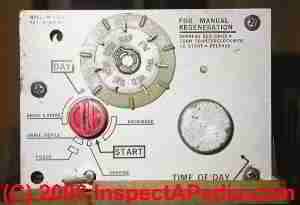 Water Softener Troubleshooting & Diagnostic Procedures
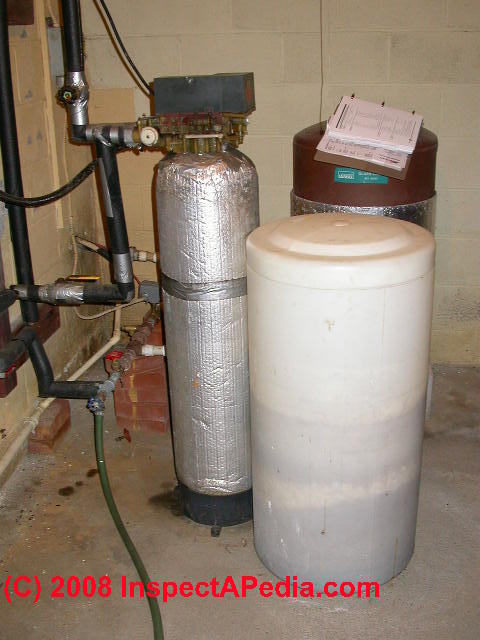
- POST a QUESTION or COMMENT about how to diagnose water softener operating problems: how long the softener runs, how much water is in the brine tank, how much salt, how salty or soft is the household water, more.
Diagnose & Fix Water Softener Problems:
This article series describes procedures for diagnosing and repairing water softener or water conditioner problems including water conditioner control settings and adjustment or repair, brine tank and brine tank float cleaning and repair, and the proper amount of water softening or conditioning that is needed.
This water softener repair article describes what to check first if the softener is not working properly. Also see the FAQs at the end of this article for examples of water softener problems & solutions.
InspectAPedia tolerates no conflicts of interest. We have no relationship with advertisers, products, or services discussed at this website.
Owner's Guide to Diagnosing A Water Softener that Is Not Working Properly
Article Series Contents
[Click to enlarge any image]
- DIAGNOSE WATER SOFTENER PROBLEMS
- CHECKLIST for an INOPERATIVE WATER SOFTENER
- STEPS to GET a WATER SOFTENER WORKING CORRECTLY
- BRINE TANK WATER TOO HIGH
- BRINE TANK WATER TOO LOW
- WATER SOFTENER RUNS TOO LONG - for softeners stuck in "regen" mode
- WHITE MINERAL SCALE DEPOSITS on PLUMBING FIXTURES
- SOFTENER CONTROL OPERATIONS
- WATER SOFTENER OUTPUT COLORS DEBRIS STAINS ODORS
- WATER SOFTENER PLUMBING PROBLEMS
To get a water softener of unknown condition into operation
- Download the Installation and Operation Manual(s) for your water softener or one close to it in design and brand
Try looking through some of the manuals to find the manual for your water conditioner found
at WATER CONDITIONER / SOFTENER MANUALS - instructions for most water softener brands and models, free PDF downloads
will give you help with those.
Follow those instructions, of which we give a general outline below. - Clean and sanitize the softener resin tank and brine tank -
see WATER SOFTENER CLEANING & SANITIZING - Test your home's water for hardness so that you can determine the probable softener settings - note that water hardness may vary by season - test water using a sample obtained ahead of the water softener itself.
see WATER HARDNESS: HOW TO MEASURE - Add salt to the softener's brine tank
- Adjust the Softener's Settings
The functions will include
- setting the timer clock- set the salt dose
- set the time of day for regeneration ("backwash") etc
- set the regen frequency - depends on volume of water use
WATER SOFTENER ADJUSTMENT & CONTROLS - Run a manual regeneration cycle
- Set the softener for automatic operation
- Test the hardness of water produced by the water softener to confirm that it's working
Water Softener Checklist: if the Softener is Not Working Check These First
Water Softener Not Producing Soft Water
if the water softener doesn't seem to be doing anything, check these items:
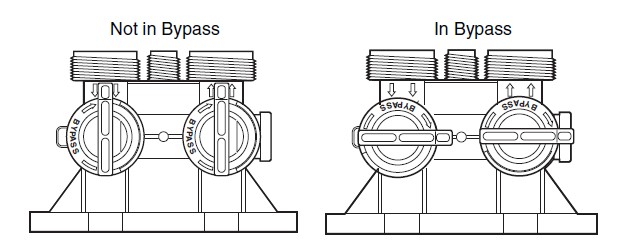
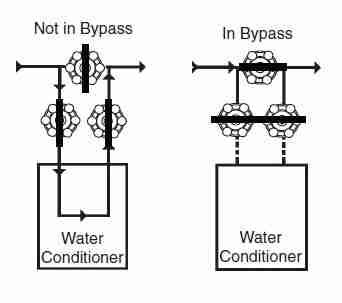
- Check the water softener bypass valve: You want first to see that the water softener is not on "bypass" - is household water flowing through the unit? A sketch of an Autotrol bypass valve is shown at left.
Details about how to use the water softener bypass valve are at WATER SOFTENER CONTROL BYPASS VALVE
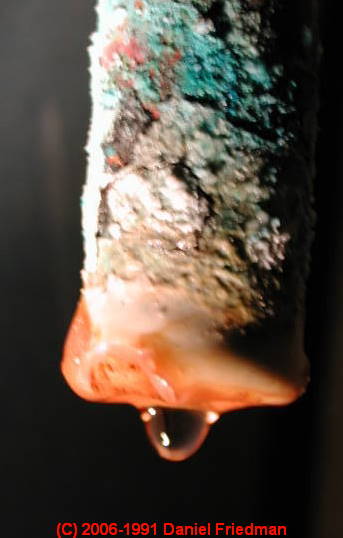
This valve is an option and may not be installed on your unit. But there may be standard plumbing valves or globe valves [photo] that accomplish the same purpose.
- Check power to the water softener: If the unit uses electricity to run a timer be sure it's plugged in to a live outlet and has power.
Some water conditioners use a low-voltage transformer to power the control - be sure that device is present, plugged in, and working. You can use a simple VOM to check that the transformer is outputting DC at the proper voltage level.
See USING DMMs VOMs SAFELY - Check the salt tank: Is there salt in the salt tank?
If the water softener produces soft water but the soft-water runs out before the scheduled or normal regeneration cycle time check the following:
Brine tank debris or salt mushing: accumulated silt or debris or powdered mushy salt in the bottom of the tank (above the salt grid plate) may prevent the preparation of the proper amount of brine needed for regeneration. Resin in the treatment tank may not be adequately re-charged with salt.
See WATER SOFTENER CLEANING & SANITIZING
then see WATER SOFTENER SALT DOSE SETTING
Brine draw cycle defects such leaks in tubing or at a control valve or improper brine tank float adjustment can cause inadequate regeneration cycle salt quantity, water volume, or duration.
See BRINE TANK DIAGNOSIS & REPAIR - Manually run a regeneration cycle: Then try a manual regen cycle - you'll see on most units a lever you can push or on electronic control heads, a push-button on the control box to start the process
- Set the water conditioner controls: Set the right doses and regen cycles for your water hardness and level of water usage
See WATER SOFTENER CONTROL ADJUSTMENT SETTINGS - Watch the water conditioner timer: it is possible that the timer mechanism itself has failed. You should see the timer wheels or clock wheels turning and, if you try setting a regen cycle at every day (just for starters) you should see and hear the system go through a regeneration cycle automatically the very next night.
- Feel and test the water supply: if you still can't get a lather when bathing the water may be insufficiently treated, or if the water feels slimy and you have trouble washing soap off, the water may be over-treated. Test the water for hardness so that you know how to set the controls.
- Potassium chloride in use instead of salt in your water softener? as we explain
at WATER SOFTENER SALT SUBSTIUTE: POTASSIUM CHLORIDE, different water softener settings will be required if you're using KCl.
How to Get a Water Softener Working & Confirm that It Works Correctly
Before replacing a water softener - a step that may not be necessary, here are some things to try:
- Make sure that the water softener is actually "on" and working, that is, that the system has electric power, valves turned on, not left on "bypass"
- Make sure the water softener is clean and that no debris is blocking any water passages or tubing.
SeeSOFTENER CLEANING & SANITIZING
Also see DIRT & DEBRIS in BRINE TANK - Make sure that the salt tank is properly filled.
If the salt tank has stayed "full" for a long time, either no salt is being used (improper operation) or a crust of salt has formed over a virtually empty tank.
Poke around into the salt to be sure the salt tank is really there.
See BRINE TANK BRIDGING or CRUSTING - Run an extra water softener regen cycle - use the water softener control to run the equipment through an extra cleaning/regeneration cycle.
- Watch the water softener control or check it frequently for several days to be sure the control is actually working and that it is cleaning and regenerating the water softener salt dose regularly.
See WATER SOFTENER BACKUP, FLOODING, LEAKS. - Test the incoming water for hardness so that you know what level of treatment is required.
See DETECT HARD WATER and MEASURE WATER HARDNESS - Test the water softener output water for hardness and if you like, also test the output water salt level for excess salt
- Check the water softener control adjustments. If the equipment appears to be working, but water is still too hard (or has too much mineral content) you can increase the salt dose or the backwash/regeneration cycle frequency.
SeeSOFTENER ADJUSTMENT & CONTROLS
and
RECOMMENDED SETTINGS for WATER SOFTENERS - If the water softener is leaving too much salt in the water, reduce the salt dose on your softener's controls.
If your water supply is too salty right after a water softener regen cycle I suspect that the complete cycle did not finish properly.
Start a new softener regeneration cycle and use your softener's controls to skip steps in the cycle up to the "final rinse" step. this should remove excess brine from the resin tank.
You may see this as a thin salty film left at faucets or in a dishwasher. Mineral scale may also be a thin hard white deposit but is a separate problem not a too-much-salt problem.
See HEALTH RISKS & WATER SOFTENERS
and SALT OR WATER INTO SEPTIC - Call for professional help with the water softener. If the equipment is not visibly broken, damaged, leaking, and/or you don't want to mess with it yourself, most water softener companies will be glad to send a service technician to your home to inspect, clean, adjust, and test the equipment.
Try these water softener diagnosis and repair steps before rushing to replace the water softener itself.
Master Table of Water Softener Problems, Causes, Repair Procedures |
||
Water Softener Problem |
Water Softener Problem Cause |
Water Softener Problem Repair |
Air discharge at plumbing fixtures after softener regen cycle |
Clogged, stuck, leaky air check valve |
Check and clean the check valve (if one is used) on the brine tube in the brine tank See WATER SOFTENER CHECK VALVE STUCK in this article: AIR DISCHARGE at FAUCETS, FIXTURES |
| Water Softener Won't Regenerate or Water softener regeneration cycle inadequate |
No electrical power | Check that the softener is plugged-in, that its electrical circuit is powered-on, that a switch, pull chain, breaker or fuse are all "on" and working. |
| Defective timer | If the timer does not operate the softener won't cycle; replace the timer. | |
| Power failure caused timer or clock to be improperly set | Re-set the day of week and time of day on the water softener timer after an electrical power failure or after the softener has been powered "off" for a time. | |
| Water Softener regeneration cycle delayed, stuck, or continuously "on" | Softener is not drawing brine from the brine tank | Comnmon causes: clogged or stuck rine tank float valve assembly, clogged drain line flow control, clogged injector or injector screen, low water pressure, internal leak in the control. |
| Softener control keeps cycling continuously | Often a broken or short circuited switch or control. See the article listed just above., | |
| Water softener drain won't stop flowing | Common causes: improper programming of the control head, timer, or failed control head; clogged or debris in the control head; leak inside the control head. | |
Hard water Water softener is not making the water soft or not making enough soft water |
Softener is in "Bypass" mode | Check the position of the softener bypass switch and close it if the switch is in "open" or "bypass" mode. |
| No salt in the brine tank | Check the brine tank salt level and add salt if needed. Check for a "salt bridge" or crust that has formed, preventing salt in the upper brine tank from falling down into the tank bottom where it can mix with water. WATER SOFTENER CLEANING & SANITIZING Break up the crust, then add salt if needed. The salt level should be above the water level in the brine tank. Normally the water level reaches 6-8" in the brine tank during a regeneration cycle. For diagnosing brine tank problems |
|
| Plugged injector screen | Clean the injector or its filter-screen. |
|
| Insufficient water flow into the brine tank | Insufficient water into the brine tank opr insufficient salt dose or related brine tank problems can cause the water softener regen cycle to be too short or can cause the softener to fail to produce enough soft water. |
|
| Scale in the hot water tank, hot water cylinder or geyser | De-scale and flush the water heater. |
|
| Distributor tube leak | Check for a cracked or leaky distributor tube; check for a bad O-ring or Tube Pilot. | |
| Internal valve leak | Replace the control head valve seals, O-rings, spacers and/or piston. | |
| Control Head program wheel not rotating (mechanical water softner controls) with timer motor | Pull cable out of the control head cover and rotate the trip-wheel manually. Program wheel must move without binding and clutch must give positive “clicks” when program wheel strikes regeneration stop. If it does not, replacethe timer assembly or control head. |
|
| Control head not measuring water flow or hardness (these features are not present on all water conditioners) | For a mechanical water conditioner control head, check output by observing rotation of small gear on front of timer (Note - program wheel must not be against regeneration stop for this check). Each tooth to tooth is approximately 30 gallons (model dependent). If not performing properly, replace the control head. |
|
| Water usage + hardness exceeds water softener capacity | Measure water hardness and daily or weekly water usage quantity; compare these with the water softener capacity specifications; try increasing the salt dose, regen cycle frequency and regen cycle duration. |
|
| Hard Water observed right after a water softener regen cycle | Bypass valve not returned to closed - water not going through the water softener | Close the bypass valve |
| Abnormal water levels in the brine tank: too high OR brine level in the salt tank is too low. | See |
|
| Injector assembly damage | Poor suction at the injector assembly due to leaks, damage, nozzle wear. | |
| Leaky bypass valve O-rings | Slightly-hard water (test it) after a regen cycle may be caused by leaks at the bypass valve, leaking hard supply water through to the building. Before attacking the o-rings, remember to check the salt dose and compare that to the original incoming water hardness to be sure your softener settings are correct. |
|
| Damaged O-ring in the distributor tube | Check for a water softener distributor tube (see your softener parts explosion) that is damaged or that is not securely connected to the control valve. This tube can be loosened by water hammer or by a water heater pressure backing up hot water into a nearby water softener. See also |
|
Hard Water observed before normal next-regen cycle is due The water softener salt dose and regen cycle frequency have been properly set for the amount of water being used in the building and the incoming water hardness but still the water becomes hard before the next regen cycle. |
Inadequate brine flow through the softener during regen cycle because of dirt at brine tank bottom | Clean the brine tank. Check for and clean the air check valve (if present) on the brine tank tube. Check for and clean the rotary valve, drain hose assembly, check valves. |
| Inadequate brine flow through the softener during regen cycle because of control valve malfunction - brine draw too fast or brine tank float or air check valve shuts off before all brine has been drawn out of the brine tank. | Clean the brine tank. WATER SOFTENER CLEANING & SANITIZING BRINE REFILL FLOAT CONTROL VALVE found in the vertical tube in the brine tank |
|
| Insufficient water entering the brine tank because of a brine tank control valve problem. Fouled brine tank control valve flow / refill control (normal = 1/4 to 1/2 gallons a minute) | Clean the brine tank control valve BRINE REFILL FLOAT CONTROL VALVE device is found in the vertical tube in your brine tank |
|
| Excessive / abnormal levels of water usage in the building due to visitors, running toilets, other water supply system leaks. | Use an extra softener regen cycle to account for visitors. Find and fix water supply system leaks such as running toilets. |
|
| Water softener settings incorrect: you may have under-estimated the actual water usage level for your building | Review actual daily water use; if a water meter is installed, check water meter readings against estimated water use. Adjust the water softener settings as needed. |
|
| Water hardness has changed, water softener settings incorrect for new hardness level. | Seasonal changes in the water table supplying a private well (usually lower in dry seasons), changes in the water table because of other wells drilled nearby, or changes in treatment of water by a municipal water supplier can result in increased actual water hardness level. Re-test the incoming water supply for hardness, compare with water softener settigns, and adjust the water softener settings as needed. |
|
| Brine tank salt bridge causing insufficient salt dissolution in the regen cycle | Bridging, the formation of a crust of salt in the brine tank, can prevent the salt from settling to the tank bottom where it is to be dissolved by incoming brine tank water during a softener regen cycle. |
|
| Reverse Osmosis (RO) water treatment system installed | RO water treatment systems increase the volume of water used in a building (to back-wash the RO system periodically) but the low-flow-rate of an RO backwash system is not detected by some water softeners whose controls and regen cycle are based on measuring the actual water usage. Adust the water softener settings to a more-frequent regen cycle frequency. |
|
| Excessive salt usage or Water tastes too salty |
Improper salt dose setting | Check the salt dose setting on the softener control head; Check the regeneration cycle frequency setting at the softener control. |
| Improper water level in the brine tank | Check for a stuck brine tank float, a clogged drain line, a clogged drain line flow control, a plugged injector system, for a timer not cycling, or for a clogged brine tank float valve. For details see BRINE TANK WATER TOO HIGH |
|
| Incomplete brine rinse | Run an extra water softener regeneration cycle, and |
|
| Loss of water pressure downstream from the water softener | Iron, scale, sediment build-up in the water conditioner supply piping | Clean the clogged piping or valve or piping elbow; install appropriate water filters or treatment if needed. See these articles and use your browser "BACK" button to return here. CLOGGED TANKLESS COIL or PIPES, LIME SCALE WATER SOFTENER PLUMBING PROBLEMS TREATMENT SYSTEMS for HOUSEHOLD WATER [PDF] |
| Iron build-up inside the water conditioner | Clean the water softener control head; add mineral cleaner to the water softener mineral bed, and increase the frequency of water softener regeneration. |
|
| Water softener resin loss | Water softener resin leaving the device can show up at faucet strainers & shower heads, clogging those fixtures and reducing the water flow rate or water "pressure". Remove the faucet strainer / shower head. Clean the debris. Flush the piping system. With the water softener in bypass mode, if the debris shows up again the problem is originating elsewhere in the system: water supply piping or the water source. |
|
| Clogged water softener control inlet due to debris in water supply or debris caused by recent plumbing work | Clean the water softener control head, piston, valves Other sources of debris in the water system or reduced water pressure: see |
|
| Minerals or resin discharge from the water softener into water supply | Air in the water system | Check and repair an air volume control, air eliminator, loss of water in the well, leak in well piping and similar causes discussed at AIR DISCHARGE at FAUCETS, FIXTURES Check for deteriorated water softener resin: if the system is years old, if you see fine silt or sand-like or resin particles in faucet strainers and shower heads, the water softener resin may need replacement. |
| Stains, odors, debris traced to water softener | Bacteria, sulphur, sediment, iron, debris can produce stains in water softener output. | See WATER SOFTENER OUTPUT COLORS DEBRIS STAINS ODORS WATER ODOR DIAGNOSIS - SULPHUR |
| Iron in the conditioned water output from the water softner, caused by a fouled mineral or resin bed | Check the water softener back-wash (regen cycle) operation and brine tank operation. Increase the water softener regeneration cycle frequency, lowering the salt dose if necessary. Increase the water water softener regeneration cycle duration time. See the diagnostic articles listed in the column entry just above. |
|
| High water level in the brine tank | Various causes explained in the article at right | |
| Low water level in the brine tank | Various causes explained in the article at right | |
| Brine Tank drain water flow abnormally high | Various causes explained in the article at right | |
| Brine Tank drain water flow weak | Various causes explained in the article at right | BRINE TANK WATER TOO HIGH |
| Leaks at the water softener | Various causes explained in the article at right | |
Notes to the table above
Question: Injector Drain Flow pipe is discharging rusty colored water and resin beads
Fifi & Boomer • 3 months ago
I noticed that my Injector Drain Flow pipe is discharging rusty colored water and resin beads. Is this a problem, and what might it be?
Reply:
Fi
Particularly IF there is no other source of rusty color or particles (such as iron pipes or iron in the water supply) THEN the color and resin beads in the discharge mean that the basket strainer in the water softener is damaged and your resin tank is losing beads - it needs repair.
Check the diagnostic suggestions in your water softener's installation & service manual.
See WATER CONDITIONER / SOFTENER MANUALS
White Scale Deposits on Plumbing Fixtures: hard water indicators
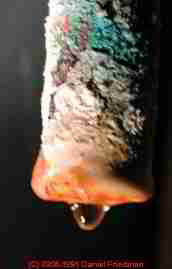 Question: White Deposits on Faucets: why does my water keep leaving water marks on my plumbing fixtures? Should I replace my water softener?
I currently have a water softener system in my home BUT, there are always water marks on my chrome fixtures and on my windows,mirrors,etc.
What can I do to improve this system or should I just replace it with a different one?
I realize that soft water does not mean non-staining water but I was hoping for better results.
Can you help of advise? - C.T.
Reply: Diagnose, clean, adjust, and test your water softener before buying a new one
We speculate that there are several likely explanations for what you describe:
The water softener is not working adequately or not properly adjusted, does not remove enough minerals, and minerals continue to be deposited on your fixtures
The water softener is not adjusted properly and excess salt is being sent through your system, depositing salt on the fixtures.
The water softener unit is dirty, and needs cleaning and perhaps also adjustment
The water softener simply has stopped working - broken, perhaps leaking, clogged, or with a control that no longer functions.
The water softener regeneration system is not working: no salt in the salt tank, or improper regeneration cycle or salt dose setting, or the regeneration control timer may be stuck.
See WATER SOFTENER BACKUP, FLOODING, LEAKS for an example of what can happen.
Watch out: too often a water softener failure or operating problem that could have been corrected by a simple adjustment, cleaning, or repair, is in stead "repaired" by installing new equipment.
Since a new water softener just installed is more likely to be clean and properly adjusted, the old problem may indeed go away, and you may think that replacement was needed, but if simple cleaning and adjustment of the old water softener would have been sufficient, you have faced an unnecessary expense.
Reader Question: corroded drains & faucets - does this mean a water softener problem?
Our drains and faucets are starting to corrode and rust. we have always used a water softener and maintained it. Is this an indication that there is a problem with our softener? - Sharon Osterby 9/16/12
Reply:
Sharon I'm not sure the problem is with your water softener or with the chemistry of your water. If the softener is not working you might see white mineral build-up at faucet strainers and openings; If the water chemistry is aggressive that might be a factor in plumbing corrosion.
Start by testing your softened water to see if it is effectively treated, and if not, clean, adjust, repair the water softener first.
If you suspect a problem with water chemistry (say the softener is working normally and the water at the tap is not hard) then I suggest asking a water treatment company to test your water.
Such vendors often will test your water at no charge (they want to sell you equipment) or if you're doubtful, pick up a sterile bottle from your local water test lab and ask their recommendations for what screening tests to perform.
Reader Comments, Questions & Answers About The Article Above
Below you will find questions and answers previously posted on this page at its page bottom reader comment box.
Reader Q&A - also see RECOMMENDED ARTICLES & FAQs
Question: I got a mouthful of briny water when brushing my teeth
I got a mouthful of briny water brushing my teeth this am. Downstairs kitchen sink water is okay.
What changed? 2 days ago my partner turned Kinetico valve in basement to "service".
We just turned it to bypass, which corrects. Can we leave on bypass until we see you, or should we turn system off?
Thanks for any comments ... . I have pics of valve settings. - E.M. by private email 2021/05/02
Moderator reply: fixing too-salty water softener output
Temporarily you can leave your water softener on bypass, or you can try running an extra regeneration cycle.
See details at
That text is going to say that you want to check your salts dose setting to make sure that that's correct on the water softener and then you check the softener regeneration frequency, the other water softener setting, and you compare those with what you know about how hard your water actually is.
We're trying to make sure that you have the correct settings.
You can skip all of that if running an extra regen cycle alone corrects the problem.
When my water softener output tasted salty I started the regeneration process and then skipped ahead to the final rinse.
It was a final rinse that made sure that excess salt in the softener itself had been removed.
How exactly you skip to the final rinse depends on how the controls work on your particular water softener.
Sometimes it's electronic and you push a button to skip to that step in the cycle or on the older softeners it's electromechanical and you turn the dial of a clock.
Check the manual for your water softener.
but
Watch out: leaving the water softener in bypass mode for months risks expensive mineral scale clogging of your hot water pipes and water heater.
Also see
- HEALTH RISKS & WATER SOFTENERS
- SALT OR WATER INTO SEPTIC
- WATER SOFTENER SALT CHOICES
- WATER SOFTENER SALT DOSE SETTING
On 2020-11-30 - by (mod) -
Cindy:
check for a blocked or crimped tubing between softener control head and the brine tank;
Check for a stuck brine tank float
And if those are intact check that the softener isn't in bypass mode
If it's not the problem may be a defective or damaged control head on the softener.
On 2020-11-30 by Cindy
My softner turns on to regenerate, but it just goes thru cycles and quits. No flowing water at all
On 2020-11-21 by (mod) - air discharge at fixtures and debris in toilet tank
Sounds as if air may have been introduced into the plumbing system during recent work - that would explain air sputtering,
See details at AIR DISCHARGE at FAUCETS, FIXTURES
as well as perhaps sealants or pipe dope or other debris - forming scum in the toilet tank or cister - that ought to simply be flushed out at nearyby fixtures and at the toilet itself.
You can simply flush out the toilet cistern with a few extra toilet flushes, or you can speed the process by holding the flush lever down so that more of the cistern drains at each flush for the next few uses of the toilet.
On 2020-11-21 by Robert
New whirpool tank installed by plumber. White material floating on water in toilet tank, sputters when water engaged

On 2020-11-15 - by (mod) -
Big
Thanks for the helpful question about excess salt or white deposits left from water treatment by your water softener. Most often when I see this complaint the problem is either the salt dose is set to high or the water softener's backwash cycle during regeneration is not working correctly or perhaps not running long enough to flush the excess salt from the resin tank.
Besides checking the softener's adjustments vs the actual measured hardness of your water supply, you might want to try
WATER SOFTENER CLEANING & SANITIZING https://inspectapedia.com/plumbing/Water_Softener_Cleaning.php
On 2020-11-15 by BigRon121
Why does my water softener leave salt stains in my sink and dishes
On 2020-11-07 - by (mod) -
James
That does sound terrible;
There are several things to check - starting with
- a close look at exactly where the spray was emanating - from a leak or a poorly-mounted drain connection between the softener drain tubing and the standpipe to which it's emptying?
- a check of water pressure - has that changed?
- a defect in the control head: was this the very first backwash cycle ever? If so the installers let you down in my OPINION by not running a test cycle at time of installation;
In any event if it's not something trivial like a poor connection of softener drain tube to building drain I'd expect the masked-installers to return to fix the trouble.
Do let me know what you see or what the installers say.
It'd be helpful to know country and city of installation and brand and model of water softener.
On 2020-11-07 by James
We just had a brand new water softener and whole house filter system installed. It’s been working well all week. Today, when the backwash cycle started, water began spraying violently out of the drain line and all over the laundry room. What would cause so much pressure while it’s draining? Our old softener did not do that, and we also had a pressure reducing valve installed on the main line to make sure the pressure was appropriate for the system. Any advice is welcome as our plumber cannot come back out for a week.
On 2020-09-23 by (mod) - WaterBoss 900 and new 50 gal. gas hot water heater: dirty water
Wally
Before starting over I'd want to know about the incoming water; do a hardness test, get that data, and we can be sure that the softener has the capacity that's needed.
On 2020-09-23 by Wally
Just installed new WaterBoss 900 and new 50 gal. gas hot water heater. Took 4 days for well water to begin to clear. Still is not soft. Have reset the softener, increased the level to 90 (max. for the softener), re-cycled numerous times, run hot water to try to clear the assumed unsoftened water that went into the hot water heater at installation. Next step is to drain the system and start again. Suggestions?
On 2020-07-28 by ldaskalyuk@yahoo.com
I My water is not running in the house and it seems like the problems is at the softener. I have water outside but not in the house.
On 2020-06-14 1 - by (mod) -
Nabeel
A Fleck 5600 SXT "On Demand" water softener costs about $550. U.S. (shown below); you'll need to buy salt for the softener, available at typical U.S. retailer for under $5.00 per 40 pound bag.
Just how much salt you need - how often you need to add salt to the softener - depends on the hardness of your water and the volume of water you use. Figure you'll need 3-4 bags for the initial softener fill-up.
You'll also need to hire a plumber to install the softener. That cost depends on where you live - varying widely from about $40. to over $200 per hour (again U.S. dollars), but typically will be 2 hours or more of installation.
 ...
... 
On 2020-06-14 - by (mod) -
Nabeel Rana said:
Great, But i would happy to know your suggestion. Please
Looks written with proper research. I read all of it. I got your main point but I would like to know more about these types.
I have a budget of 500 and my source of water is underground, my family and I have health issues, my physician recommends to use a good water softener? What would you suggest? Salt softeners are fine? But what about cost and maintenance?
I am not noob i read few blogs .... The article was informative but you content explains proper in detailed. Awesome I must say.
On 2020-05-14 - by (mod) -
Post a photo of the control and I can comment further.
On 2020-04-20 by Peggy King
I can't advance the sale level
On 2020-04-09 - by (mod) -
Martyn
Regarding your " Crown double tan block salt softener" - that is not providing soft water, please find your question and what is now a detailed answer offering several suggestions,
specifically under
- H - for Harvey Water Softeners & Manuals - UK at https://inspectapedia.com/plumbing/Water_Softener_Manuals.php#H
or found in
WATER SOFTENER MANUALS https://inspectapedia.com/plumbing/Water_Softener_Manuals.php
and don't hesitate to post follow-up questions or comments
On 2020-04-09 - by (mod) -
Jim
Responding to: Kinetico softener brine tank was 3/4 full of salt. We were gone for one week, so no water was being used. When we returned, no salt in brine tank and softener started to regenerate without anyone using any water. What could be the problem?
...
That sounds to me like a control head failure leaving the water softener stuck in "regen" mode or repeatedly cycling through regen.
The risk is more than wasting salt; if you are connected to a private septic system the risk is inadvertent flooding of the septic drainfield.
Give me the model of your Kinetco softener so we can see what the manufacturer suggests short of starting wholesale parts replacement or "shotgunning" the repair by spraying your money all over the place.
I might try a power-off reset followed by a manual regen cycle - before adding any salt - combined with watching the system to see what it does.
On 2020-04-09 by Jim
Kinetico softener brine tank was 3/4 full of salt. We were gone for one week, so no water was being used. When we returned, no salt in brine tank and softener started to regenerate without anyone using any water. What could be the problem?
On 2020-04-09 by Martyn Kebbell
I have a Crown double tan block salt softener . ID N,. NEWS/1. Serial number 21776. service meter 750. We recently renovated the kitchen and to do so had to disconnect it and then when finished the renovation reconnect it . All buy a professional plumber. Since then we have been unable to get soft water . The plumbing work looks good and the by-pass is closed. The virus has meant the plumber cannot come back immediately. What might the fault be and how can I fix it?
Thanks
Martyn
Reader Question: Water Softener Not Softening the Water: water test shows 1120 ppm of hardness and other data - how should I remove the hardness?
In my home the water test report showing the following details :
PARTICULARS OUR WATER RECOMMEND LEVEL
PH 7.7 7.5 - 8.5
TDS 1266 PPM
HARDENSS 1120 PPM
ALKANITY 450 PPM
CHLORIDES 764 PPM
Note: Not advisable for cooking & Bathing purpose use for floor cleaning & flushing.
Can I know what is the best way to remove the hardness of water. - Shobia 6/20/12
Reply: water softener capacity must be able to handle level of water hardness
Shobia it does sound as if you'd need water treatment to make that water usable in the home;
if you call two local water treatment companies they will be glad to propose systems to meet your needs, and typically don't charge for that advice. Using hardness as an example, it's quite simple to check the level of hardness you need to deal with against the capacity of the water softener system proposed.
I can't say more as I don't understand your data - hardness is usually expressed in milligrams per liter or grains per gallon, not parts per million.
Reader Comment from Cullman 8/26/12:
You need larger size water softener to remove this high hardness. Also TDS (total dissolved solids) level is very high , so for drinking water I suggest using Reverse osmosis system at the kitchen sink. Ph level is good.
Reply:
Thanks Cullman for the helpful suggestions to Shobia - Ed.
Reader Question: Water softener keeps regenerating & water remains hard
About once a year my softener will have salt in the tank and will run regenerating. But nothing happens and the water remains hard running throughout he house.
Maybe something is clogged? What should I look to do. Thanks so much. - Rob P. 7/24/12
Reply:
Rob, check for a stuck float switch in the brine tank;
See WATER SOFTENER RUNS TOO LONG
and see BRINE TANK FLOAT LEVEL ADJUSTMENT in our water softener diagnosis & maintenance articles.
Reader Question: Can I replace the resin media inside of a water softener?
8/31/14 Ron Fix It Man said:
My softener is 13 years old and I have read the resin becomes ineffective in about that life time. Iron out has been used with little benefit. Effectiveness of the softener has declined unless greater amounts of salt per cycle are used. Troubleshooting reveals no improper cycle operation.
Is it true the resin has a limited life? Can it be restored, say with a wash of dilute muratic acid? If not, where can it be purchased?
Reply: procedure to replace water softener treatment tank resin media
Ron
Indeed it is possible to replace the resin in a water softener.
Water softener resin can last for 20 years or even longer, but may have a shorter life depending on the chemistry of the water being processed in the water softener.
But I would not start down the "replace water softener resin" path before diagnosing the problem with my water softener to be sure I'm making the proper and necessary repair.
If you've done that and are ready to replace the resin in the softner tank, details of just how to replace the resin in the water softner, where to buy resin, and other advice are
at WATER SOFTENER RESIN REPLACEMENT
...
Continue reading at BRINE TANK WATER TOO HIGH or select a topic from the closely-related articles below, or see the complete ARTICLE INDEX.
Or see WATER SOFTENER DIAGNOSTIC FAQs - set 1 of questions & answers on fixing water softener problems
Or see these
Recommended Articles
- WATER SOFTENERS & CONDITIONERS - home
- DIAGNOSE WATER SOFTENER PROBLEMS
- IDENTIFY WATER SOFTENER BRAND / MODEL
- INSTALLATION of WATER SOFTENERS
- WATER SOFTENER ADJUSTMENT & CONTROLS
- WATER SOFTENER BRINE TANK DIAGNOSIS & REPAIR
- WATER SOFTENER BYPASS VALVE
- WATER SOFTENER CLEANING & SANITIZING
- WATER SOFTENER CONTROLS & OPERATION
- WATER SOFTENER EDUCTOR REPAIR
- WATER SOFTENER MANUALS
- WATER SOFTENER PLUMBING PROBLEMS
Suggested citation for this web page
DIAGNOSE WATER SOFTENER PROBLEMS at InspectApedia.com - online encyclopedia of building & environmental inspection, testing, diagnosis, repair, & problem prevention advice.
Or see this
INDEX to RELATED ARTICLES: ARTICLE INDEX to WATER TREATMENT SYSTEMS
Or use the SEARCH BOX found below to Ask a Question or Search InspectApedia
Ask a Question or Search InspectApedia
Try the search box just below, or if you prefer, post a question or comment in the Comments box below and we will respond promptly.
Search the InspectApedia website
Note: appearance of your Comment below may be delayed: if your comment contains an image, photograph, web link, or text that looks to the software as if it might be a web link, your posting will appear after it has been approved by a moderator. Apologies for the delay.
Only one image can be added per comment but you can post as many comments, and therefore images, as you like.
You will not receive a notification when a response to your question has been posted.
Please bookmark this page to make it easy for you to check back for our response.
Our Comment Box is provided by Countable Web Productions countable.ca
Citations & References
In addition to any citations in the article above, a full list is available on request.
- [1] North Dakota Standards for Water Softeners, North Dakota General Authority Law, Chapter 62-04-08, Water Softener Units http://www.legis.nd.gov/information/acdata/pdf/62-04-08.pdf. "The objective of this chapter is to provide a standard of quality, capacity, and performance for water softener units. Water softener performance is to be based upon referee tests procedures described in section 62-04-08-09."
- [2] Culligan Mark 10 Water Softener 1994-1998 Installation and Operating Instructions (covering models manufactured after 1995) (1-96) 01881948.pdf available from www.culligan.com
- Our recommended books about building & mechanical systems design, inspection, problem diagnosis, and repair, and about indoor environment and IAQ testing, diagnosis, and cleanup are at the InspectAPedia Bookstore. Also see our Book Reviews - InspectAPedia.
- In addition to citations & references found in this article, see the research citations given at the end of the related articles found at our suggested
CONTINUE READING or RECOMMENDED ARTICLES.
- Carson, Dunlop & Associates Ltd., 120 Carlton Street Suite 407, Toronto ON M5A 4K2. Tel: (416) 964-9415 1-800-268-7070 Email: info@carsondunlop.com. Alan Carson is a past president of ASHI, the American Society of Home Inspectors.
Thanks to Alan Carson and Bob Dunlop, for permission for InspectAPedia to use text excerpts from The HOME REFERENCE BOOK - the Encyclopedia of Homes and to use illustrations from The ILLUSTRATED HOME .
Carson Dunlop Associates provides extensive home inspection education and report writing material. In gratitude we provide links to tsome Carson Dunlop Associates products and services.
 | HOME | ABOUT | ASK a QUESTION | CONTACT | CONTENT USE POLICY | DESCRIPTION | POLICIES | PRIVACY | |
| © 2024 - 1985 Publisher InspectApedia.com - Daniel Friedman | |||||||||