
InspectAPedia® FREE Encyclopedia of Building & Environmental Construction, Diagnosis, Maintenance & Repair |
Question? Just ask us! InspectAPedia
|
 Water Softener Installation Procedures
How to hook up plumbing, wiring, drains for a water conditioner
- POST a QUESTION or COMMENT about how water softeners are installed: location, plumbing, wiring connections, drain connections & where to obtain installation & operation manuals
How to install or "hook up" a water softener:
How to connect a water softener to building water piping, drain piping, & electrical power; where to locate the water softener. This article explains how to hook up a water softener or water conditioner.
We describe the piping connections for water in and out of the water softener, water softener bypass valves for maintenance, and water softener drain hookups.
This article series explains how water softeners and similar water conditioners work, types of water softeners, and the basics of what water softener controls are present and what they do, how water softeners should be installed, maintained, cleaned, and adjusted.
InspectAPedia tolerates no conflicts of interest. We have no relationship with advertisers, products, or services discussed at this website.
How Water Softeners or Water Conditioners are Hooked Up to Building Plumbing
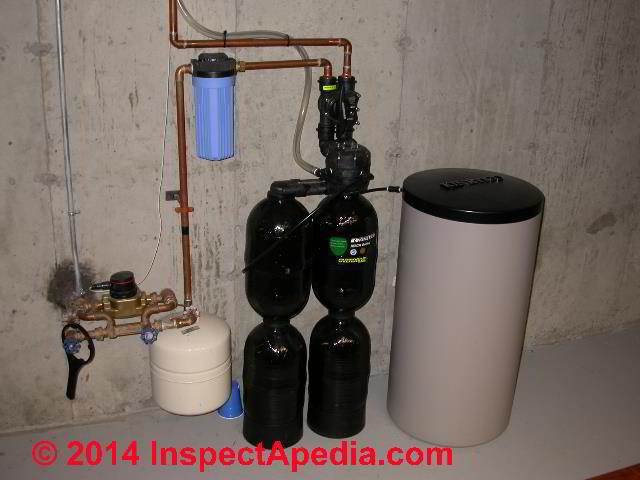 It is conceptually simple to install and connect-up a water conditioner or water softener.
You need to find physical space where the resin or treatment tank and controls will fit, and where the salt or brine tank will fit. Usually these two pieces are separate (except in some older manually operated water softeners), but they are installed side-by-side.
Our photo of a water conditioner installation at left shows a Kinetico Mach Series water conditioner system installed in a Dutchess County New York home.
Where space is really tight, we sometimes see the larger brine tank installed somewhere else not right next to the water softener, but of course connected to it by its flexible plastic tubing.
Article Contents
- INSTALLATION of WATER SOFTENERS
- How to Connect Water Softener Water Piping Input & Output Water Lines
- How & Where to Connect the Water Softener Drain Line
- Other water conditioner manufacturers (Autotrol) drain line connection details
- Avoid These Water Conditioner Drain Connection Mistakes
- Connecting Water Softener Electrical Power
- Steps in Starting Up A New or Newly-Installed Water Softener
- Free Water Softener & Water Conditioner Installation Manuals & owners' guides
Guide to Connecting A Water Softener Water Piping or Input and Output Water Lines
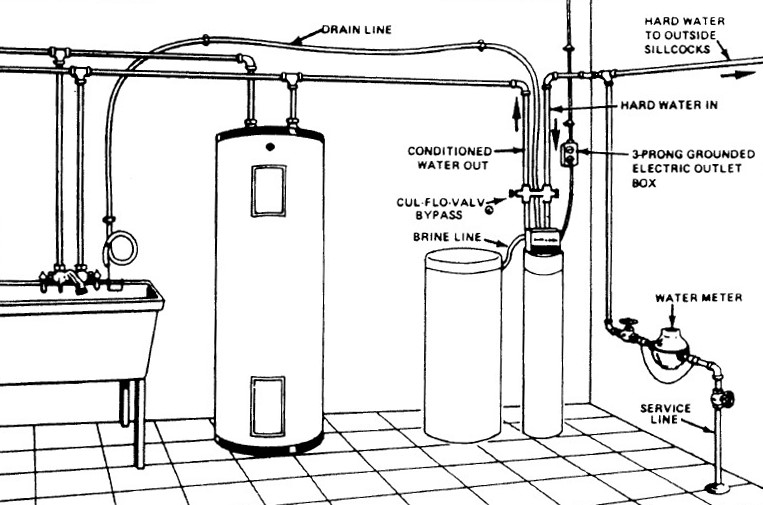 Since it's usually preferable to treat all of the building water supply with a water conditioner (this helps protect pipes from mineral-clogging by hard water), the water conditioner is usually placed as close as possible to where water enters the building.
Most installers place the water softener near other water equipment in the building such as close to an indoor pump and water pressure tank, or where municipal water is supplied, close to where the water supply enters the building.
[Click to enlarge any image or table]
The water softener hookup layout sketch shown at left is from a 1989 Culligan System 19 or 23 Water Conditioner installation manual. Be sure to consult the specific manual for your own water softener brand and model for correct hookup details for your own equipment.
The water softener is piped "in line" on the main cold water pipe entering the structure so that incoming water is treated before passing on to the building water heater, and to hot and cold water distribution piping.
If other water treatment or water sterilizing or potability system is installed (such as a chlorinator or UV light), that equipment is best placed ahead of or before the water softener to help avoid the chances of unwanted bacterial growth in the water conditioner.
If a water filter is installed, we like that to also be ahead of all other water treatment in the building to help avoid debris clogging that interferes with proper operation of other water treatment equipment. For example, dirt or silt in a water supply can quickly coat the bulb in a UV light bacterial treatment device on a private water supply system.
Incoming water is connected to the "input" side of the water softener/water conditioner, and the conditioner's output side is connected to the building water supply piping feeding the building's plumbing fixtures.
For watering gardens and lawns the installer may provide a direct connection to that building water piping taken off before the water softener so that we don't waste water softener salt treating water being used to wash a car or water the lawn.
How & Where to Connect the Water Softener Drain Line
 Periodically, depending on the water hardness and the amount of water used, the water softener or water conditioner needs to clean itself of minerals accumulated as they were removed from the water supply, and to recharge the salt used in the softener's resin chamber where water is treated.
[Click to enlarge any image or table]
On an automatic water softener the regeneration and cleaning cycle for the water softener is controlled by a simple timer or clock, or on more sophisticated systems a computer chip may monitor the amount of water used and even the hardness of water leaving the system, deciding based on that data when a backwash-regeneration cycle is needed.
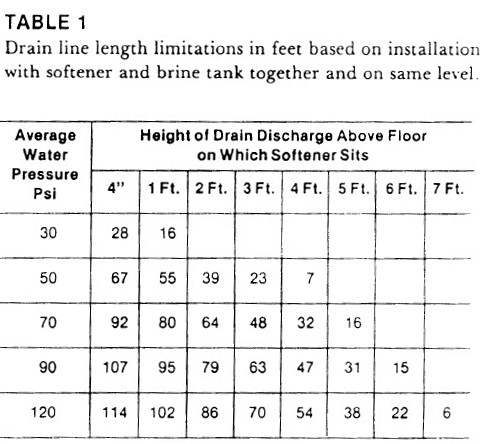
Shown at left is a chart indicating the water softener drain line length limitations in feet based on an installation in which the brine tank and water softener are installed together on the same building level.
This specific chart is from a Culligan System 19/23 Water Conditioner installation manual. Be sure to check your own equipment's installation manual.
When the water softener goes through a regeneration cycle it will bypass the building water supply, often automatically, so that water stops passing through the equipment's treatment system pump water into the separate brine tank (salt tank) where it dissolves salt pump new salty water backwards through the resin tank or treatment tank where the process removes other minerals from the treatment tank, sending this product out through a (usually plastic) drain tube to a building drain.
Other water conditioner manufacturers such as Autotrol specify other drain line connection details
- The ideal water conditioner location is above (higher than) and not more than 20 feet from the drain. Use 1/2-inch plastic tubing between the water conditioner drain hookup on the equipment and the drain.
The ideal location for a water conditioner (or softener) is also in an area protected from freezing, protected from mechanical damage (don't run into it when pulling a car into the garage), and at a location convenient for connection to building water supply piping and electrical hookups.
Usually we locate the water conditioner as close as possible to the point of water entry into the building so that we protect as much of the building plumbing system as possible from mineral clogging. - Increase the water softener drain line diameter from 1/2-inch to 3/4-inch diameter for runs of more than 20 feet in length and less than 40 feet.
- For elevated water conditioner drain lines, provided that incoming water pressure is at least 40 psi, you can elevate the drain up to six feet as long as the total drain line length is less than fifteen feet.
You can elevate the water conditioner drain line another two feet for every 10 psi increase in water pressure. For example if your water pressure is always 50 psi or higher, the drain line for the water softener can be eight feet above the unit.
Watch Out: Use a Siphon Trap: for elevated water conditioner drain lines emptying into a drain below the level of the control valve (that's where the drain line connects to the water softener), make a 7-inch loop in the plastic drain line such that the bottom of the drain line loop is level with the drain line connection point (at the water softener).
The loop should provide an adequate anti-siphon trap. Without this detail, after a water softener regen cycle when the drain line is filled, the drain can continue to siphon-drain water out of the water softener.
Warnings: Avoid These Water Conditioner Drain Connection Mistakes
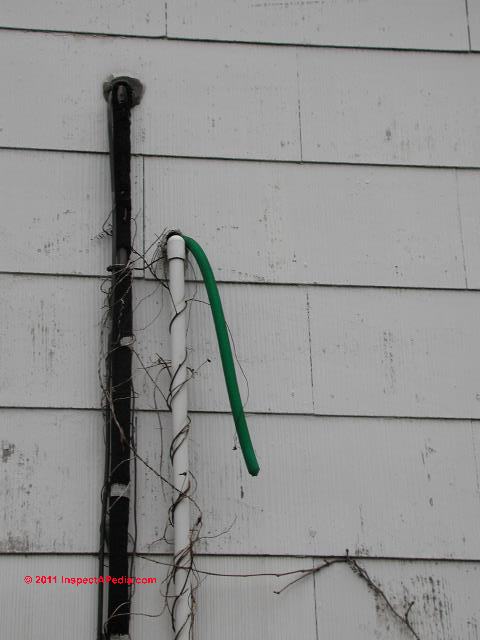
- Connect your water conditioner drain line to a building drain or to a separate graywater drain feeding drywell, but do not simply spill water conditioner drainage onto the ground surface such as is shown in our photo shown above - a water softener drain hose simply spurts out through the building exterior wall and onto the ground surface.
Doing so violates plumbing and sanitary code in most jurisdictions (and invites basement or crawl space leakage too).
- Watch out: be sure that the water softener drain connection is made following the manufacturer's instructions [usually including an air-gap rather than an air-tight/water-tight connection at the drain standpipe] so that you avoid a possibly
unsanitary CROSS CONNECTIONS, PLUMBING.
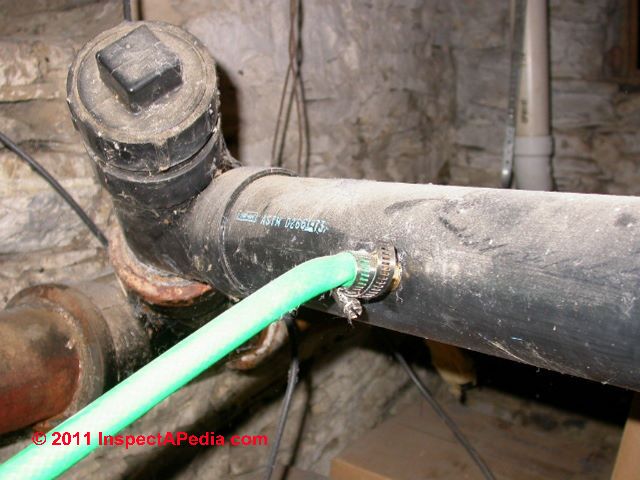
Our photo of a cross connection (left) shows a water conditioner drain line (using a garden hose) connected to a sewer pipe - inviting sewage and bacteria to enter the building's water supply. - Also, where the softener is emptying its drain product into an onsite private septic system and drainfield, the salts in the wastewater may shorten the drainfield life, so take a look
at REDUCE IMPACT of SOFTENER on SEPTIC. - Watch out also for crimped water softener drain line tubing. If you are using soft flexible tubing to connect your water conditioner to a drain line it's easy to crimp the line at a sharp bend or where it is stapled to a building support.
A crimped water conditioner drain will interfere with proper backwash/regeneration cycling of your equipment.
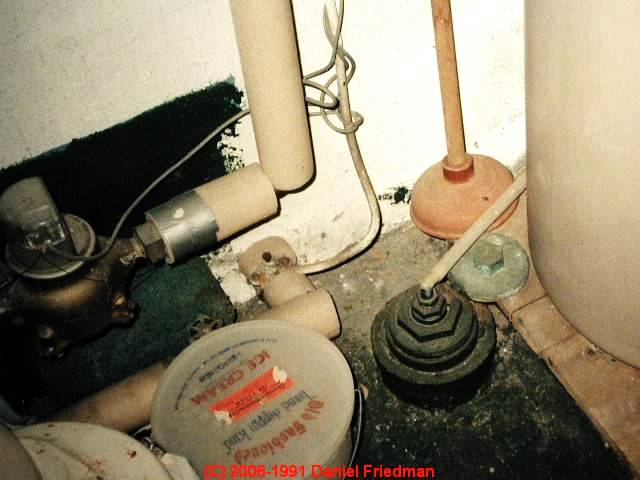
Watch out: Use an air gap: for elevated water conditioner drain lines that empty into an overhead sewer pipe or waste pipe you should use a sink-type trap for the connection (that is provide an air gap to avoid back-contamination of the equipment).
Watch out: Never connect the water softener drain line directly to a sewer drain (that is by an air-tight connection such as shown at left).
Doing so invites sewage and bacterial back-contamination into the building water supply system, especially if a sewer line backup occurs.
See CROSS CONNECTIONS, PLUMBING.
Connecting Water Softener Electrical Power
The water softener also needs to be plugged-in to an electrical outlet to power the equipment control.
See Steps in Starting Up A New or Newly-Installed Water Softener for details.
Setting up the Water Softener & Setting Its Controls
You'll need to set the water conditioner's clock to the proper time (and day on some models) and you may need to set the water softener controls that determine the frequency of regeneration and the salt dose.
See WATER SOFTENER ADJUSTMENT & CONTROLS.
Steps in Starting Up A New or Newly-Installed Water Softener
The following advice is adapted from water softener installation manuals from Culligan and other water conditioner manufacturers.
For new water conditioners: The water conditioner start-up procedure here is appropriate when you are installing a new water conditioner system or a new water conditioner media tank.
Watch out: as Culligan's manuals point out about new water conditioners,
A sanitizing agent has been added to the conditioner tank [the media tank or resin tank] at the factory. This sanitizing agent must be flushed out before the unit is placed into service, by initiating a recharge cycle using the steps outlined below.
- Plug in the power cord: Check that the water conditioner timer or control is in the "service" position, then plug in the water conditioner's power cord to an electrical outlet.
You should use a grounded outlet that will accept a grounded electrical cord plug (a three-prong plug). If necessary you can use a three-prong to two-prong adapter to connect to a two-prong electrical receptacle, but be sure that that receptacle is itself grounded. In general, a three-prong to two-prong electrical outlet adapter includes a green metal tab with a hole in it that is used to make a proper connection to the electrical grounding system.
The screw in the center of the cover plate for the electrical receptacle is removed and reinserted through the green tab so that the adapter is secured in place and a ground connection is made. We recommend that you ask your electrician to install a grounded, three-prong electrical receptacle in that location as soon as convenient. - Set the water conditioner controls: set the timer to the correct time of day, time of recharge, recharge frequency, and set the "salt dose" or refill regulator to the proper number.
See WATER SOFTENER ADJUSTMENT & CONTROLS for details. - Open the bypass valve: with the controls set for normal service, slowly open the water inlet valve or slowly open the bypass valve if it was in the closed or "bypass" position. On a Culligan water softener this means push slowly on the blue knob on the bypass valve to put the unit into service.
- Allow water to fill the resin tank.
- Perform a water softener regeneration cycle. On a typical Culligan model this may mean rotating the cam that carries the "salt dosage" dial 1/3 turn, or pushing a red "regen" button on the water conditioner timer.
Note: more detailed instructions in your water conditioner installation or user's manual may explain the need to move the salt dosage cam to start a regen cycle or to return the cam to a normal between-cycle position. - Drain and refill the hot water tank? If hard, untreated water entered the building's hot water tank while the water softener was on bypass or turned off, then you should drain and refill the hot water tank.
Watch out: Be sure that the water heater is turned off before and during drainage and refill.
List of Free Water Softener & Water Conditioner Installation Manuals
Watch out: because water softener and other water conditioner equipment models vary in features and functions, they also vary in their exact installation requirements. You should have or obtain the installation, operation, and maintenance manual for your own brand and model of water softener.
Most water softener owners manuals include detailed installation instructions and also a table of recommended settings. If you don't have an owner's manual call the manufacturer's tech service and give them the model number and ask for a manual as well as their setting advice.
- WATER SOFTENER ADJUSTMENT & CONTROLS details about water softener setting and salt dose adjustments
- Aquasoft Pro Plus water softener manual with the 460i Controllers such as PES32M268-MP - web search 09/11/2010, original source: http://www.gewater.com/pdf/resdntl/manuals/1017948.pdf describing a General Electric GE-produced control.
- Autotrol Water Conditioning Control System, Installation, Operation, and Maintenance Manual. On this Autotrol water conditioner you can specify the time of regeneration (factory is set to 2:00 AM) to be sure it's running at a time when you are not using water in the building.
- "Commercial Water Softener Installation and Operating Instructions", IBC Filtration & Water Treatment Products (Australia) for commercial, industrial and residential application www.ibcwater.com.au (07) 3219 2233
- Culligan Estate 2 and 2M Water Conditioners [Manual] Use and Care Guide, web search 01/31/2011, original source, see Culligan Manuals for Obsolete Products below.
- Culligan System 19 and 23 Water Conditioners (Filament Wound Tank) Installation and Operating Instructions, as an example of installation details for a 1989 era water softener.
- Culligan Mark 10 Automatic Water Conditioner (Water Softener Models from 1995) Installation and Operating Instructions (covering models manufactured after 1995) (1-96) 01881948.pdf available from www.culligan.com
- Culligan Mark 59 and 512 Automatic Water Conditioners Manual, 1979, web search 01/31/2011, original source see Culligan Manuals for Obsolete Products below.
- Culligan Mark 89 and 812 Automatic Water Conditioners Use and Care Guide, web search 01/31/2011, original source: http://www.eculligan.com/support/mk89_owners_guide.PDF
- Culligan Mark 100 Water Softener Owner's Guide, 1994-1998
- Culligan Manuals for Obsolete Products: see http://www.culligan.com/en/service-and-maintenance/customer-support/owners-guide/obsolete-manuals/
- "Non electric water softener, Installation and Operating Instructions", IBC Filtration & Water Treatment Products (Australia), op.cit.
- "Water Softener Twin Tank Installation and Operating Instructions", IBC Filtration & Water Treatment Products (Australia), op.cit.
- Water Softener with Microprocessor: Installation & Operating Instructions, IBC Filtration & Water Treatment Products (Australia), op.cit., web search 01/31/2011, original source: http://www.ibcwater.com.au/zone_files/PDF/as0922mp-cl.pdf
- Contact information for water softener or water conditioner manufacturers is at Technical Reviewers & References
- CONTACT us to suggest additional water conditioner manuals & installation guides
Reader Comments, Questions & Answers About The Article Above
Below you will find questions and answers previously posted on this page at its page bottom reader comment box.
Reader Q&A - also see RECOMMENDED ARTICLES & FAQs
On 2020-10-05 - by (mod) - where to find manuals for Kinetico water softeners - & fix the power cord
 Dawn:
Dawn:
Right, that Kinetico water softener uses electrical power; if you ripped the power cord out or off of the control head, a new cord will need to be attached; Some dis-assembly of the control head may be required, and at that time the repairperson will check to assure that the control board to which the power cord connects was not itself damaged.
Watch out: if you are not familiar with proper and safe electrical work then you need to hire a repair tech to do the job safely as you could be shocked or killed.
You can also give Kinetio customer support a call at 1-866-351-8722
Or see the Kinetico contact information and manuals including for your water softener, found
at KINETICO WATER SOFTENER MANUALS
On 2020-10-04 by Dawn
That's what it looks like
[photo above]It was attached but came unplugged when I was moving something and it caught it
Kinetico Water Systems
It does use power it's all digital
On 2020-10-04 by (mod) - lost electrical power cord to Kinetico water softener
Dawn:
A water softener that uses electricity normally comes with a power cord and wall plug attached.
There are some water softeners that don't use electricity and that are operated entirely by water pressure.
What are the brand and model of your water softener?
On 2020-10-04 by Dawn
I cant find where my unit plugs in at the cord didnt come attached and I have no clue it came unplugged while moving something
On 2020-04-11 by (mod)
You can post photos here using the "add image" button, Bob.
1 image per comment, as many comments as you need.
On 2020-04-11 by Anonymous
Please send me address to send photos. Thanks
Bob
docpoppi@aol.com
520-419-6735
On 2020-04-11 - by (mod) -
I see your photos;
do we know where the no-longer-used drain line goes?
On 2020-04-11 16:45:23.915456 by Bob
Drain line above unit in original installation. Now drain line rerouted thru wall, and at least 2-3 feet down exit pipe behind wall. System seems to be working fine. I was just curious about position of drain line. I took photos. Where do I send ?

On 2020-04-11 - by (mod) -
I'm not sure, Bob - a photo or drawing would help. If we're discussing a water softener drain connection that has been abandoned you may simply want to cap it.
Also I'm not sure which "tanks" you're referring-to.
WIthout more details about your installation I can but guess that perhaps the original high routing for a condensate drain line was both convenient to install and worked acceptably because condensate was being moved with a condensate pump.
A Kinetico system is a water treatment or water softener - a system that, during regeneration cycles will produce way too much water to be handled by a simple condensate drain tube, and furthermore ought just be dumped on to the ground surface as might be done with a low volume A/C condensate disposal system.
On 2020-04-11 by Bob
I had an issue with a pipe in the wall, a hole that was the result of faulty installation of my a/c unit. The drain line for my KINETICO system drained into this pipe. Because of this I rerouted the drain line, to go further down the damaged pipe.
My question : is there a reason the original placement (exit) of the drain line, was in the wall ABOVE the tanks ? I rerouted it so that it now goes into the wall BELOW the unit, and then out into the pipe . Thanks 520-419-6735. docpoppi@aol.com
On 2020-01-24 - by (mod) -
Nancy,
It's possible that the softener is not properly adjusted.
Try first running the softener through an extra regen-cycle.
Next, most softeners have a procedure that lets you start that regen cycle again but skip ahead to the final rinse cycle.
Run that rinse cycle and report back to me if that's solved the salt taste issue.
On 2020-01-24 by Nancy Golden
I just had a water softner professionally installed. Since then the tap water has a chemical/salt taste
On 2016-10-08 by (mod)
Mike:
See WATER CONDITIONER / SOFTENER MANUALS where we have some contact info for PureTel
There are many websites promising to deliver the Pure-Tel manual but not one that would deliver. I'm still looking.
On 2016-10-08 by Mike
I am trying to find a manual for a Pure-Tel 2001 water softener
On 2016-04-27 by Michele
Hello- the link for "cross connections, plumbing" is not working…
Question: Where to obtain WTF 480 or WTF 15ANX water softener manuals
Do you have any manuals on WTF 480 or WTF 15ANX water softeners? - Laura Tapp 6/12/11
Reply:
Laura, the WTF series are produced and distributed by Water Tender, 6201 South Hanover Rd., Elkridge MD 21075-5651, Tel: 410-796-7700; also Water Tender, 23204 Airpark Dr., Petersburg VA 23803, Tel: 804-732-7000. You can contact them for installation and service manuals.
Also if you scroll down to the references at the bottom of this article, at "Water Tender" you'll see a link to free online information describing various Water Tender equipment models.
Question: Autotrol 255 valve/ 400 series control water conditioner - water keeps flowing out of the hose
I have a Autotrol 255 valve/ 400 series control water conditioner, water flows out of hose non stop. We have tried regeneration several time but this doesn't shut off water. - Deloras 2/8/12
Reply:
Deloras, your water conditioner sounds like it's stuck in regen mode. See the diagnostics at WATER SOFTENER BACKUP, FLOODING, LEAKS for help in repairing this problem.
...
Continue reading at WATER SOFTENER ADJUSTMENT & CONTROLS or select a topic from the closely-related articles below, or see the complete ARTICLE INDEX.
Or see these
Recommended Articles
WATER SOFTENERS & CONDITIONERS - home
WATER SOFTENER PLUMBING PROBLEMS
Suggested citation for this web page
INSTALLATION of WATER SOFTENERS at InspectApedia.com - online encyclopedia of building & environmental inspection, testing, diagnosis, repair, & problem prevention advice.
Or see this
INDEX to RELATED ARTICLES: ARTICLE INDEX to WATER TREATMENT SYSTEMS
Or use the SEARCH BOX found below to Ask a Question or Search InspectApedia
Ask a Question or Search InspectApedia
Questions & answers or comments about problems with the operation of aerobic septic systems
Try the search box just below, or if you prefer, post a question or comment in the Comments box below and we will respond promptly.
Search the InspectApedia website
Note: appearance of your Comment below may be delayed: if your comment contains an image, photograph, web link, or text that looks to the software as if it might be a web link, your posting will appear after it has been approved by a moderator. Apologies for the delay.
Only one image can be added per comment but you can post as many comments, and therefore images, as you like.
You will not receive a notification when a response to your question has been posted.
Please bookmark this page to make it easy for you to check back for our response.
Our Comment Box is provided by Countable Web Productions countable.ca
Citations & References
In addition to any citations in the article above, a full list is available on request.
- [8] "Non electric water softener, Installation and Operating Instructions", IBC Filtration & Water Treatment Products (Australia), op.cit.
- [9] North Dakota Standards for Water Softeners, North Dakota General Authority Law, Chapter 62-04-08, Water Softener Units http://www.legis.nd.gov/information/acdata/pdf/62-04-08.pdf. "The objective of this chapter is to provide a standard of quality, capacity, and performance for water softener units. Water softener performance is to be based upon referee tests procedures described in section 62-04-08-09."
- [10] "Water Softener Twin Tank Installation and Operating Instructions", IBC Filtration & Water Treatment Products (Australia), op.cit.
- [12] Water Softeners, CMHC, Canadian Mortgage and Housing Corporation, cmhc-schl.gc.ca/en/co/maho/wawa/wawa_005.cfm - October 2008. Canada Mortgage and Housing Corporation acknowledges the contribution of Health Canada to the development of this document. For further questions regarding water treatment and water quality, contact Health Canada at watereau@hc-sc.gc.ca or call 613-957-2991 or 1-866-225-0709.
- [16] Thanks to reader Walter Schwartz for discussing water softener salt dose settings - September 2010
- In addition to citations & references found in this article, see the research citations given at the end of the related articles found at our suggested
CONTINUE READING or RECOMMENDED ARTICLES.
- Carson, Dunlop & Associates Ltd., 120 Carlton Street Suite 407, Toronto ON M5A 4K2. Tel: (416) 964-9415 1-800-268-7070 Email: info@carsondunlop.com. Alan Carson is a past president of ASHI, the American Society of Home Inspectors.
Thanks to Alan Carson and Bob Dunlop, for permission for InspectAPedia to use text excerpts from The HOME REFERENCE BOOK - the Encyclopedia of Homes and to use illustrations from The ILLUSTRATED HOME .
Carson Dunlop Associates provides extensive home inspection education and report writing material. In gratitude we provide links to tsome Carson Dunlop Associates products and services.
 | HOME | ABOUT | ASK a QUESTION | CONTACT | CONTENT USE POLICY | DESCRIPTION | POLICIES | PRIVACY | |
| © 2024 - 1985 Publisher InspectApedia.com - Daniel Friedman | |||||||||