
InspectAPedia® FREE Encyclopedia of Building & Environmental Construction, Diagnosis, Maintenance & Repair |
Question? Just ask us! InspectAPedia
|
 Water Softener Settings
Guide to Water Softener Controls, Adjustments & Maintenance
- POST a QUESTION or COMMENT about water softener controls, adjustments, timers, salt dose setting, regeneration frequency setting
Water Softener Operating & Maintenance Instructions:
How to set & adjust a water softener or water conditioner.
Here we provide an owner's guide to water softener controls, what they are, what they do, how to set them - for water softener or water conditioner maintenance, including water softener adjustment of the regeneration or backwash cycle frequency and the water softener salt dose.
We explain the salt dose, regen cycle, hardness setting, and brine tank float level adjustment. We also discuss setting the water softener timer or clock.
InspectAPedia tolerates no conflicts of interest. We have no relationship with advertisers, products, or services discussed at this website.
Homeowner's Guide to Water Softener Settings & Adjustments - how to set the water softener controls
 How to set the softener regeneration cycle frequency. Recommended water softener settings if you don't have other information; Salt dose table for water conditioners; salt dial setting procedure.
How to calculate the required salt dose; how to adjust the brine tank float; how to set the water softener clock; how to set electronic controls on a water softener.
Click to enlarge any image or table]
Article Series Contents
- WATER SOFTENER ADJUSTMENT & CONTROLS
- 4 BASIC WATER SOFTENER ADJUSTMENTS
- 6 WATER SOFTENER CONTROL SETTING DETAILS
- RECOMMENDED SETTINGS for WATER SOFTENERS
- WATER SOFTENER CAPACITY SETTING
- WATER SOFTENER CLOCK SETTINGS
- WATER SOFTENER ELECTRONIC CONTROL SETTINGS
- WATER SOFTENER SALT CHOICES
- WATER SOFTENER SALT DOSE SETTING
- WATER SOFTENER MANUAL REGENERATION
- WATER SOFTENER REGENERATION CYCLE DURATION
- WATER SOFTENER REGENERATION CYCLE FREQUENCY
- WATER SOFTENER MANUAL REGENERATION
- WATER CONDITIONER / SOFTENER MANUALS
- WATER SOFTENER RESIN REPLACEMENT
Four Basic Adjustments or Tasks Necessary to Use a Water Softener

Because the hardness and volume of water used both vary from one building to another, a water softener or water conditioner includes controls that allow the installer or building occupants to adjust the system to work properly.
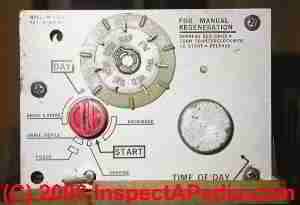
Water conditioner or water softener controls typically include either analog-type dials with pins, buttons, or levers (control at left)( or electronic controls operated by pushbuttons (discussed later in this article
at ELECTRONIC WATER SOFTENER CONTROLS).
The two principal adjustments on any water softener, whether they are done manually by an owner or automagically by water hardness sensors, are listed below, followed by two basic maintenance chores.
- Set the Regen or Backwash Frequency:
The frequency of water conditioner regeneration cycle or the "backwash" cycle.
See WATER SOFTENER REGENERATION CYCLE FREQUENCY for details - Set the Salt Dose:
The amount of salt (or salty water) that must be run through the water conditioner during each regeneration cycle or "backwash" cycle.
See WATER SOFTENER SALT DOSE SETTING for details. - Add salt:
because a water conditioner (or water softener) consumes salt during each regeneration or backwash cycle, you will need to buy and add salt to the brine tank from time to time. You can determine when to add salt by visual inspection - salt gets low inside the brine tank, or you can if you prefer hire a water softener maintenance company who will deliver and install the salt for you. - Clean the Water Conditioner:
As we explain at WATER SOFTENER CLEANING & SANITIZING, water softener brine tanks also need to be emptied and cleaned from time to time.
Sanitizing the water softener will require a regeneration cycle to be complete.
See WATER SOFTENER MANUAL REGENERATION
Question: how to use the pins and dial in the photograph above?
[Shown just above is ] exactly the control my softener has, but I cannot find instructions on how to set the pins on the dial that say 2 minutes per pin, or get repair parts.
My softener is an NPS AquAmerica Model 92083. Mfgr is/was in Norton, Ohio and was made in about 1995.
Can you help please? - Anonymous by private email 2017/01/22
Reply:
That dial is controlling the regen cycle duration - a way of adjusting the softener to accord with the hardness of your water. You'd move the pins to a higher number to obtain a longer regen time if the water remains hard after treatment - and presuming all else is working normally.
I attach a water softener manual [PDF document] that may not be an exact match but should be helpful. Found at Aqua Systems 800 n447 5582 http://www.ilovemywater.com/Contact-Aqua-Systems.aspx
Searching InspectApedia.com
for WATER CONDITIONER / SOFTENER MANUALS will provide a list of manuals listed under the AquaAmeria / AquaSoft / Aqua Systems name.
Clock Settings for a Water Softener
How to Set the Water Softener Clock & Regeneration Cycle Frequency
Because water conditioners and their controls vary among manufacturers and models, below we discuss several methods for determining and actually making the necessary settings or adjustments on this equipment.
And there is a third maintenance task for building owners who have a water conditioner: setting the clock
Guide to Setting the water softener controls:
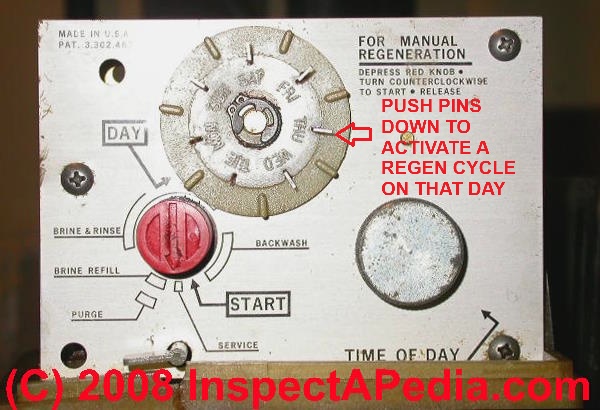
Our photo above shows the standard controls on a water softener, permitting the user to specify the days on which a recharge/backwash cycle will occur, the salt dose, and also the time of day.
Set the water softener clock:
Setting the clock on the water softener control is important for two reasons: first, you won't be bothered by hearing it run if it recycles when you are asleep or out of the home, and second, since the water softener recharge cycle uses plenty of water, it's a good idea to send that discharge to the septic system at a time when other plumbing fixtures are not in use - thus spreading the wastewater load on the septic system out over a longer period.
Set the clock dial to the accurate time of day and set the water softener regeneration time to an hour when the building occupants are least likely to be using water, such as at 2AM - the standard factory pre-set regeneration hour.
On units with a clock dial, the silver colored section corresponds to daytime hours and the black colored portion corresponds to night time hours.
Usually the "clock dial" is adjusted by lifting it up and turning it to the proper position, or turning a dial to line up the correct hour of the day with an indicator arrow (lower right in our photo).
Question: Where is the "Clock" on my water softener and how do I set it?
Extremely well written and done !! Thank you. But, i still can not identify my softener system or control clock. It was here when i bought the house. Is there anywhere some pictures identifying different controllers. bugrubert@hotmail.com
Reply:
Bugrubert, you are welcome to send me photos of the equipment and all labels you can find including inside the control cover - use the email address found at the CONTACT link shown at the top, left, and bottom of all of our web pages.
On dial type (non LED or LCD type display) water softeners or conditioners, you may not see a dial that looks like a clock with hands. In the water conditioner control photos below, from left to right,
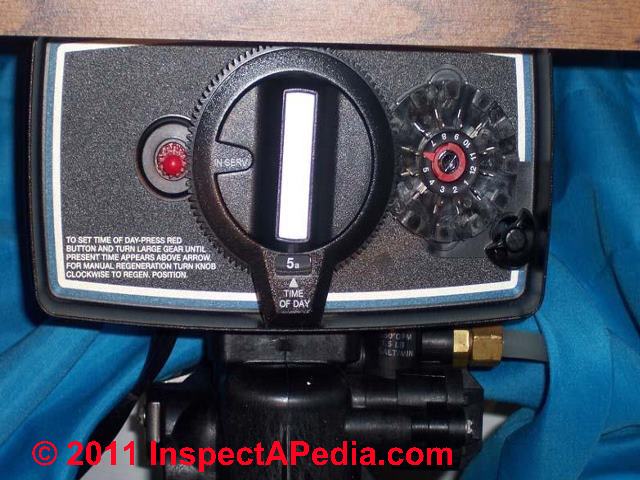
- The clock on this water conditioner control is set by turning the knob marked "Time of Day" that has numbers on it so that the current AM or PM hour is opposite the arrow point (lower right corner of our first photo at below left).
You will see a similar "Time Set" button on Autotrol water conditioners.
- The clock on the next water conditioner control (below right) is set by turning the AM (white area) or PM (black area) hour to be opposite the black pointer to which our red arrow is pointing.
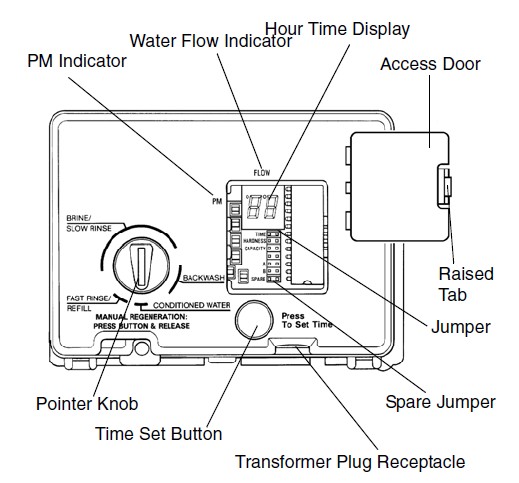
- On an electronic display water softener such as the Autotrol 460i, for example, to set the time of day you may have to set a jumper next to the word "TIME" on the control (blue arrow) and then push the "Time Set" button (red arrow) until the correct AM and PM time of day is indicated on an LED display.
Water Softener Control Adjustment Procedure Details - 6 Easy Steps to Soft Water
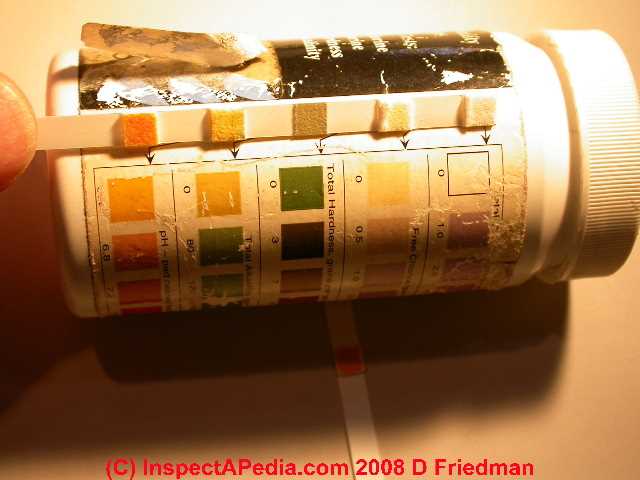
- Measure the hardness of your water
using a test kit or by asking a service tech to do it for you.
The number you get should be expressed in either GPG (grains of hardness per gallon of water) or in PPM (parts per million of minerals in your water)
Our photo (left) illustrates a simple water hardness test that also measures other water parameters. - Adjust the water softener "Hardness" setting.
Adjust the water softener "hardness" to the same number as the hardness that you measured for your own water supply. For example if you measured your water hardness as 30 grains per gallon (30 GPG), then the "hardness" setting will be "30". If your water hardness was measured in parts per million (PPM),
Divide PPM by 17.1 to get hardness in grains per gallon: PPM / 17.1 = GPG
Or to convert from hardness in PPM to hardness in grains per gallon,
Multiply grains per gallon GPG by 17.1 to get hardness in PPM: GPG x 17.1 = PPM - Set the water softener "Capacity":
Adjust the water softener capacity setting according to your manual and our example discussed earlier.
Typically capacity for a water softener is a number from 1 to 99 kilograins. This is the amount of hardness, measured in grains, that the softener can remove before it needs to be re-generated.
Suppose your water conditioner capacity setting is adjusted to 30 kilograins (1st column at left side of the salt dose able)
More details are
at WATER SOFTENER CAPACITY SETTING - Determine softener treatment tank size:
Let's assume your water softener treatment tank is a 1-cubic foot capacity unit. Notice the table column under 1.0 Ft3. (4th column from left in the water softener salt dose table). The water softener tank size is it's resin volume in cubic feet, typically a number between 0.75 cu ft and 2.0 cu ft. - Read the recommended salt dose in pounds:
reading across from 30 kilograins of hardness in column 1 to our 4th column (the 1 cubic foot softener size) we see that the manufacturer recommends 15 pounds of salt. - Set the salt dose - the brine control:
set the dial to 15 pounds of salt. If your equipment is in the U.K., Australia, New Zealand, Canada, or another country that measures and marks equipment using the metric system your salt dose will be measured in kilograms or kg of salt.
If you need to convert pounds to kilograms or kg, divide pounds by 2.2. More examples of how to determine and set the water softener salt dose can be read
at
RECOMMENDED SETTINGS for WATER SOFTENERS
Watch out: follow the instructions in the right maintenance manual for your own equipment. And in the salt dose table, don't confuse kg of salt (numbers in the table body) with kilograins of water hardness (numbers in table column 1).
Also, remember this setting is adjusting only the salt dose, not the frequency of regeneration cycle.
Another Approach to Water Conditioner Settings for Salt Dose & Regeneration Frequency
If you don't have a manual and can't find instructions for your unit, (and don't want to call a qualified service technician) leave the salt dose alone, then send the softener through a regeneration cycle and measure the hardness of your water again.
Then monitor water hardness on the days between your regen cycle and the next automatic regen cycle, during a period of your best guess at average water quantity use. If your water shows unacceptable hardness before another softener regen, you'll need to increase the frequency of regeneration cycle.
Typical frequencies for manually-set water softener regeneration as a starting point are are once a week, once every 3 or 4 days, every other day, and daily.
If you are running the system daily and water is still too hard you may need to increase the salt dose. But don't overdo the salt or you may have salty water - a health and aesthetic issue.
Subjective judgment of water hardness:
It's best to measure the hardness of your water - kits are inexpensive or some services will perform the test at no charge.
If you can't get a lather using shampoo on your head in the shower, either you're bald, or the water is still pretty hard. If your water feels slimy and you have trouble rinsing off soap, your water might be more soft than necessary (though other problems can also cause this symptom).
Water Softener or Water Equipment Adjustment Tip:
Most water treatment companies will be glad to send a representative to your building to test water hardness (or other contaminants) and to advise you on the condition and settings of the water treatment equipment you have in place, or to suggest alternatives if you are shopping.
Regeneration Cycle Frequency on Water Softeners
How Often does the Water Softener Need to Run a Backwash & Regeneration or "Recharge" Cycle?
Your water softener manufacturer will provide a Salt Dosage/Frequency Chart along with the softener's installation and maintenance instructions.
A water softener recharge frequency and salt dose example is provided by CULLIGAN:,
"If four individuals live in the household, and the water has a total hardness of 18 grains per gallon, the salt dosage per recharge for the water conditioner will be 5 pounds (2.5 kg) and the recharge frequency will be 3 (or every 2 days). Monthly salt usage can be estimated, using these figures, at about 75 pounds (37.5 kg).
IBC in Australia provides this simple formula that can calculate the regeneration cycle for a water softener if you know all of the required parameters:
Number of Days Between Water Softener Regeneration Cycles = N
Maximum capacity of the treatment tank in grams of CaCO3 or NaCL = C
Volume of water passing through the treatment tank per day = Q (Kiloliters per day) or (Gallons per day)
Hardness of the incoming water measured in micrograms/Liter (mg/L) or in PPM = H
N = C / (H x Q)
This should be taken only as a rough calculation - set your backwash frequency to this number of days or less.
An extra regeneration cycle is needed under some circumstances.
Details are at WATER SOFTENER MANUAL REGENERATION.
Water softener regeneration cycle frequency vs. cycle duration time
Above we discussed the frequency of water softener regeneration cycles: how often the equipment should run through a regeneration cycle.
Frequency of water softener regeneration is not the same question as duration of the regeneration cycle.
See WATER SOFTENER RUNS TOO LONG for a discussion of abnormally-long water softener regeneration cycle time duration.
Recommended Settings for Water Softeners
So What Settings Should I Use on My Water Softener? How to Set the Water Softener Salt Dose
Question: What salt dose should I use on my water softener?
I have a Autotrol 460i water softer. The water hardness going into my house measures 10. What settings do I need set in order to create water hardness setting out of my faucets to read around 1or 2? - Walter Schwartz
Reply: The salt dose for your water conditioner depends on some variables. Here is an example and a water softener salt dose table for reference
Some water conditioners (water softeners) automagically track water quantity usage and water hardness and adjust themselves without you having to do a thing. But lots of models require a manual adjustment based on water hardness and water quantity used.
The necessary water softener settings depend not just on water hardness but on your brand and model of water softener equipment and how much water you are using. Here are some remarks about setting the salt dose and regen frequency on a water softener:
Most water softener owners manuals include a table of recommended settings. Start there. If you don't have an owner's manual call the manufacturer's tech service and give them the model number and ask for a manual as well as their setting advice.
Water Softener "Hardness Setting"
Here is an excerpt from a copy of the manual for
your AUTOTROL WATER CONDITIONING CONTROL SYSTEM, INSTALLATION, OPERATION, AND MAINTENANCE MANUAL. [PDF]
On this water conditioner you can specify the time of regeneration (factory is set to 2:00 AM) to be sure it's running at a time when you are not using water in the building.
Here are instructions on adjusting the hardness setting for this equipment: [Quoting]
Water Conditioner Hardness Setting: Move the jumper to the set of pins next to the word HARDNESS (Figure 11).
Press the black TIME SET button until the correct hardness is displayed.
The hardness range is from 1 to 99 grains per gallon.
To change water hardness stated in parts per million (PPM) to grains per gallon (GPG) use this formula:
Parts per Million / 17.1 = Grains per Gallon
Question: can I turn off my water softener
2021/04/14
My water softener hardness was set at 197 I have city water hardness 6 I dont want it to soft pentair 255/760
Moderator reply: Explain the "Hardness setting number" on a water softener control head
@Anonymous,
If you don't already have it, look here for your PENTAIR WATER SOFTENER MANUALS.
I have to refer to the manual because the hardness setting (or salt-dose) procedure varies among softener brands and models.
You might also review the water usage rate in your home as that might let you reduce the frequency of softener regeneration.
Finally: let's be sure we've got the numbers right. If your softener is not needed at all then you could simply put the softener in bypass mode.
Let's recap the math:
How to o convert between grains of hardness (GPG) or "Grains of Hardness per Gallon of Water" and mg/L or micrograms (of calcium & magnesium) per liter of water we
- Divide mg/L by 17.2 to get GPG
- Multiply GPG x 17.2 to get mg/L
So if your water hardness is measured at 6 GPG that's 103.2 mg/L
0 to 60 mg/L (milligrams per liter) as calcium carbonate is classified as soft.
So your water is rather hard - IF that number "6" is GPG.
If you bypass the water softener you risk scale-clogged water heater and pipes.
Let's also review that 197 setting on your Pentair water softener to be sure that's a GPG setting - it might instead be a mg/L setting and so not so far off from correct as you may think.
Water Softener / Conditioner Capacity Setting
Typically the capacity for a water softener - the amount of hardness it can remove before a regeneration is necessary - is a number from 1 to 99 kilograins.
Suppose your water conditioner capacity setting is adjusted to 30 kilograins (1st column at left side of the salt dose able)
For our example water softener, move the jumper to the set of pins next to the word CAPACITY (Figure 12).
Press the black TIME SET button until the correct capacity value is displayed. The capacity range is 1 to 99 kilograins.
Refer to the Suggested Salt Dial Settings table [shown below].
Return the jumper to the top set of pins next to the word TIME and replace the access door.
The next three sets of pins are used for factory testing and are not used in normal operation. The jumper must NOT be left on any pins other than the top pair next to the word TIME. Otherwise, the unit may not function.
Note: A spare jumper is located on the bottom set of pins.
In the event that the hardness or capacity setting must be changed, simply follow the appropriate steps described above.
Note: We have tried to translate these mysterious and unclear instructions into understandable English,
at WATER SOFTENER CONTROL ADJUSTMENT PROCEDURE DETAILS
so CONTACT us with suggestions.
Like some other advanced water conditioners on the market, the control module for the Autotrol water softener includes a microprocessor that monitors your level of water usage, adjusting the regeneration cycle accordingly.
See WATER SOFTENER RESIN PROPERTIES & SOURCES for a detailed explanation of the relationship between incoming water hardness (in grains), water usage volume, water softener resin properties, and the capacity of the water softener to remove hardness.
How to Set the Water Softener Salt Dosage
Complete details about adjusting the water softener salt dose are found in these separate explanations:
Excerpts summarizing water softener salt use are just below.
Water softener brine control or salt dose and regeneration cycle frequency as well as other settings vary depending on the type of water softener control on your machine. But the basic concept remains the same:
- The harder your incoming water supply is, the larger is the salt dose that will be needed to regenerate the water softener itself.
- The larger the water quantity you use in your home, the more often the water softener will need to run through a regeneration cycle.
- The Brine Control: how to set the water softener salt dose:
Your water softener's instructions (available from the manufacturer or from a local water softener service company) will tell you what salt dosage to set on the softener as a function of how many grains of hardness your water supply shows.
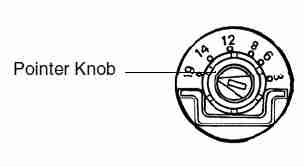
The salt dose scale on a typical water softener indicates the number of pounds of salt to be used in each water softener recharge cycle.
Shown at left, the pointer knob is set to between 14 and 15 pounds of salt on an Autotrol salt dose control (a high setting by the way).
[Click to enlarge any image]
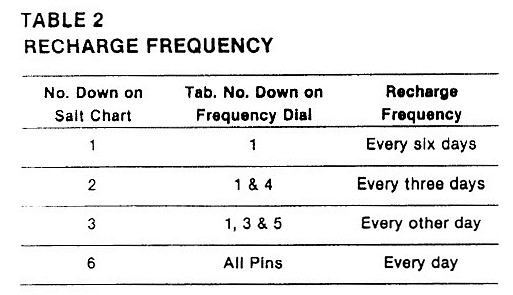
Set the water softener recharge frequency: your water softener's instructions will tell you how often the system should be recharged as a function of your estimated daily water usage in gallons.
At left is a typical water softener recharge frequency chart for a Culligan System 19 or 23 Water Conditioner.
[Click to enlarge any image or table]
Typically a water softener control includes a seven-day recharge frequency dial with tabs that can be pushed-in or pulled out to cause the water softener to use a recharge cycle on that day. Harder water and higher quantity of water usage means more frequent recharge cycling is needed.
If your water softener has an automatic sensor of the hardness of water leaving the treatment tank (such as the Culligan Soft-Minder®), it can decide for itself when a recharge or regeneration cycle is needed.
Water Softener Electronic Control Setting Procedure
Question: How do I set the Water Softener Controls on a Sears Kenmore Electronic Unit?
My water conditioner is a Kenmore model that uses an electronic control rather than dials, levers and pins. How do I set that control?
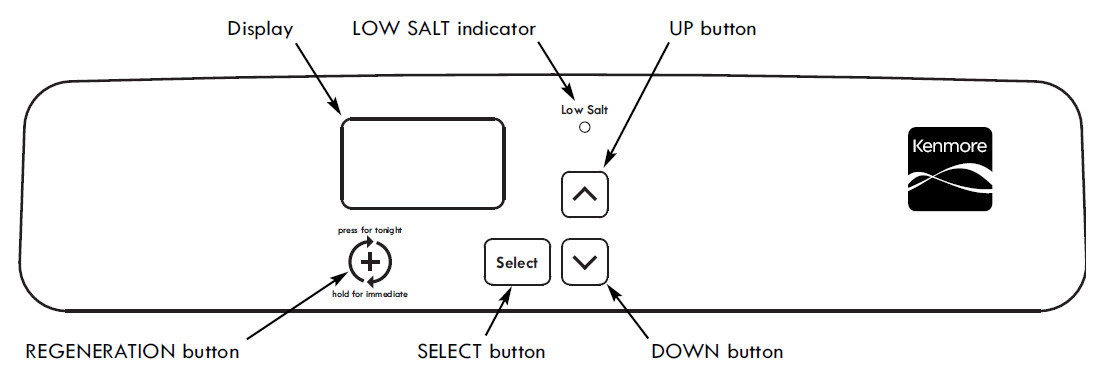
Reply:
To set a Kenmore water conditioner electronic control try these basic steps. If these instructions don't match your unit contact us by email with your brand and model number and we'll help you find those instructions. [18]
- Select button:
Find the Hardness Setting by pressing the Select Button on your water conditioner control box until you see the control display flash the word Hardness and a number. The number is the current hardness setting of your equipment. - Choose the control setting number:
The default setting on a typical Kenmore water softener with this control type is 25. The electronic control setting number to which you should set the electronic control on your water conditioner is either- Grains per gallon of hardness (if your system does not include an iron treatment component)
or - Control Setting Number calculated as follows:
For a typical Kenmore water conditioner instructions indicate
Hardness Number = GPG of hardness (grains per gallon of hardness)
Iron Number = Iron ppm x 5
Control setting = Hardness Number + Iron Number
If you don't know what hardness number you want, see our discussion about hardness numbers in the article above or use the test kits we describe to determine the hardness of your water supply. For Kenmore customers Sears offers a free water hardness and water iron test.
- Grains per gallon of hardness (if your system does not include an iron treatment component)
- Arrow Button:
press the Up or Down buttons to change the current Control Setting Number to the setting you want
To continue with other settings on this type of machine, - Select button:
press the Select Button again to show Recharge Time - Choose the Recharge Time of Day:
this setting determines the time of day at which the system will run through a regeneration cycle. The factory default is 2:00 AM - which we recommend unless you are often using building water at that hour. Use the up or down arrows to change the recharge time in one-hour increments.
To continue with other settings on this type of machine, - Select Button:
press the Select button again to show Set Salt Level - Choose the Current Brine Tank Salt Level:
open the brine tank, note the yellow sticker that has numbers 0-8 imprinted on it. Choose the salt level to match the highest number on the decal to which the salt is actually present in the brine tank.
This setting tells the water softener how much salt is in the brine tank and thus will allow the equipment to tell you (on its display) when the salt level is low - when you need to add more salt to the system. - Select Button: use the Select Button once more to finish up
setting the Kenmore water softener control by pressing it again to show the current time of day. - Set the water softener clock to correct time of day:
if the clock is not displaying the correct time, you can also use the Select Button to choose Set Time of Day, then set the correct time using the up and down buttons.
As we detail
it's easy to see if your water softener is doing anything by using one of several water hardness tests including the strips shown at left. Or you may suspect a problem if you are no longer able to get your shampoo to lather when taking a shower.
Reader Comments, Questions & Answers About The Article Above
Below you will find questions and answers previously posted on this page at its page bottom reader comment box.
Reader Q&A - also see RECOMMENDED ARTICLES & FAQs
On 2022-11-29 1 by InspectApedia (mod) - how do I set the pins for a regeneration cycle?
@Donna Alleman,
In order to be sure, we would need to know your brand and model. Then if you don't have the owner's manual, we can see if we have it and check the instructions.
Post a photo of the data tag or label if you can.
On a Culligan and many similar water softener controls, pushing the pin IN activates that interval or recharge day and pulling the pin OUT skips that day
On 2022-11-29 by Donna Alleman
I have pins set out to regenerate. Is this the proper way

On 2022-02-21 by Levi Armstrong
I like how you explained that a water softener or water conditioner includes controls that allow the installer or building occupants to adjust the system to work properly. My sister plans to get one but is unsure about knowing the right model. I'll share this with her to help with the research. Thanks!
On 2021-06-14 by danjoefriedman (mod) - lack of support from technical support
@Common Cents,
I agree;
It's past time to start supporting water softener manufacturers and suppliers who actually, in turn, support their product with real access to experts, good manuals, and, of course, good quality.
Nearly all of the brine tank fill and dose problems readers report seem to be that of a stuck or jammed brine tank float or occasionally a clogged inlet opening at the bottom of the brine tank;
It's beyond my expertise but my OPINION is it'd be odd for power fluctuations to damage a water softener control in such a narrow way that just one part of one cycle would be fouled-up. I would buy the claim of - damaged circuit boards, damaged timers, and lost programming.
On 2021-06-14 by Common Cents
@danjoefriedman,
Thank you for the prompt reply. To clarify, my background is in engineering, so I'm merely a consumer in this instance. I've attached a photo of the valve unit, and I'm sure a lot of people will recognize it.
We acquired the house 3 years ago and this softener (EcoWater ESD 518) had been installed for 8 years. When I realized it was malfunctioning, I found a used GE branded controller (*Bay) with the correct wiring/harness. It works, but also exhibits the same issue, albeit less consistently... sometimes it works, other times it short-cycles the brine fill (but only when the timer initiates a regen).
As before, a manual regen works fine. I suspect all the brands with this valve probably use the same base code (perhaps due to patent/licensing requirements), and then add their own whistles and bells to the software. That would explain this particular glitch across brands/models with this valve.
I appreciate the contact numbers, but after my experience with Electrolux/Frigidaire and Sears/Kenmore on warranty claims in 2019-2020, I have zero faith in 'technical' service departments and talking with offshore CSR's... i.e. if the scope of the problem is not in their 'script' or flowchart, resolution is unlikely. Trying to get a product engineer on the phone is an exercise in futility.
We are probably going to ditch this unit and get a Fleck (or similar) which will give us more control over regens.

On 2021-06-08 by danjoefriedman (mod) - brine tank fails to fill properly
@Common Cents,
Thank you for an important field report (assuming you are a water softener installer or user) about a timer snafu. We have not been seeing reports of this problem, though it could be occurring such that most homeowners don't get so far in diagnosis as we read in your comment.
The fact that you say you're seeing this across more than one water softener model & brand is suggestive; of course, it's no surprise to find the same component across multiple water softener brands. Flex / Pentair controls appear on many units, for example.
Every water softener manufacturer provides a technical support telephone number. Have you tried contacting the manufacturer of the unit(s) where you're seeing this error?
Try 1-800-GECares (1-800-432-2737)
or for Kenmore one of these four numbers
Kenmore Product Questions
1-844-553-6667
Sears Product Installation
1-800-326-8738
Sears Parts Direct Inquiries
1-800-366-PART (1-800-366-7278)
Sears Appliance Repair
1-888-820-3350
let us know what you're told as that will certainly help other readers, particularly repair technicians.
On 2021-06-08 by Common Cents
I want to mention a problem which I've found with electronic timer/control modules commonly found on the ubiquitous control valve used by dozens of brand names such as EcoWater, GE, Kenmore, etc. They all use the same setup & valve, except for a few variations in software features of the control unit and their respective brand names on the tank, etc.
The problem has to do with filling the brine tank, or failure to do it properly. These are systems which fill the brine tank at the beginning of a regen cycle. The crux of the problem is a glitch which occurs within the -software- of the control unit:
1) If the system is allowed to initiate a regen cycle by itself (either via schedule or demand usage/timer) the brine fill sequence will only run for 3 minutes. Regardless of float level, the unit will stop filling after 3 minutes, and proceed to draw the brine... this results in not enough water in the brine tank, ~40+ minutes of drawing from a 'dry' tank, and inadequate regeneration.
2) If, however, a -manual- regeneration is initiated, the brine fill sequence will run for the normal 14 minutes, the float will shut-off the flow at the appropriate point (usually after 7 to 10 minutes) and the brine tank will fill to the proper level.
Aside from the above, the other sequences (brine draw, backwash, and rinse) all function normally, and the cycle finishes.
This glitch in the software has been rearing it's head on several control units, and unless you actually observe how the unit behaves as it initiates the brine-fill sequence (via timer versus manually) you may not know the system is malfunctioning.
I'd like to know if this is a common problem with some branded units (I've seen it with EcoWater & G.E. control modules), or if it may be related to power fluctuations such as: the utility company grid-switching late at night, transients, brownouts, etc?
On 2021-04-15 by Anonymous
My water softener hardness was set at 197 I have city water hardness 6 I dont want it to soft pentair 255/760
On 2021-02-03 by danjoefriedman (mod) - change the resin in a water softener
First let's be confident in the diagnosis. If you put the water softener on bypass does the water pressure and flow problem go away? If so then indeed it sounds like there's a problem in the water softener. It's entirely possible to change the resin in a water softener but it's a bit of work. You can find a describe in detail in this article series.
On 2021-02-01 by Mrs j constable
I recently had a water softener guy call initially as I didn’t hear the machine coming on, I’d already done a regeneration on the machine but the tap water wasn’t flowing very well although by the time he came it was much better, however he looked at it and said I need to buy a new one as suspected it to be the resin, not happy about that and looked into cleaning the resin, if its the problem causing low power of water.
The kitchen filter tap works fine for drinking water which is separate and I’m waiting fir the delivery of resin cleaner. Although he disconnected the machine before he went saying it was unsafe to leave it as the resin could do untold damage to the system.
How do I get this back into use when I receive the resin cleaner and how should I proceed, thank you
On 2021-01-18 by danjoefriedman (mod)
Ramesh
Sure, you can reduce the level of treatment by your water softener by reducing the frequency of region or by reducing the salt dose that use. You'll see those procedures in the instructions for your specific water softener brand and model. It might be useful to actually test your water to determine the hardness level because then you can be sure that you were setting the controls for your water softener according to the manufacturer's specifications
On 2021-01-17 16:58:18.565628 by Ramesh
Our water is very comes very very soft can we reduced it to less soft
On 2020-11-05 - by (mod) -
 Jim
Jim
That's probably a common controller on many softeners; try taking a look at the steps given at
IDENTIFY WATER SOFTENER BRAND / MODEL
You can also post a photo of any other stickers or tags on or in the control; often from something as indirect as a patent no. we (or you) can use Google Scholar to find the company of origin.
On 2020-11-05 by jim
I am trying to ID what make this controller is. I have no other info on it. Looking for a manual .
Thank You.
.
On 2020-04-28 - by (mod) -
Jeff
Sorry that there seems to be a misunderstanding, but you did not purchase parts for your water softener from us. (InspectApedia.com)
We do not sell anything and never have: no parts, no services, nothing.
InspectAPedia is an independent publisher of building, environmental, and forensic inspection, diagnosis, and repair information for the public - we have no business nor financial connection with any manufacturer or service provider discussed at our website. We very much welcome critique, questions, or content suggestions for our web articles. Website content contributors, even if it's just a small correction, are cited, quoted, and linked-to from the appropriate additional web pages and articles - which benefits us both. Working together and exchanging information makes us better informed than any individual can be working alone.
More about us is at ABOUT InspectApedia.com inspectapedia.com/Admin/About_InspectApedia.php
The recommended regen frequency settings for your water softener depend on both the hardness (you cite 17 grains) and also on the water softener brand and model.
That's because water softener capacity varies among brands and models.
However it should be pretty easy to answer your question: take a look in the manual for your particular water softener. You'll find a table of recommended salt dose and regen frequency settings for your water hardness for your specific model.
Or in the article above on this very page, please take a look at
4 BASIC WATER SOFTENER ADJUSTMENTS
and
6 WATER SOFTENER CONTROL SETTING DETAILS
and don't hesitate to ask follow-up questions if any of that is unclear.
Thanks for asking.
On 2020-04-28 by Jeff
I recently purchased parts from you to rebuild my softener and it is working like a champ now. My water is 17 grains hard (untreated) and there are two of us in the house. We occasionally have two extras when a child comes home for the weekend. What would you suggest for regeneration settings?
Thanks
On 2020-04-02 - by (mod) -
 Sure Todd
Let's start by taking a look at the suggestions at IDENTIFY WATER SOFTENER BRAND / MODEL
https://inspectapedia.com/plumbing/Water-Softener-Identification.php
On 2020-04-02 by Todd
Hi, Trying to find out what softener this is. Hoping to track down a manual or instructions on how to properly set this water softener. It's an older unit, installed @ 2003. It is working, just don't know how to really anything on it. Really appreciate any one who can help out!!
Thanks!
On 2019-12-16 by Anonymous
Sounds like a lot to me. Check the settings on the water softener; often the softener will give an actual salt "dose" in pounds. You can compare that with the pounds (or volume) of salt in the brine tank.
Also tell us the level of hardness in your water and see what your softener manual says should be the salt dose setting or that hardness.
On 2019-12-16 by phil bailey
my softener used one 40# bag of salt for one regen cycle. is this normal?
On 2018-10-26 - by (mod) -
Lee
The meaning of an error light on a water softener is brand and model dependent so I'm afraid you need to consult the manual to see what the area code is.
On 2018-10-26 by Lee
Light not stop blinking
...
Continue reading at WATER SOFTENER CONTROLS & OPERATION - topic home, or select a topic from the closely-related articles below, or see the complete ARTICLE INDEX.
Or see WATER SOFTENER CONTROL SETTING FAQs - questions & answers about water softener control settings posted originally at this article
Or see these
Recommended Articles
- DIAGNOSE WATER SOFTENER PROBLEMS - if your softener is not working
- REDUCE IMPACT of SOFTENER on SEPTIC
- WATER CONDITIONER / SOFTENER MANUALS
- WATER SOFTENER ADJUSTMENT & CONTROLS
- 4 BASIC WATER SOFTENER ADJUSTMENTS
- 6 WATER SOFTENER CONTROL SETTING DETAILS
- RECOMMENDED SETTINGS for WATER SOFTENERS
- WATER SOFTENER CAPACITY SETTING
- WATER SOFTENER CLOCK SETTINGS
- WATER SOFTENER ELECTRONIC CONTROL SETTINGS
- WATER SOFTENER SALT CHOICES
- WATER SOFTENER SALT DOSE SETTING
- WATER SOFTENER MANUAL REGENERATION
- WATER SOFTENER REGENERATION CYCLE DURATION
- WATER SOFTENER REGENERATION CYCLE FREQUENCY
- WATER SOFTENER MANUAL REGENERATION
- WATER SOFTENER CONTROL BYPASS VALVE - how to put the water softener temporarily out of service.
Suggested citation for this web page
WATER SOFTENER ADJUSTMENT & CONTROLS at InspectApedia.com - online encyclopedia of building & environmental inspection, testing, diagnosis, repair, & problem prevention advice.
Or see this
INDEX to RELATED ARTICLES: ARTICLE INDEX to WATER TREATMENT SYSTEMS
Or use the SEARCH BOX found below to Ask a Question or Search InspectApedia
Ask a Question or Search InspectApedia
Questions & answers or comments about problems with the operation of aerobic septic systems
Try the search box just below, or if you prefer, post a question or comment in the Comments box below and we will respond promptly.
Search the InspectApedia website
Note: appearance of your Comment below may be delayed: if your comment contains an image, photograph, web link, or text that looks to the software as if it might be a web link, your posting will appear after it has been approved by a moderator. Apologies for the delay.
Only one image can be added per comment but you can post as many comments, and therefore images, as you like.
You will not receive a notification when a response to your question has been posted.
Please bookmark this page to make it easy for you to check back for our response.
Our Comment Box is provided by Countable Web Productions countable.ca
Citations & References
In addition to any citations in the article above, a full list is available on request.
- [1] A.I. McDermott Co., Inc. produces the AquaSoft series of water softeners including the AquaSoft Pro-Plus 460-series water softeners Pro 255, Pro Performa 400, Pro 460i, Logix, and CL softeners. Here is an example water softener manual for the Aquasoft Pro Plus water softener with the 460i Controllers such as PES32M268-MP - web search 09/11/2010, original source: http://www.gewater.com/pdf/resdntl/manuals/1017948.pdf describing a General Electric GE-produced control.
- [2] Autotro® 255 Valve / 400 Series Controls, Water Conditioning Control System, Home Owner Installation, Operation, and Maintenance Manual, Pentair Residential Filtration, LLC, 2009
- [3] Autotrol® Series 255 Valve / 460i Water Conditioning Control System, Installation, Operation, and Maintenance Manual, web search 09/01/2010 original source: http://www.qualitywatertreatment.com/PDF/Autotrol%20255-460i_Manual.pdf
- [4] Aquatell (Nelsen Corporation) produces Autotrol Water Conditioners. Email: sales@aquatell.com Tel: Toll Free 1-866-966-9951 Website: Toll Free 1-866-966-9951 Website: http://www.aquatell.com/
- [5] "Commercial Water Softener Installation and Operating Instructions", IBC Filtration & Water Treatment Products (Australia) for commercial, industrial and residential application www.ibcwater.com.au (07) 3219 2233
- [6] Culligan System 19 and 23 Water Conditioners (Filament Wound Tank) Installation and Operating Instructions, Cat. No. 00-8816-57 (Printed 6/89), Culligan INternational Company, Northbrook IL. 60062, San Bernadino CA 92402, Culligan NV/Brussels, Belgium, Culligan Italiana SpA/Bologna, Italy, Culligan of Canada, Ltd., Mississauga, Ontario, Canada L5K 1A5
- [7] Culligan Mark 10 Water Softener 1994-1998 Installation and Operating Instructions (covering models manufactured after 1995) (1-96) 01881948.pdf available from www.culligan.com
- [8] "Non electric water softener, Installation and Operating Instructions", IBC Filtration & Water Treatment Products (Australia), op.cit.
- [9] North Dakota Standards for Water Softeners, North Dakota General Authority Law, Chapter 62-04-08, Water Softener Units http://www.legis.nd.gov/information/acdata/pdf/62-04-08.pdf. "The objective of this chapter is to provide a standard of quality, capacity, and performance for water softener units. Water softener performance is to be based upon referee tests procedures described in section 62-04-08-09."
- [11] "Water Softener Twin Tank Installation and Operating Instructions", IBC Filtration & Water Treatment Products (Australia), op.cit.
- [12] Water Softeners, CMHC, Canadian Mortgage and Housing Corporation, cmhc-schl.gc.ca/en/co/maho/wawa/wawa_005.cfm - October 2008. Canada Mortgage and Housing Corporation acknowledges the contribution of Health Canada to the development of this document. For further questions regarding water treatment and water quality, contact Health Canada at watereau@hc-sc.gc.ca or call 613-957-2991 or 1-866-225-0709.
- [13] Watts Industries of North Andover, Mass., provides its ZRO-4 under counter system intended to target the independent water dealer market.
- [14] Thanks to reader M.P. for discussing the requirement to adjust the float level in water softener brine tanks - January 2011
- [15] Kinetico Model 50 Water Conditioner, 2002, Kinetico Home Water Systems, 10845 Kinsman Road
Newbury, Ohio 44065 USA, Tel: 800-944-9283. Kinetico also produces the AquaKinetic Series and Powerline Series Water Softeners. - [16] Treatment Systems for Household Water Supplies, Iron and manganese Removal, Bruce Seelig, Water Quality Specialist, North Dakota Extension Service Russell Derickson, Extension Associate in Water and Natural Resources, South Dakota Extension Service Fred Bergsrud, Water Quality Coordinator, Minnesota Extension Service, AE-1030, County Commissions, North Dakota State University and U.S. Department of Agriculture cooperating. Web search 04/16/2012, original source: http://www.ag.ndsu.edu/pubs/h2oqual/watsys/ae1030w.htm [copy on file as /Water/Iron_Manganese_Removal_NDSU.pdf]
- [17] Averbeck, David, Mike Catanzaro, Jason Davis, Andrew Warnes, "Softener Discharge Versus Aerobic Wastewater Treatment Units", Water Conditioning & Purification, Feb. 2010
[
copy on file as Water_Softener_Vs_Septic_Averbeck.pdf ]
- Alhajjar, Bashar Jamil, 1981, The Effects of Electrolyte Concentration, Cation Adsorption Ratio, and the Septic Tank Effluent Composition on Hydraulic Properties of Natural Swelling Soil Systems, University of Wisconsin-Madison.
- Corey, R.B., and Tyler, E.J., 1978, Potential Effects of Water Softener Use on Septic Tank Soil Absorption On-Site Waste Water Systems, University of Wisconsin-Madison.
- Corey, R.B., Tyler, E.J. and Olotu, M.U., 1978. Effects of Water Softener Use on the Permeability of Septic Tank Seepage Fields. Proceedings of the Second National Home Sewage Treatment Symposium. ASAE, St. Joseph, MI.
- DalTech Dalhousie University. 2001. The Effect of Softeners on Onsite Wastewater Systems, Centre for Water Resources Studies, On-Site Applied Research Program, Nova Scotia, Canada, 2001.
- Deal, K, 1998. Analysis of Septic System Failure in Gallatin County Montana, MSU Extension Service.
- Etzel, J.E., 1978. Softener Brines Do Not Harm Household Sewage Systems, Purdue University, West Lafayette, IN.
- Isaacs, W.P., and Stockton, G.R., 1981. Softened Water Energy Savings Study Controlled Experimental Testing Program on Household Water Heaters, New Mexico State University, Las Cruces, NM.
- Great Lakes Upper Mississippi River Board of State Sanitary Engineers, 1980. Recommended Standards for Individual Sewage Systems.
- Renn, C.E., Effects of Salts on Waste Treatment Systems, Johns Hopkins University.
- Tedrow, J.C.F., 1997. The Effect of Sodium Discharge from Water Softeners into the Septic Fields of New Jersey, Rutgers University.
- NSF International, 1978. The Effect of Home Water Softener Waste Regeneration Brines on Individual Aerobic Treatment Plants.
- Michaud, C.F., 2005. “What’s the Big Stick on Septic Discharge?”, WC&P Magazine, May 2005.
- National Small Flows Clearinghouse, Pipeline, Winter 2001.
- Water Quality Association. 1976. Effects of Backwash Water and Regeneration Wastes from Household Water Conditioning Equipment on Private Sewage Disposal Systems. 15. Wood, F.O., The Results of Putting Brine Effluent Into a Septic Tank Drainage System, Salt Institute, Alexandria, VA, 1984.
- [18] Kenmore Water Softener Use & Care Guide, Model 635.383000 (with a high flow valve), retrieved 2/14/2013, original source: http://c.sears.com/assets/own/896150e.pdf [ copy on file as Kenmore_Softener_No.625.383_Manual.pdf ]
- In addition to citations & references found in this article, see the research citations given at the end of the related articles found at our suggested
CONTINUE READING or RECOMMENDED ARTICLES.
- Carson, Dunlop & Associates Ltd., 120 Carlton Street Suite 407, Toronto ON M5A 4K2. Tel: (416) 964-9415 1-800-268-7070 Email: info@carsondunlop.com. Alan Carson is a past president of ASHI, the American Society of Home Inspectors.
Thanks to Alan Carson and Bob Dunlop, for permission for InspectAPedia to use text excerpts from The HOME REFERENCE BOOK - the Encyclopedia of Homes and to use illustrations from The ILLUSTRATED HOME .
Carson Dunlop Associates provides extensive home inspection education and report writing material. In gratitude we provide links to tsome Carson Dunlop Associates products and services.
 | HOME | ABOUT | ASK a QUESTION | CONTACT | CONTENT USE POLICY | DESCRIPTION | POLICIES | PRIVACY | |
| © 2024 - 1985 Publisher InspectApedia.com - Daniel Friedman | |||||||||