
InspectAPedia® FREE Encyclopedia of Building & Environmental Construction, Diagnosis, Maintenance & Repair |
Question? Just ask us! InspectAPedia
|
 Water Softener Salt Effects
on Drinking Water, Plumbing Systems, Heating Equipment & Septic Systems
- POST a QUESTION or COMMENT about the effects of water softener or water conditioner salt on drinking water & on septic system life
Water Softener Salt Effects on Drinking Water & on Septic Systems - water softener salt problems:
This article explains the effects (and potential damage or harm) of water softeners on septic systems.
Some septic system experts assert that salt discharged into the leach field is an important factor in shortening the life of the biomat which forms below the leach field (to treat effluent as part of the sanitizing process for septic effluent).
- WATER SOFTENER IMPACT on SEPTIC SYSTEMS - salt effects; water discharge volume effects
- WATER SOFTENER IMPACT on PLUMBING & HEATING SYSTEMS - hard water vs salt effects
InspectAPedia tolerates no conflicts of interest. We have no relationship with advertisers, products, or services discussed at this website.
Salt or Water Loading of the Septic System: Will the Water Softener Salt or Water Volume Damage the Septic System?
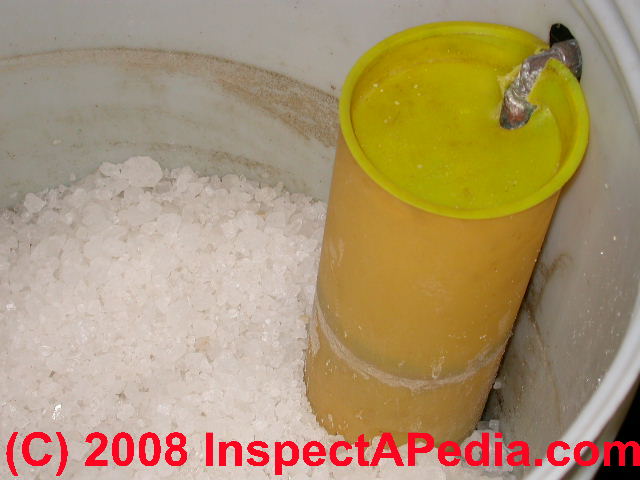
Certainly high levels of salt can kill septic tank or drainfield bacteria.
But a normally-operating water softener is unlikely to harm the septic system.
We start by agreeing that a malfunctioning water softener may damage a septic system in two ways:
- Water volume in Septic Fields from Water Softeners:
The normal water softener backwash cycle is less than 100 gallons and is not a major source of daily water usage at a property (see "Determining Needed Septic Capacity" at "More Reading" below).
If the timer or valve gets stuck in the "backwash-on" cycle (which I have seen happen), the system will run continuously and will flood the septic leach field. This is discussed in "Clogged Drain Diagnosis" referenced at "More Reading" below. - Salt dose of Sodium and Chloride in Groundwater from Water Softeners:
Part of the water softener backwash water contains no extra salt. During an interval of backwash however, some water may be quite salty, perhaps 5,000 ppm to 10,000 ppm.
If the salt dose (which is also adjustable on many water softeners) is set incorrectly high excessive salt may be discharged into the septic system where it may damage the leach field and its biomat.We encountered this condition at a property where the owner had first set the salt dose to the maximum and then set the backwash frequency to a maximum as well, when neither was needed for the level of hardness of the water.
A Michigan DES study of community wastewater treatment systems (not private septic systems) reported that sodium and chloride in the soil at their discharge sites greatly exceeded federal drinking water limits.
This point needs more research since it's not clear that groundwater is required to meet drinking water standards - this is a shortcoming of the Michigan article.
The article continued to cite 120 mg/l for sodium and 250 mg/l for chloride as the maximum allowable levels in groundwater. (See "Sodium and Chloride and Water Softeners" at "More Reading".) - Water softener salt at normal levels will not kill septic tank bacteria
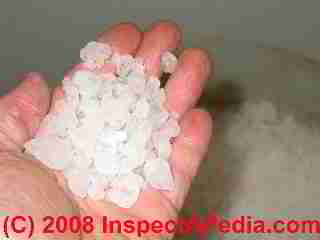 Normally the water softener salt and chloride should not be a problem for the septic system:
One of my clients is a biochemist who specializes in studying septic bacteria.
Normally the water softener salt and chloride should not be a problem for the septic system:
One of my clients is a biochemist who specializes in studying septic bacteria.
His opinion was that in a normally-working home water softener system the level of water softener-produced salt in the septic tank was so diluted by other water flowing into the tank that in his experience it never reached a level that was harmful to septic tank bacteria.
We are not sure if this same conclusion applies to bacteria in the drainfield biomat. Gayman and others have conducted research on salts in drainfield soils and their role in drainfield life.
More details about salt in wastewater are
at WASTEWATER BIOCOMPATIBILITY.
Normally water softener water volume should not be a problem for the septic system.
See REDUCE IMPACT of SOFTENER on SEPTIC and then be sure to read
WATER SOFTENER ADJUSTMENT & CONTROLS to be sure that your water softener is operating properly.
Water Softener Maintenance Tip: Should You Use Potassium Chloride (KCL) ?
Some water softener manufacturers such as for the Sears Kenmore electronic water softener recommend using potassium chloride "salt" (KCL) instead of standard sodium chloride (NaCL) which is standard or ordinary salt, arguing that the equipment will have a longer service life and acknowledging that some people want to absolutely minimize the amounts of salt that might be in softener-treated drinking water.
Watch out: however different water softener settings will be required if you're using KCL.
See WATER SOFTENER SALT SUBSTIUTE: POTASSIUM CHLORIDE
Reader Question: slimy scum water softener problems along with septic system failure - due to water softener?
Since I installed my water softener, I've noticed a few changes.
The first was a slimy scum that had formed in my main line water filter. Upon further investigation, this scum was also forming inside the toilet tanks.
The second thing that I noticed was a break-down of my septic system. I have a double septic tank that was pumped out a year and a half ago. I went five years without having to pump it since there is only my wife and myself at home. There is now a puddle of pungent water that keeps appearing over top of the septic tank.
These could be coincidental, but I think not since it was never a problem until the softener unit was installed. - Neil 4/11/12
Reply:
Neil,
I suggest following the procedures
at WATER SOFTENER CLEANING & SANITIZING,
followed by a test of your water supply (ahead of the water softener) for contaminants. It also sounds as if you have two problems: unsanitary water in the home and a failing septic system.
A relationship between the water softener & septic could be that the softener's regen cycle is flooding the septic system tank & fields, but a puddle over the septic tank could be caused by other septic problems too.
So also see SEPTIC SYSTEM INSPECT DIAGNOSE REPAIR.
For more depth of understanding of the possible issues, also
see REDUCE IMPACT of SOFTENER on SEPTIC
Reader Question: does a water softener let salt water into the plumbing system?
Why does softener let salt water into lines - Anonymous 5/23/12
Reply: a review of water conditioners & salt effects
Anon:
There are two "salt in water" topics when discussing as water softener or water conditioner: 1 = salt in the backwash or regen or recharge water run through the resin tank during a regen cycle and discharged into the sewer or septic tank, and 2 = salt that may be dissolved in to the building's water supply as that water passes through the water softener.
1. A water conditioner uses dissolved salt
in water during the water softener regen cycle.
A water conditioner or water softener works by exchanging sodium ions (salt) for magnesium or calcium ions that are dissolved in the water. It's magnesium and calcium at high levels in water that make it "hard" - high in mineral content.
In order to recharge the resin tank in which the ion exchange process occurs, salty water is washed back through the tank - simultaneously moving calcium and magnesium out with the rinse water and recharging sodium ions in the resin tank.
Because not all of the salt in the regen or recharge water stops in the resin tank, the remaining salt in the water being discharged exits into wherever the water softener backwash water is being drained.
2. A water softener will leave a small amount of dissolved salt or sodium in the building water supply
as it passes through the water softener or water conditioner.
If the conditioner is not properly adjusted the salt level in water could be excessive and can be both a health problem and a source of damage to septic systems.
Se also
REDUCE IMPACT of SOFTENER on SEPTIC.
But normally it's harmless. For people who need to be extra careful to eliminate all salt intake from their diet, some recommend installing a water supply line that can deliver water from ahead of or before the water softener, or installing equipment such as a reverse osmose system that will remove all salt and other minerals from just drinking water in the building.
Details are at HEALTH RISKS & WATER SOFTENERS.
Research on Water Softener Impact on Septic Systems
- AEROBIC SEPTIC SALT IMPACT ON [ found in AEROBIC ATU SEPTIC PROBLEMS ]
- Averbeck, David, Mike Catanzaro, Jason Davis, Andrew Warnes, SOFTENER DISCHARGE VERSUS AEROBIC WASTEWATER TREATMENT UNITS [PDF] Water Conditioning & Purification, Feb. 2010
- Alhajjar, Bashar Jamil, 1981, The Effects of Electrolyte Concentration, Cation Adsorption Ratio, and the Septic Tank Effluent Composition on Hydraulic Properties of Natural Swelling Soil Systems, University of Wisconsin-Madison
- Bounds, T. R. "Design and performance of septic tanks." ASTM Special Technical Publication 1324 (1997): 217-234.
- Bradley, Brenda Ann. THE EFFECTS OF HOME WATER SOFTENER REGENERATION WASTES ON SEPTIC TANK SYSTEM PERFORMANCE [PDF] PhD diss., Texas Tech University, 1981.
Excerpts from Conclusions:
1. The addition of simulated water softener wastes to one of the bench-scale septic tanks of this study resulted in a value for the reduction of influent COD concentration that was 24% less than the reduction obtained with the control tank.
Similarly, once simulated water softener regeneration waste was added to the control tank, a corresponding increase in effluent COD concentrations was noted.
2. Bacterial populations were decreased in the tank receiving regeneration waste in the first experimental phase. Once the tank used in the second phase began receiving regeneration waste, its bacterial populations were also decreased.
3. The MLSS data suggest that the rate of sludge accumulation would increase in a tank receiving water softener regeneration wastes because the rate of anaerobic sludge stabilization in the tank would decrease. Thus, such a tank might require more frequent sludge pumpings.
4. The effluent produced by a tank receiving water softener regeneration wastes had high SAR and specific conductance values indicating that soil permeability could be decreased resulting in potential soil absorption field failures.
5. The high specific conductance values obtained also indicate that the soil absorption field area receiving such wastes might not be suitable for certain types of plant growth, particularly garden vegetable crops.
6. Potential contamination of potable groundwater supplies might result from the high chloride ion concentrations in the effluent of a septic tank receiving water softener regeneration wastes. - Corey, R.B., and Tyler, E.J., 1978, Potential Effects of Water Softener Use on Septic Tank Soil Absorption On-Site Waste Water Systems, University of Wisconsin-Madison.
- Corey, R.B., E.S. Tyler, and M.U. Olotu. 1997. Effects of Water Softer Use on the Permeability of Septic Tank Seepage Fields. In Proceedings of Second National Home Sewage Treatment Symposium. Pub. no. 5-77. American Society of Agricultural Engineers, St. Joseph, MI.
- DalTech Dalhousie University. 2001. The Effect of Softeners on Onsite Wastewater Systems, Centre for Water Resources Studies, On-Site Applied Research Program, Nova Scotia, Canada, 2001.
- Deal, K, 1998. Analysis of Septic System Failure in Gallatin County Montana, MSU Extension Service.
- Etzel, J.E., 1978. Softener Brines Do Not Harm Household Sewage Systems, Purdue University, West Lafayette, IN.
- Grasso, Domenic, Keith Strevett, and Harish Pesari. IMPACT OF SODIUM AND POTASSIUM ON ENVIRONMENTAL SYSTEMS [PDF] Journal of Environmental Systems 22, no. 4 (1992).
- Great Lakes Upper Mississippi River Board of State Sanitary Engineers, 1980. Recommended Standards for Individual Sewage Systems.
- Gross, Mark, and Terry Bounds. "The effect of water softener backwash brine in onsite wastewater treatment systems." In Eleventh Individual and Small Community Sewage Systems Conference Proceedings, 20-24 October 2007, Warwick, Rhode Island, p. 53. American Society of Agricultural and Biological Engineers, 2007.
- Isaacs, W.P., and Stockton, G.R., 1981. Softened Water Energy Savings Study Controlled Experimental Testing Program on Household Water Heaters, New Mexico State University, Las Cruces, NM.
- Pawlak, Maciej, Agnieszka A. Pilarska, Katarzyna Zimnicka, Sebastian Kujawiak, and Radosław Matz. WATER SOFTENER REGENERATION EFFECTS ON THE OPERATION OF DOMESTIC WASTEWATER TREATMENT PLANTS: A PRELIMINARY STUDY [PDF] Applied Sciences 13, no. 5 (2023): 2853.
Abstract
There has been a large amount of scientific research carried out to date on the impact of salty backwash brine from domestic water softeners (WS) on domestic wastewater treatment plants (DWTPs). Experts and practitioners agree that the impact is harmful and there is still a need to look for new technologies. The study of the effect of an increased sodium chloride (NaCl) concentration after softener regeneration is important from the point of view of the operation of DWTPs and soil properties.
This paper presents the results of a field study of the concentration of NaCl at the septic tank (ST) drainage point, into which the grey water from the regeneration of the water softener flowed. During the six-month measurements (recorded every 1 min), an increase in NaCl concentration was observed in the septic tank outflow, from an average NaCl concentration of 1.5 g·L−1—between regenerations—to an average concentration of 4.5 g·L−1—after water softener regeneration.
The increased NaCl concentration decreased significantly up to 2 days after the water softener regeneration. Temperature changes in the treated wastewater were also measured—during the winter period, temperature differences of up to 10 °C per day were recorded.
In the second part of the study, conducted on a semi-technical scale, the effect of brine from the regeneration of the water softener on the hydraulic conductivity (Ks) of the soil from the infiltration drain of the DWTPs studied was assessed.
The Ks was determined by analysing the time it took the water to soak into the soil, using the Van Hoorn equation.
The results and statistical analysis indicate an increased salt content in the soil absorbing the brine, which may have been influenced by the reduced absorption and capacity of the drain due to adverse physico-chemical changes. Keywords: DWTPs; septic tank; water softener; sodium chloride concentration; soil hydraulic conductivity .
Excerpt from Conclusions:
The results of the hydraulic conductivity and statistical analysis, obtained from the semi-technical scale experiment, made it possible to observe differences between the filter columns supplied with treated wastewater and columns to which treated wastewater with brine was applied.
The differences in the liquid height values between the columns indicate the accumulation of salt and the likelihood of its influence on the permeability and absorption of the drain due to physico-chemical changes, including the process of soil swelling and the siltation of porous structures, among others.
Presumably, it is the type of soil that may have a decisive influence on the intensity of siltation of the infiltration drainage. Further studies on the effect of brine on the hydraulic conductivity of the soil for different types of soil and over a longer period of time are therefore planned. - Renn, C.E., Effects of Salts on Waste Treatment Systems, Johns Hopkins University.
- Tedrow, J.C.F., 1997. The Effect of Sodium Discharge from Water Softeners into the Septic Fields of New Jersey, Rutgers University.
- SEPTIC TANK/SOIL-ABSORPTION SYSTEMS: HOW TO OPERATE & MAINTAIN [PDF] - , Equipment Tips, U.S. Department of Agriculture, 8271 1302, 7100 Engineering, 2300 Recreation, September 1982, web search 08/28/2010, original source: http://www.fs.fed.us/t-d/pubs/pdfimage/82711302.pdf.
- Michaud, C.F., 2005. “What’s the Big Stick on Septic Discharge?”, WC&P Magazine, May 2005.
- NSF International, 1978. The Effect of Home Water Softener Waste Regeneration Brines on Individual Aerobic Treatment Plants.
- NSF, WATER SOFTENER USE RAISES QUESTIONS for SYSTEM OWNERS [PDF] Pipeline, Winter 2001 Vol. 12 No. 1, National Small Flows Clearing Health, retrieved 2023/08/28 from Miami County DOH, original source: miamicountyhealth.net/pdf/operational-permits/1268b5_f91b55f70bfd454889748219d73af034.pdf
Excerpts:
Researchers from NSF found that brine wastes had no negative effects on the bacterial population living in the aerobic treatment tank, even when the system was loaded with twice the normal amount of brine/
...
The study found that the volume of water discharged was comparable to or less than that from many automatic washing machines and other household appliances. Researchers also found that the wastewater flowed into the treatment tank slowly enough so that it caused minimal disturbance.
...
Researchers found that the water softener regeneration brine did not reduce the percolation rate of water in the absorption field of a normally operating septic system. This conclusion was reached because the brine contains sodium, but it also includes significant amounts of calcium and magnesium. The calcium in the brine acts similarly to gypsum, a calciumrich substance routinely used to increase the porosity of clay soils in agriculture. The research report stated that calcium, therefore, helps counteract any negative effects of the sodium. Most manufacturers and many industry experts agree with the WQA’s position.
...
“Our experience with regard to the operation and maintenance of systems that discharge water softener backwash to septic tanks is that it has a detrimental effect on the effluent that is discharged,” Bounds said. “As a researcher, I believe that when ‘all’ the variables and processes are evaluated and monitored, measured performance and science will share close results. So far, I have seen no research that compares to typical environmental engineering sciences in anaerobic digesters. Most of the reports that I’ve seen suggest that this research still needs to be done.”
Watch out: as you can read in comments by Terry Bounds, above, septic engineers and other experts disagree about these studies and their conclusions and point out that the test conditions including types of septic tank and absorption system used in studies may not represent those encountered by many homeowners, such as using aerobic septic systems that use air injection to support the growth of aerobic bacteria while most home septic systems use conventional septic systems with a tank and drainield.
- Water Quality Association. 1976. Effects of Backwash Water and Regeneration Wastes from Household Water Conditioning Equipment on Private Sewage Disposal Systems. 15. Wood, F.O., The Results of Putting Brine Effluent Into a Septic Tank Drainage System, Salt Institute, Alexandria, VA, 1984.
Effects of Water Hardness or Softness on Plumbing & Heating Equipment, Heating Boilers, Water Heaters, Tankless Coils
Effects Hard Water (high in mineral content) on Building Piping, Water Heaters, Heating Boilers, Tankless Coils
The effects of water that is too high in mineral content are widely understood to lead to mineral deposits in building plumbing systems and heating equipment.
The precipitation of minerals out of hard water into or onto plumbing and heating components is generally more rapid and extreme at points of highest temperature in the system, but the effects of hard water on building mechanicals are also a function of the volume of water moving through the system. In sum, for hard water, the effects on building piping, heating equipment, water heaters, and tankless coils is a function of
- The hardness level of the water
- The volume of water that is run through the plumbing system, boiler, water heater, or tankless coil over time
- The temperatures of the water as it moves through the equipment
- The surface properties of the equipment. For example, using an acid flush to clean a tankless coil also leaves the copper surface inside the coil etched and rougher than when new - possibly meaning that even with no change in the other parameters above, the time to clog-up again with minerals may be less than when the equipment was new.
Tankless coils
used on heating boilers to product domestic hot water are particularly prone to clogging from minerals in hard water, as we discuss in detail at Clogged Pipes / Tankless Coil De-Scale
Hydronic heating boilers
themselves are less affected by hard water because except in the case of chronic leakage, the water placed into a hydronic heating boiler system is static - we are not normally constantly introducing new water and more minerals.
However water chemistry is nevertheless important in some heating system applications, and special additives may be used to protect the system. Discuss this question with your heating service company.
Steam boilers
unlike hydronic heating boilers, may indeed suffer from high mineral content in hard water, as new or makeup water is regularly required and added (manually or by an automatic fill valve) in steam heating boiler systems. And as we just cited, water chemistry is nevertheless important in some heating system applications, and special additives may be used to protect the steam heating system.
Water heaters used to produce domestic hot water indeed suffer from scale formation from hard water.
See WATER HEATER SCALE DE-LIMING PROCEDURE and WATER HEATER SCALE PREVENTION for details.
Effects of Soft Water (very low in mineral content) on Water Heaters & Heating Boilers
Lochinvar® LLC, a producer of high efficiency boilers, water heaters, and pool heaters, has produced an interesting technical bulletin that warns installers and building owners about special considerations when their equipment (and most likely that of other manufacturers when the heat exchanger is made of copper) is installed in buildings served by a water softener. [20] Quoting:
The required temperature rise and the standard pump used with Copper Heat Exchangers is based on the presumption of typical water chemistry of 8 – 25 grains of hardness, and less than 350 ppm dissolved solids (TDS). Caution must be used when heating water softened water below 8 grains.
Typically commercial water softeners reduce hardness to 0 grains which may result in long term problems in the system.
When using softened water the installer must be aware that increasing temperatures causes an increase in the speed of chemical reactions. The rate of increase of chemical reactions approximately doubles for every 25 – 30 degrees Fahrenheit rise in temperature up to about 160 degrees F.
The rate of water flow governs the rate at which the dissolved oxygen (essential to corrosion) is replenished at metal surfaces. Typically the corrosion is characterized by pitting resulting from metallic hydroxide and tuberculation reaction.
Metal hydroxide dissolves the metal, and tuberculation reduces the hydraulic capacity of the tubing. Since this aggressive reaction typically happens at the metal to flow interface early heat exchanger failure can be expected.
Water heaters can be used in softened water but it is imperative that careful attention be paid to the heat exchanger. Proper operation will normally require setting the water heater with a lower flow rate and higher temperature rise.
Decreasing the flow rate will reduce the erosion process, however the heat exchanger should be monitored to ensure the scale/liming process is not exacerbated. The unit should be placed on a comprehensive inspection schedule until optimum flow rates can be established.
Problematic water areas may require heat exchanger inspection every two weeks. The total scale accumulation should never exceed the thickness of a piece of paper. Should scale accumulation exceed this thickness the flow rate will need to be increased. The tubes should not have a bright shiny copper look.
This would indicate that the erosion process has begun and the flow rate will need to be decreased. Once the proper flow rates have been established the inspection intervals can be increased to every 30 days, once a quarter, to a bi-annual inspection.
This procedure should insure proper operation of the unit as long the water quality stays consistent.
- Lochinvar, LLC World Headquarters, 300 Maddox Simpson Pkwy., Lebanon, TN 37090, Tel - Customer Service:
615-889-8900, contact Lochinvar Technical Service at 1-800-722-2101, Website: http://www.lochinvar.com/ [20]
The company's technical bulletin includes a table that relates heater BTU Input Rates (between 90,000 & 500,000 BTUH), and Delta T at 0-7 grains of hardness compared with Delta T at 8-25 grains of hardness. We note that the higher the BTUH firing rate of the heating equipment, the higher is the required Delta T (temperature rise). For example,
- a 90,000 BTUH input water heater [using a copper heat exchanger] handling water at 0-7 grains of hardness has its Delta "T" set to 8 degrees, while the same device handling water at 8-25 grains of hardness uses a Delta "T" of 5 degrees.
- a 135,000 BTUH input water heater [using a copper heat exchanger] handling water at 0-7 grains of hardness has its Delta "T" set to 12 degrees, while the same device handling water at 8-25 grains of hardness uses a Delta "T" of 7 degrees.
- a 500,000 BTUH input water heater [using a copper heat exchanger] handling water at 0-7 grains of hardness has its Delta "T" set to 40 degrees, while the same device handling water at 8-25 grains of hardness uses a Delta "T" of 28 degrees.
So you can see there is a significant change in temperature requirements for high-BTUH equipment.
Extensive quotation & technical review requested of Lochinvar 12/15/12
...
Continue reading at REDUCE IMPACT of SOFTENER on SEPTIC or select a topic from the closely-related articles below, or see the complete ARTICLE INDEX.
Or see these
Recommended Articles
- AEROBIC ATU SEPTIC PROBLEMS
- HEALTH RISKS & WATER SOFTENERS - possible health concerns for salt added to drinking water by a water softener
- OTHER SOFTENER METHODS - examples of water treatment & water softening methods that do not use salt or ion-exchange
- REDUCE IMPACT of SOFTENER on SEPTIC
- SALT DOSE SETTING, WATER SOFTENER - how to determine & set the water softener salt dose
- WATER SOFTENER SALT CHOICES
- WATER SOFTENER SANITIZER IMPACT on SEPTICS - does using a sanitizer to clean the water softener hurt the septic system?
Suggested citation for this web page
SALT / SOFT WATER IMPACT on SEPTIC, PLUMBING, HEATERS at InspectApedia.com - online encyclopedia of building & environmental inspection, testing, diagnosis, repair, & problem prevention advice.
Or see this
INDEX to RELATED ARTICLES: ARTICLE INDEX to WATER TREATMENT SYSTEMS
Or use the SEARCH BOX found below to Ask a Question or Search InspectApedia
Ask a Question or Search InspectApedia
Try the search box just below, or if you prefer, post a question or comment in the Comments box below and we will respond promptly.
Search the InspectApedia website
Note: appearance of your Comment below may be delayed: if your comment contains an image, photograph, web link, or text that looks to the software as if it might be a web link, your posting will appear after it has been approved by a moderator. Apologies for the delay.
Only one image can be added per comment but you can post as many comments, and therefore images, as you like.
You will not receive a notification when a response to your question has been posted.
Please bookmark this page to make it easy for you to check back for our response.
Our Comment Box is provided by Countable Web Productions countable.ca
Citations & References
In addition to any citations in the article above, a full list is available on request.
- [1] North Dakota Standards for Water Softeners, North Dakota General Authority Law, Chapter 62-04-08, Water Softener Units http://www.legis.nd.gov/information/acdata/pdf/62-04-08.pdf. "The objective of this chapter is to provide a standard of quality, capacity, and performance for water softener units. Water softener performance is to be based upon referee tests procedures described in section 62-04-08-09."
- [2] Culligan Mark 10 Water Softener 1994-1998 Installation and Operating Instructions (covering models manufactured after 1995) (1-96) 01881948.pdf available from www.culligan.com
- [3] Water Softeners, CMHC, Canadian Mortgage and Housing Corporation, cmhc-schl.gc.ca/en/co/maho/wawa/wawa_005.cfm - October 2008. Canada Mortgage and Housing Corporation acknowledges the contribution of Health Canada to the development of this document. For further questions regarding water treatment and water quality, contact Health Canada at watereau@hc-sc.gc.ca or call 613-957-2991 or 1-866-225-0709.
- [4] "Commercial Water Softener Installation and Operating Instructions", IBC Filtration & Water Treatment Products (Australia) for commercial, industrial and residential application www.ibcwater.com.au (07) 3219 2233
- [5] "Non electric water softener, Installation and Operating Instructions", IBC Filtration & Water Treatment Products (Australia), op.cit.
- [6] "Water Softener Twin Tank Installation and Operating Instructions", IBC Filtration & Water Treatment Products (Australia), op.cit.
- [8] North Dakota Standards for Water Softeners, North Dakota General Authority Law, Chapter 62-04-08, Water Softener Units http://www.legis.nd.gov/information/acdata/pdf/62-04-08.pdf. "The objective of this chapter is to provide a standard of quality, capacity, and performance for water softener units. Water softener performance is to be based upon referee tests procedures described in section 62-04-08-09."
- [9] Culligan Mark 10 Water Softener 1994-1998 Installation and Operating Instructions (covering models manufactured after 1995) (1-96) 01881948.pdf available from www.culligan.com
- [10] Water Softeners, CMHC, Canadian Mortgage and Housing Corporation, cmhc-schl.gc.ca/en/co/maho/wawa/wawa_005.cfm - October 2008. Canada Mortgage and Housing Corporation acknowledges the contribution of Health Canada to the development of this document. For further questions regarding water treatment and water quality, contact Health Canada at watereau@hc-sc.gc.ca or call 613-957-2991 or 1-866-225-0709.
- [11] "Commercial Water Softener Installation and Operating Instructions", IBC Filtration & Water Treatment Products (Australia) for commercial, industrial and residential application www.ibcwater.com.au (07) 3219 2233
- [12] "Non electric water softener, Installation and Operating Instructions", IBC Filtration & Water Treatment Products (Australia), op.cit.
- [13] "Water Softener Twin Tank Installation and Operating Instructions", IBC Filtration & Water Treatment Products (Australia), op.cit.
- [15] Andress, S., and C. Jordan. 1998. Onsite Sewage Systems. Virginia Polytechnic Institute and State University, Civil Engineering Department, Blacksburg, VA.
- [17] Mancl, K.M. 1998. Septic Tank Maintenance. Ohio State University Extension publication AEX-740-98. Ohio State University, Food, Agricultural and Biological Engineering. Columbus, OH.
- [18] University of Wisconsin. 1978. Management of Small Waste Flows. EPA-600/2-78-173. U.S. Environmental Protection Agency, Cincinnati, OH.
- [19] U.S. Environmental Protection Agency (USEPA). 1992. Manual: Wastewater Treatment/Disposal for Small Communities. EPA 625/R-92/005. U.S. Environmental Protection Agency, Cincinnati, OH.
- [20] "Softened Water Impact on Water Heaters, Bulletin Number: 2004-02I", Lochinvar High Efficiency Water Heaters, Boilers & Pool Heaters, Lochinvar, LLC World Headquarters, 300 Maddox Simpson Pkwy., Lebanon, TN 37090, Tel - Customer Service: 615-889-8900, contact Lochinvar Technical Service at 1-800-722-2101 web search 12/15/2012, original source: http://www.lochinvar.com/
Lochinvar United Kingdom 7 Lombard Way The MXL Centre Banbury, Oxon OX 164TJ Phone: (01295)-269-981 Fax: (01295)-271-640 Web: www.lochinvar.ltd.uk - [21] Kenmore Water Softener Use & Care Guide, Model 635.383000 (with a high flow valve), retrieved 2/14/2013, original source: http://c.sears.com/assets/own/896150e.pdf [ copy on file as Kenmore_Softener_No.625.383_Manual.pdf ]
- [1] A.I. McDermott Co., Inc. produces the AquaSoft series of water softeners including the AquaSoft Pro-Plus 460-series water softeners Pro 255, Pro Performa 400, Pro 460i, Logix, and CL softeners. Here is an example water softener manual for the Aquasoft Pro Plus water softener with the 460i Controllers such as PES32M268-MP - web search 09/11/2010, original source: http://www.gewater.com/pdf/resdntl/manuals/1017948.pdf describing a General Electric GE-produced control.
- [2] Autotro® 255 Valve / 400 Series Controls, Water Conditioning Control System, Home Owner Installation, Operation, and Maintenance Manual, Pentair Residential Filtration, LLC, 2009
- [3] Autotrol® Series 255 Valve / 460i Water Conditioning Control System, Installation, Operation, and Maintenance Manual, web search 09/01/2010 original source: http://www.qualitywatertreatment.com/PDF/Autotrol%20255-460i_Manual.pdf
- [4] Aquatell (Nelsen Corporation) produces Autotrol Water Conditioners. Email: sales@aquatell.com Tel: Toll Free 1-866-966-9951 Website: Toll Free 1-866-966-9951 Website: http://www.aquatell.com/
- [5] "Commercial Water Softener Installation and Operating Instructions", IBC Filtration & Water Treatment Products (Australia) for commercial, industrial and residential application www.ibcwater.com.au (07) 3219 2233
- [6] Culligan System 19 and 23 Water Conditioners (Filament Wound Tank) Installation and Operating Instructions, Cat. No. 00-8816-57 (Printed 6/89), Culligan INternational Company, Northbrook IL. 60062, San Bernadino CA 92402, Culligan NV/Brussels, Belgium, Culligan Italiana SpA/Bologna, Italy, Culligan of Canada, Ltd., Mississauga, Ontario, Canada L5K 1A5
- [7] Culligan Mark 10 Water Softener 1994-1998 Installation and Operating Instructions (covering models manufactured after 1995) (1-96) 01881948.pdf available from www.culligan.com
- [8] "Non electric water softener, Installation and Operating Instructions", IBC Filtration & Water Treatment Products (Australia), op.cit.
- [9] North Dakota Standards for Water Softeners, North Dakota General Authority Law, Chapter 62-04-08, Water Softener Units http://www.legis.nd.gov/information/acdata/pdf/62-04-08.pdf. "The objective of this chapter is to provide a standard of quality, capacity, and performance for water softener units. Water softener performance is to be based upon referee tests procedures described in section 62-04-08-09."
- [11] "Water Softener Twin Tank Installation and Operating Instructions", IBC Filtration & Water Treatment Products (Australia), op.cit.
- [12] Water Softeners, CMHC, Canadian Mortgage and Housing Corporation, cmhc-schl.gc.ca/en/co/maho/wawa/wawa_005.cfm - October 2008. Canada Mortgage and Housing Corporation acknowledges the contribution of Health Canada to the development of this document. For further questions regarding water treatment and water quality, contact Health Canada at watereau@hc-sc.gc.ca or call 613-957-2991 or 1-866-225-0709.
- [13] Watts Industries of North Andover, Mass., provides its ZRO-4 under counter system intended to target the independent water dealer market.
- [14] Thanks to reader M.P. for discussing the requirement to adjust the float level in water softener brine tanks - January 2011
- [15] Kinetico Model 50 Water Conditioner, 2002, Kinetico Home Water Systems, 10845 Kinsman Road
Newbury, Ohio 44065 USA, Tel: 800-944-9283. Kinetico also produces the AquaKinetic Series and Powerline Series Water Softeners. - [16] Treatment Systems for Household Water Supplies, Iron and manganese Removal, Bruce Seelig, Water Quality Specialist, North Dakota Extension Service Russell Derickson, Extension Associate in Water and Natural Resources, South Dakota Extension Service Fred Bergsrud, Water Quality Coordinator, Minnesota Extension Service, AE-1030, County Commissions, North Dakota State University and U.S. Department of Agriculture cooperating. Web search 04/16/2012, original source: http://www.ag.ndsu.edu/pubs/h2oqual/watsys/ae1030w.htm [copy on file as /Water/Iron_Manganese_Removal_NDSU.pdf]
- National Small Flows Clearinghouse, Pipeline, Winter 2001.
- [18] Kenmore Water Softener Use & Care Guide, Model 635.383000 (with a high flow valve), retrieved 2/14/2013, original source: http://c.sears.com/assets/own/896150e.pdf [ copy on file as Kenmore_Softener_No.625.383_Manual.pdf ]
- In addition to citations & references found in this article, see the research citations given at the end of the related articles found at our suggested
CONTINUE READING or RECOMMENDED ARTICLES.
- Carson, Dunlop & Associates Ltd., 120 Carlton Street Suite 407, Toronto ON M5A 4K2. Tel: (416) 964-9415 1-800-268-7070 Email: info@carsondunlop.com. Alan Carson is a past president of ASHI, the American Society of Home Inspectors.
Thanks to Alan Carson and Bob Dunlop, for permission for InspectAPedia to use text excerpts from The HOME REFERENCE BOOK - the Encyclopedia of Homes and to use illustrations from The ILLUSTRATED HOME .
Carson Dunlop Associates provides extensive home inspection education and report writing material. In gratitude we provide links to tsome Carson Dunlop Associates products and services.
 | HOME | ABOUT | ASK a QUESTION | CONTACT | CONTENT USE POLICY | DESCRIPTION | POLICIES | PRIVACY | |
| © 2024 - 1985 Publisher InspectApedia.com - Daniel Friedman | |||||||||