
InspectAPedia® FREE Encyclopedia of Building & Environmental Construction, Diagnosis, Maintenance & Repair |
Question? Just ask us! InspectAPedia
|
 Reduce Effects of Water Softener
or
Water Conditioner (salt and water volume)
on Septic Systems
- POST a QUESTION or COMMENT about how to reduce the effects of a Water Softener or Water Conditioner (salt and water volume) on septic systems
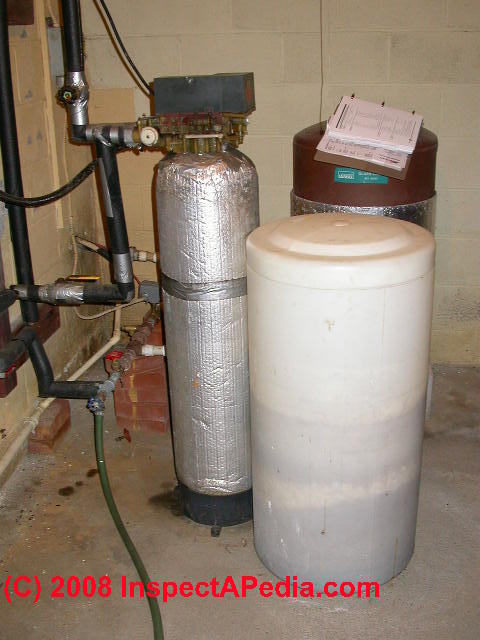
How to reduce the effects of a Water Softener or Water Conditioner (salt and water volume) on septic systems : this article provides tips on how to minimize the volume of water used and amount of salt damage to septic tanks and drainfields.
InspectAPedia tolerates no conflicts of interest. We have no relationship with advertisers, products, or services discussed at this website.
How to reduce the impact of a water softener on the Septic System and on Groundwater
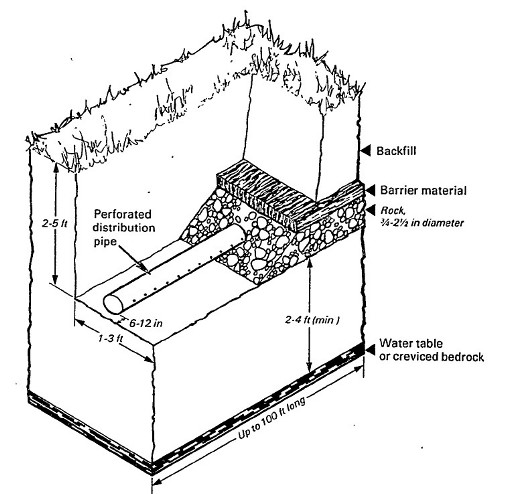 At SALT OR WATER INTO SEPTIC we explain the impact and possible damage of (an improperly operating) water softener on septic systems or on building drinking water.
If your water treatment equipment, such as a water softener, sulphur-odor remover, sediment filter, or chlorinator is properly adjusted, the concentration of chemicals discharged by the equipment should not harm the septic tank and drainfield, according to a septic-bacteria microbiologist whom we consulted.
He explained that in a properly-operating water softener system the concentration of salt released into the septic system would be so low as to be harmless to the bacteria needed in septic tanks and drainfields.
Really? But if water treatment is not working properly, or if it is simply not adjusted properly, both the water volume discharged by the equipment and the concentration of chemicals or salts discharged by the equipment might be a problem for the septic tank or drainfield.
Really again? By 2022, a number of U.S. states are reported to have taken steps intended to reduce the use of water softenrs, including Arizona, California, Wisconsin, Michigan, Delewaer, Florida, Connecticut, Minnesota. (SaltMiner 2022).
Here we list things you can do to protect the septic system from harm from water treatment equipment.
- Adjust the water softener
to the recommended settings for the level of hardness of your water supply. (Some water softeners actually monitor water hardness and water usage and will adjust the recharge cycle frequency and salt dose automatically. Other water softeners require that these settings be made manually. Still simpler water softeners have no automatic recharge cycle and must be backwashed and recharged manually.
See WATER SOFTENER ADJUSTMENT & CONTROLS for details of how to do this, but also remember to check the actual hardness of your water supply and to adjust the softer according to the tables and instructions provided by the manufacturer. - Set the water softener operating controls correctly
as we discuss at Guide to Water softener Adjustment below.
Be sure the water softener backwash frequency and salt dose are set properly for the hardness of your water and water volume usage.
See WATER SOFTENER ADJUSTMENT & CONTROLS for details. - Don't use a water softener if it is not necessary.
Test your water for hardness. - Watch for malfunctioning water softening equipment:
if you hear water running continuously in your drain you should track down the source to a leaky toilet tank, faucet, or malfunctioning water softener, etc.
We have seen a septic drainfield completely flooded by a water softener that stuck in it's "backwash" cycle.
Similarly, if a water softener is not properly adjusted it may use more salt, more potassium permanganate, or other water treatment chemicals than it should. Flushing salt, potassium permanganate, chlorine, or other chemicals into the septic system can cause a problem if it kills off septic tank bacteria or soil bacteria. - Turn off the water softener when the building will be unoccupied.
There is no need to recharge the water softener when no water is being used in the home.
See Winterize Water Softener & Treatment Equip for the water softener shut-down procedure. 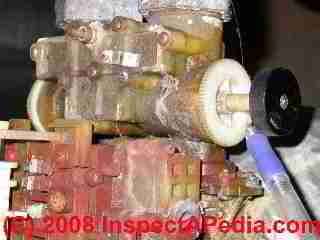 Bypass the water softener
when you are watering plants or washing the car.
Some plumbers install a water line direct to an outside faucet, bypassing the water softener for this purpose.
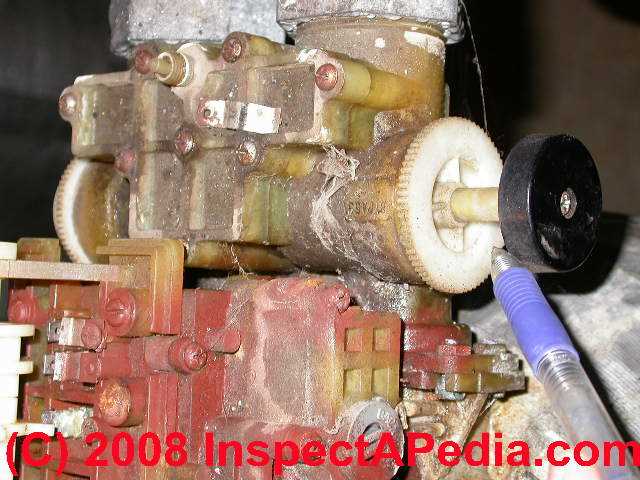
If you do not have a separate water line to an outside hose bib, you can temporarily put the water softener on "bypass" using a push-type control such as the one shown in this photograph.
Remember to push the bypass lever back to softening position after such an outside use of water, lest you forget and clog your pipes with minerals.
See WINTERIZE WATER SOFTENER & TREATMENT EQUIPMENT for details on how to do this.- Use salt alternatives in the water softener:
potassium chloride may be an acceptable alternative to normal salt or sodium chloride for problem areas - Use a separate drywell
to receive water softener backwash. This reduces the wastewater load on the septic system drainfield or seepage bed. Using a separate drywell to receive water softener backwash, or backwash from any water treatment equipment, also reduces the chances that water treatment chemicals will harm bacteria in the septic tank or drainfield.
Water treatment chemicals such as salt, potassium permanganate (often used to remove a sulphur odor from water), chlorine or other disinfectants will not usually harm a septic system provided that they enter the septic tank in a dilute solution such as that provided by a normal, properly-adjusted water softener.
But should the equipment mal-function or be mal-adjusted, both water quantity and chemicals in water discharged by the treatment equipment might be a problem. - Connect to municipal water supply (if available)
so that your water will arrive already properly conditioned and wont' require softening - See water softener maintenance guide
of how to adjust the water softener and how to clean the water softener salt tank
at WATER SOFTENER ADJUSTMENT & CONTROLS
Research on Environmental Effects of Salt in Wastwater Discharged from Water Softners
- Averbeck, David, Mike Catanzaro, Jason Davis, Andrew Warnes, SOFTENER DISCHARGE VERSUS AEROBIC WASTEWATER TREATMENT UNITS [PDF] Water Conditioning & Purification, Feb. 2010
- Salt Miner, SALT REGULATIONS [PDF] - The Salt Miner - (no personal identification is provided), Email: info@thesaltminer.com Tel: (760) 408-4536, retrieved 2022/09/21, original source: https://thesaltminer.com/regulations/
Note; "The Salt Miner" appears to be a modular system intended to remove salt from wastewater before the wastewater is discharged to sewer or septic systems. We did not find details nor supporting research for this interesting idea, nor an explanation of how the removed salt is then disposed-of. - More research citations are
at SALT / SOFT WATER IMPACT on SEPTIC, PLUMBING, HEATERS
Reader Comments, Questions & Answers About The Article Above
Below you will find questions and answers previously posted on this page at its page bottom reader comment box.
Reader Q&A - also see RECOMMENDED ARTICLES & FAQs
On 2017-05-17 by Trish - does a water softener ever damage a septic system / drainfield?
Does a water softener system cause ANY problems with a septic system/ drain field?
On 2017-05-17 2 by (mod) - Does a water softener system cause ANY problems with a septic system/ drain field?
A water softener can damage a drainfield, Trish, as we describe in the article above and in this article series, in particular if
- water softener regen cycles flood the drainfield either by a high-frequency regular program or due to a control malfunction
and also because
- salt in the softener regen backwash is harmful to septic drainfield bacteria. Gayman's research on this indicated that salt in the drainfield was very harmful
Ideal would be to route the softener's discharge to a separate drywell
On 2016-09-13 by Joanne - neighbors dump their softener backwash towards my well
Neighbours have their softener backwash hose aimed at my well
On 2016-09-14 0 by (mod) - Neighbours have their softener backwash hose aimed at my well
Joanne,
Sounds annoying to me too, Joanne. However the actual risk of salty water softener backwash discharge contaminating your well depends on a number of variables including
The distance from the discharge to your well, the type of well, the adequacy of ceiling of your will against surface runoff, and perhaps other features.
If you have a modern sanitary will using a steel casing, then that casing needs to be sealed against ground water or surface runoff leaking into your well from any Source. Otherwise your well water would be contaminated.
Check with your local health department and building department to see if your neighbor is discharging Wastewater to the surface. In many jurisdictions that is not permitted. It is also possible that the neighbor is discharging closer to the property line then would be permitted.
On 2015-10-08 by Anonymous - water softener waste discharge may harm an ECO Septic System - pete moss?
will a water softner hurt an eco sewer system somebody told me it breaks down the pete moss
On 2015-10-08 by (mod) - not permitted to dump graywater to the ground surface
IN many jurisdictions it is not permitted to dump graywater to the ground surface. A drywell might work for that situation.
Salts in softener discharge may damage some wastewater treatment systems - Gayman has done extensive research confirming that assertion.
...
Continue reading at WATER SOFTENER SANITIZER IMPACT on SEPTICS, or select a topic from the closely-related articles below, or see the complete ARTICLE INDEX.
Or see these
Recommended Articles
- AEROBIC ATU SEPTIC PROBLEMS
- HEALTH RISKS & WATER SOFTENERS
- OTHER SOFTENER METHODS - examples of water treatment & water softening methods that do not use salt or ion-exchange
- SALT / SOFT WATER IMPACT on SEPTIC, PLUMBING, HEATERS - effects of softened or aggressive water
- SALT DOSE SETTING, WATER SOFTENER - how to determine & set the water softener salt dose
- WATER SOFTENER ADJUSTMENT & CONTROLS - how to adjust the water softener
- WATER SOFTENER SALT CHOICES
- WATER SOFTENER SANITIZER IMPACT on SEPTICS - does using a sanitizer to clean the water softener hurt the septic system?
Suggested citation for this web page
REDUCE IMPACT of SOFTENER on SEPTIC at InspectApedia.com - online encyclopedia of building & environmental inspection, testing, diagnosis, repair, & problem prevention advice.
Or see this
INDEX to RELATED ARTICLES: ARTICLE INDEX to WATER TREATMENT SYSTEMS
Or use the SEARCH BOX found below to Ask a Question or Search InspectApedia
Ask a Question or Search InspectApedia
Questions & answers or comments about how to reduce the effects of water softeners on septic tanks or septic systems in general
Try the search box just below, or if you prefer, post a question or comment in the Comments box below and we will respond promptly.
Search the InspectApedia website
Note: appearance of your Comment below may be delayed: if your comment contains an image, photograph, web link, or text that looks to the software as if it might be a web link, your posting will appear after it has been approved by a moderator. Apologies for the delay.
Only one image can be added per comment but you can post as many comments, and therefore images, as you like.
You will not receive a notification when a response to your question has been posted.
Please bookmark this page to make it easy for you to check back for our response.
Our Comment Box is provided by Countable Web Productions countable.ca
Citations & References
In addition to any citations in the article above, a full list is available on request.
- [1] North Dakota Standards for Water Softeners, North Dakota General Authority Law, Chapter 62-04-08, Water Softener Units http://www.legis.nd.gov/information/acdata/pdf/62-04-08.pdf. "The objective of this chapter is to provide a standard of quality, capacity, and performance for water softener units. Water softener performance is to be based upon referee tests procedures described in section 62-04-08-09."
- [2] Culligan Mark 10 Water Softener 1994-1998 Installation and Operating Instructions (covering models manufactured after 1995) (1-96) 01881948.pdf available from www.culligan.com
- [3] Water Softeners, CMHC, Canadian Mortgage and Housing Corporation, cmhc-schl.gc.ca/en/co/maho/wawa/wawa_005.cfm - October 2008. Canada Mortgage and Housing Corporation acknowledges the contribution of Health Canada to the development of this document. For further questions regarding water treatment and water quality, contact Health Canada at watereau@hc-sc.gc.ca or call 613-957-2991 or 1-866-225-0709.
- [4] "Commercial Water Softener Installation and Operating Instructions", IBC Filtration & Water Treatment Products (Australia) for commercial, industrial and residential application www.ibcwater.com.au (07) 3219 2233
- [9] Culligan Mark 10 Water Softener 1994-1998 Installation and Operating Instructions (covering models manufactured after 1995) (1-96) 01881948.pdf available from www.culligan.com
- [10] Water Softeners, CMHC, Canadian Mortgage and Housing Corporation, cmhc-schl.gc.ca/en/co/maho/wawa/wawa_005.cfm - October 2008. Canada Mortgage and Housing Corporation acknowledges the contribution of Health Canada to the development of this document. For further questions regarding water treatment and water quality, contact Health Canada at watereau@hc-sc.gc.ca or call 613-957-2991 or 1-866-225-0709.
- [11] "Commercial Water Softener Installation and Operating Instructions", IBC Filtration & Water Treatment Products (Australia) for commercial, industrial and residential application www.ibcwater.com.au (07) 3219 2233
- [12] "Non electric water softener, Installation and Operating Instructions", IBC Filtration & Water Treatment Products (Australia), op.cit.
- [13] "Water Softener Twin Tank Installation and Operating Instructions", IBC Filtration & Water Treatment Products (Australia), op.cit.
- [15] Andress, S., and C. Jordan. 1998. Onsite Sewage Systems. Virginia Polytechnic Institute and State University, Civil Engineering Department, Blacksburg, VA.
- [16] Corey, R.B., E.S. Tyler, and M.U. Olotu. 1997. Effects of Water Softer Use on the Permeability of Septic Tank Seepage Fields. In Proceedings of Second National Home Sewage Treatment Symposium. Pub. no. 5-77. American Society of Agricultural Engineers, St. Joseph, MI.
- [20] "Water Softener Twin Tank Installation and Operating Instructions", IBC Filtration & Water Treatment Products (Australia), op.cit.
- [21] Watts Industries of North Andover, Mass., provides its ZRO-4 under counter system intended to target the independent water dealer market.
- In addition to citations & references found in this article, see the research citations given at the end of the related articles found at our suggested
CONTINUE READING or RECOMMENDED ARTICLES.
- Carson, Dunlop & Associates Ltd., 120 Carlton Street Suite 407, Toronto ON M5A 4K2. Tel: (416) 964-9415 1-800-268-7070 Email: info@carsondunlop.com. Alan Carson is a past president of ASHI, the American Society of Home Inspectors.
Thanks to Alan Carson and Bob Dunlop, for permission for InspectAPedia to use text excerpts from The HOME REFERENCE BOOK - the Encyclopedia of Homes and to use illustrations from The ILLUSTRATED HOME .
Carson Dunlop Associates provides extensive home inspection education and report writing material. In gratitude we provide links to tsome Carson Dunlop Associates products and services.
 | HOME | ABOUT | ASK a QUESTION | CONTACT | CONTENT USE POLICY | DESCRIPTION | POLICIES | PRIVACY | |
| © 2024 - 1985 Publisher InspectApedia.com - Daniel Friedman | |||||||||