
InspectAPedia® FREE Encyclopedia of Building & Environmental Construction, Diagnosis, Maintenance & Repair |
Question? Just ask us! InspectAPedia
|
 Guide to Aerobic Septic Systems
Septic Alternative for Difficult Sites
- POST a QUESTION or COMMENT about aerobic treatment units (ATUs) and aerobic septic systems: design, installation, inspection, maintenance, & repair
ATUs - Aerobic Septic Systems:
ATUs aerobic treatment units - Design, installation, and maintenance of aerobic septic systems. Specifications for ATU septic tank sizes, final treatment steps, certifications, and failures or problems. Suggestions for aerobic septic system maitnenance, choices of ATU disinfectants, and sources of Aerobic Septic System Supplies. ATU spray head maintenance.
This article series explains the designs and products, installation, maintenance, and repair of aerobic septic treatment units (ATUs) for onsite waste disposal, also called fine bubble aeration systems.
We describe how aerobic treatment units work, what are the components of aerobic septic systems, now they are maintained or repaired, and where to find replacement parts, owners manuals, and operating instructions.
We address aerobic septic system design, features, inspection, repair, and maintenance. Product sources are also listed.
InspectAPedia tolerates no conflicts of interest. We have no relationship with advertisers, products, or services discussed at this website.
Aerobic Treatment Septic Systems: types, designs, maintenance instructions
Aerobic Septic systems add oxygen to the process of treating septic of sewage wastewater by using any of several types aeration or "fine air bubble" systems to increase the level of effluent treatment in the septic tank by encouraging aerobic bacteria. Aerobic systems produce a better-quality wastewater effluent for discharge into the absorption system for final treatment and disposal.
What is an Aerobic Treatment Unit for Septic Effluent?
In residential use, aerobic treatment units (ATUs, also called "home aeration systems" or "septic tank aeration systems") are pre-packaged septic treatment systems which are in essence a mini-wastewater treatment plant for home use. "Aerobic" refers to the use of an air pump to add oxygen to the treatment tank to increase the level of treatment by the system.
AEROBIC Septic systems thus require electrical power and cost more to install and operate (more frequent tank pumping) than a traditional gravity septic tank and drainfield.
Aerobic treatment, which can produce very high quality treated effluent, is used at sites where a conventional septic drainfield simply wont' work, perhaps because of wet soils or very rocky conditions.
ATUs are also used to restore a working septic system where a traditional septic system has failed and is difficult to repair. Other common reasons for installing aerobic septic treatment units include lots close to lakes and streams or lots which are too small to fit a conventional septic system.
Aerobic treatment may not entirely eliminate the requirement for a drainfield, but it can substantially reduce the drainfield area and capacity required. This is not a "new" idea. Aeration of wastewater as a means of septic effluent treatment has been in use for more than 100 years (using media filters according to Jantrania).
How do Aerobic Septic Treatment Units Work?
An aerobic treatment unit is basically an "oxidizer" which uses extra oxygen dissolved in the wastewater to support aerobic microorganisms which in turn decompose dissolved organic and nitrogen compounds into simple CO2 or into inorganic compounds.
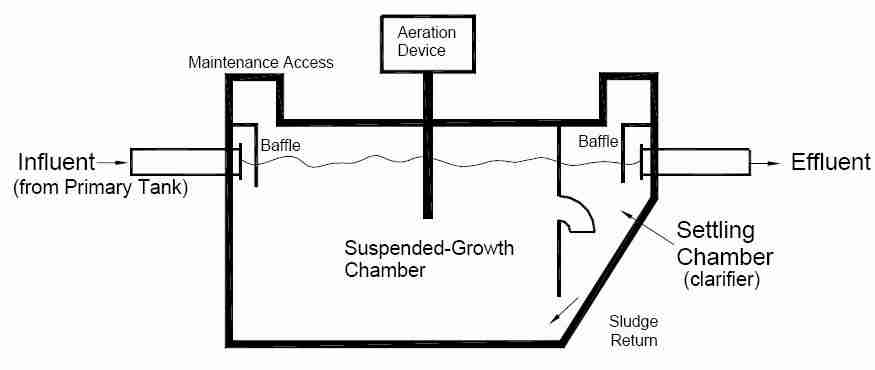
As microorganisms die off they accumulate as a sludge of biological material, some of which supports the development of new cells or microorganisms to keep the system working. ATU's separate solid waste first in the "trash tank" and later, additional solids are separated in the clarifier or settlement tank from which they may be returned to the primary tank for more treatment. (See the sketch at the top of this page.)
"Typical organic materials that are found in residential strength wastewater include carbohydrates, fats, proteins, urea, soaps and detergents. All of these compounds contain carbon, hydrogen, and oxygen. Domestic wastewater also includes organically bound nitrogen, sulfur and phosphorus.
During biochemical degradation, these three elements are biologically transformed from organic forms to mineralized forms (i.e., NH3, NH4, NO3, SO4, and PO4)." -- Reference #3 at page bottom. In contrast, an example of an anaerobic process involved in the breakdown of wastewater would be fermentation, the exothermic, enzymatic breakdown of soluble organic compounds which does not depend on the presence of dissolved oxygen. Methane and CO2 are both products of wastewater fermentation.
Simplest Two-Chamber Aerobic Treatment Unit Design
Waste from the occupied building is fed into a septic tank primary treatment chamber where it is kept agitated and aerated (oxygenated) by an air pump and rotor or mixer. By increasing the oxygen level in the effluent, we increase activity by the tank's aerobic bacteria and other naturally occurring microorganisms such as fungi, protozoa, rotifers, and other microbes.
Effluent passes out of the primary treatment tank into a settlement chamber where sludge settles out for recycling into the primary treatment tank. Clarified effluent passes to an absorption or further treatment system. An alarm system is usually installed to tell the building owner if the equipment has stopped working.
Three-Chamber Aerobic Septic System ATU Design
- AEROBIC Septic Trash Tank:
Waste from the occupied building is fed into a "trash tank" (similar to a septic tank); septic solid waste and scum are retained in the "trash tank" and as with a conventional septic tank, must be periodically removed by a septic pumping company. (ATU's require more frequent septic tank pumping than a conventional septic system.)
The ATU tank works like a septic tank but can be smaller because the system does not depend on a long "settlement time" to remove solids and grease as occurs in a conventional septic tank. - AEROBIC Septic System Aeration Chamber & Aeration Pump:
An aerator or air pump, normally installed in a chamber atop or close to the septic tank, pumps air into the septic tank's aeration compartment using any of several methods to aerate the wastewater.
A mixing device or rotor
may be used to further agitate the wastewater in the aerobic treatment tank to increase the oxygen level in the effluent and to support treatment by aerobic bacteria in the tank. Speaking slightly more technically, the aerobic process in the treatment tank provides for biochemical oxidation of the soluble organic compounds found in domestic wastewater.
AEROBIC Septic Aeration Chamber:
Septic effluent moves out of the "trash tank" to a separate aeration chamber. In the aeration chamber air (oxygen) is pumped through the system to provide oxidation and waste treatment using a variety of designs.
The added level of oxygen permits a variety of microbial life forms (bacteria, fungi, protozoa, and others) to oxidize or otherwise process pathogens and nitrogen compounds in the discharged septic effluent. The aerated, or oxygenated wastewater is called the "mixed liquor". - AEROBIC Septic System Clarification Chamber:
After having been aerated and mixed in the aeration chamber, the effluent flows to a clarification chamber. Solids settle out of the effluent and stay inside the ATU. In some designs the sludge is recycled to the aeration chamber.
The settled sludge and solids support the formation of additional microbial growth which in turn is used to process pathogens as we just described.
The ATU may, depending on its design, also remove nutrients, solids which were not retained in the trash tank, and pathogens.
Suspended Growth vs. Attached Growth Septic Systems:
Oxygen-supported (aerobic) bacteria in the mixed liquor perform the primary treatment in the system. As the bacteria themselves die off they remain suspended in the mixed liquor - a "suspended growth aerobic treatment system". Alternatively, a media, such as synthetic fabrics, may be suspended in the treatment tank, permitting the bacteria to attach to the media surfaces - an "attached growth aerobic treatment system".
Saturated vs. Non-Saturated Wastewater Treatment Systems:
An aerobic treatment unit (ATU), because it involves a tank filled with wastewater and forced oxygenation of that wastewater, is a type of saturated wastewater treatment system. Other non-saturated wastewater treatment systems such as trickling filter beds use passively-infused air to support their oxygen-supported microorganisms.
Unlike ATUs, non-saturated systems allow passive air contact with effluent as it moves through the media. Air is not being pumped. Both types of systems make use of aerobic microorganisms.
Four-Chamber Aerobic Systems - 4-chamber ATU Design
Four-chamber Aerobic Treatment Units are also designed for and used in some areas, though how we count chambers may be confusing - some designers may not design or count a separate aeration chamber. A four-chamber aerobic tank uses
- AEROBIC Septic Tank Sewage receiver:
a compartment to receive sewage and collect sludge; - Aerobic Treatment Unit Aeration Chamber:
an aerobic chamber to pump air and thus oxygen through wastewater to assist in the aerobic treatment process; - AEROBIC Septic Effluent Settling Chamber:
a clarifying or settling chamber which permits remaining solids to settle out of the wastewater; disinfection may take place in this chamber; - AEROBIC Septic Effluent Pumping Chamber:
a pumping chamber to receive treated effluent for discharge to an absorption system or other destination.
Also see BAT MEDIA SEPTIC PLANTS for an example of a three or four chamber septic tank that combines aerobic treatment with a septic media.
Aerobic Wastewater Treatment System: difference between aerobic wastewater treatment unit and sand filter treatment design
Be sure to check with the manufacturer of your specific ATU or WTU for its maintenance requirements as the details vary considerably among aerobic treatment unit designs. But in general, as various experts point out [3], there are two basic types of ATU systems:
- Aerobic wastewater treament units - the focus of information in the article above
- Aerobic sandfilter treatment systems.
Sand filter ATUs have the same treatment level as the type 1 aerobic systems above, but work by filtering effluent through a sand layer to provide natural aeration rather than using a compressor or air pump inside of the treatment tank.
Treatment of wastewater in the sand bed occurs through natural (no pump) aeration and biological oxidation through the action of aerobic bacteria and nitrifying organisms.
Following increased tretment of wastewater in the aerobic treatment unit tank (using higher levels of oxygen provided by aeration) the effluent is further processed by allowing for settlement out of solids, disinfection, and then pumping to a disposal location.
The effluent discharged from a properly working ATU is sufficiently sanitary that it should be able to be used for surface irrigation within the site. That's why we see, for example in the Southwestern U.S., wide use of spray diffusers that in dry areas may discharge treated effluent onto lawns as a watering system.
Typical Aerobic Septic System Costs
Reader Question: what do Aerobic Septic Systems COst
Prices for the equipment, ranging from hundreds of dollars to a few thousand U.S., are typically the smaller part of the septic system installation, Todd as site work, excavation, and even ongoing maintenance as well as anticipated septic system life are key cost factors in any septic system design and installation
- Septic aerator pumps are in the $200 to $500. range. in U.S. dollars
- Septic effluent filters are in the $50 to $250 range depending on type
- 100 lbs of septic disinfectant tablets (need in some designs) costs about $500.
- An effluent pumping station used in some designs is in the $1000. - $1500 price range
- A packaged aerobic system can cost 25-75% more than a typical gravity drainfield system with conventional septic tank. You are right that that septic contractors and aerobic system vendors don't want to quote prices online, perhaps because of sticker shock or perhaps because there are many site-specific dependencies.
- Using U.K. prices as an example, in a 10,000 UK Pound septic system, 3500 of that is the tank and 6500 is the sitework cost.
See AEROBIC SEPTIC SYSTEM SUPPLIERS for suppliers, contact information, more prices
Regarding your concern about sales pressure, I agree that that's an interference.
To protect the trust of our readers, InspectApedia.com does not sell anything, no product, no service. We have no business nor financial relationship with companies or their products and services that may be discussed at this website.
...
Reader Comments, Questions & Answers About The Article Above
Below you will find questions and answers previously posted on this page at its page bottom reader comment box.
Reader Q&A - also see RECOMMENDED ARTICLES & FAQs
Question: Someone stole parts off of our aerobic system, I don't know what I need to replace
i recently purchased a home and before we could move in someone stole parts from my aeration system i don't know what they took i need some sort of a parts list or basic diagram to figure out what they took and what i need to replace - Jeremy 8/2/11
Reply:
Jeremy the very specific parts you are missing may be more detailed than I can guess.
I'd take a look at the basic aerobic components described here so that you have an idea how systems work, including the aeration components, then I'd call a local septic system repair company or installer and ask them to get the system working.
Typically the contractor has all the small parts on the truck that you may need to hook up a missing aeration pump, tubing, connectors, etc. that otherwise will send you running back and forth to plumbing suppliers guessing at how to hook things back up.
If you can send along photos (see the CONTACT link at the ARTICLE INDEX the bottom of this article ) of your system I might be able to help with research or comment further.
Question: my site septic plan was denied due to wet conditions. Do aerobic systems require perc tests?
My site was denied due to wet conditions, do you have to pass a perk test to have a aerobic system installed? - Marylin 10/4/11
Reply:
Marylin, the specifics of what a local building or health department official wants to see as the perc test procedure as well as perc test results are usually determined locally, as local soil conditions vary.
An aerobic system can produce effluent treated to a higher level, making its disposal easier, but you'll still need to demonstrate (with help from your septic engineer) that the effluent will be disposed-of acceptably for your site and soil conditions.
Question: how do I turn on my aerobic septic system?
How do I turn on my aerobic system. It has 3 switches, pump, comp, and alarm. Do I turn all 3 switches on to operate it? - Linda 4/23/12
Reply:
Linda it sounds as if you have a
- pump switch (that needs to be on for an aerobic system to be working)
- compressor switch (that needs to be on for an aerobic system to be working - presuming this is an air compressor as part of an aerator system)
- alarm switch - that tells you when the level in a tank is high enough that a pump is not working - or some other failure condition.
I would contact the manufacturer of your system and ask for their advice and for a copy of the instruction manual.
Also see AEROBIC SEPTIC EFFLUENT SPRAY HEAD REPAIR and
Question: can the aeration system be turned off while on vacation?
(Feb 13, 2014) Gary said:
can the aeration system be turned off while on vacation?
Reply:
Gary, leaving home for a month or less you should always leave the aerator system on to keep the septic tank working normally; if you are going to be away for very long periods (months) it would make sense to shut down the system but before doing so I would still check with the manufacturer of your particular equipment to see what they require.
Aeration pumps typically use very little electrical energy and their use is important to keep the septic tank at work processing the waste flushed therein. Turning the system off may lead to undue sludge formation, settlement, odors, malfunction, or the ejection of inadequately treated wastewater into the disposal field - shortening its life.
Or install a timer set to periodic pump-on cycles as per instructions from your aerobic system's particular manufacturer.
Also if your system has an effluent pumping or spraying system and if you are sure the home's plumbing system won't be in use even by visitors while you're away you can shut that system off.
Question: do I need air vents on my aerobic septic tank?
(Oct 28, 2015) Anonymous said:
Is it necessary to have air vents in the top of the tank if the air pump is operated regularly?
Thanks
Chris.pasterfield@pasterfields.co.uk
Reply:
(Oct 28, 2015) (mod) said:
I would guess that the answer is yes as aeration may increase gas formation, but I don't know, Chris but I think the answer depends on the specific aerobic system design - as designs vary widely.If you can tell us who is the manufacturer of your aerobic system we can help by inquiry with the design engineer.
...
Continue reading at AEROBIC SEPTIC ATU CERTIFICATIONS, the next article in this aerobic treatment unit (ATU) design & maintenance series, or see the complete list of aerobic septic system articles near the top of this page, or select a topic from the closely-related articles below, or see the complete ARTICLE INDEX.
Or see AEROBIC SEPTIC DIAGNOSTIC FAQs - questions & answers posted originally on this page.
Or see these
Aerobic Septic System Articles
- AEROBIC SEPTIC SYSTEMS, ATUs - home
- AEROBIC ATU SEPTIC FAILURE RATES, COSTS
- AEROBIC ATU SEPTIC MAINTENANCE PROCEDURES
- AEROBIC ATU SEPTIC PROBLEMS
- AEROBIC ATU SEPTIC TANK SIZES
- AEROBIC SEPTIC AERATOR PUMPS
- AEROBIC SEPTIC AERATOR PUMP SOURCES
- AEROBIC SEPTIC ALARM SYSTEMS - what to do if the septic alarm is sounding
- AEROBIC SEPTIC ATU CERTIFICATIONS
- AEROBIC SEPTIC SYSTEM ATU SUPPLIERS & MANUALS
- AEROBIC SEPTIC CONTINUOUS FLOW, Suspended Growth
- AEROBIC SEPTIC DISINFECTANTS - Calcium Hypochlorite
- AEROBIC SEPTIC DISINFECTANTS - Pool Chlorine
- AEROBIC SEPTIC EFFLUENT SPRAY HEAD REPAIR
- AEROBIC SEPTIC SYSTEM ATU SUPPLIERS & MANUALS
- AEROBIC SEPTIC SYSTEM MAINTENANCE COSTS
- AEROBIC ATU SEPTIC OPERATING COSTS
- AEROBIC SEPTIC SYSTEM MAINTENANCE: Clearstream ATUs
- CONVERT to AEROBIC SEPTIC SYSTEM
- HOOT AEROBIC SEPTIC TROUBLESHOOTING
- SEWAGE TREATMENT PLANTS, RESIDENTIAL - packaged onsite residential (and commercial) sewage treatment systems
Suggested citation for this web page
AEROBIC SEPTIC SYSTEMS, ATUs at InspectApedia.com - online encyclopedia of building & environmental inspection, testing, diagnosis, repair, & problem prevention advice.
Or see this
INDEX to RELATED ARTICLES: ARTICLE INDEX to SEPTIC SYSTEMS
Or use the SEARCH BOX found below to Ask a Question or Search InspectApedia
Ask a Question or Search InspectApedia
Questions & answers or comments about septic effluent disinfection systems - chemicals to use and others to avoid using
Try the search box just below, or if you prefer, post a question or comment in the Comments box below and we will respond promptly.
Search the InspectApedia website
Note: appearance of your Comment below may be delayed: if your comment contains an image, photograph, web link, or text that looks to the software as if it might be a web link, your posting will appear after it has been approved by a moderator. Apologies for the delay.
Only one image can be added per comment but you can post as many comments, and therefore images, as you like.
You will not receive a notification when a response to your question has been posted.
Please bookmark this page to make it easy for you to check back for our response.
Our Comment Box is provided by Countable Web Productions countable.ca
Citations & References
In addition to any citations in the article above, a full list is available on request.
- [5] "Looking after your household sewerage system," New Plymouth District Council, Taranaki NZ, newplymouthnz.com, retrieved 4/4/13, [copy on file as Septic_Maintenance_Taranaki_NZ.pdf]
- "International Private Sewage Disposal Code," 1995, BOCA-708-799-2300, ICBO-310-699-0541, SBCCI 205-591-1853, available from those code associations.
- "Manual of Policy, Procedures, and Guidelines for Onsite Sewage Systems," Ontario Reg. 374/81, Part VII of the Environmental Protection Act (Canada), ISBN 0-7743-7303-2, Ministry of the Environment,135 St. Clair Ave. West, Toronto Ontario M4V 1P5 Canada $24. CDN.
- US HEW, MANUAL of SEPTIC TANK PRACTICE [PDF] 1975, U.S. Department of Health, Education and Welfare, Public Health Servicve, original source: https://nepis.epa.gov/
- Manual of Septic Tank Practice, US Public Health Service's 1957, reprinted in 1963, 1967, 1969 and in a 1975 edition given just above.
- Advanced Onsite Wastewater Systems Technologies, Anish R. Jantrania, Mark A. Gross. Anish Jantrania, Ph.D., P.E., M.B.A., is a Consulting Engineer, in Mechanicsville VA, 804-550-0389 (2006).
- US EPA Onsite Wastewater Treatment Systems Manual [online copy, free] Top Reference: US EPA's Design Manual for Onsite Wastewater Treatment and Disposal, 1980, available from the US EPA, the US GPO Superintendent of Documents (Pueblo CO), and from the National Small Flows Clearinghouse. Original source http://www.epa.gov/ORD/NRMRL/Pubs/625R00008/625R00008.htm Onsite wastewater treatment and disposal systems, Richard J Otis, published by the US EPA. Although it's more than 20 years old, this book remains a useful reference for septic system designers. U.S. Environmental Protection Agency, Office of Water Program Operations; Office of Research and Development, Municipal Environmental Research Laboratory; (1980)
- "International Private Sewage Disposal Code," 1995, BOCA-708-799-2300, ICBO-310-699-0541, SBCCI 205-591-1853, available from those code associations.
- "Manual of Policy, Procedures, and Guidelines for Onsite Sewage Systems," Ontario Reg. 374/81, Part VII of the Environmental Protection Act (Canada), ISBN 0-7743-7303-2, Ministry of the Environment,135 St. Clair Ave. West, Toronto Ontario M4V 1P5 Canada $24. CDN.
- Manual of Septic Tank Practice, US Public Health Service's 1959.
- Onsite Wastewater Treatment Systems, Bennette D. Burks, Mary Margaret Minnis, Hogarth House 1994 - one of the best septic system books around, suffering a bit from small fonts and a weak index. (DF volunteers to serve as indexer if Burks/Minnis re-publish this very useful volume.)While it contains some material more technical than needed by homeowners, Burks/Minnis book on onsite wastewatre treatment systems a very useful reference for both property owners and septic system designers. We refer to it often. While Minnis says the best place to buty this book is at Amazon
- Septic Tank/Soil-Absorption Systems: How to Operate & Maintain, Equipment Tips, U.S. Department of Agriculture, 8271 1302, 7100 Engineering, 2300 Recreation, September 1982, web search 08/28/2010, original source: http://www.fs.fed.us/t-d/pubs/pdfimage/82711302.pdf
- In addition to citations & references found in this article, see the research citations given at the end of the related articles found at our suggested
CONTINUE READING or RECOMMENDED ARTICLES.
- Carson, Dunlop & Associates Ltd., 120 Carlton Street Suite 407, Toronto ON M5A 4K2. Tel: (416) 964-9415 1-800-268-7070 Email: info@carsondunlop.com. Alan Carson is a past president of ASHI, the American Society of Home Inspectors.
Thanks to Alan Carson and Bob Dunlop, for permission for InspectAPedia to use text excerpts from The HOME REFERENCE BOOK - the Encyclopedia of Homes and to use illustrations from The ILLUSTRATED HOME .
Carson Dunlop Associates provides extensive home inspection education and report writing material. In gratitude we provide links to tsome Carson Dunlop Associates products and services.
 | HOME | ABOUT | ASK a QUESTION | CONTACT | CONTENT USE POLICY | DESCRIPTION | POLICIES | PRIVACY | |
| © 2024 - 1985 Publisher InspectApedia.com - Daniel Friedman | |||||||||