
InspectAPedia® FREE Encyclopedia of Building & Environmental Construction, Diagnosis, Maintenance & Repair |
Question? Just ask us! InspectAPedia
|
 Chemical Toilets - How to Use & Maintain a Chemical Toilet or "Porta Potty"
- 8 Steps to successful use of a portapotty
- POST a QUESTION or COMMENT about buying, using, maintaining, repairing, and emptying out a chemical toilet or porta potty.
A buyer's & user's guide to portable chemical toilets: This article describes use of chemical toilets, how they work, and how they reduce wastewater consumption.
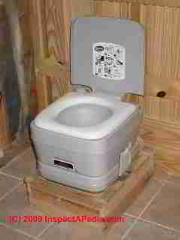
The photograph at page top is of the Thetford PortaPotti, a portable toilet which uses chemicals. Other common portable toilets include models from Sears, the Coleman, and Reliance toilets who provide a hassock model portable chemical toilet.
This article provides the details of the set-up, use, maintenance, cleaning,and emptying-out of chemical toilets. We also discuss portable toilet repairs and winterizing.
InspectAPedia tolerates no conflicts of interest. We have no relationship with advertisers, products, or services discussed at this website.
Guide to Buying & using a Chemical Toilet or Portable Toilet
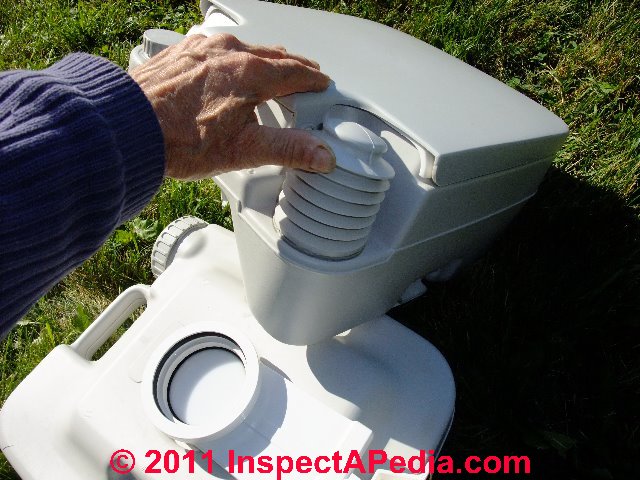 Chemical Toilets: use a chemically treated reservoir located directly
below the toilet seat. The chemicals reduce odors and perform partial (incomplete) disinfection of the waste.
Chemical Toilets: use a chemically treated reservoir located directly
below the toilet seat. The chemicals reduce odors and perform partial (incomplete) disinfection of the waste.
[Click to enlarge any image]
Article Contents
- CHEMICAL TOILETS
- BUILD a THRONE to Elevate the Toilet & Give Armrests for Those who Need Assistance
- HOW TO ADD CHEMICAL DEODORANT / DISINFECTANT to a chemical toilet
- HOW TO USE A CHEMICAL TOILET
- HOW TO ADD WATER to the CHEMICAL TOILET FLUSH TANK
- WHEN TO EMPTY & CLEAN the CHEMICAL TOILET
- HOW TO EMPTY & CLEAN the CHEMICAL TOILET
- WHERE TO EMPTY the CHEMICAL TOILET or "porta potty"
- HOW TO STORE a CHEMICAL TOILET when NOT IN USE
- REPLACE the ACCORDIAN VALVE on a Chemical Toilet or Porta Potty
- FREEZE PROTECT a CHEMICAL TOILET Porta Potty
- CHEMICAL TOILETS as a SEPTIC DESIGN ALTERNATIVE
Chemical toilets have limited storage capacity and must be pumped and periodically cleaned by a septic company.
Similar to simple chemical toilets but more sophisticated in design are recirculating toilets which separate the waste from the chemical and then re circulated the fluid through the toilet tank.
Chemical toilets with larger waste reservoirs are used in RV's and campers as well as for full-sized portable toilets or Porta-Johns used at construction sites and at outdoor festivals.
Readers should also see ALTERNATIVE & WATERLESS TOILETS for a discussion of camping toilets, chemical toilets, emergency-use toilets, waterless toilets, graywater systems, composting toilets, home health care toilets, incinerating toilets, outhouses, and latrines. Citation of this article by reference to this website and brief quotation for the sole purpose of review are permitted.
The following is from: New York State Appendix 75-A.10 Other systems [Web article]
(i) Chemical toilets provide a toilet seat located directly above a vault containing a chemical to disinfect and remove odors from the wastewater. Recirculating toilets use chemicals as the toilet flush fluid. The wastes are separated from the fluid, wastes discharged to an internal holding tank, and the fluid reused.
(ii) The liquids used in these types of toilets do not completely disinfect the wastes; therefore, waste products from these units shall not be discharged to surface waters or to the ground surface.
(iii) The reduced volume wastewater from recirculating toilets may be discharged to a larger holding tank but not to a subsurface absorption system.
How to Use and Maintain a Chemical Toilet
 Chemical Toilets: use a chemically treated reservoir located directly
below the toilet seat. The chemicals reduce odors and perform partial (incomplete) disinfection of the waste.
Chemical Toilets: use a chemically treated reservoir located directly
below the toilet seat. The chemicals reduce odors and perform partial (incomplete) disinfection of the waste.
Chemical toilets have limited storage capacity and must be emptied and cleaned by the user.
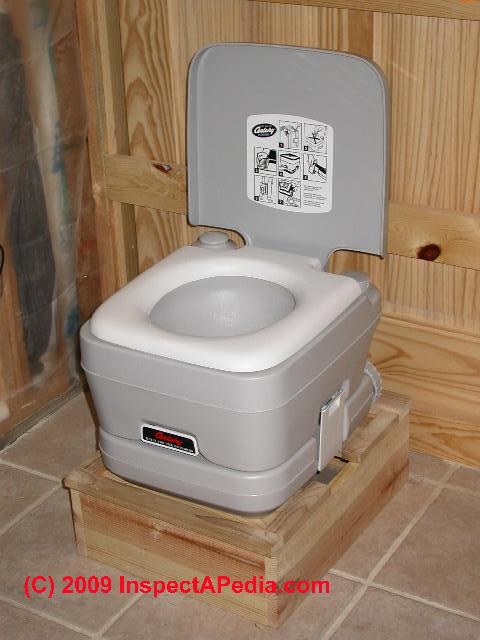
The photograph at page top is of the Century 6205 2.6-Gallon Portable Toilet by Century Tool, a portable toilet which uses chemicals to deodorize and disinfect toilet waste.
We built the wooden platform shown underneath this toilet in order to raise the seat height to a more comfortable position, but in normal use this toilet works just fine placed directly on a floor or on the ground outdoors.
Version I of our wooden chemical toilet height platform is shown at the top of this page.
Version 1 had no sides, no back, no armrests. The toilet seat height was elevated for both comfortable use and to make the toilet meet accessibility requirements for people who may have trouble sitting down onto and/or rising from a too-low toilet seat.
Version II of our chemical toilet height increase platform, shown below, added railings and a wider platform for greater stability - we call this version, constructed in 2014 the Throne.
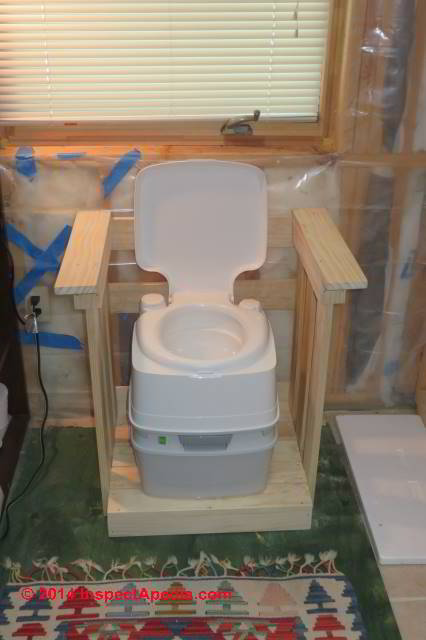 The Throne uses a Thetford® Porta Potty replacing the slightly smaller original Coleman® unit and converting the accordion flush valve to a pump style flush valve.
Designed by Jennifer Church and constructed by the author, the Throne added a 3-inch bottom platform that raised the seat height of the porta-potty to about 19" from the floor. That's the maximum height recommended by the ADA though some users may prefer 20".
If you need to provide seat height and grabrails that meet ADA specifications for accessible designs see
- DISABLED or ELDERLY-USE TOILETS
- BATHROOM DESIGN, ACCESSIBLE - best practices guide to accessible bathroom designs
- "2010 ADA Standards for Accessible Design", U.S. DOJ, online version, original source: http://www.ada.gov/regs2010/2010ADAStandards/2010ADAstandards.htm#Toilet
Other common portable toilets include models from Thetford®, Sears®, the Coleman®, and Reliance® toilets who provide a hassock model portable chemical toilet.
Several readers have written asking for plans for "the throne" toilet surround. Indeed the provision of a stable base that is not tippy, that is strong enough to help a person with limited mobility to use the toilet, and that's simple and inexpensive to make from readily-available materials has proven useful.
My carpentry teacher Bernie Campbalik taught us to never ever build anything without a drawing - if you do you'll always mess up something as you will fail to anticipate all of the widths and lengths and thicknesses of materials
Plans for "The Throne" wood base for a Chemical Porta-Potti
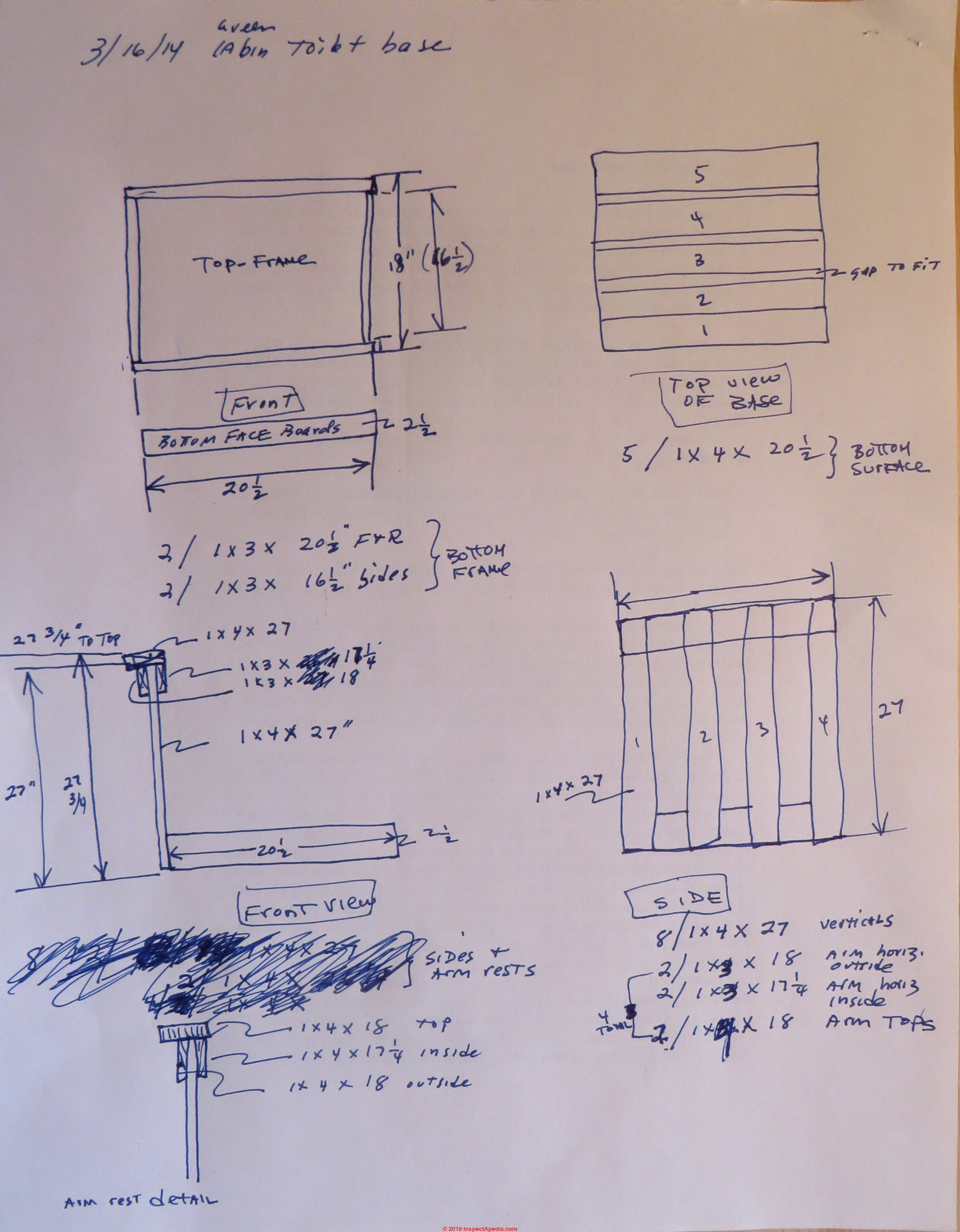
My toilet throne drawings along with measurements are given here. OPINION: InspectApedia.com is NOT Fine Homebuilding where every project looks perfect at every stage and money is no object and nothing ever goes wrong during construction.
These are a bit honest - real-world, sloppy plans exactly as I drew and amended and used them, including scribbling over mistakes and re-calculating when necessary to get to the end result you see in the photos.
[Click to enlarge any image]
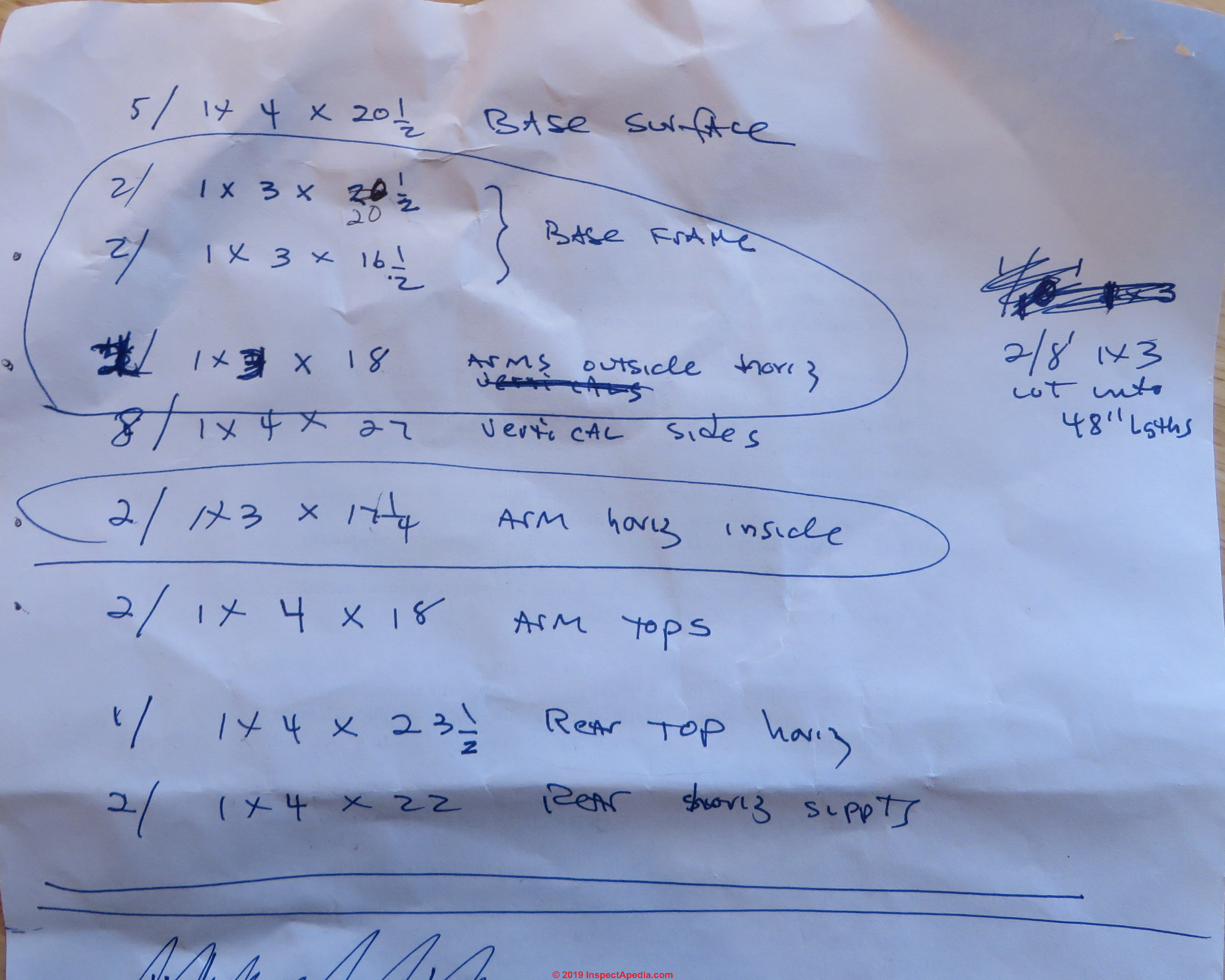 The the pages shown here list all of the parts in my plan so as to permit calculation of the necessary materials. If you enlarge the drawings (click to enlarge) you'll see dimensions and where screws were placed.
Because we has only an old Buick passenger car to get materials, all of the wood was cut to 4 ft lengths for ease transportation and sized for minimum waste.
Bill of Materials for Building the Toilet Throne
- 4 - 4ft 1x3 clear pine
- 10 - 4ft 1x4 clear pine
- Construction adhesive - glue and screw all joints. Strong joints are essential for safety.
- 2" Trim screws: short enough that I could screw the side rails on both sides of the vertical balusters without the screw tips poking through the total 2 1/4" thickness at that section of the project.
- 100 g sandpaper
- Satin polyurethane sealant
I used clear pine 1/4's for every part of the toilet.
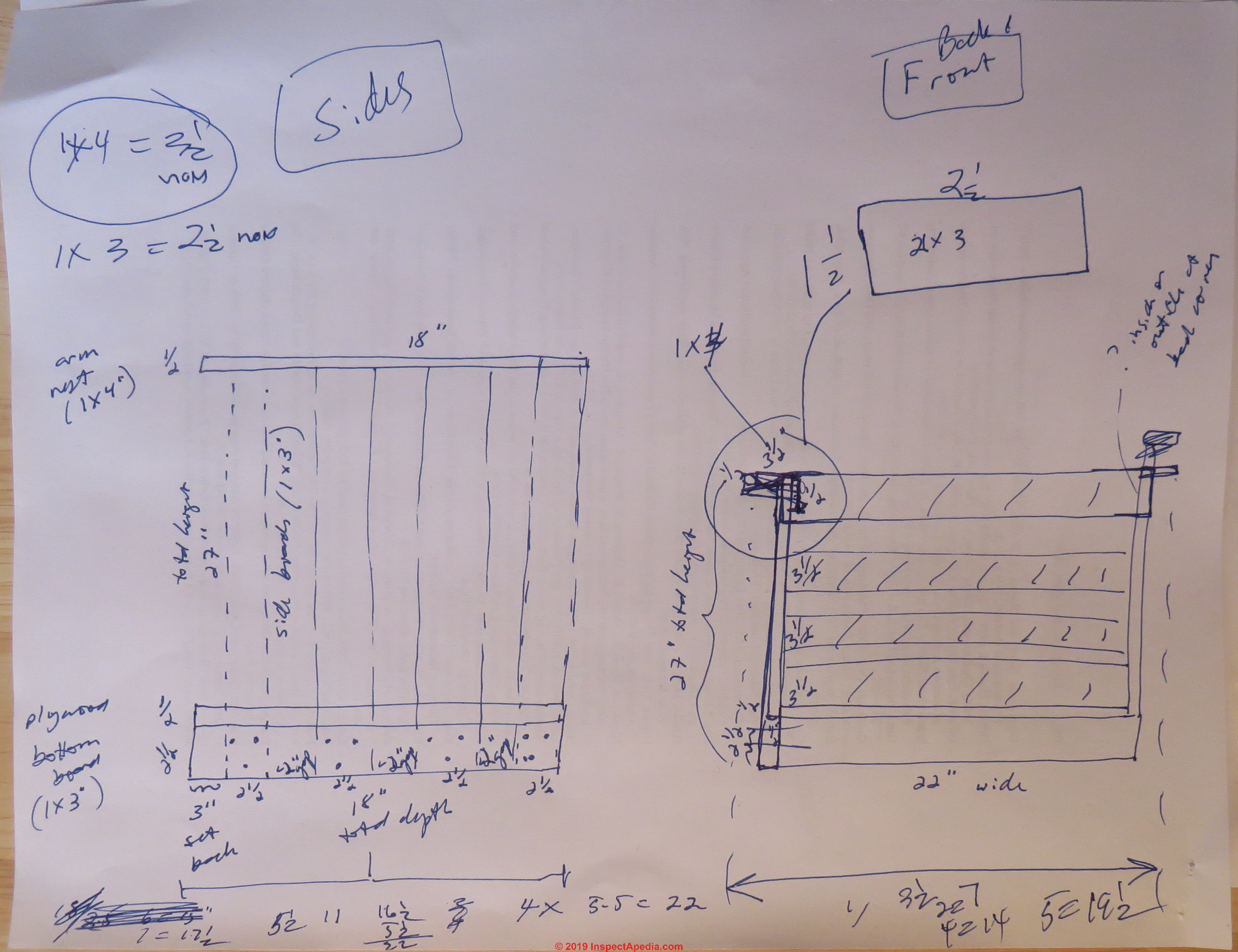
Steps in Construction of "the throne"
The base, constructed first, is shown viewed from below: it's just a simple platform. The base and the whole throne outer dimensions are bigger than needed just to squeeze in a typical plastic chemical porta-potty. We wanted added width and depth so that when a user leans on the armrests to sit down or to rise, the throne and toilet won't tip over.
For heavier larger users you may want either outriggers or a larger base that extends out past the side guards and back support.

You construct the base platform, cut the vertical side balusters, screw them to the base, attach the back rails and top rails to the sides, and then the flat arm rests.
- Build the base platform. The top boards are screwed down into the edges of the perimeter boards and the perimeter board ends are screwed together. Glue everything. Work on newspaper so you don't glue yourself to the floor and tick off your wife.
- Attach / build the side guards: screw vertical side balusters to base using 4 trim screws and construction adhesive.
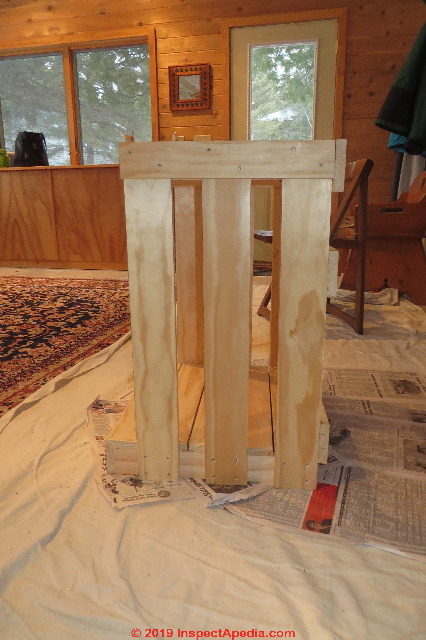
Photo above: the side guards, formed by three vertical 1x4 balusters are screwed to the base. The right-most side baluster edge is flush with the back edge of the platform. You can see the end of a horizontal board connecting the bottom of the side balusters - added for strength and to keep the toilet from pushing back through the back of the throne.
- Attach horizontal top rails on edge to inside and outside faces of the top of the side-guard balusters - shown below. Hold in place with clamps so your screws don't shoot through.
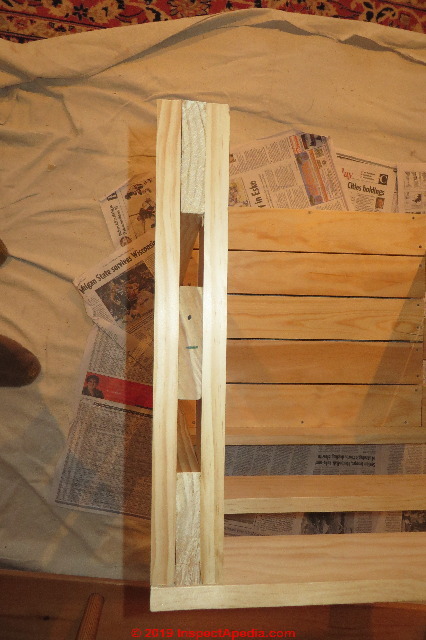
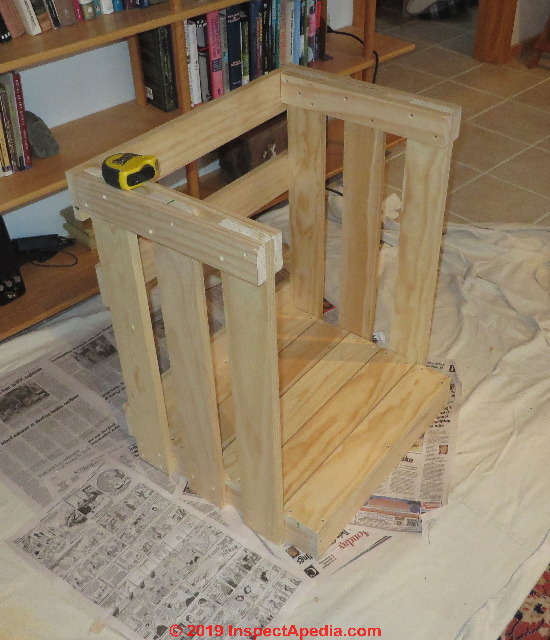
- Attach horizontal back slats across the rear of the side guards - shown below. The spacing of the middle back slat was somewhat arbitrary but is far enough down to give added strength against racking that would be missing if you pushed it right up tight against the top slat.
Notice in the photo below that the top back slat is screwed into the edges of the rear-most guard baluster and is cut long enough to cover the ends of those outer horizontal rails. This is the sort of cut mistake you'll make (too short) if you don't make a drawing. Or maybe even if you do.
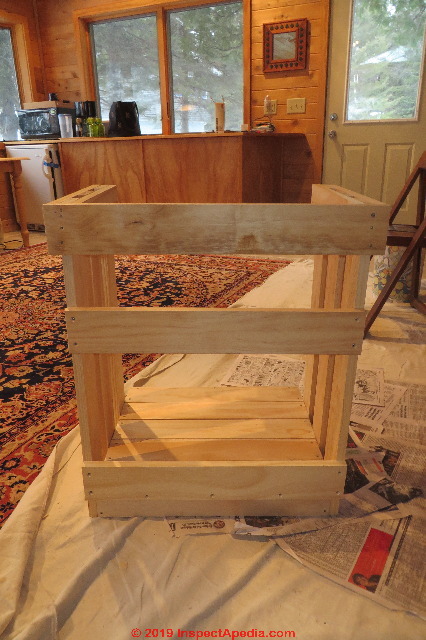
- Attach arm rest tops to top of side guards. The arm rests are long enough to project out over the front of the platform but not longer. I don't want someone leaning on the rests to tip the throne forward.
I screwed right down through the top of the arm rest into the horizontal top rails, leaving the trim screw tops exposed.
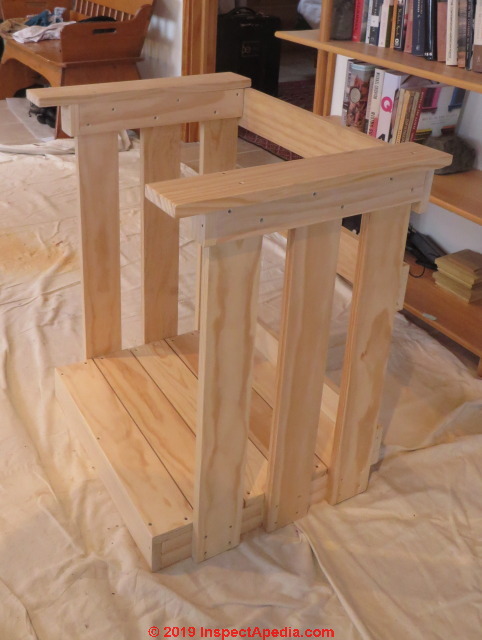
- Add a small trim block underneath the projecting front of each arm rest and against the exposed ends of the side rails - this is entirely cosmetic. I cut small blocks to cover the ends of the side rails under the arm rests so that we won't see the otherwise unattractive front ends of the tops of the side guards.
- Sand all edges to prevent splintering; lightly sand rough surfaces. Slightly round the corners of the front of the top armrests - both to avoid sticking a splinter into the queen when she sits down on the throne and also to avoid splitting off bits of wood through use that would make the throne ugly.
- Seal the wood surfaces; I like satin polyurethane, or a water bourne sealant of any sort.
Watch out: Use construction adhesive as well as construction or trim screws to assemble the throne and it will be solid.
Finish up by sanding the edges to avoid splinters, giving a slight champfer to all sides. You might want to include a couple of coats of clear satin polyurethane to seal the wood against soiling.
How to Operate a Chemical Toilet or Porta Potty
Here are complete details for operation and maintenance of the chemical porta-potty toilet.
Before First Use of the Toilet
- Check for deodorant/disinfectant: pull out the “T” handle located at the center of the toilet front to open the sliding door that separates the toilet bowl from the waste reservoir and look into the toilet base.
If you see blue-green powder or liquid on the toilet bottom and perhaps a tiny amount of water then the toilet is ready for use.
If there is no chemical visible in the toilet base the follow step 2.
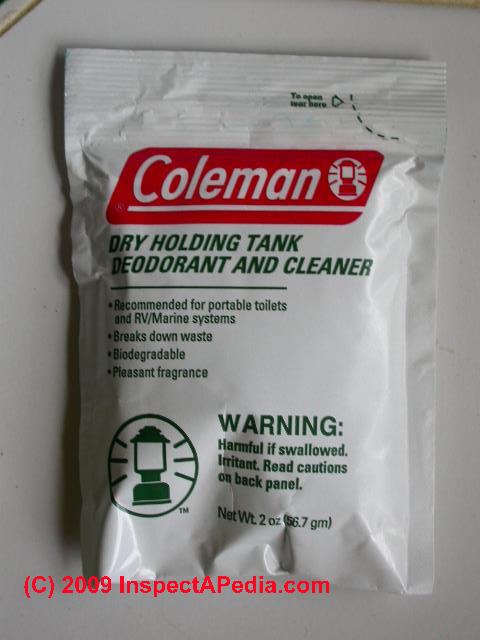
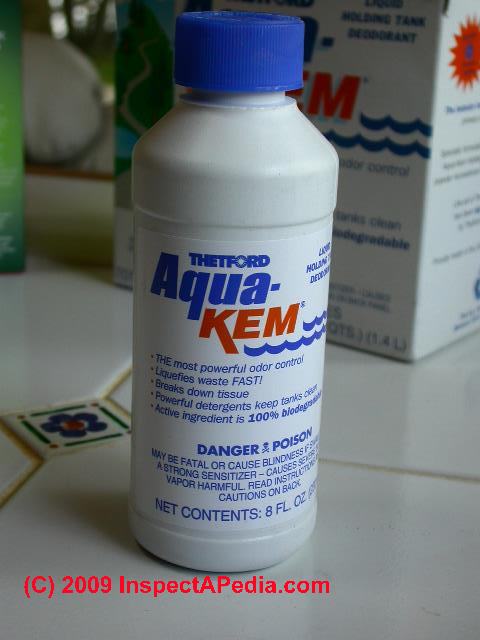
Otherwise go to step 3. - Add deodorant/disinfectant: locate the chemical toilet disinfectant/deodorant chemicals. Both dry powder and liquid versions of chemical toilet holding tank deodorants and cleaners are available, as we show below where our photographs illustrate Coleman toilet holding tank chemical and Thetford's AquaKem toilet tank deodorant and sanitizer.
How to add chemical deodorant / disinfectant to a chemical toilet
- Separate the toilet top and bottom sections by un-latching the white plastic clips on the left and right side of the toilet, then lift the top away from the bottom section and set it aside.
- Open the waste reservoir: Pull the “T” handle located at the center of the front of the toilet base (same handle as described in step 1 above) to open the sliding door that opens the waste reservoir in the toilet base.
- Add chemical disinfectant
see HOW MUCH CHEMICAL to ADD below - Replace the toilet top half onto the bottom reservoir base and re-latch the two side clips that secure these parts together.
- Add water: Push the toilet flushing rubber accordion-valve on the rear left corner of the toilet once or twice to flush water from the toilet top water tank into the toilet bowl. If there is no clean water in the toile top flush reservoir,
see HOW to ADD WATER to the toilet top flush tank below - Close the waste reservoir opening by pushing the “T” handle back in.
The portable chemical toilet is now ready to use.
How much toilet disinfectant / deodorizing chemical to add
One packet of dry powder, or one plastic bottle of liquid portable toilet disinfectant / deodorant (shown above) is sufficient to treat forty gallons of wastewater, but this toilet base only holds about three gallons of waste, so just use a tiny amount, about 1/10 of a dry powder packet or 1/10 of a liquid bottle of chemical. Just estimate – precision is not necessary.
Thetford's instructions for adding chemical treatment to a porta potty or chemical toilet recommend the following:
Aqua Kem® Blue Concentrated toilet additive is added at 60 ml (2 US fluid ounces) per 20L (5.2 US gallons) of waste-holding tank capacity.
For larger waste tanks Thetford recommends adding 2-3 L (0.5 to 0.8 U.S. gallons) of water (this is may be a bit too much for a smaller chemical toilet or porta potty) to ensure optimal performance of the toilet.
Watch out: Keep toilet and RV waste tank treatment chemicals away from children.
How to Use a Chemical Toilet or Porta Potty or Camping Toilet
- Have a Seat. Please use this toilet only from the sitting position. Standing means messy splashes.
- Toilet tissue: we prefer to use RV-type biodegradable toilet tissue, but because this toilet is to be emptied into a septic system, any kind of toilet tissue is acceptable.
See TOILET TISSUE TEST for an ongoing test of the break-down of several types of toilet paper including RV-type toilet paper recommended for chemical toilets and RV/Marine sewage holding tanks. - Flushing the toilet after use:
- Open the waste reservoir in the toilet base - Pull the “T” handle located at the center of the front of the toilet base (same handle as described in step 1 above) to open the sliding door that opens the waste reservoir in the toilet base.
- Flush: Push the toilet flushing rubber accordion-valve on the rear left corner of the toilet once or twice to flush water from the toilet top water tank into the toilet bowl. (see “How to add water to the toilet top flush tank” below). One or two pushes of the valve are usually sufficient. More is ok but you will need to empty the waste reservoir sooner if excessive flush water is used.
- Close the waste reservoir – push the “T” handle back in.
How to Add Water to the Chemical Toilet Top Flush Tank
- If the toilet top flush water reservoir needs water
- Separate the toilet top and bottom sections by un-latching the white plastic clips on the left and right side of the toilet, then lift the top away from the bottom section.
- Carry the toilet top section to a convenient location close to a garden hose.
- Unscrew the white plastic cap on the top right corner of the toilet top section and fill the tank about ¾ full with clean water. Precision is not necessary, just estimate. Filling the tank completely is ok but makes it a bit heavier for some folks to carry.
- Replace the white plastic cap on the toilet reservoir tank.
- Replace the toilet top half onto the bottom reservoir base and re-latch the two side clips that secure these parts together.
When to Empty and Clean the Chemical Toilet
 When you observe that the toilet bottom waste reservoir tank is getting full (liquid is near the top of the opening visible when you pull the “T” handle out to give view into the bottom tank) the toilet needs to be emptied.
Or
When use of the toilet is not going to be required for a few days or longer periods it should be emptied, cleaned, and left empty.
The illustration at left shows simple pictorial instructions for a Century chemical toilet. Procedures are similar for most portable toilet brands and models such as Coleman and Thetford.
- Adding toilet deodorant / disinfectant through the toilet waste reservoir base opening.
- Do not pour toilet chemicals directly into the toilet bowl.
- Pump water from the toilet top section flush reservoir into the toilet bowl
- Pull the "T" lever to empty water or waste into the toilet bottom reservoir, (then push this opening closed again).
- How to un-latch and separate the toilet top and bottom sections
- Carrying the portable toilet waste reservoir to a dumping station
How to Empty and Clean the Chemical Toilet
Emptying the portable toilet waste reservoir into a toilet or other dumping location
- To empty out the portable toilet:
- Separate the toilet top and bottom sections if you have not already done so.
- Empty the toilet waste reservoir by unscrewing the large round cap found on the rear of the toilet waste reservoir. You’ll notice that when carrying the toilet waste reservoir by its handle this cap will be “up” and the “T” handle or toilet front will be facing down.
- Be sure that the toilet bottom reservoir is closed: that is, assure that the “T” handle at the toilet front has been pushed in.
- Carry the toilet outside: For convenience the entire toilet can be carried outside, or if you prefer, separate the top and bottom sections of the toilet while it is still indoors, and then each half can be carried separately outside. Handles on the rear of both top and bottom halves of the toilet allow easy carrying.
- Wash the toilet top and bottom halves thoroughly outdoors using a garden hose. If a small amount of deodorant/disinfectant remains in the waste reservoir you can add water from a garden hose, slosh the waste inside the reservoir to loosen it, and then empty this diluted wastewater out.
Now you are ready to install a new dose of chemical toilet deodorant and a few ounces of clean water.
Where & How to Empty a Chemical Toilet or "porta potty"
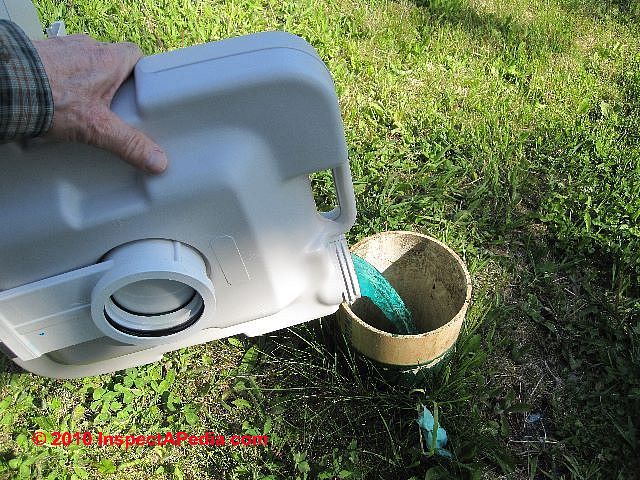 If a local septic tank outdoor access port is available, open the septic tank pump-out port at the top of the septic tank cleaning riser pipe. Pour the toilet waste reservoir contents into that opening and replace the cap on the pumping port immediately.
If the septic tank pump-out port has become buried by deep snow, or if no septic tank outdoor port nor RV dumping station is available, the portable toilet can be emptied into an indoor toilet – pour carefully so as not to splash.
Is it acceptable to ever dump an RV toilet into a home septic system tank?
The answer is, ... it depends.
Our photo (left) shows a small chemical toilet holding tank being emptied into the service riser over a residential septic tank. In some circumstances this is ok.
Notice that this chemical toilet reservoir has no hinged spout: you must pour right out of the container into the receptacle; that will work with no spillage if you hold the reservoir tank in the position shown in my photo.
RV HOLDING TANK DUMP INTO SEPTIC TANK? is a detailed article explaining when it is probably ok and when it is probably not ok to dump a chemical toilet, a porta-potty, or an RV waste holding tank into a septic tank (rather than dumping these at a sanitary waste disposal station, for example, at a campground or marina).
Tips for Emptying the Porta Potti without spillage
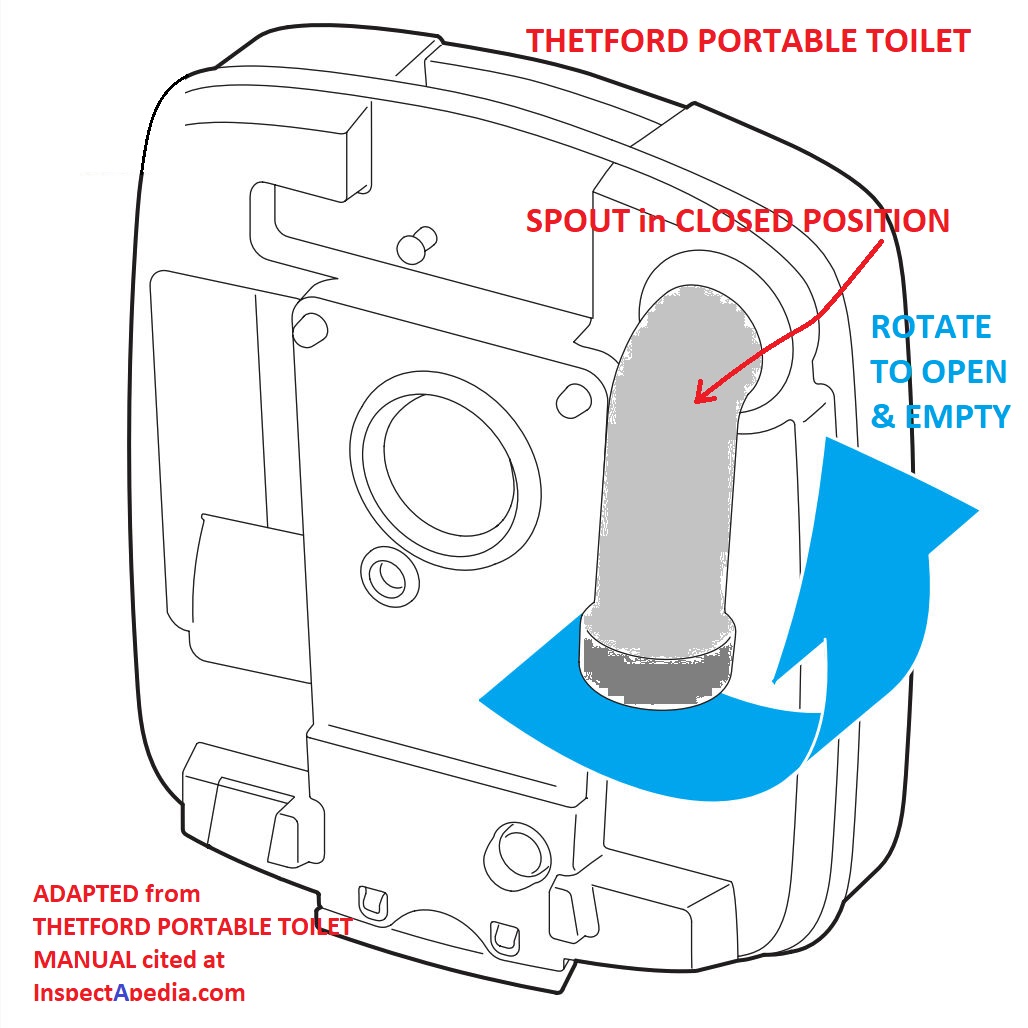
Other portable chemical toilet models like the Thetford portable toilet (listed below) use a rotating or hinged emptying spout that gives an extension and the ability to set the spout on a convenient angle for emptying the unit into the destination waste opening.
When the toilet base is assembled to the toilet seat - thus ready for use - the rotating spout is in the closed position shown in the sketch above - adapted from Thetford's instructions that we cite below.
To empty the toilet you should first agitate the tank to mix solids with liquids so that when you pour out the toilet it will empty (nearly) completely. Hold the reservoir level and shake it side to side.
Watch out: When removing, carrying, and emptying the porta potti base be sure that the center receiving port (green circle) is closed fully. Otherwise when upending the reservoir for carrying you may spill a bit of waste.
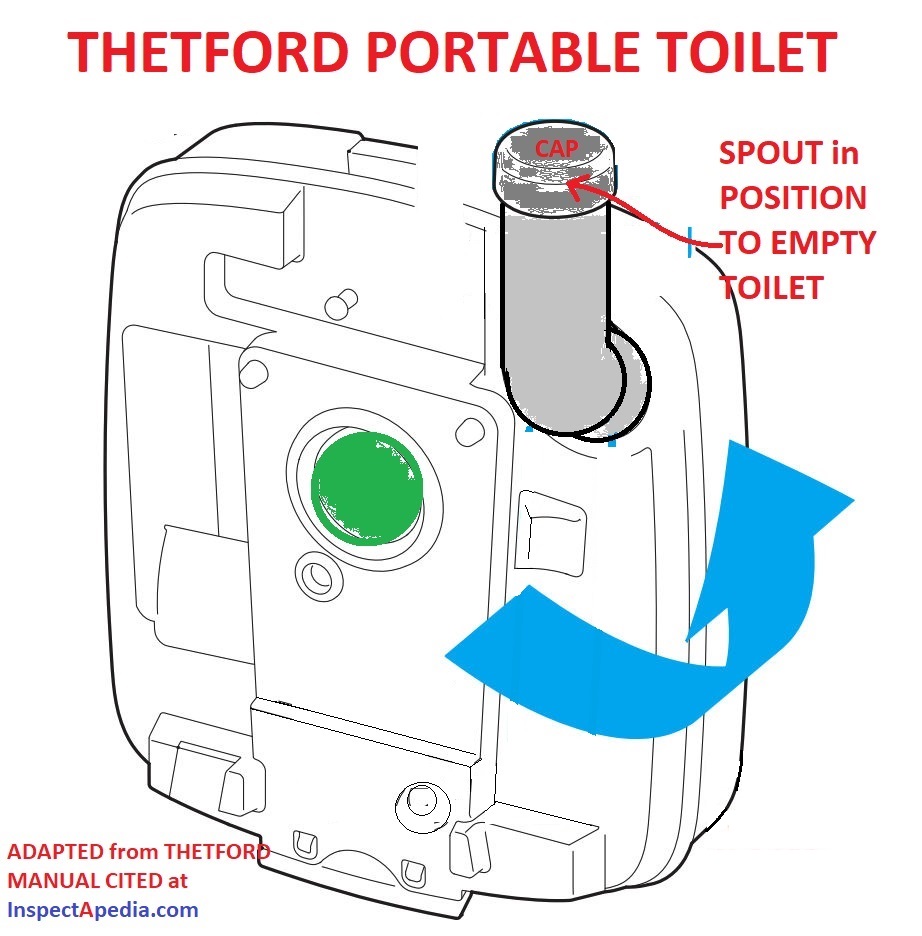
Then rotate the spout UP - as shown in our illustration above, then unscrew the cap.
As Thetford's instructions indicate, hold the reservoir roughly level, position the end of the spout over the dumping station inlet.

Carefully pour from the spout into the waste disposal opening or RV dumping station.
To completely empty the reservoir you will have to tip it up onto its end so that all waste moves to the spout and out of the spout's end.
To completely empty the waste reservoir, add a bit of fresh water to the holding tank, replace the spout cap, agitate the tank again, and empty it again: this will remove the last bits of toilet paper that may otherwise remain.
How to Store a Chemical Toilet When Not in Use
When use of the chemical toilet is not going to be required for a few days or longer periods it should be emptied completely, washed, and left empty.
For odor and sanitation control, add a fresh dose of disinfectant/deodorant to the toilet waste reservoir followed by about a half-cup of water (just enough to wet the dry chemical and cover the bottom of the waste reservoir).
See How Much Chemical to Add above
Do not leave the toilet top tank filled with flush-water as it may freeze and damage the toilet.
Replacing the Accordion Valve on a Chemical Toilet or Porta Potty
Question: How can I replace the accordion valve flush-plunger on my chemical toilet?
The accordion valve on my chemical toilet is damaged. Can it be replaced? - B. Howard
Reply: Yes but it's not easy to replace the accord ian valve or flush valve on a porta potty
The accordion valve on a chemical toilet is that flexible plunger pushed to force water from the reservoir tank into the toilet bowl (photo).
On at least some chemical toilets it's a replaceable part - you'll want to obtain exactly the proper part that matches your toilet to be sure that the replacement fits and doesn't leak.
I've replaced similar parts by carefully cutting and pulling away the old accord ian valve without damaging the plastic that surrounds the valve mounting opening. The new valve may need to be warmed in hot water a bit as well as kept wet to fit it into the opening. But I found it was a difficult process.
Watch out: You'll probably find, as I did, that a sticky sealant is used between the accordion valve or flush valve surface and the upper surface of the plastic porta potty at the mounting hole.
You may need a replacement sticky gasket kit from the manufacturer to do this job reliably. If you fail to seal the valve at its mount position the new toilet flush valve will look fine, but it may not pump an adequate dose of water into the toilet bowl for flushing.
Preparing a Chemical Toilet Porta Potty for Use in Freezing Conditions
Question: How to freeze-proof a porta potty
I want to keep my porta potty in my van for occasional use during the upcoming Michigan winter. How do I keep it useful without it freezing? - Bonnie Jones
Reply: RV Wastewater System Anti-Freeze, Heat, or Leave the System Empty
Short answer: to keep a portapotty in a van in freezing conditions, first buy and use RV wastewater and flush water environmentally safe antifreeze product from an RV supplier.
Option 1: leave the toilet drained, empty, and treated
We leave a chemical toilet in a remote cabin in northern Minnesota through very deep freezing weather.
But first we empty the water from the flush reservoir and we empty the toilet base as well. Then we leave a very small quantity of water along with toilet treatment chemical in the toilet base receptacle.
By that means the toilet fresh, without a lingering worry about developed odors, bacteria, or mold growth while it's sitting idle. The toilet is almost ready to use when people return to the cabin. All that's needed is to add water to the flush reservoir.
I would not leave any water in the toilet nor waste in the toilet in freezing conditions. The risk is that frozen water or wastewater breaks the toilet and later thaws, leaving a mess in your van.
Option 2: use an RV antifreeze product in the chemical toilet?
For buildings (or vans) where we need to leave a portapotty in ready-to-use condition in freezing conditions we'd have to add a heat source OR we'd need to add an antifreeze mix to be sure of avoiding damage. You MIGHT get away with letting a small amount of waste in the toilet bottom freeze but it's risky.
People who own an RV or a boat that includes water supply and waste piping learn that to winterize their vehicle they need to drain the system of water and usually they also add an antifreeze to be sure that pumps or any components that might contain residual water won't be damaged by freezing.
If you check with your local RV suppliers you'll find that they sell RV wastewater holding tank antifreeze for use in the holding tanks in those larger vehicles. Most RV and Marine antifreeze solutions use ethylene glycol (EG) or propylene glycol (PG), with glycerin as a primary second ingredient
t. Also in RV applications and some others, antifreeze solutions include phosphates as an anti-corrosion agent that you would not need in an all-plastic water or wastewater system. (Phosphate-containing antifreeze is used in the U.S. but prohibited in Europe.)
According to Splashproducts propylene glycol antifreeze is considered "generally regarded as safe" or "GRAS" by the U.S. FDA. The company states that their RV & Marine antifreeze is "Safe for incidental contact with people, pets, and wildlife". [1]
We'd always prefer to use an environmentally safe product that can be used in both the flush water supply and in the wastewater holding tank if you are going to use an antifreeze in a chemical toilet or portapotty.
You will also find "drinkable" antifreeze (propylene glycol based antifreeze) sold by other RV suppliers and intended for use in the RV's drinking water holding tank and pump. Although no one is going to be drinking out of your porta-potty, that's what I'd prefer to use in the porta potty flush reservoir tank.
 Watch out: be sure to follow the proper dilution instructions on the product label so that you don't over-dose your porta potty nor the dumping station into which it is later emptied.
Watch out: many antifreeze solutions are toxic if ingested (drunk) and may also be environmental contaminants that should not be dumped into a septic tank nor onto the ground surface.
Are chemical toilets useful as a septic system design alternative or not?
While at least some manufacturers of the chemicals used in chemical toilets (to deodorize and to stop bacterial action in order to prevent dangerous production of potentially explosive methane gas inside the toilet) inform us that their products are environmentally friendly, New York State, as an example, does not want homeowners discharging chemical toilets into the environment.
Further, as we have advised at RV HOLDING TANK DUMP INTO SEPTIC TANK? about dumping RV toilets into the septic system, there is some risk that discharging these chemicals into a conventional septic system could cause it to stop working, depending on the frequency and volume of chemical waste to be disposed-of.
With this in mind, we use chemical toilets where there is no onsite waste disposal system at all such as in a weekend cabin without plumbing, or in RV's, but not as a permanent toilet facility in a permanently occupied building.
Chemical toilets or camping toilets and porta-potties are also suitable for the "pack it in, pack it out" environment in which waste is removed from the site and dumped at an approved RV dumping facility.
Chemical or portable toilets may also be a life-saver for home health care or for elderly, disabled, or other people of limited mobility who need a close-by toilet or who need to avoid excreting large amounts of drugs or antibiotics into a private septic system.
See DISABLED or ELDERLY-USE TOILETS for more information.
Portable / Chemical Toilet Sources & Porta-Potty Instruction Manuals
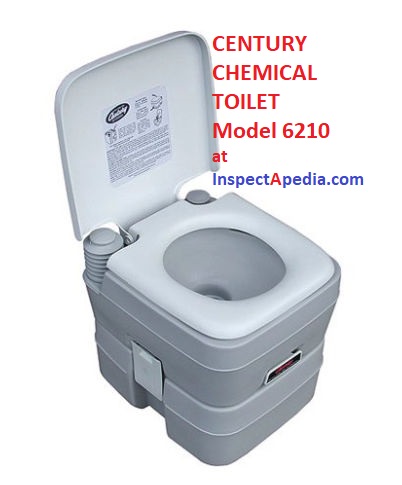 Portable toilets include these brands and others listed below along with contact information.
Watch out: a survey of portable toilet brands in July 2019 found that a number of toilets sold under different brand names (and companies impossible to track down) marketed through Amazon.com look absolutely identical in design and features. Be sure to compare alternatives closely when buying one of these.
Among the blizzard of portable toilet or even toilet and sink combinations were these names, some of whom appeared to be delivering the same product. Standing apart are a few brands such as Thetford, Camco, Dometic and possibly Reliance, Langria and Vingli.
Thetford Porta Potti, SeaLand’s SaniPottie, Camco, Century, Coleman Portable Toilet, Century Portable Toilet, Coleman plastic portable toilets, Dometic Sani Porti, Visa Potty, Companion Eziloo, Fiamma Bi-Pots, Giantex 5 gallon portable toilet, HomCom Portable toilet, Langria portable outdoor toilet, Leopard outdoor T-type portable travel toilet, Nesource Passport toilet, Palm Springs Plastic Toilet, Primus Deluxe Portable Loo, Reliance Hassock portable toilet, SafStar portable toilet, Sanitation Equipment portable toilet, Serene Life portable toilet, Stansport Easy-Go toilet, True Power portable toilets, Vingli portable toilets, USA Stock portable toilets, Ximeng portable toilet,
CONTACT us to add other portable or camping or alternative toilets and products.
Also see our detailed article about camping and emergency use toilets found
at CAMPING & EMERGENCY USE TOILETS
- Aqua Kem Blue (from Thetford Europe), Aqua Kem® Blue Concentrated toilet additive is added at 60 ml (2 US fluid ounces) per 20L (5.2 US gallons) of waste-holding tank capacity. For larger waste tanks Thetford recommends adding 2-3 L (0.5 to 0.8 U.S. gallons) of water (this is may be a bit too much for a smaller chemical toilet or porta potty) to ensure optimal performance of the toilet.
Retrieved 2019/07/20, Source: https://www.thetford-europe.com/gb/how-dose-thetford-additives - Camco Portable / Travel Toilets fdor camping, RVs, boats, etc.
- Century portable toilets in a range of designs and applications. - MANUFACTURER CONTACT INFORMATION NEEDED - use the page top or bottom CONTACT link if you have this information.
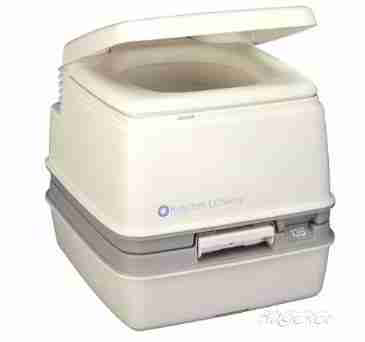
Illustration shown here: A Century 6210 5-gallon reservoir portable chemical toilet, T he Century 6205 2.6-Gallon Portable Toilet by Century Chemical shown earlier on this page was purchased at Amazon.com and costs less than $100. Other Century camping products can be seen at Sears Parts Direct.
The Century 6205 2.6-Gallon Portable shown in the photograph at page top was purchased at Amazon.com and costs less than $100. In 2019 the Century 6205 toilet had been discontinued by the manufacturer (according to Amazon.com). Other Century-brand camping products may have been produced / sold by the same company. - Coleman Corporation, 3600 North Hydrauli, Wichita, KS 67219, Tel: 1-800-835-3278, is a producer of camping equipment and gear, including chemical and portable toilets including both non-flush portable toilets and a large portable flush-toilet. Coleman has offices in many countries.
- Dometic SeaLand Portable TOilets, Dometic Sanitation Corporation, 13128 State Rt 226, PO Box 38
Big Prairie, OH 44611
SeaLand Product Customer Service: 1-800-321-9886
(8:00 a.m. - 5:00 p.m. ET)
Email: sealand@dometicusa.com
www.DometicSanitation.com - See this
DOMETIC SeaLand PORTABLE TOILET MANUAL, Sani-Potti 960 Series [PDF] (2006) - Reliance Products, 1093 Sherwin Road, Winnipeg, MB, Canada R3H 1A4, Toll Free: 1-800-665-0258, Telephone: (204) 633-4403, Website: relianceproducts.com produces the Reliance Hassock Portable Toilet #00984421. Quoting from the company's website:
Whether you’re on the road, in a campground, out on the water, or at the cabin, the Hassock is one of best portable toilets around. This lightweight, self-contained toilet has a comfortable contoured seat, a removable inner bucket for easy waste disposal and clean-up, an inner splash cover, and toilet paper holder.
In addition, the Hassock is compatible with our standard Double Doodie bag, which means virtually no clean-up and waste disposal is a snap when used together. - Rothco Corporation, 3015 Veterans Memorial Highway, Ronkonkoma, New York 11779-0512, Telephone: 631-585-9446, Toll Free: 800-645-5195
Domestic Fax: 631-585-9447, International Fax: 631-585-9442,
Email: info@rothco.com Tel. 800-645-5195; Rothco, founded in 1953, is a wholesale supplier of military and outdoor products including camping toilets. Quoting:
ROTHCO is America’s foremost wholesale supplier of military and outdoor products. - Splash RV & Marine Antifreeze, Splashproducts, Inc., Tel (651) 489-8211, 51 East Maryland Avenue, St. Paul, MN 55117-4615, web search 05/10/2011, original source: MSDS for Splash Products found at http://www.splashwash.com/data_sheets%5CMSDS%20RV-100%20new%20format.pdf
- Thetford Corporation 7101 Jackson Road, Ann Arbor, MI 48103, Phone: 1-800-521-3932 (Service & Parts) or 1-800-543-1219, 734-769-6000, Fax: 734-769-2023; Websites: http://www.thetford.com and http://www.campapotti.com
Thetford produces a wide range of permanent and portable alternative toilet designs. Quoting:
Our [toilet] products are easy to use at bedside and indispensable for the physically challenged, the aged, and small children.
Thetford's list of toilet products suitable for home or bedside health care are listed at
http://www.thetford.com/Thetford/HOME/ApplicationHome/BedsideApplications/tabid/94/Default.aspx
Thetford gets our highest marks for actually providing Porta Potty manuals for the company's portable toilets, easily found online at the company's websites.
THETFORD Porta Potti Campa Potti USERS MANUAL [PDF - converted to web page] (op. cit.)
THETFORD PORTABLE TOILET OWNERS MANUAL [PDF - converted to web page] (2012) op. cit.
THETFORD C500 TOILET USERS MANUAL [PDF - converted to web page] retrieved 2019/07/20, original source: jacksonsleisure.com/content/pdf/thetford/c502_user_manual.pdf
Reader Comments, Questions & Answers About The Article Above
Below you will find questions and answers previously posted on this page at its page bottom reader comment box.
Reader Q&A - also see RECOMMENDED ARTICLES & FAQs
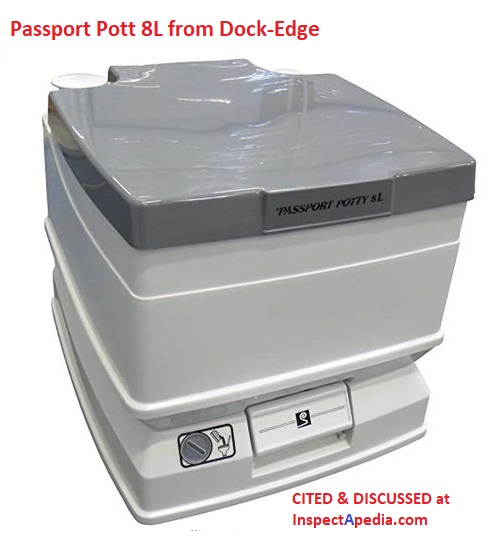
On 2020-11-05- by (mod) - directions for Passport Potty 8L
Georgie,
The Passport Potty 8L is produced and distributed by Dock Edge - at least according to the Passport Potty listings on Amazon.
But, disappointing, at the company's website I don't find mention of manuals for their porta potty.
You can contact the company directly at
Dock Edge
300 New Huntington Road
Woodbridge, Ontario
Canada, L4H 0R4
Phone: (905) 850-3999
Fax: (905) 850-3040
Email: info@dockedge.com
Email: sales@dockedge.com
Email: warranty@dockedge.com
If that doesn't work out let me know.
You can also download any of the other chemical toilet guides given in this article series as free PDFs - as these products are generally quite similar in operation.
On 2020-11-05 by Georgie Blymier-Heisey
I cannot find directions for my Passport Potty 8L and have never used one. How can I find directions or a utube on this device please. Thank you.
On 2020-10-07 - by (mod) -
Darren
Thank you for a helpful Question
Porta John sanitising and deodorising chemicals are sold in concentrated form. Typically for a 60 gallon reservoir tank in a standard porta John you would add 8 to 12 oz of treatment chemical to 2 or 3 gallons of fresh water in the bottom of the tank
On 2020-10-06 by Darren
work site porta loo what do you need to put it in it to use it , has not been used in years and is empty
On 2020-08-04 by Leigh
if you hire a portaloo for a day do you need to empty it?
On 2020-02-26 - by (mod) -
Russ:
Try a bit of spray silicone lubricant
and
Also inspect the handle for obvious mechanical damage.
On 2020-02-26 by Russ
My flush handle is hard to pull out and push in.
On 2020-02-22 by Andrew
Thank you for this thorough article. :)
...
Continue reading at ALTERNATIVE & WATERLESS TOILETS or select a topic from the closely-related articles below, or see the complete ARTICLE INDEX.
Or see CHEMICAL TOILET FAQs - questions & answers posted originally at the end of this page.
Or see these
Recommended Articles
- ALTERNATIVE & WATERLESS TOILETS
- CAMPING & EMERGENCY USE TOILETS
- CHEMICAL TOILETS
- COMPOSTING TOILETS
- COMPOSTING TOILET SUPPLIES
- DISABLED or ELDERLY-USE TOILETS
- INCINERATOR TOILET SYSTEMS
- MARINE TOILETS
- RV HOLDING TANK DUMP INTO SEPTIC TANK?
- WATERLESS URINALS
Suggested citation for this web page
CHEMICAL TOILETS at InspectApedia.com - online encyclopedia of building & environmental inspection, testing, diagnosis, repair, & problem prevention advice.
Or see this
INDEX to RELATED ARTICLES: ARTICLE INDEX to TOILET INFORMATION
Or use the SEARCH BOX found below to Ask a Question or Search InspectApedia
Ask a Question or Search InspectApedia
Try the search box just below, or if you prefer, post a question or comment in the Comments box below and we will respond promptly.
Search the InspectApedia website
Note: appearance of your Comment below may be delayed: if your comment contains an image, photograph, web link, or text that looks to the software as if it might be a web link, your posting will appear after it has been approved by a moderator. Apologies for the delay.
Only one image can be added per comment but you can post as many comments, and therefore images, as you like.
You will not receive a notification when a response to your question has been posted.
Please bookmark this page to make it easy for you to check back for our response.
Our Comment Box is provided by Countable Web Productions countable.ca
Citations & References
In addition to any citations in the article above, a full list is available on request.
- Our recommended books about building & mechanical systems design, inspection, problem diagnosis, and repair, and about indoor environment and IAQ testing, diagnosis, and cleanup are at the InspectAPedia Bookstore. Also see our Book Reviews - InspectAPedia.
- Eco John® Innovative Toilet Solutions, Global Inventive Industries, Fountain Valley CA, PDF, product brochure
- In addition to citations & references found in this article, see the research citations given at the end of the related articles found at our suggested
CONTINUE READING or RECOMMENDED ARTICLES.
- Carson, Dunlop & Associates Ltd., 120 Carlton Street Suite 407, Toronto ON M5A 4K2. Tel: (416) 964-9415 1-800-268-7070 Email: info@carsondunlop.com. Alan Carson is a past president of ASHI, the American Society of Home Inspectors.
Thanks to Alan Carson and Bob Dunlop, for permission for InspectAPedia to use text excerpts from The HOME REFERENCE BOOK - the Encyclopedia of Homes and to use illustrations from The ILLUSTRATED HOME .
Carson Dunlop Associates provides extensive home inspection education and report writing material. In gratitude we provide links to tsome Carson Dunlop Associates products and services.
 | HOME | ABOUT | ASK a QUESTION | CONTACT | CONTENT USE POLICY | DESCRIPTION | POLICIES | PRIVACY | |
| © 2024 - 1985 Publisher InspectApedia.com - Daniel Friedman | |||||||||