
InspectAPedia® FREE Encyclopedia of Building & Environmental Construction, Diagnosis, Maintenance & Repair |
Question? Just ask us! InspectAPedia
|
 Buyer's Guide to Composting Toilets
Waterless, composting, alternative toilet types, brands, sources
- POST a QUESTION or COMMENT about buying, using, & maintaining a composting toilet
Composting toilet guide:
This article describes the nature of composting toilets, how they work, how they are used, where they can be used, usage restrictions, and different composting toilet types and features. We describe how to choose a composting toilet, what questions to ask, what features you need, where to install the toilet, how much space is neeed, elecricity, heat, special supplies, cleaning & service requirements. Bulk & mulch alternatives.
We define & describe just about every composting toilet type, feature, methods of operation, & maintenance requirements as well as costs. We list sources of various models of composting toilets and compare composting toilet model features, uses, and costs. We include a table of composting toilet supplies, uses, properties & prices.
InspectAPedia tolerates no conflicts of interest. We have no relationship with advertisers, products, or services discussed at this website.
Guide to Buying, Using, & Maintaining a Composting Toilet
 What is a Composting Toilet?
A composting toilet is a self-contained unit (not connected to a septic or sewer system) which breaks-down and dehydrates human waste to a compost which can be added to soils.
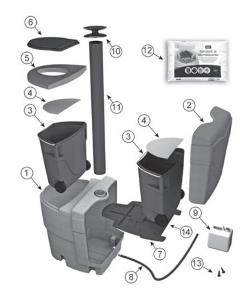
Shown, the L&T Duomatic toilet produced in Greece and discussed in this article. [Click to enlarge any image]
The toilet will consist of a place to sit (which is likely to look a lot like any other toilet), a composting chamber which breaks down and sanitizes the sewage, and a drying chamber or tray which permits moisture to escape, reducing the sewage volume.
Composting toilets come in models which use a little water or no water at all, and in electric (heated and power-vented) models and non-electric models. Some models include electro-mechanical mixers which mix waste in with a mulch product to speed and improve the composting process
. Properly designed and installed the toilet is vented so that there are no abnormal toilet odors. Periodically the compost must be emptied and on occasion toilet components are cleaned.
People use the toilet in a normal manner, and modern composting toilets in fact look pretty familiar, resembling water-based toilets in general shape and comfort. Waste is mixed with a "starter mulch" to begin the composting process.
Composted waste is emptied from the toilet at intervals ranging from one or two months to 12 months depending on level of usage and toilet design.
Composting toilets which do not mix new human waste with material already being composted produce a compost which is easier and safer to handle. This is a reason that some models use multiple containers or compartments, though there are other solutions to this problem. If the visible portions of the toilet need cleaning, normal household cleaner and toilet brush are used.
Composting Toilet Selection Guide
The following questions one asks when considering installing a composting toilet are addressed in the article below:
- WHERE will the composting toilet be used?
- WHEN will the composting toilet be used? Part time, full time?
- HOW OPERATED depending on who is using the toilet you'll choose between manually-operated toilets, semi-automatic, or fully automatic operation of the composting unit and other features. And the smaller composting toilet units, depending on usage level, will require more frequent attention. This is also a "WHO" question as different user populations will be more or less happy doing maintenance tasks
- OPERATING REQUIREMENTS for composting toilets include
- ELECTRICAL SERVICE is there electricity available? 120V, 12V, solar, or none? Composting toilet models include non-electric as well as various electrical models that operate the composter, operate ventilating fans, and in freezing climates provide heat
- SPACE AVAILABLE for the composting toilet system is important for small cabin, buildings with no basement or easily-accessible crawl area
- CLEANING & MAINTENANCE requirements exist for all toilets, but details and frequency of cleaning, emptying the compost, operating the compost mixing feature, and other tasks vary by design and toilet capacity
- COMPOSTING TOILET SUPPLIES - provides a table comparing supply requirements & costs. All models require some form of composting bulk medium: sawdust, peat moss, or specially prepared products. Some people try wood chips - which IMO are not likely to work well in most designs and can clog or break others,
- FEATURES of the composting toilet
- TOILET BOWL CLOSURE methods are important to some users; how is the trap or door between the bowl and the composter opened and shut?
- PROCESS of COMPOSTING:- batch processing is compared with continuous processing
- REGULATIONS: composting and other alternative toilet designs are regulated in some jurisdictions.
- SOURCES: list of composting toilet manufacturers, brands, sources. Some of these manufacturers include helpful product choice guides right on their websites, and some also sell composting supplies for their toilets.
Where are Composting Toilets Most Often Used?
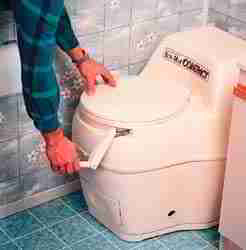
Composting Toilets may be used where the water supply is limited or not available at all, or where a building owner for other reasons wishes to conserve water use. Other wastewater treatment will still be required for handling graywater from sinks and showers. Shown above is the SunMar compact composting toilet. SunMar composting toilets and toilet models by other manufacturers are described below.
Full-Time and Part-Time Usage Composting Toilets
The buyer should consider carefully their intended maximum usage level of the toilet before choosing a composting toilet model.
Full time composting toilets are intended to serve as the main toilet in a full-time occupied building (more than 5 days continuous use, for example).
Part time composting toilets are intended to serve buildings which are not occupied full time (that is less than 5 consecutive days) or by some manufacturers, these models are intended for use during limited hours per day (10 or less).
Electric vs. Non-Electric Composting Toilets
Electric models include heaters to aid the composting, possibly a power ventilation system, possibly a system which mixes air in with the compost to improve the aerobic bacterial breakdown of waste, and possibly a mixing mechanism to mix sewage with mulch to aid the composting process.
Non-electric composting toilets may also be vented but will lack a heater and power mixing.
Water and Electricity for Composting Toilets
Composting toilet models vary among waterless, low water, and foam flush units. Obviously a water-model requires a water source.
Composting toilet models also vary between models requiring electricity (typically 110V), battery operated (12V), possibly solar powered, and models which use no electrical power. Features such as automatic mixing, aeration, and vent fans will require electricity
The Composting Earth Closet: Antique Composting Toilet Photos
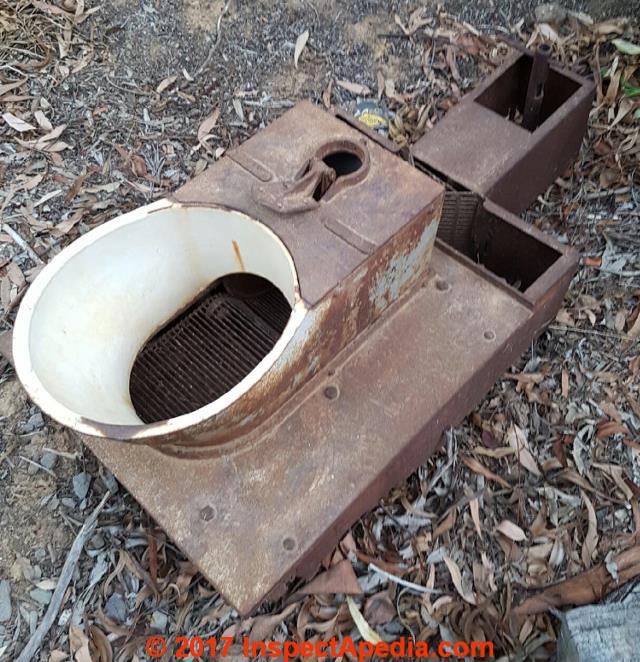
Sent to us by an Australian reader, and shown here are images of what we think is an antique composting toilet, missing some parts of course. Readers who have more to offer about this device are welcome to use the page top or bottom CONTACT link to send us information.
Below first photo: two large gear wheels mesh with and move a steel conveyor belt that moves waste to a mixing chamber.
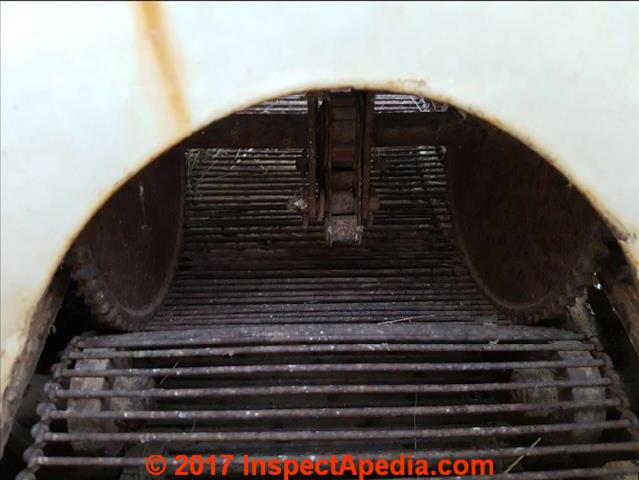
In our second photo, propellers (yellow arrows) driven by the rear conveyor gear (orange arrow) provide additional mixing of waste with compost, typically using a sawdust starter.
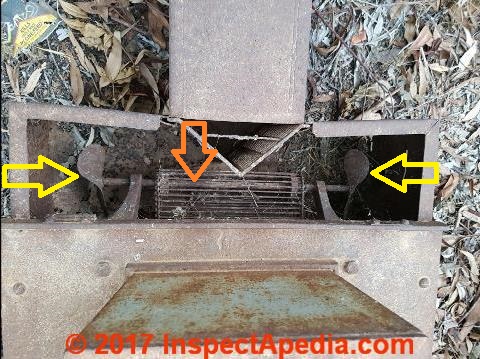
Since earth closets incorporating moving parts have been described as early as 1881 it's certainly possible that the device above was a mechanically operated composting toilet.
Davey & Co. advertised a "self-acting" earth closet, according to compostingtoilet.org - http://compostingtoilet.org/news/000305.php retrieved 2016/02/25 - Ed.
Automatic, Semi-Automatic, and Manual Composting Toilets
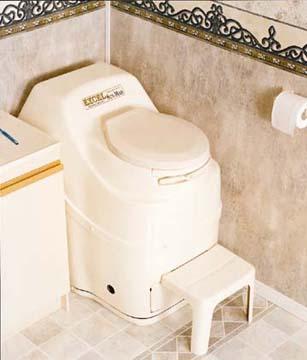
A fully automatic composting toilet will typically control a heater, ventilating fan, and a mixer to mix sewage and mulch together. A fully automatic toilet mixes each time the seat is lowered.
A semi-automatic composting toilet will still use a thermostatically controlled heater, fan. But the sewage-compost-mulch mixer is manual, typically providing a handle that is turned a few times after each use of the toilet.
[Click to enlarge any image]
The compost process involves biological breakdown of the waste - a process that needs oxygen (air) heat, and some moisture.
Waste/compost/mulch mixing (the traditional "turning of the compost pile") is used to improve the aerobic breakdown of waste pathogens, to macerate the waste (which aids breakdown), to be sure that all parts of the sewage are heated and treated, and to speed the composting process.
Not all composting toilets use a compost/sewage/mulch mixing mechanism, and composting toilet manufacturers do not all agree on whether or not mixing is required. The Humanure Handbook by Joseph Jenkins has an article discussing this topic [www.jenkinspublishing.com] [Envirolet has posted his article at their website].
Shown at page top is the SunMar Excel™ composting toilet. SunMar provides low water and no-water composting toilets. Image courtesy of naturalhome.com and SunMar.
Composting Unit Size and Features vs Maintenance Needs
Smaller composting units, especially smaller units which do not use heaters and aerators, because they risk unwanted liquid accumulation, insects, and nitrification of the waste, will require more maintenance and care than units which provide an aerator fan, heater, and compost mixer.
Toilet Trap/Bowl-Closure Methods
Because some folks don't want to look into the sewage/compost in a self-contained composting toilet, and also for odor control and sanitation, all composting toilets have some method of closing off the bottom of the bowl from the waste line or composting receptacle.
Some composting toilet models use an automatic trap closing mechanism which appeals to people who don't want to operate any unfamiliar controls on their toilet.
Other composting toilets use a manual valve to close the bottom of the bowl. The manufacturers of composting toilets which use a manual valve point out [Envirolet] that men who are accustomed to urinating while standing up will have to sit to urinate on toilets which provide an automatic bowl valve.
Watch out: we've come across composting toilet user reviews complaining that the bowl closing door design looked great (automatic when the seat was lifted) but proved flimsy or actually broke quickly when the toilet was in service.
Note: we have not quoted specific reviews griping about shoddy products, clogs, breaks, and snafus or poor service because of uncertinty about the review source, authority, etc. But it's worth reading a few of these when sorting out composting toilet features and maintenance and repair performance.
Composting Toilet Waste Process Methods - Batch vs Continuous
Composting of sewage in a composting toilet involves worm processing, micro-organism processing (bacteria, molds, and possibly other microorganisms) and dehydration by the evaporation of moisture.
The toilet manufacturer may recommend or provide a specific mulching product to aid the composting product and probably to aid in deodorizing.
Batch System Compost Toilets
A batch-system composting toilet interior contains multiple or change-out composting compartments. When a compartment (or change-out container) is filled with waste it is sealed and taken out of use to permit the sewage breakdown to continue. When the composting process is complete for a given container it is emptied (and presumably applied to soil in a legal manner) and the container is returned to use.
Continuous Composting Toilets
A non-batch, continuous composting toilet receives waste continuously into a single container. The composting procedure reduces the volume of the waste which is eventually (typically after 6-12 months) removed from the bottom of the container and is considered "fully composted material" which is then emptied (and presumably applied to soil in a legal manner).
Compost Toilet Installation Space
Be sure to review the installation requirements for the composting toilet you're considering. Some models require that the toilet be installed directly over the composting reservoir and others not; some models use a large reservoir below the toilet, others may be much smaller and self-contained.
This makes a big difference if you're considering a composting toilet in a one story building built on a slab, particularly if your toilet installation space does not include space for an along-side composting tank.
In a non-freezing climate it may be feasible to add-on a shelter against a building wall to contain the composting unit, but in freezing climates where the composter needs to be protected from freeze damage (varies by model) placing the composting tank outside the building envelope increases the installation cost as well as risks of freeze damage.
When planning for space for a central composting unit (using a composting tank that is separate from the toilet itself) remember that you're not going to just jam the composter into an inaccessible crawl area. Access needs to be easy, safe, and comfortable, as regular access will be required for cleaning, emptying, and other maintenance chores.
Compost Toilet Operating Requirements
- Ordinary toilet tissue
can be used in composting toilets; we read some reviews complaining of clogging in the composter: I suspect the clog issue is more around excessive tissue use, wrong bulk media (wood chips for example), or inadequate manual operation of a mulcher/rotater in the composting mulch mixture. - Electrical power:
120V electricity is required for some, not all models of composting toilets. Models of composting toilets are available that operate on no electricity at all, or that can use 240V, 120V, 12-V, or solar power. Electricity may operate a vent fan, a composting mulcher, liquid pumps, or freeze-protection heaters. - Heat & freeze protection:
Ambient temperature in the room where the toilet is used (at least for some models) must be above 64 deg F when the toilet is being used. At least some models permit the temperature to drop (presumably below freezing?) during periods when the toilet is not in use.
Composting is unlikely to proceed at low temperatures, a condition which may affect the level of usage allowed and the length of time for composting to complete.
Watch out: some composting toilet models may not work in freezing conditions, or may be damaged, or may require a heat source. Look for this detail in the product literature when choosing a model. - Compost disposal:
periodically the composted waste is removed for disposal. It may be placed around trees and flowers or shrubs, but the owner needs to comply with local codes in this matter. - Liquid waste disposal:
Watch out: a number of the composting toilet models we've reviewed may not emphasize or state clearly the liquid waste handling features of the system.
Handling urine can be a problem in some designs where storage space is limited or where excessive urine liquid waste levels have to be addressed separately.
Maybe in the backwoods you're fine with peeing on the ground behind the cabin, but in many installations simply routing excess liquid waste out through a wall won't work or may violate local codes. In a climate subject to freezing we don't want to be faced with an overflowing composter because a pee overflow line froze. - Toilet cleaning:
occasionally the exposed parts of the toilet will receive normal cleaning.
Don't use bleach, which in a composting toilet would damage the composting organisms and may stop the composting process. Because most composting toilets are made of either plastic or fiberglass use of abrasive cleaners is probably a bad idea as well. - COMPOSTING TOILET SUPPLIES
- Service & repair of composting toilets:
Watch out: we were disturbed to read that a few composting toilet distributors provided very poor service, repair advice, and even worse warranty coverage. Problems seemed worse when a single "mom and pop" business was operating as the sole importer for a brand of composting toilet made in another country.
Take a look at user reviews of the toilet brand and model you're considering buying.
Regulations and Standards for Composting Toilets
- BC COMPOSTING TOILET MANUAL & GREYWATER PRACTICE [PDF 2MB] (2016), BC British Columbia Canada Ministry of Health, Ian Ralston et als., retrieved 2018/05/30, original source: https://www2.gov.bc.ca/assets/gov/environment/ waste-management/sewage/ provincial-composting-toilet-manual.pdf
- The U.S. standard for composting toilets is NSF (National Sanitation Foundation) Standard 41.
Some, probably not all, models advertised have been tested to determine if they meet this standard.
In Canada, the CSA- has adopted and also certifies composting toilets
to meet National Sanitation Standard (NSF-) Standard-41.
The following is from: New York State Appendix 75-A.10 Other systems [web article]
These units shall be installed in accordance with the manufacturers instructions. The units shall have a label indicating compliance with the requirements of National Sanitation Foundation (NSF) Standard 41 or equivalent. Only units with a warranty of five years or more shall be installed.
Where to Buy Composting Toilets and Composting Toilet Brand & Model Comparisons
Composting Toilet Product Index & Feature Guides
- AF Waterless Toilet for use with the Waterless Centrex 2000 / Centrex 3000 systems [BuilderDepot, Inc., sold at Walmart & other suppliers] - see SUN MAR below.
- AIRHEAD composting toilets (Australia)
- BIOLAN composting toilets (Finland)
- BIOLET composting toilets
- CENTREX composting toilets
- CLIVIS MULTRUM composting toilets
- CTS composting toilets
- Eco JOHN composting toilet
- Eco TECH Carousel composting toilets
- Eco TOILETS composting toilets (New Zealand)
- EKOLET Dry Composting Toilets (Finland)
- ENVIROLET composting toilets
- L&T DUOMATIC - kompostikäymälä composting toilets (Greece)
- LETS GO GREEN (Sunmar)
- LIBERTY PUMPS composting toilets aka Liberti Toilets
- NATURES HEAD composting toilets
- NATURE LOO composting toilets (Australia)
- PHOENIX composting toilets
- SEPARETT composting toilets, urine separating
- SITE BUILT DIY Composting toilets
- SUN FROST composting toilets
- SUN MAR composting toilets
- SUN MAR CANADA LetsGoGreen composting toilets
- THETFORDcompo Composting Toilets
- Also see
COMPOSTING TOILET SUPPLIES - CONTACT Us to list your product or service here - if you are a manufacturer of composting toilets or other alternative wastewater treatment system equipment your product may be listed at no fee. Website content critique, additions, and suggestions are also invited. InspectApedia.com has no financial nor business relationship with products or services discussed here.
Airhead Composting Toilerts
 ...
... 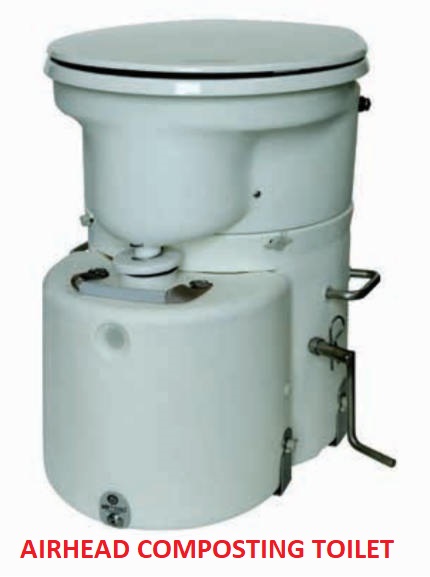
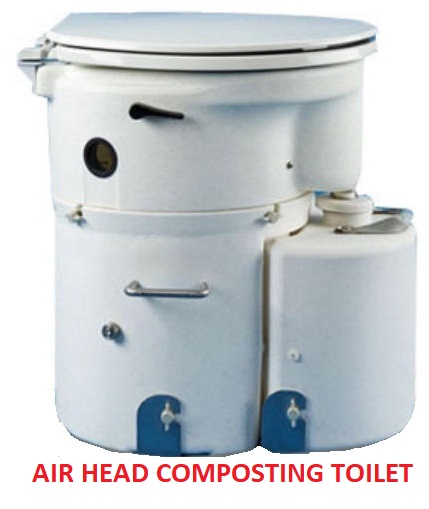
Above: two views of the Air Head composting toilet. [Click to enlarge any image]
- Air Head Composting Toilet, Tel: 740-392-3642, Email: support@airheadtoilet.com Website: https://airheadtoilet.com/ [No corporate address found at this website - Ed. ]
A Better Way To Go, 314/91 Murphy Street (P.O.Box 203) Richmond Victoria 3121. T 03 9421 4235 M 0407 355 875 E info@abetterwaytogo.com.au www.abetterwaytogo.com.au
Air Head describes itself as ideal for boats, RVs, & tiny homes. - AIRHEAD COMPOSTING TOILET MANUAL [PDF], Airhead Composting Toilets, Distributed in Australia by A Better Way To Go 314/91 Murphy Street (P.O.Box 203) Richmond Victoria 3121. T 03 9421 4235 M 0407 355 875 E info@abetterwaytogo.com.au www.abetterwaytogo.com.auretrieved 2018/03/22, original source: https://www.abetterwaytogo.com.au/ assets/files/Air%20 Head%20 Instructions_2016.pdf
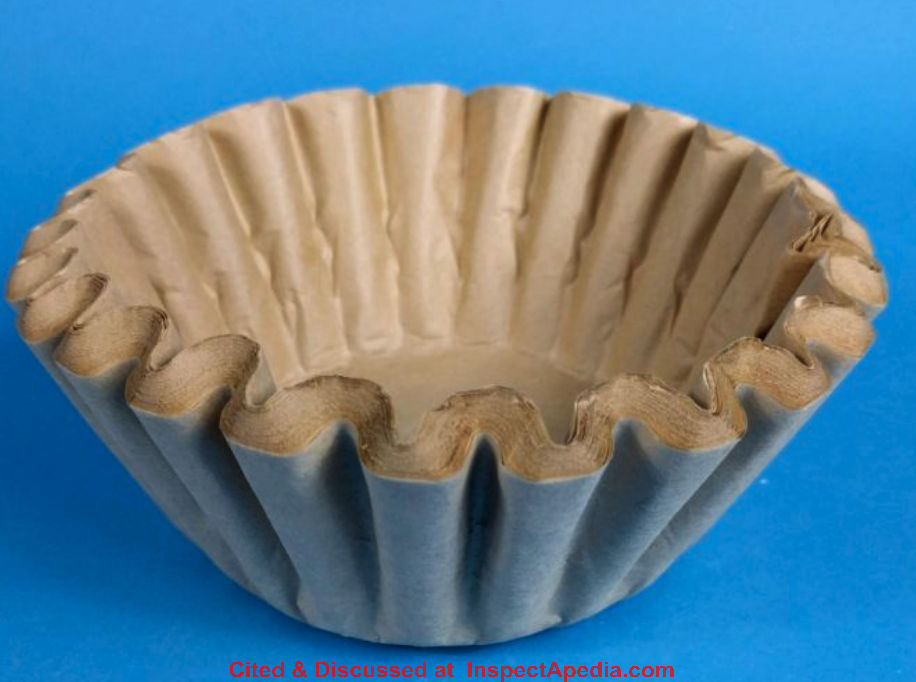
Above: paper carriers used in the Airhead composting toilet.
Biolan Populett Composting Toilets
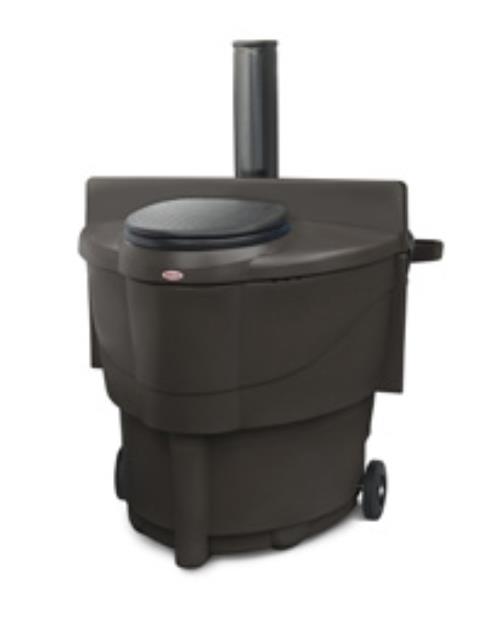
- Biolan Oy - Biolan Oy
PL 2, 27501 KAUTTUA
Tuoteneuvonta:
puh.0600 16999, arkisin klo 9 - 12
Website: www.biolan.fi or Website-English: http://www.biolangroup.fi/english/default4.asp?active_page_id=102
The operation of the Toilet is based on separation of the solid waste and liquid in the seat part. The toilet requires neither water nor electricity supply.
Excerpts describe an example of the use of the Biolan toilet at the Nuuksio National Park in Metsähallitus
Metsähallituksen kohteissa noudatetaan kestävän luontomatkailun periaatteita. Metsähallituksen hoidossa olevassa Nuuksion kansallispuistossa käy vuosittain noin 180 000 retkeilijää. Alueella on monipuoliset palvelut.
Käymälöitä kansallispuistossa on kaikkiaan noin 30. Jokaisen telttailualueen, tulentekopaikan, keittokatoksen ja laavun yhteydessä on kuivakäymälä. Näiden lisäksi Haukkalammen luontotuvan vieressä sekä Kattilassa on kuivakäymälä.
Alueen kuivakäymälöistä kaksi on 300-litraisia Biolan Populettia ja yksi 200-litrainen Biolan Populett. Tuotekehitysvaiheessa olevat isot Populett-kuivakäymät otettiin Nuuksiossa koekäyttöön vuonna 2008. Vasta tämän jälkeen ne tuotiin kuluttajamyyntiin.
The principles of sustainable nature tourism are followed by the Forestry Authority. Approximately 180,000 hikers annually visit Nuuksio National Park in Metsähallitus. The area offers versatile services. There are altogether about 30 toilets in the national park. There is a dry closet for each tent site, campfire site, kitchen cage and lava. In addition to these there is a dry closet next to Haukkalampi Nature Reserve and Kattila.
Two of the area's dry toilets are the 300-liter Biolan Populet and one 200-liter Biolan Populett. The big Populett dry sprays in the product development phase were taken to Nuusho for trial in 2008. Only then did they bring them to consumer sales. - BIOLAN COMPOSTING TOILET MANUAL [PDF]
Biolet composting and waterless toilets
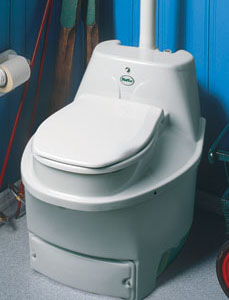 BioLet Toilet Systems
830 West State Street
Newcomerstown, OH 43832, USA Tel: 800-524-6538, Website: biolet.com
BioLet Toilet Systems
830 West State Street
Newcomerstown, OH 43832, USA Tel: 800-524-6538, Website: biolet.com
- Biolet 10 Standard Waterless Toilet, $1,800. Fan, thermostatically controlled heater, and a handy manual mixing control, Rated: 3 people full time or 4 people part time use. Cottage, basement, barn, etc.
- Biolet 20 Deluxe Waterless Toilet, $2000. Fully automatic composting toilet. Thermostat, fan, automatic mixer, automated liquid controls. Rated 3 people full time, 4 people part time.
- Biolet 60 XL Waterless Toilet, $2,500. Swan Ecolabel certification. Extra capacity. Thermostat, fan, automatic mixer, automated liquid control.
- * Biolet - Web: http://www.biolet.com/
Swedish composting toilets ranging from fully automatic electric composting BioLet 60 XL (4 people full time use) Composting toilet prices: $2000. U.S. to a non-electric BioLet 30 NE model (3 people full time use) $1400. U.S. Smallest model: $1000. - * BioLet XL - web: http://www.ecological-engineering.com/ecotech.html
composting toilets available from BioLet (link above) and from EcoTech (link above). EcoTech is a supplier of composting toilets including the BioLet series) are intended for cottages, extra rooms, and remote buildings.
The unit includes a mixing motor, heater, and fan. BioLet toilets are available from the manufacturer and from various composting toilet suppliers. EcoTech also offers a urine-diverting toilet to expand the capacity of a composting toilet system, construct a drying toilet, and to provide source denitrification of sewage waste. - BioLet 30 NE Non-Electric Waterless Solution Biological Toilet,
[quoting]
With over 30 years of Swedish engineering experience, BioLet has released the 5th generation of their self-contained composting toilets. Constant advancements in their products have resulted in BioLet being the most advanced, easiest to use, easiest to install, self-contained composting toilet system in the world.
Designed for locations where reliable electricity is not available, the BioLet 30 NE is the perfect choice for the rustic cabin, hunting camp, or house off the grid. The BioLet 30 NE is also the perfect choice for applications supplied by solar power where the additional load of the electric models may be too much for your system.
Rated at 3 people full-time use and 4 people part-time use, the 30 NE's capacity can be increased to 4 people full-time use and 6 people part-time use by adding the auxiliary 12VDC fan.
Equipped with a convenient drain tube, the 30 NE drains off the excess liquids to an auxiliary container, French drain or leach field. Since liquids are not a limiting factor, the 30 NE will allow for applications where a larger capacity may be needed. When the compost bin fills, just transfer the humus to an auxiliary compost container outside for further composting.
As with all BioLets the 30 NE is easy to install by anyone with basic handyman knowledge in just a couple hours with common household tools.
BioLet 30 NE Non-Electric Waterless Solution Biological Toilet Features:; 3 people full-time use (4 people with auxiliary fan), 4 people part-time use (6 people with auxiliary fan); Installed: Height - 25", Seat height 19.5", Width - 15.75", Depth - 29"; Completely sealed casing of ABS - plastic.
Mixing arms and other important metal components of stainless steel.; Box Includes: o 1 - BioLet 30 NE Composting Toilet o 1 - 8 gallon bag Starter Mulch o 1 - Auxiliary compost bin o 1 - Winterizing plug o 1 - Manual mixing rake o 5 - 2' sections
...
Centrex Composting Toilets
 ...
... 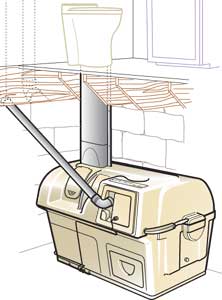
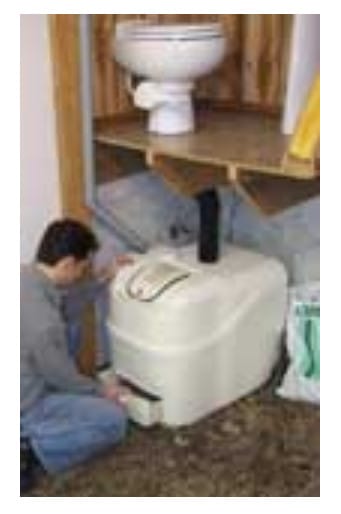
- Centrex central flush composting system (images just above) Available in three batch unit sizes & 1 continuous-use unit used with 1-pint flush toilets. Available in electric (120V or 12V) and non-electric models.
Liquid output is drained separately and needs to be directed to an approved facility.
The Centrex line is available from Sun-Mar Products, http://www.sun-mar.com/prod_flush.html (requires under-floor space for the composting unit)- BuyGreen - http://www.buygreen.com/ (retailer)
- Sun-Mar Corp. 600 Main St. Tonawanda, NY 14150, USA, Tel: 1-888-341-0782, Tel, International: 905-332-1314, Email: compost@sun-mar.com
- Sun-Mar Corp. 5370 South Service Rd. Burlington, ON, L7L 5L1 Canada
Clivis Multrum Composting Toilets
- Clivus Multrum Inc., 15 Union Street
Lawrence, MA 01840
USA, Tel: 800.425.4887
978.725.5591
Fax: 978.956.0977 Web: http://www.clivusmultrum.com/
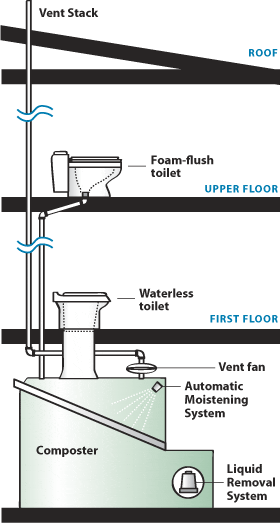
composting toilets have been around long enough to be famous. (The Clivus Multrum composting toilet was invented by the Swede Richard Lindstrom in 1938.) Toilet models include a central composting system design, a waterless design and a foam flush design.
The foam flush model does not have to be directly over the composter. The low water system automatically adds water to the composter.
Clivis describes an integrated outbuilding restroom design too. The company offers factory technician maintenance service for the composter (which appears larger than some competing units, but CM may have other smaller models).
This system uses a lower-temperature decomposition process known as moldering, which takes place slowly over several years and for this reason involves a comparatively large composting unit, manual liquid removal, and steps to address persistent pathogens or pests that may develop in the composter.
Prices: $2500 - $5000. Clivus Multrum offers other wastewater disposal systems and products such as a greywater system which we discuss
at GREYWATER SYSTEMS - Clivus Multrum, Inc. 1994. “When Nature Calls... It Calls Clivus®.” Clivus Multrum, Inc. Lawrence, Massachusetts.
Creative Energy Technologies
- Creative Energy Technologies Carsten Ginsburg 10 Gerty’s Path Summit, NY 12175
CTS Composting Toilets

- CTS - Composting Toilet Systems. Web: http://www.comtoilet.com/
six models, large below-toilet composter, built-to-order using fiberglass and plywood. Website does not quote prices.
CTS also distributes Sun-Mar.
Compost Toilet Prices $4600. to $5300. plus additional charges for support kit, solar-operated vents, fire suppression system.
Eco Toilets - New Zealand composting toilets
- Eco Toilets - Enviro Composting Toilets, New Zealand, Web: http://www.ecotoilets.co.nz/
Composting toilets for permanent dwellings as well as for holiday homes.
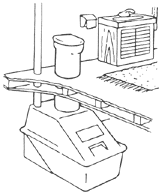
Flushable Toilets, Non-flushable Toilets - Composting and Electric Toilets. EcoToilets Toatrone (shown here) is a non-flush waterless toilet which also performs urine separation.
The composting reservoir is placed directly below the toilet. EcoToilets informs us that this composting toilet design is derived from the earlier Clivus Multrum composting toilet design.
In this Eco Toilets composting model, a special "air staircase" allows air to penetrate through the composting sewage waste from below, a detail which the designer says makes the process of decomposition very efficient. Usage level: designed for permanent living.
A normal household would remove waste as compost once a year.
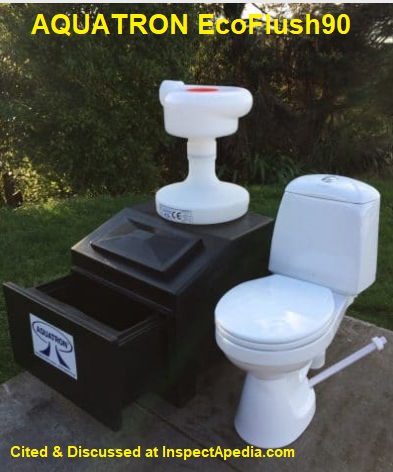
- Eco Toilets also offers Aquatron flush composting toilets [shown just above]
ECO FLUSH TOILET BROCHURE [PDF] Wostman.
Web: http://www.ecotoilets.co.nz/aquatrontoilets.htm Tel: Ramon at 020-4003-3683
which use urine separation, flushing, and a composting container. Eco Toilets is located in Hamilton, New Zealand
Carousel Composting Toilets - EcoTech

- * Carousel batch composting toilets
include self-contained and under-floor models.
Excerpt:
The EcoTech Carousel Composting Toilet System uses the biological process of composting to break down organic wastes. No water or chemicals required for clean wastewater management. EcoTech Carousel’s superior composting speed and effectiveness are the result of its patented design, which features four composting chambers used alternately via a convenient rotating carousel base.
CAROUSEL COMPOSTING TOILET EMPTYING INSTRUCTIONS [PDF]
Web: https://ecotechproducts.net/product/ecotech-carousel-composting-toilet-system/#:~:text=The%20Carousel%20reduces%20waste%20to,%2C%20school%2C%20and%20public%20facilities.
Composting waste is kept separate from in-use toilet. Similar to the Norwegian Vera (TM).
Ecological Engineering Group, Web: http://www.ecological-engineering.com
Website excerpt:
Ecological Engineering Group is a unique engineering and design practice combining conventional engineering, innovative ecological design, and permitting know-how. Our work ranges from residential homes to multi-building sites, many with environmentally sensitive or restricted conditions. We provide a wide array of services including:
Prices: $2200. to $3400. U.S.
...
Eco John Composting Toilets - U.S.
- Eco John, 6148 Getty Dr North Little Rock, AR 72117, USA, Tel: 1-866-ECOJOHN Web: http://www.ecojohn.com/ Email: team@ecojohn.com Email: techsupport@ecojohn.com
Website excerpt:
The first ECOJOHN® models were developed in the early 1990's and ever since, thousands of units have been installed around the world. Our clients consist of residential customers who install them in cottages, guest houses, RV's etc. Other clients include large corporations, worldwide governments, disaster relief, US military, and other international MoD. They are manufactured using the highest quality materials available and built to last. Our company's headquarters is located in North Little Rock, AR and we have great manufacturing capabilities that can handle anything from small to large volumes as well as customized units. - Eco John EcoJohn Basic - A waterless separating composting toilet, which is perfect where an ecologically sensitive toilet facility is desired.
Few product details were at the Eco John toilet website. This is a California company not the New Zealand listing just above. - Eco-San, low density polyethylene, waterless urinal, wind-turbine vent system, outside composter attached to the toilet. Composting toilet price $3000.
Eco Toilets, Composting Toilets, New Zealand
- EcoToilets (New Zealand), Ecotoilets, PO Box 7257, Te Ngae,
Rotorua 3042 New Zealand
57 - 77 Wahanga-a-Rangi Cres,
Eastgate Industrial Park,
Te Ngae Rotorua
New Zealand
Phone: +64 (7) 349 4940. Web: http://www.ecotoilets.co.nz/
Composting toilets with urine separation.
|
Website: http://www.ecotoilets.co.nz/ [Swedish technology] The below-floor composter in this design feeds liquid waste into gray water tanks that feed a leach field.
The company also provides an Aquatron low-flush toilet and composter system and a Toatrone waterless toilet developed from the original Clivus Multrum 1938 design.
A smaller eco-solution re-locatable toilet uses a smaller composter that is emptied on 6-month intervals and can be equipped with a solar-powered vent fan.
No prices are quoted but a fully operational system target is $10,000. NZ.
Ekolet Dry Composting Toilets
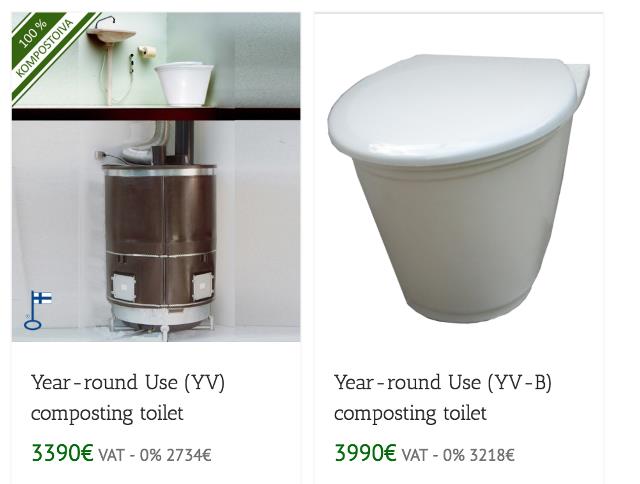
- Ekolet Ltd,
Estetie 3,
00430 Helsinki,
Finland;
E-mail: info(at)ekolet.com;
Phone +35 810 666 2690; The Ekolet company provides composting toilets for outdoor use (outhouses), holiday homes, and indoor use to replace a standard WC.
Excerpt: Composting Ekolet Dry Toilets are completely odorless. Inside the container the waste is composted into fertilizing soil, and the extracted liquid is biologically cleaned. The compositing toilets for home are suitable for regular, year-round use. You can replace an ordinary water closet with an Ekolet toilet.
Dry toilets are in wide use in Finland, with usage increasing after a 2004 passage of a wastewater treatment regulation # 542/2003 and an update to the regulation in 2011, Finland rgulation # 209/2011 that address handling of wastewater in buildings that are not connected to a public sewer.
Envirolet Low Water & Waterless Toilets & Composting Toilets
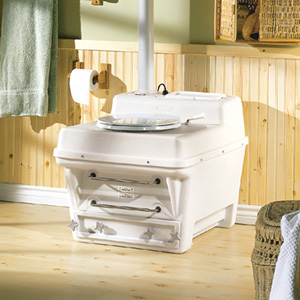
- Envirolet Waterless Remote Composting Toilet System (120v Electric) -
Watch out: appears to be out of business, at least in the U.S. 2023/07/05 - Ed.
Contact information for Envirolet (as of 2011)
Envirolet® USA & WORLD envirolet.com CANADA envirolet.ca EUROPE envirolet.eu NORWAY enviroletnorge.com FINLAND enviroletfinland.com
Sancor Contact information USA 1-800-387-5126 CANADA 1-800-387-5245 DIRECT +1 416 299 4818 EMAIL support@sancorindustries.com WEB sancor.ca
Excerpt: We manufacture advanced composting toilet systems under two brand names, Envirolet® and Santerra Green. They are the same systems. Throughout this manual we will refer to them as Envirolet®/SG
Manufactured by Sancor Industries Ltd. 341 Marwood Drive Oshawa, Ontario L1H 7P8 Canada
Santerra Green™ santerragreen.com
The Envirolet Waterless Remote System (120VAC Electric) is ideal when you have space directly below your bathroom either in a basement or outside. The Waterless Toilet goes in your bathroom and is connected to the Waterless Remote System (shown above).
The highest capacity Envirolet System available. This System was feature in the Field & Stream "Dream Cabin" magazine! Included with system purchase:
1. Envirolet Waterless Remote (120VAC Electric) Composting Unit
2. Waterless Toilet (White)
3. Premix Starter Kit
4. Envirolet Compost Accelerator (8oz)
5. 4" Wind Turbine
6. Vent/ Drain Kit (Includes: 2' x 8" Flexible Drain Duct, 8" Gear Clamp, 4' x 4" Flexible Vent Duct, 4" Coupling, 4" Gear Clamp, Silicone, and Rubber Roof Flashing.
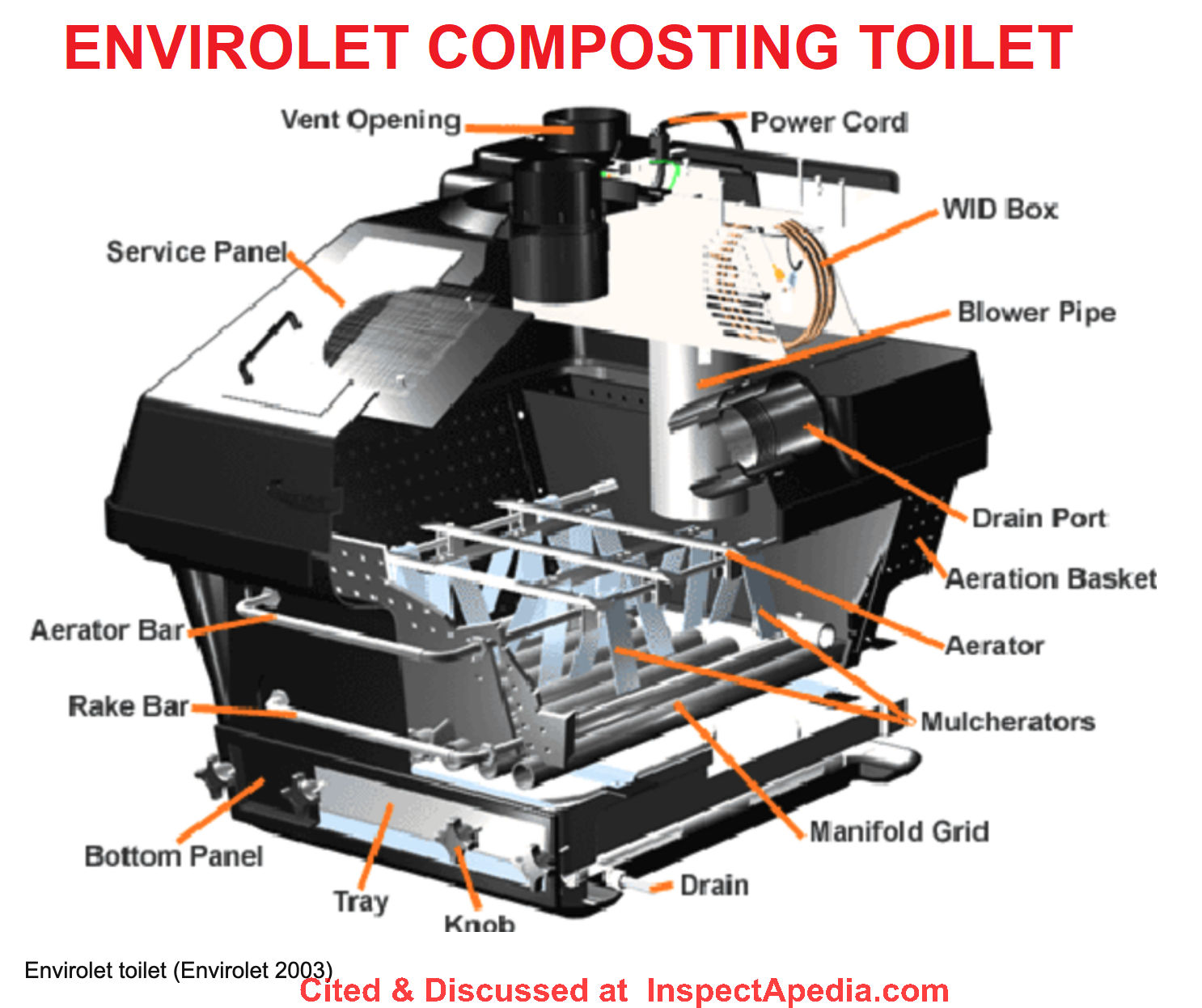
- Envirolet Low Water Remote Composting Toilet System (120v Electric)
The Envirolet Low Water Remote (120VAC Electric) Composting System has the highest capacity of all the Low Water Remote Systems and allows for up to three toilets to be connected to the composting unit.
Each Low Water Toilet flushes with as little as one pint. Included with system purchase:
1. Envirolet Low Water Remote (120VAC Electric) Composting Unit,
2. Premix Starter Kit,
3. Envirolet Compost Accelerator (8oz),
4. 4" Wind Turbine,
5. 2-Stage Pre-Sediment Filter Drain Kit (Filter Tray, 5' Nylon Drain Line Quick Connect Breather "T"),
6. Luxury Low Water Toilet (White),
7. Vent/ Drain Kit (3' x 3" Flex Drain Duct, 4' x 4" Flex Vent Duct, Gear Clamps, Water Supply, Floor Flange, Coupling, Silicone, and Rubber Roof Flashing) - Envirolet Waterless Toilet (Black Granite) , This toilet is easy and sanitary to clean with its removable bowl.
Used with Envirolet Waterless Remote Composting Toilet Systems, but can also be used with existing outhouse or other composting toilets -- not that anyone would choose anything other than an Envirolet! This toilet is 16.5" W x 22.5" L x 20.5" H (15" height to seat). Waterless toilet (black granite), toilet seat (oak), rubber floor gasket and hardware included - Envirolet Waterless Toilet (Cream)
- Envirolet, ENVIROLET®/SANTERRA GREEN COMPOSTING TOILET SYSTEMS INSTALLATION & OPERATION MANUAL [PDF] (2011)
- Envirolet, ENVIROLET®: USE & CARE MANUAL [PDF] (2010) Envirolet® Composting Toilet System use & care including system start-up, power controls and normal operation instructions.
Jade Mountain Inc.
- Jade Mountain Inc. Wes Kennedy P.O. Box 4616 Boulder, CO 80306
L & T Duomatic - kompostikäymälä Composting Toilet - Greece
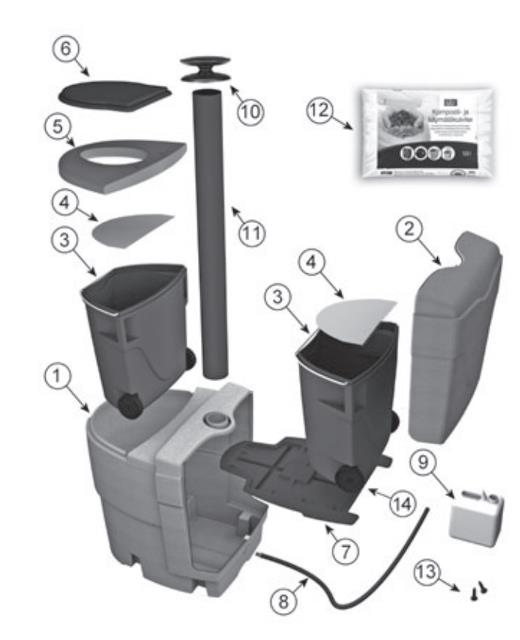
- L&T Duomatic -kompostikäymälä, developed by L&T in 2008.
- DUOMATIC INSTALLATION & OPERATION MANUAL
Excerpts:
L&T Duomatic needs no electricity or water and it is odour-free and easy to empty when correctly installed and properly used. The L&T Duomatic composting toilet has two 80 litre containers, one of which is in use while the other one is composting its contents in the rear of the toilet.
The toilet has a capacity of some 70 usage days / 4 persons / container. In the L&T Duomatic toilet, liquids filter through the substance and the evaporation screen into the container below and keep the composting substance suitably moist.
Efficient ventilation system The L&T Duomatic composting toilet has a ventilation system which allows some of the liquids to evaporate from the evaporation chamber below the compartments during the composting process.
Some of the liquids can be drained through a hose from the evaporation chamber to the seepage canister.
The package includes a separate seepage canister and hose. It is recommended to dig the canister into the ground, and the seepage hose should be installed to the canister, because in an overflow situation the seepage will drain from the evaporation chamber through the hose into the canister.
In case of possible odour problems, the seepage should be drained directly from the evaporation plate into the canister.
LetsGoGreen - SunMar Canada
- LetsgoGreen is not a toilet manufacturer but rather a Canadian supplier of SunMar and other electric and non-electric versions of composting
toilets (Ontario, Canada).
Website: http://www.LetsGoGreen.com
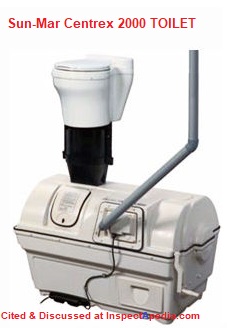
The toilet shown here is the Sunmar Centrex 2000 A/F central-flush waterless air flow composting toilet which uses a below-floor composting drum (110V, Composting Capacity: 4-6 Residential, 6-8 Weekend/Vacation Use, cost $1,795.00).
Other self-contained composting toilet models are available.
Liberty Pumps composting toilets
- Liberty Pumps, 7000 Apple Tree Avenue Bergen, NY 14416 USA Phone: (800) 543-2550 Website: www.libertypumps.com
- Liberty ASCENTII-RSW, Complete Macerating Toilet System, Round, 1/2 HP, 115V
Excerpts:
The Liberty Pumps ASCENTII-RSW is a complete Macerating Toilet System with round front style. It is perfect for bathroom additions and remodeling without breaking concrete floors. It can pump up to 25’ vertically and 150’ horizontally through a 1" discharge pipe.
The ASCENTII-RSW features advanced RazorCut technology for improved maceration of waste and a removable service panel that provides quick access to the cutter area without disconnecting the plumbing. Other features include IST solid state switching, a built-in alarm and LED lights with external touchpad for alarm silence and manual override.
The high quality toilets, available in round front and elongated, have improved flush performance and carry the WaterSense mark. Both models feature insulated tanks to eliminate sweating. - LIBERTY PUMPS ASCENT II MACERATING TOILET INSTALLATION MANUAL [PDF] (2012)
Nature's Head composting toilets
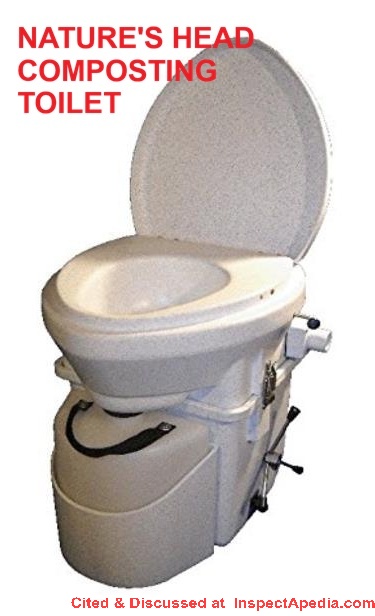
- Nature's Head is a U.S. made stainless-steel composting toilet, designed originally for the marine environment (use on boats). This is a portable, self contained, urine separating dry toilet that can be used where electricity is not available.
The liquid waste compartment can store 2.2 U.S. gal. which the manufacturer recommends disposing of in a public restroom.
Liquid urine waste is automatically separated from the solids. Solid waste that has composted (decomposed) for 3 months or more can be used as plant fertilizer; solid waste that has not composted that long can be bagged and disposed-of in a dumpster.
The base product cost is about $850.00 U.S.
The manufacturer notes that the toilet system does not produce the odors associated with holding tank toilet systems. It is suitable for cabins, cabanas, boat houses, hunting camps, RVs, basements, semi-trucks, and even pick-up trucks.
The unit is vented to outside a venting kit chosen depending on the installation requirements. A 12-V fan is used to operate the ventilation system, powered by battery or a solar vent with backup solar-charged battery pack. Available with choice of conventional crank agitator handle or spider-handle (shown in our illustration) to mix waste with composting media.
The composting system is primed with damp, crumbly peat moss. Telephone: 251-295-3043 email: Sales@NaturesHead.net
We have reviewed reports of consumers who installed a Nature's Head composting toilet in an RV as well as installing it in boats for marine use. Some extra materials will be needed for those installations.
Freezing climates & Nature's Head:
Important for consumers installing this toilet in a freezing climate: the company's installation manual as well as EnviroPro in Australia note that as long as the urine bottle has been emptied, nothing needs to be done to protect the toilet from freezing.
In our OPINION [DF] it should be noted that in frozen waste/compost inside any composting toilet seems likely to render the toilet inoperative until it has thawed. For example turning a hand-operated or electrically-operated mixing crank will not be possible if the mixer is immersed in frozen waste.
- NATURES HEAD COMPOSTING TOILET MANUAL [PDF] Nature’s Head, Inc., PO Box 250, Van Buren, OH 45889 Tel: 251-295-3043 Email: sales@NaturesHead.net Website: www.NaturesHead.net Nature's Head Corporate HQ, 535 Bayou Sara Avenue, Saraland, AL 36571 USA, retrieved 2018/03/22, original source: https://cdn.shopify.com/s/files /1/1493/0568/files/ Natures_Head_Installation_Manual_Users_Guide_2017.pdf
- NATURE'S HEAD COMPOSTING TOILET INSTRUCTIONS [PDF] retrieved 2018/03/22
Excerpt:
Although the concept of a composting head (toilet) is not a new one, the unit which you have purchased is the freshest of the new generation of this kind of product.
Nature's Head designers, both sailors with many years of boating experience, and their wives—one a research biologist and one an RN, have used earlier versions of composting toilets on their boats.
The concept has been refined and reworked to provide you with a more user friendly product which is aesthetically pleasing, more space-efficient, and a more affordable alternative to previously offered models. - Nature's Head Composting toilets, Australia distributor: EnviroPro, Email: info@enviropro.com.au Tel: 1800 707 076, Website: https://www.natureshead.com.au
EnviroPro provides a Nature's Head Composting toilet troubleshooting guide at: https://www.natureshead.com.au/overview/troubleshooting/ - 3/7/2014 Alan Morton said: Nature's Head Composting Toilets are now available ex-stock in New Zealand from the sole importing agent - The Outdoor Shop, 2 Cobham Road, Kerikeri, Bay of Islands. Phone: 64-(0)9 - 4077641 or email admin@natureshead.co.nz www.outdoorshop.co.nz or www.natureshead.co.nz
Nature Loo Composting Toilets, Australia
- Nature-Loo, 25 Shannon Pl, Virginia QLD 4014 Australia, Tel: 07 3889 6144 / 1300 138 182
Email: info@ecoflo.com.au Website: http://www.nature-loo.com.au/
composting toilet is an Australian product includes ceramic and plastic models.
Available in both full time & part time use models & models for mobile homes & boats. For homes & extensions, available in split systems for non-slab-floor installations & self-contained systems for slab floor installation.
Phoenix Composting Toilets
- Phoenix Composting Toilet from Advanced Composting Systems, 195 Meadows Road, Whitefish, MT 59937 USA, Web: http://www.compostingtoilet.com/
requires 5 watts of electric power. Hand pump to remove excess liquid; rotating tines to move compost to the removal area. DC fan; can run on photovoltaics.
Phoenix Composting Toilet Prices: $4100. to $6100.Email: phoenix@compostingtoilet.com, Website: Internet: http://www.compostingtoilet.com
Also available from Sunergy Systems Ltd., Box 70 • Cremona, AB T0M 0R0 Phone/Fax: 403-637-3973
Email: sunergy@compostingtoilet.com
Operating Manual: http://www.compostingtoilet.com/LITRACK/manual.pdf
Separett Urine Diverting Composting Toilet
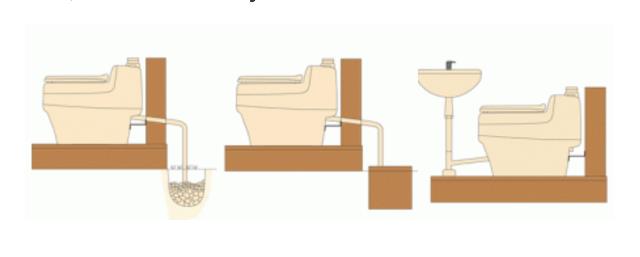
- Separett Villa 9210 AC/DC Urine Diverting Toilet using compostable waste bag liners.
Separett-USA/EcoServices PO Box 226 Barrington NH, 03825 USA Tel: 800.682.8619 Email info@separett-usa.com Website: http://www.separett-usa.com/index.php/waterless-urine-diverting-toilet.html
Sold at shoptinyhouses.com and other outlets.
Excerpts: The Separett Villa waterless toilet, is a urine diverting design which redefines the approach required for remote cottage, tiny home, boat, RV and residential sanitation requirements, providing a system equal to a modern water based toilet in every way.
The Villa 9210 is designed to accept 12V DC power from a battery or solar resource, or the AC converter - on standard AC power. It's the perfect unit if you may be changing from on grid to off or vice versa.
For installation in locations where the unit is not used for a period of time, and power is not continual, we recommend that when closing your location, you place the lid on storage container to eliminate the need for ventilation. Upon return, remove the lid and restart the fan for proper ventilation.
Using the Villa 9210 AC/DS unit allows solid waste to be stored for disposal while liquid waste is safely diverted into a drain pit, storage tank, or waste water system.
Site-Built Composting Toilets
Shown below is a composting toilet system in use above Akaroa at the Hinewai Reserve (Maurice White Native Forest Trust) on the Banks Peninsula in New Zealand.
Using a combination of purchased and site built components this composting toilet serves hikers and visitors to the preserve.
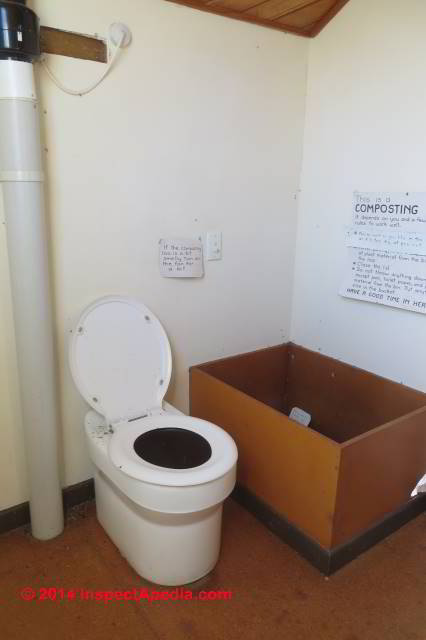
Separate toilet facilities or latrines for urine are provided for use if the liquid level in the composting toilet becomes too high but at the time we visited this facility a note from the management encouraged peeing into the composting toilet as the mixture was too dry.
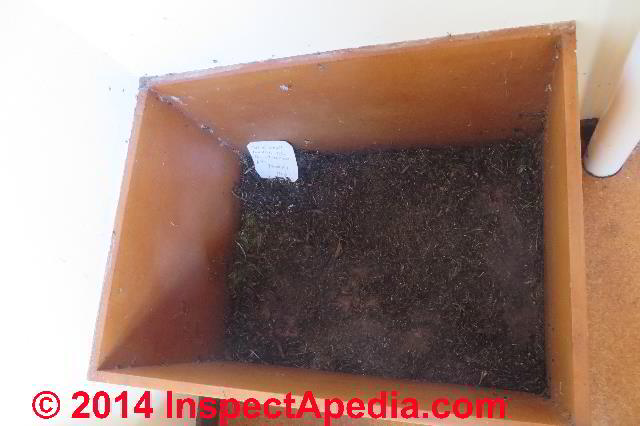 ...
... 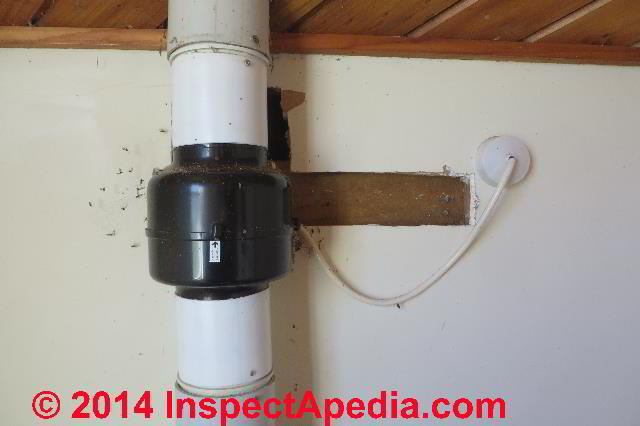
At above left is the box of dry plant material, of which a small handful is tossed into the composting loo after each use. At above right we see that this composting loo includes a ventilating fan that can be switched on if the composting toilet is a bit smelly.
Sun Frost Human Humus Composting Toilets
- Sun Frost "Human Humus Machine" Composting Toilet, Sun Frost, Sun Frost
824 “L” Street
Arcata, CA 95521, Tel: 707-822-9095, Email: info@sunfrost.com, Website: http://www.sunfrost.com. Pricing not found at website. Quoting:
The Human Humus Machine is available in a relatively low-cost kit form. The kit consists of all the parts necessary to convert two 55-gallon drums into a state-of-the-art composting toilet. The drums have a plastic liner to eliminate rusting. The kits are easy to assemble and can be completed in less than 2 hours. The installer would obtain the drums locally. We can also offer fully assembled units.
The Human Humus Machine is a batch-type CT. After the drum is full, the contents of the drum are allowed to sit for a number of months to complete the composting process. In non-batch type composters, newly deposited material can contaminate compost ready to be removed.
SunMar Composting Toilets
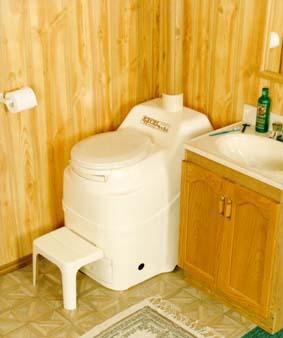
- * SunMar Sun-Mar Corporation Fraser Sneddon 5035 North Service Road, Unit C9-C10 Burlington, ON L8N 2Y9 provides low water and no-water composting toilets, and
stand alone toilets as well as equipment to provide central composting supporting multiple toilets.
(Their website http://www.sun-mar.com/ says there are 20 models of low water or no water toilets.)
SunMar uses a rotating drum to mix the compost. Sun-Mar is described by some vendors as not a true composting toilet but as a "dry toilet", smaller than true composting toilets, and using supplemental heat, air, and mixing to assure waste decomposition.
Waste is kept on an outside compost pile for six months before spreading on soils.
More frequent emptying and smaller capacity than "true composters" this toilet may be a best fit for a low-use remote cabin.
SunMar offers a variety of composting toilets including a self-contained composting marine toilet model, the SunMar Mobile, certified by the U.S. Coast Guard ($1,489.00). Shown here is the SunMar Excel ne composting toilet [Click image for larger photo].
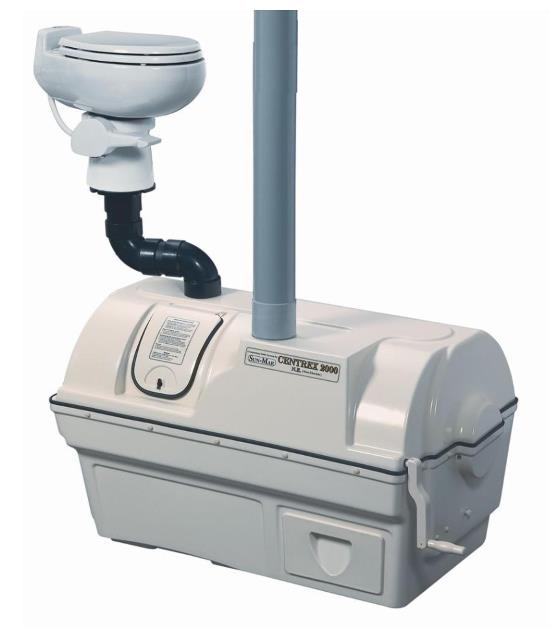
Sunmar produces an elongated base dry toilet, non-electric, ADA-compliant, also sold as the AF Waterless Toilet for use with the Waterless Centrex 2000 / Centrex 3000 systems [BuilderDepot, Inc., sold at Walmart & other suppliers] shown below.
Thetford Composting Toilets
- Thetford Corporation 7101 Jackson Road, Ann Arbor, MI 48103, Phone: 1-800-543-1219, 734-769-6000, Fax: 734-769-2023; Website: http://www.thetford.com
Thetford produces a wide range of permanent and portable alternative toilet designs. Quoting:
Our [toilet] products are easy to use at bedside and indispensable for the physically challenged, the aged, and small children. Thetford's list of toilet products suitable for home or bedside health care are listed at http://www.thetford.com/Thetford/HOME/ApplicationHome/BedsideApplications/tabid/94/Default.aspx
* - units that were recommended by RealGoods and which look good to us.
Thetford produces also the Bravura low profile RV toilet.
Trisynergy Inc.,
- Trisynergy Inc. Tevan Riedel P.O. Box 27015 San Diego, CA 92198-1015
Table of Composting Toilet Operating Costs, Choices, Supplies - do we really need to buy mulch or sawdust or other stuff?
This information is now found at
Composting Toilets - Books & References
- Cook, B. 1981. “Field Evaluation of Compost Toilets.” Individual Onsite Wastewater Systems: Proceedings of the Seventh National Conference. pp. 83–98.
- Crites, R. and G. Tchobanoglous. 1998. Small and Decentralized Wastewater Management Systems. The McGraw-Hill Companies. New York, New York
- Del Porto, David & Carol Steinfeld, Composting Toilet System Book: A Practical Guide to Choosing, Planning and Maintaining Composting Toilet Systems, [Book for sale at Amazon]
Quoting an Amazon review: Del Porto's book is the definitive composting toilet book at this time. There is nothing even close. His book covers all aspects of composting toilet systems and touches on graywater issues as well. He treats the composting toilet as part of the home system.
If a person is seriously interested in installing/having a composting toilet, this book can save him/her all of the mistakes people usually make. He even (carefully) explodes some of the advertising myths that the purveyors of composting toilets would have us believe. The book covers ready-made systems as well as home built systems. As trite as this sounds, the book truly is a must for someone considering installing composting toilet. - Eco John® INNOVATIVE TOILET CATALOG [PDF] Global Inventive Industries, Fountain Valley CA, PDF, product brochur
- [3] Envirolet's name is on "Composting Toilet World" website: Watch out: avoid this website, all advertisements, no information, very annoying website with flashing advertisements at http :// www .composting toilet . org / news/ [link disabled]
- Felton, D. (editor). 1981. “State-Of-The Art Assessment of Compost Toilets and Greywater Treatment Systems.” The Winthrop Rockefeller Foundation. Little Rock, Arkansas.
- [2]Franey, Tara, "Composting Toilets: Alleviating Regulatory Barriers to an Integrated Green Solution", Land Use Institute, Vermont Law School, 164 Chelsea St , P.O. Box 96, South Royalton, VT 05068 tfraney@vermontlaw.edu, Web search 5/3/12, original source: http://www.vermontlaw.edu/Documents/Land%20Use% 20Institute/NEWEA_paper_final_1.pdf
- Jenkins, Joseph C., The Humanure Handbook: A Guide to Composting Human Manure, 3rd Ed.,
Quoting part of an Amazon review: The Humanure Handbook provides a wealth of thoroughly researched, hands-on experience and scientific data that demonstrates that after a natural process called "thermophilic" bacterial digestion, which occurs in a compost bin and where all pathogens are killed, excreta is then converted to a valuable nutrient for agriculture and thereby completing a full-circle life cycle. Most importantly, effluent can then be kept out of our drinking water and not treated or referred to as an undesirable "waste product".
The information is conveyed in a humorous, folksy, down-to-earth easy to understand style along with drawings, charts, tables, photos and a wealth of resource info for further research. - Guttormsen, D. 1979. “Evaluation of Compost Toilets—A Field and Laboratory Update.” Individual Onsite Wastewater Systems: Proceedings of the Sixth NationaConference. Ann Arbor Science Publishers, Inc. Ann Arbor Michigan.
- Hoxie, D. C. and W. W. Hinckley. 1977. “Factors Affecting Acceptance of Waterless Toilets—The Maine Experience.” Individual Onsite Wastewater Systems: Proceedings of the Fourth National Conference. National Sanitation Foundation (NSF).
- Jacobson, A. R. January 1982. “Waterless, Solar Toilets for Colorado Park.” Public Works. vol. 113. no. 1. p. 85.
- [1] Phoenix Composting Toilet from Advanced Composting Systems (195 Meadows Road, Whitefish, MT 59937),
requires 5 watts of electric power. Hand pump to remove excess liquid; rotating tines to move compost to the removal
area. DC fan; can run on photovoltaics. Composting Toilet Prices: $4100. to $6100.Email: phoenix@compostingtoilet.com,
Website: Internet: http://www.compostingtoilet.com
Also from Sunergy Systems Ltd., Box 70 • Cremona, AB T0M 0R0 Phone/Fax: 403-637-3973
Email: sunergy@compostingtoilet.com
Web search 5/3/12, original source: Operating Manual: http://www.compostingtoilet.com/LITRACK/manual.p - Kavanagh, Lydia, J., MODERN APPROACH FOR WATER RENEWAL IN SINGLE TOILET SYSTEMS USED ON TRAINS, BOATS, COACHES AND MOTOR HOMES [PDF] © CRC for Sustainable Tourism Pty Ltd 2005
- Rockefeller, A. 1980. “Separated Treatment: Composting Toilets and Greywater.” Conference Proceedings. pp.104–118. Environmental Policy Institute and Clean Water Fund. Cambridge, Massachusetts.
- Scholze, R. J. 1984. “Appropriate Technology for Army Waste Management: Applications for Remote Sites and Mobilization.” DAEN-ZCF Technical Note No. 84-2. Department of the Army, Office of the Chief of Engineers. Washington, D.C.
- Scholze, R. J. September 1985. “Innovation in Remote Site Waste Treatment.” BioCycle. pp. 37–38
- Scholze, R. J.; J. E. Alleman; S. R. Struss; and E. D. Smith. December 1986. “Technology for Waste Treatment at Remote Army Sites.” USA-CERL Technical Report N-86/20. USA-CERL. Champaign, Illinois.
- Seabloom, R. W. and J. Engeset. March 1 & 2, 1978. “An Appraisal of Composting Toilets.” Proceedings of the Second Northwest On-Site Wastewater Disposal Short Course. University of Washington. Seattle, Washington
- Smith, E. D.; C. P. C. Poon; S. R. Struss; J. T. Bandy; and R. J. Scholze. April 1984. “Appropriate Technology for Treating Wastewater at Remote Sites on Army Installations: Preliminary Findings.” USACERL Technical Report N-160. USACERL. Champaign, Illinois.
- US EPA, COMPOSTING TOILETS, Water Efficiency Technology GFact Sheet, EPA 832-F-99-066 (1999) retrieved 2019/09/18 original source: https://www.epa.gov/sites/production/files/2015-06/documents/comp.pdf
Excerpt:
A composting (or biological) toilet system contains and processes excrement, toilet paper, carbon additive, and sometimes, food waste.
Unlike a septic system, a composting toilet system relies on unsaturated conditions where aerobic bacteria break down waste. This process is similar to a yard waste composter.
If sized and maintained properly, a composting toilet breaks down waste 10 to 30% of its original volume. The resulting soil-like material called “humus,” legally must be either buried or removed by a licensed septage hauler in accordance with state and local regulations. - Vinneras,B, & A. Bjorklund, H. Jonsson. "Thermal composting of fecal matter as treatment and possible disinfection method--laboratory-scale and pilot-scale studies",
Quoting Amazon review: When using toilets where the urine and faeces are collected separately for reuse as nutrients in agriculture, the collected matter should be disinfected. One way to do this is by thermal composting.
Composting of different material mixes was investigated in a laboratory-scale experiment. This showed that the best mixture for dry thermal composting was a mix of faeces, food waste and amendment. The urine was collected separately by use of urine-diverting toilets.
A new method was developed to mathematically evaluate and estimate the safety margins of pathogen inactivation during thermal composting.
The method is based upon a mathematical calculation of the number of times total inactivation (at least 12log"1"0 reduction) of the organisms is achieved. In a pilot-scale experiment, the disinfection of a faeces/food waste mix was performed with a calculated safety margin of more than 37 times the total die-off of Enteroviruses and some 550 times that of Ascaris. Thus, well functioning composting seems to be effective for disinfection of faecal matter.
To get a high temperature in all of the material, the reactor has to have sufficient insulation. A major disadvantage is the initial need for handling the raw un-disinfected material. The degradation of the organic matter in the compost was almost 75%, resulting in a small final volume that could safely be recycled.
Experiences with a composting toilet article from: Countryside & Small Stock Journal, available as HTML download. Quoting Amazon review: This digital document is an article from Countryside & Small Stock Journal, published by Countryside Publications Ltd. on May 1, 1994.
From the supplier: A composting toilet is a good alternative to propane burning toilets, but it also has many problems. The worst part is emptying the waste and compost every 4-6 weeks. Other problems are the fan that must be kept running constantly and bug infestation.

- US EPA, WATER EFFICIENCY TECHNOLOGY FACT SHEET: COMPOSTING TOILETS, [PDF] (1999) US EPA Article on Incinerating Toilets PDF file, retrieved 1/19/1999, 3/6/2014 and anew 2019/07/20
Excerpt:
Originally commercialized in Sweden, composting toilets have been an established technology for more than 30 years, and perhaps longer in site-built forms.
As they require little to no water, composting toilet systems can provide a solution to sanitation and environmental problems in unsewered, rural, and suburban areas and in both developed and underdeveloped countries. A composting (or biological) toilet system contains and processes excrement, toilet paper, carbon additive, and sometimes, food waste.
Unlike a septic system, a composting toilet system relies on unsaturated conditions where aerobic bacteria break down waste. This process is similar to a yard waste composter. If sized and maintained properly, a composting toilet breaks down waste 10 to 30% of its original volume.
The resulting soil-like material called “humus,” legally must be either buried or removed by a licensed septage hauler in accordance with state and local regulations. - US EPA, FOLLETO DE TECNOLOGÍA DEL USO EFICIENTE DEL AGUA INODOROS DE COMPOSTAJE , [PDF] (1999) US EPA Article on Incinerating Toilets PDF file, retrieved 1/19/1999, 3/6/2014 and anew 2019/07/20
- U.S. EPA, DECENTRALIZED SYSTEMS TECHNOLOGY FACT SHEET: SEPTIC TANK - SOIL ABSORPTION SYSTEMS, PDF Document provides basic information about septic tanks and drainfields.
Reader Comments, Questions & Answers About The Article Above
Below you will find questions and answers previously posted on this page at its page bottom reader comment box.
Reader Q&A - also see RECOMMENDED ARTICLES & FAQs
On 2018-02-05 by Zara - use waterless toilets in Cape Town South Africa
Here in Cape Town , South Africa we are in a severe drought; in danger of our water supply being cut off in May 2018; looking for ways of using as little water as possible. Many thanks for your article/s
On 2018-02-05 by (mod) - need to use water-saving toilets in Cape Town South Africa where water is scarce
Zara
Thank you for the nice note - we work hard to provide unbiased and researched information that might be useful. So I'm really glad when you find it so. We also welcome specific questions - working together helps us both.
We are following the Cape Town drought with great concern, both from our offices in the U.S. and in Mexico where we also have growing concerns for the water supply. In our town there the water table is dropping at about two meters per year!
In our area nearly every new bathroom and many older toilets are being fitted with both low-flush toilets and waterless urinals - the latter use no water at all. IF that might help (in my opinion it will but way too slowly) sources of waterless urinals are given atFLUSHOMETER TOILETS & URINALS inspectapedia.com/plumbing/Flushometer_Toilets_Urinals.php
I would like to add more sources there including for people in South Africa, particularly Cape Town.
Our home page for this topic is atWATER CONSERVATION MEASURES inspectapedia.com/water/Water_Conservation_Methods.php
I would appreciate any specific questions you might have as that can prompt research on our end that might be useful.
I am among the crowd who have have long predicted that particularly as made worse by global warming we are facing tremendous problems based on no more than the water supply itself and it is obvious to anyone (other than our current national government that countries world-wide are facing massive movements of people trying to simply have water to drink, and probably fighting over water supplies.
On 2015-11-26 1 by edith - What are the regulations for installing a compost toilet in Alberta?
What are the regulations for installing a compost toilet in Alberta?
On 2015-11-26 by (mod) - Composting Toilet Codes for Alberta Canada
Edith
I searched the Alberta sanitary code for "compost" - the word did not appear. You might want also to check with your local plumbing inspector. Or you can call the provincial authority at
Toll-free in Alberta:
310-0000
From outside Alberta
(long distance charges apply):
1-780-427-2711
Question: multi-seat composting toilets?
(Apr 4, 2014) Colleen Oliver said:
Is there a system that can take more than one toilet bowl - for a camp ground
Reply:
Yes Colleen, some of the composting toilet manufacturers provide a system that uses a common composting toilet tank with multiple toilets.
On 2012-08-15 by M Guy - does not like Envirolet toilets
OPINION of this reader:
Composting toilets are a joke, Envirolet toilets are
a complete ripoff. It take years to compost human love and all they are is a small holding tank that you have to clean every week. They leak they smell they are filthy.
Don`t fall for comments praising these systems just try and post an unfavorable comment on Envirolets ``The Buzz`` I grantee you will never see it posted. I spent 3000.00 on one of their systems and it ended up in the land fill.
On 2012-08-09 by Acv
The biggest cause of problems is the toilet paper!The more expensive no tear toil paper jams the machinery..hardens like concrete...the binder also clogs the drain filters...
use cheap single ply which disintegrates when wet, helps allot.......yup I learned the hard way and got a composter full of"soup" because that famous brand of toilet paper
On 2012-08-07 by D&V - user's experience positive for Sun-Mar composting toilet
We have a SUN-MAR Excel, which is described on this site. We have been using it for about 6 years with good success. The maintenace cost is low. ( $10. / year )
We use a mix of dry pine shavings and peat moss. We empty about half of the volume in the spring and fall. The manufacturer support has been good. At one point we started to get a problem with smell. They walked us through talking off a cover over the motor, and adjusting the fan to a higher setting. I would recommend this product to anyone.
On 2012-08-08 by (mod) - SUN-MAR Excel feedback and comments
D&V, thanks for the feedback - hearing from people using equipment is invaluable. And indeed the manufacturer has a great interest in their product working successfully, which is why it makes sense to ask them for advice.
We'll keep your exhaust fan tuneup suggestion here as it will surely help other readers.
Daniel
On 2012-04-02 1 by Martha Dominguez marthacd@earth - want to know if Nature's Head compost toilet is NSF approved
I want to know if Nature's Head compost toilet is NSF approved and whether is acceptable for Tucson, Arizona requirements. Please I need your help.
On 2012-04-03 by (mod) - Pima County DEQ Water Authority
Martha, you might want to call the Pima County DEQ Water Authority directly
Pima County
Department of Environmental Quality
33 N. Stone Avenue, Suite 700
Tucson, Az 85701
Phone (520) 243-7400
"For an alternative system (AAC R18-9-E303 (4.03) through R18-9-E323 (4.23)), the applicant shall submit the alternative "Notice of Intent to Discharge" form and any system-specific supplemental information and forms."
Another possible source is your
PDEQ solid waste division
5301 W. Ina Road
Solid Waste Business Office - 744-6173
On 2012-01-01 by david - Reporting roblems with the Envirolet toilet - urine problems
we have the envirolet and have the same problem as allanday and Bob. The toilet motor does,nt work. There is no help in Victoria. We have had the toilet 2 years in a holiday houseand have used it approx 3 months in total.
We are very disappointed and the urine in the bottom of the unit is a constant problem. We have used plenty of peat and fine grade wood shavings.
On 2011-12-17 0 by Bob - review of Envirolet Electric Toilet - trouble report
I owned a envirolet for 6 months. This is a review. It was an electric model and was completley worthless. 2 people used it and it continuously dried out into a hard mass making agitation impossible. We used their recommended coco hulls for mulch.
After cheseling the non composted mass out for the tenth time we requested a refund I cannot believe they are still in business. They refunded some of our money and we disposed of the entire device at the local landfill. Very disapointing. They must know it doesn't work
On 2011-12-24 by allanday16@yahoo.co.uk - trouble report for Envirolet toilet in the UK
I have found evirolet 12V similar same problem as Bob. I live in the UK I would like a refund.
The urine does not soak away. I find in bottom holding tray is full of slimy urine. I am 80years and need urgent help. what will envirolet help.
On 2011-12-24 by (mod) -
Allanday and Bob:
Can you confirm that you followed the toilet's instructions to the letter?
We are following your complaints with interest and hope that you will report back to us describing what response you've had from Envirolet. - Ed
...
Continue reading at INCINERATOR TOILET SYSTEMS or select a topic from the closely-related articles below, or see the complete ARTICLE INDEX.
Or see these
Alternative Toilet Type Articles
- ALTERNATIVE & WATERLESS TOILETS
- CAMPING & EMERGENCY USE TOILETS
- CHEMICAL TOILETS
- COMPOSTING TOILETS - you are on this page
- COMPOSTING TOILET SUPPLIES
- GREYWATER FLUSH TOILETS
- INCINERATOR TOILET SYSTEMS
- OUTHOUSES & LATRINES
- TOILET TYPES, CONTROLS, PARTS - home
- WATERLESS URINALS
Suggested citation for this web page
COMPOSTING TOILETS at InspectApedia.com - online encyclopedia of building & environmental inspection, testing, diagnosis, repair, & problem prevention advice.
Or see this
INDEX to RELATED ARTICLES: ARTICLE INDEX to TOILET INFORMATION
Or use the SEARCH BOX found below to Ask a Question or Search InspectApedia
Ask a Question or Search InspectApedia
Try the search box just below, or if you prefer, post a question or comment in the Comments box below and we will respond promptly.
Search the InspectApedia website
Note: appearance of your Comment below may be delayed: if your comment contains an image, photograph, web link, or text that looks to the software as if it might be a web link, your posting will appear after it has been approved by a moderator. Apologies for the delay.
Only one image can be added per comment but you can post as many comments, and therefore images, as you like.
You will not receive a notification when a response to your question has been posted.
Please bookmark this page to make it easy for you to check back for our response.
Our Comment Box is provided by Countable Web Productions countable.ca
Citations & References
In addition to any citations in the article above, a full list is available on request.
- Flatley, Joshua, BRF/BAT Technical Lead, "BAT Classification for Waterless Toilet Systems", Maryland Department of the Environment (Maryand DOE), 1800 Washington Blvd., Baltimore MD 21230, Tel: 410-537-3000, Tel: 800-633-6101, Website:www.mde.maryland.gov, Memorandum, 10 March 2015 to Environmental Health Directors, THRU: Jay Prager, Wastewater Permits Program, Deputy Program Director,
- In addition to citations & references found in this article, see the research citations given at the end of the related articles found at our suggested
CONTINUE READING or RECOMMENDED ARTICLES.
- Carson, Dunlop & Associates Ltd., 120 Carlton Street Suite 407, Toronto ON M5A 4K2. Tel: (416) 964-9415 1-800-268-7070 Email: info@carsondunlop.com. Alan Carson is a past president of ASHI, the American Society of Home Inspectors.
Thanks to Alan Carson and Bob Dunlop, for permission for InspectAPedia to use text excerpts from The HOME REFERENCE BOOK - the Encyclopedia of Homes and to use illustrations from The ILLUSTRATED HOME .
Carson Dunlop Associates provides extensive home inspection education and report writing material. In gratitude we provide links to tsome Carson Dunlop Associates products and services.
 | HOME | ABOUT | ASK a QUESTION | CONTACT | CONTENT USE POLICY | DESCRIPTION | POLICIES | PRIVACY | |
| © 2024 - 1985 Publisher InspectApedia.com - Daniel Friedman | |||||||||