
InspectAPedia® FREE Encyclopedia of Building & Environmental Construction, Diagnosis, Maintenance & Repair |
Question? Just ask us! InspectAPedia
|
 Greywater or Gray Water Systems
Water Conservation, Re-Use
- POST a QUESTION or COMMENT about greywater systems
This article defines and explains the disposition of greywater, a type of wastewater.
Greywater is wastewater which does not contain sewage, typically coming from building sinks, showers, and laundry facilities.
Graywater systems can reduce the load on or size of a septic system, and gray water separation, filtration, storage, and piping systems can conserve water, for recycling for various uses such as flushing toilets, landscaping, or irrigation.
This article describes alternative graywater systems and designs, lists gray water (or grey water) products and suppliers, and compares products, models, and features. We discuss the advantages as well as the concerns that arise when using graywater or sink or laundry or showere water specifically to flush toilets.
InspectAPedia tolerates no conflicts of interest. We have no relationship with advertisers, products, or services discussed at this website.
What is Greywater or Graywater and What is Blackwater?
How to install & use graywater systems to conserve water or relieve septic system loading: using a greywater distribution or greywater diversion system. Comparison of sources of water for household or garden use besides wells or municipal water supply: rainwater collection, water condensation systems.
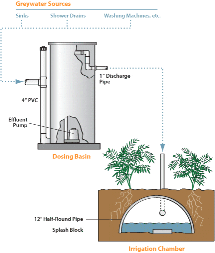
In addition to explaining graywater systems we list and compare other sources of water for use on lawns, gardens, orchards, or for purification as drinking water. We also include links to greywater system references and books. Shown at page top is a clean design for onsite greywater disposal using a sketch from Clivus Multrum (see links below).
[Click to enlarge any image]
Article Series Contents
- GREYWATER SYSTEMS - home
- DEFINITION of GRAYWATER SYSTEMS
- FILTERS SEPTIC & GREYWATER
- TYPES of GRAYWATER SYTEMS PRODUCTS
- USE GRAYWATER to REDUCE SEPTIC LOAD
- GREYWATER DISINFECTION BEFORE RE-USE
- GREYWATER FREEZE PROTECTION
- GREYWATER CODES & REGULATIONS
- GREYWATER FLUSH TOILETS
- GREYWATER RE-USE & RAINWATER COLLECTION SYSTEMS
- GREYWATER SYSTEM PRODUCTS, SUPPLIERS
Also see additional citations atReferences or Citations
Other greywater systems include incineration and alternative greywater disposal methods. The EcoJohn Jr. shown below at our list of product sources uses a low-flush toilet (not a waterless toilet). This particular toilet is an incinerating unit not a composting toilet.
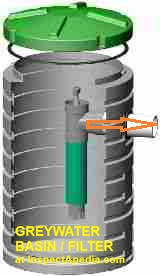
At left is a sketch of a typical graywater filter. This filter is available from thenaturalhome.com and other sources given
at GREYWATER SYSTEM PRODUCTS, SUPPLIERS.
People who want to construct a greywater system should also see the greywater design books listed below atReferences or Citations .
Technical review by industry experts has been performed and is ongoing - reviewers welcomed and are also listed and cited.
Definition of Greywater or Graywater:
greywater is defined as the liquid wastewater from buildings that excludes septage, that is toilets. So water from a laundry, sink, bathtub, or even a shower all are considered graywater waste.
Definition of Blackwater:
blackwater is defined as building wastewater that includes sewage (waste from toilets). Note that if your building drains mix water from sinks, bathtubs, showers, etc. into a common drain with toilet waste (sewage, fecal waste), then all of that water becomes "blackwater" as it leaves the building.
Definition of Greywater Systems:
"Greywater Septic Systems" refer to onsite wastewater systems which reduce the liquid effluent load on a septic system by separating greywater (or graywater) from sinks and showers from blackwater (black water from toilets.
When we inspect a home which uses a separate drywell to handle greywater we presume that the owners discovered that their septic system, or at least its leach field, was of limited capacity or life.
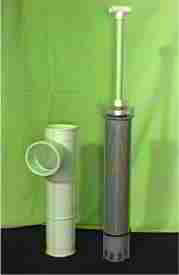
Gray water systems may also be used to conserve and recycle water in areas of limited water supply. The graywater filter basin and graywater filter shown above are discussed at FILTERS SEPTIC & GREYWATER
Gray water is usually water from building drains other than toilets, such as water from a laundry system, sink, or shower, and effluent from sump pumps. Other site gray water (or greywater) which is sometimes preserved and used at a building includes rainwater or roof runoff.
Some writers include groundwater in the greywater category. I disagree, though greywater disposal systems may benefit the environment by replenishing groundwater.
Greywater does not contain human waste products. Therefore when it is disposed-of on-site, it does not need to be treated to the same extent as is required for sewage or "black water". In fact, soil filtration and soil biomat treatment of greywater can produce very clean water for ultimate discharge into the environment.
Therefore building code requirements for on-site disposal of grey water are less strict. However in most jurisdictions it is illegal to simply dispose of greywater by dumping it on the ground surface. Some treatment and filtering such as that provided by a drywell will be required.
For building sites where there is limited space for septic "black water" disposal and treatment, one can install piping and equipment separate the gray water from black water (human waste) - a step which reduces the needed size of the septic system. (Space will still be needed for graywater handling).
A second reason that some property owners install graywater handling systems is a shortage of potable water or the need to conserve and recycle water for re-use. In dry areas where there are limitations on the water supply, filtering and treating graywater can permit its use for watering lawns or crops as well as for flushing toilets. This approach serves two goals, both disposing of onsite graywater and supplying water for crops or shrubs.
A typical graywater system can save 50 to 100 gallons of water a day, or even more, depending on the level and types of water usage in a building. Even homes connected to a municipal water supply benefit from a gray water system as by recycling water for re-use the building owners save on their water bill.
The following sample greywater system specification is from:
New York State Appendix 75-A.10 OTHER SYSTEMS [topic home page]
Other U.S. state's laws and specifications regulating greywater systems are listed below.
(5) Greywater Systems
Greywater [grey water, gray water] systems shall be designed upon a flow of 75 gpd/bedroom and meet all the criteria previously discussed for treatment of household wastewater.
[DF NOTE: Grey water is water that does not include sewage, including water from sinks, showers, and laundry facilities.]
Types of Graywater Products and Systems
Here we outline a variety graywater products, systems, and designs used to conserve water, re-use or recycle water, reduce water use, or to store and re-use graywater. Links to in-depth articles about these products and systems are provided below.
See WATER SOURCE ALTERNATIVES for details.
- Cisterns
have been used since prehistoric time to collect and store rain water or water from other sources. Modern cistern systems use concrete tanks, steel, fiberglass, plastic, or site built tanks to store water for re-use.
See CISTERN & RAINWATER COLLECTION SYSTEMS
Also see WATER SOURCE ALTERNATIVES. - Composting Toilets
reduce water consumption by using little or no water from the building water supply.
See ALTERNATIVE & WATERLESS TOILETS and COMPOSTING TOILETS. - Drywells
are used to dispose of un-wanted graywater on-site. There is no provision for water storage or water re-use.
See DRYWELL DESIGN & USES. - Filters for Greywater
are installed at a laundry sink, clothes washer, or at the outlet of a wastewater tank to filter water for re-use.
See FILTERS for SEPTIC TANKS & GRAYWATER SYSTEMS to protect septic drainfields and reduce drainfield clogging. - Grey Water Irrigation Systems
or drip irrigation systems make use of (usually filtered) greywater to provide water to lawns, plants, or crops.
Greywater distribution devices or greywater diversion systems are packaged pump, filter, and controls to collect and distribute greywater from a building into a drip irrigation system.
Some nearly identical terms people use for greywater handling systems include Grey Water Diversion Systems, Grey Water Distribution & Graywater Irrigation Systems. - Low Water Toilets or Low Flush Toilets
conserve water by using only a small amount of water to achieve the flush cycle. Low-Water or Low-Flush toilets work well partnered with graywater systems to both conserve and re-use water.
See TOILET ALTERNATIVES. - Rainwater Collection Systems
provide alternative water supply for use in flushing toilets or irrigating crops, lawns, or plants.
Rainwater collection relieves the load on the potable water supply whether it's from a local well or from municipal supply piping. Rainwater collection systems range from a simple "rain barrel" to collect roof runoff, to very large cisterns which store water for onsite use during dry seasons or droughts.
Examples of rainwater collection and re-use systems are
at CISTERN & RAINWATER COLLECTION SYSTEMS
at WATER SOURCE ALTERNATIVES
at PASSIVE SOLAR HOME, LOW COST
- Waterless Toilets
conserve water by using no water to achieve the toilet flush cycle. Like composting toilets (see above), waterless toilets work well partnered with graywater systems to conserve water.
Waterless toilets include incinerating toilet models (seelinks listed at the ARTICLE INDEX the bottom of this article for more about alternative toilet products & designs.)
See TOILET ALTERNATIVES. - Also see additional citations atReferences or Citations
Use of a Greywater System to Reduce Load on Septic System Drainfield
Question: Can I Use a "Packaged" Greywater System to Solve my Septic System Worry?
I purchased a home that had a septic system that is not in great shape. To take some of the strain off of the septic system I decided to put in a graywater system. I was looking at a packaged "ready to go" system that includes a bank of mesh filters and a pump enclosed in a plastic shell.
I wanted to see your thoughts on it. Can you recommend an inexpensive system? - C.M. (California)
Reply: Compare a Greywater Diversion Device and a Conventional Greywater Drywall
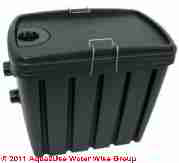
An example of a packaged grey water system is the Aqua2use greywater system that is described by Water Wise Group, its distributor in the U.S., as the "most efficient and advanced greywater diversion device available".
Image at left of the Aqua2Use system interior components is used with permission from Water Wise Group.
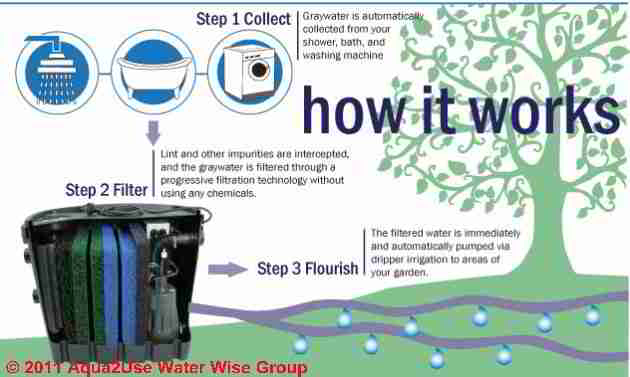
Here is an exterior view [Image] and here is a sketch of how this system works [Image].
A typical greywater diversion system provides a greywater receiving filter-tank or pumping chamber, a cascade of greywater filter materials and greywater pump itself, perhaps with integrated controls that operate the pump.
Remy Sabiani from Water Wise Group adds: "With its Multi Stage Filtration system, the Aqua2use makes the greywater suitable to use with a drip irrigation system. it also includes two magnetic micro floats that sense the water level, and automatically control the pump."
But without more information about your water usage, site characteristics, and irrigation needs, we are not sure it's what you need. Let's look at some details.
Adding up the Components & Costs of a Greywater Diversion System
At under $650. for a packaged "ready-to-go" greywater system dispersion device itself, that cost is less than the excavation, piping, and installation of a conventional drywell.
To that you'll need to add the cost of the greywater drip irrigation piping and its installation, and you may need to add the cost of a larger receiving tank, filter and tank maintenance if your daily surges in water usage are larger than the greywater diversion system's tank and piping can absorb in short intervals.
You also will need to add the cost of changing existing home drain piping to divert graywater from baths and kitchen or at least the laundry system into a separate drain connected to the greywater diversion system.
A graywater system produces water that can be used to irrigate a lawn or garden (but not a vegetable garden) - by filtering greywater and feeding it into a drip irrigation system, and at the same time it relieves the septic system drainfield of having to absorb that same water volume - presuming your drip irrigation tubing is placing the water somewhere else.
Also see SEWAGE TREATMENT PLANTS, RESIDENTIAL
Greywater Distribution System Site Factors
Also depending on how you are using your building plumbing system, and other factors like your site size and terrain slope, diameter and length of the drip piping system, the rate at which the graywater treatment pump and filter can accept and push through graywater may be more limited than a conventional drywell that by comparison has no trouble accepting a surge of graywater and disposing of it more slowly into the surrounding soil.
Take a look at your site shape, slope, and piping to see how easily you can separate off graywater draining from sinks, showers, tubs, laundry. You might find that the cost of those plumbing changes is also substantial when you are changing an existing home (as opposed to planning for graywater separation in new construction).
Take a look at the Aqua2Use Pump Curve and you'll see that if there is substantial head pressure (in feet) the flow rate in GPM that the system handles is slowed.
Greywater Distribution & Local Codes
In California where you are located, you can install a graywater system that accepts just water from an individual clothes washing machine without having to obtain a permit.
See these California Greywater Regulations [PDF]
That's a simple installation that can reduce the load on your septic system drainfield, similar to using a conventional drywell for the same purpose, but adding filters and a pump and piping to dispose of the graywater on your property.
Watch out: most national and local plumbing codes do not permit discharge of grey water directly onto the ground surface, so simply spraying grey water over the ground like from a lawn sprinkler is probably not going to be accepted in your area.
But to complicate this worry further, treated effluent from an aerobic septic treatment unit (ATU) may be allowed to be distributed by above-ground sprinkler systems, for example in some Texas communities. What's the difference? Probably the level of phosphates or detergents found in washing machine grey water.
See GREYWATER CODES & REGULATIONS
Considering a Conventional Drywell for Greywater Disposal
But the costs of in house plumbing changes (usually high if you are including graywater from other sinks, tubs, showers) plus cost of the drip line installation (may be high) makes a simpler approach: connect the building laundry sink/washer and maybe dishwasher to a separate conventional drywell, worth considering, especially if you do not need to use the water for irrigation.
All of those costs combined with attention to your starting objective: relieve water load on a drainfield, suggest that you should also consider a simpler and more conventional drywell with an inlet filter to trap lint and large debris.
See FILTERS SEPTIC & GREYWATER .
If your soils have reasonable percolation rate, the drywell will handle a large volume of graywater without going to the added site-wide excavation to put in drip lines. No pumps or electricity are needed if you can drain graywater directly to the drywell by gravity.
Don't Forget to Care for the Septic Tank and Drainfields
Finally, your wish to reduce the load on the septic system by separating graywater presumes that it is the drainfield of your system that is limited, old or failing. But you should also have the septic tank pumped and inspected. It may need baffles, it may be damaged or leaky, it could have an unsafe cover, it may be small and require frequent pumping.
And inspect the existing drainfield and D-box to see if there are alternate drainfield lines that can be switched into use, and to confirm that effluent is indeed entering all of the existing drainfield lines - all considerations that are very important in extending the life of the drainfield.
In sum, if you have reason to need and want a drip irrigation system anyway, say for lawn, plantings, or decorative (non-edibles) garden, and especially if you are in an area of limited water supply or drought restrictions, then you could use the graywater system but you'll need to get a more realistic cost estimate by including not just the graywater filter, tank, and pump but also the entire drip irrigation system.
But if all you want is to relieve the liquid load on your drainfield a drywell may be a simpler approach that I recommend you consider. It too can handle larger surges of graywater.
Also see SEWAGE TREATMENT PLANTS, RESIDENTIAL
Disinfection Requirements for Grey Water Prior to Re-Use
Winward (2008) points out that grey water filtration and then disinfection can be required before grey water an be re-used in some applications.
Abstract quotation:
Adequate disinfection of grey water prior to reuse is important to prevent the potential transmission of disease-causing microorganisms.
Chlorine is a widely utilised disinfectant and as such is a leading contender for disinfection of grey water intended for reuse. This study examined the impact of organics and particles on chlorine disinfection of grey water, measured by total coliform inactivation.
The efficacy of disinfection was most closely linked with particle size. Larger particles shielded total coliforms from inactivation and disinfection efficacy decreased with increasing particle size.
Blending to extract particle-associated coliforms (PACs) following chlorine disinfection revealed that up to 91% of total coliforms in chlorinated grey water were particle associated.
The organic concentration of grey water affected chlorine demand but did not influence the disinfection resistance of total coliforms when a free chlorine residual was maintained.
Implications for urban water reuse are discussed and it is recommended that greywater treatment systems target suspended solids removal to ensure removal of PACs prior to disinfection. - Winward (2008)
Greywater Re-Use & Rainwater Collection Methods to Obtain Additional Water Supply
 Storing Rainwater & Greywater for Re-Use
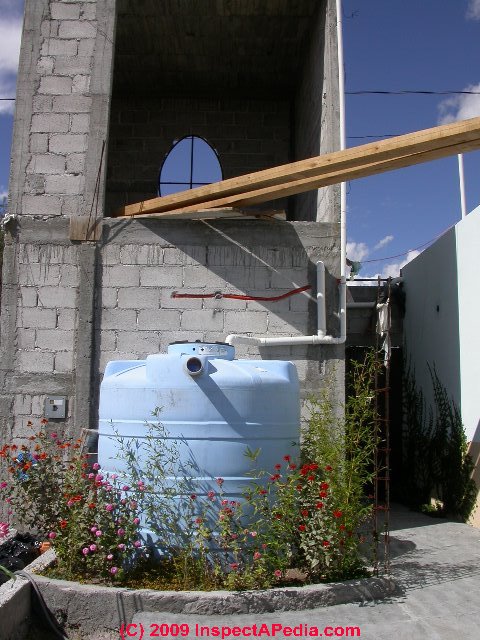
You might find that rainwater collection in areas where rainfall is plentiful in some seasons, or graywater use, are more economical for your use, and that condensation is more costly to operate and less productive in quantity unless you design a cheap, very large solar condensing operation.
You may find that you are better off providing a large cistern type storage tank to collect rainwater for future use or to collect greywater in a smaller tank for prompt re-use on-site in flush toilets or for gardening and irrigation.
Use of large water storage cisterns has been a common practice for thousands of years and continues in modern use with plastic or fiberglass water storage tanks into which rainwater or in some areas even surface runoff may be channeled for future use.
See the rainwater collection and storage tank we show at RAINWATER STORAGE CISTERNS for collecting and storing as much rainwater as possible when rainy weather occurs.
Watch out: do not store greywater longer term for future use. Stored grey water that has not been filtered and disinfected contains bacteria and other pathogens that will grow in the water, risking making it unsafe in a short time, even 24 hours.
Re-Using Greywater in Toilets & Irrigation
Many sources have described re-using greywater in combined sink and flush toilet combinations or to flush toilets. A hand-sink may be built onto the top of a toilet flush tank to permit hand-wash water to be used in the next toilet flush, or greywater from other sources might be routed to flush toilet cisterns.
Water conservation sources and septic system design sources also discuss using greywater on houseplants or to water plants grown in a greenhouse. Because greywater contains organic contamionants and might contain lint, hair, and other fibers, possibly also containing some household cleaning chemicals, some filtration and treatment might be needed.
Graywater Re-Use Research & Produts
See
- GREYWATER FREEZE PROTECTION also discusses re-using grey water as an alternative to greywater disposal - a solution that's particulary appealing in freezing climates where greywater disposal is more-difficult.
- GREYWATER SYSTEM PRODUCTS, SUPPLIERS for examples of greywater re-use products.
- Alsulaili, Abdalrahman D., Mohamed F. Hamoda, Rawa Al-Jarallah, and Duaij Alrukaibi. "Treatment and potential reuse of greywater from schools: a pilot study." Water Science and Technology 75, no. 9 (2017): 2119-2129.
Abstract
This study presented performance data on a low cost and easy maintenance pilot system for on-site treatment and reuse of water collected from wash sinks and fountains, as major sources of greywater (GW) at schools.
Various treatment options were studied including screening, sand filtration, chlorination, and UV disinfection operated at different flow rates. Results showed that filtration operated at low rates is very effective in total suspended solids (TSS) removal, while UV proved to be more effective than chlorination for reduction of biochemical oxygen demand (BOD), chemical oxygen demand (COD), and total coliforms.
Removal efficiencies up to 63%, 30% and 20% were obtained for TSS, COD and BOD, respectively and reductions of log TC (CFU/100 ml) from 6.5 to 2 were obtained at a filtration rate of 14 m3/d·m2.
Treated effluent satisfied WHO standards for reclaimed water reuse in landscape irrigation and toilet flushing. The filtration-UV system is robust, showing the best and most reliable performance for low and high strength GW treatment even under a 10-fold increase in flow rate.
A 5 m3/d pilot plant was developed for schools having 500 students and detailed cost-benefit analysis indicated a net saving value, a surplus of $1,600 per year, and pay back after 6 years and 11 months. - Chung, Kevin & Meredith "Phoebe" White, GREYWATER REUSE: Understanding Greywater Reuse Systems in the Current and Future Urban Contexts and How Individuals can Promote Greywater Reuse [PDF], Cornell University, courses.cit.cornell.edu Service, retrieved 2018/06/27, original source: https://courses.cit.cornell.edu/crp384/2009reports/White&Chung_Gray%20Water%20Reuse.pdf
- Also see additional citations atReferences or Citations
Use of Graywater to Flush Toilets
This topic has moved to a separate article now found at GREYWATER FLUSH TOILETS
Greywater System Freezing or Frost Protection
In freezing climates it is necessary to protect the grey water system from freezing. Otherwise in freezing weather your grey water disposal system will stop functioning and it may also be damaged.
This topic has moved to a new page at GREYWATER FREEZE PROTECTION
Grey Water System Regulations
This topic has moved to a separate article now found at GREYWATER CODES & REGULATIONS
Graywater Products, Systems, Pumps, Tanks, Books
Moved to GREYWATER SYSTEM PRODUCTS, SUPPLIERS
...
Continue reading at GREYWATER FLUSH TOILETS or select a topic from the closely-related articles below, or see the complete ARTICLE INDEX.
Or see these
Recommended Articles
- CISTERN & RAINWATER COLLECTION SYSTEMScombination of rainwater collection and graywater collection, diversion, re-use on a home built in an area of water scarcity.
- GREYWATER SYSTEMS - home
- DEFINITION of GRAYWATER SYSTEMS
- FILTERS SEPTIC & GREYWATER
- SEWAGE TREATMENT PLANTS, RESIDENTIAL
- TYPES of GRAYWATER SYTEMS PRODUCTS
- USE GRAYWATER to REDUCE SEPTIC LOAD
- GREYWATER DISINFECTION BEFORE RE-USE
- GREYWATER FREEZE PROTECTION
- GREYWATER CODES & REGULATIONS
- GREYWATER FLUSH TOILETS
- GREYWATER RE-USE & RAINWATER COLLECTION SYSTEMS
- GREYWATER SYSTEM PRODUCTS, SUPPLIERS
- WATER CONSERVATION MEASURES
Suggested citation for this web page
GREYWATER SYSTEMS found at InspectApedia.com - online encyclopedia of building & environmental inspection, testing, diagnosis, repair, & problem prevention advice.
Or see this
INDEX to RELATED ARTICLES: ARTICLE INDEX to SEPTIC SYSTEMS
Or use the SEARCH BOX found below to Ask a Question or Search InspectApedia
Ask a Question or Search InspectApedia
Try the search box just below, or if you prefer, post a question or comment in the Comments box below and we will respond promptly.
Search the InspectApedia website
Note: appearance of your Comment below may be delayed: if your comment contains an image, photograph, web link, or text that looks to the software as if it might be a web link, your posting will appear after it has been approved by a moderator. Apologies for the delay.
Only one image can be added per comment but you can post as many comments, and therefore images, as you like.
You will not receive a notification when a response to your question has been posted.
Please bookmark this page to make it easy for you to check back for our response.
Our Comment Box is provided by Countable Web Productions countable.ca
Citations & References
In addition to any citations in the article above, a full list is available on request.
- Australia, GREYWATER REUSE [PDF], Australia. Northern Territory Government. Department of Natural Resources, Environment, and the Arts. Technical Fact Sheet - retrieved 2018/06/27 original source: https://nt.gov.au/property/building-and-development/wastewater-management/greywater-reuse
- Australia, “Gardening - GREY WATER FACT SHEET [PDF] Australian Broadcasting Corporation.
2005 - retrieved 2018/06/27 original source: http://www.abc.net.au/gardening/factsheets/grey-water/9424030
Excerpt: One option becoming popular is reusing grey water on the garden. Grey water is household waste-water from the bathroom, hand basin, shower, and laundry. Figures show that one Australian house can produce about 400 litres of grey water a day, something like 40 percent of total use. But if this grey water is used effectively, it can lead to considerable savings. There are three types of grey water systems, ranging from complex through to really simple. But they all divert grey water from the house onto the garden. - Greywater, GREYWATER POLLUTION [PDF] Greywater. 03 Dec. 2009 - retrieved 201806/27, original source: http://www.greywater.com/pollution.htm
Excerpt:
Perhaps the most significant difference between blackwater and greywater lies in the rate of decay of the pollutants in each. Blackwater consists largely of organic compounds that have already been exposed to one of nature's most efficient "treatment plants": the digestive tract of the human body. It is understandable that the by-products from this process do not rapidly further decompose when placed in water. - New York State Department of Health, APPENDIX 75-A WASTEWATER TREATMENT STANDARDS - INDIVIDUAL HOUSEHOLD SYSTEMS , [PDF] New York State Department of Health, 3 February 2010, retrieved 3/1/2010, original source: https://www.health.ny.gov/regulations/nycrr/title_10/part_75/appendix_75-a.htm
- American Rainwater Cachment Systems Association (ARCSA), 823 Congress Avenue, Suite 230, Austin, TX 78701, 512-617-6528 Email: info@arcsa.org. Quoting from the association's website:
The Mission of the American Rainwater Catchment Systems Association is to promote sustainable rainwater harvesting practices to help solve potable, non-potable, stormwater and energy challenges throughout the world.
The American Rainwater Catchment Systems Association is a 501(c)(3) non-profit organization that was founded in 1994 by Dr. Hari J. Krishna in Austin, Texas, to promote rainwater catchment systems in the United States. Our memberships consist of professionals working in city, state, and federal government, academia, manufacturers and suppliers of rainwater harvesting equipment, consultants, and other interested individuals. Membership is not limited to the United States, and we encourage all rainwater harvesting enthusiasts to join our organization. Local responsibilities are often delegated to ARCSA's Regional Representatives. - Winward, Gideon P., Lisa M. Avery, Tom Stephenson, and Bruce Jefferson. "Chlorine disinfection of grey water for reuse: Effect of organics and particles." Water research 42, no. 1 (2008): 483-491.
- Cawley, William E., and Basil W. Mercer. "Water recycle system." U.S. Patent 4,812,237, issued March 14, 1989.
- Graywater and Rainwater System Plans from Ecological Engineering
- Thanks to reader C.M. (California) for discussing greywater distribution devices, January 2011
- BUY GREYWATER BOOKS ONLINE [web page] providing book recommendations such as
- Builder's Greywater Guide, [book for sale at Amazon] Art Ludwig. Oasis Design, 2006, ISBN-10: 0964343320 ISBN-13: 978-0964343320
- Create an Oasis with Greywater, Choosing, Building, and Using Greywater Systems , [book for sale at Amazon] includes Branched Drains, Art Ludwig, Oasis Design, 2006, ISBN 0964343398
- the Culture of Technology, Arnold Pacey,
- Effects of Water Age on Distribution System Water Quality, American Water Works Association.
- Ferrocement Water Tank, Frans Dubbeldam. German Volunteer Service in Nepal
- Ferrocement Water Tanks and their Construction, S.B. Watt, printed by the Intermediate Technology Publications, London, UK.
- Gravity Flow Water Systems: Handbook of Gravity Flow Water Systems Thomas D. Jordan, Jr. Intermediate Technology Development Group. 1980.
- Maruata en el Cruce de Caminos, Art Ludwig. Oasis Design. Ecological systems designs for an indigenous community in Mexico, including water supply and sanitation. See PDF downloadable book at www.oasisdesign.net/design/examples/maruata/book.htm.
- "Microbial Problems in Treated Water Storage Tanks", Smith, C., and G. Burlingame. 1994. In Proc. of the 1994 Annual AWWA Conference. Denver, Colo.: AWWA.
- Quality of Water in Storage Grayman, W.M. and G.J. Kirmeyer. 2000. "Protecting Your Storage Tank - An Analysis of Long- and Short-Term Options", Jacobs, K.A. 2000. In Proc. of the AWWA Infrastructure Conference. Denver, Colo.: AWWA.
- Rainwater Catchment Systems for Domestic Supply, John Gould and Erik Nissen-Petersen. Intermediate Technology Publications, 1999.
- Sand filters See www.oasisdesign.net/water/treatment/slowsandfilter.htm.
- Slow Sand Filtration, Huisman L. and Wood, W.E., WHO 1974
- Mays, Larry W., Stormwater Collection Systems Design Handbook, ISBN-13: 978-0071354714 ISBN-10: 0071354719 ,
- In addition to citations & references found in this article, see the research citations given at the end of the related articles found at our suggested
CONTINUE READING or RECOMMENDED ARTICLES.
- Carson, Dunlop & Associates Ltd., 120 Carlton Street Suite 407, Toronto ON M5A 4K2. Tel: (416) 964-9415 1-800-268-7070 Email: info@carsondunlop.com. Alan Carson is a past president of ASHI, the American Society of Home Inspectors.
Thanks to Alan Carson and Bob Dunlop, for permission for InspectAPedia to use text excerpts from The HOME REFERENCE BOOK - the Encyclopedia of Homes and to use illustrations from The ILLUSTRATED HOME .
Carson Dunlop Associates provides extensive home inspection education and report writing material. In gratitude we provide links to tsome Carson Dunlop Associates products and services.
 | HOME | ABOUT | ASK a QUESTION | CONTACT | CONTENT USE POLICY | DESCRIPTION | POLICIES | PRIVACY | |
| © 2024 - 1985 Publisher InspectApedia.com - Daniel Friedman | |||||||||