
InspectAPedia® FREE Encyclopedia of Building & Environmental Construction, Diagnosis, Maintenance & Repair |
Question? Just ask us! InspectAPedia
|
 Using Single Pass or Recirculating Septic Media Filters
- POST a QUESTION or COMMENT about single pass recirculating septic system media designs & filters
Single Pass compared with Recirculating Filter Septic Media Designs:
This document discusses the differences between single pass and recirculating septic media filter systems. Media filter septic systems use a conventional septic tank followed by any of several methods to further filter and treat septic effluent before it is discharged to the soil, soil surface, or waterway.
InspectAPedia tolerates no conflicts of interest. We have no relationship with advertisers, products, or services discussed at this website.
Single Pass Septic Media Filter Systems

Single pass media filers using sand, other natural septic filter media or manufactured/synthetic media filter media, are usually designed for effluent to be applied (dosed) using a pressure distribution system, typically a small-diameter perforated pipe.
The single pass septic media filter design permits effluent to be applied to the filter uniformly, in small, regular doses, permitting the filtering and biomat processes to do their work and avoiding overloading the system.
Other high-treatment aerobic septic systems use AEROBIC SEPTIC EFFLUENT SPRAY HEAD REPAIR to distribute effluent over the surface of the media. See AEROBIC SEPTIC EFFLUENT SPRAY HEAD REPAIR.
Recirculating Septic Media Filter Systems

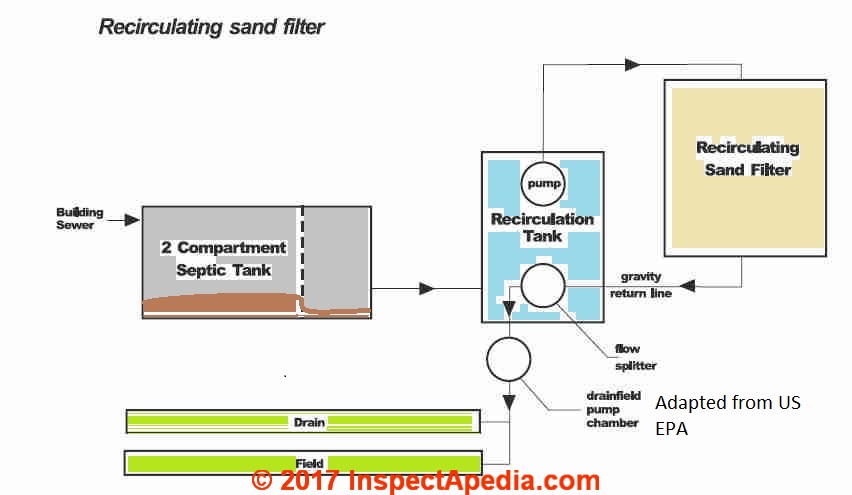
A recirculating septic media filter system, in general, may be constructed using the same materials discussed throughout this document. What's different? A recirculating media filter system will be water tight (commonly using 30-mil polyvinyl chloride plastic (PVC) - so that it can process and then recirculate the effluent back to the pumping station.
Effluent cycles through the recirculating media filter a specified number of times before being later discharged to a dispersal system. A common design to make final disposal of the effluent uses a pressure distribution system to disperse effluent into the soil.
Where high levels of treatment of the effluent are achieved
(see below), a biomat is not going to form so the absorption system can be expected to have a longer life.
A recirculating effluent septic system, by its ability to handle higher volumes of effluent or
effluent at a higher rate, may be constructed with a much smaller footprint than a single-pass media filter.
Recirculating media filter septic systems may also be better at reducing the nitrogen load in the processed effluent. Jantrania cites
ratios of total recirculating effluent to incoming effluent as ranging from 2:1 to 50:1 depending on system requirements.
A typical recirculating media filter system, if constructed using sand, will be constructed in a watertight excavation and filled in layers, from the bottom up, 12" of gravel, 24" of coarse sand coarse (0.05-2.0 mm), topped with another 12" of gravel. The bottom of the recirculating media sand and gravel filter bed slopes (perhaps 1" in 8 ft) to drain to the return from the media filter to the pumping station. 4" PVC pipe returns effluent by gravity to the pumping station.
Wastewater is applied to a system of this design usually at 4-5 gallons per square foot of area of the media filter system's footprint. So a family of four, using 70 gpd of wastewater, (figure 300 gpd total, a commonly-used number which I am betting is low) would need only 75 sq. ft. for the filter bed if you believe these calculations. Naturally the actual system will be built with more capacity to handle aging, variations in efficacy, and variations in loading rate.
A recirculating sand media filter of this design can remove 30% to 70% of the nitrogen in the incoming effluent, and 10 to 30% of the phosphorus in the incoming effluent. BOD may be reduced from 175 mg/L (leaving the septic tank) to 20; fecal coliform may be reduced from 1 million or much higher MPN/100mL leaving the septic tank to perhaps 5000 to 100,000 MPN/100mL.
A recirculating sand bed media filter system produces highly treated effluent and has good removal of nitrogen. In part because of the larger sand used in a recirculating system, fecal coliform is not reduced as effectively as a single pass sand media filter or a peat media filter.
The life expectancy of a recirculating media filter system of this type and the frequency with which the sand needs to be raked or replaced, is not an easy statistic to find. I'll plug that data in here when I can dig it out from the experts.
Clearly a septic media filter system like this needs regular maintenance and more frequent attention than a conventional septic tank and drainfield. Figure on a regular maintenance contract with perhaps quarterly inspections of the return media flow (slowing indicates clogging), returning effluent quality, and proper operation of the pump and controls.
The University of Minnesota Extension Service estimates an annual operating cost including inspection, maintenance, and electricity of $200.-$500./year. This figure does not appear to include, however, the cost of periodic replacement of the media.
...
Continue reading at TEXTILE SEPTIC MEDIA FILTERS or select a topic from the closely-related articles below, or see the complete ARTICLE INDEX.
Or see these
Recommended Articles
- MEDIA FILTER SEPTIC SYSTEMS - home
- BAT MEDIA SEPTIC PLANTS
- DOSING CONTROL for SEPTIC MEDIA SYSTEMS
- FOAM CUBE SEPTIC MEDIA FILTERS
- PEAT SEPTIC MEDIA FILTERS
- RUCK® SEPTIC MEDIA FILTER SYSTEMS
- SAND SEPTIC MEDIA FILTERS
- SANDY SOIL SEPTIC DESIGNS
- SEPTIC MEDIA FILTER CAPACITY & MAINTENANCE
- SEPTIC MEDIA FILTER SOURCE LIST
- SEPTIC MEDIA FILTER SYSTEM OPERATION
- SINGLE PASS vs RECIRCULATING SEPTIC MEDIA FILTER DESIGNS
- TEXTILE SEPTIC MEDIA FILTERS
- TYPES of SEPTIC MEDIA FILTER MATERIALS
Suggested citation for this web page
SINGLE PASS vs RECIRCULATING SEPTIC MEDIA FILTER DESIGNS at InspectApedia.com - online encyclopedia of building & environmental inspection, testing, diagnosis, repair, & problem prevention advice.
Or see this
INDEX to RELATED ARTICLES: ARTICLE INDEX to SEPTIC SYSTEMS
Or use the SEARCH BOX found below to Ask a Question or Search InspectApedia
Ask a Question or Search InspectApedia
Try the search box just below, or if you prefer, post a question or comment in the Comments box below and we will respond promptly.
Search the InspectApedia website
Note: appearance of your Comment below may be delayed: if your comment contains an image, photograph, web link, or text that looks to the software as if it might be a web link, your posting will appear after it has been approved by a moderator. Apologies for the delay.
Only one image can be added per comment but you can post as many comments, and therefore images, as you like.
You will not receive a notification when a response to your question has been posted.
Please bookmark this page to make it easy for you to check back for our response.
Our Comment Box is provided by Countable Web Productions countable.ca
Citations & References
In addition to any citations in the article above, a full list is available on request.
- New York State Department of Health, APPENDIX 75-A WASTEWATER TREATMENT STANDARDS - INDIVIDUAL HOUSEHOLD SYSTEMS , [PDF] New York State Department of Health, 3 February 2010, retrieved 3/1/2010, original source: https://www.health.ny.gov/regulations/nycrr/title_10/part_75/appendix_75-a.htm
- "Septic Tank/Drainfield System Fact Sheet", Utah Department of Environmental Quality, Division of Drinking Water, Source Protection Program - (801) 536-4200 Division of Water Quality - (801) 538-6146 Sonja Wallace, Pollution Prevention Coordinator - (801) 536-4477 Environmental Hotline - 1-800-458-0145 - Original source: http://www.drinkingwater.utah.gov/documents/spec_services/pollution_prevention_septic_tanks.pdf
- New York State Wastewater Treatment Standards - Individual Household Systems, Appendix 75-A (1990), Public Health Law 201(1)(1).
- Advanced Onsite Wastewater Systems Technologies, Anish R. Jantrania, Mark A. Gross, CRC Taylor & Francis, 2006 ISBN 0-8493-3029-7
- Our recommended books about building & mechanical systems design, inspection, problem diagnosis, and repair, and about indoor environment and IAQ testing, diagnosis, and cleanup are at the InspectAPedia Bookstore. Also see our Book Reviews - InspectAPedia.
- In addition to citations & references found in this article, see the research citations given at the end of the related articles found at our suggested
CONTINUE READING or RECOMMENDED ARTICLES.
- Carson, Dunlop & Associates Ltd., 120 Carlton Street Suite 407, Toronto ON M5A 4K2. Tel: (416) 964-9415 1-800-268-7070 Email: info@carsondunlop.com. Alan Carson is a past president of ASHI, the American Society of Home Inspectors.
Thanks to Alan Carson and Bob Dunlop, for permission for InspectAPedia to use text excerpts from The HOME REFERENCE BOOK - the Encyclopedia of Homes and to use illustrations from The ILLUSTRATED HOME .
Carson Dunlop Associates provides extensive home inspection education and report writing material. In gratitude we provide links to tsome Carson Dunlop Associates products and services.
 | HOME | ABOUT | ASK a QUESTION | CONTACT | CONTENT USE POLICY | DESCRIPTION | POLICIES | PRIVACY | |
| © 2024 - 1985 Publisher InspectApedia.com - Daniel Friedman | |||||||||