
InspectAPedia® FREE Encyclopedia of Building & Environmental Construction, Diagnosis, Maintenance & Repair |
Question? Just ask us! InspectAPedia
|
 Using a Raised Bed Effluent Disposal System as a Component of Alternative Septic Systems for Difficult Sites
- POST a QUESTION or COMMENT about this article topic.
Raised bed septic system designs:
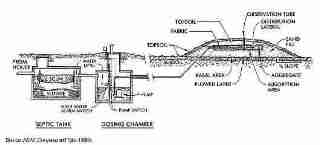
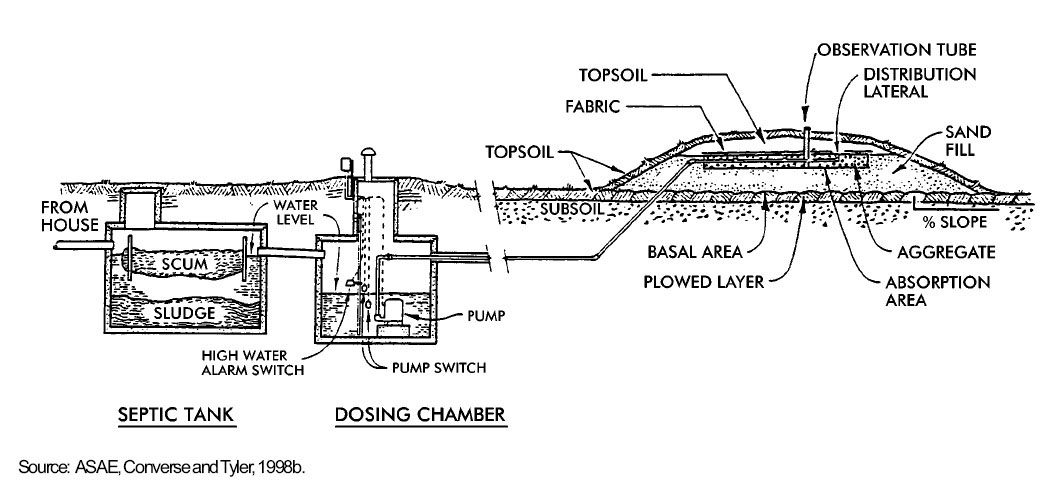
This article explains the design and function of raised bed septic systems. In the sketch shown here the raised bed septic system is similar in design to a mound system but some use is made of original local soils for the raised bed. (Source: US EPA)
Wastewater effluent is discharged to the effluent treatment and absorption system by a pumping chamber. Alternatively the raised bed component of a septic system, if suitably located, may be supplied effluent by gravity feed.
Citation of this article by reference to this website and brief quotation for the sole purpose of review are permitted. Use of this information at other websites, in books or pamphlets for sale is reserved to the author.
InspectAPedia tolerates no conflicts of interest. We have no relationship with advertisers, products, or services discussed at this website.
Raised Septic Systems Designs
Raised bed septic designs are a wastewater absorption trench system that has been constructed in soil-fill material which has been placed on top of the natural soil on a building lot.
Raised systems are often confused with mound septic systems, but they are not identical: raised bed septics have different design requirements, and make at least partial use of existing soils for wastewater treatment while in a septic mound system disposal of septic effluent depends entirely on and occurs within soils brought to the site and shaped into a long elevated mound.
Raised bed septic systems are constructed in fill over soil which can accept septic effluent below the fill.
MOUND SEPTIC SYSTEMS are constructed in fill over soil which does not acceptably treat septic effluent below the fill - all of treatment occurs in the mound. Other requirements differ as well.
The following description of raised bed septic system design, installation, and maintenance is
from: New York Appendix 75-A.9 ALTERNATIVE SEPTIC DESIGN CODES section 9.b Raised Bed Septic Systems
Section 75-A.9 Alternative Septic Systems: (b) Raised Septic Systems Design Criteria
Title: Appendix 75-A.9 - Alternative Septic Systems
[Regulation and System Design Criteria for Raised Septic Systems,
Septic Mound Systems, Intermittent Sand Filter Bed Systems,
Evaporation-Transpiration Septic Systems,
Evaporation-Transpiration Absorption Septic Systems, and
Other Alternative Septic Systems]
Effective Date: 12/01/1990
(1) General: Raised Septic Systems
A raised septic system [or raised bed septic system] is an absorption trench system constructed in fill material with acceptable permeability placed above the natural soil on a building lot.
[DF: Note: while they are similar in design "raised septic systems" discussed here are not identical to "mound septic systems" discussed at SEPTIC MOUND DESIGN SPECIFICATIONS which have different site requirements]
(2) Site Requirements for Raised Septic Systems
A raised system may be used where all the following conditions are found:
(i) There is at least one foot of original soil with a faster than 60 minutes percolation rate, above any impermeable soil layer or bedrock, but not more than two feet.
(ii) The maximum high groundwater level must be at least one foot below the original ground surface.
(iii) Slopes shall not exceed 15%.
(iv) All minimum vertical and horizontal separation distances can be maintained as described in Table 2.
(3) Design Criteria for Raised Bed Septic Systems
(i) Percolation tests shall be conducted in the fill material at the borrow pit and after placement and settling at the construction site. The slower percolation rate of these tests shall be used for design purposes.
(ii) The total area beneath the absorption trenches, extending 2.5 feet in all directions from the outer edge of all trenches, is defined as the basal area. The minimum size of the basal area of the raised bed shall be calculated based upon 0.2 gpd/sq.ft.
(iii) An absorption trench system as described in Section 75-A.8(b) is designed using the percolation rate of the fill material. The use of slowly permeable soils for the fill material will result in a trench system that will have a basal area larger than the minimum area calculated in (ii) above.
(iv) Sufficient soil with a percolation rate of between 5 - 30 min/in is required to maintain at least two feet separation between the proposed bottom of the trenches and any boundary condition such as groundwater, bedrock, clay or other relatively impermeable soil or formation.
(v) The edge of the fill material shall be tapered at a slope of no greater than one vertical to three horizontal with a minimum 20 foot taper.
(vi) Horizontal separation distances shall be measured from the outside edge of the taper.
(vii) The system shall incorporate siphon dosing or pressure distribution except where the following conditions are met:
(aa) The local health department has a program incorporating site evaluation, system design approval, and construction inspection/certification.
(bb) A minimum of two feet of fill material with a percolation rate of 5 - 30 min/in shall be placed between the bottom of the trenches and the existing ground.
(viii) Curtain drains may be used to intercept and carry underground water away where high groundwater levels exist. Curtain drains shall be upslope from the system and at least 20 feet from the toe of slope of the fill material.
(4) Construction details for raised bed septic systems
(i) Heavy construction equipment shall not be allowed within the area of the system. The underlying soil shall be undisturbed although the surface may be plowed with at least a double bottomed blade/furrow plow and the furrow turned upslope.
(ii) A system shall not be built in unstablized fill material. The fill material shall be allowed to settle naturally for a period of at least six months to include one freeze-thaw cycle.
(iii) The absorption trenches shall be constructed in the fill material.
(iv) The entire surface of the system including the tapers shall be covered with a minimum of six inches of topsoil, mounded to enhance the runoff of rainwater from the system and seeded to grass.
(v) On sloping sites a diversion ditch or curtain drain shall be installed uphill to prevent surface water runoff from reaching the bed area.
Example Raised Bed & Mound Septic Design Specifications
- Ohio - SAND MOUND SEPTIC DESIGN SPECIFICATIONS [PDF] retrieved 2017/10/20, original source: http://www.odh.ohio.gov/
- Ohio - SEPTIC SEPARATION from SEASONAL HIGH WATER LEVEL [PDF] Drainage to manage the level of seasonal water in soils
Watch out: also see Bicki, T. J., and R. B. Brown. "ON-SITE SEWAGE DISPOSAL: THE IMPORTANCE OF THE WET SEASON WATER TABLE." [PDF] Journal of Environmental Health 52, no. 5 (1990): 277-279.
Also see CURTAIN DRAINS or intercept drains can protect septic drainfields in areas of wet soils or surface and subsurface groundwater
Technical review by industry experts has been performed and is ongoing - reviewers welcomed and are listed atReferences or Citations .
Reader Comments, Questions & Answers About The Article Above
Below you will find questions and answers previously posted on this page at its page bottom reader comment box.
Reader Q&A - also see RECOMMENDED ARTICLES & FAQs
On 2020-05-09 by Marcus Corey
Can I create my own as-built for this kind of system? If so, any idea of what needs to be included?
On 2020-04-18 - by (mod) -
I think you need more than septic system specs, Tony, you need the local health or building department to give you a permit and approval on the specific septic system for your specific site.
On 2020-04-18 by Tony
for a south jersey resident can I put the system in if the county gives me the specs
On 2019-02-21 - by (mod) -
Elaine
You need help from a septic engineer who will design a mound or raised bed septic that brings the bottom of the effluent disposal mount two feet or more abover the seasonal high water table. There's no other way for such a system to work.
On 2019-02-21 by Elaine
I have a home on a river In Tennessee that has been closed since Sept trying to install a new septic system but the ground is too wet and refuses to dry out enough for an install. I can’t even stay there! Help!!!
On 2012-01-03 by Steve
We bought our house new from the builder 2 1/2 years ago. We discovered the pump was not running after being in the house for 1 year, 2 months (home warrenty was for a year) but water was not backing up to the house. I had a company come out and we discovered the pump tank is about 3ft in the ground.
They dug down, opened it and found the pump was no good and replaced it with a 1/2hp pump (the "old" one was a 1/3hp). Yesterday, 1 year and 4 months after replacing the first pump, I found that now that pump has stopped (warrenty on the pump was a year).
Both times we knew we had a problem because the gfci outlet was tripped and would not reset while the pump was plugged in. Once again there is no backup in the house because the house is above the level of the raised bed.
This does not seem normal to be losing pumps so quickly and it's getting expensive. Also, back to the issue of depth of the tank, since the pump tank is over 3ft in the ground I'm sure the septic tank is as well.
My neighbors house was built by the same builder and had a backup a couple months ago because the tank needed pumped and they found his septic tank at the same depth with no risers to get the lids where they should be. I checked the code, and the lids should be within 6" of grade. I called the inspector and he said when he did his inspection, it was in code and the builder must have added dirt after the inspection.
So my questions are:
1) Do I need to replace the pump since water is not backing up to the house (although the tanks must be filled to the top since they are so deep)
2) What advise would you give about the tanks not being of proper depth or having risers to compensate? Should I be able to go to the builder and tell him I want it fixed? The work of adding the risers will cost probably around
$800.
3) What do you think about the pumps going bad so quickly--bad luck, pump being over worked, system not designed properly?
Thank you for help, in advance.
On 2011-10-19 - by (mod) -
Richie:
If the discharge pipe from a septic tank is always full there are two different conditions:
If the pipe is designed to drain into a drainfield by gravity then it should not be full and there is a clog or blockage that needs repair. Indeed freezing and damage are possible depending on pipe depth.
If the septic tank discharge line is designed to be pumped by a septic grinder pump up to a raised septic drainfield system or bed or soakaway bed, or any effluent disposal system that is higher on the site than the elevation of the septic tank itself, then the pumping line or "forced main" needs to be protected by frost, either by burying it below the local frost line or by a combination of insulation and burial depth.
On 2011-10-10 by Richie
Is there any concern for freezing. The discharge pipe from the tank is always full out to the bed.I am confused;(
On 2011-07-19 - by (mod) -
Emma there are these concerns about using a raised bed septic area for anything but growing grass:
- traffic and worse vehicles that risk compacting the soil can ruin the system
- there could be bacterial hazards in foods grown on such an area
- less obvious, if the system should fail and effluent reach the ground surface, a scout could become infected or sickend by exposure to septic effluent.
In the ARTICLE INDEX left take a look at
DRIVING or PARKING OVER SEPTIC COMPONENTS?
and at
PLANTS & TREES OVER SEPTIC SYSTEMS
for details.
On 2011-07-18 by Emma
We've been told we have to get this raised bed pure flow system for our new Scout Den which is basically some old sheds under renovation. They have said that if we use it though we will be unable to use the garden it's going into for anything else.
We had hoped to be able to camp back there and generally hold meetings and use the green area and it seems an awful shame to lose the area. In what I've read however I don't see any reason why we couldn't use the garden once it's installed. Can you tell me if it's correct that we won't be able to use the garden and why? Thanks!
On 2011-07-08 - by (mod) -
Driving over a raised bed septic system:
I would not recommend driving any heavy equipment over the raised bed septic mound as you risk compressing the soil or breaking a pipe. If you want to level or smooth the top surface you can do so using lightweight equipment such as a modest-sized lawn mower or walk-behind grader. Or better, a hand rake.
On 2011-06-23 by carol and darryl
can u drive or disturb soil on top we have a raised tile bed that is all bumpy cannot cut or ride tracot on too steep any suggestions?
...
Continue reading at MOUND SEPTIC SYSTEMS or select a topic from the closely-related articles below, or see the complete ARTICLE INDEX.
Or see these
Recommended Articles
- MOUND SEPTIC SYSTEMS
- New York Appendix 75-A.9 ALTERNATIVE SEPTIC DESIGN CODES
- SEPTIC MOUND DESIGN SPECIFICATIONS
- SEPTIC SYSTEM DESIGN ALTERNATIVES - home
Suggested citation for this web page
RAISED BED SEPTIC SYSTEMS at InspectApedia.com - online encyclopedia of building & environmental inspection, testing, diagnosis, repair, & problem prevention advice.
Or see this
INDEX to RELATED ARTICLES: ARTICLE INDEX to SEPTIC SYSTEMS
Or use the SEARCH BOX found below to Ask a Question or Search InspectApedia
Ask a Question or Search InspectApedia
Try the search box just below, or if you prefer, post a question or comment in the Comments box below and we will respond promptly.
Search the InspectApedia website
Note: appearance of your Comment below may be delayed: if your comment contains an image, photograph, web link, or text that looks to the software as if it might be a web link, your posting will appear after it has been approved by a moderator. Apologies for the delay.
Only one image can be added per comment but you can post as many comments, and therefore images, as you like.
You will not receive a notification when a response to your question has been posted.
Please bookmark this page to make it easy for you to check back for our response.
Our Comment Box is provided by Countable Web Productions countable.ca
Citations & References
In addition to any citations in the article above, a full list is available on request.
- New York State Department of Health, APPENDIX 75-A WASTEWATER TREATMENT STANDARDS - INDIVIDUAL HOUSEHOLD SYSTEMS , [PDF] New York State Department of Health, 3 February 2010, retrieved 3/1/2010, original source: https://www.health.ny.gov/regulations/nycrr/title_10/part_75/appendix_75-a.htm
- Design Alternatives for Septic Systems: Alternate Onsite Wastewater Disposal Designs for Septic Systems - design engineers, consultants, products, books for special problem situations, difficult soils, old system repairs. Aerobic septic systems, chemical, composting, incinerating & waterless toilets, Evaporation-Transpiration (ET) Septic Systems, septic media filters, greywater systems, holding tank septic systems, mound septics, raised bed septics, pressure dosing septic systems, sand bed filters, peat beds, constructed wetlands, septic disinfection systems.
- SEPTIC TANK/SOIL-ABSORPTION SYSTEMS: HOW TO OPERATE & MAINTAIN [PDF] - , Equipment Tips, U.S. Department of Agriculture, 8271 1302, 7100 Engineering, 2300 Recreation, September 1982, web search 08/28/2010, original source: http://www.fs.fed.us/t-d/pubs/pdfimage/82711302.pdf.
- In addition to citations & references found in this article, see the research citations given at the end of the related articles found at our suggested
CONTINUE READING or RECOMMENDED ARTICLES.
- Carson, Dunlop & Associates Ltd., 120 Carlton Street Suite 407, Toronto ON M5A 4K2. Tel: (416) 964-9415 1-800-268-7070 Email: info@carsondunlop.com. Alan Carson is a past president of ASHI, the American Society of Home Inspectors.
Thanks to Alan Carson and Bob Dunlop, for permission for InspectAPedia to use text excerpts from The HOME REFERENCE BOOK - the Encyclopedia of Homes and to use illustrations from The ILLUSTRATED HOME .
Carson Dunlop Associates provides extensive home inspection education and report writing material. In gratitude we provide links to tsome Carson Dunlop Associates products and services.
 | HOME | ABOUT | ASK a QUESTION | CONTACT | CONTENT USE POLICY | DESCRIPTION | POLICIES | PRIVACY | |
| © 2024 - 1985 Publisher InspectApedia.com - Daniel Friedman | |||||||||