
InspectAPedia® FREE Encyclopedia of Building & Environmental Construction, Diagnosis, Maintenance & Repair |
Question? Just ask us! InspectAPedia
|
 Complete Home Buyer's Guide to Septic Systems
Instructions for Buying a Home With a Septic Tank
- POST a QUESTION or COMMENT & advice about buying a home with a private septic system
How to check out the septic system when buying a home.
This article series answers just about any question you might have about buying or owning a house with a septic system. The article gives critical advice to people buying a home with a septic tank and drainfield or similar septic systems.
We explain what a septic system is, we identify its basic parts, and we explain the basics of how private or onsite septic systems work.
This home buyer's guide to septic systems tells what inspection, testing, and maintenance are recommended when buying a home with a private septic system.Here we explain how to reduce the risk of a costly surprise by asking questions, visually inspecting the septic system, and by testing the septic system before buying a home.
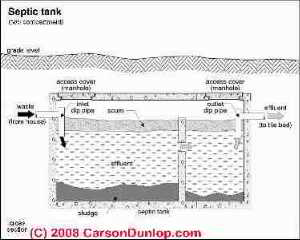
The drawing of a conventional two-compartment septic tank at page top and discussed in this article was provided courtesy of Carson Dunlop Associates, a Toronto home inspection, education & report writing tool company [ carsondunlop.com ].
InspectAPedia tolerates no conflicts of interest. We have no relationship with advertisers, products, or services discussed at this website.
Advice for People Buying a Home with a Septic Tank
Learning a little about how septic systems work (described here) and about septic cleaning (removing septic waste), and testing a septic system before buying a new home can help you avoid installing a septic system or replacing the septic system as a big surprise.
Because the septic tank and drainfield at a property are buried, thus hidden from view, because these components are expensive to replace, and because a costly problem can be present but not obvious, it is important to understand the septic system and to inspect and test it when buying a property served by its own private septic tank.
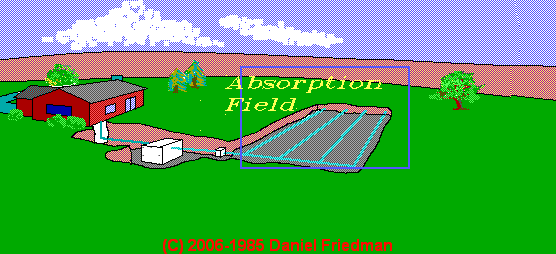
Septic systems include buried septic tanks (sewage tanks) and drainfields - expensive and hidden from view such as in the photo . This document provides advice for home buyers who are buying a home with a private septic system: homes using a septic tank and drainfield or similar soil absorption system.
Other chapters of this guide explain what goes wrong with septic systems, recommend and describe septic inspection and test methods in more detail, explain how to be sure your septic inspection and septic test are conducted properly, tell you where to get more septic system information about a given property, and warn of unsanitary or dangerous site conditions.
If you need to know how to install a septic system, or if you find that you have a sewage pit (cesspool) this website provides articles explaining those topics too.
If you prefer to read a basic guide to septic system inspection and testing for home buyers all in one brief article,
see SEPTIC SYSTEM TEST BASICS.
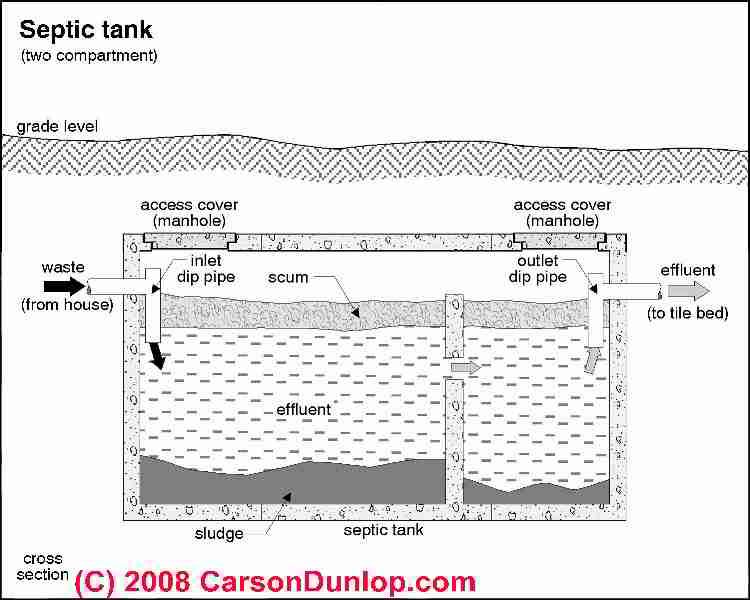
Our schematic of a conventional two-compartment septic tank (below) illustrates the first of two major septic system parts: the septic treatment tank. The image is provided courtesy of Carson Dunlop Associates, a Toronto home inspection, education & report writing tool company [ carsondunlop.com ].
What is a Septic Tank and How do Septic Systems Work: Nine Basic Questions & Answers
Home buyers frequently ask us these questions about septic systems:
- "What is a Septic Tank?
- What is a Leach Field?
- How does a septic system work?
- What does the existing septic system consist of at my new home?
- Do I have a Cesspool or Drywell?
- How do I know if the septic system is working properly?
- What septic inspections and tests should I have performed when I am buying a home?
- How long will a septic system last?
- Is septic system maintenance necessary?"
To help buyers obtain the necessary information to address these questions, we have put
together this document to guide them in making informed decisions regarding
the potential problems and costs associated with a property's septic system.
What You Need to Know, Find-out, & Do when buying a home with a septic system
How Septic Systems Work. Here is the minimum you need to know and what you need to do (or have done) when buying a property with a septic system
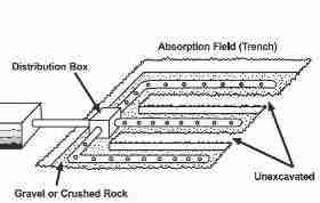
Our sketch below shows the second major portion of a septic system: the effluent disposal or drainfield or soakaway bed that disposes of clarified effluent liquid waste that leaves the septic tank.
So how does a septic system work? A private onsite septic system means that the waste from your building drains (sinks, showers, toilets) goes into a septic tank which retains the solids and lets the effluent flow into the soils on the property.
To avoid contaminating the environment, including nearby wells and waterways, septic system wastewater must be treated to reduce its pathogenicity.
Luckily naturally-occurring bacteria found in the septic tank and drainfield soils accomplish this task - as long as the septic system is working properly.
In a standard septic tank and drainfield system, about 40% of the treatment of sewage wastewater occurs in the septic tank, and the remaining 60% occurs in the drainfield trenches and surrounding soils.
Properly designed and installed private septic tank and drainfield or soakaway bed systems are functional and sanitary. Private septic systems serve more homes in the U.S. and many other countries than any other waste disposal method. But the components are costly and do not have an indefinite life.
Below in more detail we provide
a LIST of the MAJOR COMPONENTSof Residential Septic Systems: Septic Tank, Drainfield, & a Description of How Septic Systems Work
Steps to Take When Buying a Home With a Septic Tank
Because of the potential repair/replacement costs involved, and because the system is buried and cannot be exhaustively inspected and tested, you want to do what you can to evaluate the condition of the septic system before you complete the purchase of the property.
Here's what to do: If you are buying a home with a septic tank and drain field, here's what you need to do, as succinctly as possible. Each of these steps is described in more detail below, and in even more detail in linked-to documents.
Steps 1 and 2 are essential. Step 3 is usually a good idea. Step 4 depends on the results of steps 1,2,3 but is usually a good idea. Step 5 is not usually done but might be necessary. Step 6 is what you do if you're being really thorough.
Synonyms for "septic system" used by the general public include septic waste system, sewage systems, and water sewage systems, even Roman sewage systems. All of these refer to onsite systems which hold and separate sewage waste from its liquid effluent which is treated further and then disposed-of by any of a variety of means which we will discuss.
At this site we also discuss special considerations for handling septic waste such as garbage disposal septic tank waste volume and what to do about it. Perform these steps in the order we list them. (For example, don't pump the tank before a loading and dye test.)
See HOME BUYER'S SEPTIC TEST for more details about steps 1, 2, 3 in this list.
- Ask About the Septic System - where is it, what's installed, what's the service and repair history. If the owners don't know where the septic system is, ask how long they've lived in the home: that will be informative.
- Make a Visual Site Inspection for signs of trouble. Here's a great clue: if nobody knows where the septic tank is, then you can be sure nobody has been maintaining the septic system as regular pumpouts are an important part of septic system maintenance and septic system life preservation.
To find the septic tank
see SEPTIC TANK, HOW TO FIND. If you can find the tank, for safety, be sure that there is no evidence of collapse or subsidence on the property, and be sure that the septic tank (or cesspool, or drywell) has a safe cover so that no one can fall into the tank.
See SEPTIC TANK COVERS for details. - Perform a Septic Loading & Dye Test to see if it produces evidence of a failure. Hire a home inspector who knows how to perform and will include this test.
See PRE-PURCHASE SEPTIC DYE TEST
and also
See SEPTIC DYE TEST WARNINGS for warnings about what can go wrong during septic testing or what can give false test results.
Or SEPTIC SYSTEM INSPECTION & TEST GUIDE for complete details of how a septic system test is performed. - Pump the Septic Tank and inspect for additional clues, depending on what you learned at 1,2,3. Abnormal sewage levels in the septic tank can be a strong indicator of a problem with the septic system.
See SEPTIC TANK PUMPOUT TIMING ERRORS for pumpout timing details
Watch out: don't pump a septic tank before the septic test: doing so will prevent a valid septic loading & dye test.
At SEPTIC TANK LEVELS of SEWAGE we explain how to interpret the meaning of high or low sewage levels in the septic tank as well as thick or thin scum or sludge levels. For general septic tank maintenance
also see SEPTIC TANK PUMPING SCHEDULE. - Additional Septic System Physical Investigation might be needed if during the visual site inspection, the septic loading and dye test, or the septic tank open inspection and pumpout disclose abnormal conditions.
See ADDED INVESTIGATIONS for SEPTIC SYSTEMS -
discussed in HOME BUYER'S SEPTIC TEST - Get Outside Information about the septic system: There are some independnt sources of information about the septic system at your property that you can check in order to be thorough.
See ASK OUTSIDERS- also discussed
in HOME BUYER'S SEPTIC TEST - Check neighboring properties and their nearby septic systems both for advice for dealing with a neighboring septic system producing odors or seepage and to look for encroachment onto the property you are buying
See NEIGHBORING SEPTIC SYSTEM PROBLEMS for details.
The six home buying steps listed above are explained in detail
at HOME BUYER'S SEPTIC TEST but first you might want to review the basics about septic systems at
and also
4-WHAT GOES WRONG with septic systems.
Conflicts of Interest at Septic System Inspections & Home Inspections
Watch out for conflicts of interest when hiring a home inspector or a septic system inspector to examine a property before purchase. Choose an inspector who is qualified, experienced, and who will protect your interest.
Because sale of homes is a low volume high stakes deal, everyone involved feels a lot of pressure. That pressure explains why a home seller and real estate agents are very nervous about any inspector who they thinks may "rock the boat" and jeopardize their sale, though that's no excuse for putting the new home owner and occupants at risk of financial injury or worse, personal injury.
Real estate is very much a "caveat-emptor" buyer beware transaction, and the buyer is expected to perform her own due diligence. In fact, in our OPINION some of the pertinent real estate laws, while reasonable on the face of it, such as excusing an agent from liability regarding any representation of property condition, may at times encourage ... well how should we put it ... not the most honest behavior.
The concerns felt by the real estate profession may have contributed to the recent elimination of the NYS Home Inspection Advisory Board who tried monitored and advised on legislation regulating home inspectors in New York State. That news, reported by NYSAHI[5], was a sad step in a bad direction.
But more encouraging, in April 2012, the Code of Ethics for Home Inspectors for the State of New York, Title 19 NYCRR[3], now includes this text:
197-4.7 Conflicts of Interest
e) Home inspectors shall not directly or indirectly compensate, in any way, real estate brokers, real estate salespersons, real estate brokerage companies, lending institutions or any other party or parties that expect to have a financial interest in closing the transaction, for future referrals of inspections or for inclusion on a list of recommended inspectors or preferred providers or any similar arrangement.
That provision means that inspectors can't pay realtors for referrals.
The fly in the ointment of that salve is that nothing prevents a realtor from "steering" a home buyer to inspectors whom the agent knows will soft-soap or under-report concerns at a property. All it takes is a list or a wink and a nod when naming names.
That is why we have long held that folks buying a home should obtain inspection services from experts who have absolutely no relationship with others in the transaction and who are referred by independent sources such as professional home inspector associations[4] or friends or neighbors.
In our OPINION real estate agents and even lawyers for whom real estate closings are a significant part of their business should only refer their clients to independently-maintained lists of inspectors and never to their own lists or friends.
The New York State Association of Home Inspectors (NYSAHI) considers placement by a realtor (or attorney) on a list of "preferred providers" constitutes a referral, as do oral or un-written referrals as well.
Conflicts of interest are not just unethical, they invite a lawsuit for fraud.
Watch out: septic system inspections are not included in typical state home inspector regulations and laws, even if the inspector was also performing a home inspection at the time. In essence, as of 2012, ancillary property inspection and testing services such as septic inspection and testing and environmental inspections and testing are not covered by home inspection regulations.
A home inspector or a septic system inspector cannot tell you whether or not you should buy a property.
But s/he is expected to tell you about conditions that are dangerous, things that need near-term expensive repair or replacement (like a septic tank or drainfield if that inspection is performed), and about things you need that just don't work at an acceptable level of safety and reliability. An inspector who skips those items didn't do such a great job.
It would be unusual for the cost of repairs to be such a big portion of purchase price that a buyer should not proceed with the purchase. But a buyer needs to know what repairs are needed now and in the near future, what condtions are unsafe, and what conditions are causing rapid costly damage to the property - that's how the buyer can make a financially responsible financial plan, know how much money is needed, and know the priority of how to spend repair dollars.
Perhaps if enough cases of deception, manipulation, soft-soaping, or ms-representation by inspectors who are plagued by conflicts of interest reach the courts, those who are not moved by ethics will be moved by the law, and by the cost of failing to protect their putative clients.
Question: My septic inspector failed the septic drainfield during wet conditions after Hurricane Irene;
The owner disputes the results and may have added something to the fields to try to "pass" the system.
Whom can I trust?
My inspector failed the drain field on a house that I wish to purchase yesterday September 6. 2011. On August 30th was the first inspection which was a few days after Hurricane Irene. The inspector said the tank needed a clean out. Our inspector recommended waiting until Saturday for the field to dry out due to the excessive rain from the Hurricane.
Then the homeowner insisted on being at the inspection and wanted no one on his property so he pushed the inspection to one full week since he was on vacation. In the meantime the tank was cleaned out. It again rained the night before and day of the inspection of the tank and field.
Our inspector failed the field. The homeowner who claims he went to school for septic engineering is disputing the results.
He is saying that the inspector did not check the bed yesterday to see if it had drained and only looked in the tank. He claims the inspector said too much rain to test and told the homeowner and 2 witnesses that the septic should be fine, bed is far enough from house and he could test sometime in October.
Do you think the homeowner is lying and maybe adding or already added something to the septic to try to get it to pass inspection?
We are debating having a different inspector return to the property. I am afraid he may hire someone he knows due to his admission of being a septic engineer. Also, can you tell if someone added something to treat the field? If you could please let us know ASAP. Thank you my whole world revolves around this issue. I have kids in school and soon no house to live in since mine is being sold in a few days. - R.F.
This Q&A were posted originaly
at HOME BUYERS SEPTIC SYSTEM FAQs-2
Reply: Caveat emptor: when buying a home you have to rely on consultants who are both competent and have no conflict of interest
A competent onsite inspection by an expert who has expertise in septic system testing usually finds additional clues that help accurately diagnose a problem or answer questions about the condition of the system. That said, here are some things to consider:
Your inspector who wanted the tank pumped most likely would have asked that as an extra step in inspecting and diagnosing the system
A septic drainfield has to work even in rainy weather; indeed, however, if hurricane Irene had actually caused local area flooding, that'd be sufficiently abnormal as to decide to wait on testing
An owner who won't allow people on a property is in my experience waving a red flag of warning to watch out for a cover-up of a costly problem. I emphasize that point even though I understand that selling a home is a nervous time for the seller too.. Everyone wants everything to go smoothly. And on occasion I've seen sellers do very suspicious things not because there was really a serious issue, but because they were afraid there might be one. It's a mistake.
I agree with the owner, however, that just looking at the tank is hardly a competent inspection; however, one might see something at the tank, such as drain-back into the tank during pumpout or lost tank baffles that would be very indicative of a field failure.
In real estate law just about everywhere the courts opine that because buying a home is a major expense and because there are parties with strongly conflicting interests, a buyer who relies on representations by a seller or a real estate agent is ... well how should I say it ... being ill-advised.
Details are above on this page.
Home buyers are responsible for performing their own due-diligence and would be wise to rely only on advice from parties whom they are absolutely sure have no conflict of interest in the deal. Part of due diligence also involves doing your best to be sure that your advisors are not only unbiased, but competent.
In my experience and opinion, it's rare that a problem is so costly that buying the home is a mistake. It's correct, however, that the true cost of the property needs to be understood by the buyer to include the cost of necessary repairs for the property to be safe and habitable.
In sum, in the conditions you described, you would be wise to presume that on purchasing the home, at any time thereafter you are likely to face costly septic system repairs or even replacement of the drainfield; depending on the tank, its materials and conditions, there may be work there too. Age of the system, materials used, and other site clues would perhaps raise or lower the worry level but with no better data, the bottom line is unchanged.
Question: Septic system passed at time of purchase. After a few months it Failed - how could they sell a home with a bad septic?
when I made the purchase two months before. How could they sell a home with a bad septic? How could the first inspector pass and the second inspector fail my septic system?
I purchased a home in Rochester, NY in February 2012. No one had been living in the house for around six months so the bank requested $7,500 escrow.
Once I lived in the house for 1-2 months I was told to get the home inspected and once passed I'd get the escrow money returned.
I got it inspected and it failed. The tanks in there are 500 and 300 gallons and are made of steel and have concrete covers. The tanks are from around 1968 when the home was built. The house was inspected and I was told it was fine. I never saw the inspection report but my lawyer did.
Do you know the NYS laws that cover this? How could they sell a home with a bad septic and how could it have passed inspection?
Company "A" Septic Tank Service inspected it on 7-5-11 and didn't note any problems.
The bank then wanted it inspected again and the same company did it for them again on 12-12-11. Again nothing noted that anything was wrong with it. I was told the last time it was emptied was July, 2010.
I hired Company "B" to inspect the tanks and he failed them on 4-4-2012.
He said the tanks were old and rusted and could cave in at any time and that the lines going into it were rusted and leaking. Both of these gentleman have been in this business for years and years and are know for their expertise.
Company "B" said when he went for schooling at Delhi they said that steel tanks were banned and not allowed since 1968. I believe him and trust him and feel he's looking out for my welfare and obviously Duane Marshall was looking out for the welfare of the sellers of my home.
Now what do I do? Is there a law that states it should have been changed over before the home closed?
How could Company "A" pass it when Company "B" did not? I know that in two months the condition of them couldn't have deteriorated that much.
Please help. I don't know what to do or how to proceed. My lawyer seems to think I'll be lucky if I get the sellers to even cough up half of the $4,000 that Company "B" said it will take to replace it.
The seller worked for and was a leader in a labor union his entire life. You can't tell me he didn't know and realized what he was selling and doing to me. I'm looking for any direction and/or help/laws to assist me?
- [Anonymous for privacy ]
Posted originally at HOME BUYERS SEPTIC SYSTEM FAQs-2
Reply:
A competent onsite inspection by an expert usually finds additional clues that help accurately diagnose a problem or evaluate the condition of a system - certainly not something I can accomplish by email. .
That said, here are some things to consider:
In my OPINION, if you did not receive an adequate or honest inspection and report of the condition of the property and its septic system before it was purchased, whomever steered you to an inspector who didn't do the job gave you very bad advice. So you may have three parties against whom you have complaint: the seller, the inspector, and the realtor.
You will want to consult your attorney again, or if necessary find one familiar with real estate law and financing, for an authoritative answer about what you can or cannot be compelled to do. Those are legal questions. My OPINION is that the terms and conditions of financing you cite are levied by the lender, your bank, and the specifics are not regulated by law.
But it is my OPINION and experience that if there is a case of failure (errors and omissions) or real estate fraud, you may be entitled to some financial relief.
There is no doubt that there can be very serious conflicts of interest in real estate transactions. A home inspector or septic inspector who depends on real estate agents for referrals is serving two masters - his client (you) and the realtor (his "real" client). The inspector may not want to get in trouble with you, but s/he doesn't want to upset the real estate agent or referrals will stop. Stop dead.
In the home buyers septic system advice article above I include above on this page.
- It's no surprise that two different septic "experts" would make different findings of the condition of the septic system, depending on how thoroughly and carefully they did their job.
Some "defects" permit an honest difference of opinion - such as "how many years more might my roof be expected to last" because experience and judgment come into play.
Other "defects" or facts are unambiguous.
A septic tank is steel or not; its baffles or lid or tank are rust perforated, damaged or missing, or not.
I expect your attorney, realtor, and any other expert to confirm that there is no law in New York that would have required a property owner to replace a working, functional, steel septic tank after a certain date.
However if a septic system is not working, it may violate local or state health department regulations and when that failure is discovered it would at that time require proper repairs.
At this point your priorities should not be on litigation or arguing, but rather on finding out exactly what will satisfy your lender, how to get that work performed, and how to make sure that your home and all of its systems are safe, sanitary, and functional.
List of Major the Major Components of Residential Septic Systems: Septic Tank, Drainfield, & More
Basic Parts of a Conventional Septic Tank and Leachfield
Our sketch of a typical septic tank and drainfield (below) illustrates how waste moves from the building to the septic tank and how liquid waste is ultimately treated and disposed-of in the leachfield or drainfield.
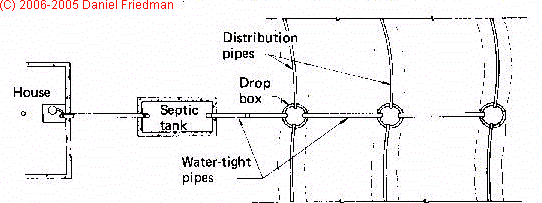
The purpose of a septic system is to retain solid waste in the tank and to dispose of effluent waste water into the ground without contaminating the environment.
To accomplish this a septic system consists of the elements shown in the sketch above. In simplest terms, a septic system consists of a holding tank which retains solid waste and grease from household waste water, and an absorption system or "leach field" which disposes of liquid wastewater or "effluent" which leaves the septic tank for absorption below ground into soils at the property.
Let's outline these main septic system parts in a little more detail:
- The main waste line or "sewer line" connects the home's plumbing to the septic tank.
- The septic tank which is often buried just a few feet from the house foundation wall,
receives all waste (solid and liquid) and has the main job of retaining solids and grease.
Solids settle to the bottom of the tank as sludge. A floating scum and grease layer forms at the
top of the tank.
Baffles at the tank inlet and outlet reduce the velocity of liquid moving through the tank and prevent solids and floating scum from leaving.
Clarified effluent is allowed to flow out of the tank into a soil absorption system. In some states (Connecticut since January 1991) septic tanks now consist of two compartments in order to do a more effective job, and increasingly other jurisdictions (Alaska, Pennsylvania) require that new and up-graded onsite wastewater disposal systems use two-compartment septic tanks. - A effluent distribution pipe direct the flow of effluent from the septic tank to the leaching system, often connecting first to one or more distribution boxes which in turn distribute flow of effluent evenly into the leaching system.
- A leaching system, or soil absorption system, also called "drainfield", a soakaway system, leachfield, or seepage bed
disperses the sewage effluent into the surrounding
natural soils. There are many types of leaching systems but the most common is a network
of perforated pipes buried in gravel-filled trenches.
The specific type utilized on a particular property depends on the soil conditions and the amount of space available.
Galleries or "septic galleys", seepage pits and sand beds have historically been used.
Most distribution piping and leaching systems are "gravity" systems, meaning the flow runs through piping and distribution boxes without the assistance of any mechanical device, such as a pump or siphon, but some homes pump their effluent uphill into a mound system.
Advanced wastewater treatment systems are also available to handle difficult sites.
Septic System & Septic Tank Guides for Home Owners & Home Buyers
- [3] Alaska DEC, HOW to MAINTAIN YOUR SEPTIC SYSTEM [PDF] Alaska Department of Environmental Conservation, Division of Water, retrieved 8/8/12, original source: http://dec.alaska.gov/water/wwdp/onsite/maintain_septic.htm
- US EPA SEPTIC TANK/SOIL-ABSORPTION SYSTEMS: HOW TO OPERATE & MAINTAIN [PDF] - , Equipment Tips, U.S. Department of Agriculture, 8271 1302, 7100 Engineering, 2300 Recreation, September 1982, web search 08/28/2010, original source: http://www.fs.fed.us/t-d/pubs/pdfimage/82711302.pdf
- Schulthesis, Robert A., Missouri SEPTIC TANK & ABSORPTION FIELD HOMEOWNERS GUIDE [PDF] (2001) retrieved 2022/04/25 original source: https://extension.missouri.edu/publications/eq401
- SEPTIC TANK PUMPING SCHEDULE - knowing when to pump and clean the septic tank and having that job done is the most important homeowner responsibility if the septic system is to last
- US EPA & Montana HOMEOWNERS GUIDE to SEPTIC SYSTEMS [PDF] (2010) - retrieved 2022/04/25 original source: https://riverstonehealth.org/wp-content/ uploads/2015/04/HomeownerGuideSepticSystems1-2010-2.pdf
- US EPA & New Jersey A HOMEOWNERS GUIDE TO SEPTIC SYSTEMS [PDF] - retrieved 2022/04/25 original source: https://www.nj.gov/dep/dwq/pdf/septicmn.pdf
Excerpt: Unlike those who live in areas served by regional sewerage systems, septic system owners are unique because they are solely responsible for the daily operation and maintenance of their wastewater treatment and disposal system.
By adhering to simple and straightforward guidelines, septic system owners can ensure years of trouble-free operation with minimal maintenance.
Reader Comments, Questions & Answers About The Article Above
Below you will find questions and answers previously posted on this page at its page bottom reader comment box.
Reader Q&A - also see RECOMMENDED ARTICLES & FAQs
On 2020-01-24 - by (mod) -
gus white said:
I didn't know before that you can avoid any surprises with a septic tank of a home that you are going to buy by simply getting it properly tested prior to buying the home. We are looking at a home to move to, and it has a septic tank. I will be sure to look for an inspection service to check the tank before we buy the home, so we could avoid any ill surprises.
On 2019-03-28 - by (mod) -
RE-posting from private email:
Anonymous asked:
We are In process of purchasing a home our Inspector found that second tank was bone dry his though was there is leak in first tank.
Owners had a professional in and his finding were same and he said PROBLEM WILL FIX ITSELF!!! I'm no inspector but if there is a leak does t it need to be FIXED after u find area that is leakng.
Reply:
I"m baffled about how a septic problem like a leaky septic tank is going to fix itself.
I am confident, however that your attorney, if she is actually working for you and not suffering from a conflict of interest, is going to agree that a buyer must do their own due diligence when purchasing a home, and that no buyer would be smart to rely on promises by an owner or by someone paid by the owner who assures the buyer that everything is OK.
You would be wise to have your own independent home inspection and septic system inspection and to obtain independent expert estimates of repair costs for any significant defects that are identified so that you can be properly prepared to handle what the home will need to be safe, sanitary, and functional.
On 2019-02-27 - by (mod) -
Anon
Before installing a septic tank you would need a septic system design approved by your local health or building department. That typically includes a soil percolation rate test or perc test intended to determine the rate at which your soil absorbs water. That in turn determines the size of Greenfield needed. So the test isn't specifically for the tank is for the system.
On 2019-02-27 by Anonymous
What kind of test must be done before a septic tank can be installed
On 2015-05-20 - by (mod) -
Steve
Document your position, in writing, to all parties. This is a potentially dangerous situation that could result in a death if someone falls into the septic tank. Driving over the top may have damaged the tank making it unsafe; similarly but less threatening is the refusal to permit inspection of any component.
My approach when working with a client at a site where an owner refuses access to anything is to respect that refusal completely but to accurately inform all parties orally and in writing of the implications.
For example, a buyer has no choice but to assume (for purposes of estimating the costs of the property including required repairs) that the component that the owner excludes from inspection is unsafe, not functional, and needs complete replacement.
A realtor may or may not have similar authority.
On 2015-05-20 by Steve
I have a realtor argueing with me that the s tank doesnt need to be uncovered. Its under 4 in of very coarse and very boney gravel . Both baffles are gone AND this system has been driven over alot with pk up truck/horse trailer.
Dbox cover is cracked and thats buried under 30 inches of material being driven over. Four inches of loose boney gravel is a whole lot worse... thoughts? email flipzhd@hotmail.com
On 2015-05-18 - by (mod) -
Anita
I can't pose a single "right" answer for the question - there are too many unknowns: is this a common property that rents lots to individual mobile homes? Would the local health and building departments approve a central septic system? How many users or "bedroom-equivalents" will be supported? What are the size, design, soil properties, distances, site size, encumbrances, etc.
On 2015-04-30 by anita
I have a neighbor that lives in a mobile home with an existing septic system. she wants to add a mobile home to the property and share the septic. is that allowed in the state of ohio?
On 2015-01-09 - by (mod) -
Angela
I would give your local building or health department a call and ask them straight-out what you are required to do. They'll be so thrilled that you're not a scofflaw that they'll try to help. Usually, in most jurisdictions, existing systems are "grandfathered" and are not required to be amended -- until the system needs repair or replacement. At that time it'll typically be required to meet current regulations.
On 2015-01-09 by Angela Cooper
My husband and I are purchasing a house in Gaines County, outside the city limits of Seminole, TX. I've been told in or around 1992 all new septic systems in the county were required to apply for permits and be registered with the health department.
I've also been told by the local septic company that if the system is not registered, it is illegal. What, if anything, can I do to fix this paperwork probably. I plan to follow all the steps to determine the condition of the system, but wondered if anyone can help with the "illegal" part.
On 2014-12-30 - by (mod) -
As is -
From the history you report, it would be prudent to assume that a new septic system, at least drainfield and possiblyi tank and drainfield, are needed.
The cost is likely to be well above $10K in most areas of the world; you need to get a septic engineer or contractor on-site to give a rough estimate of cost to install a system. The cost varies depending on site features such as available space, soil percolation rate, and size of system required.
On 2014-12-30 - by (mod) -
Maureen
I would be concerned for several reasons:
Your observation sounds like a septic system failure; we don't know if the problem is a broken pipe or a failed drainfield - further investigation is needed.
And in most communities it's illegal to discharge wastewater to the ground surface.
If we're lucky the washer is connected to a separate drywell that needs repair or replacement rather than facing a new septic system.
On 2014-12-27 by Maureen
I bought a house 7 weeks ago with a septic system that was inspected and serviced. They did require the sellers to install new drainage pipes from the house to the yard. Now, I have sudsy water that comes out of a spout in the backyard, and I'm not sure if I need to be concerned. I think it might be coming from the washer and utility tub (the water was tinged blue after cleaning paint brushes). Can someone help me understanding what is "normal"? Thank you
On 2014-12-27 by As is/ where is septic
I am considering purchasing a house as an investment property. The property is well-priced but the story goes... current septic was installed in the 80's. It's always been a rental property and in 2011, the tenants were evicted for flushing 'inappropriate" it things. The owner had the septic pumped, drained the pipes and the house has been vacant ever since.
He's sell it 'as is, where is' and 'says' that he doesn't know if the septic is working fine, needs repair, or complete replacement. At the price-point, up to $10,000 worth of repairs would actually be agreeable to me. Any suggestions on what I should look for or ask for? The property sits on approximately 2 acres.
...
Continue reading at HOME BUYER'S SEPTIC TEST or select a topic from the closely-related articles below, or see the complete ARTICLE INDEX.
Or see HOME BUYERS SEPTIC SYSTEM FAQs - questions & answers posted originally on this page
Or see these
Recommended Articles
- ABANDONED or NEW SEPTIC SYSTEM TESTS
- HOME BUYERS GUIDE to SEPTIC SYSTEMS - complete guide to buying a home with a septic tank
- SEPTIC SYSTEM TROUBLE: WHAT GOES WRONG
- HOME BUYER'S SEPTIC TEST
- PRE-PURCHASE SEPTIC DYE TEST
- SEPTIC TEST FINAL OVERVIEW
- SEPTIC FAILURE LAWSUIT
- HOME SELLERS GUIDE TO SEPTIC INSPECT
- SEPTIC SYSTEM TEST BASICS - quick guide for buying a home with a septic tank
- SEPTIC & CESSPOOL SAFETY
- SEPTIC COMPONENT LOCATIONS
- SEPTIC DRAINFIELD INSPECTION & TEST - home
- SEPTIC LOADING & DYE TEST PROCEDURE - home
- SEPTIC TANK PUMPOUT TIMING ERRORS
- TEN STEPS to Keeping a Septic System Working
Suggested citation for this web page
HOME BUYERS GUIDE to SEPTIC SYSTEMS at InspectApedia.com - online encyclopedia of building & environmental inspection, testing, diagnosis, repair, & problem prevention advice.
Or see this
INDEX to RELATED ARTICLES: ARTICLE INDEX to SEPTIC SYSTEMS
Or use the SEARCH BOX found below to Ask a Question or Search InspectApedia
Ask a Question or Search InspectApedia
Try the search box just below, or if you prefer, post a question or comment in the Comments box below and we will respond promptly.
Search the InspectApedia website
Note: appearance of your Comment below may be delayed: if your comment contains an image, photograph, web link, or text that looks to the software as if it might be a web link, your posting will appear after it has been approved by a moderator. Apologies for the delay.
Only one image can be added per comment but you can post as many comments, and therefore images, as you like.
You will not receive a notification when a response to your question has been posted.
Please bookmark this page to make it easy for you to check back for our response.
Our Comment Box is provided by Countable Web Productions countable.ca
Citations & References
In addition to any citations in the article above, a full list is available on request.
- [5] NYSAHI Newsletter, April 2012, New York State Association of Home Inspectors, NYSAHI, website: http://www.nysahi.com/,
- Builder's Guide to Wells and Septic Systems, Woodson, R. Dodge: $ 24.95; MCGRAW HILL B; TP; Quoting from Amazon's description: For the homebuilder, one mistake in estimating or installing wells and septic systems can cost thousands of dollars. This comprehensive guide filled with case studies can prevent that. Master plumber R. Dodge Woodson packs this reader-friendly guide with guidance and information, including details on new techniques and materials that can economize and expedite jobs and advice on how to avoid mistakes in both estimating and construction. Chapters cover virtually every aspect of wells and septic systems, including on-site evaluations; site limitations; bidding; soil studies, septic designs, and code-related issues; drilled and dug wells, gravel and pipe, chamber-type, and gravity septic systems; pump stations; common problems with well installation; and remedies for poor septic situations. Woodson also discusses ways to increase profits by avoiding cost overruns.
- Wells and Septic System, Alth, Max and Charlet, Rev. by S. Blackwell Duncan, $ 18.95; Tab Books 1992. We have found this text very useful for conventional well and septic systems design and maintenance --DF.
- In addition to citations & references found in this article, see the research citations given at the end of the related articles found at our suggested
CONTINUE READING or RECOMMENDED ARTICLES.
- Carson, Dunlop & Associates Ltd., 120 Carlton Street Suite 407, Toronto ON M5A 4K2. Tel: (416) 964-9415 1-800-268-7070 Email: info@carsondunlop.com. Alan Carson is a past president of ASHI, the American Society of Home Inspectors.
Thanks to Alan Carson and Bob Dunlop, for permission for InspectAPedia to use text excerpts from The HOME REFERENCE BOOK - the Encyclopedia of Homes and to use illustrations from The ILLUSTRATED HOME .
Carson Dunlop Associates provides extensive home inspection education and report writing material. In gratitude we provide links to tsome Carson Dunlop Associates products and services.
 | HOME | ABOUT | ASK a QUESTION | CONTACT | CONTENT USE POLICY | DESCRIPTION | POLICIES | PRIVACY | |
| © 2024 - 1985 Publisher InspectApedia.com - Daniel Friedman | |||||||||