InspectAPedia.com InspectAPedia®
 

Free Encyclopedia of Building & Environmental Inspection, Testing, Diagnosis, Repair

Ask a Question or Search InspectAPedia

  • HOME
  • AIR CONDITIONING
  • ELECTRICAL
  • EXTERIORS
  • HEATING
  • HOME INSPECTION
  • INTERIORS
  • PLUMBING
  • ROOFING
  • SEPTIC SYSTEMS
  • STRUCTURE
  • WATER SUPPLY
  • ENERGY SAVINGS
  • ENVIRONMENT
  • INDOOR AIR IAQ
  • INSULATION
  • MOLD INSPECT TEST REMOVE
  • NOISE
  • ODORS
  • SOLAR ENERGY
  • VENTILATION
  • EXPERTS DIRECTORY
  • CONTACT US


Mobile Phone/PDA website viewMobile View
SEPTIC SYSTEM INSPECT DIAGNOSE REPAIR

SEPTIC SYSTEMS, HOME BUYERS GUIDE to
SEPTIC SYSTEMS ONLINE BOOK
SEPTIC SYSTEM ODORS
SEPTIC SYSTEM SAFETY WARNINGS
SEPTIC SYSTEM DESIGN BASICS
  DRYWELL DESIGN & USES
  FILTERS SEPTIC & GREYWATER
  SEEPAGE PITS
  SEPTIC CLEARANCES
  SEPTIC SOIL & PERC TESTS
  SEPTIC TANK SIZE
  SEPTIC DRAINFIELD SIZE
  SEPTIC DRAINFIELD SHAPE
  SEPTIC TANK PUMPING FREQUENCY
  SEPTIC TANK PUMPING PROCEDURE
  SEPTIC SYSTEM PUMPS
  SEPTIC TREATMENTS & CHEMICALS
ALTERNATIVE DESIGNS
  AEROBIC SEPTIC SYSTEMS
  ALTERNATING BED SEPTIC SYSTEMS
  CESSPOOLS
  CESSPOOLS for WASTEWATER
  CESSPOOL FAILURE CRITERIA
  CESSPOOL SAFETY WARNINGS
  CESSPOOL AGE ESTIMATION
  DISINFECTION SYSTEMS, SEPTIC EFFLUENT
  DRYWELL DESIGN & USES
  EVAPORATION-TRANSPIRATION SEPTIC SYSTEMS
  FILTERS SEPTIC & GREYWATER
  FIXED-FILM PROCESS SEPTIC SYSTEMS
  GRAVELLESS SEPTIC SYSTEMS
  GRAVITY/SIPHON DOSING SYSTEMS
  GREYWATER SYSTEMS
  HOLDING TANK SEPTIC SYSTEMS
  LAGOON SEPTIC SYSTEMS
  MEDIA FILTER SEPTIC SYSTEMS
  MOUND SEPTIC SYSTEMS
  OUTHOUSES & LATRINES
  PEAT FILTER SEPTICS
  PRESSURE DOSING SEPTIC SYSTEMS
  SEQUENCING BATCH SEPTIC SYSTEMS
  MOUND SEPTIC SYSTEMS
  OUTHOUSES & LATRINES
  PEAT FILTER SEPTICS
  PRESSURE DOSING SEPTIC SYSTEMS
  RAISED BED SEPTIC SYSTEMS
  SAND BED SEPTIC SYSTEMS
  SEEPAGE PITS
  SEPTIC SYSTEM PUMPS
  SEQUENCING BATCH SEPTIC SYSTEMS
  SEWAGE TREATMENT SYSTEMS
  STEEP SLOPE SEPTIC DESIGNS
  TOILET ALTERNATIVES
  TOILET TYPES
  Toilet Types, Flush Methods
  TOILETS, DON'T FLUSH LIST
  TRAPS on PLUMBING FIXTURES
  VEGETATED SUBMERGED SEPTIC BEDS
  Wastewater Treatment Levels
  Wastewater Dispersal Methods
  WETLAND SEPTIC SYSTEMS

SEPTIC SYSTEM DESIGN BASICS
  DRYWELL DESIGN & USES
  FILTERS SEPTIC & GREYWATER
  SEEPAGE PITS
  SEPTIC CLEARANCES
  SEPTIC SOIL & PERC TESTS
  SEPTIC TANK SIZE
  SEPTIC TANK DEPTH
  SEPTIC TANK TEES
  SEPTIC DRAINFIELD SIZE
  SEPTIC DRAINFIELD SHAPE
  SEPTIC TANK PUMPING FREQUENCY
  SEPTIC TANK PUMPING PROCEDURE
  SEPTIC PUMPS
  SEPTIC TREATMENTS
  STEEP SLOPE SEPTIC DESIGNS
SEPTIC SYSTEM DESIGN MANUAL - Online

SEPTIC SYSTEMS, HOME BUYERS GUIDE to

SEPTIC SYSTEM INSPECTION & TEST GUIDE
SEPTIC INSPECTION COURSE
  SEPTIC FAILURE CAUSES
  SEPTIC TANK GRASS or SNOWMELT
  SEPTIC TANK INSPECTION PROCEDURE
  SEPTIC DRAINFIELD FAILURES
  SEPTIC D-BOX INSPECTION
  SEPTIC DRAINFIELD INSPECTION
  SEPTIC DYE TEST PROCEDURE
  SEPTIC FAILURE CAUSES
  SEPTIC FAILURE CRITERIA
  SEPTIC FAILURE SIGNS
  SEPTIC FAILURE SPOTS
  SEPTIC INSPECTION WORK SHEETS

SEPTIC SYSTEM DEFINITIONS
SEPTIC FAILURE LAWSUIT
SEPTIC REFERENCES
SEPTIC AUTHORITIES
SEPTIC BOOKSTORE
SEPTIC BIOMATS

SEPTIC CARE INSTRUCTIONS
SEPTIC CLEARANCE DISTANCES
SEPTIC CODES & REFERENCES
SEPTIC CONSULTANTS
SEPTIC DYE TEST PROCEDURE

SEPTIC INSPECTION BOOK
SEPTIC INSPECTION & TEST GUIDE
SEPTIC INSPECTION TYPES & LEVELS

SEPTIC SYSTEM DEFINITIONS
SEPTIC SYSTEM DESIGN MANUAL - Online
SEPTIC SYSTEMS ONLINE BOOK

SEPTIC SYSTEM DESIGN ALTERNATIVES

SEWAGE & SEPTIC CONTAMINANTS
SEWAGE BACKUP, WHAT TO DO
SEWAGE BACKUP TEST & CLEANUP
SEWAGE BACKUP PREVENTION
SEWAGE CONTAMINATION in buildings
SEWAGE CONTAMINANTS in FRUIT / VEGETABLES
SEWAGE EJECTOR / GRINDER PUMPS
SEWAGE LEVELS in SEPTIC TANKS
SEWAGE NITROGEN CONTAMINANTS
SEWAGE PATHOGENS in SEPTIC SLUDGE
SEWAGE PUMPS

SEWER BACKUP PREVENTION
SEWER GAS ODORS
SEWER LINE REPLACEMENT

SINKHOLES, WARNING SIGNS
SMELL PATCH TEST to Track Down Odors
SOAKAWAY BED FAILURE DIAGNOSIS
SULPHUR & SEWER GAS SMELL SOURCES
SUMP PUMPS

TOILETS, INSPECT, INSTALL, REPAIR
TOILET ALTERNATIVES
TOILET FLUSHOMETER VALVES
TOILET INSTALLATION PROCEDURE
TOILET OVERFLOW EMERGENCY
TOILET PLUGS, SEWER BACKUP
TOILET REPAIR GUIDE
TOILET TISSUE CHOICES
TOILET TYPES
Toilet Types, Flush Methods
TOILETS, DON'T FLUSH LIST
TRAPS on PLUMBING FIXTURES
TREATMENTS & CHEMICALS, SEPTIC

VIDEO GUIDES: Septic Videos
WASHING MACHINES
WATER SOFTENERS & CONDITIONERS
WATER SUPPLY & DRAIN PIPING
  CLOGGED DRAIN DIAGNOSIS & REPAIR
WASTEWATER TREATMENT BASICS
WATER, WELLS, WATER TANKS: TESTING GUIDE
WATER PURIFIERS

WATER QUALITY TESTS, CONTAMINANTS, TREATMENT
WATER QUANTITY IMPROVEMENT
WATER QUANTITY USAGE GUIDE
WATER, WELLS, WATER TANKS: TESTING GUIDE
WETLAND SEPTIC SYSTEMS

WINTERIZE A BUILDING

More Information

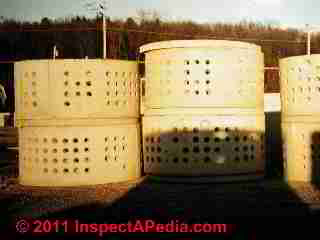
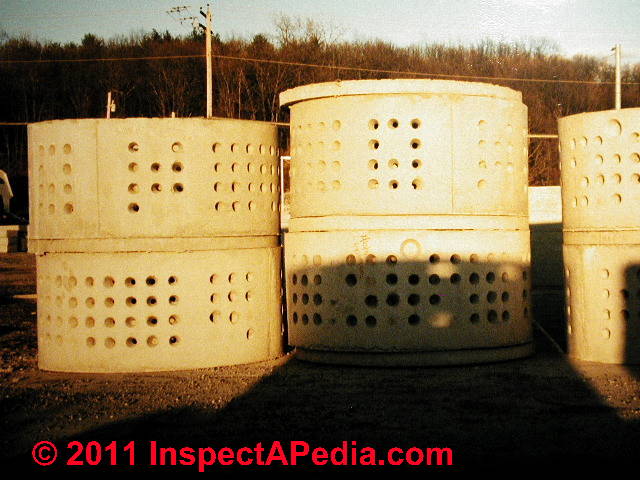
Photograph of  a seepage pit collection at the factory

How to Determine the Age of a Cesspool
InspectAPedia®  -         

  • How to determine the age of a septic cesspool
  • CESSPOOLS for onsite wastewater disposal - Visual Inspection and Site History Help Estimate the Age of a Cesspool
InspectAPedia offers impartial, unbiased advice without conflicts of interest. We will block advertisements which we discover or readers inform us are associated with bad business practices, false-advertising, or junk science. Our contact info is at InspectAPedia.com/Contact.htm.

This document suggests methods for estimating the age of a cesspool. The age of a cesspool can assist an owner in evaluating its condition and planning for its maintenance or replacement. Readers should also see our companion document Cesspools which explains what a cesspool is, gives important safety and maintenance advice for cesspools, and defines the criteria for cesspool failure.

This material is a chapter of our Septic Systems Online Book: That document explains septic system inspection procedures, defects in onsite waste disposal systems, septic tank problems, septic drainfield problems, checklists of system components and things to ask. Septic system maintenance and pumping schedules. Citation of this article by reference to this website and brief quotation for the sole purpose of review are permitted.

Use of this information in books or pamphlets for sale is reserved to the author. Some technical review by industry experts has been completed-reviewers are listed at "References." Further review comments and content suggestions are welcome. Also see Septic System Life Expectancy. Home buyers who want less technical advice should see the Home Buyer's Guide to Septic Systems. Also see The Septic Systems Home Page.

© Copyright 2012 InspectAPedia.com, All Rights Reserved. Information Accuracy & Bias Pledge is at below-left. Use page top links to major topics or use links at the left of each page to navigate within topics and documents at this website. Green links show where you are in a document series or at this website.

CESSPOOLS for WASTEWATER - How to Estimate the Age of a Cesspool

A cesspool combines the septic treatment tank and absorption system into a single component.

Several readers have written to ask if it is possible to determine the age of a cesspool A cesspool is pit into which sewage is discharged. Solids remain in the pit, effluent is absorbed into soil around the cesspool. Cesspools have a limited life and capacity, but they have been in use since the late 1400's (the beginning of the Renaissance).

While cesspools have been used for a long time, since the development of the more modern septic system (tank and drain field) cesspools may still be in use at old properties or even at newer ones (where permitted by local health departments) if there is not enough room for a conventional leach field.

Estimating the age and condition of anything which is buried is tricky, but not completely impossible. An estimate of the age of a cesspool may assist the building owner in planning for its maintenance, repair, or replacement.

Recently a reader asked if one could estimate the age and usage of a building by evaluating its cesspool. I was somewhat doubtful of this approach as cesspools have been in use for such a long time and have used such a variety of materials. But it's a very interesting idea, and certainly bounds can be put on the age of a cesspool by noting how it was constructed. The following details suggest other means for estimating the age and perhaps indirectly the condition of a residential property cesspool.

Four Steps in Estimating and Evaluating the Age and Condition of a Cesspool

Here are a few suggestions about estimating cesspool age, all of which can be answered only by collecting historical information about the home and perhaps by excavating to inspect the cesspool system.

  1. Inspecting Details Inside the Building: in the house: is there evidence of multiple generations of waste line in or leaving the building- various materials and locations?
  2. History of the Property and Septic Service Records: in the history of the house: is there record of septic system service - if so, call the contractors to ask them what they did when, and what they found to be installed and what they could see of its construction materials and location.
  3. Outside Visual Inspection for Cesspool Clues: is there visual evidence of a history of cesspools, additions, modifications. Eg. often when a cesspool fails people would leave it in place, leave the house waste line connected to it, and just build an additional cesspool "downstream" from and connected to the old one.

    A property from the 1930's in continuous use, depending on soil characteristics, level of occupancy, and cesspool size and construction, might have a chain of 3 to 5 cesspools strung out in a line from the original, or might have filled in some or some might have collapsed, leading to sewer line rerouting to new cesspools. We might observe a series of depressions extending away from the home where these systems were chained together. **SAFETY** watch out for collapsing cesspools - falling in can be a quick death.
  4. Cesspool Information by Excavating: locate and excavate the cesspool to see of what it is constructed. We might be able to recognize old building materials, e.g. concrete blocks made in the 1930's using the Sears masonry block kit that was in wide use. Also one could examine the materials used to construct the waste line itself. Orangeburg clay pipe, for example, was in common use in the 1920's and has most likely not been used since the 1950's.

    Hand made cesspools of stone, brick, or something else could be of any vintage unless we can recognize the probable age of the materials themselves. Same for cesspool covers.

    Pre-cast concrete cesspools: Finding a "new" pre-cast concrete (and safer) cesspool does not mean there was not an older one there previously, but the new unit is likely to be less than 20 years old.

Cesspool Inspection & Testing Safety Warnings

*** SAFETY WARNING *** digging up or poking into old septic systems or cesspools risks discovering a collapsing and very dangerous system. Dig and poke and excavate with great care and using a professional and not with anyone working alone - falling into a collapsing cesspool can be a quick and ugly death.

  • Safety Warning: do not walk over the top of or close to the edges of a cesspool or any other onsite pit or excavation because of the danger of fatal collapse. Keep pets and children away from such systems.
  • Safety Warning: there is a high risk of cesspool collapse, risking fatality if someone falls in to one of these systems. This is particularly true for older site-built systems that were often made of dry-stacked stone or concrete block, and more-so if such systems are not protected by a very secure cover.
  • Safety Warning: pumping cesspools is dangerous since older site-built systems may be more likely to collapse inwards when relieved of their contents.
  • Safety Warning: aerating or agitating sludge at the bottom of a cesspool in an attempt to renew its function or extend its life also risk system collapse.

In Summary: watch out for cave-ins, keep away: cesspools, particularly older site-built cesspools present a very high risk of collapse from an unsafe cover or following some types of service involving pumping, aeration, or hydro-jetting. Adults or children should not walk over or even near cesspools because of the risk of falling-in followed by collapse, a virtually certain cause of death. If the presence of a cesspool is known or suspected at a property its location should be roped off to prevent access and it should be investigated by a professional. See Cesspool Safety for more details

Questions & Answers regarding this article

.

Ask a Question or Search InspectAPedia

HTML Comment Box is loading comments...

Recommend / Share this Article            

...

Technical Reviewers & References

  • InspectAPedia.com® - Daniel Friedman - Publisher & Editor.
  • InspectAPedia Bookstore lists recommended books, organized by topic & available for purchase. Most of our articles also include a list of recommended books for the specific article topic as well as other references, and information sources.
  • Critique, contributions wanted: Contact Us to suggest corrections or additions to articles at this website, and if you wish, to receive online listing and credit as a contributor. Particular thanks are due to the many experts and also consumers who read and critique technical articles at InspectAPedia.com.
  • Additional technical contributors & reference sources for this article are listed below.

Use links just below or at the left of each page to navigate this document or to view other topics at this website. Green links show where you are in our document or website.

SEPTIC SYSTEM INSPECT DIAGNOSE REPAIR

SEPTIC SYSTEMS, HOME BUYERS GUIDE to
SEPTIC SYSTEMS ONLINE BOOK
SEPTIC SYSTEM ODORS
SEPTIC SYSTEM SAFETY WARNINGS
SEPTIC SYSTEM DESIGN BASICS
  DRYWELL DESIGN & USES
  FILTERS SEPTIC & GREYWATER
  SEEPAGE PITS
  SEPTIC CLEARANCES
  SEPTIC SOIL & PERC TESTS
  SEPTIC TANK SIZE
  SEPTIC DRAINFIELD SIZE
  SEPTIC DRAINFIELD SHAPE
  SEPTIC TANK PUMPING FREQUENCY
  SEPTIC TANK PUMPING PROCEDURE
  SEPTIC SYSTEM PUMPS
  SEPTIC TREATMENTS & CHEMICALS
ALTERNATIVE DESIGNS
  AEROBIC SEPTIC SYSTEMS
  ALTERNATING BED SEPTIC SYSTEMS
  CESSPOOLS
  CESSPOOLS for WASTEWATER
  CESSPOOL FAILURE CRITERIA
  CESSPOOL SAFETY WARNINGS
  CESSPOOL AGE ESTIMATION
  DISINFECTION SYSTEMS, SEPTIC EFFLUENT
  DRYWELL DESIGN & USES
  EVAPORATION-TRANSPIRATION SEPTIC SYSTEMS
  FILTERS SEPTIC & GREYWATER
  FIXED-FILM PROCESS SEPTIC SYSTEMS
  GRAVELLESS SEPTIC SYSTEMS
  GRAVITY/SIPHON DOSING SYSTEMS
  GREYWATER SYSTEMS
  HOLDING TANK SEPTIC SYSTEMS
  LAGOON SEPTIC SYSTEMS
  MEDIA FILTER SEPTIC SYSTEMS
  MOUND SEPTIC SYSTEMS
  OUTHOUSES & LATRINES
  PEAT FILTER SEPTICS
  PRESSURE DOSING SEPTIC SYSTEMS
  SEQUENCING BATCH SEPTIC SYSTEMS
  MOUND SEPTIC SYSTEMS
  OUTHOUSES & LATRINES
  PEAT FILTER SEPTICS
  PRESSURE DOSING SEPTIC SYSTEMS
  RAISED BED SEPTIC SYSTEMS
  SAND BED SEPTIC SYSTEMS
  SEEPAGE PITS
  SEPTIC SYSTEM PUMPS
  SEQUENCING BATCH SEPTIC SYSTEMS
  SEWAGE TREATMENT SYSTEMS
  STEEP SLOPE SEPTIC DESIGNS
  TOILET ALTERNATIVES
  TOILET TYPES
  Toilet Types, Flush Methods
  TOILETS, DON'T FLUSH LIST
  TRAPS on PLUMBING FIXTURES
  VEGETATED SUBMERGED SEPTIC BEDS
  Wastewater Treatment Levels
  Wastewater Dispersal Methods
  WETLAND SEPTIC SYSTEMS

  • Biomat Formation in the Septic System Drainfield Absorption System - what leads to drain field clogging and expensive drainfield repairs
  • Cesspools for onsite wastewater disposal
  • Cesspool Safety
  • Drywells for onsite wastewater or graywater disposal
  • Don't Flush these things into a septic system: a list of what's ok and what's not ok to put into septic tanks and building drains
  • Septic Safety: Septic System, Septic Tank, & Cesspool Safety Warnings for Septic Inspectors, Septic Pumpers, and Homeowners
  • Tank Location - How to Find the Septic Tank, how deep will the cover be, how to document its location - these methods also apply to locating a cesspool or drywell at a property.
  • Inspecting & Testing Septic Systems: Online Book, Inspection, Test, Diagnosis, Repair, & Maintenance: Our Online Septic Book: Septic Testing, Loading & Dye Tests, Septic Tank Pumping, Clearances, details of onsite waste disposal system inspection, testing, repair procedures.
  • Dye Tests: how to perform a Septic Loading and Dye Test - septic dye testing procedures in complete detail, a septic function test - a chapter in the above book.
  • When Not to Pump a Septic Tank to avoid damage, unsafe conditions, or wasting money

Books & Articles on Building & Environmental Inspection, Testing, Diagnosis, & Repair

  • Our recommended books about building & mechanical systems design, inspection, problem diagnosis, and repair, and about indoor environment and IAQ testing, diagnosis, and cleanup are at the InspectAPedia Bookstore. Also see our Book Reviews - InspectAPedia.
  • Inspecting Septic Systems: Online Book, Inspection, Test, Diagnosis, Repair, & Maintenance: our Online Septic Book: Septic Testing, Loading & Dye Tests, Septic Tank Pumping, Clearances, details of onsite waste disposal system inspection, testing, repair procedures.

  • Advanced Onsite Wastewater Systems Technologies, Anish R. Jantrania, Mark A. Gross. Anish Jantrania, Ph.D., P.E., M.B.A., is a Consulting Engineer, in Mechanicsville VA, 804-550-0389 (2006), Advanced Onsite Wastewater Systems Technologies. Outstanding technical reference especially on alternative septic system design alternatives. Written for designers and engineers, this book is not at all easy going for homeowners but is a text we recommend for professionals--DF.
  • AEROBIC SEPTIC SYSTEMS
  • Builder's Guide to Wells and Septic Systems, Woodson, R. Dodge: $ 24.95; MCGRAW HILL B; TP; Quoting from Amazon's description: For the homebuilder, one mistake in estimating or installing wells and septic systems can cost thousands of dollars. This comprehensive guide filled with case studies can prevent that. Master plumber R. Dodge Woodson packs this reader-friendly guide with guidance and information, including details on new techniques and materials that can economize and expedite jobs and advice on how to avoid mistakes in both estimating and construction. Chapters cover virtually every aspect of wells and septic systems, including on-site evaluations; site limitations; bidding; soil studies, septic designs, and code-related issues; drilled and dug wells, gravel and pipe, chamber-type, and gravity septic systems; pump stations; common problems with well installation; and remedies for poor septic situations. Woodson also discusses ways to increase profits by avoiding cost overruns.
  • Country Plumbing: Living with a Septic System, Hartigan, Gerry: $ 9.95; ALAN C HOOD & TP; Quoting an Amazon reviewer's comment, with which we agree--DF:This book is informative as far as it goes and might be most useful for someone with an older system. But it was written in the early 1980s. A lot has changed since then. In particular, the book doesn't cover any of the newer systems that are used more and more nowadays in some parts of the country -- sand mounds, aeration systems, lagoons, etc.

Composting Toilets - Books & References

  • Composting Toilet System Book: A Practical Guide to Choosing, Planning and Maintaining Composting Toilet Systems, David Del Porto, Carol Steinfeld. Quoting an Amazon review: Del Porto's book is the definitive composting toilet book at this time. There is nothing even close. His book covers all aspects of composting toilet systems and touches on graywater issues as well. He treats the composting toilet as part of the home system. If a person is seriously interested in installing/having a composting toilet, this book can save him/her all of the mistakes people usually make. He even (carefully) explodes some of the advertising myths that the purveyors of composting toilets would have us believe. The book covers ready-made systems as well as home built systems. As trite as this sounds, the book truly is a must for someone considering installing composting toilet.
  • The Humanure Handbook: A Guide to Composting Human Manure, 3rd Ed., Joseph C. Jenkins. Quoting part of an Amazon review: The Humanure Handbook provides a wealth of thoroughly researched, hands-on experience and scientific data that demonstrates that after a natural process called "thermophilic" bacterial digestion, which occurs in a compost bin and where all pathogens are killed, excreta is then converted to a valuable nutrient for agriculture and thereby completing a full-circle life cycle. Most importantly, effluent can then be kept out of our drinking water and not treated or referred to as an undesirable "waste product".
    The information is conveyed in a humorous, folksy, down-to-earth easy to understand style along with drawings, charts, tables, photos and a wealth of resource info for further research. Jenkins' website has a forum for sharing more info, experiences and to answer any and all questions in the process of humanuring and constructed wetland gray water treatment.
  • Thermal composting of fecal matter as treatment and possible disinfection method--laboratory-scale and pilot-scale studies, B. Vinneras, A. Bjorklund, H. Jonsson. Quoting Amazon review: When using toilets where the urine and faeces are collected separately for reuse as nutrients in agriculture, the collected matter should be disinfected. One way to do this is by thermal composting. Composting of different material mixes was investigated in a laboratory-scale experiment. This showed that the best mixture for dry thermal composting was a mix of faeces, food waste and amendment. The urine was collected separately by use of urine-diverting toilets. A new method was developed to mathematically evaluate and estimate the safety margins of pathogen inactivation during thermal composting. The method is based upon a mathematical calculation of the number of times total inactivation (at least 12log"1"0 reduction) of the organisms is achieved. In a pilot-scale experiment, the disinfection of a faeces/food waste mix was performed with a calculated safety margin of more than 37 times the total die-off of Enteroviruses and some 550 times that of Ascaris. Thus, well functioning composting seems to be effective for disinfection of faecal matter. To get a high temperature in all of the material, the reactor has to have sufficient insulation. A major disadvantage is the initial need for handling the raw un-disinfected material. The degradation of the organic matter in the compost was almost 75%, resulting in a small final volume that could safely be recycled.
  • Experiences with a composting toilet article from: Countryside & Small Stock Journal, available as HTML download. Quoting Amazon review: This digital document is an article from Countryside & Small Stock Journal, published by Countryside Publications Ltd. on May 1, 1994. The length of the article is 1516 words. The page length shown above is based on a typical 300-word page. The article is delivered in HTML format and is available in your Amazon.com Digital Locker immediately after purchase. You can view it with any web browser.
    From the supplier: A composting toilet is a good alternative to propane burning toilets, but it also has many problems. The worst part is emptying the waste and compost every 4-6 weeks. Other problems are the fan that must be kept running constantly and bug infestation.
  • Decentralized Systems Technology Fact Sheet: Septic Tank - Soil Absorption Systems, U.S. EPA, PDF Document provides basic information about septic tanks and drainfields.

Design Manuals for Septic Systems

  • US EPA Onsite Wastewater Treatment Systems Manua [online copy, free] Top Reference: US EPA's Design Manual for Onsite Wastewater Treatment and Disposal, 1980, available from the US EPA, the US GPO Superintendent of Documents (Pueblo CO), and from the National Small Flows Clearinghouse. Original source http://www.epa.gov/ORD/NRMRL/Pubs/625R00008/625R00008.htm Onsite wastewater treatment and disposal systems, Richard J Otis, published by the US EPA. Although it's more than 20 years old, this book remains a useful reference for septic system designers. U.S. Environmental Protection Agency, Office of Water Program Operations; Office of Research and Development, Municipal Environmental Research Laboratory; (1980)
  • Eco John® Innovative Toilet Solutions, Global Inventive Industries, Fountain Valley CA, PDF, product brochure
  • "International Private Sewage Disposal Code," 1995, BOCA-708-799-2300, ICBO-310-699-0541, SBCCI 205-591-1853, available from those code associations.
  • "Manual of Policy, Procedures, and Guidelines for Onsite Sewage Systems," Ontario Reg. 374/81, Part VII of the Environmental Protection Act (Canada), ISBN 0-7743-7303-2, Ministry of the Environment,135 St. Clair Ave. West, Toronto Ontario M4V 1P5 Canada $24. CDN.
  • Manual of Septic Tank Practice, US Public Health Service's 1959.

Greywater System Books

  • The New Create an Oasis With Greywater, Art Ludwig; Buy New: $14.25. Ludwig is one of the most thoughtful, prolific, and sometimes controversial writers on gray water systems and alternative designs. We recommend his book as clear, easy-to-understand writing aimed at property owners who want or need to consider a graywater installation to conserve water, recycle water, reduce water use, or to reduce the load on their septic system. This is the latest edition of this Art Ludwig's greywater design book classic.
  • Builder's Greywater Guide, Art Ludwig; Buy New: $10.17. Installation of Greywater Systems in New Construction & Remodeling; A Supplement to the Book "Create an Oasis With Greywater" (Paperback). Quoting a review from Amazon: I recommend that you get the 3 companion books on greywater treatment "Create an Oasis", "Branched Drain Greywater Systems" and "Builder's Greywater Guide". The information in these volumes will keep most of us far more informed than most of the regulators, the system builders, and the experts-in-theory. These volumes are real-world gems.
    Art Ludwig has cut to the core of wastewater issues. He's obviously done all of his homework, mulled-over the variables, and come up with a common sense, economically reasonable, environmentally responsible approach to wastewater. I expect to save money that I would have spent on a post-septic tank, aerobic unit that would seemingly have been ecologically responsible; but because of the technological overkill, ultimately that system would have defeated my altruistic environmental concerns.
    ... These books talk the talk and walk the walk better than anything else that I've seen. Buy a set for yourself, a set for your neighbors, and a set for the regulators.
  • Branched Drain Greywater Systems [superseded by "The New Create an Oasis with Greywater"], Art Ludwig. If you already have this book but are in the process of installing new gray water systems you should take a look at the newer edition listed first above in this section of our Greywater book recommendations. You may prefer the newest edition, but there is great information in this older version, perhaps all you need, and these copies are sold at very low prices - an aid to people of limited means.
  • Create an Oasis With Greywater: Your Complete Guide to Choosing, Building and Using Greywater Systems, Art Ludwig, [superseded by new edition] (Paperback) You may prefer the newest edition, but as I said above, there is great information in this older version, perhaps all you need, and these copies are sold at very low prices - an aid to people of limited means.
  • Rainwater Catchment Systems for Domestic Supply: Design, Construction and Implementation, Erik Nissen-Petersen, John Gould. (Mr. Ludwig, while much appreciated, is not the only author providing really useful design guides for graywater systems--DF) Quoting from an Amazon review: This book reviews the art of roof and ground catchment systems for rainwater. The water collected can be used for household or other purposes. The designs are aimed for individuals with limited access to electricity and/or civic water utilities. The text includes drawings, photographs and step-by-step instructions.
    One might say the book is really written for the 'aid worker' since it also considers ethnic and gender issues that would be 'obvious' to the future owners of the the systems.
  • Guidelines on rainwater catchment systems for Hawaii, (CTAHR resource management publication) Patricia S. H Macomber. This more technical document may be especially helpful for rainwater collection and recycling systems for climates where there is heavy rainfall such as demonstrated for Hawaii.
  • Design for Water: Rainwater Harvesting, Stormwater Catchment, and Alternate Water Reuse, Heather Kinkade-Levario. Quoting from Amazon's review: Design for Water is an accessible and clearly written guide to alternate water collection, with a focus on rainwater harvesting in the urban environment. The book:
    Outlines the process of water collection from multiple sources-landscape, residential, commercial, industrial, school, park, and municipal systems Provides numerous case studies, Details the assembly and actual application of equipment, Includes specific details, schematics, and references.
    All aspects of rainwater harvesting are outlined, including passive and active system setup, storage, storm water reuse, distribution, purification, analysis, and filtration. There is even a section on rainwater harvesting for wildlife.
    In addition to rainwater, there are several affordable and accessible alternate sources, including cooling tower bleed-off water, air conditioning condensate, gray water, and fog collection. Design for Water is geared to providing those making development decisions and guidelines with the information they need to set up passive harvesting techniques. The book will especially appeal to engineers, landscape architects, municipal decision-makers, developers, and landowners.
    Heather Kinkade-Levario is a land-use planner in Arizona and the author of the award-winning Forgotten Rain. She is president of Forgotten Rain L.L.C., a rainwater harvesting and stormwater reuse company.
  • The Toilet Papers: Designs to Recycle Human Waste and Water : Dry Toilets, Greywater Systems and Urban Sewage (Paperback) Sim Van Der Ryn, Wendell Berry; Quoting from an Amazon review: With a title like "Toilet Papers" and from a distinguished eco-architect like Sim Van der Ryn, I needed no intro or review to buy a copy of this little, but well researched historical over-view of effluent mitigation and current eco-friendly toilet design.
    This book is filled with good line drawings and photographs to depict everything from the historical perspective to the current dry toilets and their construction.
    .
  • Rainwater Reservoirs Above Ground Structures for Roof Catchment: Most Common Rainwater Tanks in Comparison and Construction Manual, (Paperback) Rolf Hasse. [I have not reviewed this book --DF, but it may be helpful to people constructing rainwater collection and reservoir systems for use in arid climates such as Mexico and the U.S. Southwest.
  • Quality issues in harvested rainwater in arid and semi-arid Loess Plateau of northern China, K. Zhu, L. Zhang, W. Hart, M. Liu, H. Chen (out of print, find by search and deferred order). Amazon's description may be helpful: Loess soils cover vast areas in the arid and semi-arid regions of northern China. Due to the lack of reliable surface water and ground-water, rainwater harvesting has played a prominent role in farmers' domestic usage and agricultural irrigation. An economical and valid type of water storage cistern with optimum design of components has been introduced to rural areas in the Loess Plateau. Different collection alternatives showed apparent variations in rainwater quality. By using different catchments, such as mortar roofs and cement-paved courtyards, compacted land or road surfaces, rainwater can be effectively collected for storage in cisterns. This study focused mainly on the quality of rainwater harvested from the different catchment systems and stored for different periods of time. By analysis of the water samples stored in these cisterns, it was evident that rainwater quality could be improved significantly by self-purification during the storage. With emphasis on rainwater quality affected by the different catchment systems, it was found that the measured inorganic compounds in the rainwater harvested from roof-yard catchment systems generally matched the WHO standards for drinking water, while the concentrations of some inorganic compounds in the rainwater collected from land and road surfaces appeared to be higher than the guideline values for drinking water, but generally not beyond the maximum permissible concentrations. However, Fecal Coliform, which is an important bacteriological parameter for the three catchment systems, exceeded the limits of drinking water to a greater extend. Trace amounts of 55 organic pollutants were identified, including aliphatic hydrocarbons, aromatic compounds and phthalate esters, etc. The analytical results indicated that roof-yard catchments that included the ''first flush'' usually provided safe drinking water with low organic contents, even for rainwater collected immediately after rainfall. In contrast, rainwater harvested from road surfaces had poor quality with respect to the organic constituents, regardless of stored time.
  • City eying home water-recycling technology; uses bath and washer water for irrigation., (ReWater Systems' equipment for greywater irrigation): This is an article from: San Diego Business Journal [HTML] (Digital) available online in digital format. I have not (yet) reviewed it -- DF

Onsite Wastewater Disposal Books

  • Onsite Wastewater Disposal, R. J. Perkins; Quoting from Amazon: This practical book, co-published with the National Environmental Health Association, describes the step-by-step procedures needed to avoid common pitfalls in septic system technology. Valuable in matching the septic system to the site-specific conditions, this useful book will help you install a reliable system in both suitable and difficult environments. Septic tank installers, planners, state and local regulators, civil and sanitary engineers, consulting engineers, architects, homeowners, academics, and land developers will find this publication valuable.
  • Onsite Wastewater Treatment Systems, Bennette D. Burks, Mary Margaret Minnis, Hogarth House 1994 - one of the best septic system books around, suffering a bit from small fonts and a weak index. (DF volunteers to serve as indexer if Burks/Minnis re-publish this very useful volume.)

    While it contains some material more technical than needed by homeowners, Burks/Minnis book on onsite wastewater treatment systems a very useful reference for both property owners and septic system designers. We refer to it often. While Minnis says the best place to buy this book is at Amazon (our link at left), you can also see this book at Minnis' website at http://web page .pace.edu/MMinnisbook
  • Septic Tank/Soil-Absorption Systems: How to Operate & Maintain [ copy on file as /septic/Septic_Operation_USDA.pdf ] - , Equipment Tips, U.S. Department of Agriculture, 8271 1302, 7100 Engineering, 2300 Recreation, September 1982, web search 08/28/2010, original source: http://www.fs.fed.us/t-d/pubs/pdfimage/82711302.pdf
  • Soil Percolation Tests soil perc testing guide and instructions
  • Percolation Testing Manual, CNMI Division of Environmental Quality, PO Box 501304, Saipan, MP 96950
  • Planting Over Septic System Component", Daniel Friedman (author/editor, InspectAPedia.com), The Innovator, Winter/Spring 2008, BCOSSA, British Columbia OnSite Sewage Association, 201-3542 Blansard St., Victoria BC V8X 1W3 Canada
  • Save the Septic System - Do Not Flush These Items Down the Toilet, Daniel Friedman, InspectAPedia.com - PDF document, printable
  • SEPTIC STANDARDS
  • SEPTIC MAGAZINES
  • Septic System Owner's Manual, Lloyd Kahn, Blair Allen, Julie Jones, Shelter Publications, 2000 $14.95 U.S. - easy to understand, well illustrated, one of the best practical references around on septic design basics including some advanced systems; a little short on safety and maintenance. Both new and used (low priced copies are available, and we think the authors are working on an updated edition--DF. Quoting from one of several Amazon reviews: The basics of septic systems, from underground systems and failures to what the owner can do to promote and maintain a healthy system, is revealed in an excellent guide essential for any who reside on a septic system. Rural residents receive a primer on not only the basics; but how to conduct period inspections and what to do when things go wrong. History also figures into the fine coverage.
  • Test Pit Preparation for Onsite Sewage Evaluations, State of Oregon Department of Environmental Quality, Portland OR, 800 452-4011. PDF document. We recommend this excellent document that offers detail about soil perc tests, deep hole tests, safety, and septic design. Readers should also see Soil Percolation Tests and for testing an existing septic system, also see Dye Tests
  • Grass is Always Greener Over the Septic Tank, Bombeck, Erma: $ 5.99; FAWCETT; MM; This septic system classic whose title helps avoid intimidating readers new to septic systems, is available new or used at very low prices. It's more entertainment than a serious "how to" book on septic systems design, maintenance, or repair. Not recommended -- DF.
  • US EPA Onsite Wastewater Treatment Systems Manual Top Reference: US EPA's Design Manual for Onsite Wastewater Treatment and Disposal, 1980, available from the US EPA, the US GPO Superintendent of Documents (Pueblo CO), and from the National Small Flows Clearinghouse. Original source http://www.epa.gov/ORD/NRMRL/Pubs/625R00008/625R00008.htm
  • Water Wells and Septic Systems Handbook, R. Dodge Woodson. This book is in the upper price range, but is worth the cost for serious septic installers and designers. Quoting Amazon: Each year, thousands upon thousands of Americans install water wells and septic systems on their properties. But with a maze of codes governing their use along with a host of design requirements that ensure their functionality where can someone turn for comprehensive, one-stop guidance? Enter the Water Wells and Septic Systems Handbook from McGraw-Hill.
    Written in language any property owner can understand yet detailed enough for professionals and technical students this easy-to-use volume delivers the latest techniques and code requirements for designing, building, rehabilitating, and maintaining private water wells and septic systems. Bolstered by a wealth of informative charts, tables, and illustrations, this book delivers:
    * Current construction, maintenance, and repair methods
    * New International Private Sewage Disposal Code
    * Up-to-date standards from the American Water Works Association
  • Wells and Septic Systems, Alth, Max and Charlet, Rev. by S. Blackwell Duncan, $ 18.95; Tab Books 1992. We have found this text very useful for conventional well and septic systems design and maintenance --DF. Quoting an Amazon description:Here's all the information you need to build a well or septic system yourself - and save a lot of time, money, and frustration. S. Blackwell Duncan has thoroughly revised and updated this second edition of Wells and Septic Systems to conform to current codes and requirements. He also has expanded this national bestseller to include new material on well and septic installation, water storage and distribution, water treatment, ecological considerations, and septic systems for problem building sites.
  • The NSFC Products List has an excellent list of design manuals/modules available from their website or by telephone 800-624-8301
  • Submissions welcome. send us a suggested document link or request an exchange of website links
  • ...
Home About Us Accuracy Contact Us Content Use Policy Privacy Website Description © 2012 Copyright InspectAPedia.com