
InspectAPedia® FREE Encyclopedia of Building & Environmental Construction, Diagnosis, Maintenance & Repair |
Question? Just ask us! InspectAPedia
|
 Septic Tank & Field Clearance Distances to Water Wells
Required Septic Isolation Distances from Wells, Streams, Trees, etc.
- POST a QUESTION or COMMENT about the required distances or clearances between septic systems, wells, property boundaries, and other site features
Clearances or isolation distances for septic tank, drainfield, soakaway bed, & wells:
Septic tank or field setbacks & clearances for septic systems to wells, buildings, property lines, & distances to other site features. Well setbacks & clearances to septics, property lines, buildings, etc.
In this article, a detailed septic distances table describes distance requirements between septic components (septic tank, leach field, cesspools, drywells) and other site features such as wells, water supply piping, streams, trees, property boundaries, lakes, etc.
InspectAPedia tolerates no conflicts of interest. We have no relationship with advertisers, products, or services discussed at this website.
Online Tables of Required Septic Setbacks & Clearance Distances
[Click to enlarge any image]
In general, septic effluent must be disposed of on the property from which it originates.
However stricter clearances and distances than this are required between various onsite wastewater treatment system components and buildings, property boundaries, lakes, streams, wells, and so on, as detailed in the table below. Contact us with corrections or additions to this data.
These septic component clearance distance tables below give distance requirements between septic components and wells, streams, trees, property boundaries, lakes, etc.
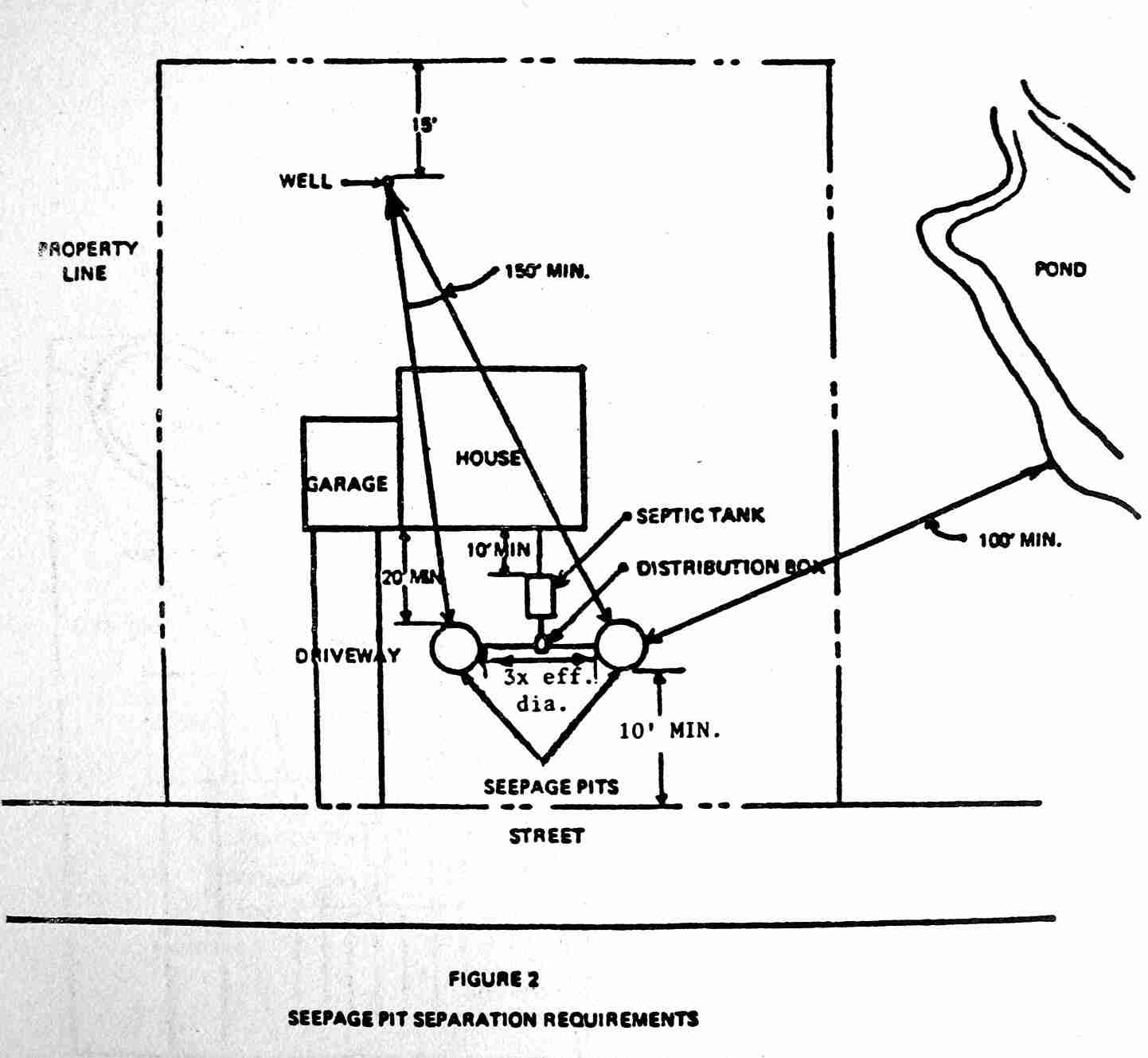
Common guidelines require at least 50' clearance distance between a well and a septic system tank or 150' between a well and a septic drainfield or leaching bed but you will see that different authorities may recommend different distances.
Local soil and rock conditions can make these "rules of thumb" unreliable. See "One and Two Family Dwelling Code, Section P-2510-Combined Seepage Pits and Disposal Fields," and Table P-2504, "Location of Sewage Disposal System." Other references are cited at the end of this table.
Article Contents
- SEPTIC CLEARANCE DISTANCES
- TABLE 1: SEPTIC COMPONENT DISTANCES: SEWER LINE, SEPTIC TANK, DRAINFIELD, SPECIAL CODES
- TABLE 2: SEPTIC CLEARANCE DISTANCES for HOLDING TANKS, LAGOONS, PONDS, GRAYWATER, OTHER CODES
- TABLE 3: SEPTIC CLEARANCE DISTANCES AFFECTED BY SOIL PROPERTIES & SEPTIC TYPE
- TABLE 4 CESSPOOL OR SEEPAGE PIT, RAISED / MOUND SEPTIC, SAND FILTER SEPTIC SPECIAL CLEARANCE DISTANCES
Table 1a Septic System Component Clearance Distances (in feet) from Wells, Buildings, & Other Site Features |
||||||||
Site Feature / Component (below) |
Sewer Line Distance |
Septic D-Box | Other Sanitary Code Specifications | General SEPTIC COMPONENT LOCATIONS |
||||
| MASSACHUSETTS TITLE 5 |
||||||||
Authority or Model Code --> |
General / TYPICAL6 |
General | General / TYPICAL |
General / TYPICAL |
FL Florida |
MA Title 5 Massachusetts |
NY New York |
More Information |
| Cistern | 25 | 25 | 25 | - | - | - | CISTERNS, WATER STORAGE | |
| Drainfield, Soakbed, Soil Absorption System above high groundwater (water table) or "depth to groundwater" | 4 - 5 ft. to > 10 ft. | - | - | 4 ft |
Allowable depth from bottom of soakbed trenches to seasonal high groundwater level Distance must be greater in coarse gravelly soil Distance may be as little as 5 ft. in fine soils passing the #200 sieve test. 8-1 Where fill is used, measure clearance distances from the edge or toe of the fill. |
|||
| Drainfield, Soil Absorption Sys. Minimum Area | 150 | - | - | - | - | |||
Drainfield, SAS Other |
20 | - | - | - | - | |||
| Dry gulch | 10 | 256.2 | - | |||||
| Embankment top or Cuts >= 2ft hgt |
20 | - | - | - | - | |||
| Intercept drain up-slope |
10 | - | - | - | - | |||
| Intercept drain down-slope |
26 | - | - | - | - | |||
| Lake, watercourse, stream, wetland [high water line] |
50 | 100 | 75 | 100 6.2 50 OH10 |
75 ft | 50 | - | Use the water-body high-water mark as its boundary. OH - Ohio code |
| Neighboring residence | 5 | 200 | - | - | - | - | ||
| Property Line | 5 - CA, FL, WA 10 - MO |
10 | 10 | 10 50 OH10 |
10 | 5 | CA-California NEIGHBORING SEPTIC SYSTEM PROBLEMS |
|
| Septic Tank cover soil backfill min" - max" |
6"-?" | - | 12"-24" | - | - | |||
| Sinkhole or drainage well | 25 12 | 300 OH10 | Reduced to 100 ft if a permanent vegetative buffer is maintained around the sinkhole or drainage well |
|||||
| Surficial Sinkhole Edges | 500 | - | - | - | - | |||
| Spring | 50 | 50 | 100 2006.1 .2 .4 |
- | - | - | - | |
| Stream or open ditch | 50 | 25 | 25 | For non-classified streams 11 | ||||
| Stream or open ditch | 50 | 50-100 | For classified streams | |||||
| Structures to Septic Tank / Leach field [Occupied] |
5 CA, FL 10 NY |
20 | 5 - general |
20 | 5 ft | 8 ft | - | CA - California, FL - Florida code MO - Missouri, NY - New York code |
| Structures to Sewer Line [Occupied] |
5 | 2 | ||||||
| Subsoil drain line | 10 | 10 | 25 | |||||
| Swimming Pool | 5 - FL | 5-FL 15-MO |
- | - | - | SEPTIC to POOL DISTANCE | ||
| Trees, large | 10 | - | ? | - | PLANTS & TREES OVER SEPTIC SYSTEMS | |||
| Water supply piping [Potable] |
10 | 10 | 25 | 10 | - | - | Closest part of wastewater treatment >= 10 ft. to any water piping | |
| Water Supply Piping under suction |
50 | 50 | 100 2006.1 .2 .4 |
- | - | - | - | |
Water well, Private, or well suction line |
25 (cast iron) or 50 other |
100 | 50 - MO 75 - FL |
10010 2006.1 .2 .4 |
75 | 100 | 50 |
Note that clearance distances from any septic system component such as septic effluent line tank to D-box and particularly including the drainfield, leachfield, soakaway, soakbed, or other synonyms for sewage effluent disposal will vary additionally in some jurisdictions according to 8-1 - The soil type. Rocky or sandy soils require greater setback distances from well to septic - The soil grade or slope and location of a water well that is down-slope from the septic system, Well separation distances from contaminant sources are increased by 50% whenever aquifer water enters the water well at less than 50 ft. below grade or additional measures to prevent contamination must be added. |
| Water well, Public or Drinking water surface water intake |
200 300 - MO |
1500 OH10 | 200 | - | 100 ? | |||
Water well |
50 | 100 OH10 | 50 | - | - | |||
...
Table 1b - Cesspool / Seepage Pit |
|||
| Site Feature / Component (below) | Sewer Line Distance |
NY Code |
More Information |
| Cesspools min. freeboard | 2ft | 6" | CESSPOOLS |
| Minimum volume | 500 | 1/2 day | - |
| Separation from Surface Water Supply | 150 | 100 | - |
| Separation from private well or suction line | 150 | 50 | - |
| Separation from private well, bad sample | 50-100 |
Notes to both of the tables above
- Distances for these onsite wastewater treatment components are given in feet to other site features unless otherwise stated
(a few distances may be given in inches).
Numbers in bold-face are those more-widely accepted or most inquired by our readers. - Variations: These septic information tables give typical required clearances for septic tank, soil absorption system (SAS), etc. but you will see that different authorities may recommend different distances.
- Small residential sewage treatment plant clearance distances are typically the same as those given for septic tanks.
- Conventional Designs:
These distances are for conventional onsite waste disposal systems which specify clearances presuming that effluent is being disposed of after minimal treatment such as is received by a septic tank or cesspool.
Advanced onsite wastewater treatment systems, such as those described by Jantrania and Gross (2006), permit substantial reduction in these clearances, depending on the level of treatment achieved. - Crossings
of subsoil drains, lakes, watercourses, streams, wetlands, and dry gulches may be permitted where pipelines are constructed of sufficient strength to contain flows under pressure, based on Colorado septic setbacks as cited below. - Drainfield clearance distances
are typically measured as from the site feature to the nearest edge of the drainfield area or trench, soak-pit, soakaway bed, mound, or raised bed, depending on septic design type. "Septic Setbacks - minimum separation distances, Park County CO, retrieved 2016/03/31, original source: http://www.parkco.us/DocumentCenter/Home/View/348
- 200 ft. The distance of 200 feet shall be maintained where fractured or jointed bedrock is within 7 ft. of the surface unless the results of a sub surface soil and geological investigation conducted by a professional geologist indicates that a lesser distance would not result in contamination of adjacent wells or aquifers. - [CO]
- Add 8 ft. additional distance for each 100 gallons per day design flow over 1000 gallons per day as specified in the table unless it can be demonstrated by a professional engineer or geologist that a mechanical or natural barrier will prevent contamination. [CO]
- Crossings may be permitted where pipelines are constructed of sufficient strength to contain flows under pressure. [CO]
- The minimum distance required between wells and leach fields in subdivisions and all other developments, platted after January 1, 1997, shall be 200 feet. [CO]
- Abbreviations:
SAS = Soil Absorption System - Leach Field etc.
UPC = Uniform Plumbing Code - Sources
of example septic setback & clearance distances, codes, citations, authorities- CO = Colorado septic setbacks, see PARK COUNTY, COLORADO ON-SITE WASTEWATER TREATMENT SYSTEM REGULATION [PDF] (2018) , Park County CO, retrieved 2016/03/31, original source: www.parkco.us/DocumentCenter/Home/View/348 - dead link in 2023, New Link - retrieved 2023/-08/28 original source: parkco.us/DocumentCenter/View/1628/Park-County-On-Site-Wastewater-Treatment-System-Regulations?bidId=
- EPA references above and for other EPA information see WATER WELL CONSTRUCTION & MAINTENANCE [Web article - Details to Help Avoid Well Water Contamination] US EPA
- Mass.Title5 = Massachusetts Title 5 Septic Code
- FL = Florida septic component clearances table, also see Florida 64E-6.005 Location and Installation. (2013)
- General or "typical" septic component clearance distances are based on the CO information source where available
- MA = Massachusetts septic component clearances table. See also the NY table Appendix 75 given below.
- MO = Missouri SEPTIC COMPONENT CLEARANCE DISTANCES [PDF] [Excerpted from the document cited just below] - Missouri distances and septic lagoon system clearances to other site features
University of Missouri extension.
For Missouri, Table 1 in this document shows the minimum setback distances that must be observed for septic tanks and absorption fields.
MO - Schulthesis, Robert A., Missouri SEPTIC TANK & ABSORPTION FIELD HOMEOWNERS GUIDE [PDF] (2001) retrieved 2022/04/25 original source: extension.missouri.edu/publications/eq401-dead link; valid updated link 2023/08/28: extension.missouri.edu/publications/eq401
- NY = New York State septic component clearances table New York State Department of Health, APPENDIX 75-A WASTEWATER TREATMENT STANDARDS - INDIVIDUAL HOUSEHOLD SYSTEMS , [PDF] (2010) New York State Department of Health, 3 February 2010, retrieved 3/1/2010, original source: https://www.health.ny.gov/regulations/nycrr/title_10/part_75/appendix_75-a.htm
New York State APPENDIX 75-A WASTEWATER TREATMENT STANDARDS - RESIDENTIAL ONSITE SYSTEMS, [PDF] (2016) retrieved 2017/12/09, original source: https://www.health.ny.gov/environmental/water/drinking/docs/appendix_75a.pdf
Unofficial compliation of codes, rules and regulations of the state of New York Title 10. Department of Health. Chapter ii. Part 75. Standards for Individual onsite water supply and individual onsite wastewater treatment systems. Appendix 75-a. - US HUD -1 Distance from source of pollution - proposed construction, US Dept. of Housing and Urban Development, FHA, Local acceptable standard No. 3, June 18, 1992, Ref. Hud Handbook 4910.1 Chg 1, Appendix K, Pg K-27
- OH - Ohio Septic Code 3701-29-20 SEPTAGE & SEWAGE MANAGEMENT, retrieved 2017/10/20 original source: http://www.odh.ohio.gov/ -/media/ODH/ASSETS/ Files/rules/final/3701 -20-TO--29/3701-29/ 2015-0101/3701-29-20-N.pdf?la=en
- WA = WASHINGTON STATE SEPTIC SYSTEM CLEARANCE CODE [PDF] WAC 246-272A-0210 - the Septic System Location Code for Washington State
For a copy of the complete Washington State septic code see:
WASHINGTON STATE SEPTIC CODE (Complete) [PDF] (2010) - retrieved 2023/08/28, original source: h pp.leg.wa.gov/wac/default.aspx?cite=246-272A - A classified stream
is any stream that maintains permanent flow or permanent pools during drought periods and supports aquatic life.
Septic tanks and soil absorption systems should never be located in the drainage area of a sinkhole.
Readers will find more details about septic system clearances and issues
at NEIGHBORING SEPTIC SYSTEM PROBLEMS.
Below we provide additional septic system component clearance distances when advanced septic system designs or other special components are in use.
Table 2a Advanced or Special Septic System Component Clearance Distances (in feet) |
||||||
Site Feature / Component |
Septic Holding Tank / Vault | Lagoon Distance LAGOON SEPTIC |
Lined Evap/Trans or Lined Pond |
Advanced Treatment or Greywater System |
Other Sanitary Code Specifications |
General SEPTIC COMPONENT LOCATIONS |
Authority or Model Code |
General / TYPICAL1 |
MO Missouri |
CO Colorado |
CO Colorado |
UPC Uniform Plumbing Code |
More Information |
| Cistern | 10 | 25 ft | 25 | 25 | - | CISTERNS, WATER STORAGE |
| Drainfield, Soakbed, Soil Absorption System above high groundwater (water table) |
- | - | SEPTIC DRAINFIELD SHAPE | |||
| Drainfield, Soil Absorption Sys. Minimum Area | - | 150 | - | |||
| Drainfield, SAS Other (Except for future repair area) |
20 ft | - | - | |||
| Dry gulch | 10 | 10 | 256.2 | |||
| Embankment top or Cuts >= 2ft hgt |
20 ft | - | - | |||
| Intercept drain up-slope |
10 ft | - | - | |||
| Intercept drain down-slope |
25 ft | - | - | |||
| Lake, watercourse, stream, wetland [high water line] |
50 | 25 ft | 50 | 506.2 | - | |
| Neighboring residence | 200 ft | - | - | |||
| Property Line | 75 | 10 | 10 | NEIGHBORING SEPTIC SYSTEM PROBLEMS | ||
| Septic Tank cover soil backfill min" - max" |
- | - | - | |||
| Sinkhole | - MO | Nowhere in the drainage area of a sinkhole | ||||
| Surficial Sinkhole Edges | 500 | - | - | |||
| Spring | 50 | 100 | - | - | ||
| Structures to Septic Tank / Leach field [Occupied] |
100 ft | 15 | 20 | 10 ft | - | |
| Structures to Sewer Line [Occupied] |
||||||
| Subsoil drain line | 10 | 10 | 25 | |||
| Swimming Pool | 100 | - | SEPTIC to POOL DISTANCE | |||
| Trees, large | - | - | PLANTS & TREES OVER SEPTIC SYSTEMS | |||
| Water supply piping [Potable] |
10 | 10 | 10 | 25 | - | - |
| Water Supply Piping under suction |
50 | 100 | - | - | ||
Water well, Private |
50 | - | 60 | 1006.2 | - | WELL LOCATION, HOW TO FIND |
| Water well, Public | 300 | - | ||||
Water well |
- | - | ||||
Notes to the table above
- See also WETLAND SEPTIC SYSTEMS
Table 2b - Special Cesspool or Seepage Pit Clearances and Specifications |
Feet | Notes |
| Cesspools min. freeboard | 2 | CESSPOOLS |
| Minimum volume | - | |
| Separation from Surface Water Supply | 150 | - |
| Separation from private well | 150 | - |
| Separation from private well, bad sample |
Notes to the Table Above
- Distances for these onsite wastewater treatment components are given in feet to other site features unless otherwise stated (a few distances may be given in inches).
- These septic information tables give typical required clearances for septic tank, soil absorption system (SAS), etc. but you will see that different authorities may recommend different distances.
- Small residential sewage treatment plant clearance distances are typically the same as those given for septic tanks.
- These distances are for conventional onsite waste disposal systems which specify clearances presuming that effluent is being disposed of after minimal treatment such as is received by a septic tank or cesspool. Advanced onsite wastewater treatment systems, such as those described by Jantrania and Gross (2006), permit substantial reduction in these clearances, depending on the level of treatment achieved.
- Crossings
of subsoil drains, lakes, watercourses, streams, wetlands, and dry gulches may be permitted where pipelines are constructed of sufficient strength to contain flows under pressure, based on Colorado septic setbacks as cited below. - Drainfield clearance distances
are typically measured as from the site feature to the nearest edge of the drainfield area or trench, soak-pit, soakaway bed, mound, or raised bed, depending on septic design type. "Septic Setbacks - minimum separation distances, Park County CO, retrieved 2016/03/31, original source: http://www.parkco.us/DocumentCenter/Home/View/348- 200 ft. The distance of 200 feet shall be maintained where fractured or jointed bedrock is within 7 ft. of the surface unless the results of a sub surface soil and geological investigation conducted by a professional geologist indicates that a lesser distance would not result in contamination of adjacent wells or aquifers. - [CO]
- Add 8 ft. additional distance for each 100 gallons per day design flow over 1000 gallons per day as specified in the table unless it can be demonstrated by a professional engineer or geologist that a mechanical or natural barrier will prevent contamination. [CO]
- Crossings may be permitted where pipelines are constructed of sufficient strength to contain flows under pressure. [CO]
- The minimum distance required between wells and leach fields in subdivisions and all other developments, platted after January 1, 1997, shall be 200 feet. [CO]
- Sources of example septic setback & clearance distances, codes, citations, authorities
- CA = California septic system codes including this model: CA GLENN COUNTY CALIFORNIA SEWAGE DISPOSAL CODE [PDF] - this is a 2.3MB PDF file retrieved 2017/05/08, original source https://www.countyofglenn.net/sites/default/files/Environmental_Health/SewageDisposalRegulations.pdf
[1] City of Calabasas California, ONSITE WASTEWSATER TREATMENT Ordinance & CODES 2009-262
[2] City of Calabasas California, SEPTIC & ONSITE WASTEWATER TREATMENT INSPECTION GUIDE 2009- 2010
- CO = Colorado septic setbacks, see "Septic Setbacks - minimum separation distances, Park County CO, retrieved 2016/03/31, original source: http://www.parkco.us/DocumentCenter/Home/View/348
- EPA references above and for other EPA information see EPA WATER WELL CONSTRUCTION & MAINTENANCE [Details to Help Avoid Well Water Contamination] US EPA
- Mass.Title5 = Massachusetts Title 5 Septic Code
- FL = Florida septic component clearances table, also see Florida 64E-6.005 Location and Installation. (2013)
- General or "typical" septic component clearance distances are based on the CO information source where available
- MA = Massachusetts septic component clearances table
- MO = Missouri septic component clearances table - Missouri distances and septic lagoon system clearances to other site features University of Missouri extension lagoon web page muextension.missouri.edu/explore/envqual/wq0402.htm
- NY = New York State septic component clearances table
New York State Department of Health, NY APPENDIX 75-A WASTEWATER TREATMENT STANDARDS - INDIVIDUAL HOUSEHOLD SYSTEMS [PDF] New York State Department of Health, 3 February 2010, retrieved 3/1/2010, original source: https://www.health.ny.gov/regulations/nycrr/title_10/part_75/appendix_75-a.htm
See additional notes about New York Septic System clearance distances in NY TABLE 4 CESSPOOL OR SEEPAGE PIT, RAISED / MOUND SEPTIC, SAND FILTER SEPTIC SPECIAL CLEARANCE DISTANCES - OH = OHIO SEPTIC CODE [PDF] (2015) Chapter 3701-29 Sewage Treatment System Rules, OH Department of Health
- TX = TEXAS OSSF SETBACK DISTANCES [Web article & Table] and also are given in this original source
TEXAS OSSF SEPARATION DISTANCES Figure: 30 TAC §285.91(10) [PDF] retrieved 2019/11/10 original source: h exreg.sos.state.tx.us/fids/201206290-3.pdf - US HUD -1 Distance from source of pollution - proposed construction, US Dept. of Housing and Urban Development, FHA, Local acceptable standard No. 3, June 18, 1992, Ref. Hud Handbook 4910.1 Chg 1, Appendix K, Pg K-27
- NC NORTH CAROLINA SEPTIC SETBACKS & CODE [PDF]
retrieved 2018/03/17, original source: alamance-nc.com/envhealth/wp-content/uploads/sites/9/2013/10/SepticRulesCompleteEff10012011.pdf CHAPTER 18 - ENVIRONMENTAL HEALTH SUBCHAPTER 18A - SANITATION SECTION .1900 - SEWAGE TREATMENT AND DISPOSAL SYSTEMS
In this document see 15A NCAC 18A .1950 LOCATION OF SANITARY SEWAGE SYSTEMS
NC CONVENTIONAL SEPTIC SYSTEMS in NORTH CAROLINA [PDF] Rule .1955 15A NCAC 18A .1900 Laws and Rules for Sewage Treatment and Disposal Systems, North Carolina Department of Public Health, retrieved 2018/03/17, original source: ehs.ncpublichealth.com/oet/docs/cit/oswpmod/oswt/C-ComponentsofConventionalSystem.pdf
NOTICE: this is a presentation and does not include actual North Carolina septic code specifications, setbacks, distances.
Also see https://content.ces.ncsu.edu/septic-systems-and-their-maintenance that in turn cites
Mancl, K.M. 1984. Journal of Environmental Engineering, Vol. 110(1):283–285 and omits North Carolina septic code details.
The below listed minimum separation distances as stipulated in North Carolina General Statutes 130A-335 (e), (f), are the most commonly used in planning for a home or small business.
North Carolina Septic Tank Clearance distances:
- septic tanks cannot be placed where there may be flooding every 10 years or less, unless the septic tank is watertight, anchored, and storm-water-entry-proof
- at least 5 ft. from any building foundation
- at least 10 feet away from property lines, water lines, and the up-slope portion of drainage systems
- at least 15 feet between septic tanks and basements, embankments, drainage system side-slopes, and swimming pools
- at least 25 ft. from property line
- at least 25 feet setback for groundwater lowering ditches and devices, and the down-slope of drainage systems
- at least 50 feet from any lake or pond
- at least 100 feet away from private or public water supplies, streams, and reservoir
- CA = California septic system codes including this model: CA GLENN COUNTY CALIFORNIA SEWAGE DISPOSAL CODE [PDF] - this is a 2.3MB PDF file retrieved 2017/05/08, original source https://www.countyofglenn.net/sites/default/files/Environmental_Health/SewageDisposalRegulations.pdf
Readers will find more details about septic system clearances and issues at NEIGHBORING SEPTIC SYSTEM PROBLEMS.
Table 3 Septic Component Clearance Distances to a Water Well According to Soil Type & Septic System Type |
|||||
| Soil Conditions 1 | Depth from SAS Bottom to Groundwater Seasonal High Level 2 | Septic Filter Trench Type & Distances to Water Well in Feet |
Comments | ||
| TYPE I Gravity-fed @ Normal Loading 3 |
TYPE II Pressure-Dosed @ Normal Loading 3 |
TYPE III Pressure-Dosed @ Low-Loading 4 | |||
| Very coarse gravelly soil < 5% Fines5 | 4 to 5 ft. | Not Allowed | 200 ft. | 150 ft. | Soil properties in other geographic locations and in other sewage code jurisdictions will differ and may have different allowable septic system clearance distances than our examples given here. |
| > 5 ft to 10 ft | 200 ft. | 150 ft. | 100 ft. | ||
| > 10 ft. | 150 ft. | 100 ft. | 100 ft. | ||
| Coarse sandy soil, 5 to 15% Fines | 4 to 5 ft. | 200 ft. | 150 ft. | 100 ft. | |
| > 5 ft to 10 ft | 150 ft. | 100 ft. | 100 ft. | ||
| > 10 ft. | 100 ft. | 100 ft. | 100 ft. | ||
Notes to the Table Above & Sources of Example Septic System Codes & Specifications
- Here "soil" is defined as the "predominant" soil between the bottom of the trench (rock bed) and the uppermost level reached by seasonal high-water in the soils below.
Also, the soil must be both well-graded and having at least 40% of the soil passing a #4 sieve test (5mm sieve test). - These distances are from bottom of the soil absorption system trench to the top of seasonal high groundwater table (see also Massachusetts Title 5 Septic Code). Any septic effluent disposal or absorption field that is seasonally flooded cannot work and cannot meet these specifications.
- "Normal septic system loading" rate is defined as a soil application rate of effluent at 1.0 gallons per day per linear foot of trench along the bottom area of the trench.
- "Low septic system loading" rate is defined as a soil application rate of sewage effluent at 0.5 gallons per day per linear foot of trench along the bottom area of the trench.
- Definition of soil fines: the portion of soil particles whose size is smaller or "finer" than particles passing through a No. 200 sieve (0.075 mm) .
Note that for some purposes and in some jurisdictions a second definition of soil fines uses a No. 400 sieve (0.038mm), for example in discussions of soil liquefaction resistance - not a common factor in septic system design.
- CA = California septic system codes including this model: CA GLENN COUNTY CALIFORNIA SEWAGE DISPOSAL CODE [PDF] - 2.3MB PDF retrieved 2017/05/08, original source https://www.countyofglenn.net/sites/default/files/Environmental_Health/SewageDisposalRegulations.pdf
- MA MASSACHUSETTS TITLE 5 SEPTIC LAW [Web article]
Table 4 Cesspool or Seepage Pit, Raised / Mound Septic, Sand Filter Septic Special Clearance Distances |
|||||
| Clearance Distances For |
Depth of System Bottom to Groundwater Seasonal High Level (1) |
Well or Suction Line (6)(8) |
Stream Watercourse (3) or Lake |
Dwelling | Property Line |
| Seepage Pit | 3 ft. | 150 ft. | 100 ft. | 20 ft. | 10 ft. |
| Raised or Mound Septic | 100 | 100 | 20 | 10 | |
| Intermittent Sand Filter Septic | 100 | 100 | 20 | 10 | |
| Non-Waterborne System, Offsite Discharge | 50 | 50 | 20 | 10 | |
| Non-Waterborne System, Onsite Discharge | 100 | 50 | 20 | 10 | |
Notes to the Table Above & Sources of Example Septic System Codes & Specifications
- NY = New York State septic component clearances table, Table 2, "Separation Distances from Wastewater System Components (in Feet)"
New York State Department of Health, NY APPENDIX 75-A WASTEWATER TREATMENT STANDARDS - INDIVIDUAL HOUSEHOLD SYSTEMS [PDF] New York State Department of Health, 3 February 2010, retrieved 3/1/2010, original source: https://www.health.ny.gov/regulations/nycrr/title_10/part_75/appendix_75-a.htm - When wastewater treatment systems are located upgrade and in the direct path of surface water drainage to a well, the closest part of the treatment system shall be at least 200 feet away from the well.
- Mean high water mark.
- For all systems involving the placement of fill material, separation distances are measured from the toe of the slope of the fill.
- Separation distances shall also be measured from the edge of the designated additional usable area as described in Section 75-A.4 (a)(5).
- The closest part of the wastewater treatment system shall be located at least 10 feet from any water service line (e.g. public water supply main, public water service line or residential well water service line).
- When sand filters are designed to be watertight and collect all effluent, the separation distance can be reduced to 50 feet.
- The listed water well separation distances from contaminant sources shall be increased by 50% whenever aquifer
water enters the water well at less than 50 feet below grade.
If a 50% increase cannot be achieved, then the greatest possible increase in separation distance shall be provided with such additional measures as needed to prevent contamination.
Reader Comments, Questions & Answers About The Article Above
Below you will find questions and answers previously posted on this page at its page bottom reader comment box.
Reader Q&A - also see RECOMMENDED ARTICLES & FAQs
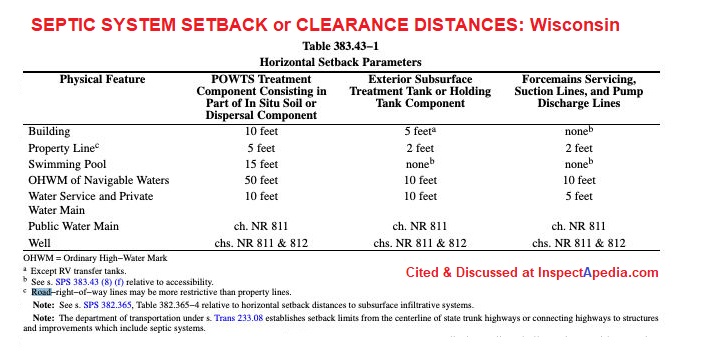
On 2022-08-21 by InspectApedia-911 (mod) - Wisconsin septic codes
@Jackie,
See more on Wisconsin septic codes at
https://inspectapedia.com/septic/Septic_Design_Regulations_U.S.A.php#WI
On 2022-08-21 by InspectApedia-911 (mod)
@Jackie,
Wisconsin septic code does not explicitly discuss clearance distance from a driveway, and interpretations of the Wisconsin septic code simply state:
Avoid compacting the soil over the drainfield area. Compaction may decrease the
soil loading rate causing the waste water to pond on the ground surface. Do not
drive vehicles or build structures over either the septic tank or drainfield. These
activities may cause cracks in the piping or tanks. - WI Wood County Private Sewage System Ordinance #702
Here is a copy of the WISCONSIN SEPTIC CODE [PDF]
https://inspectapedia.com/septic/Wisconsin-Septic-Code.pdf
A minimum of 10 feet separation between edge of a driveway and nearest edge of a septic drainfield is typical, but that's by no means the whole story.
You need also to
- be sure that surface runoff, including from a driveway, is directed away from the drainfield
- be sure that no vehicles or other heavy equipment will be tempted to drive on or over the drainfield
and of course no septic drainfield trench can extend under a driveway or other compacted area
On 2022-08-20 by Jackie
Does anyone know how far a drain field should be away from a driveway in Wisconsin?
On 2022-08-18 by InspectApedia-911 (mod)
@Kathy Barnett,
With no specific details I can't say, but indeed the local building inspector is the final legal Authority.
If the pond is sewage contaminated and is not intended to be part of the septic system, that could be a public health hazard.
On 2022-08-17 by Kathy Barnett
fvie septic fielsd were put in years ago in front of my house by our mobile home park...there is a large pond inf ront of them is this allowed today becasue tiw as put in so many years ago???
On 2022-07-29 by InspectApedia-911 (mod) - how many septic tanks and how far apart
@Pam,
You won't find a code specifying a limit on the NUMBER of septic tanks, per-se; rather, your septic design engineer will specify an appropriate septic tank SIZE in capacity, depending on the anticipated daily wastewater flow volume.
Keep in mind that the septic tank size is rarely a limiting factor in designing an onsite waste disposal system; rather it's the handling of the septic effluent that leaves the tank for dispersal into the soil (and by evaporation).
That's a function, too, of daily wastewater volume, set further by the soil properties - the soil percolation rate.
So you'll need a soil perc test as part of your system design.
The clearance distances for septic systems from various site features are given above on this page.
On 2022-07-29 by Pam
Can we have how many septic tanks and how far apart on our land in Garland county AR. We will hook up to city water How many feet apart?.
On 2022-06-21 by InspectApedia (mod) - grandfathered septic system replacement
@Logan Jones,
I am sorry to be the bearer of bad news, but in most communities, where there has been an essentially unacceptable septic design previously installed, when replacement time comes the local authorities usually require the property owner to find a different, and more-workable solution.
Visit your local health or plumbing authority to find out what alternative septic system designs they will accept, then hire a local septic engineer to propose a workable and acceptable system.
Keep me posted.
On 2022-06-21 by Logan Jones
If you have a property with a grandfathered septic system in Florida how do you proceed in replacing it when you are too close to a body of water? If you need a minimum of 75 feet, but dont have 75 feet distance, are you just not able to live there or replace the septic? Please advise asap!
Thank you!
On 2022-06-07 by InspectApedia-911 (mod)
@Alice A Smith,
Septic tank distance to a structure isn't given uniformly across jurisdictions (you don't specify country, city, province, state &c.) but is typically 10 ft.
A holding tank is just that: it "holds" or "stores" wastewater. It does not let anything out. The holding tank has to be emptied by a septic pumping contractor.
Holding tanks are prohibited (illegal) in nearly all jurisdictions except by special permit, such as perhaps a restaurant built along the edge of a river or stream.
See details
at HOLDING TANK SEPTIC SYSTEMS
On 2022-06-06 by Alice A Smith
How close can you build a garage to a holding tank. And does a holding tank have a septic field in most cases or no ?
On 2022-04-13 by Inspectapedia Com Moderator (mod) - installing an above ground pool
@Denise ryan,
Closest point of pool or any pool equipment to the closest bottom edge of the septic mound.
But there's more to consider. Be sure that the contractor building the pool doesn't drive equipment over the mound as that will damage it.
And be sure that any swimming pool discharge, such as when you are backwashing the filter or emptying the pool, is directed away from the mound.
On 2022-04-13 by Denise ryan
We Are installing an above ground pool. We want to measure the distance from the mound to the pool to make sure we’re in compliance. What are the two points from which we measure
On 2022-02-16 by Inspectapedia Com Moderator (mod) - potable water supply line should be 10-25 feet from a septic drain field
@Raquel B,
More likely the concern is that a leak in supply piping combined with a temporary loss of pressure or even exposure during its installation risks contamination of the water supply, poisoning or sickening building occupants.
On 2022-02-16 by Raquel B
Why do they say that a potable water supply line should be 10-25 feet from a septic drain field? Is is because the water pipe may break and flood the drain field?
How far does my neighbor's septic need to be away from my residential water well. I live in Northern California Glenn County
By (mod) re: septic setbacks from well in Glenn County California USA - Glenn County Sewage Disposal Code
Jimmy
Check the well to property line as well as well to septic system clearance distances given in the table given
at CLEARANCE DISTANCES, SEPTIC SYSTEM
Here are some excerpts from the Glenn County California sewage disposal code
20.06.010 Site Requirements
A. Sewage Disposal System Location: Locate the surface grade of all sewage disposal systems at a point lower than the surface grade of any water well, spring or reservoir on the same or adjoining property. When this is not possible, the site shall be located so that surface water drainage from the sewage disposal system is not directed toward a well or reservoir.
The sewage disposal system shall be located with a minimum distance between various elements as indicated in Table T-1. Soil absorption trenches in compacted areas, such as parking lots and driveways, are prohibited.
Surface water shall be diverted away from any sewage disposal system. All areas disturbed during the construction of the sewage disposal system shall be stabilized and revegetated prior to the first wet weather season after installation.
20.06.028 Filter Trench System
A. General:
The filter trench system is intended for use in coarse textured alluvial soils (leaching class 1, at least 40% of the soil passes the #4 sieve) with very rapid permeability where the water table remains at least 5 feet underground.
B. Siting Criteria:
All siting criteria for standard soil absorption systems in Division III of these regulations shall apply to Filter Trench systems except as modified by the requirements shown in Table T-9 pertaining to soil type, depth to groundwater, and
water well setback.
Table T9 in your regulations and closely replicated at TABLE 3: SEPTIC CLEARANCE DISTANCES AFFECTED BY SOIL PROPERTIES & SEPTIC TYPE requires that the absorption field setback must be between 100 ft and 200 ft depending on the soil type at the properties involved.
Here is a complete copy of the GLENN COUNTY CALIFORNIA SEWAGE DISPOSAL CODE [PDF] - this is a 2.3MB PDF file.
By Jimmy
How far does my neighbor's septic need to be away from my residential water well. I live in Northern California Glenn County - On 2017-05-08
On 2021-12-27 by Inspectapedia Com Moderator - septic sewage leaks into chicken & turkey pens
@Debra A Waugh,
Unfortunately that sounds to me as if the septic drain field has failed so sewage and effluent back up and leak, perhaps right at your septic tank.
Watch out: keep in mind that the problem is not just the smell, but it's a health hazard for you and for your animals.
On 2021-12-27 by Debra A Waugh
The house at 127 Majo ln , is have proble with the sepic tank there water and nasty water is running down in to my chicken pen dam mash from the chicken down to my trukey
i cant get down to the second pen there some much water you cant feed them frist pen you go inside it full of water and smell just like septic tank dewayne
everidge he live there before and we have problem out him and ever since i got chicken trukey i raise since they real little i live right behind the house he live in there going have be something done
On 2021-12-22 by Inspectapedia Com Moderator - private well distance to mound: measure from toe of the mound-fill
@Bigzasty,
Clearance distances are typically measured from the site feature (the private well in your case) to the nearest edge of the toe or edge of fill that was used to construct the mound or raised-bed septic drainfield area or trench, soak-pit, soakaway bed, MOUND, or raised bed.
What that clearance distance will need to be are defined in the tables above on this page and depend on various factors such soil type and septic system type.
On 2021-12-22 by Bigzasty@yahoo.com
The setback of a mound from a private well is measured from _______ of the mound? Is it the highest point can't seem to find a answer
On 2021-12-01 by Inspectapedia Com Moderator - maximum & minimum septic tank distances to house
@Reader
Your septic clearance question is the exact topic in the article above. See the chart listing specific distances in that article.
but Watch out:
1. your local septic inspector is the final legal authority on code questions
2. you don't give your country/city location; septic clearance laws vary by country, state, province, etc.
Usually the max distance is simply a practical one: consider that if your waste line has to slope 1/8" to 1/4" per foot and your septic tank is far away it would end up too deep unless you go to a force-main pump system.
As for minimum tank distance to buildings: see the tables above
On 2021-12-01 by Reader
Help! Inspecter on my case. Existing Certified. Inspected septic. What's the max and minimum clearance between tank and home?
On 2021-10-07 by Inspectapedia Com Moderator - septic distances to pond or power line?
@art beauchamo,
If you could share a bit more information that would be helpful.
What type of pond are you talking about? As part of your septic system? Or related to a well?
Adding:
In the septic clearance distances table above see the distances given for "Lake, watercourse, stream, wetland"
and GUESSING that by power line you refer to a buried or overhead electrical utility company power distribution line, that's got to be off of your property or crossing it by a right-of-way or easement, for which your septic component distances are given above in the table at "property line"
On 2021-10-06 by art beauchamo
setoff required for pond and power line
On 2021-10-05 by Inspectapedia Com Moderator - aerobic sprinkler distance to property line
@Tracy Bice,
Whenever there seems to be a problem that begins with a neighbor's property, we advise a prompt, courteous inquiry with the neighbor involved.
Calmly and politely explain your concern, invite their assistance, give the neighbor an opportunity to respond. Usually that approach will lead to satisfaction for everyone.
If you have the bad luck to encounter a neighbor who is unable or unwilling to assure that their septic system is not contaminating a neighbor, other steps may be necessary.
The second step of involving the health department to ask for their assistance may be necessary. They are the final authority with regard to code specifications and setback requirements.
On 2021-10-05 by Tracy Bice
Hi there! I am wondering how close your neighbors septic sprinkler needs to be from our property line.
My neighbors has just moved his sprinklers very close to our yard with our dogs, etc. Water just comes right over to our property.
Could you please advise on if there are any guidelines on this and what I should do.
On 2021-01-18 by (mod) - How far should a pond be from septic trench line?
Brooke
In Table 1a above on this page please see the entry titled:
Lake, watercourse, stream, wetland
[high water line]
On 2021-01-17 by Brooke
How far should a pond be from septic trench line?
On 2020-12-13 - by (mod) - septic drainfield distance to septic tank soils tank
Kelly
There is no fixed distance involved and the location as well as distance world pretty much always be site dependent. However if you found any component of the septic system your plumber can insert a sewer line camera or other grain locating equipment in order to follow the lines to the septic tank or distribution box
On 2020-12-13 by kelly sims
i found the drain tank or leach field for water what would the distance be to the soils tank
On 2020-11-28 - by (mod) - septic distance to D-box varies
The distance from the tank to the D boxes site dependent but typically is 10 to 75 feet
On 2020-11-28 by Jim
Normal distance from septic to D box in NK RI
On 2020-09-11 - by (mod) - neighbor's septic system distance to property-line
Septic to property line distance requirements vary by country state or Province and are given as examples in tables above on this page. 10 feet or 3M is a common example.
On 2020-09-11 by john futerko
How far from my propertyline can a neighbor place his leach field. I also have a well on my property.
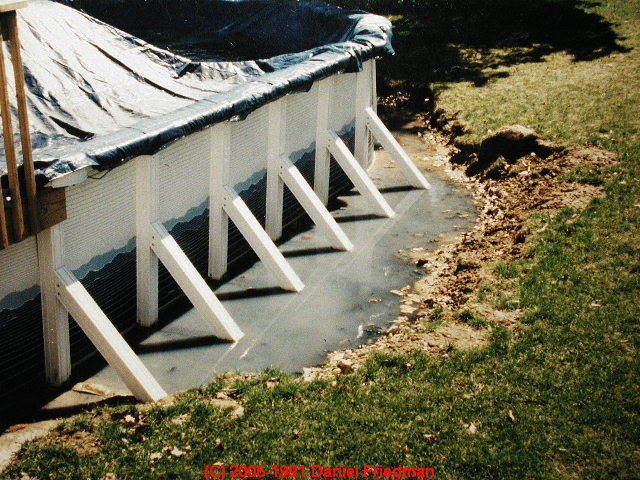
On 2020-08-20 - by (mod) - septic distance to swimming pool
Jean
The table above refers readers to SEPTIC to POOL DISTANCE
On 2020-08-18 by Jean Eckhardt
How far away from the Private Sewage (Septic) system, is required for Inground Swimming Pool
On 2020-07-21 by Carol
,
Yikes--not sure we have that much space. But yes, that's the biggest concern. So, thanks.
On 2020-07-19 - by (mod) - leach field distance to cemetery
Carol
Thank you for an interesting question.
I doubt that there is a single "right answer" to separation distance of septic drainfields or leachfields and cemeteries as there are quite a few variables such as terrain shape, soil properties, cemetery activity.
What problem are we avoiding: the obvious one at first glance might simply be avoiding any risk of sewage effluent showing up in an excavation for a grave. To be totally safe you'd use the same setbacks as for a well or water source. Typically that's 100 ft. or more.
On 2020-07-19 by Carol
Any recommendations on appropriate distance for a leachfield from an already established cemetery on the same property?
On 2020-07-20 - by (mod) - commercial septic tank distance from creek
Nick
The usual standard would be 100 feet away from the body of water
On 2020-07-18 by nick
dose a septic tank have to be 50 ft. away form a creek on commercial land?
On 2020-06-14 - by (mod) - distance from garage to leachfield
John
The clearance distance between your garage walls and drive to it need to be (typically) 5 ft to 20 ft. depending on local codes where you live. Most states in the U.S. want 20 ft. but some permit much closer clearances.
Watch out: even if you meet the garage setback to septic drainfield, be sure that your builder, in the course of putting up the garage, doesn't drive equipment over the leachfield or it may be damaged or ruined.
On 2020-06-12 by john Herod
I want to build a garage above ground. How far does it need to be from the leech area of septic system?
On 2020-05-21 - by (mod) - Septic tank clearance distances in Connecticut
Anon:
Connecticut does not specify septic distance to a deck but does specify 10 ft. to building served - see Table 1 in the Technical Standards we provide in the Connecticut Septic Regulations link I'll give below
we give download copies of septic regulations at SEPTIC & SEWAGE TREATMENT CODES & REFERENCES
and for the United States, including Connecticut,
see
SEPTIC & DESIGN CODES & SPECIFICATIONS U.S.A.
In that article you'll find CT for Connecticut Septic Regulations
Take care that a deck post doesn't punch through septic or sewer piping and take care that there remains safe access to the septic tank for periodic pumping and inspection.
On 2020-05-20 by Anonymous
distance from septic tank to deck in ct.?
On 2020-05-21 - by (mod) - well distance to septic for VA Loan?
BillieAllen:
In the U.S. the VA has not specified setbacks between well and septic; but the property certainly should meet your local and state requirements.
Those vary a bit depending on the property location, but 100 feet separation between well and septic is reasonable.
On 2020-05-20 by billieallen
How far does the well have to be from the septic system for a VA loan qualification.
On 2020-04-09 - by (mod) - ohio septic code details vs pole barn construction
Robert:
Ten feet
but
Watch out: take care that you don't ruin your drainfield or leachfield by
- driving over it during pole barn construction or use or access when the barn is complete
- driving a pole barn pole or building component into soil so as to damage the drainfield
(3) A STS shall maintain the following minimum horizontal isolation distances:
(a) All components of a STS shall be at least ten feet from any utility service line, roadway or road surface, driveway or other hardscape, property line or right-of-way boundary, properly sealed well, any building or other structure, areas with recorded easements, intermittent streams, swales, geothermal horizontal closed loop systems, irrigation lines and GWRS.
To assure that you're not in violation of the Ohio septic code, contact your local health district for specific information on STS permitting
You can contact your Lucas County Ohio health department directly at
635 N. Erie St.
Toledo, OH 43604
419.213.4100
Website: https://www.lucascountyhealth.com/sewage-treatment/
You can see the current OHIO SEPTIC CODE [PDF]
and a host of related septic guidelines and regulations for Ohio at
OHIO SEPTIC REGULATIONS
On 2020-04-09 by Robert O.
How close can I build a pole barn to my leach field in Lucas County Ohio?
On 2020-03-31 - by (mod) - building distance to septic field
Paul please take a look at the septic system clearance distances in the table above - that includes building distances and is more thorough than a generic or off-the-cuff reply here.
Don't hesitate to ask if any of that data is unclear.
Thanks
On 2020-03-31 by Paul
How far away from from a building does a septic field have to be
On 2020-03-22 - by (mod) - separation distance of septic tank from a lake or stream
50 to 100 ft - in our table see details at the entry line:Lake, watercourse, stream, wetland [high water line]
- in the article above
On 2020-03-22 by Scott
How far does a septic tank have to be from a lake or stream
On 2020-03-08 by (mod) - distance of buried propane tank to drainfield
Mark
I don't think we'll find a septic nor propane tank code that addresses the distance relationships between those two systems, but it would make sense to
1. be dead sure that nobody drives heavy equipment over your drainfield
2. keep excavation for the buried propane tank far enough away from the drainfield that you won't disturb the drainfield by the excavation, installation, soil piles, backfilling, trenching for buried gas lines, etc.
On 2020-03-06 by Mark Berger
How close can an in-ground 250 gal propane tank be buried to a septic drain field?
On 2020-05-03 - by (mod) - Mosaic Phosphate Mining Company has an EFFLUENT pipe hidden in field 130ft from our home
Rose
I can understand why you would be concerned. What does your local code official require?
Depending on the country and state or Province where you live you will have a Department of Environmental Protection or Department of Environmental Conservation.
Because regulations vary by country and Province or state you want to start by identifying where you are and asking your DEC or DEP what regulations pertain.
On 2020-05-03 by Rose
The Mosaic Phosphate Mine has a hidden Effluent Pipe 127 ft from our well .
Its a pipe carrying used mining water .
Had a relief valve. Is that allowed by law ?
On 2020-02-26 - by (mod) - Phosphate Mining company allowed to put an Effluent Pipe 150 from residence?
Thank you for the interesting question about phosphate Mining and clearance distance to water wells. I haven't seen a specific standard for well clearance distances that addresses specific materials being mined. I would expect that the authorities approving a mining operation would consider more than a standard distance. They would also need to consider the ultimate destination or flow direction of mining wastes.
We don't know what that effluent pipe is actually carrying from just from the text in your message.
You certainly can bring that question to your local Building Code Compliance inspectors.
I think the concern would be not be the location of the pipe as much as its quality and Assurance against leakage and also of course there's the question of what actually is being carried and to what destination and is that destination legal and safe.
As an opinion and a mere example you could be thousands of feet away from Phosphate Mine but if the well of concern is at the bottom of a mountain or hill down which mining wastes flow, distance may still not be sufficient
On 2020-02-26 by Rose
Is a Phosphate Mining company allowed to put an Effluent Pipe 150 from residence?
Mosaic Phosphate Mining Company has an EFFLUENT pipe hidden in field 130ft from our home and 127 feet from our well.
Is that allowed?
We have no neighbors except the mine.
On 2020-02-03 - by (mod) - shed distance to aerobic spray heads
OPINION:
Jim,
The footprint of the shed ought not be in the spray area at all;
Beyond that it needs to be far enough away so as not to be sprayed.
On 2020-02-02 by Jim
How far does a shed have to be from aerobic spray heads
On 2020-01-14 - by (mod) - how far does a 100 foot deep well have to be from my septic tank
Bob
you're on the correct web page, and the well clearance distances to septic are given above. The well depth doesn't change that General guideline.
however one could infer an important point from your question. That is one might think that a deeper well is indeed less likely to suffer contamination from a source close to the ground surface, such as a drain field for septic tank. However I think without extremely specific site to tell that's not something you can count on.
A lot depends on the Underground soil conditions, Rock, local water tables Etc.
On 2020-01-14 by bob dubois
how far does a 100 foot deep well have to be from my septic tank
On 2019-11-10 - by (mod) - Two acres of separation for septic components?
RE-POsting Q&A
Kristina
The "Two acres of separation" makes not the tiniest iota of sense whatsoever. "Two acres" is an area measurement, not a distance measurement.
in Texas Code §285.5(a) Table X. Minimum Required Separation Distances for On-Site Sewage Facilities. Figure: 30 TAC §285.91(10), where you will see that "property line" clearance distance is FIVE FEET or less.
See your question and a complete, detailed reply now found at
TX = TEXAS OSSF SETBACK DISTANCES [Web page Q&A & Table]
Kristina Daddio
Buying a house in the country with a well and septic system on an acre of land. we were told that Texas requirements are that there must be two acres of your property between you and our neighbor. That would mean we would have to buy an additional acre of land, in case of leaching/ leaking problems that could arise in the future. Is this true, Please help. ASAP.
Question: septic contamination in Cortona, Italy
thanks for your useful article on sewage systems.
We have a sewage system with an imhof-type septic tank. It has a leach pipe leading off of it. We have a neighbor downhill from us who is concerned that our system may be contamination her well. The system is located in Cortona, Italy.
There are other sources of contamination around our neighbor's well. Can you suggest a method to test whether our septic tank is leaching into the neighbor's well, or someone else who might be able to help us? - Anonymous by private email 2019/06/12
Moderator reply:
Let's start by noting the distances involved. Even before considering soil type and probabilty of effluent from your system reaching the neighbor's well, every standard and code begins with making sure there is adequate separation distance.
We can proceed from that data.
Reader reply:
I would estimate 200 feet. and a vertical distance of approx. 30 feet, our septic tank being above the well. geologically it is pietra serena with areas of sandstone
thanks for your help
Moderator reply:
200 ft from well to closest point of the leachfield piping meets anyone's standard.
Stone formations could affect effluent transport if the leachfield isn't working.
Presence of e coli in their water would indicate septic contamination but not the source - that CV could be from elsewhere, even their own septic.
You would look for signs that your system is not working or improperly designed.
Sometimes a dye test can help but isn't 100% reliable.
Reader follow-up:
200 feet is from the septic tank to the well. The septic tank has a perforated leaching pipe attached; the end of the pipe is approx. 100 feet from the well.
Moderator reply:
100ft is normally enough, with an exception in note 6 to table 1a - you might want to print that article.
Excerpting from note 6
200 ft. The distance of 200 feet shall be maintained where fractured or jointed bedrock is within 7 ft. of the surface unless the results of a sub surface soil and geological investigation conducted by a professional geologist indicates that a lesser distance would not result in contamination of adjacent wells or aquifers. - [CO]
...
Continue reading at SEPTIC COMPONENT LOCATIONS or select a topic from the closely-related articles below, or see the complete ARTICLE INDEX.
Or see SEPTIC CLEARANCE DISTANCE FAQs - questions & answers posted originally on this page.
Or see this Septic component clearance & setback
Recommended Articles
- CLEARANCE DISTANCES, SEPTIC SYSTEM
- SEPTIC to POOL DISTANCE
- SEPTIC COMPONENT LOCATIONS
- SEPTIC & SEWAGE TREATMENT CODES & REFERENCES
- SEPTIC & SEWAGE TREATMENT REGULATIONS, OTHER
- SEPTIC INSPECTION & TEST LAWS & PROCEDURES
- SEPTIC SYSTEM DESIGN BASICS - home
- SEPTIC SYSTEM DESIGN ALTERNATIVES - home
- WELL CLEARANCE DISTANCES for required distances between wells and septic systems and other site features
- WELL LOCATION, HOW TO FIND
Suggested citation for this web page
CLEARANCE DISTANCES, SEPTIC SYSTEM at InspectApedia.com - online encyclopedia of building & environmental inspection, testing, diagnosis, repair, & problem prevention advice.
Or see this
INDEX to RELATED ARTICLES: ARTICLE INDEX to SEPTIC SYSTEMS
Or use the SEARCH BOX found below to Ask a Question or Search InspectApedia
Ask a Question or Search InspectApedia
Try the search box just below, or if you prefer, post a question or comment in the Comments box below and we will respond promptly.
Search the InspectApedia website
Note: appearance of your Comment below may be delayed: if your comment contains an image, photograph, web link, or text that looks to the software as if it might be a web link, your posting will appear after it has been approved by a moderator. Apologies for the delay.
Only one image can be added per comment but you can post as many comments, and therefore images, as you like.
You will not receive a notification when a response to your question has been posted.
Please bookmark this page to make it easy for you to check back for our response.
Our Comment Box is provided by Countable Web Productions countable.ca
Citations & References
In addition to any citations in the article above, a full list is available on request.
- Advanced Onsite Wastewater Systems Technologies, Anish R. Jantrania, Mark A. Gross. Anish Jantrania, Ph.D., P.E., M.B.A., is a Consulting Engineer, in Mechanicsville VA, 804-550-0389 (2006). Outstanding technical reference especially on alternative septic system design alternatives. Written for designers and engineers, this book is not at all easy going for homeowners but is a text I recommend for professionals--DF.
- In addition to citations & references found in this article, see the research citations given at the end of the related articles found at our suggested
CONTINUE READING or RECOMMENDED ARTICLES.
- Carson, Dunlop & Associates Ltd., 120 Carlton Street Suite 407, Toronto ON M5A 4K2. Tel: (416) 964-9415 1-800-268-7070 Email: info@carsondunlop.com. Alan Carson is a past president of ASHI, the American Society of Home Inspectors.
Thanks to Alan Carson and Bob Dunlop, for permission for InspectAPedia to use text excerpts from The HOME REFERENCE BOOK - the Encyclopedia of Homes and to use illustrations from The ILLUSTRATED HOME .
Carson Dunlop Associates provides extensive home inspection education and report writing material. In gratitude we provide links to tsome Carson Dunlop Associates products and services.
 | HOME | ABOUT | ASK a QUESTION | CONTACT | CONTENT USE POLICY | DESCRIPTION | POLICIES | PRIVACY | |
| © 2024 - 1985 Publisher InspectApedia.com - Daniel Friedman | |||||||||