
InspectAPedia® FREE Encyclopedia of Building & Environmental Construction, Diagnosis, Maintenance & Repair |
Question? Just ask us! InspectAPedia
|
 Signs of Septic System Failure
Definition, Indicators of septic failure, Septic failure diagnostic steps
- POST a QUESTION or COMMENT about preliminary septic system inspections for signs of system failure - simple visual checks
What is considered a septic system or soakaway or drainfield failure? Are there failure criteria? Yes.
How Does Each Septic System Component Fail? What to Look For During a Septic Inspection - Step by Step Diagnosis of Septic System Failures, clogged drains, odors, sewer backup, wet areas in the yard, and slow drains.
This septic system inspection article describes detailed "how to" steps instructing the septic inspection investigator in how to inspect specific septic components for signs of failure.
We describe the criteria for saying a septic system has failed, and we take you step by step through the onsite waste disposal system, from the building to tank to absorption system, with suggestions for examining the condition of each component so that a proper diagnosis of the cause of septic failure and a specification of the appropriate repair can be made.
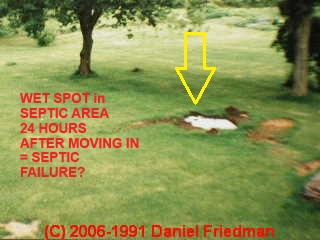
In the photo at the top of this page, a wet spot appeared in the previously "perfect" yard of this older home within twenty-four hours of the new family moving-in. The buyers had obtained a "septic inspection" but it was improperly performed and missed the chance to discover before purchase that the septic system was in total failure.
InspectAPedia tolerates no conflicts of interest. We have no relationship with advertisers, products, or services discussed at this website.
Septic System Failure Causes: What Constitutes a "Failed" Septic System?
Before digging up your septic tank or calling a septic pumper, if you think the septic system is failed because of drain blockage or drains backing up into the building, you should to see CLOGGED DRAIN DIAGNOSIS & REPAIR Is it a blocked drain or the septic system? - A First Step for Homeowners.
If you link to that text, please return here using your browser's "BACK" button.
[Click to enlarge any image]
Article Contents
- SIGNS of POSSIBLE SEPTIC FAILURE
- SEPTIC FAILURE DEFINITION - CRITERIA
- HOUSE TO TANK FAILURES & BLOCKAGES
- SEPTIC TANK FAILURES
- TANK TO DISTRIBUTION BOX PIPING FAILURES & BLOCKAGES
- D-BOX FAILURES
- DRAIN FIELD PIPING FAILURES
Signs of Possible Septic System Failure
Any of the following signs might indicate that an onsite septic system has failed:
- Sewage backup in the building, usually at lowest plumbing fixtures
- Septic or sewage odors outdoors, especially at or near the septic tank or septic drainfield or mound
- Wet areas on the ground surface around the septic tank or septic drainfield or mound or soft "spongy" grass in those areas
- Shiny iridescent greenish water visible on the ground surface, especially around the septic tank or drainfield or at the edges of a mound or raised-bed septic
Watch out: we emphasized the word might indicate a septic failure because there are other possible causes of these conditions such as a blocked building drain or a broken sewage effluent box or blocked distribution box (D-box).
Watch out: also there are other more technical septic system failures that require major repair or even re-design but that may not be immediately obvious, such as a failed septic drainfield or mound whose effluent is being discharged to a more-distant point not immediately obviously connected to the septic system, such as into a nearby drainage ditch, lake, or stream.
Another example of a "failed" septic system is really one that was improperly-designed or improperly-constructed in the first place, such as a septic drainfield or mound at which the bottom of the effluent distribution trenches is not sufficiently above the seasonal high-water table in the area (typically two feet).
If a septic system backs up, floods, or fails in wet weather it may be improperly designed, or it might be possible to correct the problem by better management of site surface and subsurface runoff control.
At RECOMMENDED ARTICLES we provide additional guides to detailed inspection procedures telling you where and how to look for and diagnose a septic system failure.
Onsite Waste Disposal System Septic-Failure Criteria
Definition of a septic system "failure": a septic system is considered in failure or to have failed if one of or more of the signs or conditions listed below are present.
Massachusetts Title 5 Septic Law lists specific failure criteria and serves as a good model for septic inspections anywhere.
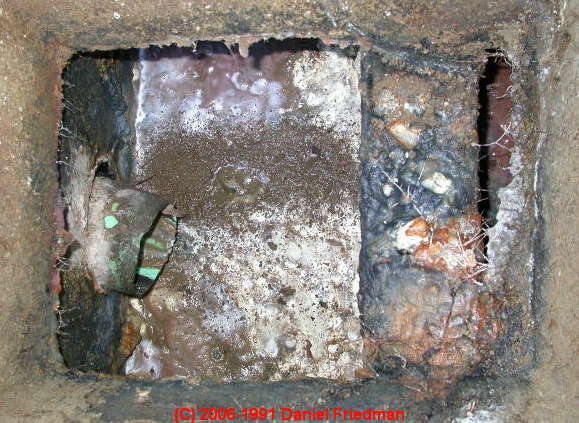
(The photograph shows the septic baffles in a concrete septic tank. While at the time of inspection the sewage was not flowing over the baffles, sewage debris atop the concrete baffle shows that at some point that problem had occurred. Further diagnosis was in order.
- Drain or Sewage Backup anywhere in the system. See
CLOGGED DRAIN DIAGNOSIS & REPAIR for details. - Discharge of effluent to the surface, stream, etc. regardless of whether or not septic dye is observed.
See SEPTIC SYSTEM INSPECTION & TEST GUIDE - Static effluent level or floating scum over the top of the baffles in the septic tank [added by DF]
- Static effluent level above outlet in the D-box
- Septic Tank or Septic System has to be pumped more than 4 times a year.
See SEPTIC TANK PUMPING SCHEDULE for details. - Metal septic tanks (municipality dependent; note that in special site conditions small metal tanks may be the "only" solution and
may be approved by local officials. An owner/buyer must be informed of the implications of such installations.)
See SEPTIC TANK INSPECTION PROCEDURE for more details. - Soil Absorption System (or cesspool, etc) is at a depth exposing it to the maximum groundwater level.
See SEPTIC SYSTEM DESIGN BASICS for more details. - Depressions or low areas over the septic tank, septic drainfield depressions: a depression in the septic tank area or a septic field depression may or may not indicate trouble with the septic system. It is normal for backfill over septic tanks or drainfield lines to settle and leave a depression or "low area" in the soil.
But if the septic tank or fields have not been dug-up, or otherwise disturbed and if you see a new depression or area of settlement it should be marked-off, access to that area should be prevented, and it should be investigated by a professional - possible collapse of a septic tank, distribution box, or other buried septic components can be very dangerous or even fatal.
See SEPTIC & CESSPOOL SAFETY for details.
Detailed criteria that define when a septic system has failed can be read
Septic Piping Failures Between Building Drains and the Septic Tank
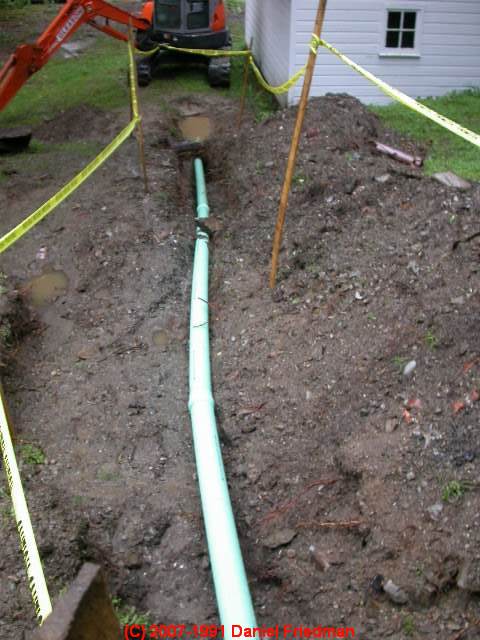
Outside, waste piping conducts sewage (black water and gray water) from the building to the treatment tank or "septic tank," and from the treatment tank to the distribution box. Our photo shows a new waste line carrying sewage down from the home to the septic tank in lower yard. The previous waste line had been broken when driven over by a heavy lawnmower.
Septic drain lines between the house and the septic tank should be of solid, non-perforated material and need to be protected from mechanical damage (such as by vehicles).
Piping extending from the distribution box into drain fields is normally perforated, though solid lines might be used if effluent is being processed by more specialized devices such as seepage pits, galleys, or a sand-bed system.
Distribution piping connects the house drain to the septic tank, running between the building and the tank inlet.
More distribution piping connects the septic tank outlet to the distribution box and from there to the leach field. Distribution pipes can settle (especially in new construction), break, become blocked or clogged, or become invaded and blocked by tree roots or soils.
Older ORANGEBURG PIPE [web article] which look like black asphalt-soaked cardboard (they are) crush and deteriorate with age.
Clay pipes also break and have a tendency to become blocked by tree roots at their joints. You won't know what kind of piping is installed until it is excavated, but the age of the property may be a clue. Homes built from the 1970's on, certainly from the 1980's on, use cast iron or more often plastic ABS or PVC piping for these connections.
This line may become blocked by waste, damaged by collapse of a section, or invaded by roots. Detection of these conditions is fairly easy by routing a snake or power snake from the building drain to the septic tank.
An experienced power snake operator can often tell by "feel" that a drain line is collapsed, partially collapsed, or invaded by roots. While you may make a temporary "repair" of such a condition by drain-cleaning, if the line is broken or root-invaded, you should expect to have to excavate and replace it soon.
Also see DRIVING or PARKING OVER SEPTIC
How Different Types of Septic Tanks Fail
- Additives: Use of septic tank or drain field additives which claim to extend system life can generate so much activity in the tank that solids are held in suspension and forced into the soil absorption system! Do not add any treatments, chemicals, yeast, or other treats to a septic system. In general these treatments don't work, may ruin the system, and are illegal in many localities. There is no magic bullet to repair a bad SAS.
- Septic tank cover failures: Concrete tanks are pretty durable but they can crack and leak or may have an unsafe cover. Leaks may occur around the cover where it rests on the tank or at the access ports through the cover.
Watch out: steel or damaged concrete covers or insecure septic tank cleanout or access port covers can cause death if someone falls into or otherwise enters a septic tank.
See SEPTIC & CESSPOOL SAFETY - Concrete septic tank baffles can deteriorate, crack, break, fall off.
- Concrete septic tank lids: can be damaged by vehicle traffic; heavy duty covers are available.
- Concrete septic tanks can crack or sections may separate causing leaks with the same effects as just stated
- Concrete septic tank baffles: may erode from chemicals, detergents, poor concrete mix, water flowing over top of baffles, or may be broken by improper pumping procedures
- Diapers, Toys, Garbage which find their way into building toilets and drains risk clogging the drain piping,
distribution piping, or the septic tank baffles. Keep diapers, tampons, sanitary napkins, kids toys, household chemicals, and the like
out of your building drains and toilets.
See WHAT CAN GO INTO TOILETS & DRAINS? - Driving over the septic tank, septic piping, or drainfield are likely to crush a pipe, collapse a tank, or ruin a drainfield.
Only if special installation steps have been taken can a septic pipe or tank be located below a driveway or parking area and never can a septic drainfield work in such a location.
See DRIVING or PARKING OVER SEPTIC - Garbage disposers also increase the solid waste load on septic tanks and may require that the tank be pumped more often.
- Home made septic tanks:
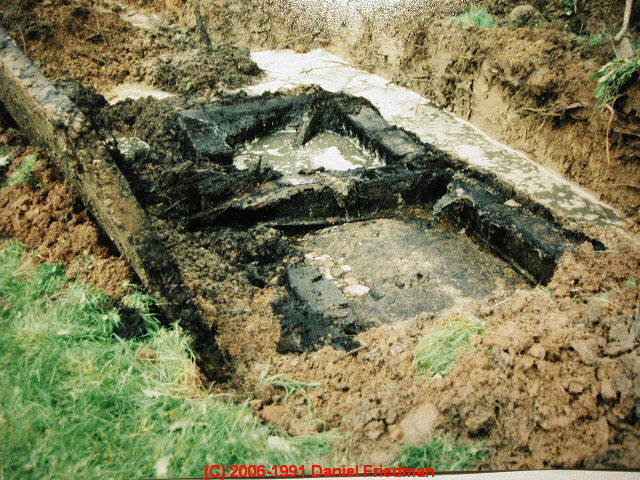
- Home made or "site built" septic tanks, often using dry-stacked concrete blocks or even stone can collapse, a fatal hazard if someone falls in.
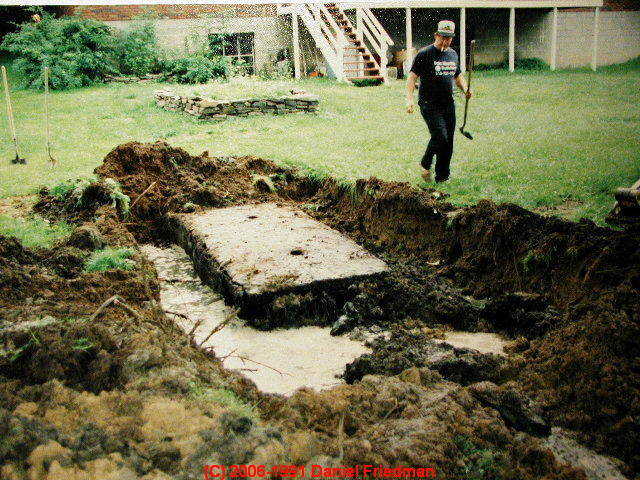
The tank shown in the photo here had
a CONCRETE SEPTIC TANK COVER [Image] but when the cover was removed we found that the tank was under-sized, built of concrete blocks, and totally impacted with waste, as shown in
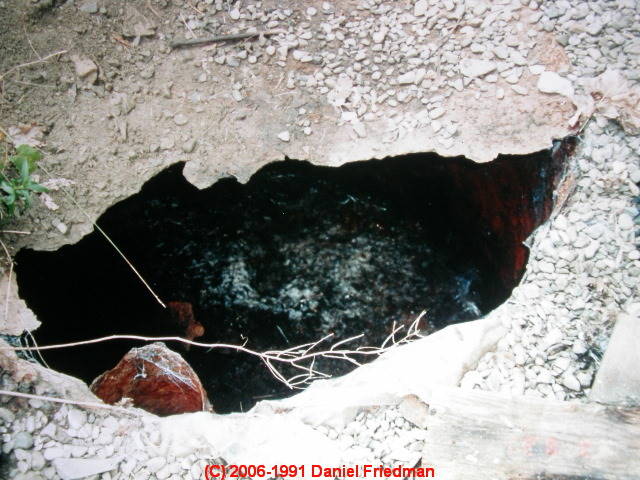
the OPEN SEPTIC TANK [Image].
The septic system was inadequate, not working, and required replacement. Incidentally, this was the septic system "serving" the property with the nice green lawn in the photo at the very top of this page. ""
The property seller was an elderly, single occupant who used no water and never did laundry in her home. The new owners had effluent in their yard within 24 hours of moving into the home.
The buyer's inspector performed an inadequate septic inspection and test. A proper loading and dye test would probably have detected this failure. - Leaks: Septic tank leaks: a septic tank should be water tight. If ground or surface water leak into the tank the result is often a flooded and failed drainfield;
if sewage effluent leak out of the septic tank the result is the discharge of inadequately treated effluent into the soils and in the case of a very leaky septic tank, the result may also be a too-rapid loss of effluent in the septic tank resulting in too rapid build-up of solids and total system clogging and failure. - Pumping: Septic Tanks which are not pumped often enough can become filled with sludge and scum, becoming totally impacted. Well before this condition is detected, such systems have sent solids into the leach field, shortening its life.
- Rusting steel septic tank covers can cause death! Rusted covers can collapse. Steel septic tanks rust out and collapse, often sending solids into the leach field and reducing its future life as well.
Watch out: Septic tank covers themselves can also collapse, especially if made of steel as shown in
the STEEL TANK PHOTO [Image] as mentioned above. Other tank covers may be made of wood which eventually rots and collapses.
Collapsing septic tanks are very dangerous. Falling into a tank is likely to be fatal.
We have reports of children and adults who have died from this hazard (December 1997, California).
In 2000 we consulted in a fatality involving an adult falling into a cesspool. At a building inspection I myself stepped through a hidden, rusted-through steel septic tank cover.
Falling into a septic tank, drywell, or cesspool is quickly fatal, either from being buried by falling soils and debris, or by asphyxiation.
Septic gases are highly toxic and can kill in just minutes of exposure. Even leaning over an empty (just pumped) tank has led to collapse and fatality of a septic pumper.
- Steel septic tank baffles rust off, as you see in the lower left of the above photo which also
depicts a very dangerous rusted-out steel septic tank cover.
Even if the cover is intact a rusted or lost septic tank baffle sends solids and grease into the leach field, shortening its life.
A steel septic tank baffle is visible in the lower left of this photograph. - Steel tank bottoms rust out permitting effluent to leak into soils around the tank, possibly giving a large void in tank at time of testing, thus subverting a loading or dye test
How to Find The Septic Blockage
The same failures can occur on the effluent distribution pipe line from the septic tank outlet in to the distribution box as we described earlier on piping from house to the septic tank.
Pipes can settle (especially in new construction), break, become blocked or clogged, or become invaded and blocked by tree roots or soils.
How to Determine Where a Septic Blockage Is Located
How would we distinguish among blockages at different points in these distribution lines?
- Blocked pipe between house and tank: discover by snaking the line from house to tank or by observing a backup in the house and, on opening the septic tank access cover, observe poor or no flow into the tank when water is running in the building drains.
- Blocked pipe between tank and septic system D-box: discover by opening the tank and seeing that it is not draining out when water is being run into it from the building drains, and by opening the D-box to observe poor flow or flow into the D-Box when the tank is backing up.
- Blocked septic system leach field lines: discover by excavating at sample points along individual leach lines, often
by opening up the line at its lower end. If no effluent is present at the lower end of a leach field line
and if effluent is entering that line at the D-Box the line is collapsed or blocked along its passage.
- Failed septic leach field: effluent is confirmed as flowing freely from building drains to tank, tank to D-Box, and D-Box attempting to flow into the leach lines - perhaps both backing up in the D-Box (see flood lines above the D-Box outlets) and also flowing out at the excavated ends of the leach lines.
Septic System D-Box Failures: What Goes Wrong at the Septic System Distribution Box
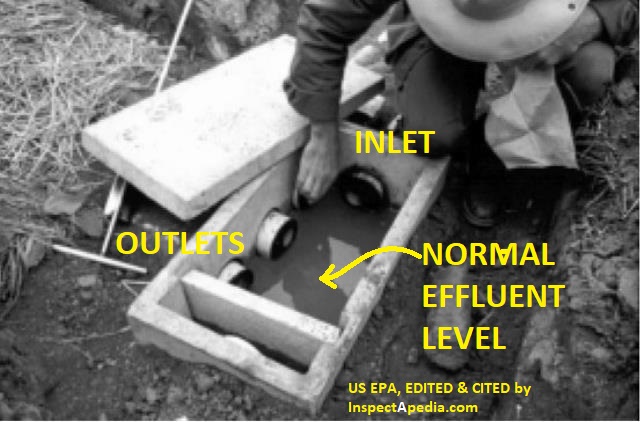
Distribution boxes serve as a connection point to distribute effluent which arrives from the septic tank outlet and is to be sent into two or more individual leach field lines.
Distribution boxes ("D-Boxes") can settle or tip.
A damaged or tipped D-box will fail to divert effluent uniformly among the effluent receiving drainfield lines, causing flooding of one leach line. If you see depressions suggesting that there are four leach lines at the property and the end of just one of them is producing wet soil or surface-breakout of effluent, we'd suspect a tipped D-box.
Opening the D-box can also show whether or not effluent is being directed uniformly into each of the leach lines. A tipped D-box can overload one line and cause early failure of the absorption system.
If this is happening, flow adjustment end-caps (eccentric holes) can be installed in the distribution box on the inlet end of each of the drain lines, permitting adjustment of effluent delivery into each line, perhaps relieving the problem line and redistributing effluent into the others.
Septic Drain Field Piping - Diagnosing Leach Field Failures
In a conventional "drain field" (synonyms: leachfield, leaching bed, soakbed, soakaway bed, seepage bed) of perforated pipes buried in gravel-filled trenches, a drain line may be invaded by tree roots. This is why experts advise keeping tree and shrub plantings away from drain fields.
Vehicle traffic can also collapse this or any outdoor waste piping, which is why experts advise against ever driving over a drainfield or over any other septic system components.
See DRIVING or PARKING OVER SEPTIC
Drainfield piping is usually constructed of perforated pipe buried in gravel-filled trenches. It receives effluent from the D-box and allows it to percolate or seep into the soil around the trench where added filtering and bacterial treatment occur.
Like the distribution piping discussed above, individual drainfield pipes can become crushed, shifted, or clogged by tree roots or other debris. More general clogging and failures of the leach field are discussed below.
A broken or clogged pipe, once it has been located, may be much less costly to repair than a complete leach field replacement, so this possibility needs to be considered during diagnosis of a "failed" septic system.
- Antiquated, obsolete septic drainfield pipe materials likely to fail or to have already failed:
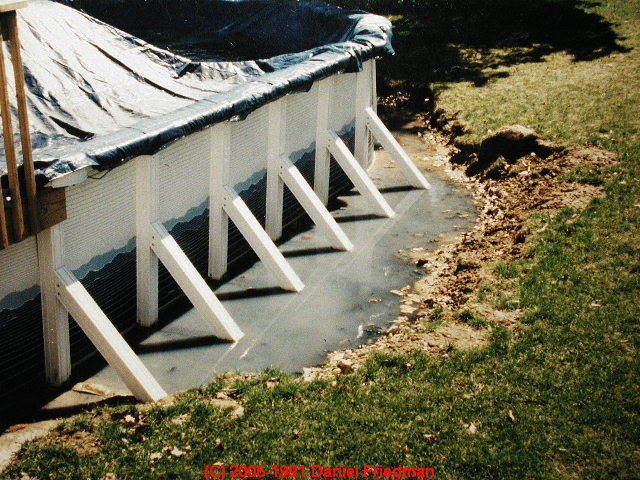
ORANGEBURG PIPE and clay or terra-cotta sewer lines and drainfield lines. - Building on the leach field: A leach field can be destroyed by other site "improvements" such as this attempt to install a swimming pool atop the leaching area in the photo shown at left.
This mistaken installation involved multiple errors: placing a pool atop the leaching area which prevents proper oxygenation and evaporation, driving over the leach field which risks damaging buried pipes and compacting the soil, and excavating to remove a portion of the absorption system soil to put in the swimming pool.
The gray water you see next to the swimming pool in LARGER PHOTO [Image] was effluent from the failed septic fields. - Compacted soils: driving over the leach field in any vehicle larger than a child's bicycle is a bad idea. Heavy vehicles may actually crush buried leach field lines, or they may compress the soils around the leach field, either of which leads to failure. Driving on or parking on leach fields will destroy them.
- Paving over the leach field: a leach field cannot function properly if it is paved-over.
Some folks may try this as a way to permit parking over the absorption system. But paving prevents both evaporation of effluent (a portion of the effluent disposal method) and it prevents oxygen from reaching the soil, thus inhibiting proper bacterial action needed to treat the effluent. - Clogged soils: Soil absorption systems stop absorbing. Eventually the soils around the leaching bed trenches become clogged and
stop passing effluent. Sending grease and floating solids into the leach field hastens this failure. The biomat which forms below the leaching beds may also become too solid and impacted, stopping soil absorption.
In this LEACH FIELD PHOTO [Image] effluent was appearing in the light colored area where the homeowner had begun some exploratory digging in a soggy spot only to see her hole fill up rapidly with effluent. - In the building drains become sluggish, stop, or back up into the building (unsanitary), or effluent may appear on the property surface when the absorption system can no longer function or where a pipe has become damaged.
Lockwood, in "An Engineer's View of Septic Systems" listed these causes of absorption field failure:
" If the liquid effluent cannot soak into the soil surrounding the leach field, sewage may back up into the system and overflow into the house or puddle on the surface of the ground. There are several possible causes for this problem."
- Poor Soil Conditions: Faulty Design or Installation of Septic Systems A leaching system placed in unsuitable soil, a system that is too small for the house it serves, or an improperly constructed system may lead to early failure.
- Soil Clogging and Septic Systems: If sludge or scum is allowed to escape into the distribution box and from there
into the leach field, the soil will quickly become clogged. If this happens, the liquid will no longer soak, or percolate, into the soil.
This condition can be caused by broken baffles in the septic tank that allow sludge or scum to escape.
Failure to have the tank pumped can also lead to a situation where the sludge and scum overwhelm the baffles.
If a steel septic tank has rusted out and collapsed you should assume that before the collapse it was releasing solids and grease into the absorption system, reducing its life. - High Water Table and Septic Systems:
During wet, or abnormally wet, seasons groundwater may rise into the leach field and force sewage upward to the ground surface.
This condition may mean the system has to be re-installed at a higher level. It may also be possible to intercept the high groundwater with a series of drains around the system called "curtain drains". - Roots and Clogging of Septic Systems: The roots of trees and bushes planted too close to the system can sometimes enter and block the pipes of the system.
Removal of the plants and clearing the pipes of the roots is usually required. - Physical Damage to Septic System Components: Trucks or heavy equipment passing over the system can damage pipes and joints to the point of rendering the system inoperable. You should be aware of the location of the system and direct traffic to avoid such damage.
Reader Comments, Questions & Answers About The Article Above
Below you will find questions and answers previously posted on this page at its page bottom reader comment box.
Reader Q&A - also see RECOMMENDED ARTICLES & FAQs
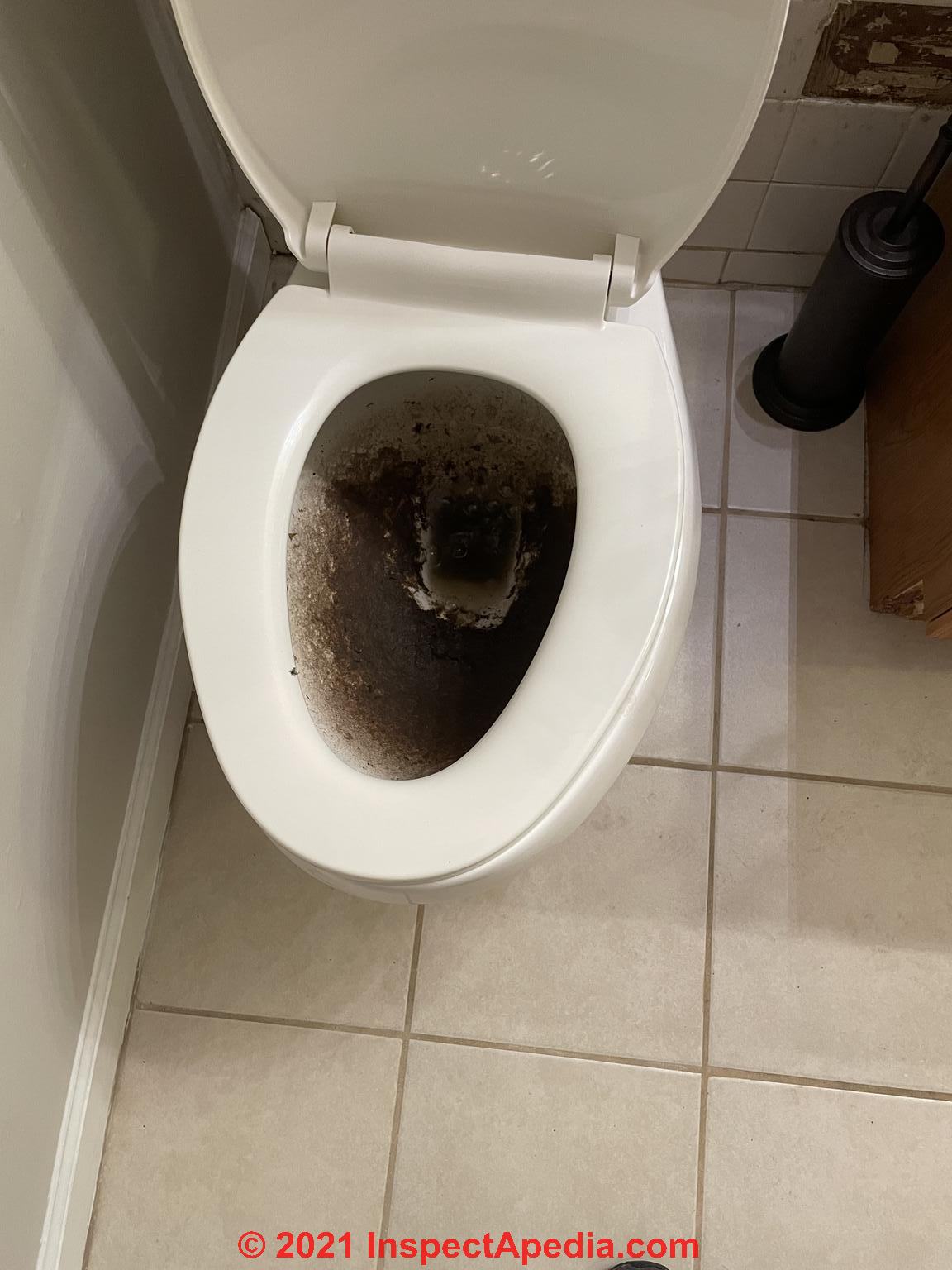
On 2021-07-22 by mod) - sewage rising in toilet: is this sewage back-flow
@backupbackup7489,
yes and yes
or a blocked sewer line or main drain
On 2021-07-22 by backupbackup7489
New tenant experiencing this - we just had septic drained, is this sewage backflow? Is it indicative of leach field problems?
On 2020-11-26 - by (mod) -
ON a 50 year old drainfield it'd be no surprise if the soil no longer absorbs effluent, having become blocked by a thickened biofilm layer; if that's the case it's time for a new drainfield.
On 2020-11-26 by Cliff Leschyshyn
We have a tank and field, installed 50 yrs. ago We have sewage coming up to the surface, wondering what the problem could be?
On 2020-11-12 by (mod) - if someone drives over the septic, how soon would I notice a field problem?
Sharon
That's a great question, but I don't know a clear answer to how long before a septic failure will show up if a septic drainfield line is crushed.
Here are two different cases that illustrate what can happen.
1. Immediate to 48 hours until septic trouble shows:
A vehicle drives over a drainfield and crushes or breaks one or more effluent lines: wastewater backs up in the septic tank and floods the building OR there is a new breakout of effluent at the ground surface in or near the area of damage.
The problem is evident almost immediately, certainly within a day or two as hundreds of gallons of wastewater enter the septic tank and push a like volume of effluent out into the drainfield.
This situation assumes that the septic system design is a conventional one and that the septic system is in use at typical levels of hundreds of gallons of wastewater per day.
2. Damage does not show up for years:
A vehicle drives over a drainfield and crushes or breaks one or more but not all of the effluent disposal lines: damage is near the end or damage does not affect all of the drainfield lines.
The damage may not appear as a septic system backup into the building nor may effluent appear at the surface for years. Instead, the effect of this damage is rather to reduce the total available drainfield area for effluent disposal.
The result may be not an immediate failure, but rather a reduced life of the septic field.
The damage may never become evident or it may become evident only if/when one or more of the old drainfield lines is excavated.
Additional variables confound the "when will septic damage show up?" question, such as soil conditions, total drainfield size, level of septic system use, weather conditions, wet or frozen weather affecting soil's ability to absorb effluent, terrain shape, level vs. sloped, rocky vs. uniform soil, and other similar factors. Septic system type and design are also critical in answering your question.
For example driving over a septic mound or raised bed or sand bed septic is likely to cause damage to show up very quickly, often as effluent breakout lower on the mound or raised bed or near its perimeter.
On 2020-11-11 by Sharon
If my field lines had been crushed or broken by a logging truck how soon would I notice a field problem?
On 2020-10-27 - by (mod) - get an accurate diagnosis of the cause of failure of your Enviro septic system
Susan
Thank you for the report on trouble with your Enviro Septic system.
It will be helpful to get as clear a diagnosis of exactly what failed and why as possible, both to minimize the chance of blaming the wrong cause and to minimize the chances of having to install a septic system over and over again because we didn't know what we were doing "wrong".
"the product is inferior" is, unfortunately, just too vague a diagnosis for me to make much out of it.
When "the tubes are full of fluid" that does NOT mean that there was no damage to the fields from an outside source.
Even if a septic effluent absorption system's piping is not itself "crushed" or visibly broken or dislocated - something to discover by a thorough inspection by sewer line camera - that does NOT tell us that there was no external damage to the system. For example if during or after construction someone drove heavy equipment over a field so as to compress the soil that can cause a field failure;
Similarly, construction of a septic field too low - too close to seasonal high water table, or failure to direct surface and subsurface runoff away from the area will guarantee that a field will have a short, ineffective use.
"Not enough sand around the tubes" - if you're referring to how perforated piping was installed in trenches to allow soil to absorb septic effluent - could be only the tip of the iceberg of frosty failure.
A lot - almost everything - depends on the type and amount of soil available to accept effluent and to host bacteria (aerobic and anaerobic) who are needed to process and digest the pathogens in the effluent. So if the soil can't accept effluent or is flooded, even just sometimes, the system won't work.
That sort of installation snafu would have little to do with "the product" and almost everything to do with "the installation".
The installation needs to follow the specifications of a professional design that was in turn set out based on a survey of the site: available space, soil perc rate, elevations, slopes, and required size based on anticipated daily wastewater flow.
So see if you can get details.
On 2020-10-27 by Susan - our Enviro system septic has failed in 2020
Hello
I'm writing to let everyone know that our Enviro system has failed in 2020 and do not recommend using this system. Buyer beware.
The plan was drawn up in 2009. We moved into our newly built home in 2011. We pumped the tank every 2 years - that's 4 times starting in 2013. The designer/surveyor that was used has done a new design gratis. Here is where it gets interesting.
The new plan is 50% larger than the original plan following the same specs of a 5 bedroom plan for our 4 bedroom home. We over built our system for our own security for it to last. I believe Presby had overestimated the quality of their product back in 2009.
The information used from Presby is sent to the state for designers to follow the specifications. At the time of our build vents were not required. The installer and designer followed those specifications and didn't have them as part of the design.
The original installer is now putting in a new field gratis, because like the designer he feels the product is inferior. In contacting Presby, they have not offered anything up other than the tech to check out our system and point fingers at others. He confirmed all the tubes where full of fluid.
Which means the had not been crushed by any outside source. He confirmed the proper sand was used but not enough of it surrounding the tubes. The designer and installer say that the sand could have moved because of the flow. Town inspector and a third party inspector who called our leach field failed feel, that the homeowners are not at fault. The pumping company are surprised we are failed.
On 2020-10-11 - by (mod) -
Rochelle
What entrance are we looking for?
SEPTIC DRAINFIELD LOCATION inspectapedia.com/septic/Septic_Drainfield_Location.php
FIND the SEPTIC TANK, HOW TO - inspectapedia.com/septic/Septic_Tank_Find.php
SEPTIC D-BOX LOCATION inspectapedia.com/septic/Septic_D-Box.php#Find
If by "cap off" you mean trying to empty or clean a septic tank by pumping it out through a small 6-8" diameter access opening, it's possible to pump the liquid and a very limited amount of the solid scum and sludge through a small opening but it is in my experience and opinion impossible to actually clean a septic tank through such a small opening.
To remove all or even most of the settled sludge and floating scum in a septic tank the pumping technician needs to be able to manipulate the pumper hose across all of the septic tank interior and often to use a hoe-like tool to break up scum and sludge to pump it out of the tank.
It's also not possible to determine the condition of the septic tank and its inlet and outlet baffles thorough such a limited access opening.
On 2020-10-10 by Rochelle K Ibanez
how do I know where the entrance is?
On 2020-10-10 by Rochelle
Can a tank be emptied at the cap off? We cwmwnted part of our yard. The cap off is in the grass at back of yard.
On 2020-09-24 - by (mod) -
Ron
When a septic tank has not been pumped in 33 years you are far past the expected life both tank and drain field
You need a septic contractor to open the tank and inspect his condition. It's quite possible that the tank is leaking and there is causing soil subsidence. Keep in mind that it's likely that your drainfield is also an end of life
On 2020-09-24 by Ron
I have a septic tank that has never been pumped (33 years). Over the last year there has been a settlement of soil around one edge of the tank. I have tried to top fill with dirt but the settling keeps happening. There are no signs of standing water, backed up drains or odors.
Any advice?
On 2020-08-03 by Al Johnstone
Our septic had one occurrence of overflow only 6 weeks after a clean out. What advice can you provide.
On 2020-07-10 by Joe
I'll do just that. Thank you!
On 2020-07-10 - by (mod) -
Joe
I agree that that's a pretty marginal "report".
If the liquid (not just scum) level was above the bottom of the outlet pipe from the septic tank then we could be facing a failed drainfield but we could be lucky and find a blockage or a tipped distribution box.
So before agreeing to any costly repair let's get a more thorough and expert diagnosis.
Start by finding the D box and using a sewer cam to check the lines.
On 2020-07-10 by Joe
Hello. I have found your site very helpful. I have a question regarding why my septic system was "failed" and expensive corrections suggested. This was the information provided as to why the septic system failed. (No prior issues. System was due for pumping. Visual inspection was done at time of pumping. 1,000 gallon capacity)
"However, the scum line was not at the appropriate level and waste was found on the
septic lid and in the build-up. This is an indication of drainage failure and should be
evaluated further."
Question: new septic system failed after just 3 weeks
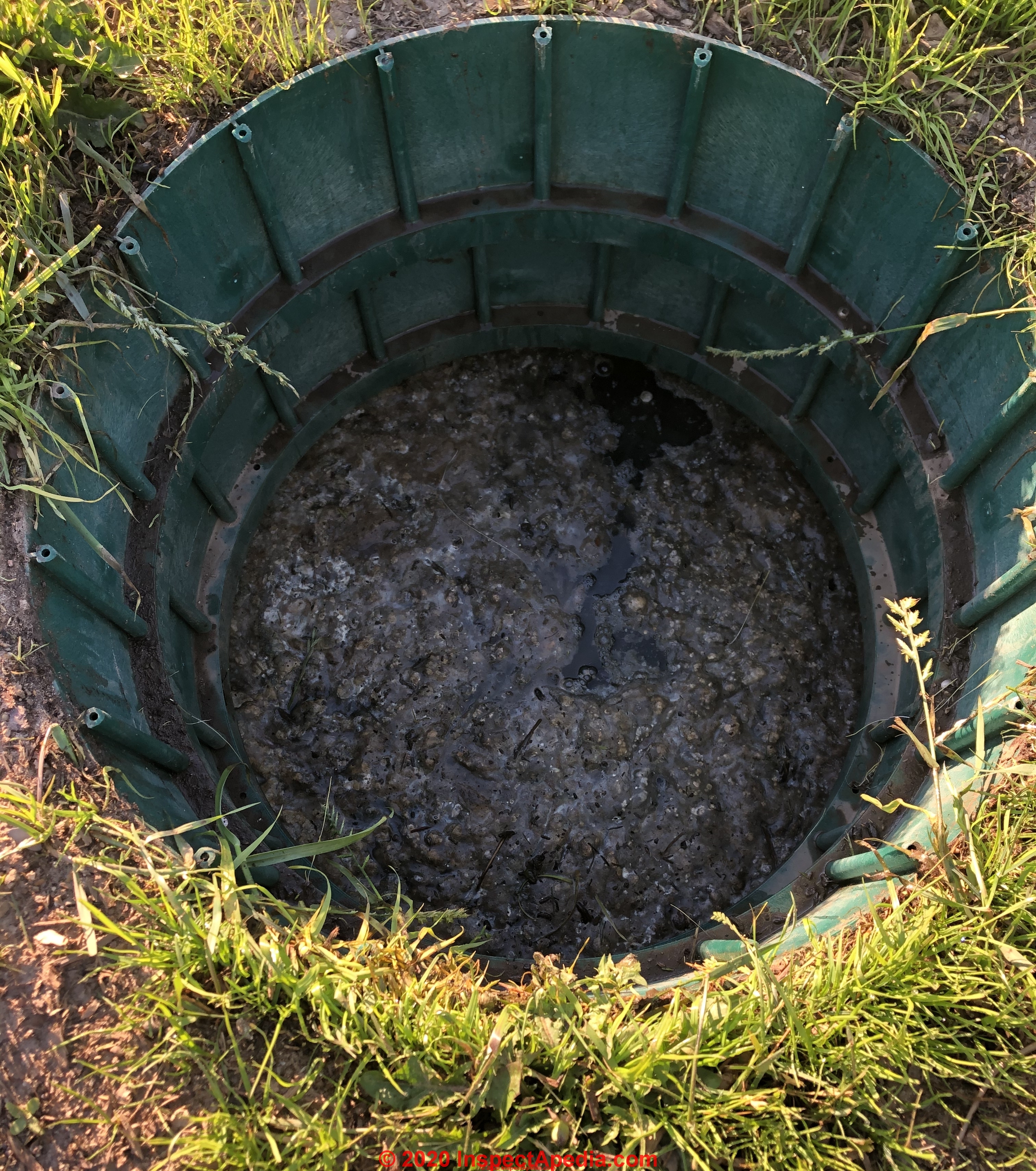 I’m not sure if you will be able to help us or not. But we live in Ontario Canada.
We had our 45 year old septic completely redone in July 2019. And in April 2020 we noticed that it wasn’t working and backed up around the lid.
So the company came again and redid part of the septic and it did the same thing.
So they came in May and did a completely new septic and it has only been 3 weeks and already it is starting to fill past the filter/distribution drain.
Not only is this completely worrisome and stressful but the hours of back breaking landscaping we have had to do to get our place back in order are countless.
We are at a loss and have co tatted the company. We are waiting for a response. I’m just wondering if you can give us any ideas moving forward.
We don’t know who else to contact and we also don’t feel we should have to pay for this.
This is after just 3 weeks - Anonymous by private email 2020/06/15
Moderator reply:
about
... it has only been 3 weeks and already it is starting to fill past the filter/distribution drain. ...
I don't understand the phrasing. Are you describing the level of sewage in the tank or something else? It's normal for a septic tank to be "full" with liquid effluent reaching the bottom of the outlet pipe, and for effluent to flow out to a drainfield.
Want to update us?
Reader follow-up:
It was draining perfectly from the house and then we had a very heavy rain and both tanks filled, past the outlet pipe.
And it has not gone back down.
Our guy says for some reason the ground is holding water.
We are having our yard dig up for the fourth time in a year next week.
It’s beyond stressful and we constantly worry that it will back up into our house.
Do you have any suggestions?
Moderator reply: "ground holding water" does not describe an acceptable nor working septic drainfield system
I'm not sure what to make of the ground holding water argument but in general if a septic drain field floods or if water leaks into the septic tank in rainy weather then there's a problem to be found and fixed.
Sometimes we can simply direct surface runoff away from the flooding septic tank. What's needed is a closer inspection to see where water is getting into the system.
It could be at the septic tank, at a piping connection, at a septic tank cover or clean out access, or it could be downstream if the drain field is flooding and back flowing into the septic.
That last case is the most serious in terms of difficulty and expense to correct the problem.
A diagnostic of a flooded or failed drainfield might be as simple as watching the septic tank during pumpout; if, as the sewage level falls below the septic tank outlet, we see or hear liquid spilling back into the septic tank from its outlet pipe then the pipe or drainfield is / are, blocked or flooded or not working properly.
On 2020-05-22 - by (mod) -
Autumn,
Discharge of waste water to the ground surface is improper, indicates a failed septic system, and is illegal in most jurisdictions.
On 2020-05-21 by Autumn M Noonan
We discovered an area of bubbly water that comes out of our ground during the day when we using water laundry ECT. and then dries up at night. And my landlord won't do anything about that is that okay? I'm on County Land he said it will be expensive to fix and he wants to give it a week to see if it dries up. For once I just like a good landlord any takers
On 2020-02-22 - by (mod) -
Natslie
Possibly,
It depends on where the line was damaged.
For example if you damaged and blocked the main effluent line out of the septic tank head of the distribution then you'd block the tank outlet.
On 2020-02-22 by Natalie
Could three fence posts put in leach field ( they DID puncture the plastic) cause the tank to not drain at all?
On 2019-10-03 - by (mod) -
Carolyn
I really wish I could be more helpful but I just don't know a thing about your site or its condition. YOu need an onsite inspection.
On 2019-09-30 by Carolyn Muldowney
Where my drain field is, the spot in the yard seems depressed. No standing water. Did notice an odor but din’r Know if it’s mune or a neighbors. Should I be concerned? I take very good care of my septic system
On 2019-09-30 - by (mod) -
Dean
Where is the septic tank riser that's leaking - in the piping scheme for the septic? If it's between house and D-box and effluent is backing up there and the D_box is dry then the line is probably blocked between the riser / access pipe and the D-box
On 2019-09-29 by Dean hammons
Riser leaking but no water in distribution box
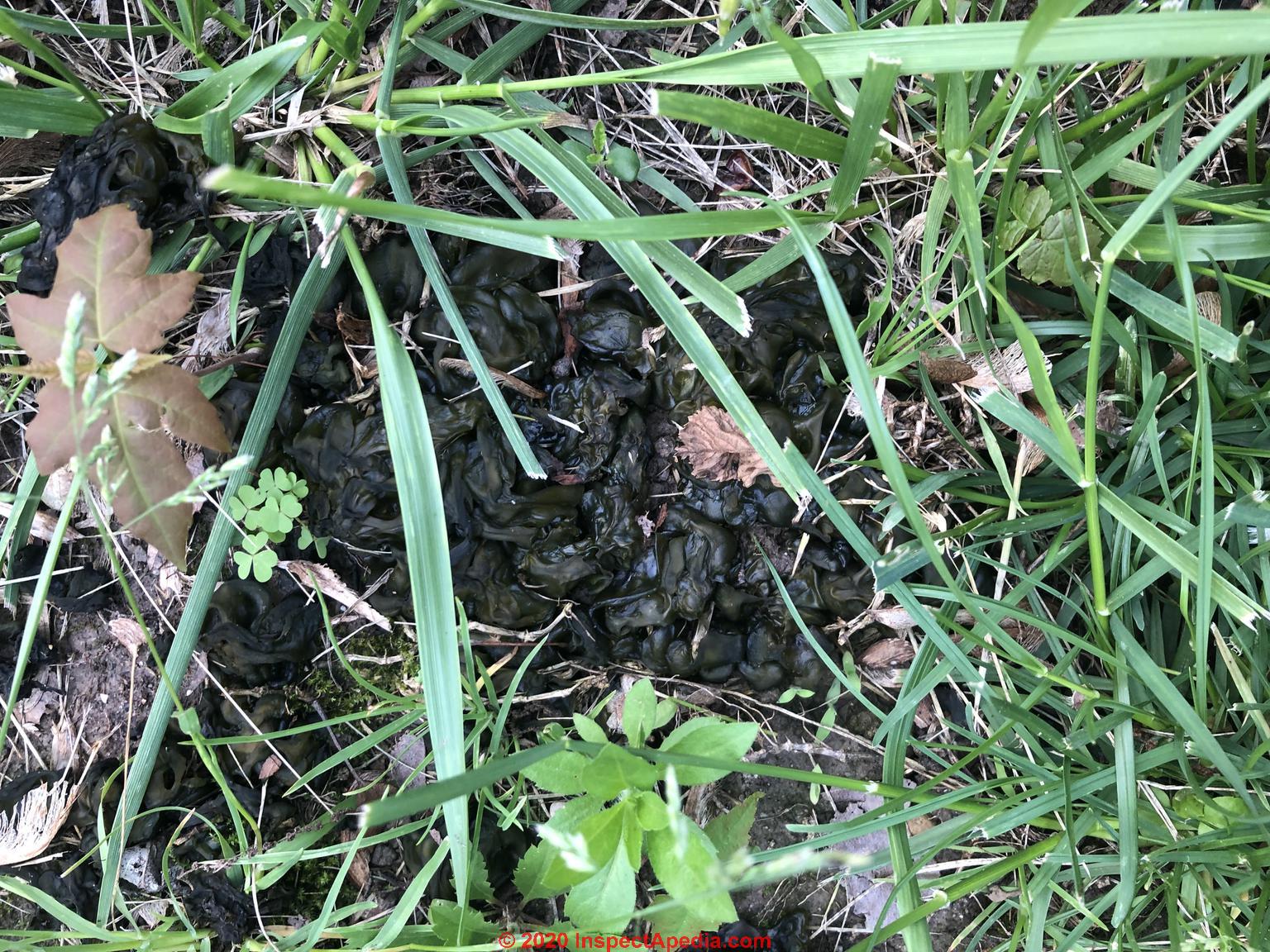
On 2019-07-03 (mod) - Nostock commune fungus growing in septic leach field area
GKW about Nostock commune - that you have identified as an algae-like cyanobacteria that looks like animal poop but is not,
Please see our discussion all collected along with more information now found at
SOAKBED SOIL CONDITIONS
On 2019-06-22 by gkw1944
I have been finding this unusual material on my leach field. Black curdled plastic/rubber stuff. It has no smell and does not appear to be waste.
I called several septic companies no one responds. Should I call a plumber instead?
On 2013-03-23 - by (mod) -
Dee
YOu should not be seeing solid waste in the drainfield. If you do then I figure your septic tank may be missing an outlet baffle and it is sending solids into the drainage area - which, if that's the case, will damage it and shorten its life.
On 2013-03-22 by dee05
we have a new drain field but waste and tise is just sitting their in a hard block when my husband open drain field and now its backing up in my house
On 2013-03-18 - by (mod) -
Lynn,
If water is backing up in the basement that ought to be enough evidence to insist that the problem must be repaired promptly; there are serious possible health hazards from sewage, bacteria, and mold.
I don't know why you'd be testing for ammonia.
BUt if you want to take a sterile bottle of "basement water" to a local testing lab they can certainly tell you the sewage level in the water.
On 2013-03-18 by Lynn Johnson
Great information from your website. I think I am dealing with a septic failure in my moms home but she is not facing reality. Water is backing up inthe basement. Short of contacting the health department, is there a test to do prove that a house has septic gases in it fromwater backup? I know you can do a test for amonia levels, but I am wondering if there is a simple tool that can read the air quality for a home.
thanks
On 2012-12-04 - by (mod) -
Tim,
In at least some installations, if the end of a leach line is uncapped effluent will, especially under heavy usage, just run out of the end of the line onto the ground surface - improper and in some jurisdictions, illegal as you're discharging wastewater to the ground surface.
More interesting is what it means if an end of a leach line is not capped and you do not see efflent running out - I'd surmise that either wastewater usage was very low, the drainfield was enormous, or that there was a blockage upstream and that line section was not taking effluent. In that case I'd start checking at the D-box and maybe at an earlier location along the line.
On 2012-12-04 by Tim
What happens if the end of a leach field line is not capped? Does the system still function?
On 2012-10-17 - by (mod) -
Christine,
If yoursnis an old rusted steel tank it is likely not repairable and needs replacement. Concrete or plastic tanks can be repaired by a professional.
DO NOT EVER attempt septic tank repair yourself. Entering a septic tank without expert training, equipment, and assistance will likely be immediately fatal.
On 2012-10-15 by Christine
If the inspector says my septic tank has a leak because the water inside tank will not remain at operating level (about amonth after tank was pumped), what are my options to fix? Can the tank be lined, the crack sealed or must the whole tank be replaced?
On 2012-09-16 - by (mod) -
Mary,
I think the first priority is to make the tank you found safe - to avoid an injury or worse, a fatal accident of someone falling into it. That means filling the abandoned tank with sand, gravel, soil. Some operators break open the tank bottom before that operation;
Beyond that specific project, you can locate other buried site components by a combination of examining likely locations visually, using a metal detector (obviously only useful for steel tanks), by finding and snaking or trying to trace sewer piping.
Detailed suggstions for finding tanks, cesspools, etc. are in a separate article found in the ARTICLE INDEX and titled
SEPTIC TANK, HOW TO FIND
On 2012-09-14 by Mary
We have just discovered an abandoned concrete septic tank. Our house was built in 1953. How do I determine if I have a leach field or a cesspool/drywell. I'm concerned about the possibility of a cesspool or drywell.
...
Continue reading at SEPTIC FAILURE SPOTS - where to look, or select a topic from the closely-related articles below, or see the complete ARTICLE INDEX.
Or see SEPTIC FAILURE INDICATOR FAQs - posted originally at this article
Or see these
Recommended Articles
- DIAGNOSING CLOGGED DRAINS
- SEPTIC DRAINFIELD INSPECTION & TEST - home
- PLUMBING DRAIN NOISE DIAGNOSIS
- SEPTIC DISPOSAL FIELD CLOGGING INSPECTION
- SEPTIC DRAINFIELD FAILURE CAUSES
- SEPTIC DRAINFIELD FAILURE DIAGNOSIS
- SEPTIC FAILURE CRITERIA
- SEPTIC FAILURE LAWSUIT
- SEPTIC FAILURE SIGNS
- SEPTIC FAILURE SPOTS
- SEPTIC ODORS INDICATING DRAINFIELD FAILURE
- SEPTIC TANK GRASS or SNOWMELT
- SEPTIC TROUBLE SIGNS, OTHER
- SOAKBED SOIL CONDITIONS
- SEPTIC DRAINFIELD LIFE
- SEPTIC DRAINFIELD LOCATION
- SEPTIC DYE TEST PROCEDURE
- SEPTIC TESTS: DYE & LOADING TESTS
- SEPTIC SYSTEM ODORS
- SEPTIC TANK LEVELS of SEWAGE
Suggested citation for this web page
SEPTIC FAILURE SIGNS at InspectApedia.com - online encyclopedia of building & environmental inspection, testing, diagnosis, repair, & problem prevention advice.
Or see this
INDEX to RELATED ARTICLES: ARTICLE INDEX to SEPTIC SYSTEMS
Or use the SEARCH BOX found below to Ask a Question or Search InspectApedia
Ask a Question or Search InspectApedia
Try the search box just below, or if you prefer, post a question or comment in the Comments box below and we will respond promptly.
Search the InspectApedia website
Note: appearance of your Comment below may be delayed: if your comment contains an image, photograph, web link, or text that looks to the software as if it might be a web link, your posting will appear after it has been approved by a moderator. Apologies for the delay.
Only one image can be added per comment but you can post as many comments, and therefore images, as you like.
You will not receive a notification when a response to your question has been posted.
Please bookmark this page to make it easy for you to check back for our response.
Our Comment Box is provided by Countable Web Productions countable.ca
Citations & References
In addition to any citations in the article above, a full list is available on request.
- New York State Department of Health, APPENDIX 75-A WASTEWATER TREATMENT STANDARDS - INDIVIDUAL HOUSEHOLD SYSTEMS , [PDF] New York State Department of Health, 3 February 2010, retrieved 3/1/2010, original source: https://www.health.ny.gov/regulations/nycrr/title_10/part_75/appendix_75-a.htm
- Pennsylvania State Fact Sheets relating to domestic wastewater treatment systems include
- Pennsylvania State Wastewater Treatment Fact Sheet SW-161, Septic System Failure: Diagnosis and Treatment
- Pennsylvania State Wastewater Treatment Fact Sheet SW-162, The Soil Media and the Percolation Test
- Pennsylvania State Wastewater Treatment Fact Sheet SW-l64, Mound Systems for Wastewater Treatment
- Pennsylvania State Wastewater Treatment Fact Sheet SW-165, Septic Tank-Soil Absorption Systems
- Document Sources used for this web page include but are not limited to: Agricultural Fact Sheet #SW-161 "Septic Tank Pumping," by Paul D. Robillard and Kelli S. Martin. Penn State College of Agriculture - Cooperative Extension, edited and annotated by Dan Friedman (Thanks: to Bob Mackey for proofreading the original source material.).
- Advanced Onsite Wastewater Systems Technologies, Anish R. Jantrania, Mark A. Gross. Anish Jantrania, Ph.D., P.E., M.B.A., is a Consulting Engineer, in Mechanicsville VA, 804-550-0389 (2006). Outstanding technical reference especially on alternative septic system design alternatives. Written for designers and engineers, this book is not at all easy going for homeowners but is a text I recommend for professionals--DF.
- US EPA ONSITE WASTEWATER TREATMENT SYSTEMS MANUAL [online copy, free] Top Reference: US EPA's Design Manual for Onsite Wastewater Treatment and Disposal, 1980, available from the US EPA, the US GPO Superintendent of Documents (Pueblo CO), and from the National Small Flows Clearinghouse. Original source http://www.epa.gov/ORD/NRMRL/Pubs/625R00008/625R00008.htm Onsite wastewater treatment and disposal systems, Richard J Otis, published by the US EPA.
- "International Private Sewage Disposal Code," 1995, BOCA-708-799-2300, ICBO-310-699-0541, SBCCI 205-591-1853, available from those code associations.
- "Manual of Policy, Procedures, and Guidelines for Onsite Sewage Systems," Ontario Reg. 374/81, Part VII of the Environmental Protection Act (Canada), ISBN 0-7743-7303-2, Ministry of the Environment,135 St. Clair Ave. West, Toronto Ontario M4V 1P5 Canada $24. CDN.
- Manual of Septic Tank Practice, US Public Health Service's 1959.
- Onsite Wastewater Disposal, R. J. Perkins;
- Onsite Wastewater Treatment Systems, Bennette D. Burks, Mary Margaret Minnis, Hogarth House 1994
- Septic System Owner's Manual, Lloyd Kahn, Blair Allen, Julie Jones, Shelter Publications, 2000 $14.95 U.S.
- Septic System Owner's Manual, Lloyd Kahn, Blair Allen, Julie Jones, Shelter Publications, 2000 $14.95 U.S. - easy to understand, well illustrated, one of the best practical references around on septic design basics including some advanced systems; a little short on safety and maintenance. Both new and used (low priced copies are available, and we think the authors are working on an updated edition--DF. Quoting from one of several Amazon reviews: The basics of septic systems, from underground systems and failures to what the owner can do to promote and maintain a healthy system, is revealed in an excellent guide essential for any who reside on a septic system. Rural residents receive a primer on not only the basics; but how to conduct period inspections and what to do when things go wrong. History also figures into the fine coverage.
- Grass is Always Greener Over the Septic Tank, Bombeck, Erma: $ 5.99; FAWCETT; MM; This septic system classic whose title helps avoid intimidating readers new to septic systems, is available new or used at very low prices. It's more entertainment than a serious "how to" book on septic systems design, maintenance, or repair. Not recommended -- DF.
- US EPA ONSITE WASTEWATER TREATMENT SYSTEMS MANUAL Top Reference: US EPA's Design Manual for Onsite Wastewater Treatment and Disposal, 1980, available from the US EPA, the US GPO Superintendent of Documents (Pueblo CO), and from the National Small Flows Clearinghouse. Original source http://www.epa.gov/ORD/NRMRL/Pubs/625R00008/625R00008.htm
- In addition to citations & references found in this article, see the research citations given at the end of the related articles found at our suggested
CONTINUE READING or RECOMMENDED ARTICLES.
- Carson, Dunlop & Associates Ltd., 120 Carlton Street Suite 407, Toronto ON M5A 4K2. Tel: (416) 964-9415 1-800-268-7070 Email: info@carsondunlop.com. Alan Carson is a past president of ASHI, the American Society of Home Inspectors.
Thanks to Alan Carson and Bob Dunlop, for permission for InspectAPedia to use text excerpts from The HOME REFERENCE BOOK - the Encyclopedia of Homes and to use illustrations from The ILLUSTRATED HOME .
Carson Dunlop Associates provides extensive home inspection education and report writing material. In gratitude we provide links to tsome Carson Dunlop Associates products and services.
 | HOME | ABOUT | ASK a QUESTION | CONTACT | CONTENT USE POLICY | DESCRIPTION | POLICIES | PRIVACY | |
| © 2024 - 1985 Publisher InspectApedia.com - Daniel Friedman | |||||||||