 Septic Tank & Drainfield Care
- POST a QUESTION or COMMENT about septic tanks and drainfields or soakaway beds: care and maintenance
What is a private septic system: tank, drainfield, absorption bed, soakbed? How do onsite septic systems work?
How should I take care of the septic system and tank?
This septic system care article offers an easy-to-understand explanation of what septic systems are, how they work, and why they fail. We give basic information about how to maintain a septic tank and drainfield.
Septic care is important for health, safety, and to avoid unnecessary and large expenses that occur when a poorly-cared-for septic system fails. We include links to companion articles which provide details of septic system care such as septic tank pumping, what not to flush down a toilet, and what you can and cannot plant over a septic leach field.
InspectAPedia tolerates no conflicts of interest. We have no relationship with advertisers, products, or services discussed at this website.
- Daniel Friedman, Publisher/Editor/Author - See WHO ARE WE?
What is a Septic System & How do They Work?
 Septic systems are considered to be on-site systems designed to safely
dispose of biological sanitary waste. "Gray water", such as laundry waste, is part of the waste system, but it may not result in what is referred to
as "biological" waste.
Septic systems are considered to be on-site systems designed to safely
dispose of biological sanitary waste. "Gray water", such as laundry waste, is part of the waste system, but it may not result in what is referred to
as "biological" waste.
We will address "gray water" waste as it impacts the design of a septic system.
Article Contents
- SEPTIC TANK & SYSTEM CARE BASICS
- HOW DO SEPTIC SYSTEMS WORK?
- SEPTIC SYSTEM COMPONENTS
- SEPTIC COMPONENT LOCATION
- SEPTIC SYSTEM MAINTENANCE
- WHY DO SEPTIC SYSTEMS FAIL?
- HOW LONG SHOULD A SEPTIC SYSTEM LAST?
- WHAT ARE SIGNS OF A FAILING SEPTIC?
- HOW TO INSTALL OR REPAIR SEPTICS
- WHEN TO ADD SEPTIC CAPACITY
- HOW BIG SHOULD THE SEPTIC TANK BE?
- HOW BIG SHOULD THE LEACH FIELD BE?
- WHAT IS GRAY WATER?
- ALTERNATIVE SEPTIC SYSTEMS
This article was prepared for a continuing training session of the ASHI Capital District Chapter (Albany NY area). Edits and additions to the original article have been made by DJF.
Comments and suggestions for content are welcome.
...
How do Septic Systems Work?
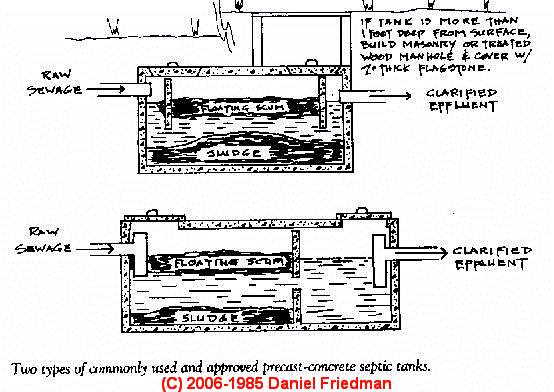
Basically a septic system provides a "holding Tank" (see our septic tank sketch just above) where natural bacterial action decomposes human waste products into environmentally acceptable components - the major end-components being water, mixed with some other components that are not readily consumed by the bacterial action, gases, and undigested solids.
The end products, except the undigested solids, are then discharged to the on-site environment.
What are the Components of a Private Septic System?
 The things that are most obvious are the things seen every day - the sinks, toilets, and pipes in a normal house. What are not visible are the things
that are underground; the things that are underground, and the ground itself, greatly impact how a septic system works.
The things that are most obvious are the things seen every day - the sinks, toilets, and pipes in a normal house. What are not visible are the things
that are underground; the things that are underground, and the ground itself, greatly impact how a septic system works.
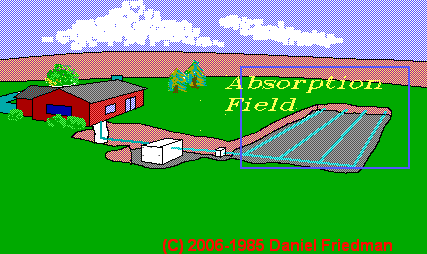
The individual parts of the system are the septic tank, a distribution box, and a leach field. Bacterial action takes place in the septic tank where the end products are mainly water, gases, and undigested material, called sludge that sinks to the bottom of the tank and scum that floats to the top of the tank.
The septic tank contains baffles that prevent any scum that floats to the surface and sludge that settles to the bottom from passing out of the tank.
The gases that are generated vent to the atmosphere via the plumbing vent system. From the septic tank, the segregated and relatively clear liquid flows into a small distribution box where it is then metered out to several perforated pipes.
These perforated pipes then deliver the liquid to a large soil surface area, called a leach field, or absorption field, for absorption.
The soil also acts as a filter to remove any small amounts of solids that may be carried along with the liquid. The sludge in the bottom of the tank must be periodically pumped out and properly disposed of.
There are other kinds of systems for special situations, but the septic tank and leach field is the most widely used system in many areas. The following discussion concentrates on this type of system.
Recommended Articles
SEPTIC SYSTEM DESIGN ALTERNATIVES for septic systems with problem sites, poor soil percolation, limited space: aerobic, dosing, evaporation, gravelless, greywater, lagoon, media filter, septic filters, mounds, raised beds, waterless toilets
HOME BUYERS GUIDE to SEPTIC SYSTEMS inspection & testing - what to do, step by step to inspect and test a septic system when buying a home
...
Where are The Septic System Components Located?
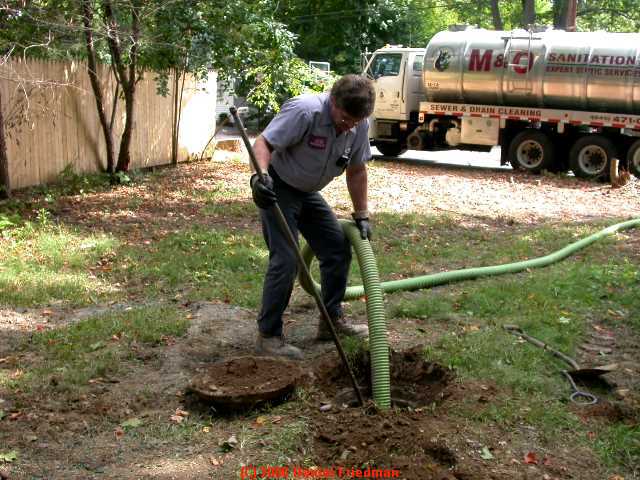 The concrete, or sometimes steel, septic tank is buried in the ground, usually a minimum of 10 feet from the house.
The top of the septic tank is usually about one foot below the soil surface so it can be periodically opened for inspection and pumping. If you do not know for sure where the tank is located, the first step is to locate where the house sewer pipe leaves the house. In a house with a basement, this is where the pipe passes through the wall.
Locating the sewer line exit point may be more difficult for a house with no basement. If the pipe exit can be found, the tank normally begins about 10 feet from the house outside wall and in line with the house sewer pipe.
If the soil is not frozen, you can usually find the tank by pushing a slender metal rod into the ground until it hits the buried tank.
You can buy a metal rod about 1/8 inch in diameter for a few dollars at most hardware stores. Be careful when probing for the tank and avoid hammering the metal rod into the ground - you could break a sewer pipe.
The distribution box is much smaller than the septic tank and is usual found about 20 feet from the house. It too is usually only about one foot below the ground. Again, you can probe the soil carefully to locate the distribution box with a slender metal rod.
From the distribution box, several pipes direct liquid to a series of pipes in trenches called laterals. The pipes in the trenches have holes in them to allow the liquid to be evenly distributed within the trench.
To keep the pipes from being blocked with soil and to provide a space for water to be stored while it is being absorbed by the soil, the pipes are laid in a bed of crushed stone. Above the stone is a soil filter (usually one or two layers of what is called untreated building paper). Above the soil filter is top soil in which grass is planted.
Equally important is WHERE THE COMPONENTS SHOULD NOT BE. If there are wells, either yours or a neighbor's, the leach field must be a minimum of 100 feet from the location of the well. In some areas, the well is not allowed to be down-slope from the leach field.
If there is a stream or pond, the leach field must also be a minimum of 100 feet from the mean high water mark.
Normally, no part of the system should be within 10 feet of a property line. In some areas and in unusual conditions, minimum distances may be greater than those noted here. In addition, no part of the system should be under a porch or driveway and you should not drive heavy vehicles (including automobiles) over the system lest the system be damaged.
Recommended Articles
SEPTIC DRAINFIELD SHAPE: septic drainfield or leaching bed shape and placement considerations
SEPTIC DRAINFIELD LOCATION: how to find the septic drain field or leaching bed
SEPTIC DRAWINGS © drawings of septic system components, fields, layouts. These are educational, not engineering drawings and are © protected. Sample engineering drawings and plans wanted for the website.
SEPTIC & CESSPOOL SAFETY Septic System, Septic Tank, & Cesspool Safety Warnings for Septic Inspectors, Septic Pumpers, and Homeowners
...
Septic System Care and Maintenance
Conventional septic systems are not entirely care free. The undigested solids (sludge) in the bottom of the septic tank should be pumped out every two to four years, depending on usage and tank size. If the sludge is not removed periodically, it will eventually carry over into the leach field and cause the field to fail.
A well designed system can handle a reasonable amount of normal household chemicals such as drain cleaners, laundry detergent and bleach; excessive usage can be detrimental. You should avoid putting in chemicals that are toxic to the bacteria, such as paint thinner, solvents, insecticides, etc. Cooking fats and grease should also be avoided. If a garbage disposal is used, more frequent tank pumping may be needed.
Depending on the size of the tank and your location, plan on a cost of about $200 each time the tank is pumped. When the tank is pumped, your service person should also check the tank baffles for possible damage; ask them to do this inspection before you contract with them.
While the septic tank is open, the service technician can also run some water from a hose into the distribution box to get an indication that the leach field is also still functioning; ask if the company offers this service.
See SEPTIC TANK PUMPING SCHEDULE for a table that helps determine just how often your septic tank should be cleaned.
Recommended Articles
SEPTIC TANK PUMPING SCHEDULE: When, Why, How to Pump A Septic Tank.
SEPTIC TANK, HOW TO FIND - How to Find the Septic Tank, how deep will the cover be, how to document its location
SEPTIC TANK PUMPING PROCEDURE step by step photo guideline of how to pump and clean a septic tank - septic tank care
WHEN NOT TO PUMP A SEPTIC TANK: warnings for home buyers about septic tank pumping
SEPTIC SYSTEM CARE GUIDE - home
TOILETS, DON'T FLUSH LIST these things into a septic system: a list of what's ok and what's not ok to put into septic tanks and building drains
...
Why Septic Systems Fail
If the liquid effluent cannot soak into the soil surrounding the leach field, sewage may back up into the system and overflow into the house or puddle on the surface of the ground. There are several possible causes for this problem.
1. Poor Soil Conditions and Septic System Failures; Faulty Design or Installation of Septic Systems
A leaching system placed in unsuitable soil, a system that is too small for
the house it serves, or an improperly constructed system may lead to early
failure.
2. Soil Clogging and Septic System Failures
If sludge or scum is allowed to escape into the distribution box and from there into the leach field, the soil will quickly become clogged. If this
happens, the liquid will no longer soak, or percolate, into the soil.
This condition can be caused by broken baffles in the septic tank that allow sludge or scum to escape. Failure to have the tank pumped can also lead to a situation where the sludge and scum overwhelm the baffles.
3. High Water Table and Septic System Failures
During wet, or abnormally wet, seasons groundwater may rise into the leach
field and force sewage upward to the ground surface. This condition may mean the system has to be re-installed at a higher level.
It may also be possible to intercept the high groundwater with a series of drains around the system called "curtain drains".
4. Roots and Clogging of Septic System Failures
The roots of trees and bushes planted too close to the system can sometimes
enter and block the pipes of the system. Removal of the plants and clearing the pipes of the roots is usually required.
5. Physical Damage to Septic System Components Causing Septic Failures
Trucks or heavy equipment passing over the system can damage pipes and
joints to the point of rendering the system inoperable. You should be aware of the location of the system and direct traffic to avoid such damage.
Recommended Articles
In order of increasing detailed explanation
SEPTIC FAILURE SIGNS in our Online Septic Book - Details Address: How Does Each Septic System Component Fail? - What to Look For During a Septic Inspection - Step by Step Diagnosis
CLOGGED DRAIN DIAGNOSIS & REPAIR
SEPTIC FAILURE CRITERIA listed by Massachusetts Title 5 Septic Law - a section of the document listed above
SEPTIC SYSTEM TROUBLE: WHAT GOES WRONG in the Home Buyer's Detailed Guide to Septic Systems - Buying a Home With a Septic Tank
GARBAGE GRINDERS vs SEPTICS and garbage disposal units - effects on septic systems and septic maintenance requirements
GRAZING ANIMALS OVER SEPTIC SYSTEMS, is it a problem?
SEPTIC LIFE EXPECTANCY and septic system components
PLANTS & TREES OVER SEPTIC SYSTEMS trees, shrubs, gardens, groundcover over or near the septic system: what can you plant over or near septic system components without causing a problem?
GARDENS NEAR SEPTICS, vegetables, fruits, other types of gardens
...
How Long Should a Septic System Last?
You can expect a conventional septic system, such as that being described here, to last about 30 years. Some systems last much longer and some systems can fail earlier for reasons like those noted above. Other things can also affect the life of a septic system.
For example, a septic drainfield system may have been providing satisfactory service for a previous owner for many years, only to fail shortly after you have bought the house.
If the previous owners were a working couple with no children, the system was probably not heavily used; if yours is a family of six, the added load could push a marginal system over the edge and into failure.
Recommended Articles
SEPTIC LIFE EXPECTANCY and septic system components
...
What are the Signs of a Failing Septic System?
Sewage backup into the home is one possible sign of a failing system. However, backup can also be simply the result of a blockage somewhere between the house and the septic tank (this is relatively easy to fix).
Another possible sign of failure is a smell of sewage outside the house. If this smell is more noticeable after a lot of water has been put into the system - multiple showers or several loads of laundry (if the laundry waste discharges into the septic system), for example - this may be an indication that the leach field is failing.
The smell may also be accompanied by a "spongy" feeling in some areas of the leach field, near the distribution box, or near the septic tank.
The "spongy" feel may be caused by water and waste being pushed to or near ground level. If ponding water is also seen, this is called "breakthrough" and is an almost positive indication of failure of one or more parts of the system. This smell, however, can also originate at the plumbing vent. In either case, further investigation is warranted.
Dye Testing: If you see such signs, a dye test may confirm your suspicions. For this test, a special strong dye is put in the system - usually by flushing it down the toilet. A significant amount of water is then washed into the system.
If there is "breakthrough", the dye will become visible on the ground surface. If the dye is seen on the surface, this would be a very strong indication that the system has failed. Your Home Inspector, a licensed professional engineer, or a septic system contractor can usually
Recommended Articles
CLOGGED DRAIN DIAGNOSIS & REPAIR: diagnosing septic backups and septic system failures versus clogged drains - key step in septic repair, how to diagnose & repair slow or clogged drains; find out if the problem is in a drain or in the septic system, a key step in septic repair
PLUMBING DRAIN NOISE DIAGNOSIS may indicate defective or clogged plumbing: how to diagnose and cure drain sounds
SEPTIC SYSTEM INSPECTION & TEST GUIDE
SEWER GAS ODORS in COLD / WET WEATHER - Septic Odors or Sewage Odor Diagnosis & Repair Guide for diagnosing and eliminating cold weather sewer gas odors
SEPTIC TANK LEVELS of SEWAGE - what are normal and abormal sewage levels in septic tanks and what do they mean about tank condition, leaks, etc.
SEWER GAS ODORS diagnosing, finding, and curing septic tank and sewer line smells
SEPTIC LOADING & DYE TEST PROCEDURE - How to perform this test
...
How To Install Or Repair Septics
If I Plan on Repairing, Installing, or Replacing A Septic System, What should I expect?
There are two major factors involved in adding a new system or repairing or replacing an existing one. The first is the cost; the second is the inconvenience of possibly not being able to use the existing system while a replacement is being installed. For new construction, the second factor is not usually a major consideration.
Repair or replacement cost will obviously depend on what has to be repaired and/or replaced. If the repair does not involve the leach field, the cost may be high, but it will probably not be exorbitant. The least expensive repair will be associated with a broken pipe between the distribution box and the house.
The cost for this type of repair is in the order of several hundred dollars. If only a septic tank needs to be replaced - and the leach field is still undamaged - the cost will be in the order of about $1500 to $2500.
If a new leach field is needed, and there is room for such an installation, you should plan on spending an additional $2000 to $3000 for a typical home. If there is not sufficient room for a new leach field, the existing field, including the clogged soil, must be removed and a completely new system must be installed. Such an effort can easily exceed $10,000.
Recommended Articles
- SEPTIC SYSTEM DESIGN BASICS: choosing septic tank size, leach field Size - basic septic system volume and absorption system design guides.
- SEPTIC SYSTEM DESIGN BASICS
- SEPTIC DRAINFIELD SIZE size and specifications for leach fields, absorption beds, gravelless systems, seepage pits
- SEPTIC SYSTEM DESIGN ALTERNATIVES for septic systems with problem sites, poor soil percolation, limited space: aerobic, dosing, evaporation, gravelless, greywater, lagoon, media filter, septic filters, mounds, raised beds, waterless toilets
- SEPTIC TANK SIZE Septic Capacity - Septic Tank Size vs. Usage, What septic size is required?
- WATER QUANTITY USAGE TABLES Septic Capacity - Based
- on WATER QUANTITY USAGE TABLES: Typical residential water usage for people, appliances, and activities.
- SEPTIC DRAINFIELD SIZE specifications for leach fields, absorption beds, gravelless systems, seepage pits
- King County, WA, SAND MOUND SEPTIC SYSTEM HOMEOWNERS MANUAL [PDF] King County/Seattle Washington, 14350 SE Eastgate Way, Bellevue WA 98007 USA, Tel: 206-477-8050, retrieved 2022/03/07
...
If my Family is Growing and I add a New Bedroom, What Should I Expect?
Septic systems are designed to dispose of household biological waste. The amount of waste to be handled depends on a number of factors. Among these are the number of people living in the house and their lifestyle. After many years of experience, a major guideline in determining the size and capability of a septic system has been correlated to the number of bedrooms in a house.
The number of bedrooms typically determines the number of people generating waste and hence the amount of waste that must be handled. If your family is growing and a new bedroom is needed, then the load on the septic system is also increased. If the septic system capability does not keep up with the increased demand, system failure may occur.
So, how do you determine the septic system needs for your growing family? The following sections deal mainly with sizing a septic system so that it can adequately perform the desired function.
Your design professional can handle the actual testing and number-crunching - but we have provided some standard guidelines developed by New York State to aid you in discussing your options with your contractor. You may not need all this information, but it could help in making your decisions.
...
How Big Should a Septic Tank Be?
Septic tanks are sized according to the amount of liquid waste they must process. This is done by counting the number of bedrooms. In New York State the minimum size tank that can be installed now is 1000 gallons for a 1, 2, or 3 bedroom house.
For each bedroom after 3, add 250 gallons to the size of the tank. If a garbage grinder is in the kitchen sink, it counts as an additional bedroom.
Recommended Articles
SEPTIC TANK SIZE TABLES Septic Tank Capacity vs Usage in Daily Gallons of Wastewater Flow & How to Calculate the Size (in gallons) of a Septic Tank
...
How Big Should the Septic Leach Field Be?
In addition to Mr. Lockwood's nice summary of how to determine the size of a septic field or trench length, readers should
see SEPTIC DRAINFIELD SIZE for details.
Determining the required size of a leach field is a bit more complicated.
Determine soakaway bed (drainfield) soil properties
The first thing to consider is the nature of the soil in which the leach field is to be constructed. Because water has to be absorbed in the soil, we need to know how fast it can be absorbed. This is called the percolation rate and is expressed as the time it takes for water in a test hole to decrease in level by one inch (minutes/inch).
We must also know the type of soil and whether seasonal changes in the natural level of groundwater will interfere with the satisfactory operation of the system. Seasonal groundwater must be more than four feet from the bottom of the leach field trenches. Judgments regarding the soil conditions and percolation rates are best left to a professional.
If the soil percolates very quickly, (less than one minute per inch) or very slowly (greater than 60 minutes per inch) it will not be possible to install a standard leach field in the existing soil.
Determine daily wastewater flow volume
We must now determine the amount of water that has to be absorbed each day. As with the septic tank sizing, there are also "rules of thumb" that can be used to find out how much water must be absorbed each day for each bedroom in the house (expressed as gallons per day per bedroom).
For older houses (built before 1979) we must allow 150 gallons per day (gpd) per bedroom. For houses where the toilets are limited to no more than 3.5 gallons per flush and the faucets and showerheads are limited to 3 gallons per minute or less, we must allow 130 gpd per bedroom.
For houses with water-saving toilets that use only one gallon per flush we allow 90 gpd per bedroom. The required flow rate is found by multiplying the appropriate flow by the number of bedrooms (in this case, we do not have to count a garbage disposal as a bedroom).
Knowing the rate at which water can be absorbed by the soil (the percolation rate) and the flow rate (in gallons per day), we can use the following table to calculate how many square feet of absorption field is needed.
Please see SEPTIC DRAINFIELD SIZE and specifications for leach fields, absorption beds, gravelless systems, seepage pits, where we give tables that easily determine the required septic absorption field size for various occupancy levels, wastewater flows and site conditions such as soil percolation rate.
Soil with a percolation rate less than 1 minute per inch or more than 60 minutes per inch is unsuitable for a conventional system. In that case you'll want to
see SEPTIC SYSTEM DESIGN ALTERNATIVES
Recommended Articles
How to Calculate the Required Size of the Leach Field - or Absorption Bed
Required Soak-Bed Area (square feet) = Flow Rate (gallons per day) / Application Rate (gallons per day per square foot).
...
Calculate the Required Number of Feet of Septic Leach Field Trench
Now that we know the number of square feet of absorption field that is needed, we can divide by the width of each trench to see how many feet of trench is required. The normal trench width is two feet.
Let's do a sample calculation to see how this works.
Assume you are buying a 3-bedroom house that was built in 1971. The leach field has failed and a new one must be installed. You have had a percolation test performed and the design professional has determined that the soil is suitable, the groundwater conditions are acceptable, and the percolation rate is 32 minutes per inch. How big an absorption field will be needed?
Since the house was built before 1979, the flow rate is 3 bedrooms times 150 gallons per day per bedroom, or 450 gallons per day. [Alternatively you can estimate daily water usage and thus the approximate daily waste water volume or "Flow Rate" (gallons per day) in Lockwood's equation by using
these WATER QUANTITY USAGE TABLES daily water usage chart.--DF
From the table above, the application rate is 0.5 gallons per day per square foot for a percolation rate of 32 minutes per inch.
The required trench area is then 450 gallons per day divided by 0.5 gallons per day per square foot. By this calculation you will need 900 square feet of absorption area. If the absorption trenches are 2 feet wide, you will need a total of 450 feet of absorption trench.
Most health codes limit the length of any one trench (called a lateral) to no more than 60 feet, the minimum number of laterals is 450 feet divided by 60 feet per lateral, or 7.5 laterals. Where property conditions permit, it is best to keep the laterals the same length, so your design professional may specify 8 laterals, each 60 feet long.
But what if there is only room on the property for laterals that are 45 feet long. In this case, you would need 10 laterals, or trenches. In addition to the area needed for the leach field, you should also allow room for possible expansion (50% expansion area is required in New York State).
[When a leach field fails, if adequate area was reserved on the property in the area of the original field, the repair process may permit installation of new leach lines in between the existing set of trenches (perhaps this is covered in the "50% expansion" cited above.
But additional requirements for the location, size, layout, and trench lengths in the leach field must also consider clearances from property boundaries, wells, and other encumbrances, and variations in site conditions (area of buried rock, slope, trees, etc.).
So the table and calculation approach shown here probably gives the minimum area for the soil absorption system to adequately treat the effluent discharged from the septic tank.
SEPTIC SYSTEM DESIGN ALTERNATIVES can substantially reduce the required soil absorption field area and in some instances can eliminate it entirely. --DF]
Recommended Articles
SEPTIC DRAINFIELD SIZE size and specifications for leach fields, absorption beds, gravelless systems, seepage pits
SEPTIC SYSTEM DESIGN ALTERNATIVES for small, rocky, or low-perc sites
...
What is grey water or a graywater system?
Gray water is usually water from a laundry system, perhaps the effluent from a sump pump, the foundation footing drains, roof runoff, and sometimes shower drains. This water usually does not contain human waste products and does not need to be digested like human waste.
The disposal requirements for this type of water are less stringent than those for human waste. If there is a space problem on your site, it may be possible to segregate the gray waste from the human waste and minimize the size of the system needed for control of the human waste. Your design professional (Licensed Engineer or Registered Architect) can advise you of your options in this area.
Recommended Articles
GREYWATER SYSTEMS designs, products, explanation
...
Alternative (Other Types of) Septic Systems for Onsite Wastewater Treatment & Disposal
The system discussed above is a conventional system installed in the soil that exists on the site. Where the site conditions do not lend themselves to installing this type of system, there are alternatives.
For example, if ground water or percolation rates are unsuitable, it may be possible to install what is called a "mound" system. In a mound system, a suitable soil is placed above the unsuitable soil. A conventional system is then installed in the mound. There are some additional requirements for this type of design.
If there is not enough room for a conventional leach field, it may be possible to install one or more cesspools, or seepage pits. These units are usually round, require less open ground, and are deeper than a conventional leach field. Again, there are specific requirements for these systems.
Conventional, mound, and seepage pit systems all work by what is called anaerobic bacterial action. This means the bacteria work without oxygen. Some systems are designed to be aerobic - meaning the bacteria need oxygen (air); There are also hybrid systems that use a combination of anaerobic and aerobic sections.
Your design professional will advise you if one of the non-conventional systems is best for your needs.
Recommended Articles
SEPTIC SYSTEM DESIGN ALTERNATIVES for small, rocky, or low-percolation soil sites
- Portions of the original text for this article were contributed by Lockwood, Dietershagen Associates [1]
...
Thank you to our readers for their generous comments
Thank you for the great info. Moved to the country for the first time and been having issues. This explained a lot! On 2011-07-13 by Matt
Boy, did I learn a lot in a small amount of information from this. Much better explanation than what my Sanitarian Engineer that I've been dealing with has spoken about.
This finally helps me understand what the problems are with my system and (almost) helps me understand why my Board of Health is enforcing its new rules against my old house to my di$may. On 2011-05-04 by SavannahSue
Thanks so much for this information. I want to build a subdivision in Vermont in three years. You have been helpful. On 2011-04-23 by From Genie : gnterwilliger@chart
Thanks for making this easy to understand for being so thorough. On 2012-03-14 by Anonymous
Great article. On 2011-11-01 by Aaron
...
...
Continue reading at SEPTIC SYSTEM CARE GUIDE- home, or select a topic from the closely-related articles below, or see the complete ARTICLE INDEX.
Or see SEPTIC TANK & SYSTEM CARE BASICS FAQs - questions & answers posted originally at the end of this page
Or see these
Recommended Articles
- SEPTIC DRAINFIELD LIFE
- SEPTIC LIFE EXPECTANCY
- SEPTIC LIFE MAXIMIZING STEPS
- SEPTIC SYSTEM CARE GUIDE- home
- SEPTIC SYSTEM TROUBLE: WHAT GOES WRONG
- SEPTIC TANKS - home
- SEPTIC TANK & SYSTEM CARE BASICS
- SEPTIC TANK PUMPING SCHEDULE
- TEN STEPS to KEEP a SEPTIC SYSTEM WORKING
Suggested citation for this web page
SEPTIC TANK & SYSTEM CARE BASICS at InspectApedia.com - online encyclopedia of building & environmental inspection, testing, diagnosis, repair, & problem prevention advice.
Or see this
INDEX to RELATED ARTICLES: ARTICLE INDEX to SEPTIC SYSTEMS
Or use the SEARCH BOX found below to Ask a Question or Search InspectApedia
Ask a Question or Search InspectApedia
Share this article:Ask a Question or Search the InspectApedia website using the box just below.
Need to make a private comment? Email editor@inspectApedia.com. We welcome email with your website content critique, corrections, suggestions or questions. Email is monitored daily but our workload may prevent an immediate reply. For immediate results, we hope you'll first try asking your question using the search box just above.
Citations & Reviewers
In addition to any citations in the article above, a full list is available on request.
- New York State Department of Health, APPENDIX 75-A WASTEWATER TREATMENT STANDARDS - INDIVIDUAL HOUSEHOLD SYSTEMS , [PDF] New York State Department of Health, 3 February 2010, retrieved 3/1/2010, original source: https://www.health.ny.gov/regulations/nycrr/title_10/part_75/appendix_75-a.htm
- [1] Lockwood, Dietershagen Associates Licensed Professional Engineers 1 Earl M. Court Clifton Park, New York 12065 (518) 371-2027
- The Plumbers's Handbook, Howard C. Massey, Craftsman Book Company; Rev Sub edition (April 1998), ISBN-13: 978-1572180567 includes septic system design basic sketches and specifications.
- Thanks to reader Michael Roth for technical link editing 6/29/09.
- SEPTIC TANK CAPACITY VS USAGE in Daily Gallons of Wastewater Flow, calculating required septic tank size, calculating septic tank volume from size measurements
- Table of Required Septic & Well Clearances: Distances Between Septic System & Wells, Streams, Trees, etc.
- Pennsylvania State Wastewater Treatment Fact Sheet SW-161, Septic System Failure: Diagnosis and Treatment
- Pennsylvania State Wastewater Treatment Fact Sheet SW-162, The Soil Media and the Percolation Test
- Pennsylvania State Wastewater Treatment Fact Sheet SW-l64, Mound Systems for Wastewater Treatment
- Pennsylvania State Wastewater Treatment Fact Sheet SW-165, Septic Tank-Soil Absorption Systems
- Document Sources used for this web page include but are not limited to: Agricultural Fact Sheet #SW-161 "Septic Tank Pumping," by Paul D. Robillard and
Kelli S. Martin. Penn State College of Agriculture - Cooperative Extension, edited and annotated by Dan Friedman (Thanks: to Bob Mackey for proofreading the original source material.)
- Wells and Septic System, Alth, Max and Charlet, Rev. by S. Blackwell Duncan, $ 18.95; Tab Books 1992. We have found this text very useful for conventional well and septic systems design and maintenance --DF.
- The NSFC Products List has an excellent list of design manuals/modules National Small Flows Clearinghouse (NSFC) now (2019/12/13) hosted at http://www.nesc.wvu.edu/ Tel: 304-293-4191 e-mail info@mail.nesc.wvu.edu.
- In addition to citations & references found in this article, see the research citations given at the end of the related articles found at our suggested
CONTINUE READING or RECOMMENDED ARTICLES.
- Carson, Dunlop & Associates Ltd., 120 Carlton Street Suite 407, Toronto ON M5A 4K2. Tel: (416) 964-9415 1-800-268-7070 Email: info@carsondunlop.com. Alan Carson is a past president of ASHI, the American Society of Home Inspectors.
Thanks to Alan Carson and Bob Dunlop, for permission for InspectAPedia to use text excerpts from The HOME REFERENCE BOOK - the Encyclopedia of Homes and to use illustrations from The ILLUSTRATED HOME .
Carson Dunlop Associates provides extensive home inspection education and report writing material. In gratitude we provide links to tsome Carson Dunlop Associates products and services.
 |
HOME | ABOUT | ASK a QUESTION | CONTACT | CONTENT USE POLICY | DESCRIPTION | POLICIES | PRIVACY | |
| © 2026 - 1985 Publisher InspectApedia.com - Daniel Friedman | |||||||||