 Using a Cesspool for onsite septic wastewater disposal.
- POST a QUESTION or COMMENT about cesspools for onsite wastewater disposal: cesspool construction, installation, maintenance, repair & safety
Cesspool type septic systems:
This article explains what a cesspool is, gives important safety and maintenance advice for cesspool systems, and defines the criteria for cesspool failure.
We also provide critical safety warnings concerning cesspool systems as with some older and especially site-built cesspools there is a risk of dangerous collapse or cave-ins.
InspectAPedia tolerates no conflicts of interest. We have no relationship with advertisers, products, or services discussed at this website.
- Daniel Friedman, Publisher/Editor/Author - See WHO ARE WE?
Guide to Using a Cesspool for Onsite Sewage Disposal - properties of cesspools used for onsite wastewater disposal
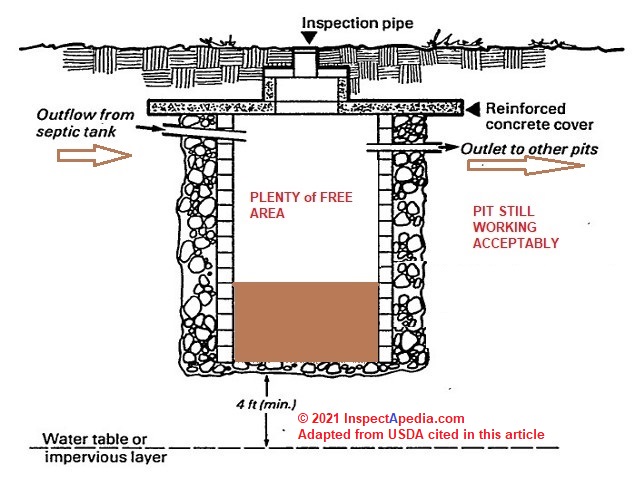 What is a cesspool? A cesspool combines the septic treatment tank and absorption system into a single component. A cesspool is not a septic tank and does not work like one.
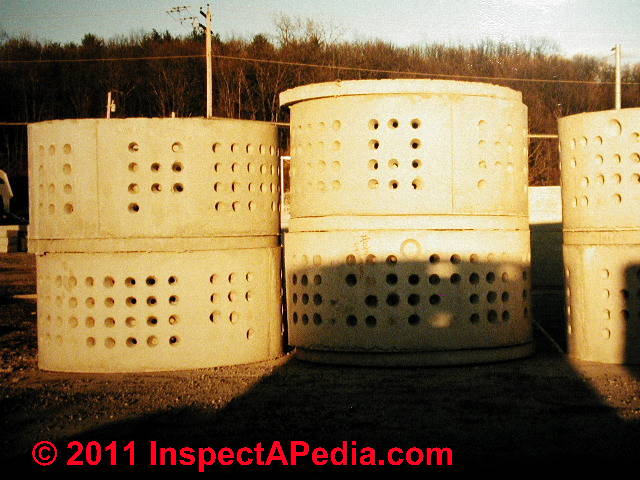
In its most basic and traditional form a cesspool is a hole in the ground to receive sewage: the walls of the "hole" are lined with stone or concrete block or (safer) pre-cast concrete (photo) to form a masonry-lined pit into which sewage is discharged. Solids (sewage from the building) remain in the pit, effluent is absorbed into soil below and at the sides of the cesspool.
Solids settle to the bottom, floating grease and scum collect at the top, and liquid seeps into the ground, initially through the bottom and most of the time through the side of the cesspool.
Cesspools as a means to dispose of sewage have been around since the late 1400's at the beginning of the Renaissance. (Before that people simply tossed their night soil into the street.)
While cesspools have been used for a long time, since the development of the more modern septic system (tank and drain field) cesspools have often used where there is limited physical space (no room for a leach field), and perhaps where the soil absorption rate was high such as areas of gravel or sandy soils.
For most buildings and onsite waste disposal installations which use a "cesspool", you should consider the use of a cesspool as an obsolete, limited capacity system likely to need replacement, and involving significant cost. Some immediate concerns are stated next.
Cesspool Failure Criteria
Failure Criteria for Cesspools is given by this basic but widely-used definition of a failed cesspool that needs replacement:
If the waste level is within 12" of the inlet pipe near the top of a cesspool the system is at end of life and needs to be replaced.
Some municipalities and experts will state other distances.
In the U.S. in Massachusetts according to the Massachusetts Title 5 Septic Law the following are considered a failed or unacceptable cesspool installation:
- Less than 6inches of freeboard in the cesspool - this means that the top of sewage inside the cesspool is within six inches of the bottom of the inlet pipe
- Less than 1/2 day's storage - the free volume (air) inside the cesspool is less than will hold the number of gallons of waste and wastewater equaling the typical daily use of the cesspool system
- Cesspools located within100 ft. of a pond or dug well (surface water supply) are unacceptable
- Cesspools located within 50 ft. of a private well (modern sanitary well) are unacceptable
- Cesspools located between 50 and 100 ft from a private well if the well fails bacteria test are also unacceptable
- In some states including Massachusetts, cesspools located within Zone 1 of a public well are considered failed and unacceptable
- In most jurisdictions, board of health (BOH) evaluation is required if a cesspool is located within 50 feet of any surface water such as a lake, pond, stream, or river.
A cesspool needs replacement
if it meets any of these failure criteria. While a septic company may offer to pump, partially pump out, or agitate or aerate the bottom sludge in the cesspool in an effort to extend its life, these procedures are potentially very dangerous and at best will give only temporary relief.
Where a new cesspool of traditional sort is going to be installed you should at least use a concrete pre-cast model with a safe cover (see photos at left and above).
Fortunately there are alternative onsite wastewater disposal alternative designs which can handle limited or even zero-space sites, so a simple cesspool as a destination for blackwater is no longer the only choice for limited-space sites.
Are Cesspools Even Legal?
Watch out: cesspools are not legal for use as wastewater treatment and disposal systems. In some areas existing cesspools used for wastewater handling [no conventional cesspool adequately treats wastewater] may be "grandfathered" in and permitted to continue in use.
But home buyers purchasing a property served by a cesspool should keep in mind not only the limited function of such systems but the significant cost that will be faced when the system is no longer functional - because at that time the local authorities may require that a different, more effective wastewater treatment system be installed, such as a septic tank and drainfield. And space limitations on a property can cause real trouble when the cesspool has to be abandoned.
Cesspools are flatly declared "not legal for use as wastewater treatment and disposal systems" in other jurisdictions such as in the Alaska state sanitary code. [4]
Cesspool Safety Warnings and Cesspool Capacity Limitations
Very Important Cesspool Safety Warnings
- Safety Warning: do not walk over the top of or close to the edges of a cesspool or any other onsite pit or excavation because of the danger of fatal collapse. Keep pets and children away from such systems.
- Safety Warning: there is a high risk of cesspool collapse, risking fatality if someone falls in to one of these systems. This is particularly true for older site-built systems that were often made of dry-stacked stone or concrete block, and more-so if such systems are not protected by a very secure cover.
- Safety Warning: pumping cesspools is dangerous since older site-built systems may be more likely to collapse inwards when relieved of their contents.
- Safety Warning: hydrojetting, aerating or agitating sludge at the bottom of a cesspool in an attempt to renew its function or extend its life also risk system collapse, particularly for site-built or home made cesspools.
In summary about cesspool hazards: watch out for cave-ins,
keep away: cesspools, particularly older site-built cesspools present a very high risk of collapse from an unsafe cover or following some types of service involving pumping, aeration, or hydro-jetting.
Adults or children should not walk over or even near cesspools
because of the risk of falling-in followed by collapse, a virtually certain cause of death. If the presence of a cesspool is known or suspected at a property its location should be roped off to prevent access and it should be investigated by a professional.
Cesspool Capacity and Testing Limitations
Cesspools can obscure or prevent effective septic loading and dye testing:
If a cesspool is in use at a property a septic dye test would not be a reliable indication of good system condition since the test could simply be trying to fill a large near-empty hole in the ground; yet such a system may fail soon after being returned to active or heavier regular use.
Cesspool Treatment Chemicals
Using lime in a cesspool?
Our reader asked:
Does lime help to break down the walls in a cespool. My friend said to dump a 50 pound bag in. He said his friend did it and it ate the walls and his pit is working great. He also said he saw cracking in the side walls and after adding the lime the sides of the walls basically fell in. This was concerning to me. - Lance 5/11/12 (originally asked at SEPTIC TREATMENTS & CHEMICALS)
Reply: do not add lime to a cesspool; watch out for fatal cesspool collapse hazards
Lance:
A cesspool is intended to treat the sewage it receives, discharging effluent into soils around the cesspool itself.
While there is a sound argument that no cesspool adequately treats raw sewage and thus none is really sanitary, dumping lime into the cesspool is going to kill off cesspool bacteria, hastening its ruination and reducing still further its treatment of sewage. It would be a mistake. Your friend is mistaken and is likely to cost you plenty.
Watch out: cracking in the cesspool sides, if you mean the structure of the cesspool, is would be extremely dangerous, risking a cesspool collapse. There have been fatalities from just that cause when someone fell into and was buried alive in a collapsing cesspool.
If you do not know the condition and safety of your cesspool cover and structure, or if there is any indication of cracking or shifting of the cesspool, you should immediately block off all access to the area while you wait for an experienced contractor to excavate, diagnose, and repair or replace the system.
Details are at CESSPOOL SAFETY WARNINGS.
This material is a chapter of our Septic Systems Online Book that explains septic system inspection procedures, defects in onsite waste disposal systems, septic tank problems, septic drainfield problems, checklists of system components and things to ask. Septic system maintenance and pumping schedules.
Home buyers who want less technical advice should see
the HOME BUYER's GUIDE to SEPTIC SYSTEMS to Septic Systems.
Using hydrogen peroxide in a cesspool?
Our reader said:
I was told by a Bio tech company that sells bacteria for cesspools to use hydrogen peroxide 30 gallons after pumping 3/4 out. We have been
Putting in bacteria for 2 years and the level is still about 2 feet down.
Level goes up and down but never lower than 2 feet. Have you heard of peroxide to open up soil? And do you know what is acceptable level. We had a back up into the house 2 years ago and pumped out and began the bacteria tx then. Thanks for any info (Oct 21, 2014) Maureen
Reply:
Maureen,
Using ANY chemical or treatment that kills the required bacteira that make a septic system or cesspool work is a terrible idea and is not recommended by any proper septic authority.
See SEPTIC TREATMENTS & CHEMICALS for details
Cesspool References & Research
- See also the Cesspool Articles at the page bottom RECOMMENDED ARTICLES List
Notice that some authorities simply prohibit the use of cesspools and may require that existing ones be properly and safely abandoned. - ARIZONA ADMINISTRATIVE CODE 18 A.A.C. 9 Supp. 18.3 www.azsos.gov, TITLE 18. ENVIRONMENTAL QUALITY, CHAPTER 9. DEPARTMENT OF ENVIRONMENTAL QUALITY - WATER POLLUTION CONTROL [PDF] - retrieved 2022/03/26, original source: Department of Environmental Quality
1110 W. Washington St.
Phoenix, AZ 85007
Telephone: (602) 771-6176
E-mail: dunaway.david@azdeq.gov
Website: http://www.azdeq.gov/draft-and-proposed-rulewater-quality-division
Excerpt:
R18-9-A309. General Provisions for On-site Wastewater Treatment Facilities A.4
A person shall not use a cesspool for onsite sewage disposal.
- Amendments to N.J.A.C. 7:9A Regarding Cesspools and Inspections for Real Property Transfers - An Update [PDF] - original source: nj.gov/dep/dwq/pdf/tnef2.pdf
- CESSPOOLS in HAWAII, [PDF], retrieved 2016/06/26, original source: health.hawaii.gov/wastewater/cesspools/
...
Reader Comments, Questions & Answers About The Article Above
Below you will find questions and answers previously posted on this page at its page bottom reader comment box.
Reader Q&A - also see RECOMMENDED ARTICLES & FAQs
What kind of cesspool should we install based on our soil perc test results?
We had a test boring done in the only place we can put a new cesspool and the results were Perched Water: 6'1" comment possible stream. Estimated Actual Ground Water Level 18' O +/-
My question is how and what kind of cesspool can be put in under these conditions (Oct 1, 2014) perne construction
Reply: none.
Perne
I would not install any kind of cesspool - as that approach to wastewater disposal does not effectively treat the effluent (not enough aerobic bacteria) and as cesspools are not permitted in new construction in most jurisdictions.
If your lot space is very small you may need an advanced wastewater treatment system, even an aboveground one such as Jantrania discusses. It's time to ask for help from a septic design engineer.
Read about the severe limitations of cesspools as "septic systems"
at CESSPOOLS
Can I connect a new septic tank to the existing cesspool?
If my cesspool works great but my solids tank has failed is it legal to replace the solids tank but connect the new tank to the cesspool instead of building a leach field? On 2021-06-05 by Alicia
by mak.church (mod)
@Alicia,
If you have a 'solids' tank (septic tank), then I suspect you have a 'seepage pit' vs. a 'cesspool'. The following article will define both and how to distinguish the difference.
SEEPAGE PITS
Watch out: cesspools and seepage pits may dispose of effluent but they don't treat it; the risk is contaminated nearby wells, streams, etc.
Depending on the jurisdiction, the local authorities may not permit replacing an old seepage pit or cesspool or just the septic tank, so it'd make sense to start with your local building or plumbing department. The local code inspector is the final legal authority.
Let us know if you have additional questions.
How can I fix a cesspool that is filled up ?
If my cesspool is filling up with water and not seeping into the soil. Is it because a bio mat is clogged? And if so how can I fix this problem? - On 2020-11-24 by Joe
by (mod) - it cannot be repaired; you need a new cesspool or better, a septic drainfield or mound system
Joe
Sorry to say there is no durable useful fix for a cesspool that is at the end of its life.Although there are methods of people used to try to slightly extends the life such as jetting or probing or partial pumping of the cesspool:
Watch out: These approaches have a short benefit and furthermore in some cases can make the cesspool unsafe by damaging its walls or cover.
I'm aware of fatalities resulting from just that condition.
So what people usually do is to install a new Cesspool nearby. Sometimes the installer can simply pipe the existing Cesspool Outlet opening into the new cesspool that avoids having to completely remove the old one.
What is the liquid disposal rate of a cesspool ?
How much liquid should a cesspool weep out in a 24 hour period in Pa. ? jbhm3782@yahoo.com On 2020-06-30 by Jim B.
by (mod) - here are the determining factors for a cesspool's capacity
Jim
The question of the liquid disposal rate of a cesspool is an interesting one but not one for which there can possibly be a single "right answer".
The rate at which liquid effluent seeps out of a cesspool and into surrounding soils for disposal depends on some very significant variables that will be quite different from one installation and site to another, such as (this probably isn't the whole list of cesspool disposal rate factors)
- the size of the cesspool- the construction of the cesspool, materials, openings, quality of surrounding gravel
- the depth of the cesspool
- the percolation rate of the surrounding soil
- the daily wastewater volume flowing into the cesspool
- the cesspool's age and condition: cesspools ultimately clog and stop disposing of effluent entirely
If your question is prompted by evidence of a problem with your cesspool, you will want to take a look at
CESSPOOL FAILURE CRITERIA
...
Continue reading at CESSPOOL FAILURE CRITERIA or select a topic from the closely-related articles below, or see the complete ARTICLE INDEX.
Or see these
Recommended Articles
- CESSPOOLS
- CESSPOOL FAILURE CRITERIA
- CESSPOOL AGE ESTIMATES
- CESSPOOL SAFETY WARNINGS
- CISTERNS, WATER STORAGE
- DRYWELL DESIGN & USES
- HOLDING TANK SEPTIC SYSTEMS
- GREYWATER SYSTEMS
- SEEPAGE PITS
- SEPTIC TANK ABANDONMENT GUIDE
- SEPTIC TANK, DRAINFIELD INSTALLATION
- SEPTIC TANKS - home
- SEWER GAS ODORS - home
- SEWER GAS ODORS in COLD / WET WEATHER
Suggested citation for this web page
CESSPOOLS - topic home, at InspectApedia.com - online encyclopedia of building & environmental inspection, testing, diagnosis, repair, & problem prevention advice.
Or see this
INDEX to RELATED ARTICLES: ARTICLE INDEX to SEPTIC SYSTEMS
Or use the SEARCH BOX found below to Ask a Question or Search InspectApedia
Ask a Question or Search InspectApedia
Share this article:Search the InspectApedia website
Need to make a private comment? Email editor@inspectApedia.com. We welcome email with your website content critique, corrections, suggestions or questions. Email is monitored daily but our workload may prevent an immediate reply. For immediate results, we hope you'll first try asking your question using the search box just above.
Citations & References
In addition to any citations in the article above, a full list is available on request.
- In addition to citations & references found in this article, see the research citations given at the end of the related articles found at our suggested
CONTINUE READING or RECOMMENDED ARTICLES.
- Carson, Dunlop & Associates Ltd., 120 Carlton Street Suite 407, Toronto ON M5A 4K2. Tel: (416) 964-9415 1-800-268-7070 Email: info@carsondunlop.com. Alan Carson is a past president of ASHI, the American Society of Home Inspectors.
Thanks to Alan Carson and Bob Dunlop, for permission for InspectAPedia to use text excerpts from The HOME REFERENCE BOOK - the Encyclopedia of Homes and to use illustrations from The ILLUSTRATED HOME .
Carson Dunlop Associates provides extensive home inspection education and report writing material. In gratitude we provide links to tsome Carson Dunlop Associates products and services.
 |
HOME | ABOUT | ASK a QUESTION | CONTACT | CONTENT USE POLICY | DESCRIPTION | POLICIES | PRIVACY | |
| © 2026 - 1985 Publisher InspectApedia.com - Daniel Friedman | |||||||||