
InspectAPedia® FREE Encyclopedia of Building & Environmental Construction, Diagnosis, Maintenance & Repair |
Question? Just ask us! InspectAPedia
|
 Septic Tank Condition - How to Inspect Septic Tank Baffles
- POST a QUESTION or COMMENT about how to find, inspect, and troubleshoot the septic tank baffles or tees
Guide to septic tank baffles & tees:
This document describes how to inspect the condition of septic tank baffles at the septic tank inlet baffle and septic tank outlet baffle ports.
Septic tank baffles are a key component of septic tanks which prevent damage to the drainfield by reducing effluent agitation as sewage enters the septic tank, and by preventing solids from flowing out of the tank to the drainfield.
If the septic tank baffles are damaged, missing, or were never provided in the first place, the life of the drain field or leach field will be seriously shortened. Inspecting concrete septic tanks is a key component in onsite wastewater disposal systems.
InspectAPedia tolerates no conflicts of interest. We have no relationship with advertisers, products, or services discussed at this website.
SEPTIC TANK BAFFLES - Inspect the Condition of Septic Tank Baffles
 [Click to enlarge any image]
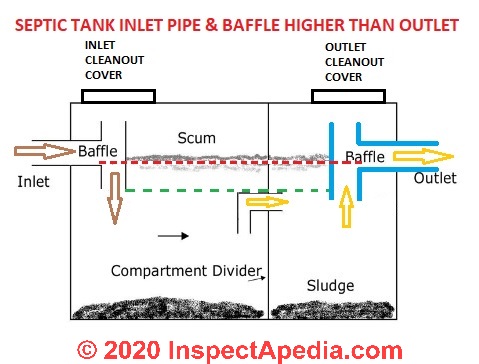
In the sketch at left the inlet and outlet septic tank baffles or "tees" are shown in brown and light blue respectively. You can see that the inlet tank baffle or tee will direct incoming wastewater down into the tank (not zooming across a tank to rush to the outlet opening).
Article Contents:
Forcing the incoming sewage to make a right turn (down) also slows its impetus. This turn and downwards direction are even more critical in a one-compartment septic tank.
Image adapted from Alaska DEC [3] The dashed lines illustrate the liquid level (red) and the difference in elevation (green) between the inlet and outlet septic tank pipe connections.
You can see that both of these septic tank baffles or tank tees keep the floating scum and grease from blocking the septic tank inlet (at left) and importantly, the tee or baffle keeps the floating scum and grease from exiting the septic tank outlet (where it would clog the drainfield). If these components have been lost or damaged in your septic tank they need to be replaced or repaired, as we explain here.
If at the septic tank outlet the baffles are damaged or missing, or if no replacement "tee" has been installed, you can be sure that sewage has been pushed into the drainfield or absorption system, reducing its future life by speeding soil clogging there.
How to Find & Repair Lost or Rusted Septic Tank Baffles
If septic tank baffles are lost or damaged (rusted off on a steel tank or broken off on a concrete tank), they can be repaired or replaced.
For example at a steel tank the contractor may simply insert a plastic piping "Tee" into the tank inlet or outlet to create a new baffle system.
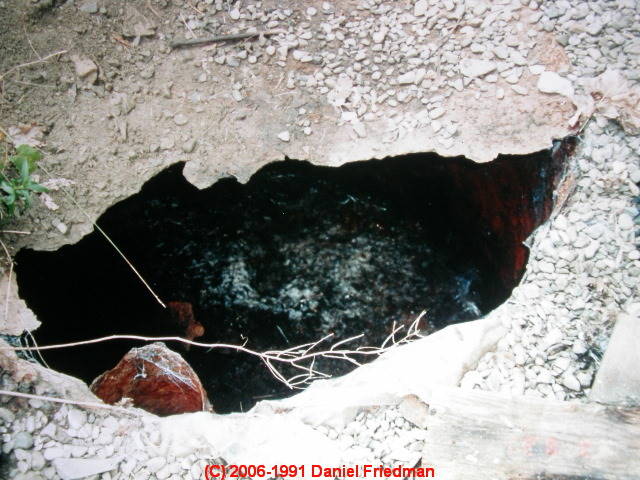
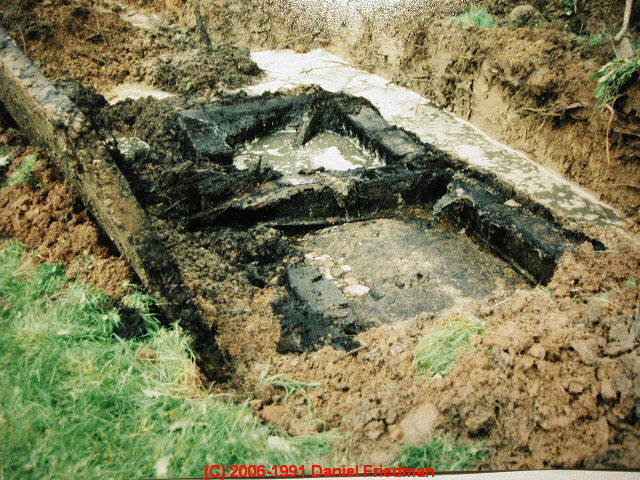
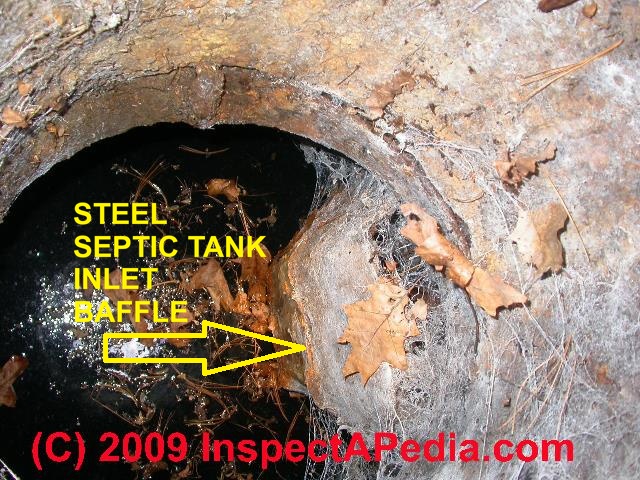
Baffles in a septic tank are provided to keep solids and floating scum and grease inside the tank. Baffles are provided at both the inlet to the tank (from the building) and the outlet from the tank (to the absorption system). The steel septic tank shown above at left has a baffle that is rusted away at its top.
On pumping this old steel septic tank one expects to see the baffle bottom has rusted off too. The home made septic tank shown above at right had no inlet baffle and a broken outlet baffle, factors in the rapid destruction of the leach field for this septic system.
 Broken septic tank baffles or high sludge levels can cause solids to flow out of the tank and into the absorption system. The result is reduced absorption into surrounding soil and eventual failure of the system.
Floating scum thickness and settled solids thickness can be measured through access ports into the tank or cesspool.
Our photo (left) shows an old steel septic tank with the baffle at the right side of the photo. Just touching the baffle with a tool showed us that it was rusted and collapsing.
This septic tank was pumped out, filled-in, and abandoned. But had the owners intended to use it they'd have needed to excavate the tank to install a baffle.
Finding solids at or covering the outlets or damaged baffles should result in report of a very questionable absorption system and possible major repair cost.
Depending on how long the tank was used without good baffles, the volume of solids and grease that moved from the tank to the absorption system will have begun clogging soils there and will have reduced the future life expectancy of the absorption system.
Baffle damage and repair, or even a complete tank replacement when the absorption system has been left alone always lead the author to warn the building owner that the future life of the absorption system may be in doubt and that additional expense will be involved.
See SEPTIC TANK TEES for instructions on how to install septic tank tees when septic tank baffles are damaged or missing.
Steel septic tanks beyond repair
Below: a steel septic tank rusted way beyond the point of being repairable, courtesy of Lawrence Transue.
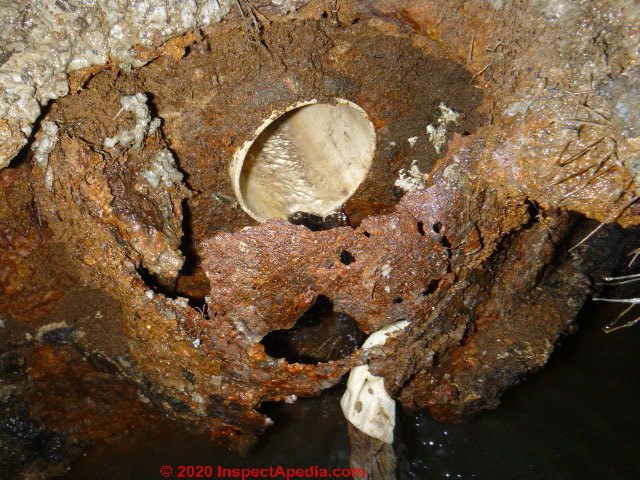
This septic tank is unsafe, not repairable, and needs replacement; you should assume that the drainfield life has been seriously reduced by the condition of the septic tank as there is no protection against pushing solids into the drainfield.
Watch out: this septic tank is unsafe, risking fatal collapse should someone walk on or even near it. The tank should be roped off and protected against access by anyone until it can be replaced.
Concrete Septic Tank Baffle Inspection
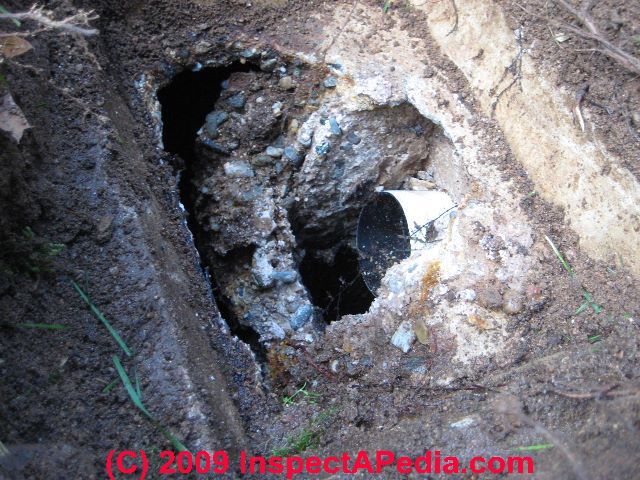
Inspect for Damaged Septic Tank Baffles at Inlet & Outlet:
The condition of the septic tank baffles tells you what has been happening in the septic system.
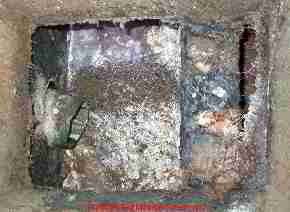
Our photo , compliments of architect Jerry Waters, shows a badly deteriorated concrete septic tank baffle. Details of the septic tank baffle repair, involving installing a PVC tee in this septic tank, are shown
at SEPTIC TANK TEES.
Concrete septic tank baffles may erode from chemicals, detergents, poor concrete mix, water flowing over top of baffles, or may be broken by improper pumping procedures.
Look for evidence that the floating scum layer is over or has ever been over the tank baffles - an indication of system failure that needs further investigation.
Inspecting for Septic Tank Baffle Overflow
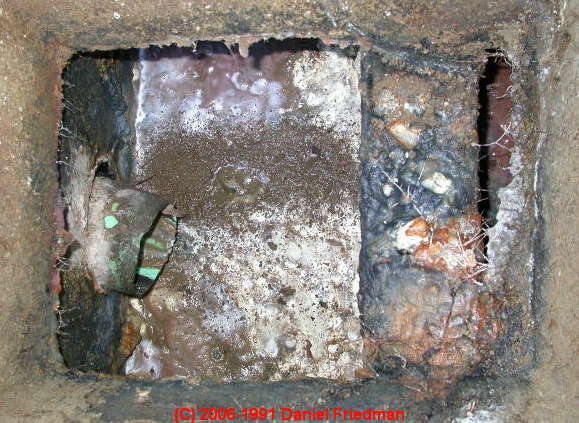 When a septic tank is opened for tank pumping at a center cleanout port the baffles are not easily visible except indirectly by mirror or camera held inside the tank.
However for this case we opened and inspected the septic tank inlet baffles.
When a septic tank is opened for tank pumping at a center cleanout port the baffles are not easily visible except indirectly by mirror or camera held inside the tank.
However for this case we opened and inspected the septic tank inlet baffles.
This photo shows inlet sewer line (green pipe at left) and concrete baffle (at right) at the inlet end of a 1000 gallon concrete septic tank which is in use.
While the sewage level looks normal in the tank at the time of this photo, the sewage atop the concrete tank baffle suggested that the septic tank had been flooded in the past.
We were concerned by the evidence that sewage had been flowing over the top of the baffle - an abnormal condition that could suggest a prior blockage either at the tank inlet baffle or at the tank outlet.
We decided to pump the tank, clean it, and inspect it further. The step by step septic tank opening, pumping, and inspection procedure are documented
at SEPTIC TANK PUMPING PROCEDURE.
Flooded Septic Tanks due to Leaks Into the Septic Tank
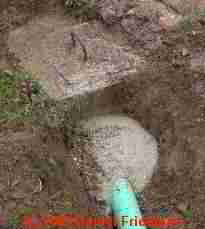
Ground water or surface runoff leaking into a septic tank will flood the tank and add to saturation of and early failure of the septic system leach field or drainfield. At the septic tank shown in these photographs, water was leaking into the septic tank around the tank inlet sewer pipe.
We located and corrected the probable source of water leaking into the tank. In this case the leak was at the inlet pipe to the septic tank where water was collecting by running down the hill into the sewer line trench.
The combination of a downhill trench headed towards the septic tank (the trench collects and aims surface and subsurface runoff water towards the septic tank), and a leak at the entry of the sewer pipe into the septic tank was causing the tank to flood.
We sealed the entry to the septic tank with concrete as shown in this photo of a concrete seal which we installed at the sewer line entry to the septic tank.
See SEPTIC TANK LEAKS - for an explanation of how and why septic tank leaks cause septic system failures.
At SEPTIC TANK BACK FLOODING we explain the causes of abnormally high sewage levels in septic tanks.
You cannot see the entire condition of the septic tank baffle before the tank is pumped, but inspect the baffle tops for evidence of corrosion, damage, total absence, or of sewage flowing over the baffle top (an indication of excessive in-tank sewage levels). Photos of the septic tank baffles in a concrete tank, as seen from inside the septic tank are provided at "Septic Tank Pumping Procedure" for which we provide a link at "More Reading" below.
The sewage level inside a septic tank should always be several inches below the baffle top but within a right at at or just below the bottom of the tank inlet pipe. If sewage level is low inside a septic tank which is in use, it is almost certain that the tank has been damaged and is leaking into surrounding soil.
Septic tank maximum scum and sludge buildup prior to pump out, and instructions for measuring the floating scum layer thickness and settled sludge layer thickness in a septic tank are available
at SEPTIC TANK PUMPING SCHEDULE.
Also see MEASURE SEPTIC TANK SCUM & SLUDGE for details of how we make these measurements.
See SEPTIC TANK LEVELS of SEWAGE for details on normal and abnormal levels and what they mean. Our page top photo shows a typical concrete septic tank baffle at the inlet pipe. Steel septic tanks have a similar barrier installed.
If your septic tank baffles are damaged and need repair or replacement, see SEPTIC TANK TEES [live link given just below] for help on how to install septic tank tees when tank baffles are damaged or missing. It's an easy repair.
We also recommend septic tank outlet filters installed at the tank outlet tee to extend the drainfield life. [Live link given just below].
Reader Comments, Questions & Answers About The Article Above
Below you will find questions and answers previously posted on this page at its page bottom reader comment box.
Reader Q&A - also see RECOMMENDED ARTICLES & FAQs
On 2020-07-11 - by (mod) -
Kenneth
Ask for specifics about the existing tank:
What, exactly is the problem?
For example, a broken or missing tank baffle, cover, or access opening can usually be repaired.
But a tank that is crumbling or collapsing is extremely dangerous (if someone falls in it's quickly fatal) - if that's the case keep people away, rope off the area.
let me know what you're told
On 2020-07-11 by kenneth
Hello,
Thank you for the service you are providing!
I live in a co-op with 8 homes. We have three septic tanks, and we are part of a sewer district.
We have a 17 year old concrete tank that they are telling us needs to be replace! That's a lot of money!!
It seems that there should be ways to try and repair things first no?
I have another person coming to evaluate and give us a second opinion.
What things can I ask him? What is repairable or not? Sometimes it feels like it is more lucrative and standard issue for companies to replace the whole thing.
Thank you
Kenneth
On 2020-05-09 - by (mod) -
If there is no above-ground cover to give access to the outlet from the septic tank, installing a T, though that's what protects the drainfield, is not practical. NEVER EVER enter a septic tank for any reason - it's likely to be a quick death.
On 2020-05-09 by Eddie
@Eddie,
(Sorry for the double post but I accidentally hit comment too early)
Given the condition of the inlet pipe, and the possibility of no outlet access cover..how difficult would it be to install tees? I plan on hiring the job out.
On 2020-05-09 by Eddie
I have a very old, single chamber septic tank. The inlet pipe is cast iron and has a significant layer of rust and crud making the O.D. larger than standard.
There is an access cover near the inlet pipe, but I don’t know if there is an access cover near the outlet. The previous owners had the leach field failed and installed a new field.
There are no tees on the inlet or outlet. Would it be beneficial to install tees? Would it be beneficial to install a tee on the outlet only?
On 2020-03-23 - by (mod) -
Bud
There is no standard distance of D-box from septic tank; it's site depenent; typicaly the D-box will be at the head of the drainfield area;
Similarly the distance from tank to drainfield is site dependent: area, slope, soil conditions, available space, etc.
See details at SEPTIC COMPONENT LOCATIONS -
tips
on how to find a septic tank, d-box, drainfield and other septic system components
On 2020-03-23 by Bud
Thank you for your response. Generally, how far is a distribution box from the tank? And, would installing a PVC baffle at the outlet help my situation?
On 2020-03-23 by Anonymous
Bud
That sounds to me like a clog in the septic tank Outlet or a failure of the drain field. You could start by finding the distribution box and investigating there for further closed and or have a professional with a sewer line camera see the condition of the lines between the tank and the distribution box
On 2020-03-23 by Bud
I have a 1980's 1,000 gallon single chamber concrete septic tank. The tank became overfilled and was flowing back into the basement toilet.
The top of the tank is 4'-0" below ground level. There's a metal drum on top of the tank to allow for access to the center hole in the top of the tank.
By "overfilled" I mean the tank fluid was in the metal drum above the tank. I had the tank emptied by a local septic company. I have dug down and uncovered the outlet baffle cover.
The outlet pipe is 3" PVC with concrete around the pipe at the outside of the tank. When I took off the concrete cover and looked down the concrete outlet baffle (not a PVC baffle), there is dark material on the bottom of the concrete baffle cover, on the PVC pipe's open end at the top of the baffle, as well as clinging to the baffle's overflow opening at the top of the baffle opening into the tank's main chamber.
I checked the outlet pipe and outlet baffle first thinking that the reason the tank is overfilling is because there is a problem with the outlet baffle or outlet pipe or the drain field, not allowing the liquid effluent to drain out of the tank.
Based on these details, what steps/solutions will fix the overfilling problem? Would a PVC outlet baffle help? Should I try to unclog the outlet pipe? What other steps should I take?
On 2019-01-22 by (mod) - importance of a missing septic tank baffle or tee
Tawn
Kudos to the septic company for recognizing a missing baffle: you don't say if the baffle is on the inlet or outlet end of the septic tank - but BOTH are needed. The inlet baffle prevents clogging the inlet line with floating scum and grease.
The outlet baffle prevents pushing solids out into the drainfield where they will promptly destroy it by clogging the pipes and soil.
If your septic system backed up then, I'm sorry to report, the drainfield may already be at the end of life and need replacement.
So what's needed is a thorough inspection of the drainfield piping from septic tank to D-box, D-box to leach lines, and in the leach lines: for signs of backup or flooding or clogging.
If you're lucky there could be a clog to clear. Otherwise the drainfield is probably shot. Using the washing machine becomes a lesser issue.
On 2019-01-21 by Tawny Steel
Our septic tank sewage backed up into our basement so we had it pumped and the septic company said the baffle is missing. Will we still be able to use our washing machine without a baffle in our septic tank?
On 2018-04-24 by (mod) - dropped and left the concrete baffle in the bottom of the tank.
Well as a fussy person myself I would prefer not to have concrete debris in the bottom of the septic tank it's not going to hurt anyting. The volume occupied by the baffle in the tank should be trivial and it's not blocking or affecting septic tank activity.
On 2018-04-18 by Misty
We just had our septic pumped and our concrete baffle replaced with a plastic Tee. The septic guy dropped and left the concrete baffle in the bottom of the tank. He said it's fine and won't hurt the system. Is this correct? Are there other cons to leaving this in the tank?
On 2017-10-03 by Michael A. Urbisci
How can I determine if the clarifier baffles are in need of repair?
How much should I expect to pay to have them replaced if needed.
Thank you.
On 2017-09-02 by (mod) -
Anon
Take a look at the photo at the top of this page. That's about what the dimensions should look like for a concrete tank with a concrete baffle
On 2017-09-01 by Anonymous
How close is too close? Is there a recommended minimum distance between the end of the waste pipe and the baffle to keep it from being clog-prone?
I can't see how far into the tank the pipe extends but the distance from the end of the pipe to the baffle appears to be about 5 or 6 inches. Is that enough?
On 2017-09-01 by (mod) -
Anon
The waste pipe entering the septic tank does not need to extend into the tank more than an inch or two ; it should be sealed at the tank entry. If it's too close to the facing side of a concrete or metal tank baffle it may be clog-prone.
Also see SEPTIC TANK TEES at https://inspectapedia.com/septic/Septic_Tank_Tees.php
On 2017-09-01 by Anonymous
What should be the distance between the end of the waste pipe entering the tank and the baffle? I'm experiencing clogs between the end of the pipe and the baffle every two years or so. Had the tank pumped the first time and was told it was operating fine and the pumping wasn't necessary and the system was fine.
On 2016-12-19 by Anonymous
One of the baffles in the septic tank has become loose and fell to the bottom of the tank. What does it until 2 place that baffle back where it belongs? Can it be done from the inside of the tank or do they have to excavate on the outside to get to it? What are the cost?
On 2016-08-02 by (mod) -
Sandria Warne said:
Amazing article!! I had installed a septic tank last year at my home. Now i need septic inspection services. i also wanted to know how it is done and why. I found your post really very helpful. thank you so much for posting.
On 2016-04-02 by (mod) - buyer wants septic tank baffles inspected
Well that's interesting. Indeed if an inspection shows that the baffles are rusted away or broken off, I'd be a bit more pessimistic about the remaining life of the septic system.
On the other hand, if the drainfield is 20+ years old, in most neighborhoods, I'd figure the system didn't have a predictable future life regardless.
If you want to let the buyer have a septic inspection performed that includes opening the tank you want to be sure that they are liable for any damage or injury that could ensue - such as some idiot falling into the tank;
it's reasonable to ask that after their inspection, as excavation will be required, that they restore the ground rather than leaving you with an ugly mess that would deter another buyer if the present one changes their mind.
In almost 50 years of building inspections I've rarely seen any defect whose cost to cure was such a large percent of the value of the property that the purchase became financially infeasible.
On 2016-04-01 by phyllis miller
We are selling our house and buyer wants septic tank baffles inspected
Technical content contributors
Special thanks to
- Lawrence Transue is a Pennsylvania building scientist and consultant, a certified ASHI home inspector, a Licensed Pesticide Applicator, a BPI Building Analyst & Envelope Professional, with 18 Years of Home Inspection Experience. He can be reached by Telephone: 610.417.0763, by Email: lawrence@lawrencetransue.com as well as at his WEBSITE and at FACEBOOK.
...
Continue reading at SEPTIC TANK TEES how to detect a lost or damaged septic tank baffle or a damaged tank tee; when & how to add a septic tank tee or select a topic from the closely-related articles below, or see the complete ARTICLE INDEX.
Or see SEPTIC TANK BAFFLE FAQs - questions & answers about septic tank baffles that were posted originally on this page
Or see these
Recommended Articles
- FILTERS SEPTIC & GREYWATER to add a septic filter or graywater filter to extend the life of septic tank, soakpit, soakaway bed, drainfield, leachfield, or drywell or cesspool
- SEPTIC TANKS - home
Suggested citation for this web page
SEPTIC TANK BAFFLES at InspectApedia.com - online encyclopedia of building & environmental inspection, testing, diagnosis, repair, & problem prevention advice.
Or see this
INDEX to RELATED ARTICLES: ARTICLE INDEX to SEPTIC SYSTEMS
Or use the SEARCH BOX found below to Ask a Question or Search InspectApedia
Ask a Question or Search InspectApedia
Try the search box just below, or if you prefer, post a question or comment in the Comments box below and we will respond promptly.
Search the InspectApedia website
Note: appearance of your Comment below may be delayed: if your comment contains an image, photograph, web link, or text that looks to the software as if it might be a web link, your posting will appear after it has been approved by a moderator. Apologies for the delay.
Only one image can be added per comment but you can post as many comments, and therefore images, as you like.
You will not receive a notification when a response to your question has been posted.
Please bookmark this page to make it easy for you to check back for our response.
Our Comment Box is provided by Countable Web Productions countable.ca
Citations & References
In addition to any citations in the article above, a full list is available on request.
- New York State Department of Health, APPENDIX 75-A WASTEWATER TREATMENT STANDARDS - INDIVIDUAL HOUSEHOLD SYSTEMS , [PDF] New York State Department of Health, 3 February 2010, retrieved 3/1/2010, original source: https://www.health.ny.gov/regulations/nycrr/title_10/part_75/appendix_75-a.htm
- [1] Pennsylvania State Fact Sheets relating to domestic wastewater treatment systems include
- Pennsylvania State Wastewater Treatment Fact Sheet SW-161, Septic System Failure: Diagnosis and Treatment
- Pennsylvania State Wastewater Treatment Fact Sheet SW-162, The Soil Media and the Percolation Test
- Pennsylvania State Wastewater Treatment Fact Sheet SW-l64, Mound Systems for Wastewater Treatment
- Pennsylvania State Wastewater Treatment Fact Sheet SW-165, Septic Tank-Soil Absorption Systems
- Document Sources used for this web page include but are not limited to: Agricultural Fact Sheet #SW-161 "Septic Tank Pumping," by Paul D. Robillard and Kelli S. Martin. Penn State College of Agriculture - Cooperative Extension, edited and annotated by Dan Friedman (Thanks: to Bob Mackey for proofreading the original source material.)
- Septic Tank/Soil-Absorption Systems: How to Operate & Maintain [PDF ] - , Equipment Tips, U.S. Department of Agriculture, 8271 1302, 7100 Engineering, 2300 Recreation, September 1982, web search 08/28/2010, original source: http://www.fs.fed.us/t-d/pubs/pdfimage/82711302.pdf.
- [3] "How to Maintain Your Septic System", Alaska Department of Environmental Conservation, Division of Water, retrieved 8/8/12, original source: http://dec.alaska.gov/water/wwdp/onsite/maintain_septic.htm [copy on file as Alaska_Septic_Care.pdf]
- [4] Installers Manual for Conventional Onsite Domestic Wastewater Treatment and Disposal Systems", Alaska Department of Environmental Conservation, Division of Water, retrieved 1/15/2001, original source: [copy on file as Alaska_Certified_Installer's_Manual.pdf]
- Septic Systems Inspection, Testing, & Maintenance - online textbook. Detailed how to inspect, maintain, repair information
- The Home Buyer's Guide to Septic Systems
- Septic Tank Pumping Guide: When, Why, How to pump the septic tank
- Home & Outdoor Living Water Requirements
- SEPTIC TANK CAPACITY VS USAGE in Daily Gallons of Wastewater Flow, calculating required septic tank size, calculating septic tank volume from size measurements
- Ten Steps to Keeping a Septic System Working, suggestions from the U.S. EPA, edits and additions by DJF
- Advanced Onsite Wastewater Systems Technologies, Anish R. Jantrania, Mark A. Gross. Anish Jantrania, Ph.D., P.E., M.B.A., is a Consulting Engineer, in Mechanicsville VA, 804-550-0389 (2006). Outstanding technical reference especially on alternative septic system design alternatives. Written for designers and engineers, this book is not at all easy going for homeowners but is a text I recommend for professionals--DF.
- In addition to citations & references found in this article, see the research citations given at the end of the related articles found at our suggested
CONTINUE READING or RECOMMENDED ARTICLES.
- Carson, Dunlop & Associates Ltd., 120 Carlton Street Suite 407, Toronto ON M5A 4K2. Tel: (416) 964-9415 1-800-268-7070 Email: info@carsondunlop.com. Alan Carson is a past president of ASHI, the American Society of Home Inspectors.
Thanks to Alan Carson and Bob Dunlop, for permission for InspectAPedia to use text excerpts from The HOME REFERENCE BOOK - the Encyclopedia of Homes and to use illustrations from The ILLUSTRATED HOME .
Carson Dunlop Associates provides extensive home inspection education and report writing material. In gratitude we provide links to tsome Carson Dunlop Associates products and services.
 | HOME | ABOUT | ASK a QUESTION | CONTACT | CONTENT USE POLICY | DESCRIPTION | POLICIES | PRIVACY | |
| © 2024 - 1985 Publisher InspectApedia.com - Daniel Friedman | |||||||||