
InspectAPedia® FREE Encyclopedia of Building & Environmental Construction, Diagnosis, Maintenance & Repair |
Question? Just ask us! InspectAPedia
|
 Septic Tank Size Requirements
Septic tank size calculations, size tables & codes
- POST a QUESTION or COMMENT about how to calculate the necessary size of a septic tank
Septic tank size specifications & requirements: how big should the septic tank be? Given dimensions, what is the septic tank size or capacity in gallons?
We begin with a table showing the required septic tank capacity or size vs. septic system usage in daily wastewater volume or flow.
Next we provide required septic tank size based on the number of bedrooms in a building - presumably the number of occupants.
Then we explain how to calculate septic tank volume or capacity based on septic tank inside dimensions measured in feet or inches how to convert between cubic feet or cubic inches and gallons of capacity.
We include tables of typical septic tank size dimensions and capacities for concrete septic tanks, plastic or fiberglass septic tanks & steel septic tanks. How to calculate septic tank capacity are explained.
InspectAPedia tolerates no conflicts of interest. We have no relationship with advertisers, products, or services discussed at this website.
Tables, Codes & Calculations of Required Septic Tank Size
How big does a septic tank need to be? Typically the septic tank volume for a conventional residential septic tank and onsite effluent disposal system (such as a drainfield) is estimated at a minimum of 1000 gallons or 1.5 x average total daily wastewater flow.
Here we also discuss the smallest recommended septic tank sizes based on building occupancy or wastewater volume. One should also ask, how does weather affect the necessary septic tank size?
Table of Required Septic Tank Size Based on Daily Waste-Water Volume in Gallons |
|
| Average Sewage Wastewater Flow - Gallons Per Day |
Minimum Septic Tank Size in Gallons of Effective Capacity Needed (1) |
| 0-500 gpd | 900 gals |
| 601-700 | 1200 |
| 801-900 | 1500 |
| 1001-1240 | 1900 |
| 2001-2500 | 3200 |
| 4501-5000 | 5800 |
Notes to Table Above
- (1) Source: Florida ASHI Seminar, Kissimmee, October 1993, included sheet from Environmental Health Services, March 17, 1992.
- Some intermediate table entries were eliminated but can be recalculated by interpolation
- In most U.S. jurisdictions we surveyed, the minimum permitted tank size for new septic installations is 1000 gallons. Special site considerations may require design by a septic-engineer before local health departments can approve an installation.
- WATER USAGE TABLE provides companion data if you don't already know your daily wastewater volume
- This table is for sizing residential septic tanks.
Separately, COMMERCIAL SEPTIC DESIGN discusses commercial septic tank and drainfield sizing based on wastewater flow estimates. There we also include excerpts from the EPA Design Manual's discussion of how a septic tank size should be determined, including safety factors but balancing design capacity safety with avoiding unnecessarily high costs.
Table of Required Septic Tank Size Based on Number of Bedrooms in a Home
How big does our septic tank need to be based on the number of bedrooms in the home? Some jurisdictions use the number of bedrooms rather than number of occupants or estimated daily wastewater flow to guide homeowners and septic installers in choosing a septic tank size.
Septic Tank in Gallons Size Based on Number of Bedrooms |
||
| Number of bedrooms | Minimum Septic Tank Capacity (Gallons) | Minimum Septic Tank Liquid Surface Area (sq.ft.) |
| 0 bedrooms | 750 gal. (2) - obsolete in NYS | |
| 1, 2, or 3 bedrooms | 1,000 gallons | 27 sq.ft. |
| 4 bedrooms | 1,200 gallons | 34 sq.ft. |
| 5 bedrooms | 1,500 gallons | 40 sq.ft. |
| 6 bedrooms | 1,750 gallons | 47 sq.ft. |
Notes to the septic tank sizing table above
An older version of this table permitted 750 gallon septic tanks in some jurisdictions and permitted 1,500 gallon septic tanks for 6-bedroom homes. Some current standards such as New Mexico still permit these smaller septic tank sizes.
Other experts estimate that occupants use between 50 and 100 gallons of water per person per day in a home in the U.S. We can use that guesstimate to compare different septic tank size guidelines.
Also see WATER USAGE TABLE for estimates of typical daily wastewater flow for buildings
The current and somewhat more stringent septic tank size used in the U.S. by New York (Public Health Law 201(1)(1) Section 75-A) standard includes these comments on septic tank sizing:
Tank size requirements for more than six bedrooms shall be calculated by adding 250 gallons and seven square feet of surface area for each additional bedroom.
A garbage grinder shall be considered equivalent to an additional bedroom for determining tank size.
Watch out: 750 gallon septic tanks are smaller than the minimum 1000g size required for new construction in many jurisdictions world-wide.
Source: New York State Department of Health, APPENDIX 75-A WASTEWATER TREATMENT STANDARDS - INDIVIDUAL HOUSEHOLD SYSTEMS, [PDF] New York State Department of Health, 3 February 2010, retrieved 3/1/2010, original source: https://www.health.ny.gov/regulations/nycrr/title_10/part_75/appendix_75-a.htm, updated 12 January 2015 to current table that lumps 1-3 bedrooms together and adds 6-bedroom homes.
Septic Tank Size Requirements May Be Set or Adjusted
by Local or State or Provincial Ordinances, Lift Stations, Weather
 In some jurisdictions, government ordinance may simply specify the minimum allowable septic tank size by:
- Number of bedrooms (as in our table above).
For example the Alaska state regulation (18 AAC 72) specifies that the minimum septic tank size shall be 1000 gallons for a home with three or fewer bedrooms.
(Most septic design guides presume an occupancy of two people per bedroom, so if your home is more crowded your septic tank size should be increased). - Septic pumping chambers: use of a septic system pumping chamber: the same example regulations as above state that
If a septic tank incorporates an integral lift station pumping chamber, the required tank size must be increased by 250 gallons [4] - Local weather temperatures: the same example septic regulation just cited also points out that septic tank sizes need to be considered in view of the climate where they are installed.
In very cold climates such as Alaska and northern Canada, because cold temperatures reduce the anaerobic rate of digestion of sewage solids, the septic tank sizes need to be increased - more size, more net free area, longer septic tank retention times are all needed.
Conversely in warm or hot climates where the level of bacterial action is comparatively greater, septic tank sizes may be a bit smaller.
How to Compute Septic Tank Size and Capacity in Gallons
How do we compute the volume in gallons that a septic tank provides based on simple measurements we can make?
A typical residential septic tank is usually about 4.5 feet wide x 8.0 feet long x 6 feet tall. Your septic tank may be a different size however. Best practice is to find and measure your septic tank for accurate calculations.
Tanks are typically buried 4 inches to 4 feet deep depending on local site conditions, shape, slope, and other factors.
Here is the basic math for computing septic tank capacity (volume) in gallons. Measurements are in feet, taken of inside dimensions of the septic tank.
How to Calculate the Septic Tank Capacity in Gallons |
|
| Round Septic Tanks | 3.14 x radius squared x depth (all in feet) = cubic capacity. Cubic capacity x 7.5 = gallons capacity. |
| Rectangular Septic Tanks | Length x Width x Depth in feet x 7.5 = gallons |
| Rectangular Septic Tanks (alternative method 1) |
Length x width in inches / 231 = gallons per inch of septic tank depth. Multiply this number by septic tank depth in inches to get gallons |
| Rectangular Septic Tanks (alternative method 2) |
Length x Width x Depth in feet / .1337 = gallons |
Notes to the table above
These simple constants and the formula for the volume of a rectangular or round tank will help us convert any septic tank size in cubic feet to gallons of wastewater:
- One gallon = 0.1337 cubic feet.
- One gallon = 231 cubic inches
- 1 cubic foot = 7.48 gallons
- Volume of a rectangle = Length x Width x Depth
- Volume of a cylinder = Pi x radius2 x depth
where radius = half the diameter - Pi = 3.1416
Examples of Computing Septic Tank Size, Capacity or Volume in Gallons
Example 1: volume of a rectangular septic tank using 0.1337 cubic feet. per gallon
How many gallons of sewage is held in a a 4ft. deep x 5ft. wide x 8 ft. long rectangular septic tank?
The volume in cubic feet of a tank of these tank dimensions is 4ft. x 5ft. x 8ft. = 160 cubic feet.
Using the conversion factor to convert cubic feet to gallons, 160 / .1337 = 1196 - or about a 1200-gallon tank.
One cubic foot of volume can contain 7.481 gallons of liquid. So a second approach to calculating septic tank actual size or capacity in gallons is to multiply the septic tank volume in cubic feet by this constant, which we round up to 7.5 gallons/cubic foot.
Example 2: volume of a rectangular septic tank using 7.5 gallons per cubic foot
How many cubic feet and how many gallons wastewater are held in a rectangular septic tank of typical dimensions of 4.5 ft. wide x 8.0 ft. long x 6 ft. high.
The volume in cubic feet of a tank of these tank dimensions is 4.5 x 8 x 6 = 216 cubic feet.
Since one cubic foot can contain 7.481 gallons, which we round up to 7.5 gallons per cubic foot: 216 x 7.5 = 1620 gallons of septic tank capacity - this is probably nominally a "1500-gallon septic tank".
Note that if the dimensions given by your septic contractor are the external dimensions of a concrete or other thick-walled septic tank tank rather than the internal dimensions then the volume given by this calculation will come up with a septic tank size estimate that is higher than the actual tank capacity - the error is due to failure to allow for the thickness of the septic tank walls.
So for fitting a septic tank into a tight spot, the outer dimensions of the septic tank are important. But for accurate calculation of the capacity of a septic tank you need to use the septic tank internal dimensions.
Example 3: volume of a round septic tank measured in inches & using 231 cu. in. per gal
How many cubic feet and gallons of wastewater are held in a round steel septic tank of dimensions 46 inches in diameter and 73 inches deep?
For this example we're working in inches, not feet.
To calculate the volume of a cylinder, in this case our round septic tank, we use
Septic tank diameter = 46" so its radius is half that or 23"
Septic tank height = 73"
Septic tank volume V = 3.1416 x (23")2 x 73"
Vinches= 121,319 cu. in.
Vgallons = 121,319 cu. in. / 231 cu. in. per gal
Vgallons = 525 gallons
Watch out: this tank will be too small to be acceptable by modern septic tank standards where most codes require a septic tank of at least 1000 gallons. ..
On 2017-08-23 by Robby - how do I calculate the size of a septic tank based on influent and effluent BOD loadings?
I am working on a project that will utilize septic tanks (several in parallel and series). The WW flows are 20,000 GPD, and influent WW BOD strength is about 450 mg/L and it will be permitted with an effluent strength of 100 mg/L.
The effluent will be disposed of via surface irrigation. I have not been able to find any literature on how to size a septic tank using influent and effluent BOD loadings. All literature I have found is based on number of bedrooms. This OSSF system will serve a Kid's Summer Camp.
Thanks and I look forward to your response. Robby
This question was posted originally at SEPTIC SYSTEM DESIGN BASICS
On 2017-08-23 by (mod) - how to size a septic tank using influent and effluent BOD loadings
Right. Yet there has to be an engineering assumption underneath the "number of bedrooms" that translates to "number of occupants" that in turn translates to average daily wastewater flow. That's what we both should look for and report back here.
See for starters WATER QUANTITY USAGE GUIDE https://inspectapedia.com/septic/Water_Quantity_Usage_Tables.php
and be sure to see SEPTIC TANK SIZE https://inspectapedia.com/septic/Septic_Tank_Size_Tables.php
In my OPINION the rule of thumb of 50 to 100 gallons of water per person per day may not be the right match for a kids' summer camp
but it would be really interesting to calculate:- toilet flushes
- showers
- use of laundry facilities
- dishwashing and cleaning by camp staff
The volume of wastewater in the net free area between the top of sludge and bottom of scum determines the treatment time in the tank as new wastewater flows into the system. That in turn will be an important determinant of BOD measurement results.
For other readers septic BOD refers to Biological Oxygen Demand - the amount of oxygen consumed by and thus required by septic tank bacteria in the breakdown of sewage waste.
Septic Tank Dimensions by Tank Size & Type
Concrete, Plastic / Fiberglass, Steel Septic Tank Dimensions
Table of Concrete Septic Tank Outside Dimensions, Capacity, & Other Data |
||||
| Rectangular Concrete Septic Tank Size (Gallons Capacity) |
Tank Length (Inches) |
Tank Width (Inches) |
Tank Depth (Height) (Inches) |
Comments SEPTIC TANKS, CONCRETE |
| 600 gallons | 78 | 56 | 60 | Not legal in many jurisdictions |
| 800 | 96 | 67 | 57 | Not legal in many jurisdictions |
| 1000 heavy duty | 96 | 78 | 61 | |
| 1000 low profile | 120 | 67 | 57 | low profile septic tank |
| 1000 /600 | 145 in. | 68 in. | 61 in. | two compartment tank |
| 1200 | 111 | 78 | 61 | |
| 1250/750 | 162 | 78 | 64 | two compartment tank |
| 1600 | 145 | 78 | 61 | |
| 1600/1400 | 174 | 90 | 73 | two compartment tank |
| 2000 | 162 | 78 | 64 | |
| 2600 | 147 | 90 | 73 | |
| 3000 | 165 | 92 | 76 | |
| 5000 | 204 | 96 | 93 | |
While septic tank sizes are normally given in gallons or liters of wastewater capacity, the actual physical proportions of a septic tank can be important for some considerations.
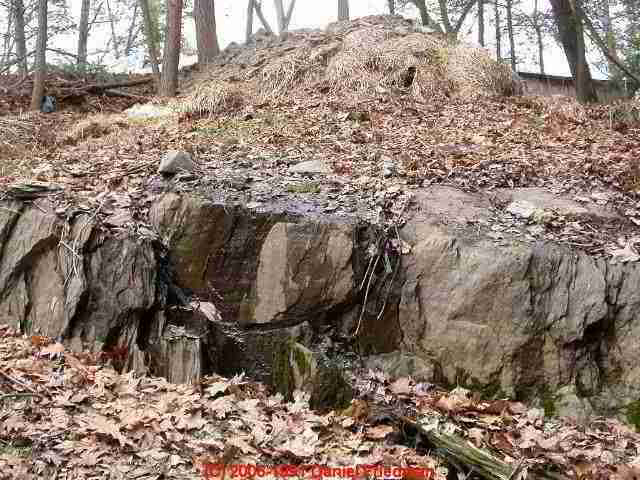
For example on a very rocky site where excavation to bury a septic tank runs into trouble the installer may decide to choose a shallow but large "flat" septic tank.
In my limited experience with shallow septic tanks they don't work so well and need to be pumped more often. I suspect that the net free area in total volume may meet spec but effluent settlement time may still be too little.
The septic tank under the pile of straw at the top of the septic system failure photo was just such a shallow or "flat" septic tank. Here is a table of some typical septic tank dimensions and other properties.
Plastic or Fiberglass Septic Tank Typical Dimensions |
||||
| Plastic / Fiberglass Septic Tank Size (Gallons Capacity) |
Tank Length (Inches) |
Tank Width (Inches) |
Tank Depth (Height) (Inches) |
Comments SEPTIC TANKS, FIBERGLASS / PLASTIC |
| 500 spherical | 64 | 64 | 64 | holding tank or pumping tank, Norwesco |
| 750 linear | 96 | 60 | 51 | sold as single or dual compartment |
| 900 | Snyder Industries. | |||
| 1050 | 126 | 60 | 51 | |
| 1250 | 161 | 60 | 51 | |
| 1500 | 191 | 60 | 51 | |
...
Notes to the Septic Tank Capacity Table Above
500 gallon septic tanks were usually round; larger tanks may be round or rectangular.
In the U.S. older round cylindrical septic tanks were placed end-wise, that is with a flat end down and a flat cover on top.
Manhole risers: for septic tanks buried at a depth that prevents ready access to and removal of cleanout & inspection covers, a manhole riser with a concrete or steel cover is recommended to permit proper inspection & cleaning. Covers must be of sufficient strength & security to prevent collapse & to prevent a septic tank fall-in hazard.
Concrete & some steel tanks are usually rectangular; plastic & fiberglass septic tanks may be roughly rectangular, oval, or even round spherical. Spherical tanks are usually used for pumping stations not for primary septic tank applications.
Rectangular steel septic tanks are installed in low-profile forms in problem sites in some jurisdictions.
Dimensions & properties taken from surveys of septic tank manufacturers (concrete & other materials).
- "Environmental Health Practitioner Manual: A resource manual for Environmental Health Practitioners working with Aboriginal and Torres Strait Islander Communities", Australia Department of Health, Department of Health GPO Box 9848, Canberra ACT 2601, Australia, retrieved 3/31/14, Original source: https://www.health.gov.au/internet/publications/publishing.nsf/Content/ ohp-enhealth-manual-atsi-cnt-l~ohp-enhealth-manual-atsi-cnt-l-ch2~ohp-enhealth-manual-atsi-cnt-l-ch2.9
- Norwesco, Inc., P. O. Box 439 4365 Steiner Street St. Bonifacius, MN 55375-0439 Tel 800-328-3420 (Customer Service) Fax 800-874-2371 (Customer Service) http://www.NORWESCO.com
- "Septic Tanks", Greer Tank & Welding, Inc., 3117 107th Street Greer Steel in Lakewood Washington Woodworth Industrial Park Lakewood, Washington 98499 Tel: 800-725-8108, email: info@greertank.com, retrieved 3/31/14, original source: http://www.greertank.com/septictanks.html
- "Septic Tank Dimensions & Weights", Huffcutt Concrete, Inc., retrieved 3/31/14, source: http://www.huffcutt.com/tank-weights.php
- "Septic Tanks, Septic Tank Systems - the superior traditional two chamber design", Crystal Sewage Treatment
Unit 2
Bolton House Farm
York
North Yorkshire
YO41 5QX
United Kingdom
Telephone: 01759 369915
Email: info@crystaltanks.com
Website: http://www.crystaltanks.com, Tel: 01759-369915, retrieved 3/31/14, original source: http://www.crystaltanks.com/septic_tank_crystal.html
For sewage tanks In the U.K. also see "Code of Practice - Flows & Loads 4 - Sizing Criteria, Treatment Capacity for Small Wastewater Treatment Systems" & "Code of Practice - Guide to the Installation of Small Wastewater Treatment Systems" and
"Code of Practice – Guide to the Desludging of Small Wastewater Treatment Systems" provided by britishwater.co.uk at http://www.britishwater.co.uk/publications/Publications_and_Technical_Guides.aspx - Snyder Industries, Inc. Corporate Headquarters 4700 Fremont Street (P.O. Box 4583) Lincoln, Nebraska 68504 Phone: 402-467-5221, Tel (Sales): 402-465-1237, Email: sales@snydernet.com
- See details at SEPTIC TANKS, STEEL
Large Capacity Septic System Design Requirements
On 2016-01-23 by Mark - size for a septic tank in a population area of 650 people
What can be the appropriate size for a septic tank in a population area of 650 people?
Posted originally at SEPTIC SYSTEM DESIGN BASICS
On 2016-01-24 by (mod) - for 650 people - use an onsite wastewater treatment plant
Mark,
No conventional septic tank would be reasonable for 650 people; the septic tank would have to be millions of gallons, and even then you'd need a thousand acres or so for a conventional drainfield.
For a population of 650 people, you'd need an onsite wastewater sewage treatment plant.
Design, Code & Size Requirements for Two-Compartment Septic Tanks
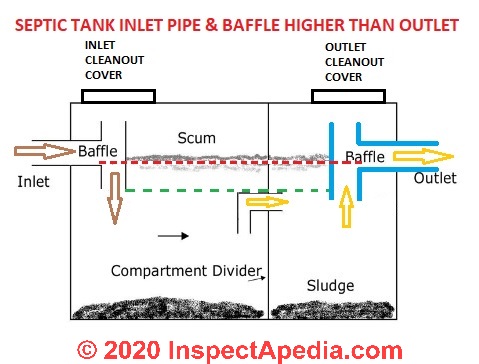 Two compartment septic tanks do a somewhat better job of removing suspended solids from wastewater than single compartment septic tanks, and some jurisdictions, including Alaska (18 AAC 72), require that two compartment septic tanks be used.
But we have not found regulations that translate that design difference into different septic tank size requirements.
In some states (Connecticut since January 1991) septic tanks now consist of two compartments in order to do a more effective job, and increasingly other jurisdictions (Alaska, Pennsylvania) require that new and up-graded onsite wastewater disposal systems use two-compartment septic tanks.
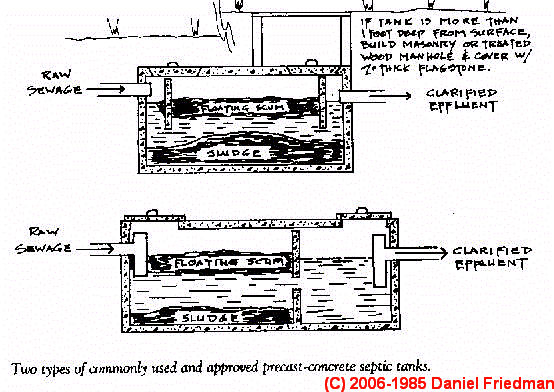
Image adapted from Alaska DEC [3] The dashed lines illustrate the liquid level (red) and the difference in elevation (green) between the inlet and outlet septic tank pipe connections.
More about these measurements is
at SEPTIC TANK TEES where we discuss repair procedures and also the problem caused when a septic tank is installed "backwards" with its outlet higher than its inlet.
In a two compartment septic tank the wall separating the two compartments will have an opening that allows liquid effluent to flow into the second compartment, keeping floating scum and settled sludge in the first compartment (mostly).
The septic entire tank, both compartments, will need to become filled with wastewater before any effluent will begin to flow out of the septic tank and into the drainfield or soakaway bed. That happens naturally during normal building plumbing system usage over the course of several days for typical septic tank sizes.
So when you observed about two feet of waste in the septic tank, then left the system unused, you'd expect to find exactly the same amount in the tank weeks later. Only a very slight drop in level might occur, less than an inch - caused by evaporation - because you left the tank open (and dangerous).
Watch out: if your tank is a two compartment type the solids, floating scum and settled sludge are accumulating at the inlet portion of the tank. Inspecting at the final septic tank outlet end will not discover sludge and scum early enough to prevent septic system damage.
Such septic tanks may have a center inspection port which admits tank access at the outlet of the sludge/scum containing compartment. That's where to test in two-compartment septic tanks.
Please see SEPTIC TANK LEVELS of SEWAGE for details about how to interpret abnormal levels of sewage found in the septic tank (too high or too low).
Septic media filter systems also require either two septic tanks or a two compartment tank -
see details at SAND FILTER SEPTIC DESIGNS.
References & authorities for large capacity onsite wastewater treatment plants
- ONSITE WASTEWATER PROGRAM INFORMATION PACKET FOR APPLICANTS (For Septic Tanks with Secondary Treatment) [PDF], Louisiana Department of Health & Hospitals
Office of Public Health Center for Environmental Health Service retrieved 2016/06/26, original source: http://new.dhh.louisiana.gov/assets/oph/Center-EH/sanitarian/ onsitewastewater/AppPackSepticTankSecTreat.pdf - SEPTIC & SEWAGE TREATMENT CODES & REFERENCES
- SEPTIC INSPECTION & TEST LAWS & PROCEDURES
- SEPTIC TANK DESIGN SPECIFICATIONS - example code specifying septic tank design parameters
- SEPTIC TANK DESIGN STRENGTH SPECS - the required strength of construction of septic tank & cesspool covers, walls, sides, bottoms
Reader Comments, Questions & Answers About The Article Above
Below you will find questions and answers previously posted on this page at its page bottom reader comment box.
Reader Q&A - also see RECOMMENDED ARTICLES & FAQs
On 2022-07-06 by Brian F - How big of a holding tank is suggested for 12 unit one bedroom Coop
How big of a holding tank is suggested for 12 unit one bedroom Coop with washing machines and dishwashers?
On 2022-07-06 by InspectApedia-911 (mod) - commercial septic design tables
@Brian F,
We don't use septic holding tanks (tank only, no drainfield) except in a very few installations as they are generally illegal, prohibited by local plumbing codes.
But I recognize that everyone knows exactly the lingo here so if you meant septic tank which is connected to a drain field or other absorption system then for your case you should see the sizing tables found at
COMMERCIAL SEPTIC DESIGN
https://inspectapedia.com/septic/Commercial_Septics.php
You will see that both the septic tank itself and also the treatment system or drain field or some miniature sewage treatment plant needs to be sized to handle the daily volume of Wastewater flow
On 2022-06-05 by Ernest - What size septic tank for a 4 bedroom 3 bathroom house
What size septic tank for a 4 bedroom 3 bathroom house
On 2022-06-05 by InspectApedia-911 (mod)
@Ernest,
Thank you for the septic tank size question.
You'll find your question answered simply by looking at the SEPTIC TANK SIZE TABLE BASED ON NUMBER OF BEDROOMS given above on this page.
Do let me know if any of that is unclear.
On 2021-11-29 by Lynn - what size septic system is required for 10 space rv park ?
what size septic system is required for 10 space rv park
On 2021-11-30 by Inspectapedia Com Moderator
@Lynn,
as we said to LL below:
Your septic engineer will work with you to estimate the total number of visitors per day in your RV park, or you might have data on typical holding tank volume and dumping frequency, and from that she can calculate the daily wastewater flow volume. That's what is needed to size the septic tank and drainfield.
COMMERCIAL SEPTIC DESIGN discusses commercial septic tank and drainfield sizing based on wastewater flow estimates.
On 2021-11-22 by LL - size and cost of a septic tank should be for a new minature golf course
How do you know what the size and cost of a septic tank should be for a new minature golf course with bathroom?
On 2021-11-22 by Inspectapedia Com Moderator
@LL,
Your septic engineer will work with you to estimate the total number of visitors per day and from that the daily wastewater flow volume.That's what is needed to size the septic tank and drainfield for a minature golf course.
COMMERCIAL SEPTIC DESIGN discusses commercial septic tank and drainfield sizing based on wastewater flow estimates.
https://inspectapedia.com/septic/Commercial_Septics.php
On 2021-11-19 by Gene - septic tank size for a 50 site Rv park
I am building a 50 site Rv park in Alabama. The national average water usage for rv’s is 25 gal. per day per unit. How do I compute the size and number of tanks needed.
On 2021-11-19 by Inspectapedia Com Moderator
@Gene,
50 "sites" is at least equivalent to 50 bedrooms, in daily wastewater flow if you assume a 100% occupancy rate during at least parts of the year and if you recognize that any septic system must be capable of handling its peak loads.
It's not just the number of tanks, it's the total wastewater storage volume (big enough to give at least 24 hours settling time) AND the wastewater effluent disposal system or drainfield.
For big operations like yours, looking at common residential septic designs is probably a mistake as you'll see the cost of 50 or even just 25 separate residential septic systems would be so stunning as to knock you out.
You'll probably find that your septic engineer will want you both to look at an onsite wastewater treatment plant designed and sized for your application.
COMMERCIAL SEPTIC DESIGN
discusses commercial septic tank and drainfield sizing based on wastewater flow estimates.There we also include excerpts from the EPA Design Manual's discussion of how a septic tank size should be determined, including safety factors but balancing design capacity safety with avoiding unnecessarily high costs.
On 2021-10-14 by Nawal Kishore Tiwari - septic tank size for 4 people
For four members family what is the size of septic tank in feet please inform
On 2021-10-14 by inspectapedia.com.moderator - septic tank size
@Nawal Kishore Tiwari,
Above on this page we give several methods for finding the septic tank size needed - by average daily wastewater flow, or easier, by number of bedrooms.Why?
Because code designers and septic engineers design a septic system to serve a property based on a reasonable guess at how many people the system MIGHT need to serve over its life (hence nr. bedrooms, not the number of people there right this second).
In our tables above you'll see 3 bedrooms - 1000 gallons septic tank size.
In our article above you will see also find tables giving typical septic tank dimensions in feet or inches versus tank size and shape.
PLEASE take a look and don't hesitate to ask if anything you find in our article on septic tank size is unclear.
On 2021-10-01 by Orville LaVenture - septic tank size for a duplex with total of 4 bedrooms
I own a duplex with a total of four bedrooms (2 in each unit). The total count of persons occupying the duplex is 4 adults and 3 children. are there any codes regarding the septic system capacity required?
On 2021-08-09 by Colleen Burne - septic tank size for a 6 bedroom home?
How large a tank is necessary for a 6 bedroom home?
On 2021-10-01 by inspectapedia.com.moderator
@Orville LaVenture, and @Colleen Burne,
Sure. The article above describes three ways you'd figure the required size of the septic tank for your duplex, to which you'll consider a fourth step: find out what criteria your local building inspector will use.One example table is at SEPTIC TANK SIZE TABLE BASED ON NUMBER OF BEDROOMS
On 2021-06-04 by Kristen - can old septic tank size handle an accessory dwelling
I have a 4 br 2 ba home and am wanting to add an accessory dwelling with a kitchenette and bathroom w/shower. My existing system was installed in late 80s. At that time it was inspected/permitted for a 4 br home with 17-18 fixtures.
Codes have changed since then and I’m having trouble determining if my existing system will be sufficient to support adding the accessory dwelling.
Records from permitting and inspections indicate I have a 1000 gal + 1000 gal sump and 700’ + pump. Assuming the county will consider the accessory dwelling as a 5th bedroom, is my existing system sufficient? I’m in NC if that helps. Class II-III soil.
Also, I may need to add a garbage disposal since I plan to have dishwasher installed. In case that needs to be factored in. Thanks in advance for assistance. Kristen
[Click to enlarge any image]
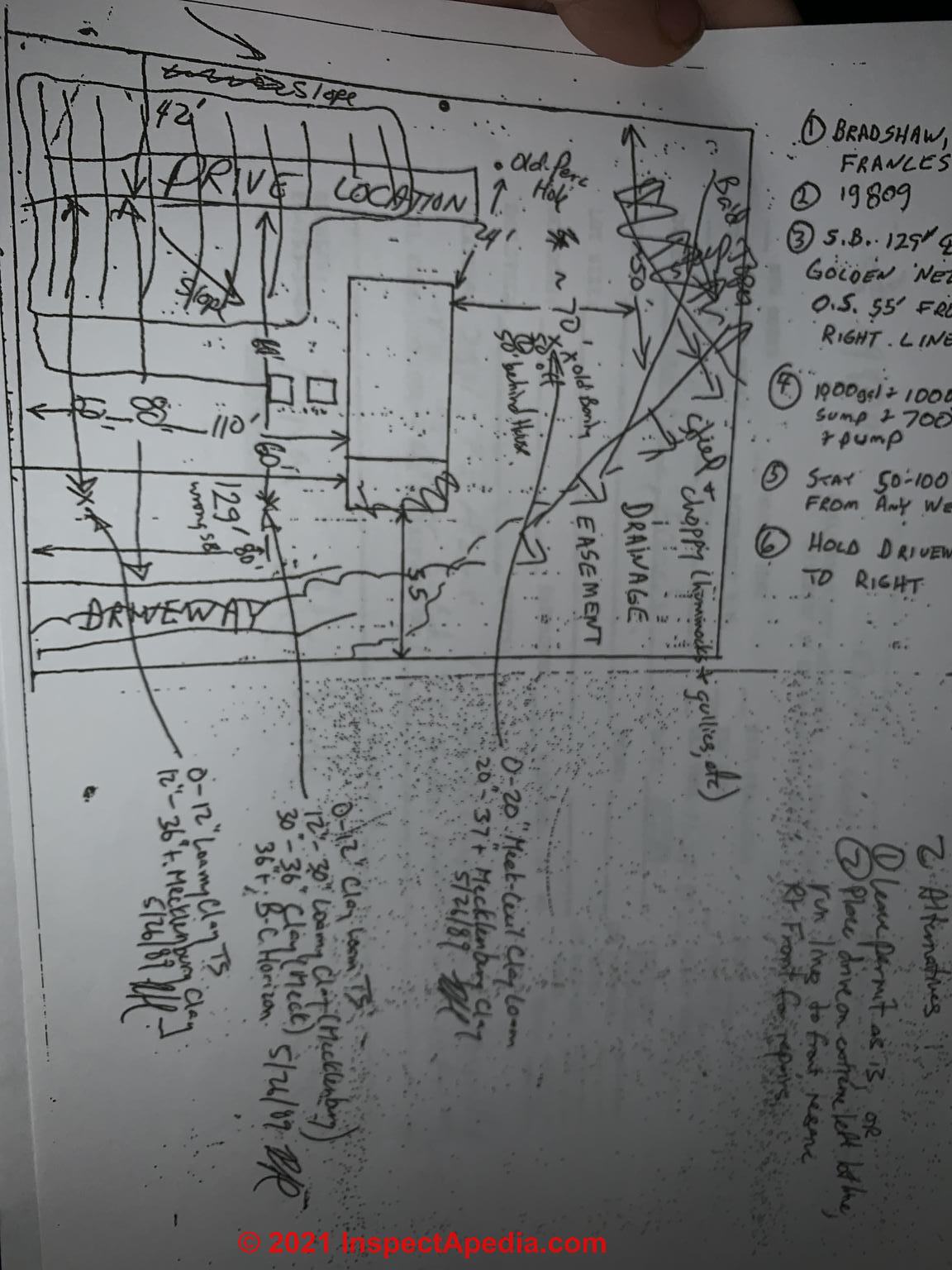
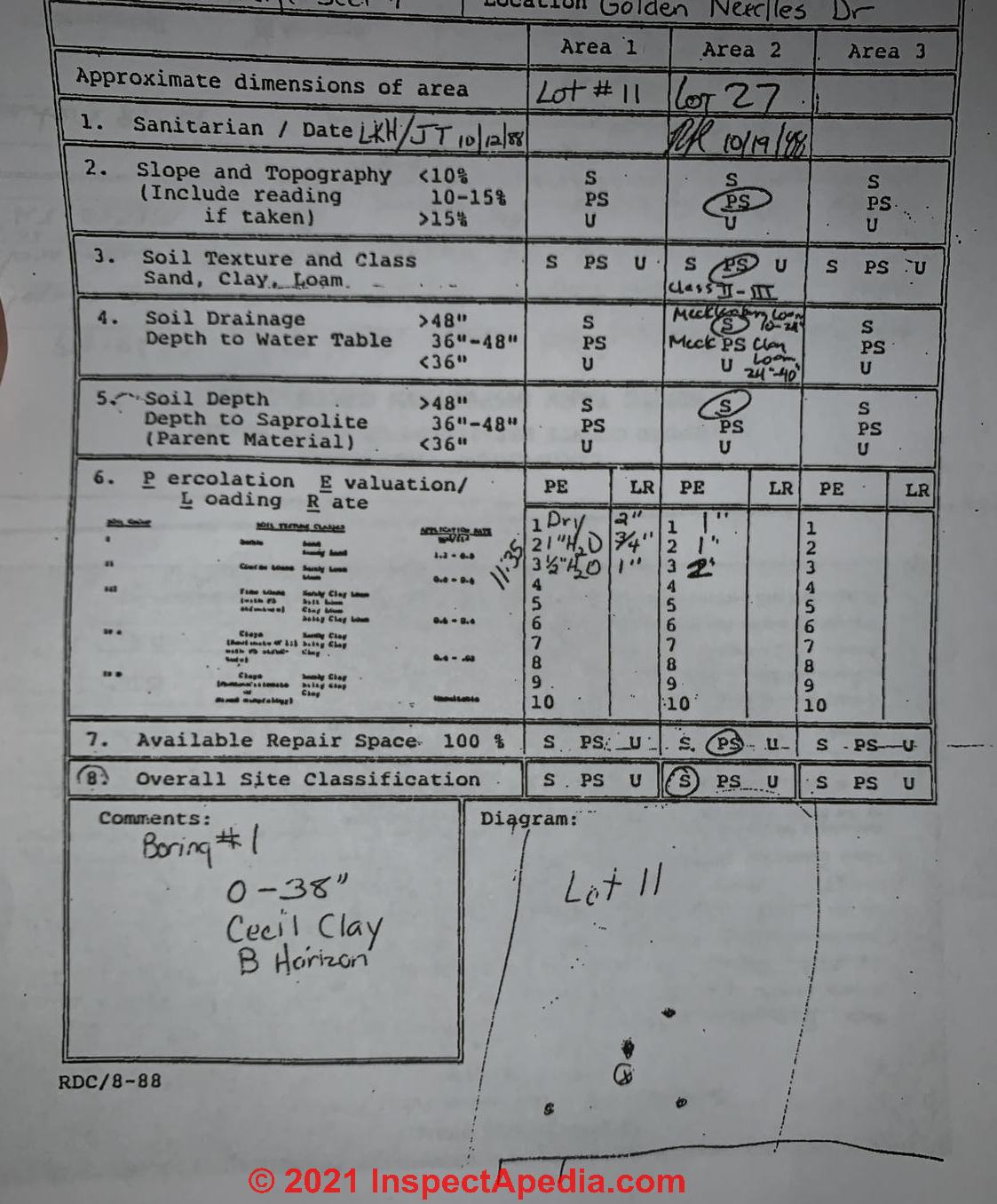
Maybe this will help? Lot 27 info
Yes, that what I’m having trouble discerning. Tank size seems sufficient based on table. Drain field seems huge. At least a 1/4 acre. See image.
On 2021-06-04 by inspectapedia.com.moderator (mod)
@Kristen,
Take a look at the septic tank sizing table sabove on this page. Remember that's only telling you tank size. The drain field size that you have may be inadequate. That answer depends on the soil percolation rate at your site.
On 2021-06-04 by Kristen - someone told me I needed a garbage disposal if I added a dishwasher
@inspectapedia.com.moderator,
Hhmm, seems someone must’ve told me I needed a garbage disposal if I added a dishwasher. Likely that was bad info. Since I’ve never had one, I’m definitely not sure. Good to hear that maybe I don’t need one. As far as the other factors, I had hoped the previous testing records I attached below would give the info needed to advise.
I read through all the info posted on page last night and I think it looks to be a sufficient system to support the accessory dwelling.
Just wanted your input to make sure I’m interpreting the info correctly. Thanks again for your help. I’ve been trying to reach the right person at the county environmental Dept.
All week and haven’t been able to connect to get answers based on existing records or determine if a new site survey will be needed. Appreciate any interim guidance while I continue to try to reach them.
On 2021-06-04 by inspectapedia.com.moderator (mod)
@Kristen,
I'm unclear why a dishwasher requires a garbage disposer.
I commented earlier on the drainfield size;
Size alone means too little; it's soil perc rate and drainfield age, condition, maintenance history; and perhaps the result of a SEPTIC LOADING & DYE TEST
(try the on page search box)
On 2021-06-03 by Mike - septic tank size for factory in South Africa
Hi, I'm from South Africa.
Got a factory with 70 staff and 10 toilets and 5 basins. What size would my septic tank have to be? Regards Mike
On 2021-06-03 by inspectapedia.com.moderator (mod)
@Mike,
Please take a look at
COMMERCIAL SEPTIC DESIGN
https://inspectapedia.com/septic/Commercial_Septics.php
And don't hesitate to post further comments or questions as needed
On 2021-06-01 by Anonymous - septic tank size for RV trailer with 2 adults & 1 child
rv trailer 2 adults and one child
On 2021-06-01 - by (mod) -
@Anonymous,
See the septic tank sizing table above on this page that uses number of bedrooms
On 2021-05-29 by Frank - septic tank size for 250 people
Whats the size of septic tank needed for 250 persons in and out...?
On 2021-05-30 - by (mod) -
@Frank,
What you are describing, 250 people, is a much different septic design than a simple residential septic tank for 1 or 2 families.Please see
https://inspectapedia.com/septic/Commercial_Septics.php
COMMERCIAL SEPTIC DESIGN
On 2021-05-05 by Christy - what size septic tank for an 8 bathroom hospital?
what's the size of a septic tank needed for a 8 bathrooms attached hospital
On 2021-05-06 - by (mod) -
@Christy,
You will want to update your daily Wastewater flow based on the anticipated usage of your bathrooms and then look at the septic tank size tables given above on this pageThen use the wastewater flow volume table septic tank sizing guide.
On 2021-04-20 by Haley - standard size for a septic tank fodr two people
Hi, what is the standard size for a septic tank & overflow for sep up system for a maximum of two person thanks?
On 2021-04-20 - by (mod) -
@Haley,
The smallest residential septic tank size permitted by building officials in most communities is 1000 gallons - but your local building or health or plumbing department is, of course, the final legal authority to answer that question.
Septic tanks do not "overflow" and there is no "overflow size" but I suspect you meant to refer to the require soil absorption system or drainfield or soakaway into which clarified effluent, leaving the septic tank, is absorbed and treated.
There is no single "right answer" to the minimum drainfield size as the size depends on both the average daily wastewater flow volume AND on the soil's ability to absorb effluent - which varies enormously by location.
See those details at SEPTIC DRAINFIELD SIZE https://inspectapedia.com/septic/Septic-Drainfield-Size.php
And don't hesitate to post follow-up questions if any of that is unclear
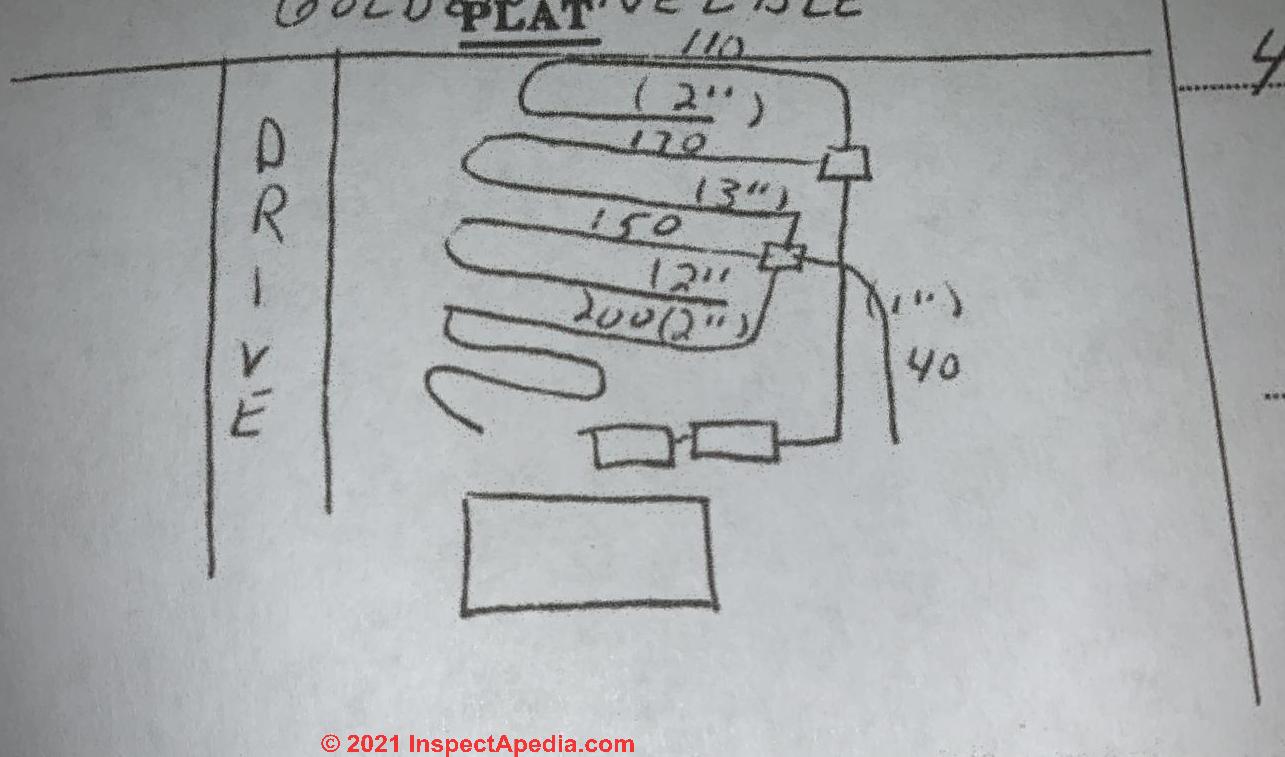
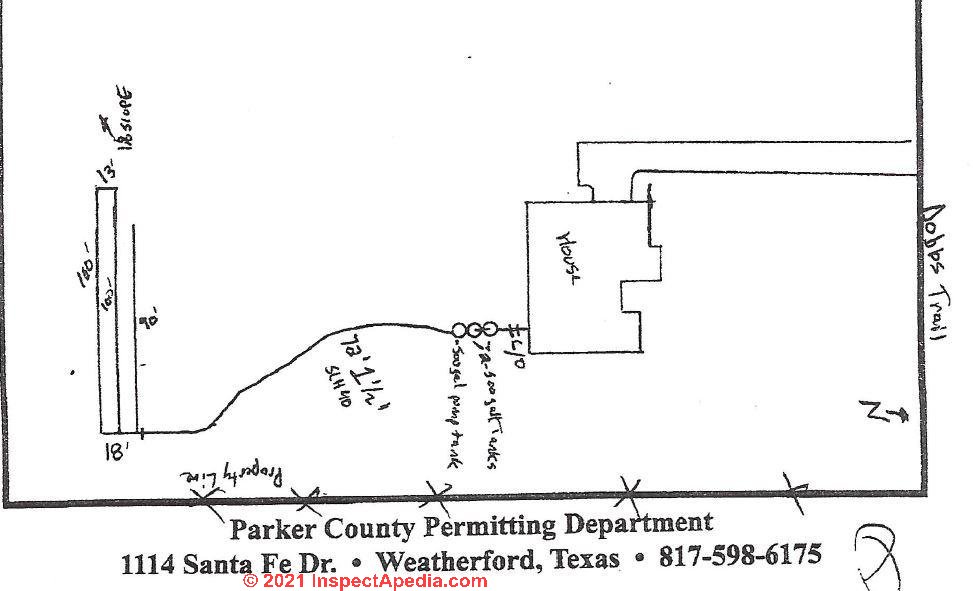
On 2021-03-05 by Jennifer - home has 3 500 gallon septic tanks!
I am buying a home with 2-500 gallons and 1-500 gallon pump tank. [Septic system layout sketch shown above]
The house size is 2543, 4 bedrooms, 2 bathrooms and it also has a seperate appartment that is 702 sq ft, 1 bedroom, kitchen, 1 bathroom. Is this septic system big enough?
On 2021-03-05 - by (mod) -
@Jennifer, no one can give a confident, correct answer to your question without more information, for example, soil percolation rate, drainfield size, tank size; surely you had a septic engineer design the system based on loading volumes and site characteristics?
Above on this page in the table titled
Table of Required Septic Tank Size Based on Daily Waste-Water Volume in Gallons
you will see that a 1000 gallon capacity septic tank can support 1900 gallons of daily wastewater flow.
In the alternative table
Septic Tank in Gallons Size Based on Number of Bedrooms
you will see that a 4 bedroom house wants a 1,200 gallon septic tank or larger.
I am treating your 3rd 500 gallon tank as a pumping chamber so am not counting it in capacity - but that' s a question to review with your septic engineer.
The concept is that we need a sufficient septic tank volume to allow sufficient settlement time that we don't push solids out into the drainfield (destroying it).
On 2021-03-02 by Ferdinand - how big should the septic tank be for serving 100 people?
How big should be the septic tank that is to be used by 100 people
On 2021-03-02 - by (mod) -
@Ferdinand,
The residential septic tank sizes on this page won't get us to a working septic system to support 100 people.
Take a look at
COMMERCIAL SEPTIC DESIGN https://inspectapedia.com/septic/Commercial_Septics.php
and at
SEWAGE TREATMENT PLANTS, RESIDENTIAL https://inspectapedia.com/septic/Packaged-Cluster-Septic-Systems.php
You'll see that the real rub is how to dispose of the volume of effluent or wastewater.
That's why none of the residential or even commercial septic design articles in this series simply give a tank size for large numbers of people.
On 2020-08-05 by Douglas - inspector says I need a larger septic tsank
I'm purchasing a 4 bedroom house in Wisconsin and we are scheduled to close early next week. I will be the only person living in the house. I just found out the septic tank is a 1,000 gallon concrete tank and the septic permit was for a 2 bedroom house. The inspector recommended installing a 1,500 gallon plastic tank to the tune of $15,000. Is this something I need to worry about?
On 2020-08-05 by (mod)
Rather than pouring $15,000 into the ground before it's necessary, you may find you can simply have the septic tank pumped more-frequently, and when the tank is pumped, have the sludge and scum levels measured as that will tell you if you're pumping often enough.
Watch out: keep in mind that buying an older home with a septic system means you probably don't know the condition of the system and you could be facing a costly failure. Was your inspector a home inspector or did you have an actual septic inspection and test performed?
On 2020-05-20 by John - is a 36-inch small septic tank usable?
Can you use a square tank 84”x84”x39”deep concrete tank as a septank if you have all the hooks for it
On 2020-05-20 - by (mod) - shallow septic tanks have very limited capacity
Relatively shallow septic tanks may get local approval, but in my view there is a significant risk of early drainfield failure as shallow depth, further reduced by sludge and scum layers means inadequate settling time in the tank.
Inadequate settling time means pushing solids into and thus damaging the absorption field or drainfield.
On 2020-01-29 by Certified - 4 bathrooms: what size tank do you recommend?
I have 4 bathrooms, with 1 toilet, 1 sink, 1 shower in each. And 3 washing machine boxes What size of septic tank do you recommend.
On 2020-01-29 - by (mod) - how to size the septic tank based on water usage
Cert
If you want to size the septic tank based on water usage take a lookat AVERAGE DAILY WATER USAGE for some reasonable estimates.
then come back to the septic sizing tables on this page
On 2020-01-26 by Gareth - septic tank to support a 30 tent site camping area
Hi Folks,
Detailed article and most helpful - just looking for some feedback/ideas on a suitable system for a 2 Acre campsite (max 30 pitches per acre/60 pitches total - lets say an average of 2 per pitch therefore upto 120 people) plus also a cafe that seats 36 inside and an additional 28 outside (when sunny!)
System would be seasonal - quiet in winter but during weekends/holidays/summer months can be extremely busy.
Any thoughts/ideas welcome and unfortunately cannot use soakaway/cesspit so must be a treatment plant (but struggling to size it)
Thanks in advance :)
G
On 2020-01-26 - by (mod) - septic tank size for very high wastewater volumes for a campsite
Gareth
For a usage at that level I think you're going to want to look at a mini-onsite wastewater treatment system - of which a packaged unit may work;The issue isn't just the size of the tank (no conventional septic tank would be big enough to give enough settling time) it's the problem of how to handle the wastewater volume.
Take a look at
SEWAGE TREATMENT PLANTS, RESIDENTIAL
On 2017-08-15 y boieezcar@gmail.com - computation of septic tank capacity per person
please provide proper computation of septic tank capacity per person
This question and answer were posted originally at SEPTIC TANK PUMPING MISTAKESOn 2017-08-15 (mod) - how to calculate the required septic tank size
Boieez
Thanks for the septic tank capacity question. Please hop overto SEPTIC TANK SIZE
Also see SEPTIC SYSTEM DESIGN BASICS
where in reply to a reader question we discuss average daily wastewater flow per person design assumptions. Also see our companionarticle WATER QUANTITY USAGE TABLES
On 2017-07-15 by Brandon - use a 550 gallon water tank as a septic tank?
Can a 550 gal water tank be used as septic tank
On 2017-07-15 by (mod) - No
Not in any useful nor effective way
A water tank is the wrong shape, lacks the appropriate access connections for clean-out or connections to the Sewer Inlet or a fluid outlet, and by virtually all contemporary standards 550 gal would be too small. A water tank is also not designed to be buried nor withstand corrosion, earth pressure Etc.
It's a great question but IMO not a great idea.
On 2017-05-25 by (mod) - - how is the volume of a septic tank calculated?
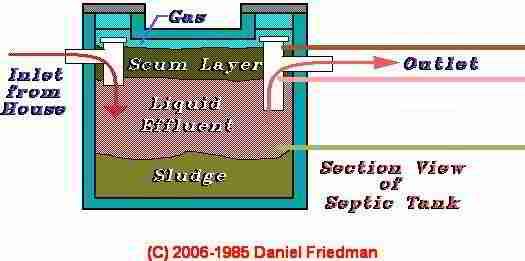
Many readers have asked us how we calculate the actual volume of a septic tank.
The volume of a septic tank is calculated based on the shape of the tank - calculating the volume of a rectangular shape Vol = L x W x H or for a cylindrical shape the formula and examples are
at CALCULATE SEPTIC TANK CAPACITY - compute required septic tank capacity based on its measurements
The actual volume of wastewater in a properly-working rectangular septic tank is easier to calculate than a cylindrical one since we have to consider just the volume of the container up to the bottom of the outlet pipe.
If you want to calculate just the "liquid" volume of the septic tank you need to measure the current thickness of the floating scum layer and bottom sludge layer and thus to subtract those from the first volume that you calculated.
The "freeboard" in the septic tank has to be the volume between the bottom of the septic tank outlet pipe (assuming again a properly-working septic system with no blockages in the outlet or drainfield) and the top of the septic tank baffle or tee.
That's because any depths higher than the tee top mean that the outlet is blocked and the system is not working normally.
On 2017-05-25 by (mod) - why can't I do some separate treatment of urine and sewage that will permit installing a septic system on a site that the authorities say is too small.
Regarding a reader question of treatment of urine and water mixture, I can't answer without knowing the intended application.
Normally urine and other wastewater flows either into a public sewer and on to a sewage treatment plant or into a private septic system where the wastewater in a conventional system is treated by bacteria in the septic tank (45%) and by both aerobic and anaerobic bacteria in the soil of the soakaway bed (55%).
Aerobic septics and other designs treat wastewater to different levels at different states of the process. Still other systems may use a disinfection step combining UV light or chlorine injection.
But ultimately the septic system components that dispose of wastewater effluent have to be able to do that effectively in the available space.
...
Continue reading at SEPTIC DRAINFIELD SIZE or select a topic from the closely-related articles below, or see the complete ARTICLE INDEX.
Or see SEPTIC TANK SIZE FAQs - questions & answers about septic tank size posted originally on this page.
Or see these
Recommended Articles
- COMMERCIAL SEPTIC DESIGN
- SEPTIC DRAINFIELD SIZE
- SEPTIC TANK PUMPING SCHEDULE
- SEPTIC TANK SIZE
- SEPTIC TANK SIZE vs SEWAGE FLOW
- SEPTIC TANKS, STEEL
Suggested citation for this web page
SEPTIC TANK SIZE at InspectApedia.com - online encyclopedia of building & environmental inspection, testing, diagnosis, repair, & problem prevention advice.
Or see this
INDEX to RELATED ARTICLES: ARTICLE INDEX to SEPTIC SYSTEMS
Or use the SEARCH BOX found below to Ask a Question or Search InspectApedia
Ask a Question or Search InspectApedia
Try the search box just below, or if you prefer, post a question or comment in the Comments box below and we will respond promptly.
Search the InspectApedia website
Note: appearance of your Comment below may be delayed: if your comment contains an image, photograph, web link, or text that looks to the software as if it might be a web link, your posting will appear after it has been approved by a moderator. Apologies for the delay.
Only one image can be added per comment but you can post as many comments, and therefore images, as you like.
You will not receive a notification when a response to your question has been posted.
Please bookmark this page to make it easy for you to check back for our response.
Our Comment Box is provided by Countable Web Productions countable.ca
Citations & References
In addition to any citations in the article above, a full list is available on request.
- [2] Septic Tank/Soil-Absorption Systems: How to Operate & Maintain [PDF ] - , Equipment Tips, U.S. Department of Agriculture, 8271 1302, 7100 Engineering, 2300 Recreation, September 1982, web search 08/28/2010, original source: http://www.fs.fed.us/t-d/pubs/pdfimage/82711302.pdf.
- [3] "How to Maintain Your Septic System", Alaska Department of Environmental Conservation, Division of Water, retrieved 8/8/12, original source: http://dec.alaska.gov/water/wwdp/onsite/maintain_septic.htm [copy on file as Alaska_Septic_Care.pdf]
- [4] Installers Manual for Conventional Onsite Domestic Wastewater Treatment and Disposal Systems", Alaska Department of Environmental Conservation, Division of Water, retrieved 1/15/2001, original source: [copy on file as Alaska_Certified_Installer's_Manual.pdf]
- "International Private Sewage Disposal Code," 1995, BOCA-708-799-2300, ICBO-310-699-0541, SBCCI 205-591-1853, available from those code associations.
- "Manual of Policy, Procedures, and Guidelines for Onsite Sewage Systems," Ontario Reg. 374/81, Part VII of the Environmental Protection Act (Canada), ISBN 0-7743-7303-2, Ministry of the Environment,135 St. Clair Ave. West, Toronto Ontario M4V 1P5 Canada $24. CDN.
- Manual of Septic Tank Practice, US Public Health Service's 1959.
- In addition to citations & references found in this article, see the research citations given at the end of the related articles found at our suggested
CONTINUE READING or RECOMMENDED ARTICLES.
- Carson, Dunlop & Associates Ltd., 120 Carlton Street Suite 407, Toronto ON M5A 4K2. Tel: (416) 964-9415 1-800-268-7070 Email: info@carsondunlop.com. Alan Carson is a past president of ASHI, the American Society of Home Inspectors.
Thanks to Alan Carson and Bob Dunlop, for permission for InspectAPedia to use text excerpts from The HOME REFERENCE BOOK - the Encyclopedia of Homes and to use illustrations from The ILLUSTRATED HOME .
Carson Dunlop Associates provides extensive home inspection education and report writing material. In gratitude we provide links to tsome Carson Dunlop Associates products and services.
 | HOME | ABOUT | ASK a QUESTION | CONTACT | CONTENT USE POLICY | DESCRIPTION | POLICIES | PRIVACY | |
| © 2024 - 1985 Publisher InspectApedia.com - Daniel Friedman | |||||||||