
InspectAPedia® FREE Encyclopedia of Building & Environmental Construction, Diagnosis, Maintenance & Repair |
Question? Just ask us! InspectAPedia
|
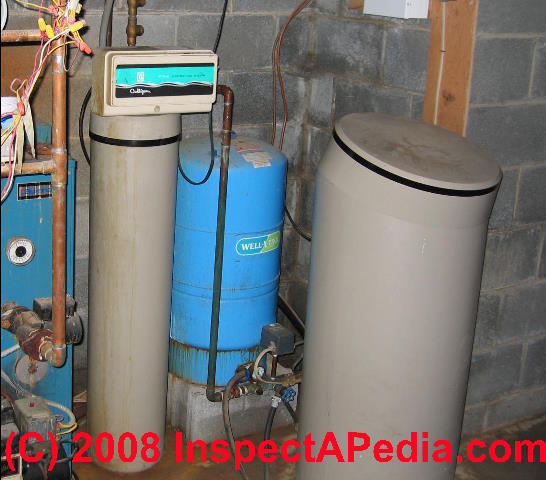
 Water Softeners / Water Conditioners
- POST a QUESTION or COMMENT about buying, installing, identifying, maintaining, and repairing all types of water conditioners and water softeners
Water Softeners, operation, maintenance, adjustment, and repair home page:
This water softener (water conditioner) article series explains how to inspect, diagnose, and adjust or repair water softeners or water conditioners.
We describe how to adjust the water softener (water conditioner) for proper operation to minimize damage to a septic system, to set the correct salt dose, brine tank water level, and regeneration time
Here you will find answers to just about any question about water softeners, water conditioners, hard water, water treatment & water testing.
The articles in this series explain what hard water is, describe how water softeners work, and tell readers how to be sure that the salt used by most water softeners does not become a problem for people drinking the water nor a problem for the septic system. Where septic systems are already in trouble, we describe how to reduce the load on the septic system by making some changes to how the water softener is used and how its discharge is handled.
InspectAPedia tolerates no conflicts of interest. We have no relationship with advertisers, products, or services discussed at this website.
Water Softeners & Water Conditioners: Water Hardness, the Need for Water Softeners
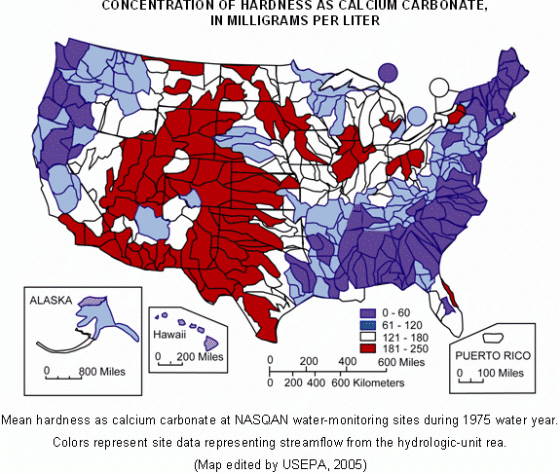
Water "hardness" refers to the level of unwanted minerals, principally calcium and magnesium, found in your water supply.
Hard water is an aesthetic issue (poor lathering, spots on dishes) and a mechanical issue (clogged pipes, expensive repairs, poor washing machine performance) but it is not a health concern. Hard water is found only in certain neighborhoods and usually only on private water supplies from a local well or wells.
[Click to enlarge any image]
"Water hardness varies throughout the United States. If you live in an area where the water is "soft," then you may never have even heard of water hardness.
But, if you live in Florida, New Mexico, Arizona, Utah, Wyoming, Nebraska, South Dakota, Iowa, Wisconsin, or Indiana, where the water is relatively hard, you may notice that it is difficult to get a lather up when washing your hands or clothes."--"Common water measurements", USGS - see "More Reading".
Municipal water is required by federal law to be treated and tested for sanitation, hardness, corrosivity, and other features.
You may sense that water is "hard" in a building if you find that you can't get a lather in the shower when shampooing, if you find lots of spots on dishes after washing them, poor performance of a washing machine, mineral deposits on plumbing fixtures such as a mineral ring around the tip of a faucet or in a toilet bowl, and mineral clogging of the tankless coil if you make your hot water using such a device.
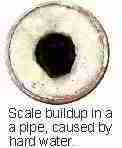
Minerals dissolved in "hard" water precipitate out in building plumbing pipes and fixtures where they form a hard calcium/magnesium deposit which can severely clog piping and fixtures.
The photo at left shows a cross-section of scale build-up in a building water supply pipe.
What a Water Softener Does to the Water Supply
Water softeners remove unwanted minerals, principally calcium and magnesium,. from a hard water supply (correcting "high mineral content") by using one of several water conditioning or water treatment methods discussed here.
The most common water softener methods uses an ion exchange process that swaps low levels of salt (sodium ions) into the water causing other minerals (mostly calcium and magnesium and some iron) to precipitate out of the water supply.
Watch out: water softeners are not designed to remove other water contaminants such as bacteria, chemicals, odors, or sediment, though some softenes can reduce low levels of some odors. Your water system may need other water treatment equipment such as filters to remove sediment (TDS or total dissolved solids) or odors or sanitizing equipment to handle bacterial or chemical contaminants.
See WATER TREATMENT EQUIPMENT CHOICES for details.about other types of water treatment equipment besides water softeners or water conditioners.
Water Softener suggestions for minimizing the impact on septic systems, and suggestions about salt in drinking water
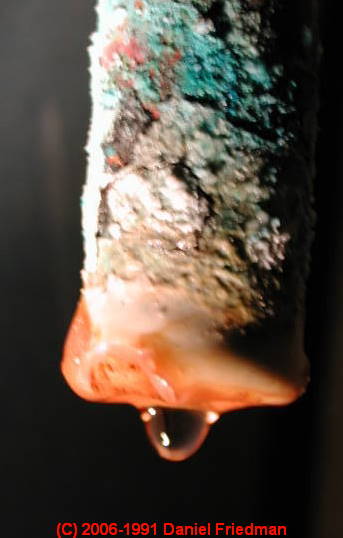
The mineral deposits on the dripping water pipe in the photo at left are evidence of both a protracted leak and hard water. But if a water softener is improperly adjusted, or if it is not working properly, excessive salt or softener backwash discharge, if sent into the septic tank and leach fields, can damage or reduce the life of the septic system.
Our photo shows a close-up image of mineral deposits (and some corrosion) on a faucet where the water supply was high in mineral content.
How do we Measure Water Hardness - Table of Water Hardness Grains
Hard water is generally taken to mean water containing minerals over 121 mg/L, micrograms per liter of water, or over 7 grains of hardness per gallon. The following table is based on information from the Canadian Mortgage and Housing Corporation, CMHC.
| Hardness of Water Before Treatment | Mineral Content - Hardness of Water |
|---|---|
Soft Water |
less than 17 mg/Liter - 0-1 grains/gallon |
Slightly Hard Water |
17.1 to 60 mg/L - 1.1 to 3.5 gpg |
Moderately Hard Water |
61 to 120 mg/L - 3.6 to 7 gpg |
Hard Water |
121 to 180 mg/L - 7.1 to 10.5 gpg |
Very Hard Water |
more than 180 mg/L - over 10.5 gpg |
Water Softeners or Water Conditioners Impact on Septic Systems - US EPA Information
Onsite Wastewater Treatment Systems Special Issues Fact Sheet 3 - EPA 625/R-00/008
Description of the Effect of Water Softeners on Septic Tanks & Drainfields
Home water softeners, which periodically generate a backwash that is high in sodium, magnesium, and calcium concentrations, can affect wastewater treatment processes and the composition and structure of the infiltration field biomat and the underlying soil. However, attempts to predict whether impacts will occur and to estimate their severity are difficult and often inconclusive.
Water softeners remove "hardness" (dissolved calcium and magnesium) through ion exchange processes. Incoming hard water passes through a tank of containing high-capacity ion exchange resin beads supersaturated with sodium. The calcium and magnesium ions in the water attach to the resin beads, replacing the sodium, which is released into the water. The softened water is then distributed for use throughout the house.
Over time, the ion exchange resin beads become saturated with calcium and magnesium ions. When this occurs, the tank must be recharged by flushing with a salt brine solution. Sodium ions reclaim their position on the resin beads, and the calcium and magnesium ions are released into the backwash water.
The backwash water then exits the tank and is discharged to the wastewater treatment system. The number of times the tank is recharged and the amount of wastewater generated depends on a number of factors, including the hardness of the water, the amount of water used, the size of the water softener, and the capacity of the resins to remove calcium and magnesium.
The wastewater generated during the recharge phase of the water softening process mixes with other household wastewaters, enters the septic tank, and eventually moves to the soil adsorption field.
Studies conducted by soil scientists at the University of Wisconsin and the National Sanitation Foundation conclude that the wastewater effluent generated from properly operating and maintained water softeners will not harm onsite systems that are designed, operated, and maintained appropriately. Specifically, the studies conclude the following:
- High concentrations of calcium and manganese in the softener backwash water have no deleterious effect on the biological functions occurring in the septic tank and may, in some cases, be helpful.
- The additional volume of wastewater generated (typically about 50 gallons per recharge cycle) is added slowly to the wastewater stream and does not cause any hydraulic overload problems.
- Soil structure in the soil absorption field is positively affected by the calcium and magnesium ions in water softener effluent (Corey et al., 1977).
Regarding the last conclusion, some people have the misconception that the salt brine that enters the ion exchange tank also exits the tank as wastewater. In fact, the influent with its high concentration of sodium ions is very different than the effluent, which has a high concentration of calcium and magnesium ions. Consequently, the potential for chemical clogging of clayey soil by sodium ions is reduced. The calcium and magnesium input may even help improve soil percolation.
Risk management issues Regarding the Effect of Water Softeners on Septic Tanks & Drainfields
The human health impacts of ingesting softened water are increasingly discussed in addition to the traditional benefits of reduced use of surfactants and plumbing repair requirements. The choice of the homeowner to soften or not to soften will factor into all arguments.
Also, the preceding descriptions are predicated on whole-house-supply softening. Today point-of-use devices designed for use with specific features in the house make the traditional advantages and disadvantages less clear.
Also see WHAT CAN GO INTO TOILETS & DRAINS?, a guide which explains how to extend the life of the septic system by being careful about what goes into it.
Common Water Softener Questions & Answers
Reader Question: Can You Help Identify Our Water Softener Brand and Get an Operating Manual so we can Set the Controls?
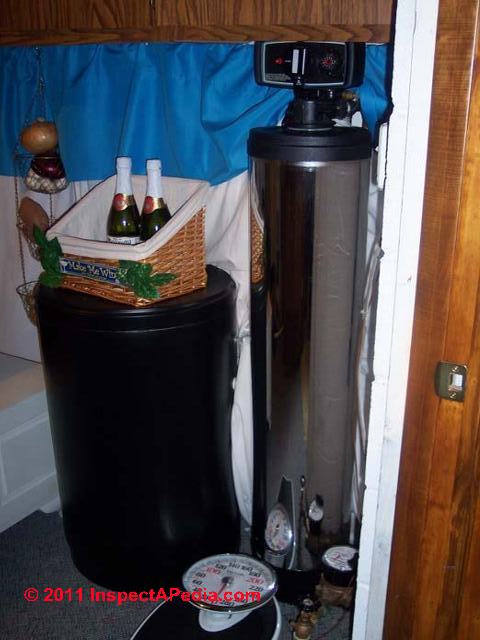
Attached are two photographs of our water softener. We do not know what type of softener we have or how to set it. Can you give us a clue to the manufacturer and where we could get a manual?
We are guessing what the different knobs are? We can't seem to set it to run on the timer. We set it to "in service" and the time of day, but it won't run on its own at that setting.
So we have been setting it to regenerate to get it to run manually. We would like to get it to run automatically. We need help. - B.B.
Reply:
I don't know this specific brand for sure but doing some research on stainless steel water conditioner brands I found that
- The control head (water softener valve) for your water softener is found in a Chinese unit sold to various manufacturers - you can see the control at http://www.china-water-filter.com/Stainless-Steel-Water-Filter-Housing-17.html and also at http://www.alibaba.com/product-gs/357047492/detail.html?s=p
- And a similar control head is used on Aqua Maidwater systems found at http://www.aquamaidwatersystems.com/Products/SSC.aspx
- The stainless steel water conditioner tank and salt tank in your photo are a match for Crystal Quest Water Softeners - see http://www.crystalquest.com/watersoftener.htm
So your unit may be a Crystal Quest or an Aqua Maid POE (Point of entry) water conditioner or water softener similar to their models CQE-WH-01127 or CQE-WH-01128 but with an older control head.
The Water Conditioner Control Valve is the Key to Setting & Using a Water Softener
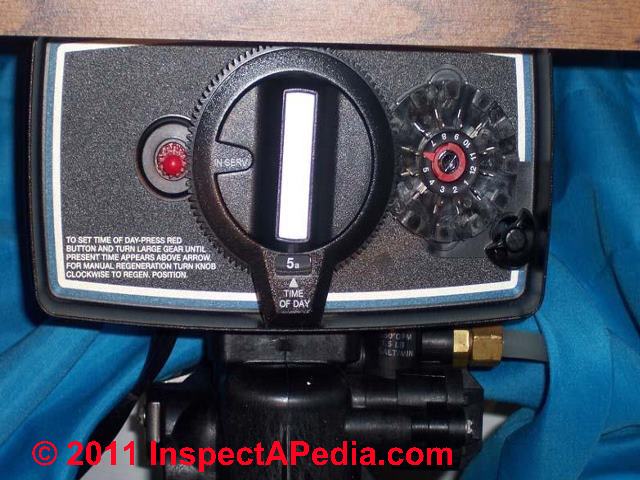
It is the control head or water conditioner "valve" mounted on top of the unit that controls the system's regeneration cycle and salt usage. So that part is key.
Start by looking carefully on all sides and under covers or the control head cover and back for a manufacturer or brand, or if you cannot find any such labeling, you could try contacting local water softener distributors, since your unit was most likely installed by a local supplier.
You can also try contacting the water conditioner manufacturers we list below. Since the control valve on your water softener matches photos of units at the Aqua Maid website I'd start by contacting Aqua Maid and asking for (or downloading) the installation and operation manual for their equipment.
Aqua Maid can be contacted at 3375 Hwy 98S Suite B-1 Lakeland, Fl 33803 Phone: 1-888-925-0213 Fax: 863-665-9595 aqua665@aol.com http://www.aquamaidwatersystems.com/Products/SSC.aspx
Crystal Quest 2130 Northwest Pkwy S.E. Suite - i Marietta, GA 30067 1-800-934-0051 1-770-951-5600 1-800-716-7718 1-770-953-1600 support@crystalquest.com sales@crystalquest.com http://www.crystalquest.com/watersoftener.htm
From just looking at your photo of the control valve I see that you can set
- the time of day
- the salt dose (that red dial with a center screw
- The automatic regeneration frequency (pull out or push in those individual pins that will trip the automatic regeneration cycle as the timer dial rotates under clock control. If your system is not regenerating under control of the valve (control head) then perhaps none of the push-pull pins has been changed to cause the regen cycle to occur.
Reader Question: how do I identify the model and brand of my water softener? Where do I get water softener operating instructions.
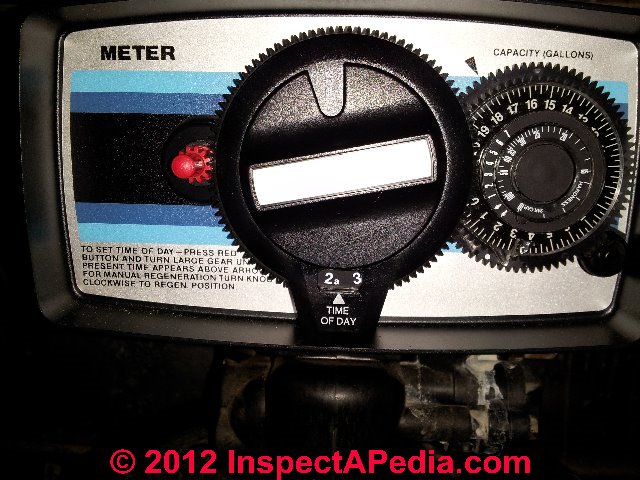
Attached is a picture (shown at above left) of the control for the water softener that came with the house three years ago. I just started running the water softener after cleaning the brine tank and filling it up with salt. I left the settings as is.
The unit has a separate tank for the brine with a float inside. (tank size is 18" x 33") Unfortunately, I don't have any manual on the system and on top there is no manufacturer's name, model no.
Except there is hand written note "TT 948 56 AE". S/N 12671 Could you please help me identify the maker of this machine or how should I proceed to set it up correctly?
Reply: how to identify a water softener brand and obtain operating instructions
KD: the water softener control that is shown in your photo (above left) appears to be widely used across a variety of water softener brands and models, as you can read in the FAQ text just above.
That's because some OEM manufacturers of water softener controls and parts sell those components to a number of companies who then sell and install water softeners under their own brand.
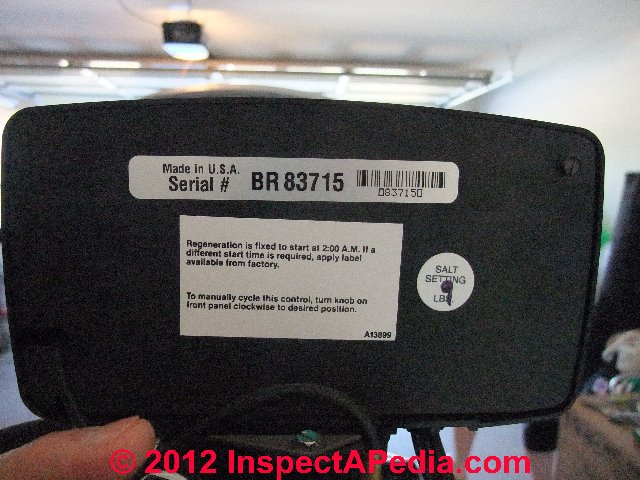
For example in Sun City Arizona and other parts of that state, the water softener you show above is widely distributed under the Pro-Tec Water Equipment brand. Depending on where you live, choose and try calling one of the water conditioner distribution & sales companies listed just below, as all of them sell water softeners using the control shown in your photograph:
- Aqua Maid can be contacted at 3375 Hwy 98S Suite B-1 Lakeland, Fl 33803 Phone: 1-888-925-0213 Fax: 863-665-9595 aqua665@aol.com http://www.aquamaidwatersystems.com/Products/SSC.aspx
- Crystal Quest 2130 Northwest Pkwy S.E. Suite - i Marietta, GA 30067 1-800-934-0051 1-770-951-5600 1-800-716-7718 1-770-953-1600 support@crystalquest.com sales@crystalquest.com http://www.crystalquest.com/watersoftener.htm
- Pro-Tec Water, 18700 N 107th Avenue # 9, Sun City, AZ 85373-9759, Tel: 623-977-0071 Website: www.pro-tecwater.com (inoperative)
- The control head (water softener valve) for your water softener is also found in a Chinese unit sold to various manufacturers (notwithstanding the labelthat may say "Made in the USA:) - you can see the control at http://www.china-water-filter.com/Stainless-Steel-Water-Filter-Housing-17.html and also at http://www.alibaba.com/product-gs/357047492/detail.html?s=p
- WATER CONDITIONER MANUALS lists and provides free copies of instruction manuals for many water softener brands and models
Some of the water conditioner's operating instructions are printed right on the front of the control. On many models, basic water softener adjustment procedures and guidelines are printed inside of the control cover or lid. But best is to obtain the installation and operating guide book from your equipment's manufacturer.
Make a note of your water softener's model and serial number if you can find it. Your note contained some of that information; Often, as our photo illustrates, the back of the water softener control includes a sticker with water conditioner model and serial number information. That information can help assure that the manufacturer whom you contact can provide you with the most accurate water softener operating instructions.
Please also see WATER SOFTENER ADJUSTMENT & CONTROLS where we explain how to adjust and set the controls on water conditioning and water softener equipment.
Reader Question: Water-Rite 740 water softener has brine tank full of water - what's the normal liquid level in the brine tank?
Hi, can you tell me how much water should be in a brine tank of a water rite softener under normal use, now it is full of water all the time, is this normal. I think this will just melt all the salt in the tank all the time. It is a model 740 - M.C., Canada
Reply: you should not normally see liquid in the brine tank unless it's about out of salt
The most common causes of a flooded water softener brine tank are
- A stuck brine tank float that is not properly controlling the water entry to the tank. Details on freeing the float are given just below.
- The brine tank drain line is restricted, crimped, bent, or clogged
- The water softener venturi or nozzle (usually at the control head) is clogged. Take apart and clean the nozzle and venturi assembly, replace any damaged parts, take care to assure that the O-rings are intact.
- The water softener valve-rotor disc or seals are damaged. Check the rotor assembly for gouges or scratches and replace it if necessary.
A competent onsite inspection by an expert usually finds additional clues that help accurately diagnose a problem or in this case just what's wrong with your water softener. That said, here are some things to consider:
We don't know specifically by quantity, but in general, you should not see water in the brine tank unless salt has been used up to the last 6-12 inches in the tank. So we suspect that the brine tank float level control valve that sets the water level in the tank is not working properly.
Check the brine refill control valve in your water softener brine tank
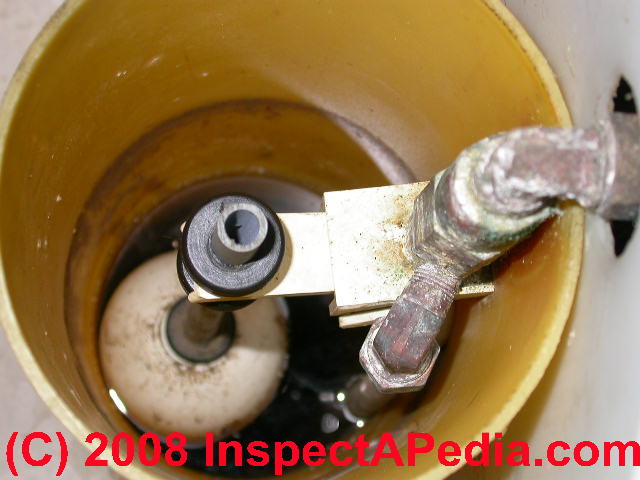
The BRINE REFILL FLOAT CONTROL VALVE device is found in the vertical tube in your brine tank. Typically it incorporates a float, vertical rod, and a switch that controls the water level in the tank during a brine generation cycle. The part is also called the brine refill control valve.
We discuss how the brine refill control valve works and how it may be adjusted
at WATER SOFTENER ADJUSTMENT & CONTROLS.
More photos of this valve are
at WATER SOFTENER CLEANING & SANITIZING.
How to fix the brine tank water level
First check the water softener settings
See details at WATER SOFTENER ADJUSTMENT & CONTROLS .
Try emptying the brine tank completely, cleaning all the parts, make sure that the brine control valve (the float actuated switch in the brine tank) moves freely up and down, then fill it at least 1/3 full of salt. For details about cleaning out the water softener brine tank
see WATER SOFTENER CLEANING & SANITIZING.
Then send the water softener through a manual regeneration cycle and watch what happens.The volume of water that is pumped into the brine tank and then out back through the water softener is set by the salt "dose" setting on the water softener control.
- If you need to adjust the brine tank refill valve just follow the instructions
at FLOAT ADUSTMENT in the SOFTENER SALT TANK - If you need to adjust the salt dose or regeneration cycle frequency on your water softener, s
ee WATER SOFTENER ADJUSTMENT & CONTROLS - If the brine tank water level is still abnormally high,
see TOO MUCH WATER in the BRINE TANK Diagnosis and Cure
The manufacturer of your Water Rite water softener, properly a Water-Right water softener, can provide you with the installation, operation, and maintenance manual for your water softener if you don't already have one.
- [1] Water Right, 1900 Prospect Court Appleton, Wisconsin 54914, Tel: 920-739-9401, Website: http://www.water-right.com/ and their water softener manuals are available online at http://www.water-right.com/library/literature/literature_manuals.html
Reader Question: our water softener brine tank never fills up with water but we do see the salt level dropping - what's wrong with our water conditioner?
Tank wont fill with water but salt level still goes down - Tom 11/27/12
Reply: probably nothing
Tom,
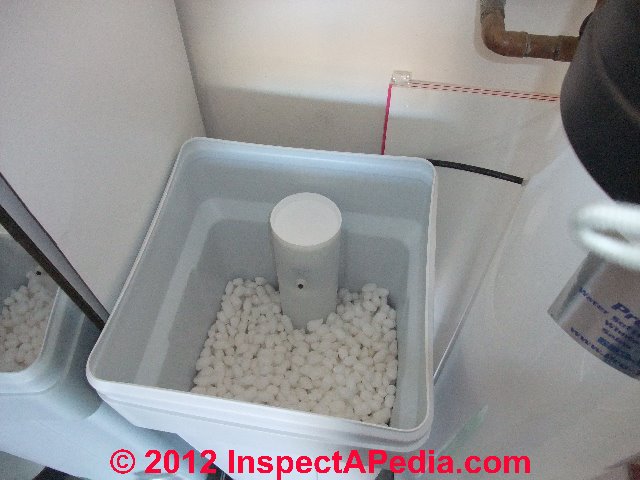
The water softener brine tank does not normally FILL with water. Rather, water is pumped into the bottom of the tank, water level rises under control of a brine level float switch usually found inside a vertical platic tube in the tank, then pumping stops, salt dissolves, and salty water is pumped back out.
So you won't see the water unless you've let the salt run out.
Sounds as if your system is working normally.
Reader follow-up: what is the brine tank on a water softener?
the tank that holds the salt is the brine tank? or is the small tube with the salt level numbers the brine tank? - Tom
Reply: photo above shows the water softener brine tank, brine level float control tube, and water/brine pumping tube
Tom
The tank that contains the salt crystals or salt pellets is the brine tank (red arrow in our photo above).
The small vertical tube is the location of the brine level float control and will be found in the salt tank at one side (blue arrow in our photo above).
Water passes from the water softener resin tank (at the right side in our photo) into the brine tank through the black tube (yellow arrow in our photo above) to dissolve salt, and salty water is pumped back through the resin tank through that same tube.
Reader question: my water softener is not making the water soft
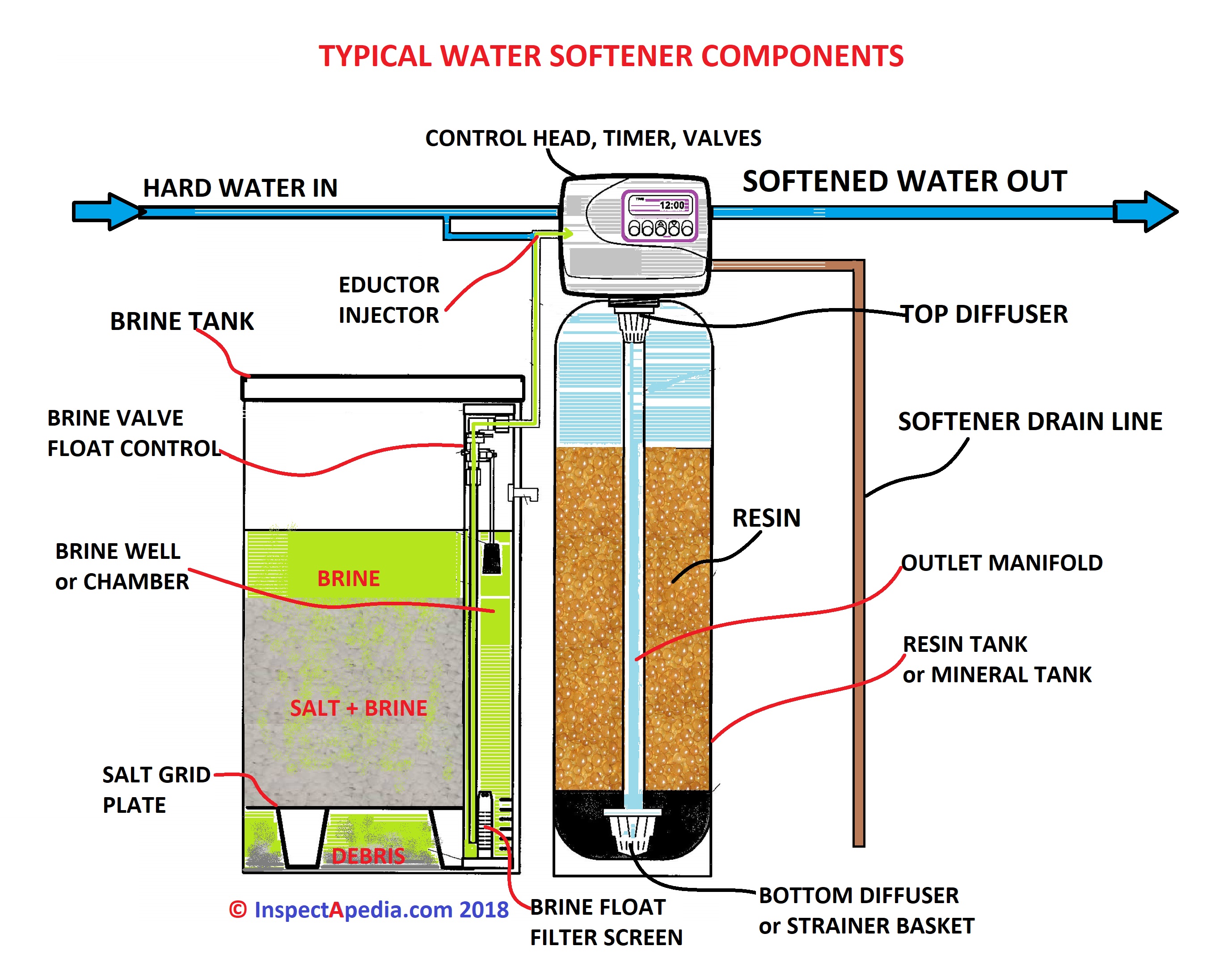 My water softener seems to run through regen cycles but the water is still hard. What's wrong? - Anon.
Reply:
The most common sources of a water softener not removing minerals and not producting soft water at all include:
- There is no salt in the brine tank
- There is salt in the brine tank but it is bridged - that is, a crust of salt has formed across the brine tank so that when you look into the tank the salt level always looks the same. Try poking the top of the salt to see if a crust has formed. Break it up or remove it.
- The water softener is set in manual bypass mode. Check the bypass control position.
- The water softener venturi or nozzle is dirty, clogged, damaged. Remove, disassemble, clean these parts, replace any damaged parts, check that O-rings are intact.
- The brine tank drain hose is plugged, crimped, or blocked.
The most common causes of a water softener that sometimes doesn't produce soft water or water that is not soft enough are these:
- The water softener is not properly set or adjusted: check the salt dose and regen cycle frequency against the hardness of your water and the water volume usage.
See WATER SOFTENER ADJUSTMENT & CONTROLS - You are using water during a water softener regen cycle. During regen the softener is automatically put in bypass mode. Change the regeneration cycle time to run at a time when you won't be using water. Allow about two hours for the regeneration cycle to complete.
- The water supply hardness level has changed. This can be a seasonal or permanent change. Test your water for hardness and compare that finding with your water softener hardness settings.
See "
Reader Comments, Questions & Answers About The Article Above
Below you will find questions and answers previously posted on this page at its page bottom reader comment box.
Reader Q&A - also see RECOMMENDED ARTICLES & FAQs
On 2019-12-21 by Ron Wood
My softener control panel is providing a error code of ERR After it stopped working, any idea of how to fix this?
On 2019-12-09 - by (mod) -
I have found considerable variation in the results from home test kits for various water parameters and worse, some kits come without proper instructions so the test results can be completely wrong. For example some test strips can simply be dipped into a stream of running water at a faucet while others are intended to be immersed in a specific volume of water for a brief time.
While I like some water test kits for general screening of water parameters (I"m working on an article comparing some tests),
For a home with questions about water quality upon which significant expense will turn it is worth having tests performed by a local water test lab.
On 2019-12-08 by Eric
I have a well with a very old softener with an old autotrol 1550 TC controller; the system hasn't been renovated in at least 14 years; the controller needs repair.
There are mineral stains on some plumbing fixtures and shower tiles, which I assumed were iron. We're thinking of a new softener, so I got some test strips.
The H2O OK brand tested total hardness at about 240 ppm ( this is from the well, (before the softener or filters). The Pro-lab brand strips tested the same water at virtually nil hardness!! The pro-lab then tested the inside faucet water at basically nil for hardness
I did not have an extra strip to test the faucet with the H2O brand strip. Both brands tested alkalinity pretty high; both detected negligible iron. How reliable / consistent are these home test strips usually? Do I need to get some more testing? Is the high alkalinity part of the problem with stains? .
On 2019-09-18 - by (mod) -
 WATER SOFTENER ADJUSTMENT & CONTROLS
At https://inspectapedia.com/plumbing/Water_Softener_Settings.php
You'll find setting recommendations
On 2019-09-18 by Travis
I’m trying to figure out what setting I need to have the Capacity (Gallons) indicator set at. We have 2 people in our household and our water hardness is around 7-10 for our area
On 2018-07-10 - by (mod) -
I will take a look.
You might find if you're just replacing washers that they are probably a standard part that you can buy from a hardware supplier. It would be unusual for a manufacturer to design a unique general type washer for their product as that pushes the cost up unnecessarily.
On 2018-07-10 by Glen
Have a Nationspure Water System / RO. Need to replace some washers on the control valve units on top of tanks. I am unable to locate a manual and Nationspure believes they are the only game in town and won't provide a service manual. Any ideas where to locate Nationspure Service Manual?
On 2013-03-26 - by (mod) -
Alicia, the rate at which your water softener uses salt is set by the salt-dosage controls. If you look into the tank and see that the salt level is low, indeed the system wants salt added.
But if you are seeing an increase in salt usage or if the amount of salt used seems odd to you I suggest
- check first that the softener is not stuck in backwash / regen cycle mode
- check next the frequency to which the softener is set to run a regen cycle - make sure someone hasn't accidentally set the controls to regen more often than needed
- check the salt dose used at regen time for the same reasons.
Instructions for setting the salt dose and regen cycle frequency (which depend on water hardness and water volume used) are in the Related Articles link near page top where you see
SOFTENER ADJUSTMENT & CONTROLS
Finally, if all of the settings look right and in normal range, you might also ask a lab to test the salt level in your system to be sure it's working correctly.
On 2013-03-26 by alica
how often are we supposed to be adding salt to our tank? seems like we are always adding salt
On 2013-03-20 - by (mod) -
Mike,
The article I recommended "Air discharge at faucets" has our best diagnostic tips for tracking down air coming out of faucets.
But your case is not one I've come across: air only at the hot water faucets. That wouldn't normally be traced back to a water softener, as both hot and cold water are fed through the softener.
Extremely hot water might appear to be discharging air, but I don't hear that in your description.
I'm baffled but will think on this some more. The recommendations I've seen on the web that focus on a one-time "getting the air out of your system" are simply off base. We need to know why the air is appearing in the first place.
Is it possible that air is entering your water supply from one of the problems in our "air discharge" article but that because of arrangement of piping, say a vertical hot water riser early in the piping system, taken off of the incoming cold line, could be picking up the air and routing it just through hot water piping?
On 2013-03-20 by Mike C
There is no odour from the taps. I might also mention that I'm on a well using a submersible pump, if that makes a difference.
Mike C.
On 2013-03-18 - by (mod) -
Water tastes salty:
Check that your brine dose system is not stuck - check the brine float; it may need to be freed-up or repaired.
On 2013-03-18 - by (mod) -
Mike,
Possible ... well I suppose an odd leak in the piping system, but no, that's not what I'd expect. Air appearing at the hot water taps could be from
- air entering your water supply system, maybe accumulating in the hot water tank?
- if the hot water smells, maybe a hydrogen sulfide gas problem (unsafe) - does it smell bad?
Search InspectApedia for
air discharge at faucets
for diagnostic steps
On 2013-03-17 by Mike C.
Is it possible that a water softener can cause air in my hot water system? Softener is less than a year old and seems to be working fine. But in the last few months I've noticed air at my hot water taps when first turned on. There is no air at the cold water taps.
On 2013-01-22 by Water Tastes Salty recently
Noticed about a week ago drinking water tastes salty? Softener cycles middle of night once a week and has for years, dump hose is not plugged and is clear to drain so why now does it taste salty all of a sudden?
Thanks Dan
...
Continue reading at WATER SOFTENER ADJUSTMENT & CONTROLS or select a topic from the closely-related articles below, or see the complete ARTICLE INDEX.
Or see WATER SOFTENER REPAIR FAQs for help with common water softener diagnosis & repair questions.
Or see these
Recommended Articles
- WATER SOFTENERS & CONDITIONERS - home
- BRINE TANK DIAGNOSIS & REPAIR - home
- BYPASS VALVE on WATER SOFTENERS
- CHEMICAL CONTAMINANTS in WATER
- DE-WINTERIZE WATER SOFTENER
- DIAGNOSE WATER SOFTENER PROBLEMS
- HEALTH RISKS & WATER SOFTENERS
- HOW WATER SOFTENERS / CONDITIONERS WORK
- IDENTIFY WATER SOFTENER BRAND / MODEL
- INSTALLATION of WATER SOFTENERS
- OTHER WATER SOFTENING METHODS
- MANUALS for WATER SOFTENERS
- REDUCE IMPACT of SOFTENER on SEPTIC
- SALT / SOFT WATER IMPACT on SEPTIC, PLUMBING, HEATERS
- WATER SOFTENER ADJUSTMENT & CONTROLS
- WATER CONDITIONER / SOFTENER MANUALS
- WATER HARDNESS: HOW TO DETECT
- WATER HARDNESS: HOW TO MEASURE
- WATER HARDNESS TEST San Miguel de Allende
- WATER SOFTENER ADJUSTMENT & CONTROLS
- WATER SOFTENER BRINE TANK DIAGNOSIS & REPAIR - home
- WATER SOFTENER CLEANING & SANITIZING
- WATER SOFTENER CONTROLS & OPERATION
- WATER SOFTENER CONTROL ADJUSTMENT SETTINGS
- WATER SOFTENER CONTROL BYPASS VALVE
- WATER SOFTENER EDUCTOR REPAIR
- WATER SOFTENER MANUALS
- WATER SOFTENER OPERATING CYCLES
- WATER SOFTENER OUTPUT COLORS DEBRIS STAINS ODORS
- WATER SOFTENER PLUMBING PROBLEMS
- WATER SOFTENER REGENERATION CYCLE DURATION
- WATER SOFTENER REGENERATION CYCLE FREQUENCY
- WATER SOFTENER RESIN LOSS
- WATER SOFTENER RESIN PROPERTIES & SOURCES
- WATER SOFTENER RESIN REPLACEMENT
- WATER SOFTENER SALT CHOICES
- WATER SOFTENER SALT DOSE SETTING
- WATER SOFTENER SALT SUBSTIUTE: POTASSIUM CHLORIDE
- WINTERIZE WATER SOFTENER
- WATER TREATMENT EQUIPMENT CHOICES
Suggested citation for this web page
WATER SOFTENERS & CONDITIONERS at InspectApedia.com - online encyclopedia of building & environmental inspection, testing, diagnosis, repair, & problem prevention advice.
Or see this
INDEX to RELATED ARTICLES: ARTICLE INDEX to WATER TREATMENT SYSTEMS
Or use the SEARCH BOX found below to Ask a Question or Search InspectApedia
Ask a Question or Search InspectApedia
Try the search box just below, or if you prefer, post a question or comment in the Comments box below and we will respond promptly.
Search the InspectApedia website
Note: appearance of your Comment below may be delayed: if your comment contains an image, photograph, web link, or text that looks to the software as if it might be a web link, your posting will appear after it has been approved by a moderator. Apologies for the delay.
Only one image can be added per comment but you can post as many comments, and therefore images, as you like.
You will not receive a notification when a response to your question has been posted.
Please bookmark this page to make it easy for you to check back for our response.
Our Comment Box is provided by Countable Web Productions countable.ca
Citations & References
In addition to any citations in the article above, a full list is available on request.
- [1] Autotrol Series 255 Valve / 460i Water Conditioning Control System, Installation, Operation, and Maintenance Manual, web search 09/01/2010 original source: http://www.qualitywatertreatment.com/PDF/Autotrol%20255-460i_Manual.pdf
- [2] Aquatell (Nelsen Corporation) produces Autotrol Water Conditioners. Email: sales@aquatell.com Tel: Toll Free 1-866-966-9951 Website: Toll Free 1-866-966-9951 Website: http://www.aquatell.com/
- [3] Aqua Maid can be contacted at 3375 Hwy 98S Suite B-1 Lakeland, Fl 33803 Phone: 1-888-925-0213 Fax: 863-665-9595 aqua665@aol.com http://www.aquamaidwatersystems.com/Products/SSC.aspx
- [4] Crystal Quest 2130 Northwest Pkwy S.E. Suite - i Marietta, GA 30067 1-800-934-0051 1-770-951-5600 1-800-716-7718 1-770-953-1600 support@crystalquest.com sales@crystalquest.com http://www.crystalquest.com/watersoftener.htm
- [9] Culligan Mark 10 Water Softener 1994-1998 Installation and Operating Instructions (covering models manufactured after 1995) (1-96) 01881948.pdf available from www.culligan.com
- [10] Water Softeners, CMHC, Canadian Mortgage and Housing Corporation, cmhc-schl.gc.ca/en/co/maho/wawa/wawa_005.cfm - October 2008. Canada Mortgage and Housing Corporation acknowledges the contribution of Health Canada to the development of this document. For further questions regarding water treatment and water quality, contact Health Canada at watereau@hc-sc.gc.ca or call 613-957-2991 or 1-866-225-0709.
- [11] "Commercial Water Softener Installation and Operating Instructions", IBC Filtration & Water Treatment Products (Australia) for commercial, industrial and residential application www.ibcwater.com.au (07) 3219 2233
- [12] "Non electric water softener, Installation and Operating Instructions", IBC Filtration & Water Treatment Products (Australia), op.cit.
- [13] "Water Softener Twin Tank Installation and Operating Instructions", IBC Filtration & Water Treatment Products (Australia), op.cit.
- [15] Andress, S., and C. Jordan. 1998. Onsite Sewage Systems. Virginia Polytechnic Institute and State University, Civil Engineering Department, Blacksburg, VA.
- [16] Corey, R.B., E.S. Tyler, and M.U. Olotu. 1997. Effects of Water Softer Use on the Permeability of Septic Tank Seepage Fields. In Proceedings of Second National Home Sewage Treatment Symposium. Pub. no. 5-77. American Society of Agricultural Engineers, St. Joseph, MI.
- [19] U.S. Environmental Protection Agency (USEPA). 1992. Manual: Wastewater Treatment/Disposal for Small Communities. EPA 625/R-92/005. U.S. Environmental Protection Agency, Cincinnati, OH.
- [20] Watts Industries of North Andover, Mass., provides its ZRO-4 under counter system intended to target the independent water dealer market.
- [21] Ecodyne Industrial, 1270 Frontenac Road, Naperville, IL 60563 Tel: 1 800-228-9326 (USA Only) Tel: +1 630-961-5043 Fax: 1 800-671-8846, Customer Service: 1 800-228-9326, Email: customers@ecodyneind.com, Website: http://www.ecodyneind.com/
- [22] Lochinvar High Efficiency Water Heaters, Boilers & Pool Heaters, Lochinvar, LLC World Headquarters, 300 Maddox Simpson Pkwy., Lebanon, TN 37090, Tel - Customer Service: 615-889-8900, contact Lochinvar Technical Service at 1-800-722-2101 web search 12/15/2012, original source: http://www.lochinvar.com/
- [23] Pro-Tec Water, 18700 N 107th Avenue # 9, Sun City, AZ 85373-9759, Tel: 623-977-0071 Website: www.pro-tecwater.com (inoperative)
- In addition to citations & references found in this article, see the research citations given at the end of the related articles found at our suggested
CONTINUE READING or RECOMMENDED ARTICLES.
- Carson, Dunlop & Associates Ltd., 120 Carlton Street Suite 407, Toronto ON M5A 4K2. Tel: (416) 964-9415 1-800-268-7070 Email: info@carsondunlop.com. Alan Carson is a past president of ASHI, the American Society of Home Inspectors.
Thanks to Alan Carson and Bob Dunlop, for permission for InspectAPedia to use text excerpts from The HOME REFERENCE BOOK - the Encyclopedia of Homes and to use illustrations from The ILLUSTRATED HOME .
Carson Dunlop Associates provides extensive home inspection education and report writing material. In gratitude we provide links to tsome Carson Dunlop Associates products and services.
 | HOME | ABOUT | ASK a QUESTION | CONTACT | CONTENT USE POLICY | DESCRIPTION | POLICIES | PRIVACY | |
| © 2024 - 1985 Publisher InspectApedia.com - Daniel Friedman | |||||||||