
InspectAPedia® FREE Encyclopedia of Building & Environmental Construction, Diagnosis, Maintenance & Repair |
Question? Just ask us! InspectAPedia
|
 Asbestos Cement Siding or Asbestos Cement Shingles
Identify & inspect asbestos-cement wall siding or wall shingles
- POST a QUESTION or COMMENT about asbestos cement siding on buildings
Asbestos-containing building siding identification & history:
This document assists building buyers, owners or inspectors who need to identify asbestos materials (or probable-asbestos) in buildings by simple visual inspection. In cement asbestos siding article series listed below, we provide photographs and descriptive text of asbestos insulation and other asbestos-containing products to permit identification of definite, probable, or possible asbestos materials in buildings.
While an expert lab test using polarized light microscopy may be needed to identify the specific type of asbestos fiber, or to identify the presence of asbestos in air or dust samples, many asbestos-containing building products not only are obvious and easy to recognize, but since there were not other look-alike products that were not asbestos, a visual identification of this material can be virtually a certainty in many cases.
InspectAPedia tolerates no conflicts of interest. We have no relationship with advertisers, products, or services discussed at this website.
Photo Guide to Cement-asbestos Wall Shingles or Siding Products
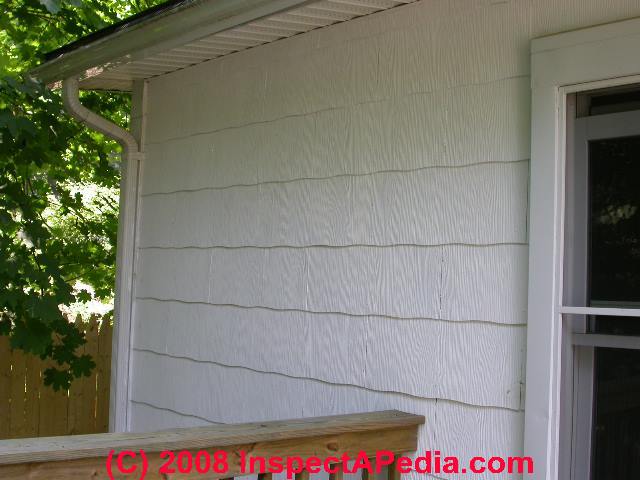 In this photo of a house in New York State we can see both original cement-asbestos wall shingles and newer fiber cement replacement wall shingles that do not contain asbestos. This is the "wavy edge" asbestos cement shingle siding product.
But only the installer (me in this case), an expert, or a lab can tell the new fiber cement from the old asbestos fiber cement shingles - or you can with help of the inspection and repair tips we provide below.
Is it safe to buy a home with cement asbestos siding?
Most cementious building materials are considered to be non-friable, and are probably less hazardous than other friable asbestos products such as asbestos pipe insulation.
[Click to enlarge any image]
However removal of asbestos-containing roofing products is regulated as we discuss at ACRM Roofing Disposal Regs.
Asbestos-cement products were developed in an era of ingenuity for creating easy to install and economic building materials.
Although asbestos-cement has acquired a poor reputation by association of its title, it has not gained that reputation through a lack of durability or utility.
In order to preserve this twentieth-century material, understanding what makes, or does not make, asbestos a hazard is truly important. In this case, no hazard is created when asbestos-cement building materials are sound and left in place, or when treatments incorporate non-abrasive means. - "Keeping a Lid on It..., Woods, NPS technical brief
Friable and nonfriable asbestos are defined
at ASBESTOS DEFINITION & COMPOSITION
 Asbestos cement wall shingles were in popular use in the U.S. from the 1920's (est) through the 1960's (est). A mixture of asbestos fibers and portland cement the material was durable and fire resistant.
What forms of asbestos were used in fiber cement products?
Medium length asbestos fibres and possibly also asbestos shorts or fragments were used in fibre cement products.
The fibres, usually chrysotile asbestos (white asbestos), were used to impart strength or resistance to breakage of the asbestos cement product, while shorts or "dust" or fine asbestos particles were used in some products as a filler.
The types of asbestos used may vary, chrysotile is normally always present but crocidolite and amosite (asbestos grunerite) were also added to many products. - (Burdett 2007)
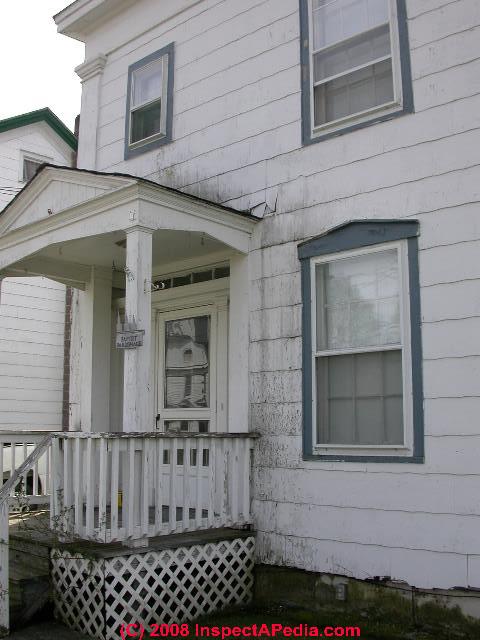
The building shown at left, located in Hughsonville, NY, using the "thatch edged" shingle siding style is almost certainly sided with asbestos-cement shingles.
From the 1940's to perhaps the early 1970's it was popular to cover peeling wood clapboard buildings with this durable material. We estimate that this building was probably re-sided in the 1960's.
Siding materials that use fibers and aggregate other than asbestos are properly called "fiber cement" building siding products.
Some manufacturers use the term "fiber-reinforced cement" for these products.
All of these products use some sort of fiber along with cement. Before 1978 in the U.S. the common reinforcing fiber used was asbestos.
Asbestos in granular or powder form may also have been mixed in with cement as a filler when these products were manufactured.
How can we tell the difference between asbestos-containing shingles and fiber-cement wall shingles?
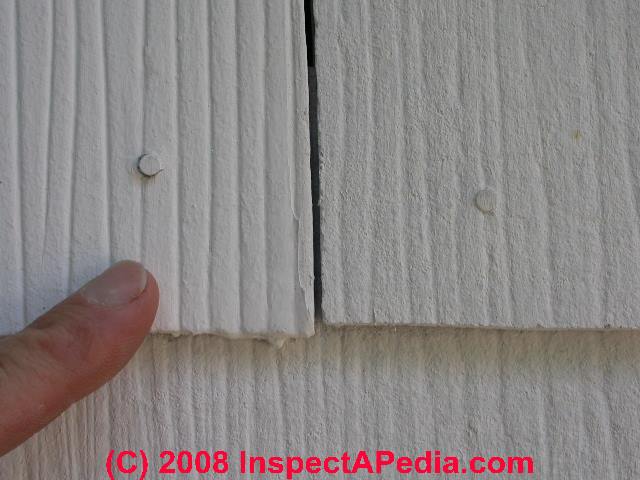
It's tricky. But here are some ways to distinguish between asbestos containing shingles and non-asbestos fiber-cement shingles. At below left, I point to an older asbestos cement siding shingle while to the right of my finger the next shingle is a modern asbestos-free fiber cement siding shingle.
I know the difference because I installed the new material. Otherwise, without close inspection or a lab test it would be difficult to say which was which.
- Age or date of fiber cement or asbestos cement shingle siding installation:
installed before 1978 the fiber-cement shingles probably contain asbestos.
- Layers of paint or finish coatings;
the original shingles of both asbestos-cement and fiber cement usually come from the factory painted white on one side.
Owners often painted cement asbestos shingle siding to make it look fresh, or if it was weathered and fuzzy, to preserve it.
On a building that has has a portion of its original cement asbestos shingles replaced with newer fiber cement shingles, and where some original asbestos cement shingles remain, you'll see a difference in the thickness of layers of paint on the two materials.
The shingle at the right in the above-left photo clearly has fewer paint layers than the one at left. The left shingle is an older asbestos-cement shingle and the right photo is a new fiber cement shingle we installed.
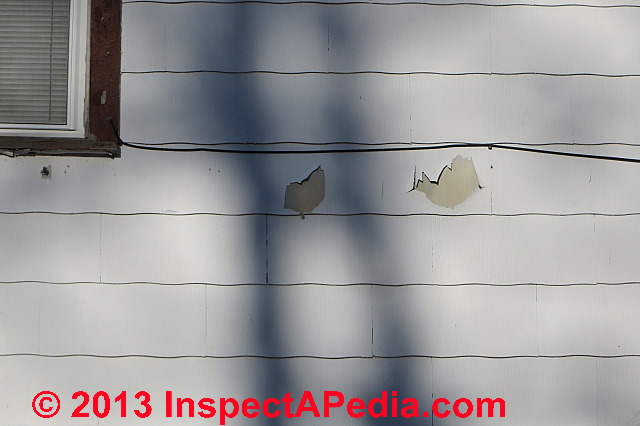
At above right we illustrate why additional coats of paint on a fiber cement or asbestos cement siding shingle means future painting maintenance will be required.
Proper paint preparation (cleaning) and priming, then painting with paints recommended for use on this material may give better results than we see at above right.
If an asbestos-cement sided home has been re-modeled such as by adding a window or door, it's likely that the old asbestos cement shingles were broken around that new opening during the construction work - expect to see newer fiber cement shingles there.
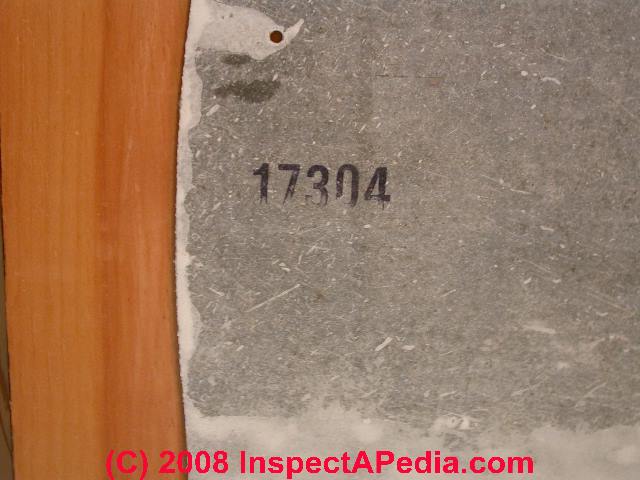
- The back of a new fiber cement wall shingle
will probably have a code stamped on it such as we show above.
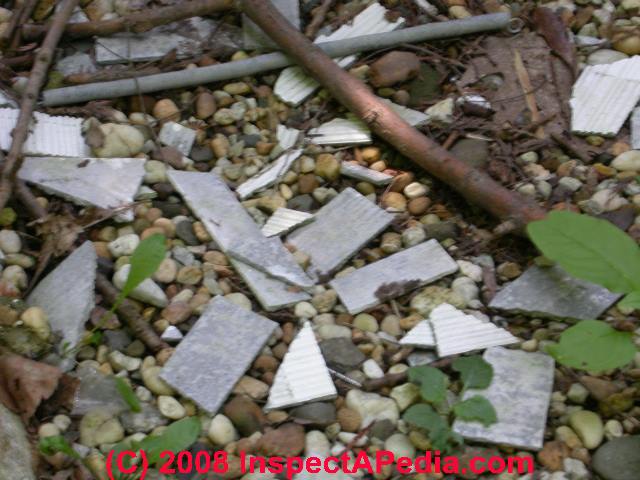
- The presence of old dirty demotion materials
may suggest that old asbestos cement shingles have been removed from the home even when new, completely different materials are installed.
We found this cement asbestos siding debris on the ground around a home that boasted new vinyl siding. - The presence of multiple layers of exterior siding
can be spotted by noticing that the wall cladding extends out past the original window or door trim.
But beware; when we renovated the building shown above we built-out the exterior trim so that it would continue to project beyond new vinyl siding installed on some wall surfaces. - The nails
used to secure the shingles probably won't help unless some are obviously different from others; installers use the same galvanized box nails to hang these shingles as they did in 1955.
Watch out: because fiber cement siding manufactured in North America after around 1978 was made without using asbestos in those later products, and because those non-asbestos fiber cement shingles included products that by eye were an exact visual match for their older asbestos-containing brothers and sisters already installed, a building built before 1978 and sided with cementious shingles may contain a mix of both asbestos-containing and non-asbestos-containing cementious shingles.
Why? From first hand experience I note that we often made repairs to or replaced damaged asbestos cement shingles with non-asbestos-based fiber cement shingles on older buildings. So any older building could contain a mix of asbestos- and non-asbestos cement shingle siding.
Watch out: if you are testing fiber-cement shingles on an older building for asbestos content, be sure that you select for testing one of the older shingles installed before 1978. Else you may miss asbestos containing material on the building. Clues given just above can help you select older shingles for tests for asbestos.
Early History & Age of Asbestos-Cement Siding & Roof Shingles: Production & Use
 The Rosato text cited below and our research article and patent search on asbestos cement shingles and siding give insight into the history of and development of cement-asbestos shingles, siding, and cement board used on and in buildings.
Cementious siding and roofing such as fiber-cement siding, lap siding, and fiber cement roof shingles containing asbestos may then have appeared on homes constructed between 1906 and 1980 in North America and continuing later in some other countries.
At CEMENT ASBESTOS PRODUCT MANUFACTURE we provide a more-detailed history of the development and use of asbestos in building and other products.
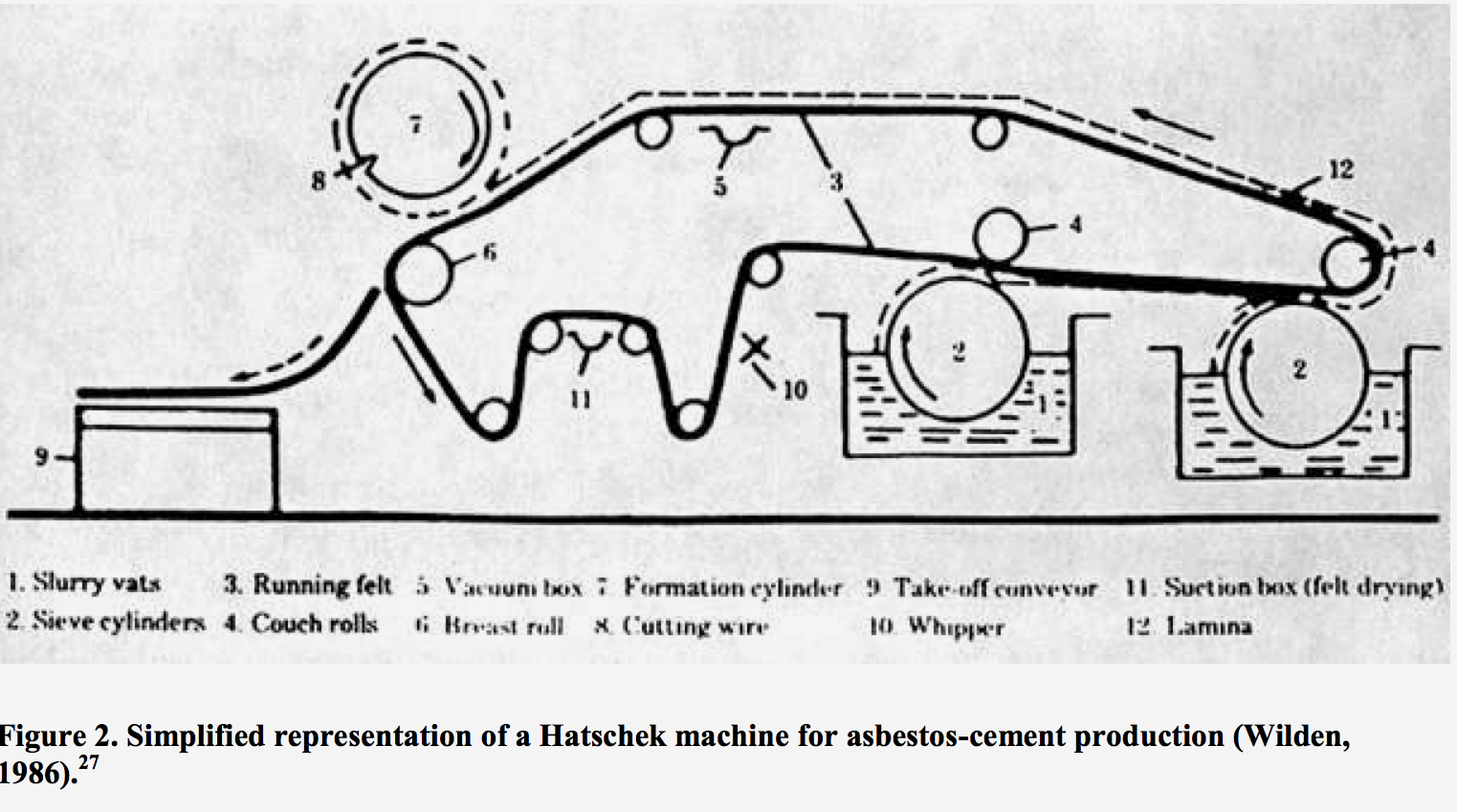
There we describe the Hatschek Machine for Production of Asbestos Sheet Goods.
Excerpt:
It was not until 1907 that the invention by an Austrian engineer, Ludwid Hatschek, made possible the manufacture of pre -formed asbestos-cement products.
The Hatschek machine, a wet transfer roller, was used to produce the initial asbestos-cement sheets, while two other manufacturing processes included the Mazza process for pipes, and the Magnani semi-dry process for corrugated sheets. - Woods (2000)
We learn further from patent citations that asbestos-cement products were in use in the U.S. before 1910, as inventions often cite improvements to existing designs and that an explosion of patents and products making use of asbestos-cement ensued between 1907 and 1940.
The improved fire-resistance of cement asbestos roofing led to its recommendation in the U.S. by the National Board of Fire Underwriters in 1920. (National Board of Fire Underwriters 1920).
A similar-looking product, composite siding made of asphalt-impregnated fiberboard was also used for lap siding and wall shingles but is not an asbestos-cement product.
See SIDING TYPES, INSTALLATION, DEFECTS for a guide to siding products of various types.
History of Uses of Asbestos in Modern Products
 When was asbestos used in modern products?
Question: when was asbestos cement siding first used?
2016/09/08 Gary said:
In what year did they start to use asbestos in cement siding ?
This question was posted originally at ASBESTOS DISPOSAL REGULATIONS
[Click to enlarge any image]
Reply:
Gary, a reasonable guess for the start of widespread use of asbestos cement siding in the U.S. would be 1920, but patent disclosures and other research make clear that such products were in development and use one or two decades earlier.
The earliest use of asbestos in modern building products that I found was discussed in a Scientific American article published in 1876 and cited below. Asbestos researchers note that human interest in the properties and uses of asbestos is more than 2000 years old.
Chronology of Inventions in the Use of Asbestos & Asbestos Cement in Building Materials
The following citations giving a history of the use of asbestos-cement in building products are arranged chronologically, rather than alphabetically - Ed.
- An excellent history of the use of Asbestos was provided by Rosato whose complete text we provide online beginning
at ASBESTOS ORIGIN & NATURE - CERAMO CERAMIC-GLAZED ASBESTOS-CEMENT SIDING [PDF] - illustrated just above.
- "The Industrial Uses of Asbestos," Scientific American (22 April 1876), 258-259.
Back issues of Scientific American magazine are available from http://www.scientificamerican.com/store/archive/?magazineFilterID=Scientific%20American%20Magazine - H. W. Johns, Patent Trademark Materials: Asbestos (New York: H. W. Johns Manufacturing Co., 1878) filed by H W JOHNS Manufacturing Co. [Predecessor to Johns Manville corp. ? - Ed.]

- Martin, R.H., Non-Conducting Covering [PDF] US Patent No. 497,382. Patented May 16, 1893.
Excerpt:
My improved non-conducting material is made in the form of a sheet of asbestos fiber in loose or flocky state ...shall be peculiarly soft, flexible, elastic and porous, being in the nature of a soft bat or wad, and the fibers are held together by an adhesive material which extends here and there, throughout the entire thickness of the bat,
so that it is held together by the adhesion of the fibers to each other at innumerable points throughmuch adhesive material as to interfere with the softness, flexibility, elasticity and porosity of the sheet or bat and owing to the method employed by me for introducing the adhesive or cementitious material,
I am enabled to get a lighter product, possessing the qualities before referred to, than any heretofore known to me.
I also avoid an objectionable feature in other similar products, that is to say, they are liable to split, because my sheet or bat is made in one thickness and the fibers extend without scams or layers, from one side to the other side of the bat.
To make my improved product I feed the fiberized and cleansed asbestus fiber to a picker by which it is thoroughly disintegrated and thrown onto a traveling apron in such quantities as may be desired to make the sheet or bat of the requisite thickness.
The fiber is deposited upon the apron in an even manner.

Shown here: Martin's 1901 patent, assigned to H.W. Johns Manufacturing Co.
- Martin, Robert H. Apparatus for molding fibrous material [PDF] U.S. Patent 684,648, issued October 15, 1901 Assignee
H.W. Johns Manufacturing Co.
Excerpt:
My invention in general relates to an apparatus for forming layers of fibrous material into various curved shapes. More specific ally, it consists of an improved apparatus for forming curved sections designed to serve as a non-heat-conducting covering for steampipes, 850.
In the manufacture of such pipecovering I preferably employ a material known in the trade as fire-felt, which consists, ordinarily, of a layer or hat of asbestos fibers having intermingled therewith a sufficient quantity of some agglutinating compound, such as silicate of soda, for the purpose of causing the said fibers to adhere one to the other and form a self-sustaining mass.
This product may be substantially that described and set out in Letters Patent of the United States No. 497,382, issued to me on the 16th day of May, 1893. - Jacobs, Frank Davis. "Roofing and siding material." U.S. Patent RE12,475, issued April 24, 1906.

Shown here: Norton's patent for forming continuous fiber-cement or asbestos cement sheets.
- Norton, Charles Ladd. Process for forming fibrous sheets [PDF] U.S. Patent 979,547, issued December 27, 1910.
Excerpt:
Be it known that 1, CHARLES LADD NORTON, a citizen of the United States, and resident of Hudson, in the county of Hillsboro and State of New Hampshire, have invented 'newand useful Improvements ,in Processes for Forming Fibrous Sheets, of which the following is a specification.
This invention relates to the manufacture of sheets, slabs,and similar articles, of cement and fiber, or fiber-concrete, and consists in a new process of manufacture whereby such articles may bemade rapidly, continuously and economically.
Slabs or sheets of fiber and cement have been made singly in fiber presses, and with success, using heavy pressure upon wet mush or pulp composed of fiber. and cementitious material, but though the improvements in compounding and handling such material by the press-process have reduced the cost and increased the output, the advantages of a continuous process have not, so far as I am informed, been attained.
My invention relates particularly to the manufacture of fire-proof sheets or slabs for structural and analogous purposes, in which asbestos fibers, or the similar fibers obtained by grinding serpentine rock and a hydraulic cement, constitute the ingredients of the fiber-concrete, and the following specifications will be addressed to the manufacture of asbestos fiber and hydraulic cement sheets or slabs.
Such cement-asbestos concrete nec essarily requires the presence of water to set the cement, and also requires considerable pressure to compact the mass before the hydration, or setting, of the cement is completed.
Attempts to produce compressedsheets by feeding a wet mass of concretepulp through rollers or other progressive pressure devices have been embarrassed by the persistence with which the wet pulp sticks to the pressure devices and to other objects which come in contact with wet uncompressed pulp.
My improved process which obviates the difllculties encountered in handling wet uncompressed pulp, is characterized by a preliminary continuous or progressive dry pressing of a properly compounded mixture of fiber and cement: the dry pressing comi pacts the'mixture and gives it consistency and integrity which, when setting liquid is afterward added, is effective to prevent the concrete mass from sticking to objects with which it makes contact, so that a final wet continuous or progressive pressing is easily applied. to give the finished product the necessary density and strength for mechanical and structural uses, and a progressive or continuous manufacture of'concreted sheets is made practical and possible. - Newsome, Edgar Thomas. "Protected metal sheet." U.S. Patent 1,002,301, issued September 5, 1911.
- Stewart, Perez M. "Composite building structure." U.S. Patent 1,068,541, issued July 29, 1913.
- Asbestos Shingle, Slate and Sheathing Company, Asbestos Corrugated Sheathing, Ambler, Pennsylvania: The Keasbey & Mattison Company, 1913

- Heppes, George P. "Shingle." U.S. Patent 1,159,766, issued November 9, 1915.
Excerpt:
In both views the same reference characters are employed to indicate similar parts. While my invention may be used in connection with shingles and tiling generally it is especially adapted for composition shingles, such as those made of asbestos and the like and a more or less flexible asphalt shingle of which felt forms the base. - Wardell, Henry R. "Cement shingle." U.S. Patent 1,244,148, issued October 23, 1917.
Excerpt:
Be it known that I, HENRY R. WARDELL, a citizen of the United States of America, residing at New York city, borough of Man- 5 hattan, county and State of New York, have invented certain new and useful Improvements in Cement Shingles, of which the following is a specification.
My invention relates to the production of 10 cement shingles, or to shingles formed of hydraulic cement and asbestos known as asbestos shingles, and is particularly designed to produce a shingle, or similar slab, which shall have a surface variegated in color, or of a dominant color different from that of the cement or other materials of which the body of the slab is formed, and which color shall be permanent and not removable by the action of Water
. In certain aspects my invention constitutes an improvement on the fibrous sheets set out in U. S. Letters Patent to Charles L. Norton, numbered 979,547 and 97 9,548, granted'December 27, 1910.
The asbestos shingles or other articles made by the Norton process, or by any other process known to me, are extremely difficult to color-permanently. Furthermore the color produced by known methods is usually a flat even shade, devoid of relief or variegation.
If architects or owners object to the natural light s gray color of such shingles it has been customary to treat them after manufacture with various coloring solutions, but when in use the rain gradually washes out the coloring matter entirely or so as to produce an unsightly streaked appearance.
Many ex periments have been made in the attempt to produce a coloringmaterial which will per 40 manently resist the effects of weather and the action of sunlight when applied to or incorporatechin these asbestos shingles, but so far without-entirely satisfactory results as far as'I know. - MacMillan, A. "Asbestos-Cement Roofing." Industrial & Engineering Chemistry 9, no. 10 (1917): 983-983.
Excerpt: ... After being finely ground and freed from extraneous matter the asbestos, which acts as a reinforcing agent, is mixed with Portland cement in the ...

- Mattison, Richard V., Machine for Rolling Asbestos Cement Composition [PDF] US Patent 1321384 issued November 11, 1919
Excerpt: I, Richard V. Mattison, Jr., a citizen of the United States, residing in Upper Dublin township, in the county of Montgomery and State of Pennsylvania, have invented a certain new and useful Machine for Rolling Asbestos-Cement Composition, of which the following is a specification, reference being had to the accompanying drawings.
My invention relates to rolling mechanism to be employed for drying and com pressing fiat sections of cement composition such as asbestos cement, in the shape of tiles or shingles. Such asbestos cement composition is usually mixed wetjand in this condition may be-worked in a pug or auger mill by the employment of a proper nozzle and die.
The plastic mixture is extruded from the auger mill in the shape of a fiat endless ribbon from which suitably sized sections are successively cut off as bya wire cutter.
In order to obtain proper results, it is neces sary that these flat asbestos cement sections be rolled under sufiicient pressure to remove the surplus moisture which they contain and to properly compress the material before they are allowed to set, and to accomplish this compression properly, it is important. that the sections be rolled first in one direction and then izra direction at right angles thereto.
- The National Board of Fire Underwriters, Dwelling Houses (New York: The National Board of
Fire Underwriters, 1920), 2nd ed. pp 36-37.
Also see National Board of Fire Underwriters: Dwelling houses : a code of suggestions for construction and fire protection recommended by the National Board of Fire Underwriters, New York, to safeguard homes and lives against the ravages of fire.
([New York : National Board of Fire Underwriters], 1920) (page images at HathiTrust) This book can be viewed in PDF form from a copy obtained from the University of Minnesota
Excerpt from p. 36-37:
Whenever possible use a fire-resistive roof covering. The safety which it offers is well worth the additional expense. There is a variety of approved roofings on the market which will afford satisfactory protection and service; a number of them are but little more expensive than first class wooden shingles.
The first cost of a roofing material must be averaged with the years of service it will render in order to ascertain the real expense of maintaining the construction. The life of the best fire-resistive roofings is considerably longer than that of the wooden shingle, and this fact should be considered in selecting.
Among the recommended roofings are tile, tin, slate, asbestos shingles, and other composition shingles and prepared roofings which have been tested and approved for fire-resistance and durability. - Norton, Charles L. "Process for controlling the setting of cement products." U.S. Patent 1,379,204, issued May 24, 1921.
- Burkhardt, Curt R., Scharwath John A., "Asbestos shingle." U.S. Patent 1,404,483, issued January 24, 1922.
Excerpt:
The shingle or artificial slate of this invention comprises a slab of asbestos cement, tapered in thickness from one end to the ot er as indicated at1 5 and provided in the .back thereof, at the lower thicker end, with recesses 01'' depressions 6, said recesses being separated and defined by an intervening rib or ribs 7,
These recesses are shown as extending longitudinally throughout greater portion of the thickened section of the shingle and as tapering in depth from, the lower to the upper end thereof to accord with the reduced thickness of the shingle and so produce a substantially even thickness of wall and distribution of weight throughout theshingle.
The intervening rib or ribs 7 strengthen and support the reduced or thinned portion of the shingle, reinforcing and preventing breakage of the same.
In the first form disclosed, there are only two depressions 6, but in Figure 4 we have illustrated three such -de ressions, with two in tervening ribs 7 and it will be apparent that this number may be increased, if desired. - Overbury, Frederick C. "Roof and roof covering." U.S. Patent 1,447,567, issued March 6, 1923.
- Brossler, Franz. "Asbestos slate material and process for manufacturing it." U.S. Patent 1,541,106, issued June 9, 1925.
- Blake, Ernest G., Roof Coverings: Their Manufacture and Application, New York: D. Van Nostrand Company, 1925.
- Buczkowski, Edward J. "Apparatus for forming shingles." U.S. Patent 2,010,425, issued August 6, 1935. assigned to Keasbey & Mattison Company

Shown here: Smolak's 1934 patent for surfacing asbestos cement shingles with an embossed pattern.
- George, Smolak, and Mcquade Walter. Surfacing of rigid shingles and the like [PDF] U.S. Patent 1,945,003, issued January 30, 1934. assigned to Johns Manville
Excerpt:
The present invention relates to a method of surfacing materials which are plastic or readily deformable in one stage of their manufacture.
The invention is primarily concerned with the provision of ornamental contours in the surface of such materials while in the readily deformable state by impressing suitable depressions and prominences in the surface portion, and preserving these contours against substantial deformation during subsequent operations such as hardening and densifying of the material by the application of pressure, by filling the depressions with a readily removable filler material.
Rigid shingles prepared from a mixture of Portland cement and asbestos fibers in presses, or by machines of a type similar to that described in Norton U. S. Patent 979,548, dated 12/27/10 are illustrative of the products and materials to which our invention has been successfully applied, and the invention is specifically described hereafter with reference to such products. - Lechner, E. “Recent Innovations in the Manufacture of Asbestos-cement,” Cement and Cement Manufacture, (June 1934).
- Brown, George B. "Apparatus for making an asbestos product." U.S. Patent 2,230,880, issued February 4, 1941. assigned to Johns Manville
- James McCawley, Asphalt and Asbestos-Cement Shingle Residing, New York: United Roofing Contractors Association, (1940).
- Asbestos-Cement Products for War Buildings," Asbestos (April 1942)
- De, Vault Aylett F. "Method of making asbestos cement shingles." U.S. Patent 2,307,733, issued January 12, 1943.
- Wayne, Rembert Ernest. "Manufacture of fiber-cement sheets." U.S. Patent 2,401,663, issued June 4, 1946. Assigned to Johns Manville
- Otis, Harold J., and Hesse Jack. "Manufacture of cementitious sheets." U.S. Patent 2,446,782, issued August 10, 1948.
- Nelson, William L. "Apparatus for texturing asbestoscement sheets." U.S. Patent 2,529,175, issued November 7, 1950.

Above: Bollaert's 1951 patent illustrated a decorative pattern embossed into asbestos cement siding sheets, shingles, boards.
- Bollaert, Edgard M. Method of making color ornamented asbestos-cement sheets [PDF] U..S. Patent 2,573,659, issued October 30, 1951.
Excerpt: A demand has therefore sprung up for more or less ornamental asbestos-cement siding and shingles which present a more pleasing appearance, with a smooth surface to which dirt will not adhere; They also present a variegated appearance occasioned by a difference in the color of the various areas of the product. - Greider, Harold W., and Marion F. Smith. Asbestos sheet material and method of manufacture [PDF] U.S. Patent 2,567,558, issued September 11, 1951. Filed by Philip Carey Manufacturing Co.,
Excerpt:
This invention relates to asbestos products and relates especially to products which comprise fibrous material containing asbestiform mineral fibers disposed in intimately contacting relation as by felting or other operation adapted to form a sheet or sheet-like body.
The asbestos products which find most extensive commercial use are asbestos sheet materials that are usually produced by water laying and that are generally referred to as asbestos paper or asbestos millboard, which is referred to herein generally as paper.
The bulk of the asbestiform mineral fiber that is used in asbestos paper usually runs from about to A in length, although the fiber that is supplied for paper making generally contains a considerable quantity of shorter fibers of varying lengths and may contain a portion of longer fibers.
The most generally accepted system of classification of asbestos fibers is that of the Quebec Asbestos Producers Association.
The asbestos fibers which are most commonly used for the manufacture of asbestos paper are those which range from Group 5 or paper classification to the Group '7 or shorts classification'of the Quebec Asbestos Producers Association, or mixtures thereof. - United States Department of the Interior Bureau of Mines, Materials Survey: Asbestos, (Washington D.C.: US Government Printing Office 1952).
- Buczkowski, Edward J., Stanley J. Ostrowski, and Harvey R. Anderson. "Method and apparatus for making decorated asbestos-cement sheet material." U.S. Patent 2,738,713, issued March 20, 1956.

Above: Read's 1958 patent for asbestos cement siding that is prepared with a colored and embossed or patterned surface resembling wood shingles or wood board siding.
[Click to enlarge any image]
- Read, Clinton I., and Francis H. Reilly. Asbestos-cement board, siding and shingle. [PDF] U.S. Patent 2,818,824, issued January 7, 1958.
Note: This patent, describing rolled asbestos-cement board or shingle siding, illustrates the characteristic and popular "wood grain" like embossed finished surface on these products.
Excerpt: Clinton I. Read, Trumbull, and Francis H. Reilly, Stratford, Conn., assignors to Tilo Roofing Company, Inc., Stratford, Conn., a corporation of Delaware Application August 22, 1952, Serial N o. 305,754 7 Claims. (Cl. 10S-)... ing or siding or shingle that has the: great advantage of showing its contrasting colors irrespective of whether it is viewed from directly in front, i. e., 90 to its front surface, or at an angle to -that surface, say or other angle to the front surface.
This advantage alone is very important as.it is highly desirable to have a fireproof and waterproof cementitious type of siding or shingle represent a wooden type of siding or shingle no matter from what angle lthe siding or shingle is viewed.
For instance, when an observer approaches and moves past a building that is wooden shingle clad, he appreciates from any angle that the building is shingle clad, and that the appearance of the siding is pleasing.
Heretofore, when an observer approached and moved past a building that was clad with the `contrasting color type of cementitious covering or siding or shingle previously made, he could only appreciate the varied color effect when he was substantially directly in front of the building, i. e., when standing at approximately 90 to the full front surface of the building or shingle.
- Hamme, Richard B., and Robert M. Johnson. "Method for making integrally colored asbestos-cement products." U.S. Patent 3,491,174, issued January 20, 1970.
- Hannant, D.J., Fibre Cements and Fibre Concretes, New York: John Wiley & Sons, (1978).
- Gazzard, Warwick H., and Roger M. Kearin. "Embossed patterning of asbestos-cement and like sheets." U.S. Patent 4,072,460, issued February 7, 1978.
- Gazzard, Warwick H., and Roger M. Kearin. "Embossed patterning of asbestos-cement and like sheets." U.S. Patent 4,216,043, issued August 5, 1980.
- Wilden, John E., A Guide to the Art of Asbestos Cement , Winchester, England: Taylor & Partners Translations, (1986).
- Bentur, Arnon & Sidney Mindess, Fibre Reinforced Cementitious Composites, London: Elsevier Applied Science, 1990.
- Woods, Amy Lamb, "Keeping a Lid On It: Asbestos Cement Building Materials" [PDF], U.S. National Parks Service, (2000), www.cr.nps.gov/hps/tps/recentpast/asbestosarticle.htm
- Ward, Michael. Fire officer: Principles and practice. Jones & Bartlett Learning, 2005.
- Burdett, G., Investigation of the chrysotile fibres in an asbestos cement sample [PDF] (2006), U.K. HSE, HSL/2007/11 retrieved 2018/08/28,original source: http://www.hse.gov.uk/research/hsl_pdf/2007/hsl0711.pdf
- IAFC, "Live Fire Training: Principles and Practice", International Society of Fire Service Instructors, Barnes & Noble, Jones & Bartlett Learning, (2014) (2016 in e-book edition),
ISBN-13:9781284041231
Description:
All fire fighters need the safe and controlled “real life” training offered through live fire exercises in order to be fully prepared for the hazards of the fireground. Live Fire Training: Principles and Practice Revised First Edition provides a definitive guide on how to ensure safe and realistic live fire training for both students and instructors.
Updated to address all the requirements for NFPA 1403, Standard on Live Fire Training Evolutions, 2012 Edition... - Wilson, Richa, Kathleen Snodgrass, "Early 20th-Century Building Materials:
Siding and Roofing" [PDF], U.S. Department of Agriculture Forest Service, Technology & Development Program (February 2008) #0873-3208-MTDC, USDA Forest Service, Missoula Technology and
Development Center
5785 Hwy. 10 West
Missoula, MT 59808–9361
Phone: 406–329–3978
Fax: 406–329–3719
E-mail: wo_mtdc_pubs@fs.fed.us retrieved 2016/09/08, original source: http://www.fs.fed.us/t-d/pubs/pdfpubs/pdf08732308/pdf08732308dpi72.pdf
Excerpt:
In the early 1900s, manufacturers reinforced Portland cement with asbestos fibers to create a fire-resistant and durable building material. The product, first made in 1905, served as a coating for boilers, steam pipes, and equipment that generated heat.
Asbestos-cement coatings also were used to patch roofs and seal areas where pipes or other items penetrated the roof. The production of asbestos-cement sheets became possible in 1907 when Austrian Ludwig Hatschek brought his patented process to the United States.
Forming and curing processes were improved and it was not long before shingles and corrugated panels for roofs and walls were manufactured. A wide range of asbestos-cement products, such as pipes, faux ceramic tiles, and decorative moldings, became available.
Successful manufacturers included Eternit, Johns-Manville, and the Asbestos Shingle Slate and Sheathing Co. The National Board of Fire Underwriters, with its initiative to eliminate the fire hazards of wood shingles, was instrumental in the public’s acceptance of asbestos-cement roofing.
By the 1920s, large asbestos-cement roof shingles were available in a natural gray color, as well as red and blue-black colors that resembled tile and slate. Pigments, either added to the wet mixtures or rolled into surfaces, faded when they were exposed to the elements. - ASBESTOS (CHRYSOTILE, AMOSITE, CROCIDOLITE, TREMOLITE, ACTINOLITE AND ANTHOPHYLLITE) [PDF] , U.S. NCBI, National Center for Biotechnology Information, NIH, National Institutes of Health, U.S. Website: https://www.ncbi.nlm.nih.gov/,
Excerpt:
Asbestos is the generic commercial designation for a group of naturally occurring mineral silicate fibres of the serpentine and amphibole series.
These include the serpentine mineral chrysotile (also known as ‘white asbestos’), and the five amphibole minerals – actinolite, amosite (also known as ‘brown asbestos’), anthophyllite, crocidolite (also known as ‘blue asbestos’), and tremolite (IARC, 1973; USGS, 2001).
The conclusions reached in this Monograph about asbestos and its carcinogenic risks apply to these six types of fibres wherever they are found, and that includes talc containing asbestiform fibres.
Erionite (fibrous aluminosilicate) is evaluated in a separate Monograph in this volume. [see the book link below]
in Arsenic, Metals, Fibres and Dusts [PDF book] , retrieved 2018/08/28, original source: https://www.ncbi.nlm.nih.gov/books/NBK304374/
Planning demolition of cement asbestos siding or shingle siding materials?

The risk of high levels of airborne asbestos from cementious products is probably very low unless the workers are using power equipment like sanders and saws on these substances.
Our photograph at left illustrates that corrugated asbestos cement (or on newer buildings corrugated fiber cement) panels are also used as siding, not just as a roofing product.
This building was observed in New York City and based on its age, we suspect that the material shown is asbestos cement corrugated siding, not a newer fiber cement product.
Using cement asbestos roofing products as an example, according to NRCA, the National Roofing Contractors' Association, their studies up to February 1992 had not found a single roofing job at which these limits were exceeded, and NRCA reported that in some cases no fiber release was detected.
But it appears that the association may have been referring only to asphalt-based roofing materials, not jobs involving the demolition of other ACRM such as cement-asbestos roof shingles (or "asbestos roof tiles" as some consumers refer to them) which might produce different statistics.
Reader Comments, Questions & Answers About The Article Above
Below you will find questions and answers previously posted on this page at its page bottom reader comment box.
Reader Q&A - also see RECOMMENDED ARTICLES & FAQs
On 2023-04-04 by InspectApedia Editor
@Kim,
We're glad to assist. Working together helps us both.
Daniel
On 2023-04-04 by Kim
@InspectApedia Editor , thank you so much for your valuable information. You are incredibly helpful.
On 2023-04-03 by InspectApedia Editor - percentage of asbestos in asbestos cement siding
@Kim,
Continuing: about the percent asbestos in asbestos cement siding, Rosato, one of the original experts on the topic, put that at over 50% in some products. The manufacturers used both long fibers for strength and shorts or in essence waste asbestos "dust" as a filler material mixed with cement.
Sometimes we see lab reports giving a much lower percentage of asbestos in products: I [DF] worry that in some cases and with some procedures, the lab may not be looking for the shorts and fragments.
On 2023-04-03 by InspectApedia Editor
@Kim,
Thanks for the very helpful photo: yes that looks like a common fiberboard (plant-based) backer-board adhered to asbestos-cement or fiber cement shingle siding.
In addition to asbestos content in the FC siding, asbestos may be present in the mastic adhesive used to bond the fiberboard to the FC shingle.
On 2023-04-03 by Kim
@InspectApedia Editor , sorry for the chopped reply. This is an image of the small amount left over. I presume the blue part is asbestos cement since it's c. 1960. Most is just fiberboard left. What % asbestos are we talking in this type of siding?

On 2023-04-03 by Kim
@InspectApedia Editor , this is a pic of a small amount of leftover remaining. Primarily, I am wondering if this brown backing is safe-ish. There is very little of the front cementous (1960's) portion left. Yes, I meant asbestos cement. What %asbestos
On 2023-04-02 by InspectApedia Editor - Asbestos in Fiberboard Backer used on Cement Asbestos Siding or Roofing?
@Kim,
Asbestos in Fiberboard Backer used on Cement Asbestos Siding or Roofing?
Asbestos-cement siding or roofing was, as you suggest, a mixture that contained cement and asbestos; if you have a fiber-cement shake siding product on your building and that product includes a fiberboard backing, that product is most likely a wood or plant fiber product. Not asbestos.
Of course as they are bound together, on demolition or dissection, some of the cement-asbestos material would probably be bound to the fiberboard backer.
Asbestos would be uncommon in fiberboard, though we have reported on some exceptions, such as by cross-contamination.
Those details can be read at
SHEATHING, FIBERBOARD ASBESTOS CONTENT
Note: This answer presumes that you meant to type "Asbestos Cement Shake Siding" - you wrote "Asphalt Cement Shake" which is not a product term that we know.
Asbestos in Asphalt Shingle Siding or Roofing?
There was a siding product that we'd call asphalt-siding sold in a wide range of patterns, some of which resembled brick or even "wood" in a pattern. That product is a mineral-granule-surfaced asphalt-impregnated paper that, in older versions, often contained asbestos.
Those details are at:
ASPHALT SIDING CONTAINS ASBESTOS?
and at
ASPHALT ROOF SHINGLE ASBESTOS
Please let me see details of the siding about which you're asking. Post photos (one per comment) of the siding exposed face, another of its edge and if you have some that is not attached to a building, show me a photo of the back surface of the material.
Also tell me the age of the building itself and its location.
Thanks for a helpful question. - DF
On 2023-04-02 by Kim
Did the fiberboard backing of 1960's asphalt cement shake siding also contain asbestos, or was it just added to the cement?
On 2022-10-15 by InspectApedia (Editor) - unless there's significant disturbance of the siding material, it's safest left-alone
@Anonymous by private email,
Asbestos cement - or fiber cement siding look identical on buildings. Neither is friable. Unless the material is being ground, chopped, sawn, or perhaps power-washed there is no detectable hazard from its presence.
If I didn't make this comparison before, tell your neighbor that the material is NOT radioactive. It doesn't emit harmful particles on its own. Asbestos doesn't "jump" out of fiber cement siding. The siding might shed a small amount of surface material from weathering, more from power-washing. But unless there's significant disturbance of the material it's safest left-alone, in place. I'm doubtful that your neighbor can find an informed, qualified expert who'd say otherwise.
About testing, in my OPINION there is no justification for testing this siding for asbestos.
If your home's siding was installed in the U.S before the mid 1980s, at least some, if not all of those fiber cement shingles would contain enough asbestos that you'd not want to create a dusty mess.
Because it's possible to buy and install replacement fiber cement shingles that look identical to their original asbestos-containing sisters, even testing a sample and finding that it contained no asbestos
would be NO assurance that other siding on the building was asbestos free.
**IF** you had to demolish the siding by chopping, sanding, etc., the you would treat it as presumed to contain asbestos. Else, leave it alone; it's not hurting anyone.
On 2022-10-15 by Anonymous by private email
I own a home in upstate NY that is sided with the product shown attached. I have been attempting to identify the siding since there seems to be varying levels of concern with the “asbestos” subject. Frankly, I am NOT concerned because I am not, nor will I be performing enough cutting or disturbance to rile up any asbestos fibers.
However, I found your wonderfully comprehensive site regarding the subject and am still a bit confused as to the amount of asbestos that may be in our siding. I think I understand that there were different amounts at different points of manufacture.
Can you give me an idea based on what you see and/or can I mail you an actual sample for confirmation? Please give me an idea of your fee for service and timing once you have the sample.
My inquiry is the result of a neighbor who regards himself to be an expert and has taken to warn others about getting close to the stuff!

On 2022-08-03 by InspectApedia-911 (mod)
@Anonymous,
Glad to assist; working together helps us both.
On 2022-08-02 by Anonymous
@InspectApedia-911,
Thank you so much! You have been incredibly helpful. I am so glad I found this page!
On 2022-08-02 by InspectApedia-911 (mod)
@Anonymous,
Got it.
OK so I expect you may see some asbestos-cement shingle breakage when installing the drywall.
If you're seeing a lot of that and don't want to face the cost and trouble of removing it properly, you might consider installing drilled-screwed-up furring strips to carry the drywall.
On 2022-08-02 by Anonymous
@InspectApedia-911, thank you for this info. The drywall would be going on top of the asbestos siding so we don't disturb it more than we need to...hopefully. there is no wood siding on top of the asbestos siding :(
On 2022-08-01 by InspectApedia-911 (mod) - can we put drywall on top of the asbestos siding
@InspectApedia-911,
Fiber cement or asbestos cement is not friable but it can shed particles if severely weathered, damaged, broken up during demolition, or power-washed.
If this is your building's exterior siding and if it's covered by other siding then it has no detectable effect on the building and its hazards.
If I understand correctly, you're adding an addition that abuts an exterior wall that has asbestos-cement shingles that are already covered by wood siding. If that's the case, no further covering would normally be needed.
You can, of course, add a layer of drywall, and in fact local building codes might require it for fire-safety when building additional occupied space - check with your local building department.
Keep in mind that nailing drywall to wood siding and / or to fiber cement shingles can cause the shingles to break a bit. So you may still have some cleanup to do if that material falls out into exposed areas of the roof.
On 2022-08-01 by Remodeling help: Is this asbestos?
@InspectApedia-911, thank you for your response. If we cover this up with drywall, is it correct that we will not need to worry about it contaminating our home, or am I understanding incorrectly?
On 2022-07-31 by InspectApedia-911 (mod)
@Remodeling help: Is this asbestos?,
Yes, if that fiber-cement shingle siding was installed in North America before 1986 it's likely to contain asbestos.
On 2022-07-31 by Remodeling help: Is this asbestos?
We are currently adding an addition to our 1910 home and under the wood siding, we found this. By visually looking at this, is this asbestos? Thank you!

On 2022-07-18 by InspectApedia-911 (mod) - need to follow the proper steps to remove asbestos cement siding
@James,
Removing cement asbestos siding is likely to create a lot of hazardous dust and some of that dust might be on the surface of the wood siding that is then exposed so you might need to clean that surface.
But don't assume that the wood siding on the building that you expose is going to be in great condition.
Usually the reason people install some siding over original wood clapboards is that there was repair or at least a paint job needed.
If you're going to remove asbestos cement siding you need to follow the proper steps to avoid creating or losing control of hazardous dust and debris and of course to wear the correct personal protective equipment.
It doesn't mean it can't be done it just means it needs to be done properly.
On 2022-07-18 by James
My home has asbestos siding. Underneath it it appears there is wood siding. If I remove the asbestos cement siding from my home, is the siding underneath it contaminated as well? Will have to to remove the wood siding as well?
On 2021-07-06 by danjoefriedman (mod) - Asphalt shingles are basically not "friable"
@Briget518,
Technically and more-precisely, the siding might indeed be shedding bits of material onto the soil below as it is exposed to weather.
Realistically: Asphalt shingles are basically not "friable" - you can't crush the asbestos-containing material to a dry powder between thumb and forefinger; so unless the asphalt-shingle siding is being disturbed by repair or demolition, it's not likely that it's creating a detectable, measurable, or significant airborne asbestos hazard.
On 2021-07-06 by Briget518
Are asphalt/asbestos house shingles a threat to occupants health if old and cracked?
On 2021-03-29 - by (mod) -
@Adam, no worries I am often led astray myself. Should you ever have a post that you want to lead it just let me know and I can do that.
On 2021-03-29
by Adam
Thank you, I'll have a look. And apologies, I realised I posted in the wrong area after posting, but couldn't undo my post.
On 2021-03-29 - by (mod) -
 @Adam,
That siding is not an asbestos-cement product like those discussed on this page.
Instead, it is an asphalt-impregnated paper or hardboard product.
Please see details at SIDING ASPHALT SHINGLE or SHEET
Watch out: I would also look closely at what is under that asphalt siding as we might also have a layer of asbestos-cement shingles there.
On 2021-03-28 by Adam
Hello,
We have purchased an old cottage/home that was built in 1940. It has an exterior siding that has been covered up on most of the home.
[Photo above]
Do you think this might contain asbestos?
Thank you!
On 2021-01-16 - by (mod) -
Anon
That doesn't sound like a measurable nor detectable asbestos hazard.
The composition of asbestos cement products is given by Rosato at ASBESTOS CEMENT PRODUCTS https://inspectapedia.com/hazmat/Asbestos_Cement_Products.php
On 2021-01-15 by Anonymous
What type of asbestos was usually used in these siding shingles? I believe to have some on an indoor porch/ mud room type room on my house and did not know for the last 3 years what it was. I’m a bit concerned about exposing myself and my family to it from some small cracks and repeatedly hitting one shingle with the door knob during that time.
I read chrysotile isn’t as bad as amosite and other amphiboles, but I was wondering that’s true and what type these shingles would most likely consist of.
On 2021-01-14 - by (mod) -
Mark
Forgive me but I don't know what "stucco cement board" is - that's not a product name with which I'm familiar.
"Stucco" is generally used to mean a cementious coating applied to a wall. Is your home clad in 4x8 sheets of pre-fab, pre-stucco-coated surface cement board?
On 2021-01-14 by Mark
We have a house in North Carolina built in 1979 that has 4x8 stucco cement board siding. Would this contain asbestos?
On 2021-01-08 - by (mod) -
Mark
The R-value of asbestos cement siding (or shingles) is given in
INSULATING R-VALUES & PROPERTIES of VARIOUS MATERIALS
On 2021-01-08 by Mark Tomlinson
Thank you for your complete site here - it's amazing! Without digging any deeper, what is the R value for Asbestos-Cement siding?
On 2020-09-15 - by (mod) -
Tina that is not slate siding in your photo, it is fiber cement siding, and if it's from the 1960s, it's asbestos-cement siding. You'll find matching images on the page above.
Regarding "insuring" the siding: insuring against what? It is a very durable material, weather and fire-resistant.
So I'm baffled by your insurance company's position on refusing to insure a home with fiber cement siding - or perhaps they are just concerned about extra costs involved in repairing the siding if it is an asbestos cement siding.
This siding, if it's mechanically damaged such as by impact, the damaged piece can be replaced with an identical-looking modern fiber cement siding shingle that does not contain asbestos.
Those details are at ASBESTOS CEMENT SIDING REPLACEMENT
On 2020-09-15 by (mod) - do not confuse slate with fiber cement or asbestos-cement shingle siding
 Tina that is not slate siding in your photo, it is fiber cement siding, and if it's from the 1960s, it's asbestos-cement siding. You'll find matching images on the page above.
On 2020-09-14 by Tina A Young
Hi I was wondering if you, in your expert opinion thought this slate siding has asbestos?
The house was built in 1920 and the people who we bought it from had lived here from around 1963 or 1965 until 2010.
My homeowners insurance just lists it as slate siding and doesn't mention anything about asbestos on my policy.
However with insurance going up all the time I wanted to switch it to my other insurance that I have my autos through.
My agent who is a friend of mine said they needed to see pictures of it and then he told me they couldn't insure it because it has asbestos.
They never came and inspected it or anything but I'm just wondering how One insurance company can insure it and another one won't.
I would appreciate any help you could give me. Thank you.
Question: My builder said this is plywood siding - I think it's something else

I'm hoping you can give me your opinion on this siding. I wasn't sure how to post a photo in the comments. It was put on a cottage in Northern Ontario (Canada) we think around 1965. We were told by a siding contractor yesterday that this is plywood siding.
It's in much better condition than the surrounding wood so that doesn't make complete sense.
It doesn't look like the asbestos shingles I see online. Have you seen this pattern? - Anonymous by private email, Toronto 2020/07/03
Moderator reply: asbestos cement shingle siding or (less-likely) mineral-covered asphalt/fiberboard/metal shingles - turns out to be plywood!
 My friend Alan Carson, from Carson Dunlop Associates in Toronto, (a home inspection and education firm) suggests that the dark siding we see in your photo underneath the vinyl siding may be cement asbestos or fibre cement shingles.
It should be trivially easy to make a distinction between a wood product like plywood (softer, wood fibres on probing, joints in 4 ft or 8 ft or greater centers) and fiber cement or asbestos cement shingles (hard, cementious, many smaller pieces and joints).
Plywood siding will be, quite obviously, a wood product showing wood grain and fibres if cut, scraped, or poked. Asbestos-cement siding will be cementious.
Alan Carson said:
Looks like a fiber cement (asbestos cement back then) siding. Maybe manufactured by Johns Manville. Or possibly Gold Bond.
The 1965 construction date, if accurate makes me think the asbestos cement siding would be original. I don’t suspect there would be an additional layer of siding beneath.
I have always thought of this as very good quality siding. Very popular in war time and post war housing here.
Johns Manville in Canada collapsed in 1982, with many asbestos lawsuits.
Some Canadian history here: https://www.brownlawyers.ca/johns-manville.html https://www.brownlawyers.ca/johns-manville.htmlhtml.
- Mr. Carson is a frequent contributor to InspectApedia.com and Carson Dunlop's illustrations are used (with permission) across the website.
-
 Carson, Dunlop & Associates Ltd., 120 Carlton Street Suite 407, Toronto ON M5A 4K2. (416) 964-9415 1-800-268-7070 info@carsondunlop.com. The firm provides professional HOME INSPECTION SERVICES, HOME INSPECTION TRAINING, Horizon INSPECTION SOFTWARE & PUBLICATIONS.Alan Carson is a past president of ASHI, the American Society of Home Inspectors. Thanks to Alan Carson and Bob Dunlop, for permission for InspectAPedia to use text excerpts from The Home Reference Book & illustrations from The Illustrated Home.
We agree with Mr. Carson.
Reader follow-up: It's not plywood siding. It is very hard material.
I really appreciate your reply. I agree it's not plywood siding. It is very hard material.
Is there a way to determine whether it's fiber cement (without asbestos) or asbestos cement shingles? We would like to replace it with wood siding and would like to remove it first regardless.
The joints aren't obvious. It looks more like long strips than shingles. It does not appear to have been painted as the grooves are evenly defined.
Are there any more clues I can look for to determine what it is?
Moderator reply: more clues to identifying hard shingle siding: Asbestos cement vs mineral-granule asphalt shingles or metal shingles
- Expose enough to get a better photo or several to me
- Give dimensions of one segment
- Age of building
- Is that mystery material atop wood clapboard?
- What does window trim look like.
- Where are nails visible?
Reader follow-up: it was plywood!
 The cottage is in the Haliburton area and we live in Toronto. I will take more photos next week when we go up.
The building was built in 1965. It was a water access hunting cabin (700 square feet). Now there is a road in.
There is beige vinyl siding on top of the suspect siding. The suspect siding shows under the roofline. The windows look original. They have old screened awning vents that open inward. The window trim and doors also look original and are brown wood.
Yes, I can see some nails on the suspect siding. They are capped with the same colour as the siding so they blend right in. They are in the attached photos.
We would like to remove all the siding and put wood siding on. We purchased the place a month ago.
Moderator reply:
Thank you for the added photos; the colour-matched exposed nails, the size of individual siding shingles, the vertical grooves, its hard cementious nature, the age of the building, and Al Carson's remarks all argue that on the home what you're showing is probably asbestos cement shingle siding, probably original, (on still older homes, sometimes installed atop older clapboards).
Often on an older building this asbestos-cement shingle siding was installed rather than re-paint. It is a very durable, fire-resistant material and one that I prefer to leave alone.
See ASBESTOS CEMENT SIDING [above on this page - Ed.]
where there are similar grooved asbestos cement shingle siding photos, though not in this exact color and grooved pattern. I suspect this is a Canadian product.
The other possibility is a mineral-granule coated asphalt-based shingle siding or a mineral-granule-coated fiberboard based shingle siding.
IF that were the case, a close examination of or probing the bottom edge of the shingle material will expose it black asphaltic- or brown soft wood fiber substrate.
SIDING ASPHALT SHINGLE or SHEET - shows both asphalt- based and asphalt/combined with fiberboard- based mineral granule covered shingle siding in various forms.
Below is an example.

In both cases, as both products may contain asbestos, removing this siding will add cost to your renovation job; either treat the material as presumed to contain asbestos or have a sample tested.
Expert sources universally advise that the safest, and least-costly approach to such material is to leave it alone, intact, in place, covering it over if appropriate.
I asked about windows and trim to form a guess at whether the reddish brown grooved cementious siding was original or if instead it was itself installed atop older wood clapboards. If there are multiple layers of siding on a building often the trim begins to recede into the walls - unless it is built-out by the contractors.
That detail can tell us what to expect during a renovation or re-siding job.
Reader follow-up:
Just to clarify we think the timeline is...
1965 - water access cottage built with brown wood siding
1976 - road was put in allowing for easier access. Original owner died this year and cottage was transferred to wife. It is likely the red siding was put on after this point. We are not sure exactly when but likely when the original wood siding was in need of repair
2008 - property changed hands within same family (transferred to son). After this we suspect siding was updated to beige vinyl siding
So the red siding was most likely put on after 1976. Assuming wood siding would have lasted at least 15 years that would be 1980.
Was asbestos in fiber cement siding in 1980 in Canada? Have you seen 80s siding that looks like this?
Moderator reply:
no, but I don't know this siding pattern at all, not as fiber cement, not as plywood.
Reader follow-up: it's plywood siding
2020/07/12 We scraped the siding with a knife and it's officially plywood!! :-)
On 2013-03-26 - by (mod) -
K Casey
I'm not sure that there'd be much particle release during a careful side-over on asbestos-cement siding shingles unless the contractor does something stupid like running power saws, grinders, tools and cutting, sanding, or smashing up the siding.
There is a technical or aesthetic problem that you will want to build out window and door trim so the house doesn't look weird with such thick covering layers on the exterior walls.
On 2013-03-26 by KCasey
Much like Gord, our house has the Asbestos shingles over cedar. However, we'd been advided to no put a 3rd layer of siding over the asbestos/cedar mix. It was mentioned through securing, it will release the particles by our contractor. Truth? Or a ploy to get more work ($$) by getting down to the base of the structure?
On 2012-12-01 by Gord
Thanks for the good advice. We decided not to buy that house as it turned out to have a rotten roof, but there are lots of houses in the region with asbestos siding so it's good to know our options. There's another house that has diamond-shaped asbestos siding; they're in better shape than the ones on the other house.
On 2012-11-28 - by (mod) -
Gordon,
You can do either.
I've tried gentle cleaning and bleaching (power washing may cause damage and make asbestos dust issues)
And
Painting, which worked well, looked good, but has to be repeated on occasion as that converts a no-maintenance surface into one that will need periodic repainting
And
Siding over with vinyl which is more costly, may require building out window and door trim, and can require some care in nailing or using vertical furring strips.
If siding over, don't put a vapor barrier on the outside of the walls if in a northern climate.
On 2012-11-28 by Anonymous
Oh, thanks, Dan. I think we'll either just paint it or cover it with vinyl.
On 2012-11-15 - by (mod) -
Worthwhile is a subjective decision - the siding you have on the home is usually quite durable and if not extensively broken or damaged, functional. Removing it and restoring wood shingles, in my experience, will be costly if for no other reason than the probable need to replace a lot of the original shingles you'd uncover. That's because people generally didn't install a new layer of building siding until the original layer was in poor shape.
On 2012-11-15 by Gordon
We are interested in buying a house built in 1905 that has asbestos-cement siding tiles. Underneath these tiles exists the original siding of wood shingles. Would it be worth our while to have the tile removed and to restore the shingles, or would that be biting off more than we could chew?
Thanks!
On 2012-03-15 by Mike
How much does 1 square foot of transite sheeting weigh?
On 2012-02-24 by barry
worst case scenario 1950s exterior unmaintained structure mildew and flaking. neighborhood options prove hazzards
...
Continue reading at ASBESTOS CEMENT SHINGLE WEAR SIGNS or select a topic from the closely-related articles below, or see the complete ARTICLE INDEX.
Or see ASBESTOS CEMENT SIDING FAQs - questions & answers posted originally at this page
Or see these
Recommended Articles
- ASBESTOS CEMENT PRODUCTS
- ASBESTOS CEMENT SIDING - home
- ASBESTOS DISPOSAL REGULATIONS
- ASBESTOS & FIBER CEMENT ROOFING - home
- ASBESTOS REMOVAL, WETTING GUIDELINES
- FIBERBOARD ROOFING & FIBER-WOOD ROOFING - home
- PERMA-STONE EXTERIORS
- SIDING ASPHALT SHINGLE or SHEET - some asphalt shingle products contain asbestos too
- SIDING, FIBER CEMENT - newer non-asbestos cement-based siding
- STONE VENEER WALLS - some permastone products contain asbestos
Suggested citation for this web page
ASBESTOS CEMENT SIDING at InspectApedia.com - online encyclopedia of building & environmental inspection, testing, diagnosis, repair, & problem prevention advice.
Or see this
INDEX to RELATED ARTICLES: ARTICLE INDEX to ASBESTOS HAZARDS
Or use the SEARCH BOX found below to Ask a Question or Search InspectApedia
Ask a Question or Search InspectApedia
Try the search box just below, or if you prefer, post a question or comment in the Comments box below and we will respond promptly.
Search the InspectApedia website
Note: appearance of your Comment below may be delayed: if your comment contains an image, photograph, web link, or text that looks to the software as if it might be a web link, your posting will appear after it has been approved by a moderator. Apologies for the delay.
Only one image can be added per comment but you can post as many comments, and therefore images, as you like.
You will not receive a notification when a response to your question has been posted.
Please bookmark this page to make it easy for you to check back for our response.
Our Comment Box is provided by Countable Web Productions countable.ca
Citations & References
In addition to any citations in the article above, a full list is available on request.
- Asbestos products and their history and use in various building materials such as asphalt and vinyl flooring includes discussion which draws on Asbestos, Its Industrial Applications, D.V. Rosato, engineering consultant, Newton, MA, Reinhold Publishing, 1959 Library of Congress Catalog Card No.: 59-12535 (out of print).
- "Handling Asbestos-Containing roofing material - an update", Carl Good, NRCA Associate Executive Director, Professional Roofing, February 1992, p. 38-43
- EPA Guidance for Controlling Asbestos-Containing Materials in buildings, NIAST, National Institute on Abatement Sciences & Technology, [republishing EPA public documents] 1985 ed., Exposure Evaluation Division, Office of Toxic Substances, Office of Pesticides and Toxic Substances, U.S. Environmental Protection Agency, Washington,D.C. 20460
- EPA, ASBESTOS IN YOUR HOME [PDF] - U.S. EPA, Exposure Evaluation Division, Office of Toxic Substances, Office of Pesticides and Toxic Substances, U.S. Environmental Protection Agency, Washington,D.C. 20460
- NRCA Roofing and Waterproofing Manual, 4th Ed., available from the National Roofing Contractors' Association.
- "Tips for working with fiber-cement roofing products", Thomas L. Smith, AIA, RRC, Professional Roofing, September 1996
- "Copy on file as - /exterior/Asbestos_Cement_Shingles_NPS.pdf - Keeping a Lid on it - Asbestos Cement Building Materials - ", Amy Lamb Woods, Technical Preservation Services, National Park Service, 2000. Web search 07/08/2010 original source: http://www.nps.gov/history/hps/tps/recent past/asbestosarticle.htm
Asbestos-cement products were developed in an era of ingenuity for creating easy to install and economic building materials. Although asbestos-cement has acquired a poor reputation by association of its title, it has not gained that reputation through a lack of durability or utility. In order to preserve this twentieth-century material, understanding what makes, or does not make, asbestos a hazard is truly important. In this case, no hazard is created when asbestos-cement building materials are sound and left in place, or when treatments incorporate non-abrasive means.- END NOTES to the above article provide excellent historical references for asbestos cement products:
1D.V. Rosato, Asbestos: Its Industrial Applications (New York: Reinhold Publishing Corp., 1959), 1, 62. This text is an excellent resource for information on the manufacture and production of asbestos products.
2 L. Michaels and S.S. Chissick, eds., Asbestos, Properties, Applications, and Hazards (New York: Wiley, 1979), 1-2. Resource for various kinds of asbestos, their properties and chemical constituencies.
3 Arnon Bentur and Sidney Mindess, Fibre Reinforced Cementitious Composites (London: Elsevier Applied Science, 1990), 288-304. This text reviewed long-term performances of asbestos-cement and concluded that “in natural weathering the composite is excellent.” More detailed quantitative material properties are also given in this text.
4 L. Michaels and S.S. Chissick, eds., 306-312
5 United States Department of the Interior Bureau of Mines, Materials Survey: Asbestos, (Washington D.C.: US Government Printing Office 1952), I-1 - I-4.
6 Caleb Hornbostel, Construction Materials: Types, Uses and Applications (New York: John Wiley & Sons, 1978), 82.
7 H. W. Johns, Patent Trademark Materials: Asbestos (New York: H. W. Johns Manufacturing Co., 1878), 12.
8Rosato,63.
9 D.A. St John, A.B. Poole, and I. Sims, Concrete Petrography: A Handbook of Investigative Techniques (London: Arnold Publishers, 1998), 320-322.
10"Asbestos-Cement Products for War buildings," Asbestos (April 1942), 2-4
11 Rosato, 75.
12 The National Board of Fire Underwriters, Dwelling Houses (New York: The National Board of Fire Underwriters, 1920), 36-37.
13 Ernest G. Blake, Roof Coverings: Their Manufacture and Application (New York: D. Van Nostrand Company, 1925), 144-171. Resource for detailed descriptions of many asbestos-cement roof shingle forms, styles, and hardware.
14 James McCawley, Asphalt and Asbestos-Cement Shingle Residing (New York: United Roofing Contractors Association, 1940).
15 E. Lechner, “Recent Innovations in the Manufacture of Asbestos-cement,” Cement and Cement Manufacture, 7:6 (June 1934), 180-181.
16 R.C. Smith, Materials of Construction, Third Edition (New York: McGraw-Hill Book Company, 1979), 358-359
17 Asbestos Shingle, Slate and Sheathing Company, Asbestos Corrugated Sheathing (Ambler, Pennsylvania: The Keasbey & Mattison Company, 1913), 1.
18 “Johns-Manville” product advertisement, Sweet’s Catalogue of Building Construction (F. W. Dodge Corporation, 1906-1961), 8b/4.
19 Rosato, 63.
20 National Trust for Historic Preservation, "Coping with Contamination: A Primer for Preservationists," Information Bulletin No. 70 (1993), 12.
21 Bentur and Mindness, 304.
22 Guidance given here only makes recommendations based on national agency laws and regulations; all applicable federal, state, and local laws and regulations must be followed for any asbestos-containing material project.
23 Roger C. Whitman, More First Aid for the Ailing House (New York: McGraw-Hill Book Company, 1977), 282.
24 Martin E. Weaver, Conserving buildings, Guide to Techniques and Materials (New York: John Wiley & Sons, Inc., 1993), 26.
25 D.J. Hannant, Fibre Cements and Fibre Concretes (New York: John Wiley & Sons, 1978), 146-155. This reference give quantitative engineering properties for asbestos-cement and other fiber-cements..
26 "The Industrial Uses of Asbestos," Scientific American (22 April 1876), 258-259.
27 John E. Wilden, A Guide to the Art of Asbestos Cement (Winchester, England: Taylor & Partners Translations, 1986), 108. This resource is primarily concerned with the experience or art of producing asbestos-cement and reflects the practical side of production.
- END NOTES to the above article provide excellent historical references for asbestos cement products:
- Malco® TSFC Tubo Shear fiber cement cutting tool (sold at Amazon and at other tool distributors) and also the Malco TSF2A Shear Cutting Tool, a heavy-duty pneumatic shear cutting tool for the same purpose (available at Amazon.com) Malco Products, http://www.malcoproducts.com/ specializes in producing tools for the HVAC trade. Malco Products, Inc. - PO Box 400, 14080 State Highway 55 NW, Annandale, MN 55302-0400 P: 800-328-3530, F: 320-274-2269
- Asbestos Identification and Testing References
- Asbestos Identification, Walter C.McCrone, McCrone Research Institute, Chicago, IL.1987 ISBN 0-904962-11-3. Dr. McCrone literally "wrote the book" on asbestos identification procedures which formed the basis for current work by asbestos identification laboratories.
- Stanton, .F., et al., National Bureau of Standards Special Publication 506: 143-151
- Pott, F., Staub-Reinhalf Luft 38, 486-490 (1978) cited by McCrone
- ASBESTOS IN YOUR HOME U.S. EPA, Exposure Evaluation Division, Office of Toxic Substances, Office of Pesticides and Toxic Substances, U.S. Environmental Protection Agency, Washington,D.C. 20460
- Asbestos products and their history and use in various building materials such as asphalt and vinyl flooring includes discussion which draws on ASBESTOS, ITS INDUSTRIAL APPLICATIONS, ROSATO 1959, D.V. Rosato, engineering consultant, Newton, MA, Reinhold Publishing, 1959 Library of Congress Catalog Card No.: 59-12535 (out of print, text and images available at InspectAPedia.com).
- "Handling Asbestos-Containing roofing material - an update", Carl Good, NRCA Associate Executive Director, Professional Roofing, February 1992, p. 38-43
- EPA Guidance for Controlling Asbestos-Containing Materials in buildings, NIAST, National Institute on Abatement Sciences & Technology, [republishing EPA public documents] 1985 ed., Exposure Evaluation Division, Office of Toxic Substances, Office of Pesticides and Toxic Substances, U.S. Environmental Protection Agency, Washington,D.C. 20460
- Our recommended books about building & mechanical systems design, inspection, problem diagnosis, and repair, and about indoor environment and IAQ testing, diagnosis, and cleanup are at the InspectAPedia Bookstore. Also see our Book Reviews - InspectAPedia.
- In addition to citations & references found in this article, see the research citations given at the end of the related articles found at our suggested
CONTINUE READING or RECOMMENDED ARTICLES.
- Carson, Dunlop & Associates Ltd., 120 Carlton Street Suite 407, Toronto ON M5A 4K2. Tel: (416) 964-9415 1-800-268-7070 Email: info@carsondunlop.com. Alan Carson is a past president of ASHI, the American Society of Home Inspectors.
Thanks to Alan Carson and Bob Dunlop, for permission for InspectAPedia to use text excerpts from The HOME REFERENCE BOOK - the Encyclopedia of Homes and to use illustrations from The ILLUSTRATED HOME .
Carson Dunlop Associates provides extensive home inspection education and report writing material. In gratitude we provide links to tsome Carson Dunlop Associates products and services.
 | HOME | ABOUT | ASK a QUESTION | CONTACT | CONTENT USE POLICY | DESCRIPTION | POLICIES | PRIVACY | |
| © 2024 - 1985 Publisher InspectApedia.com - Daniel Friedman | |||||||||