
InspectAPedia® FREE Encyclopedia of Building & Environmental Construction, Diagnosis, Maintenance & Repair |
Question? Just ask us! InspectAPedia
|
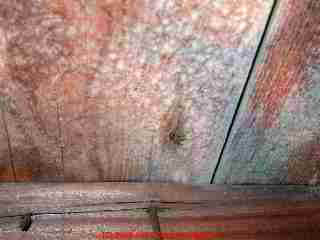 What does mold in attics look like?
Which attic molds are likely to be harmful?
- POST a QUESTION or COMMENT about how to spot mold contamination in building attics: what does attic mold contamination look like?
Appearance of attic mold contamination: how to recognize mold growth on surfaces in a building attic. Are all attic molds harmful? Does the roof need to be torn off? What cleanup and attic mold remediation steps are needed? Do we need to test or identify mold growing in an attic?
This document gives advice on how to find, test for, and remove attic mold. Here we show what mold looks like in building attics with mold photographs.
It is useful to distinguish between a real roof leak or ice dam leak and more trivial drip stains from attic condensation. Attic condensation and the resulting drip marks on the attic floor or on attic insulation, as shown here, is not itself likely to wet the attic insulation nor the surfaces below it enough to cause a big mold reservoir.
InspectAPedia tolerates no conflicts of interest. We have no relationship with advertisers, products, or services discussed at this website.
What does attic mold look like?
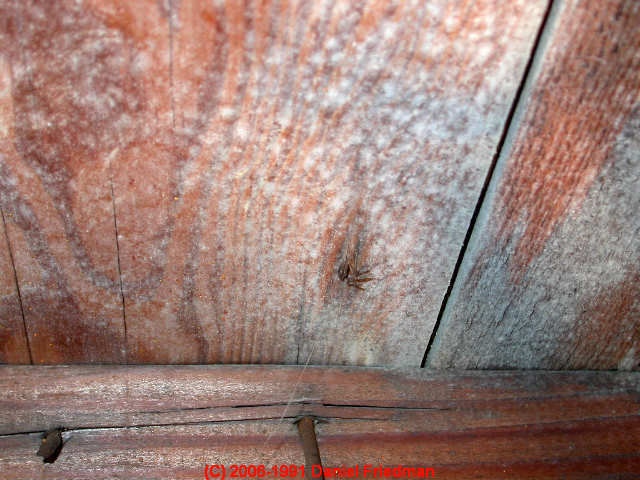
White attic mold: The photo at page top shows white attic mold on the roof sheathing and rafters and some brown or black mold on the attic-side of ceiling drywall where we pulled back insulation.
Green attic mold: In the attic photograph at left we show a mix of green, gray, and white attic mold. When looking for attic mold, trace both leak areas and areas of poor ventilation in the attic.
However, attic condensation is evidence of wet or very humid attic conditions. Therefore I'd take a close look at the roof sheathing and framing in an attic that has been moist or humid even though there were no roof leaks. (Click photo for larger image).
The mold shown in the attic photographed above was identified as Aspergillus sp. on attic mold visible on pine tongue and groove roof sheathing near the building eaves.
Also notice the condensation stains at the shingle nail, more evidence of a history of attic moisture which was a factor in this mold growth. (Click photo for larger image).
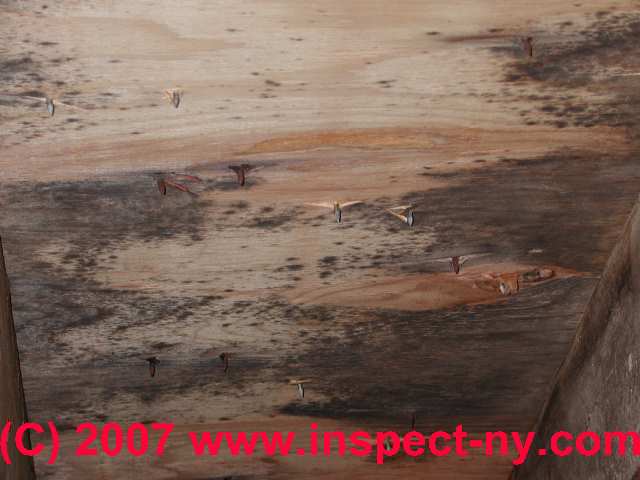
Uncertain attic mold:
The photo at the very top of this page shows where you may find mold growing on the attic side of ceiling drywall, particularly below roof leaks or in areas of ice dam leaks at a building eaves.
BROWN MOLD on plywood roof sheathing in an exposed to leaks or moisture problems is one of the most common molds spotted by home inspectors.
Often in attics we also find Cladosporium sphaerospermum or Aureobasidium pullulans which looks about the same, or a little darker on plywood or framing.)
When the attic has been damp or wet, there might be a more serious problem with Aspergillus sp. or Penicillium sp. in mold contaminated-insulation.

BLACK MOLD in attics: in this photo of very dark mold in an attic, in a wet attic mold which we found to be "brown" in the microscope, looked "black" on the plywood.
The black attic mold shown here confirms that this attic had a serious venting and moisture problem, including moisture from sources lower in the building.
The insulation was contaminated, and we inspected the attic side of the ceiling drywall below for signs of leak stains or mold.
Reader Comments, Questions & Answers About The Article Above
Below you will find questions and answers previously posted on this page at its page bottom reader comment box.
Reader Q&A - also see RECOMMENDED ARTICLES & FAQs
On 2019-10-09 (mod) - what is this white moldy stuff in my attic?
 Commenting on Bill's photo of white stuff in an attic:
That could indeed be and looks like a white fungus or "mold" growth on roof sheathing. Frankly nobody who actually knows much about mycology and mold would, from looking at the white growth on a surface by naked eye, assert that it is a species of Aspergillus. Therefore we already know something about your third remediator and his or her claim.
Aspergillus might be white but it can be any of many other colors, and there are plenty of other white molds that are not Aspergillus - we illustrate a few of these at
WHITE MOLD PHOTOS - a spot where I'll include your nice white mold photo.
It's possible that a closer examination of the white "stuff" on this plywood will find that we are looking at thick mycelial growths of a fungus. There is no reason to assume it's Aspergillus or any other specific fungal genera when no lab or microscopic examination has been performed. Nor does it matter, as I'll explain.
Aspergillus occurs as about 180 different sub-species (some sources list 250 species) of which about 20 are commonly found on building surfaces. ( US CDC www.cdc.gov/fungal/diseases/aspergillosis/causes.html )
The color of Aspergillus mold colonies ranges from black or very dark brown (A. niger) through greens, yellows, tans; A brand new Aspergillus colony may appear as a white growth but usually when we see species of Aspergillus on a building surface it's not brand new (hours to days old) and it's got color.
As the Aspergillus colony matures it darkens to green, green-gray, or green-brown with a white apron at the margin, very much depending on the species of Aspergillus and possibly as well as on what the Aspergillus has to eat - what material it's growing upon.
Furthermore it's unusual for there to be only one mold genera/species in a building where mold contamination is found. For example I can identify three entirely different mold genera/species on the same piece of drywall simply by collecting samples at different heights from a wet floor.
That's because the moisture gradient varies, with drywall higher from the floor being less wet and thus growing different genera/species. That's also why any single surface test or most other samples do not characterize the building's mold family.

[Click to enlarge any image]
The Aspergillus Taxonomic Scheme generously provided above by Janet Gallup, EMLaboratory, shows that while there are light colors of species of Aspergillus, most of its species are more-exciting in their pigment.
Fortunately, despite a near-overwhelming attention given by mold remediation companies and their websites to mold color and what it means, or to scaring the devil of people with a misplaced attention to "toxic black mold" (as mold may be harmful across the entire rainbow of colors), the color of the mold doesn't mean a darn thing about what you need to do about it.
Testing to identify the mold genera/species is interesting and scholarly but it will not change the mold cleanup procedure one bit. That is, the color of mold or its species does not affect the mold remediation plan.
Remove the mold, clean the surfaces, fix its cause.
There are occasionally reasons to identify the mold genera / species found in a building, most-often to aid a doctor's work on a sick patient and occasionally to prove that a remediation containment was successful - or not.
Details are at MOLD TEST REASONS
On 2019-10-09 by Bill M - what is this white mold in my attic?
Any thoughts on what this might be? [Photo above] In attic. 2 out of 3 remediators said it was not mold. The third said immediately that it was an Aspergillus. I have not sent for testing yet.
This Q&A were posted originally at MOLD APPEARANCE on VARIOUS SURFACES
Reader Question: once attic ventilation is improved do I need to remove attic mold?
(Mar 5, 2012) Paul said:
I appreciate the article and information. So if this type of "black mold" shown in the second picture ( described as Cladosporium sphaerospermum or Aureobasidium pullulans which looks about the same, or a little darker on plywood or framing) is due to moisture/circulation problems ( in this case, insulation was packed where baffles should have been placed) what needs to be done if anything at all. Is the condition harmless?
Once baffles have been installed to promote circulation, is the problem solved and no further action required? I eventually will add a doghouse/false dormer and change the roof line on another section of the existing roof. I was planning to have the sheathing replaced in a few months.
Will the replacement of the sheathing create any problems? Thanks once again for sharing your information and expertise
Reply:
Paul:
First: any mold growth is a water or moisture indicator which means there may be other mold or water related problems that would be a concern but were less visually obvious - so some investigating is worthwhile.
Second we can't identify mold in-situ - it takes a lab analysis; there are about 1.5 million species, (happily they don't all grow indoors) but plenty look alike on building surfaces.
Third: even the king of molds (Cladosporium sp.) includes species that are allergenic - properties can be a problem for some people with allergies or asthma, or that can cause illnesses. The actual risk depends on the quantity, location, the exposure as well as individual sensitivity.
Watch out: also for mold-contaminated building insulation in attics (or other building cavities) where there have been leaks or high moisture levels.
See INSULATION MOLD CONTAMINATION TEST
Certainly if you're going to do a tear-off of moldy sheathing (don't do that just because of mold) it's not worth any costly testing, but it would be worth protecting the building interior and insulation from all that moldy dust and debris - or just pull out old insulation, clean the exposed surfaces (HEPA Vac is fine if there's no growing mold to be cleaned off), and re-insulate.
Reader Question: is green attic mold harmful
(Mar 3, 2013) DD said:
I just found green mold in the attic?
Reply:
DD:
Watch out: while a lab test would be needed to reliably identify the genera/species of the green attic mold you have found, a common greenish-coloured mold found in attics and roof spaces on wood surfaces includes several species of Aspergillus sp. that could be harmful, particularly if it is entering the living area.
Also see GREEN MOLD PHOTOS
...
Continue reading at ATTIC MOLD, HARMLESS COSMETIC? or select a topic from the closely-related articles below, or see the complete ARTICLE INDEX.
Or see these
Attic Mold Contamination Articles
- ACTION GUIDE - WHAT TO DO ABOUT INDOOR MOLDD
- ATTIC MOLD - home
- ATTIC MOLD CAUSES
- ATTIC MOLD IS A PROBLEM ?
- ATTIC MOLD - IS IT TOXIC?
- ATTIC MOLD, WHERE TO LOOK
- ATTIC MOLD, WHAT IT LOOKS LIKE - you are on this page
- ATTIC MOLD, HARMLESS COSMETIC?
- ATTIC MOLD ROOF TEAROFF
- ATTIC MOLD ENCAPSULANTS
- INSULATION MOLD CONTAMINATION TEST
- MOLD APPEARANCE - WHAT MOLD LOOKS LIKE
- MOLD in BUILDINGS - how to find mold and test for mold in buildings, how and where to collect mold samples using an easy, inexpensive but very effective mold testing method.
- MOLD CLEANUP GUIDE- HOW TO GET RID OF MOLD
- MOLD / ENVIRONMENTAL EXPERT, HIRE ?
- TEST KIT for DUST, MOLD, PARTICLES: INSTRUCTIONS
Suggested citation for this web page
ATTIC MOLD, WHAT IT LOOKS LIKE at InspectApedia.com - online encyclopedia of building & environmental inspection, testing, diagnosis, repair, & problem prevention advice.
Or see this
INDEX to RELATED ARTICLES: ARTICLE INDEX to MOLD CONTAMINATION & REMEDIATION
Or use the SEARCH BOX found below to Ask a Question or Search InspectApedia
Ask a Question or Search InspectApedia
Try the search box just below, or if you prefer, post a question or comment in the Comments box below and we will respond promptly.
Search the InspectApedia website
Note: appearance of your Comment below may be delayed: if your comment contains an image, photograph, web link, or text that looks to the software as if it might be a web link, your posting will appear after it has been approved by a moderator. Apologies for the delay.
Only one image can be added per comment but you can post as many comments, and therefore images, as you like.
You will not receive a notification when a response to your question has been posted.
Please bookmark this page to make it easy for you to check back for our response.
Our Comment Box is provided by Countable Web Productions countable.ca
Citations & References
In addition to any citations in the article above, a full list is available on request.
- Atlas of Clinical Fungi, 2nd Ed., GS deHoog, J Guarro, J Gene, & MJ Figueras, Centraalbureau voor Schimmelcultures, Universitat Rovira I Virgili, 2000, ISBN 90-70351-43-9
- In addition to citations & references found in this article, see the research citations given at the end of the related articles found at our suggested
CONTINUE READING or RECOMMENDED ARTICLES.
- Carson, Dunlop & Associates Ltd., 120 Carlton Street Suite 407, Toronto ON M5A 4K2. Tel: (416) 964-9415 1-800-268-7070 Email: info@carsondunlop.com. Alan Carson is a past president of ASHI, the American Society of Home Inspectors.
Thanks to Alan Carson and Bob Dunlop, for permission for InspectAPedia to use text excerpts from The HOME REFERENCE BOOK - the Encyclopedia of Homes and to use illustrations from The ILLUSTRATED HOME .
Carson Dunlop Associates provides extensive home inspection education and report writing material. In gratitude we provide links to tsome Carson Dunlop Associates products and services.
 | HOME | ABOUT | ASK a QUESTION | CONTACT | CONTENT USE POLICY | DESCRIPTION | POLICIES | PRIVACY | |
| © 2024 - 1985 Publisher InspectApedia.com - Daniel Friedman | |||||||||