
InspectAPedia® FREE Encyclopedia of Building & Environmental Construction, Diagnosis, Maintenance & Repair |
Question? Just ask us! InspectAPedia
|
 Attic Mold Tests
What Tests & Inspections to Make Before Removing Mold - identify harmless black mold
- POST a QUESTION or COMMENT about testing attics and other building areas for mold contamination: when, where, why, and how of mold testing
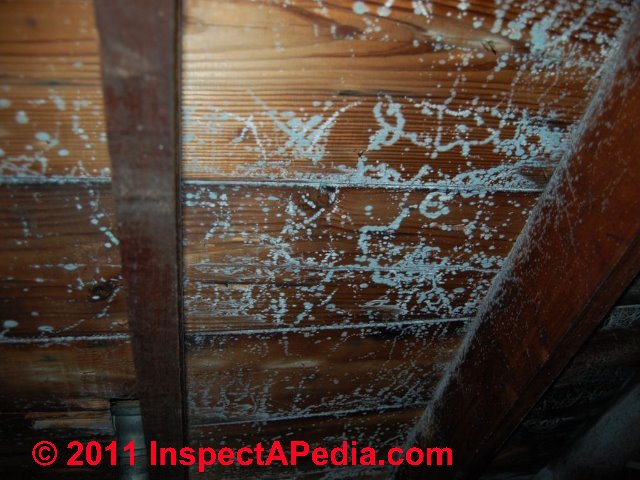
Do we need to test attics or cathedral ceilings for mold?
If so when and how? This document gives advice on the tests & inspections that a building owner or mold investigator should perform before starting an attic mold remediation project.
InspectAPedia tolerates no conflicts of interest. We have no relationship with advertisers, products, or services discussed at this website.
BEFORE REMOVING ATTIC MOLD - What Tests and Inspections Should Be Made Before Tackling an Attic Mold Problem?
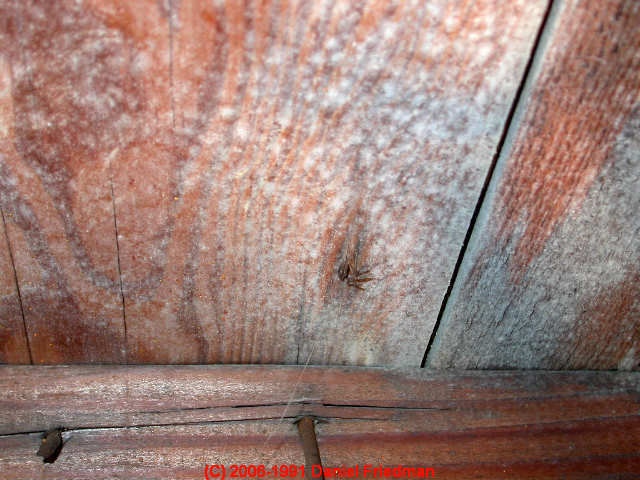
Before starting an attic mold removal project, there are some important questions that should be answered.
If we fail to consider the points listed below there is a risk of spending a lot of money unnecessarily and a further risk of an eventually still higher cost to remove toxic or allergenic indoor mold:
- Is the attic mold the actual source of building air quality complaints?:
if there are indoor IAQ mold or allergen complaints, let's be sure that the attic space is the culprit.
I've seen cases where people did (an unnecessary) complete roof tear off to "fix" an attic mold problem spotted by their home inspector, only to discover that the real mold problem in the house was in the basement or crawl space.
Think about the source of building moisture that is resulting in attic mold. Moisture usually moves UP through a home, riding warm air convection currents, finding its ultimate way into the attic where it condenses on sheathing or framing, inviting mold growth. That same moisture, if for example it's in a craw space or basement, often produces a more serious mold problem in those locations.
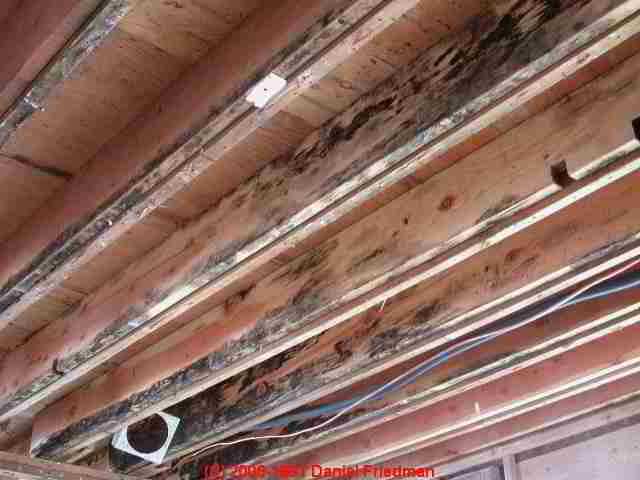
- Is the attic mold harmful?: be sure that the mold in the attic is harmful - often in attics we identify an allergen such as Cladosporium sp. or "black mold" which turns out to be simply cosmetic and totally harmless.
At left our photo shows harmless black mold on the sides of rafters or floor joists. This cosmetic mold is discussed at BLACK MOLD, HARMLESS. - Is the attic mold entering the living area?: be reasonably sure that the attic mold is entering or likely to enter the living space.
Other attic mold contaminants such as Aspergillus sp. or Penicillium sp. can be quite harmful to building occupants, particularly if the mold spores are being transported into the occupied space such as through leaks in HVAC return air ducts or through (less common) conditions that cause downwards movement from an attic or roof cavity into the occupied space.
Air movement in buildings in many cases tends to be up and out through an attic, not down from an attic into the living space. If attic mold is not entering the living area and is unlikely to do so, the priority for addressing this condition may be lower than previously thought.
However in some buildings where air conditioning is cooling the interior space of an upper floor, heavier cool air may actually flow downwards in the building, drawing attic or roof cavity air as well as airborne particles into the living space. - What steps will be taken to correct the original cause of attic mold?: it is essential that the building attic can be vented and that abnormal moisture sources (such as leaks, missing insulation, or a wet basement or crawl space) are corrected the attic mold problems don't recur
In Summary about attic mold removal: Do not begin an attic mold remediation project without first having carefully examined the whole building, and without first having set priorities of remediation, making sure we have found the real problem mold reservoir, its source, and its extent. The real indoor air quality problem in some buildings might not even be attic mold at all.
This article is part of our series: MOLD in BUILDINGS which describes how to find mold and test for mold in buildings, including how and where to collect mold samples using adhesive tape - an easy, inexpensive, low-tech but very effective mold testing method.
This procedure helps identify the presence of or locate the probable sources of mold reservoirs in buildings, and helps decide which of these need more invasive, exhaustive inspection and testing.
Attic Mold Contamination Articles
- ATTIC MOLD - home
...
Continue reading at ATTIC MOLD ROOF TEAROFF or select a topic from the closely-related articles below, or see the complete ARTICLE INDEX.
Or see these
Recommended Articles
Suggested citation for this web page
ATTIC MOLD, HARMLESS COSMETIC? at InspectApedia.com - online encyclopedia of building & environmental inspection, testing, diagnosis, repair, & problem prevention advice.
Or see this
INDEX to RELATED ARTICLES: ARTICLE INDEX to MOLD CONTAMINATION & REMEDIATION
Or use the SEARCH BOX found below to Ask a Question or Search InspectApedia
Ask a Question or Search InspectApedia
Try the search box just below, or if you prefer, post a question or comment in the Comments box below and we will respond promptly.
Search the InspectApedia website
Note: appearance of your Comment below may be delayed: if your comment contains an image, photograph, web link, or text that looks to the software as if it might be a web link, your posting will appear after it has been approved by a moderator. Apologies for the delay.
Only one image can be added per comment but you can post as many comments, and therefore images, as you like.
You will not receive a notification when a response to your question has been posted.
Please bookmark this page to make it easy for you to check back for our response.
Our Comment Box is provided by Countable Web Productions countable.ca
Citations & References
In addition to any citations in the article above, a full list is available on request.
- Indoor Gas Sampling Plan for Residential buildings lists a number of toxic indoor gases which we test for, depending on the building complaint and building conditions
- Ozone Warnings - Use of Ozone as a "mold" remedy is ineffective and may be dangerous.
- In addition to citations & references found in this article, see the research citations given at the end of the related articles found at our suggested
CONTINUE READING or RECOMMENDED ARTICLES.
- Carson, Dunlop & Associates Ltd., 120 Carlton Street Suite 407, Toronto ON M5A 4K2. Tel: (416) 964-9415 1-800-268-7070 Email: info@carsondunlop.com. Alan Carson is a past president of ASHI, the American Society of Home Inspectors.
Thanks to Alan Carson and Bob Dunlop, for permission for InspectAPedia to use text excerpts from The HOME REFERENCE BOOK - the Encyclopedia of Homes and to use illustrations from The ILLUSTRATED HOME .
Carson Dunlop Associates provides extensive home inspection education and report writing material. In gratitude we provide links to tsome Carson Dunlop Associates products and services.
 | HOME | ABOUT | ASK a QUESTION | CONTACT | CONTENT USE POLICY | DESCRIPTION | POLICIES | PRIVACY | |
| © 2024 - 1985 Publisher InspectApedia.com - Daniel Friedman | |||||||||